Idiot Joy Showland

This is why I hate intellectuals

On crapness and Christmas

If there’s a general cultural mode to contemporary existence in Britain, it’s an overwhelming and pervasive sense of the crap. This crapness – this New British Coprotopia – isn’t quite the same as postimperial decay. Decay is the riotous and unrestrained explosion of new life over the shrinking territory of the corpse, while crap is a zombie: dead matter assuming the warmth and the trajectory of something living. Crapness isn’t a slow entropic dissolution, it’s something that’s deliberately created. Everywhere there’s a distinctly faecal seediness, but above all crapness is the seediness of efficiency. In the UK our new professional apartments in their crap-Modernist blocks tend to have smaller floor sizes than the old social housing units; our government’s plan to ease the recession is to make the country competitive by systematically depressing wages through the introduction of slave-labour workfare; our scopophilic security services, our system of control orders, and our fungally breeding network of security cameras together make up the pillars of a uniquely crap police state. Once again, Britain leads the world; we’re the new vanguard of humanity’s foetid future, and nowhere are the machinations of this New Turd Order more in evidence than in the phenomenon of the crappy winter theme park.

This year’s defining crap Christmas experience is the Winter Wonderland in Milton Keynes. Visitors were told to expect a ‘fabulous, enchanted woodland with magical creatures.’ Here, vast and otherworldly powers far beyond the comprehension of we mere mortals – beings made all the more unfathomable by their infinite and frankly undeserved beneficence towards mankind – would place one small patch of the South Midlands ‘under a captivating spell, to come alive and be transformed into an enchanting Winter Wonderland.’ Instead, those initiates of the cosmic mysteries who made the pilgrimage to Buckinghamshire found themselves in a muddy field with only two miserable huskies and an emaciated hornless reindeer to give a sense of the non-human world through their sad, trapped, uncomprehending eyes. Meanwhile, the ice rink had no ice and Santa was unacceptably skinny, his street clothes plainly visible under his flimsy red cloak. Previous failed Christmas parks such as 2008’s Lapland New Forest attracted similar complaints: the Enchanted Walk Through The Woods was a plywood shack with fake pine branches and cheap stuffed toys scattered on the floor; the advertised polar bear was plastic; the snow came from a spraycan; the animatronic Rudolf’s nose gave visitors radiation sickness; the Santa’s Chimney Experience was just an open-pit toilet, the Good-Or-Bad-O-Meter rated every child as ‘bad’ while explaining that ‘wrong life cannot be lived rightly,’ and so on. Occasionally these places are bad enough that someone has to go to court to make up for all the loss of childhood innocence; mostly, though, they’re just dull enough to go unnoticed. Generally they make pretty good money.

These things aren’t aberrations; they’re part of a wider system. The War on Christmas is over (it never really began); now Christmas itself is staged as a kind of proxy warfare. As the economy still struggles to break out of recession, fourth-quarter retail spending is now gravely important. Forget the potlatch, forget your heartfelt and home-crafted expressions of affection; Christmas is a matter of national security. If it doesn’t go precisely according to plan, the cuts will lacerate deeper. Every high-priced gadget you don’t buy is another meal torn from the hands of the impoverished and another bullet out the armoury of our brave boys battling it out in Afghanistan. It’s not hard to imagine the Tory Trotskyites in charge having to impose their own version of War Communism: the establishment of large and well-disciplined labour armies of consumerism with George Osborne valiantly marching at their helm, buying gift after gift on increasingly shaky credit and pressing them into the hands of ever more distant acquaintances, knowing full well that their generosity will have to be reciprocated, enjoying Christmas to the point of penury, starvation and death.

This is the mechanism of crapness: something efficient and regimented and dead following the course of something alive, following it so closely that it’s not always entirely possible to tell that anything’s changed. There’s only the lingering feculent whiff of an essential insufficiency. Delve deep enough into the history of the winter festival and you’ll find a scene not unlike the Milton Keynes Winter Wonderland. A cold and muddy field somewhere in England, a small circle of primitive buildings, a pile of soggy logs on which a few feeble flames tremble, the tears of children, the haunted stares of animals, the ritual exchange of gifts, everywhere skinniness and emaciation, everywhere magic. Real magic, the kind that requires a blood sacrifice or an orgy or, ideally, both. When the disappointing winter wonderlands offer us an escape into the wonderful world of seasonal Christmas magic, we should keep in mind that seasonal magic is an ancient and agricultural magic – in other words, one of brutal and immediate violence. These winter wonderland parks are so popular – and despite the near-riots they provoke they are popular; thousands pour in every year and millions more giggle over them in newspapers – because they’re a comforting reminder that the living fire, horror, and beauty of Christmas has been replaced by a dead mechanical crapness. (New Year’s is admittedly different; by the time midnight rolls around, most people on the streets are crying, fighting, or being arrested. Linear time is a terrible thing to do to people.) It’s a similar phenomenon to that of the Christkindlmarkten sprouting up everywhere across the country: plywood huts decorated with fake holly and Gothic lettering, beer halls hosting oompah bands who don’t speak a word of German, something somehow intrinsically less than it is. (It’s important to note that the UK’s cutesy German Christmas markets are mostly franchises of the one in Frankfurt, that notably non-rustic centre of European finance capital.) Crapness is everywhere at all times, but it’s at Christmas that the gap it opens yawns the widest.

In his Fundamental Concepts of Metaphysics, Heidegger devotes nearly one hundred pages to the philosophical study of boredom. His paradigmatic example is the act of waiting in a rural train station: without distractions time starts to bear down on you; you have nothing but the raw experience of time and the raw experience of yourself. After a while it almost becomes a physical sensation, a slow sickening horror you’ll do anything to escape. It’s not hard to visualise Heidegger’s train station: the stiflingly still air, the low and unchanging clouds, the pebble-dashed pillars, the flaking white paint, the single pigeon limping up and down the tarmac, the almost tangible lack of a train – in other words, a scene of arrested motion, of crapness. But it’s precisely here, on this miserable platform, that the potential for a transformative phenomenology is opened. Heidegger identifies three modes or stages of boredom: gelangweilt sein von etwassich langweilen bei etwas, and es ist einem langweilig (‘becoming bored by something,’ ‘being bored by something,’ and ‘it is boring for one’). The first appears when we encounter something concrete but existentially boring: someone very dull at a party, for instance, or an overly self-indulgent essay on the internet; it’s achingly unfulfilling. The second form, meanwhile, isn’t quite so direct: Heidegger uses the example of a dinner party where everything ‘is not only very tasty, but tasteful as well;’ you enjoy yourself immensely, and it’s only after returning home that you realise the whole evening was utterly dull, a senseless waste of time. The third form, ‘it is boring for one,’ is also referred to as tiefen Langeweile: profound boredom. Here the self is fully detached from a world that comes to reveal itself as entirely dull, entirely pointless, and entirely without charms or interest. The very identification of Dasein as being-in-the-world comes to fall apart. Heidegger isn’t proposing a nihilism: it’s exactly at this point, when the world of objects seems to offer nothing of substantial interest, that the potential for transformation appears. Once you decide that all things are boring, the question of what a non-boring thing would actually look like emerges, and with it a sudden universe of possibilities. As Heidegger puts it (in a sadly untranslatable pun), alles Versagen ist in sich ein Sagen, dh Offenbarmachen – all withdrawing is a telling or a making-manifest.

If the question of boredom yields an ontological philosophy, the parallel problem of crapness is one of politics. Crap Christmases give rise to a limited, intrinsic, demoralising sense of the crappy; the slow enshittening of all experience forces us, urgently, to conceive of a less miserable world. Like every weapon in the arsenal of capital, crapness is also a weakness. The critique of the crappy winter wonderland isn’t a grouchy bah-humbug; it’s a call to action. The struggle for a non-crap Christmas is the struggle for a world defined by its possibilities rather than its restrictions; in the end, it’s the struggle to reclaim life.

Maybe I’m not strong enough; I’ve fled Britain for the holidays. No Queen’s speech, no schmaltzy Doctor Who special, no winter wonderlands. France has its own inchoate modality of crapness too; it might be that I’m more willing to forgive it because it’s not mine. The big wide flat fields; the hypermarkets crouching, tense as spiders, by the motorways. Look at any French city and it’s immediately clear that the empire never went away; it just changed its spatial logic. There’s still colony and metropole, but now they’re bound together in the same urban topology. Those in the medieval centre find themselves encircled by angry car-burning hordes; those in the concrete prison-suburbs that surround them are disenfranchised and dispossessed, their choice of clothing regulated by the state, their lives at the mercy of the police. A crap colonialism. Still, it’s different. At night you can hear the slow determined creak of the avalanches as they roll down the mountainsides. They’re set off by explosives, but at least the snow is real.


Sympathy for the antisemites

For all their faults – and they have plenty – it’s undeniable that antisemites are incredibly productive. Other racists don’t even come close: a slur, a darkly muttered comment, occasional eruptions of violence; they don’t need to really say anything because their racism already forms the unvoiced content of society at large – the state does their job for them, groups like the EDL can even function as an auxiliary wing of the police and the border agency. People who hate Jews are different. They need to write it all down; each one of them has to produce their own personal account of exactly what it is that they think the Jewish hive-mind is up to. From Martin Luther’s On the Jews and their Lies to Louis-Ferdinand Céline’s Trifles for a Massacre to contemporary polemics on the Zionist Occupied Government, antisemities are driven to produce manifestos. It’s hard to not feel sorry for them. They’ve been trapped, and it’s not entirely their fault. The problem with all their constant literary production is that the ramblingly impassioned hate-screed is very much a Jewish art. Nobody hates the Jews quite like the Jews themselves; ordinary antisemites are grasping amateurs. In the Old Testament the Jews are so venal and wicked that God is required to periodically massacre them as they plod in circles through the desert. The prophets are full of bitter reproach. Jeremiah thunders: Hast thou seen that which backsliding Israel hath done? she is gone up upon every high mountain and under every green tree, and there hath played the harlot… This people hath a revolting and a rebellious heart; they are revolted and gone. Ezekiel seethes: They are impudent children and stiffhearted. Little’s changed since. Every Jew-hating tract is an unwitting tribute to Portnoy’s Complaint. In his study of the phenomenon Sartre writes that the antisemite depends on the Jew to maintain his status as an antisemite, that if there were no Jews the antisemites would have to create them. He came close, but as he wasn’t a Jew or an antisemite, he couldn’t see what was actually going on. The antisemite doesn’t just depend on the Jew; consciously or not, antisemitism is an imitation, an attempt to capture and reproduce some of the Jew’s unique talent for self-loathing.

These days there are very few Jews and even fewer antisemites, and both are furiously engaged in the invention of the other. I’ve always been fascinated by antisemitism, especially in its conspiracy-oriented strains. Part of it’s pure narcissism: I’m a Communist and a Jew, someone whose face is turned to history as to a single catastrophe, and it’s quite nice to hear that I’m not in a desperate struggle against existing conditions but actually part of a tiny cabal that secretly rules the world. At the same time this stuff has an incredible heuristic potential; it’s not unlike Borges’ First Encyclopedia of Tlön, a description of a totally different world that intends to slowly map itself onto our own. Read enough antisemitic literature and you’ll learn that the chief architect of our alienated and commodified culture is none other than Theodor Adorno, otherwise known for his scathing critiques of alienated and commodified culture. You’ll discover that Lenin’s struggle against the bourgeoisie, the same revolution that prompted military intervention from the imperialist powers, was in fact a ploy by the Rothschild banking houses. You might even encounter something called ‘sexual Bolshevism,’ which for some unaccountable reason is held to be a bad thing. Antisemitism in the West has for the most part shed its appearance as mass or state violence; it’s turned into a glitteringly inventive mythopoeia. That’s why I’m unusually heartened by the news that the model and reality TV personality Tila Tequila has decided to launch a one-woman crusade against the international Jewish conspiracy.

Tila Tequila – born Thanh Thi Thien Nguyen – is one of those people that inhabits a strange shadow-zone on the borderlands of ontology. She exists (even if her reality is more virtual than actual), but unlike tables and mountains and other things that exist in the ordinary sense of the world she continually has to justify why. In this she’s in pretty exclusive company, sharing her spectral realm with Paris Hilton, the Kardashians, and the State of Israel. Unlike Hilton or the Kardashians, whose rise to fame could be seen as a sensible old-fashioned reinvestment of already existing capital, Tila Tequila’s emergence represents more of an autogenerative point of intensity in the swirling field of aleatory alienation that constitutes present-day existence. She was spotted by a Playboy scout in a Houston mall; by some quirk of chance (or eternal destiny, there’s little difference) the music she put on MySpace snowballed into mass popularity and a record deal while other near-identical attempts didn’t. Since attaining stardom Tequila has had a number of high-profile media gigs, including hosting duties on the televised striptease contest Pants-Off Dance-Off and cameos in The Cleveland Show, finally culminating in A Shot at Love with Tila Tequila, her own reality dating programme. In early 2012, she announced that she was converting to Judaism. In late 2013, she set up a new (and very much non-anonymous) website called Anonymous Truth Blog, in which she announced, among other revelations, that a secret ‘dark cabal’ of Jews controls the world and that she is the reincarnation of Adolf Hitler.

Clearly Tila Tequila isn’t at all well, but to simply state that fact out misses the point. Given that antisemitism is now primarily a literary phenomenon, are Tila Tequila’s Jew-hating rants actually any good? Are we dealing with a Louis-Ferdinand Céline or a Mel Gibson?

Tequila’s writing isn’t immediately accessible, but it’s not necessarily bad either – in fact, it can be situated squarely within the tradition of continental Modernist literature. Her screeds are punctuated with *giggles* and *sighs*, conventions that have their origins in internet language but that also represent an attempt to break through the ossification of the written word and recover some of the immediacy of speech. Here Tequila pushes against the binds of the antisemitic pamphlet as literary form – one that is, of course, heavily indebted to the Jewish scriptural tradition. By advancing this logocentrism she attempts to claim back the primacy of the Greek system (abstract logic, vocal discourse, circular time) against that of Judaism (written polemic, scriptural law, linear time) – in other words, to undo both the Pauline and the Derridean critique of the logos. It fails, of course: in fighting the tainted written word she can’t help but refer back to other literary works. There are strong traces of Céline, who perhaps succeeded most in stripping writing of its textual quality and dragging it into new forms. He’s there in the breathless fury of her ellipses and interjections – Tequila writes: They literally are out to kill you and if they cannot kill you, they will find other means, anything dirty and corrupt they can think of to fuck with you! Céline shouts in agreement: So you want to cover me with garbage! I hear your tawdry surreptitions! your riflings-through! your screwings-over of your wastebaskets! How dimwitted and stupid you are! More flatulent! More cowardly! At the same time her habit of sneaking in unattributed lines from other sources recalls the poetic bricolage of TS Eliot, that other great literary antisemite, and her manic asyntactic switching between themes and topics – declaring Hitler a prophet in one sentence, making jokes about her name in the next – bears the stamp of Antonin Artaud’s prose-poetry. (In fact, some of Artaud’s Letter against the Kabbala could probably be slotted into the Anonymous Truth Blog without much notice: I think I have taken about as much shit as I’m going to from Kafka, his arsoterical allegorical symbolism, as well as this Judaism of his, which contains every last one of those chicken-livered suckaprickadickadildoes that have never ceased giving me a pain in the ass… What I especially abhor in Kafka is that return of the old kike spirit, that intolerable kike mentality.) On occasion, her reflections tend towards a stoic melancholy that could be called Beckettian. What the fuck is wrong with these people?? she complains. Oh man… it’s just too bad because I think if they had a more open mind or if they weren’t already dead… Beckett’s Molloy utters a similar sentiment: Someone has drawn the blinds, you perhaps. Not the faintest sound. Where are the famous flies? Yes, there is no denying it, any longer, it is not you who are dead, but all the others.

Despite her engagingly doomed contributions to the genre, there’s no getting away from the content of what she writes. In between her exposés of the Jewish conspiracy, Tila Tequila claims to be a goddess, to be an avatar of Vishnu, and to have created two parallel universes. She’s (probably) mad – and given the tragic difficulties in her life so far, it’s not hard to see why – but the pathologisation of antisemitism is far less interesting than the pathology of that pathologisation. Why is it that antisemitism – which for an unacceptable prejudice has a fairly respectable intellectual pedigree – is now seen as a token of madness? Conversely, why is it that madness now manifests itself as an antipathy specifically towards Jews?

Unlike finance and entertainment, Jews don’t in fact have a monopoly on the conspiracy racket. In Azerbaijan and Turkey there’s some belief in the idea of a global Armenian conspiracy, one led by a secret cabal that fabricated the Armenian genocide and works tirelessly towards their goal of Armenian world dominance. For some reason, the Armenian conspiracy never reached the same heights as its Jewish counterpart. There’s something about the Jews: we were the bad conscience of Europe, but at the same time we have projects.

Deleuze and Guattari discuss some of this in Kafka: Towards  a Minor Literature. In their understanding, Jewish populations are not themselves minoritarian or in a state of absolute deterritorialistion, rather they’re molar formations, ‘an oppressive minority that speaks a language cut off from the masses.’ However, they raise the potential for minority within the minority: a becoming-minor more defined by the trajectory of its Becoming than the phases through which it passes, something ‘creating an interplay of similarity and difference that conspicuously resists reduction into identity.’ There are Jews of the Jews: Jesus of Nazareth sent to the cross; St Paul torn between Jerusalem and Rome, Spinoza excommunicated by the Amsterdam community; Karl Marx baptised as an infant; Kafka writing in German. Through this operation minority is put in direct contact with the universal, whether it’s as the undifferentiation of humanity in the body of Christ, the prior ontological substance, or emancipatory Communism. Along the way, you get all the other great Jewish inventions: linear time, literature, numerology, psychoanalysis. It’s also precisely this Jewish renunciation of molar identity that has its distorted (and sometimes murderous) mirror-image in antisemitism. Tila Tequila doesn’t want to be herself any more, so she starts hating Jews.

This quality is also precisely what’s missing today. The reason that antisemitism turned into a literary and heuristic project is that there are no Jews any more. Sartre’s prophecy has come to pass, and once antisemitism becomes fundamentally an  invention of its own object there’s no reason why it shouldn’t also invent parallel universes, black magick, reborn Hindu deities. Antisemitism has become isomorphic with madness because of something cataclysmic that happened in the middle of the twentieth century. With the horrors of the Holocaust, the old antisemites almost managed to destroy themselves as antisemites by wiping out the Jews. With the realisation of the Zionist project, Jews have finally succeeded in destroying ourselves. Israelis aren’t Jewish; all this messing about with states and armies and the systematic dispossession of other people is, in the end, something fundamentally very goyische. 1948 marks at once the culmination of Jewish universalism – finally we have a state, just like every other nation – and its extinction – finally we have a state, just like every other nation.

For all its crimes, perhaps the most startling thing about the State of Israel is just how boring it is. We’ve made the desert bloom, and now palm trees scar the Negev with their strict regimented grids. The settlements are as blandly pleasant as American suburbs, but they’ve been fully and murderously weaponised. For a country founded by the inheritors of one of the world’s oldest literary traditions, it’s astounding how few decent writers Israel has. Amos Oz is no Franz Kafka. AB Yehoshua is no Bruno Schulz. Meanwhile, across barbed wine and concrete walls, the Palestinian refugee camps are full of poets.

Why I want to fuck Boris Johnson

Apologies to J.G. Ballard. No, really. I’m so sorry.

THE ZIPLINE INCIDENT: MYTHOPOEIA OF THE LEGENDARY

Focus group surveys aimed to reproduce a representative sample of the British population at large for market research. Subjects surveyed included a recent university graduate wondering how long he has until it’s no longer acceptable to listen to house music, a semi-popular circuit comedian gradually metamorphosing into his own character, a harried single mother who’s been tramping up and down a single supermarket aisle for fourteen consecutive hours, everyone inside a Blackpool bingo hall at 7 pm last Friday, a Welshman, an ethnic, and a football with a smiley face drawn on in felt-tip pen. Most subjects were recruited for consumer surveys through pop-up adverts on the lactation fetish pages of several popular pornographic websites; others were kidnapped on the street; some were grown in vitro and have lived here their entire lives, consuming nothing but weak tea and re-runs of BBC panel shows.

Subjects were asked to evaluate Boris Johnson’s performance in a number of Mayoral duties: leading an army of warriors against the goblin menace, pushing back the tide as it creeps up the Thames in his quest for a new airport, initiating a nuclear attack on Argentina, nursing a newborn fawn at his lactating teat, baking a tray of delicious muffins, and dangling from a zipline. Evaluations were given on a five-point mythological and meta-narratival scale, descending from epic through legendary, saga-esque and apocryphal to Talmudic. A full 91% of respondents considered the Mayor of London’s breastfeeding abilities to be either legendary or epic. In response to being questioned on his abilities as a military leader against geopolitical, elemental and supernatural foes, most respondents either marked him as Talmudic, considered the question to be metaphorical, or begged to be released. During a word association exercise Johnson was, in 82% of cases, identified with the ‘maternal’ against the ‘paternal’ element of a word pairing (as in cake/bread, warm/cold, shame/fear, hate [existential]/hate [conditional], wine/beer).

JOHNSON’S HAIRSTYLE

Subjects were asked to give examples of consumer products that could be improved or more easily marketed if supplied with their own trademark straw-coloured Bojo mop. ‘A potato’ was not included in statistical analysis given the bewigged potato’s physical indistinguishability from the Mayor himself. The most popular non-tuberal responses were (in descending order) a dead pigeon on the pavement, the pudenda, standard issue prison uniform, a small heap of used teabags, and the white cliffs of Dover.

TOP BANTER

Altered footage was assembled, using a team of Californian CGI artists, of the Mayor appearing to perform the following comedic routines: a rambling and repetitive Stewart Lee monologue about shoelaces, Michael McIntyre drunkenly failing to seduce a 17 year old in an Edinburgh dive bar, the Socialist Workers Party Disputes Committee’s proceedings against Comrade Delta, and Hitler’s speech before the Reichstag of July 13th 1934. All were seen by the vast majority of subjects to exhibit Johnson’s trademark wit and intelligence. The latter sequence, when spliced into Dave’s regular Tuesday night programming, is believed to have caused a statistically significant spike in the national birth rate nine months later. Video footage of ‘Boris Johnson’ stamping on kittens was, when rated on a scale from cute and blimey to fail and trashy, voted cute by 87% surveyed.

THE GENETIC ARISTOCRACY

99.87% of sixth-form students at St. Jonty’s School for the Incurably Retrognathic believed themselves to be among the 2% of the human species with an IQ over 130. The same proportion, when presented with the idea that ‘intelligence’ when phrased in such terms is nothing more than an instrument used by those with social status to justify their position after the fact and to wage war against those without, agreed vociferously, adding that this is exactly as things ought to be.

MACHINE RUNWAY HYPERSYNTHETIC GENODATA NANOSPASM

Subjects were introduced to the ‘Bumblorator 3000,’ a basic robot programmed to painfully wound them and then make a brief apology or a comic pratfall. Laceration with a rotary blade followed by ‘oh, I am frightfully sorry’ produced a weary chuckle in 63% of subjects. Removal of the lower teeth with pliers followed by a collapse into a small pond produced a 77% rate of muffled sympathetic giggling. Decapitation of the subject with a rusty machete followed by ‘my word, what could I have been thinking’ produced an apologetic grin in 61% of freshly severed heads.

BORIS JOHNSON’S FACE: CRISIS OF POSTLIBIDINAL SEXUALITY

Several scenarios were drawn up by market researchers for sexual congress with Boris Johnson; among them ‘creepy uncle at Christmas,’ ‘forbidden thrill of filial incest,’ ‘boyish public school hijinks,’ and ‘coked-up yacht orgy.’ Almost all were deeply unsuccessful, with subjects (drawn from the ear, nose & throat wards of three hospitals) reporting sensations of extreme distress and self-recrimination. The conclusion that Boris Johnson was not a fit libidinal object was broken by two anomalous findings. Firstly, simulated congress involving rope, hot wax, body hanging, coprophagia, urophagia and nipple clamps was reported to result in a sensation of fuzzy warmth tinged with bittersweet nostalgia. Secondly, scenarios in which Boris Johnson was presented attempting coitus with non-human objects including a cupcake, a copy of the Daily Telegraph and a porcelain teacup induced spontaneous orgasm within two minutes in nearly all subjects. When replicated across the board a similar result was obtained.

While the faces of Tony Blair, David Cameron and Nick Clegg uniformly provide genital – specifically phallic – suggestions, that of Boris Johnson was held by 81% of those surveyed to resemble the breasts of a woman or the buttocks of a man. The Mayor of London could be held to represent a pornographic or post-libidinal sexual politics in which he simultaneously represents sexual object and fetish-object, the central point in a sexual topology otherwise characterised by total indifference. Should Boris Johnson succeed in becoming Prime Minister the suicide rate is not expected to spike significantly, although a gradual increase in fatal incidences of auto-erotic asphyxiation is inevitable over the course of his term. The actual conversion of the entire country into an enormous playground for international finance capital should result in no more that 1-2 million excess deaths.

Defying Gravity

The new film Gravity does something quite brave: it doesn’t make space beautiful. We all have an idea of what outer space should look like: all those vast pink and blue nebulae draped in purple stars, swirling at the slow pace of cosmic infinity into (of course) phallic or pudendal forms. Space has gas clouds and supernovae and green-skinned alien babes and, quite possibly, God. At the same time we know that the sublime images we get from NASA are all in false colours; that for all the fascinating things in it (and there are plenty of them), most of space itself is actually quite boring as far as our libidinal imaginations are concerned. It’s a dead black void scattered with a few dead grey rocks, and they crash into each other according to a precise mathematical senselessness. But in our fiction, at least, we can have it all: black holes, asteroid fields, c-beams glittering in the dark near the Tannhäuser Gate. Not for Alfonso Cuarón; he’s got a real pedant’s eye for this stuff. The Earth is beautiful in Gravity, its clouds burning orange as the line of sunset crosses its surface, its cities shining in the night like diamonds on a lace – but space beyond its orbit is just a cold dark nothing. There’s only one shot that throws a sop to our aestheticised vision of the universe: our hero drifts out briefly into the void, and we see her framed against a galaxy of stars – but even here it looks washed out and anaemic; a semi-skimmed Milky Way. No grandeur, just emptiness. It’s incredibly impressive.

Cuarón does something else that’s pretty extraordinary: in a film where every shot and effect is fine-tuned to perfection, he’s managed to craft a plot that’s entirely unremarkable, dialogue so corny as to border on the emetic, and characters who might be floating in infinitely extended space but are entirely lacking in any depth themselves. It’s strange. In Y Tu Mamá También and Children of Men Cuarón showed that he’s every bit as capable a writer as he is a director, but the plot in Gravity hugs so closely to genre that you can pretty much work it all out from the trailer (if you can’t, look away now). There’s a disaster in space; Sandra Bullock and George Clooney are cast adrift; he dies heroically saving her life; she has a crisis of confidence but then looks inside herself to find the strength that she needs to survive, and ends up setting foot once more on the friendly soil of Earth. Along the way there’s some seriously embarrassing dialogue (“Will you pray for me? Nobody ever taught me how”) and a seemingly unnecessary backstory about the death of Bullock’s young daughter in lieu of any actual characterisation. It’s interesting that Clooney’s space fratboy – for all the wacky stories he half-relates – never has his emotional past strip-mined in the same manner; clearly the psychological depths of hysteria are still only to be plunged by women. In this really excellent post at Wasted Ideology the dodgy gender politics of the film are thoroughly taken apart, and the result isn’t pretty: in the end, even a disaster film in space needs to continually reaffirm ‘the centrality of love and family to everyone’s experience, weak women and strong men.’

This doesn’t mean that there’s not room for some significance in the film: after all, it has all that terrifying empty space gnawing at its periphery. The psychotherapist Aaron Balick gives an interesting reading, in which the repeated motif of ‘letting go’ (including in the film’s tagline) and the subject of Bullock’s lost daughter is read against Freud’s Mourning and Melancholia, turning the film into a psychological parable:

For Freud, the refusal to let go results in the person holding onto the lost other inside one’s self. So long as the lost person remains psychologically inside the self, they can never be properly mourned (or let go of) and nothing can ever take its place. Furthermore, it is a constant drain on the life energy as it is pulled inwards towards the lost object, and not available to go outwards into to the world; it operates like an internal black hole. When Dr. Stone [Sandra Bullock] decides to give up hope, this is a giving up of her relationship to the world. In a sense, it is an (unconscious) choice to abandon the real world and to be sucked into the endless chasm of depression induced self-involvement: to literally let go of the world and collapse in upon the self and die. She shuts off the oxygen in her pod awaiting her death, when the spectre of Matt [George Clooney] comes to snap her out of it (a representation from her unconscious). It is he (whom she has refused to let go before) that guides to towards the what she has lost, not just the whom, to use Freud’s words. He brings the unconscious part of her loss to consciousness. He essentially says, “your daughter is dead, you are not, you can choose life.”

Letting go, yes – but something of a Leninist approach is needed here: letting go into what? There’s something crucial in Mourning and Melancholia that’s missing in this approach; Freud’s text isn’t a self-help guide. Freud describes melancholia as a turning of the ego against itself – ‘the patient represents his ego to us as worthless, incapable of any achievement and morally despicable; he reproaches himself, vilifies himself and expects to be cast out and punished.’ What’s interesting is that Freud doesn’t necessarily disagree: the melancholic patient isn’t delusional, he probably is worthless, his sickness is that he’s lacking the narcissistic delusions that let most people ignore this fact and go about their days as normal. Freud connects this falling-away of delusions with the loss of a desired object (this loss isn’t necessarily death, but a rejection or disappointment) that the ego continues to strongly attach itself to. It’s not just a simple matter of ‘letting go’ of a loved one – the point is that the ego directs its hatred against itself because it unconsciously hates that same object of desire, but still identifies with it too strongly to express that hate. When you love someone, that other person becomes something of a master-signifier; the point around which your entire life and subjectivity gains meaning. It’s an impossible task; in the end we’re all just bags of flesh and offal, and loving someone is a terrible thing to impose on them. When that person inevitably fails to be perfect, it’s felt as a loss and a betrayal. Hatred results; if you love someone, you can’t help but hate them at the same time. Sometimes you can manage that hatred, but if you’re really in love, full of fire and passion, all your hatred is turned inwards on yourself, and the only way to recover from this is to admit to yourself how you actually feel. Letting go isn’t Sandra Bullock finally managing to move past the death of her daughter and value her own life. It’s a furious exclamation: fuck her, fuck her for dying; how could she do that to me? Letting go means floating off alone into the seething blackness of space.

You let go into empty space, but space always carries meaning. Since Kant we’ve known that spatiality isn’t an objective prior substance in which things exist but something that we create when we conceive of relations between objects. In A Thousand Plateaus, Deleuze and Guattari posit two modalities of space: the smooth and the striated. Smooth space is intensive nomad space, in which ‘the point is between two lines;’ striated space is the extensive space of the State, in which ‘the line is between two points.’ Felt is smooth; woven cloth is striated. Earth orbit in Gravity is a heavily striated space; movements are always made between fixed positions. We go to the shuttle, and from there to the ISS, and from there to the Chinese station; as Bullock tumbles into the void Clooney tries to fix her line of flight through reference to points. What can you see? Can you see the shuttle? Can you see the moon? However, as Deleuze and Guattari point out, the two forms of space are always in a dialectic: farmers put up walls and pastoralists tear them down. At the beginning of the film there’s a catastrophe: an anti-satellite missile test goes horrible wrong and suddenly a deadly tide of debris is circling the planet at lethal speed. Now every fixed point must be considered in terms of its relation to that moving line. Striated space comes with all the blockages of bourgeois subjectivity – the nation-state, the family unit, the Oedipal triangle – and, of course, Bullock only survives in the film by upholding these striations. She doesn’t let go, she doesn’t admit that she hates her dead daughter, she keeps on going to preserve her melancholic attachment, to carry on affirming that desire is a lack. But there’s another way.

The Earth is beautiful in Gravity. Space isn’t beautiful, but it is smooth, a void in which nothing is stable, crisscrossed by tumbling objects and lines of flight. However tightly focused the action is onscreen, it’s always lurking there in the background, a silent rebuke to all the striations arcing up from the planet’s surface. As he floats away to die, Clooney’s character has a choice: he can disappear among the stars, or he can use the last few breaths of fuel in his jetpack to nudge himself in the direction of Earth. After a while, floating will become falling. Gravity will get him. He’ll burn to a crisp, but he’ll do so under the blue skies of home. What would you do? Clooney chooses the stars, and he can do this because he hasn’t been subjected to the same bullshit characterisation as Bullock. The narrative demands that she risk her life re-entering the atmosphere because she’s been thoroughly interpellated as a woman, a grieving mother, and a melancholic. Clooney still has a touch of the everyman about him, and out there in empty space you can approach what Badiou calls the ‘generic.’ You become your own movement. Gender and nation and subjectification mean nothing for a human body spinning powerlessly in the void. In a way, God is out there; the promise of the New Testament is fulfilled: There is neither Jew nor Greek, there is neither bond nor free, there is neither male nor female: for ye are all one in Christ Jesus. The film can’t endorse it, of course – that’s why it’s only ever presented as a danger – but it’s still haunted by this idea: the communism of outer space.

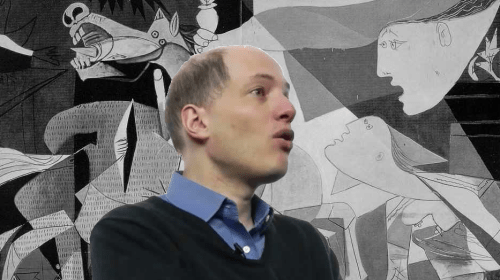
Why does Alain de Botton want us to kill our young?

Philosophy means asking difficult questions. Not the questions that actually make up philosophical enquiry – those tend to be quite simple, which is why they can be so easily worked into summer blockbusters – but the tiny, dark questions that swarm around them. The questions that you can never quite get out of your head, even though you know full well that the answers won’t bring you any hope or solace. Questions that form miniature doorways into small tight universes of unrelenting horror. A field philosopher of an earlier century, his brain slow-cooking in his pith helmet, tramping through the sweaty heat of a tropical rainforest with the weight of his rifle and pack dragging him down into the muddy ooze below, trying to discern the mating call of his prey in the jungle’s unending din, might stop and ask himself – if I do manage to track and shoot the synthetic a priori proposition, will that make me happy? These days, the rainforests have mostly been cleared to grow soybeans and palm oil, and the old briery questions that used to hide in their shadows are now everywhere. Why do I keep making such a tit out of myself at parties? Was romantic love really invented by a conspiracy of medieval poets and soft toy manufacturers in collusion against the world? Does Alain de Botton actually fuck? And if he does, then what could that kind of monstrosity actually look like?

Alain de Botton is the most banal man alive and the most banal man to have ever lived, but it’s not enough to just complain about banality as itself, because banality doesn’t exist. Banality isn’t like misery, or ecstasy for that matter, which swallow you up completely, admitting no outside or differentiation, like Badiou’s grey-black that negates even the possibility of a light. Banality is a spectral relation between something real and something that used to be real; it speaks to something that’s been lost. If everything in the world were completely banal and always had been, we wouldn’t be able to talk about it; we’d have nothing to compare it to. There has to be something significant, somewhere. The problem is that most things are pretty dull. Look around you; try to find one non-boring mass-produced object, anything whose existence you could really uphold in the court of eternity. It’s not easy. The sense of banality is the ghost of a significance that has been thoroughly and deliberately wiped out. These concepts are all the products of a particular set of material and historical circumstances: the idea of virtue would be impossible without classical slavery, ennui came out of the stillbirth of modernity, and banality is the cultural logic of colonial genocide. Dig around near the roots of any piece of tritely inspirational advice, and it won’t be long before you unearth the mass graves.

You can see this in the suburb, an urban form so monolithically banal its structural violence rivals that of the temple complexes in Tenochtitlan. The vast bloated suburbs of the western United States could only be built once the native Americans had been completely wiped out and any mystical autonomous connection between humanity and the earth had been eradicated; only then were the hills and the desert reduced to mere land, which could be parcelled out in lots for tract housing and strip malls. In France, meanwhile, the suburb-form appears as a drab concrete prison suffocating the ancient heart of the city, a holding pen for the survivors of the state’s imperial killing sprees abroad. Britain’s commuter belt villages, coma-quiet but for church bells and the dying yelps of the foxes, built their sleepy tedium on the superprofits extracted through the rape of three continents. The strange tendency for acolytes of the supremely boring New Atheism to be from Australia makes a lot of sense in this context: once the songlines have been scrubbed out and the unburdened creativity of the Dreaming has been extinguished – along with the continent’s original inhabitants – the land becomes a flat and empty space for the exercise of instrumental reason. Israel, one of the few actively ongoing colonial projects in the old mould, is fast getting in on the act: it’s official propaganda is now laced with dull affirmatory homilies. Banality is the quiet revenge of the societies we’ve destroyed and the lives we’ve extinguished, its stiflingness is the traumatic echo of the bloody chaos that suddenly descended on them. And Alain de Botton is the most banal person to have ever lived. How many massacres must he have committed?

I’ve mentioned de Botton a few times before in these pages, but only because I find him an object of gruesome fascination and psychotically obsessive hate. According to his own personal website, he is ‘a writer of essayistic books that have been described as a ‘philosophy of everyday life.’ He’s written on love, travel, architecture and literature. His books have been bestsellers in 30 countries.’ He’s also presented a couple of TV series and is the founder of something faintly ominous called the ‘School of Life.’ He is, we’re expected to believe, a philosopher: someone with the same basic job description as Heraclitus or Kant or Hegel. What the site fails to mention is that he looks like nothing of this world. Generally it’s bad form to make fun of someone’s physical appearance; they can’t really help it, after all. (In any case, philosophers shouldn’t really look like normal people. They exist to seek out the strangeness in life: Heraclitus was a ragged he-crone, Kierkegaard was a hunchback, Adorno was an absurd Humpty Dumpty figure; if these people weren’t weirdos they would’ve ended up getting a normal job.) With de Botton it’s different; his bodily strangeness is inseparable from the bland conventionality of his thought.  Alain de Botton looks like a human being as designed by HR Giger. His forehead rises high up to a vaulted dome, a tapering lizard’s egg of a cranium. His eyebrows jolt and shudder with his shoulders. His nose has a lubricious gleam; his mouth is a dark stain, red wine or fresh blood, and when he talks his deathly-white teeth seem to slide oilily against each other. His skin is faintly rubbery, and while it mostly seems to fit him there are still a few places where is bunches up or stretches out, like a cutaneous gimp suit. He looks weird, interstellarly weird; half Mystery Man from Lynch’s Lost Highway, half sentient rock formation. The general impression given is that of a reptilian alien awkwardly stuffed into a human form – not a particularly malevolent alien, just one that in its own unknowable way is making an honest and doomed attempt to fit in among us Earthlings. It’s a lie. He’s evil, and his evil is entirely human.

Alain de Botton specialises in a kind of humdrum potted sagacity, the kind of stuff that has all the outward appearance of insight while managing to avoid saying anything at all. This mushy nothingness can take the form of pointless tautology (‘In a meritocracy, success comes to seem earnt – but failure deserved’), excerpts from the Dictionary of Twee Vacuousness (‘Magnanimity: the one who was right does not say ‘I told you so,’ the one who was wronged does not seek vengeance’), outright untruth (‘Choosing a spouse and choosing a career: the two great decisions for which society refuses to set up institutional guidance’), inspirational pap (‘Our real motivation comes from people who don’t believe in us’), and the final spluttering descent into total incoherency (‘The end logic of our relationship to computers: sincerely asking the search engine “what should I do with the rest of my life?”‘).

These nuggets are all from his inevitable Twitter account; for the really heavy froth you’ll have to turn to his books. To be fair, Alain de Botton is a man of great intellectual breadth. In his many published works he has managed to be boring about Proust, anodyne about art and architecture, tedious about travel, and spend several hundred pages completely failing to understand love, sex, and religion. Aside from the general awfulness of his writing, it’s on these last two subjects (I don’t really like Proust) that his peculiar monstrosity really shines through. In Religion for Atheists (Penguin, 2012) he tries to reconcile the virtues of religious faith with a non-belief in an objectively existing God. That’s perfectly fine; plenty of worthwhile thinkers (Bloch, Althusser, Agamben, Badiou) have tried to do the same. However, for de Botton religion is useful because it ‘teaches us to be polite, to honour one another, to be faithful and sober’ and because it can help us learn ‘how to face the trials of the workplace with a modest and uncomplaining temper.’ No it’s not. Religion is fire and passion, a point of connection between humanity and the infinite, the cry of the oppressed creature, the foundation of universalism. It’s meant to be vast and terrifying and emancipatory. In the face of the vastness of the Absolute Other all human distinctions are meaningless; that’s why so many radical liberation movements have been religious in nature. What this book does is try to turn six millennia of blazing fervour into a half-baked set of minute consolations. It’s an act of hideous violence.

That’s bad enough, but How To Think More About Sex (Picador, 2012) might be the worst book ever written. It’s not too long, but de Botton manages to squeeze into its pages an entire compendium of some of the most grotesque and ungodly sexual acts ever committed. There are the infamous blood orgies of the Mughal emperors, in which the slit throat of a young harem slave was used as a lubricant; there are the thanatophilic séances of certain Theosophist sects, in which the spirits of the dead were summoned and subjected to days of sexual torture; there’s the story of the medieval Saint Quasivermus of Caenumia, who held that congress with earthworms was the only unsinful carnal activity. His book describes every possible interposition of body parts with orifices: there are toes in nostrils, the practice of ‘elbow-fucking,’ and one instance in which an entire dwarf is inserted into an anus. The whole book is awash in a queasy sea of bodily effluent – blood, vomit, bile, cum, pus, piss. Of course, none of this is in the text itself, but it’s the unvoiced content of de Botton’s continual refusal to follow his title and actually think about sex. What he does is recoil from it. For him, sex is for procreation and to stave off loneliness; it’s always a fundamentally selfish act. Most of the time it’s a case of ‘squandered human energy;’ he continually resorts to the idea of sexuality being somehow base: a vestigal, degrading, primal urge we’d all be better off without. At one point he even upholds impotence as an ‘achievement of the ethical imagination.’ None of which is necessarily objectionable – maybe we would be better off without libidinality, free to concentrate on more important things like compiling spreadsheets of sporting statistics and overthrowing capitalism – except for the fact that de Botton never actually makes any argument for this position; he just presents it as a given. He doesn’t seem to even consider the idea that sexuality might be fundamentally related to how we can conceive of ourselves as people, or even that it might actually be enjoyable.

Alain de Botton doesn’t understand sex or religion because sexual and religious experiences are fundamentally transcendental; they allow people to escape the bounds of the atomised subject. They point, however darkly, to something we can’t quite name or describe. They are experiences that are not yet completely banal, and there’s no room for that kind of thing in his watered-down gruel of a philosophy. Does Alain de Botton fuck? Of course he doesn’t. What happens is the female of the de Botton species releases her eggs in the water, and the male comes along later and fertilises them. But supposing he did?

It’s all very well to make fun of Alain de Botton for being an intellectual lightweight and looking like a monster from a cheap B-movie, but these facts should be immediately obvious to anyone. The point is that his brand of fluffy philosophy-as-self-help isn’t just annoying. It’s an enemy; it’s bloodthirsty and dangerous. The usual charge levied against de Botton is that he ‘isn’t a real philosopher.’ This isn’t true at all; he’s a philosopher in the highest sense, as described by Marx and Nietzsche – in the sense that philosophers are ‘advocates who refuse the name, wily spokesmen for their prejudices,’ or those who try to interpret the world when the point is to change it. Despite his small nods to the idea that maybe the senseless and continual catastrophe of capitalism might not be the best way to run a planet, de Botton isn’t really interested in changing the world. He thinks people should be a little bit more reflective, he thinks he can help people cope with the stresses of the workplace and the perils of romance, he thinks everyone should have a ‘sunlit room set with honey-coloured limestone tiles’ in which to relax – and that’s basically it. No passions, no fury, no grand and wild ideas, just a dull life with a few small pleasures and a few small worries, instantly soothed. He’s standing atop a pile of corpses and suggesting that they might be arranged more pleasingly. Alain de Botton isn’t just banal, he embraces his own banality; he tries to dress vacuousness up as significance. If the sense of the banal is the whispering reminder that there was once something important and our society has since then expended every effort in wiping it out, then de Botton’s achievement is to close up that anxious gap, to make dullness a universal with no horizon. With that achieved, the slaughter can continue. Alain de Botton would see the seas turned to acid slime and the sky filled with iron and smoke. He is directly responsible for every evil act in the world today. He wants us to kill our young.

He’s not alone. De Botton is just the thin edge of an enormous and boring wedge, the Blitzkreig of banality. This stuff is dangerous, and it needs to be fought with every weapon available, with all the puerile and tasteless fury we can muster. What if Alain de Botton actually fucked? What could such a monstrosity actually look like? His tiny, shiny pebble-head gleaming with sweat, his weird lips twisting into a grimace of enjoyment. His flappy, skinny torso heaving, pale as milk, brushed with dark greasy hairs. He’d go too far. He’s coming into contact with something he’s disavowed his entire life; all his symbolic violence is coming into brutal reality. First the blood, then the fragments of bone tossed around the room, a screeching, scrabbling fury. Alain de Botton rears his head and howls – then stops. He looks down at himself. He looks at the carnage he’s responsible for. Finally, he’s come face to face with what he really is.

PS: I might have been a little unkind to Mr. de Botton. He’s not a total stranger to outright fury – after a negative book review, he left a comment on the author’s blog, writing ‘I will hate you till the day I die and wish you nothing but ill will in every career move you make.’ I await his comments on my own appraisal of his work with anticipation.

On the encounter, or how I missed a flight because of Slavoj Žižek

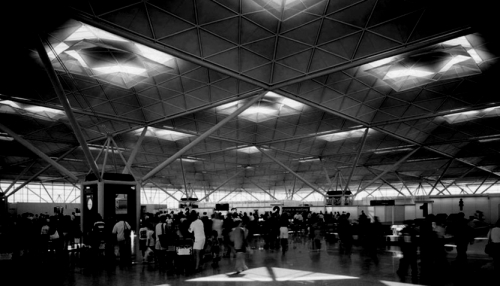
I have experienced the full horror of an encounter with that which exists beyond the wall of language and beyond the limits of our comprehension, and it happened in the departure lounge of London Stansted airport, in a seating area between the Wetherspoons pub and a branch of Pret A Manger.

I was there to visit some friends in Edinburgh, and I was flying because it’s cheaper to get to Scotland by hurtling through the sky in a tin can full of burning kerosene than it is to take a train. I don’t like airports. I don’t think anyone does, apart from planespotters, executive bankers, Boris Johnson, and other such psychopaths. It’s not even the queuing, or the brusquely voyeuristic security measures, or the abolition of the indoor smoking areas; it’s the fact that airports seem to be the focal points of a very peculiar sort of regimented insanity. Why do the tannoy announcers in airports seem to be so ashamed of their humanity that they mimic the blank tone and halting cadence of a robotic voice? Why do most of the books sold at airports seem to concern a terrorist plot to kill hundreds of people in an airport? In 2009 Heathrow chose as a writer-in-residence for its newly opened terminal that blithering clunkhead Alain de Botton. He wrote a book about the experience. Sample sentence: In the cloudless dawn, a sequence of planes, each visible as a single diamond, had lined up at different heights, like pupils in a school photo, on their final approach to the north runway. I don’t think anyone capable of producing such artless imagery should be allowed near a rural bus stop, let alone an international air transit hub. But in a way it makes sense: de Botton’s banal quietism, vaguely inquisitive but ultimately more concerned with homilies than critique, is precisely the kind of attitude that our infernal masters in the airport system want to promote.

In Stansted, I was busy inadvertently scalding my tongue on coffee and trying to pummel my mind into a book by de Botton’s less platitudinous namesake, Alain Badiou. I’d managed to find a less crowded area, but there was still plenty of commotion. Kids gnawed at the edges of their seats. Clashing strains of cheery pop blared from various exciting retail spaces. Harassed-looking commuters played an endless series of computerised bloops through their iPads as they crushed candies or angered birds or did whatever it is we’re now required to do to stop us committing suicide whenever we have five minutes to ourselves. Badiou was trying to tell me about the universality of the truth-event, but I’d had three hours’ sleep the previous night and it was pretty hard to listen. I felt a faint shadow fall over me in the diffuse airport light, and looked up. Standing in front of me, meeting my gaze with his, was the Slovenian philosopher, critic, author of over seventy books, and ‘intellectual rock star,’ Slavoj Žižek. He was pale and haggard, his nose pulsing, his legs trembling. I might have imagined this, but he appeared to be wearing an illustrated Žižek alphabet t-shirt: A is for the Absolute, B is for the Big Other, C is for cocaine, and so on, and so on. And he was looking at me with pure, undisguised terror.

I’d come across Žižek before. In a talk at the Royal Festival Hall he’d accused the entire audience – myself included – of being ideologically incoherent for failing to properly understand the ‘tomorrow belongs to me’ scene in Cabaret. In these pages I’ve variously mocked his beard, parodied his writing and speaking style, and pointed to the dearth of censure for his outbursts of antiziganism. His publishers follow me on Twitter. This was different. I wasn’t facing the ‘Elvis of cultural theory’ or ‘the most dangerous philosopher in the West,’ or even the author of over seventy books. With his sad grey eyes and his meline snuffling Slavoj Žižek looked like nothing so much as some reclusive woodland creature, something small and hunted and incredibly fragile. He was in shock. He’d been in London to promote his new film; he’d been surrounded by journalists and interviewers and, worst of all, his fans, who he famously can’t stand. Finally, he was in Stansted airport, protected by a wall of duty-free perfume and ruffled copies of the Daily Mail; he thought he was safe. No such luck. He was just looking for somewhere to sit before his flight, but then he saw me. He saw what I was reading. In a blurb, Žižek has said of Badiou that ‘a figure like Plato or Hegel walks here among us.’ I would know who he was. I would want to talk to him, or take a photo, or have him sign something; it would be unendurable. He had to leave before I noticed him. Too late. I looked at him and he looked at me. Or maybe the other way round: for a Lacanian, the Gaze is never your gaze, it’s the gaze of the Other, the anxious feeling that the object of our glance is looking back at us. In any case, he grunted and shuffled away as quickly as he could.

I was in shock too. My plans for that morning were to drink some coffee, try to read a book, and catch my flight to Edinburgh. I wasn’t expecting to be thrust into a miniature staring contest with Slavoj Žižek. Nobody had warned me that this was about to happen. Now I know how I’ll behave in a moment of crisis: as the sniper fire whooshes past my ears or the avalanche slowly descends or the inferno blazes around me I’ll just sit there, mute and stunned, an idiot smirk hovering on my lips. By the time I regained my senses he was gone. Quickly I hurried after him. I had to get something: a photo, an autograph, a blurb for my first novel, a response to my critique of his contribution to David Lynch scholarship, something to prove our encounter had actually happened. He had his role, and I had mine. He would flee, and I would hunt him.

I never did find him. By the time gave up my hunt my flight’s final call was imminent. In my panic I followed the wrong signs and found myself trapped on a slow-moving automated transit to a distant outpost of the terminal. When I eventually reached my gate the staff told me that the plane’s doors had been closed less than two minutes ago and that I couldn’t be allowed to board. Pleading had little effect. I had missed my flight, the next one wasn’t for seven hours, and it was all Slavoj Žižek’s fault.

This is what’s meant by an encounter. Most of the time when we see people we don’t really look at them, and for good reason. Walk down a crowded street and you’ll be confronted with countless gazes and subjectivities, an infinity of infinities of experience. You can’t approach all these people as other subjects; you’d go mad, end up as a street preacher or a serial killer. It’s much safer for everyone if you consider them as vaguely mobile obstacles. If you see someone you find particularly attractive or particularly objectionable you might go into a brief flailing panic, your eyes darting around them, your neck craning over to watch them walking away, but that’s over in a second. Sometimes, though, there’s an encounter; a point where you approach someone else in a manner that is entirely beyond the structures of signification and at the same time full of an incredible significance. We all leave a certain amount of turbulence in our wake. The encounter can result in grand leaps in human knowledge, or the ruin of cities, or me being stuck in Stansted airport for seven hours. For Badiou, though, the encounter is the fundamental basis of love. As a good Maoist, he rejects the banal cod-spiritualist view in which love is seen as a process by which two people become one: the essence of love is the properly dialectical formation of a Two. In an encounter – in a real encounter – a monadic subjectivity finds itself opened up to other people, to numerativity, and through this it gains access to the infinity of experience.

I’m not so sure about this. Badiou’s maths is probably better than mine, but I’ve yet to see a series of integers ever actually ending in infinity. Žižek is less positive about the whole thing; for him the paradigmatic form of the encounter is the encounter with the Real. He writes: ‘When do I actually encounter the Other ‘beyond the wall of language’, in the Real of his or her being? Not when I am able to describe her, not even when I learn her values, dreams, and so on, but only when I encounter the Other in her moment of jouissance: when I discern in her a tiny detail (a compulsive gesture, a facial expression, a tic) which signals the intensity of the real of jouissance. This encounter with the real is always traumatic; there is something at least minimally obscene about it; I cannot simply integrate it into my universe, there is always a gulf separating me from it.

My encounter with Slavoj Žižek was an encounter of this kind. I looked at him and he looked at me; we saw each other beyond the wall of language. The sensation that accompanied this encounter wasn’t love: it was mutual horror. For a brief second before I set off to chase him down, the linguistic structure of my subjectivity was shattered. I saw myself from the outside. It was something like Kristeva’s formulation of abjection – the awareness of a subject as something other than a subject, the feeling you get when confronted with human shit or a corpse. The traumatic sense of my own finitude.

The encounter is unpleasant, but this doesn’t mean that it should be avoided. In a sense, Badiou is right: it opens up a pathway to the infinity of experience, not through numerativity but through a Deleuzian operation of minority and multiplicity. Deleuze claims that we never encounter another person directly. We encounter the Gaze, and this wordless gaze emanates from the Real where there is no lack and no insufficiency. It’s upsetting, but it’s a duty: in the end, it’s our duty towards our own deaths.

In the end, I caught the next flight. Edinburgh was very nice.

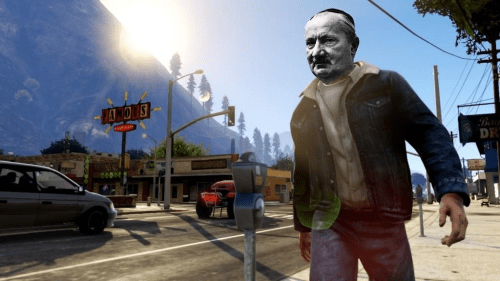
Grand Theft Auto and the extinction of being

More like Geworfenheit Theft Auto amirite

In Rostov-on-Don, a provincial city in the south of Russia, two men had an argument in a supermarket. There’s no footage of it, but we can imagine the scene. The squeaky lino floors, the tinny sound of pop music. The strip-lighting, buzzing as it casts a dreary mundane pallor on the rows of produce, scrubs the shadows from the faces of the disputants, and eventually drains all colour from the flecks of blood. The other shoppers look on first in exasperation, then in horror: the argument devolves into a fistfight until its frenzy reaches a point where one man pulls out a gun and fires several rubber bullets into the other’s head. So it goes. What’s brought this dull event to the world’s attention is the fact that the two men were reportedly arguing about the philosophy of Immanuel Kant. The international press has treated this story with a kind of wry amusement: it’s perfectly normal to shoot someone in an argument over sex or money or football; it’s pretty weird (and kinda funny) to shoot someone in an argument over the nature of the noumenon. Going by the experience of history, this isn’t really the case. For a good part of the 20th Century, a philosophical debate (or at least something that claimed to be a philosophical debate) about the degree of contradiction between the material dialectic and humanist values got so out of hand that for a quite while it looked like the only way to properly resolve the issue was through the mass slaughter of every human being on the planet. Disputes over the mysteries of the Holy Trinity saw swarms of horsemen turn fields into hellish seas of mud under their hooves and reduce cities to blood-drenched ruins under their swords. Aristotle’s doctrine of virtuous moderation allowed his protégé to send a moving line of fire and bloodshed that swept from the Aegean to the Indus. You haven’t really made it as a philosopher until you’ve stacked up a decent body count.

Even Kant, shy and gentle, punctiliously pedestrian, isn’t exempt from the violence of philosophy. Presidente Gonzalo, the leader of the Peruvian Shining Path, had a secret identity: Abimael Guzmán, mild-manned professor of philosophy at San Cristóbal of Huamanga University. As the group’s notorious massacres in peasant villages show, he had a lot to learn about the proper implementation of Mao Tse-Tung Thought; nonetheless, his Kantian credentials are impeccable. If anything, transcendental idealism handily lends itself to a certain kind of will to destruction. Like most very clever people, Kant had something of a nasty smug streak. In his What is Enlightenment?, he describes the unenlightened condition of humanity as a ‘self-imposed nonage’: if other people are stupid, lazy, and cowardly, it’s only their own fault; leaders and tyrants only channel this mass stupidity rather than imposing it. This is why he can write that ‘freedom need not cause the least worry concerning public order or the unity of the community.’ Against those who try to stifle argument, Kant proposes the dictum ‘argue as much as you like – but obey!’ Enlightened argument can only proceed towards a singular truth, and if a ruler is himself enlightened, then any argument that challenges his rule is by definition invalid, with no place in a liberated discourse. Kant’s enlightenment admits no contradiction. There’s a very short line from his veneration of Frederick’s Prussia to a man being shot in the head in a Russian supermarket. The shooter was applying the categorical imperative perfectly: if everyone who dares to be so clearly and obstinately wrong about philosophy gets a rubber bullet to the head, then proper reasoned argument can begin, to the benefit of all humanity.

~

One man shooting another because they disagree about the fundamental nature of reality is a funny human interest story. Someone pretending to shoot a virtual prostitute is grounds for a moral panic. Every iteration of the Grand Theft Auto series of games seems to raise the same clamour: it’s an awful, violent game in which you, the player, can fuck a prostitute, kill her, and then take your money back. It’s a strangely specific complaint – after all, you can do a lot of terrible things in GTA, your basic mode of existence in the game is that of a spree killer. This might have something to do with the level of intent involved: the game is ‘open’ to the extent that you can walk into a shop, stand in line for a while, and then shoot another customer in the head, but you can’t (yet) have a steadily escalating argument about Kant with him beforehand. The prostitute scenario is different; you have a reason to kill her. Ultimately, I think there’s more to it than that. The real object of horror isn’t the murder, it’s the retrieval of the money. What’s being dramatised is a violation of the laws of exchange, those in which – as Marx puts it in Volume I of Capital – ‘the owner of money must meet in the market with the free labourer, free in the double sense, that as a free man he can dispose of his labour-power as his own commodity, and that on the other hand he has no other commodity for sale, is short of everything necessary for the realisation of his labour-power.’ By taking your money back, you’re breaking a contract, dispelling the comforting illusions of the marketplace, turning the covert oppression of the trade in bodies into its overt expression in violence.

The question of violence in video games is based on the horror of the uncanny: it’s about the power of images of things to come alive, the potential for onscreen violence to turn into actual violence. What’s apparently certain is that these games have some primordial connection to humanity’s intrinsic cruelty. Depending on whether you believe the dessicated pinch-faced puritans or the sloppily hirsute misogynists that make up video gaming’s core user base, this relation is either one of normalisation, in which representations of violence bring our animal natures out from the fragile cloak of civilisation – or one of release, allowing an expression of this violent nature that helps us function normally in the real world with only minimal loss of life. The case of the argument over Kant in Rostov-on-Don shows that it’s a little more complicated than that. Violence doesn’t proceed only from violence but from something quite different; there’s nothing more shatteringly, existentially violent than the infinite stillness of a Rothko multiform or the fragile sorrow of Chopin’s nocturnes. I’m not going to question whether or not human beings are existentially violent; at root the question is what it means for us to be violent, or, more fundamentally, what it means for us to be – and, as Heidegger shows, our being is inseparable from the world in which we exist.

Heidegger’s innovation is not only to ground ontology in actual existing beings instead of some grand unifying principle (as in Spinoza’s substance or Leibniz’s monads) but to stress the situatedness of the ontological object. His term for the human mode of existence, or that ‘which, in its very Being, comports itself understandingly towards that Being,’ is Dasein – literally ‘being-there.’ Awareness of your own existence is a matter of experience rather than a solipsistic Cartesian introspection; Dasein is a being-in-the-world rather than a being that just so happens to find itself inhabiting something vaguely world-shaped. This world isn’t just a set of beings, or the spatial framework in which they are dispersed: in Heidegger’s definition, ‘the world worlds, and is more fully in being than the tangible and perceptible realm in which we feel ourselves to be at home.’ Non-human beings, meanwhile, are encountered in two modes: as present-at-hand (in which they’re an object of detached contemplation) and as ready-to-hand (in which Dasein is absorbed in their use, with the categories of subject and object falling away into the undifferentiated process of work). Against much previous philosophy, which considers entities in terms of their properties and attributes, Heidegger stresses the primacy of the ready-to-hand. On perceiving a hammer, we don’t think about its abstract composition but how we can use it. The world is filled with equipment; useful, handy things.

It’s a nice way of thinking about things, but you get the feeling that for all his talk of handiness and equipmentality Heidegger would still have trouble with an Ikea wardrobe. Beyond that, Heidegger’s system runs into some problems when we’re forced to confront beings that aren’t handy or useful to us. True to form, he has his own word for this: Unzuhandenheit, unreadiness-to-hand. The unready-to-hand tool is something broken that doesn’t fulfil its function properly; it inhabits a grey phantom zone between the absorption of the ready-to-hand and the distant appraisal of the present-at-hand. We become aware of the thing as an object, but at the same time Dasein is engaged with it in the search for a solution. What happens, though, when we come up against something which is working in perfect order, but whose being is directly adversarial to ours? It’s an important question, because these things have come to dominate our lives.

Scholars of Heidegger tend to dispute the exact nature of Dasein and its relation to what we think of as the human being (there haven’t been any recorded fatalities yet, but there’s still plenty of time). Graham Harman and other advocates of object-oriented ontology attempt an ‘anthropodecentrism,’ in which the status of human beings as those beings that move towards their own Being is deprivileged. In a way, they have it right. Under industrial capitalism, an understanding comportment towards Being isn’t something that occurs on the level of the human, but on that of the firm. Humans are instrumentalised, first through their labour-power, and again through their position as consumers, becoming tools used in the production process. Capital-producing institutions are Dasein, reaching out towards an authentic existence; we are Zuhandenheit, the equipment used. The immense wealth of commodities produced is useful, but not for us. There are few consumer items that are used to solve our problems; our new technologies impose themselves as the solutions to problems that didn’t even exist before their arrival. Tools bear the stamp of their owners; now the tool is the stamp. The new iPhone has a fingerprint scanner, the new Xbox has an always-on camera. At the same time, it’s these same things that are used to stage our response: a steady, furious crusade against everything useful and handy, a purging of our own usefulness. Our violence is the violence of a being-in-the-world whose ability to understand that Being is under threat of extinction.

Watch someone playing GTA – not going through the storyline missions, but really playing, tearing at random through the vast cityscape, mowing down pedestrians, ducking down alleyways to avoid the cops. The landscape is littered with useful things, but rather than being absorbed in their use, we discard and destroy them. Get out of one car, steal another, over and over again. What distinguishes Grand Theft Auto is the sheer destructibility of the environment; we are the equipment through which the world’s destructibility is realised. In a world where the relation between humans and tools is inverted, the game offer us another reversal. Heidegger describes the condition of the individual human as one of thrown-ness, a state that goes beyond its Sartrean reformulation in the precession of existence over essence to encompass the position of having-to-be-open. We’re tossed into a world we don’t understand; to make sense of it we have to open ourselves to other beings. Through GTA, the world is thrown into us and has to be open to us. We’re faced with the infinite usefulness that’s lacking in reality. And so, of course, we have to destroy it.

PS: Incidentally, this is why video games can never be art. Art discloses the world; by giving us a world thrown into us, video games enframe it. They’re technology, and also a waste of time.

PPS: I haven’t actually played the new GTA, but they’re all basically the same, aren’t they?

Philosophy for the weak

But God hath chosen the foolish things of the world to confound the wise; and God hath chosen the weak things of the world to confound the things which are mighty; and base things of the world, and things which are despised, hath God chosen, yea, and things which are not, to bring to nought things that are.
I Corinthians 1:27-28

A sick man, a spiteful man, an unpleasant man; a cruel and strange weirdo, a loser, a stateless foreigner living alone in a single room; in other words, a man who can’t bear to see a horse being whipped. He hugs its neck, he wails, he collapses. Eventually the police are called. What’s the deal with Nietzsche and horses? Twenty years beforehand, when he was young and strong, he’d abandoned his ancient books and joined the Prussian artillery, quickly distinguishing himself as an excellent rider. Then, one day, as he jumped happily into the saddle, something went wrong. He tore two muscles down his left side; he couldn’t walk for months. A fracture opened up. No more games with horses and cannon for young Fritz; an unhappy return to his old childhood world of classical philology, Hölderlin and Schopenhauer. From here on his body would only disintegrate: syphilis turns his bones to mush; indigestion sets his entrails on fire; genius, the worst sickness of all, sends him mad. All because of one horse. It’s hard to see Nietzsche angry at the horse, though; it’s much easier to imagine him bent over in pain as the horse watches with placid incomprehension, looking up into its dark eyes and suddenly conceiving of the doctrine of eternal recurrence. All this could happen again, exactly, to the last detail, and he’d be glad. Nietzsche trying and failing to mount his horse is a philosophical encounter. He loves horses, wild horses, war-horses, cart-horses. We could ask instead: what’s the deal with Nietzsche and his father? Ever since Freud’s Little Hans we’ve had to look at horses suspiciously. A horse isn’t just a horse, it’s a big snorting priapic dad. It’s strange, though: the same furious Nietzsche who tears down gods and nations speaks in only the kindest terms of his timid Lutheran pastor of a father; through him he invents an entire lineage of Polish nobility to be his ancestors. A delusional man. A man whose life isn’t so much a life as a constant writhing agony. His apartment in Turin is full of dust and little else; no wonder his lungs are playing up. It’s dark, and faintly moist, and it smells of decay. Moths flap about in gloomy corners. A single trunk, a single desk, a single bed. The gas-lamp outside sends the odd flicker of orange light, Dämmerung-deathly, across the room. In the middle of all this, Friedrich Nietzsche sits down at his desk and writes works of cold bright Arctic clarity.

In Anti-Nietzsche, Malcolm Bull confronts the modern-day ubiquity of that strange and lonely man going mad in Turin. Nietzscheanism is everywhere; Bull points out quite rightly how strange it is that a philosopher famous for his oppositionalism is so scarcely opposed. Socialists, feminists, and Christians swear their fidelity to the ideas of the anti-egalitarian, misogynist and atheist Nietzsche. However, Bull points out that defeating him isn’t an easy thing to do. Nietzsche writes about the will to power; if you try to critique his ideas, you’re only asserting your own will to power over his. Nietzsche writes about master and slave morality; if you try to overturn his principles, you’re only proposing your own master morality. Nietzsche’s works are full of conflict, war, and dynamite; if you try to fight him, he’s already won. So Bull doesn’t try. As he puts it, Nietzsche wants us to ‘read for victory,’ so he reads for defeat. Bull’s tactic is for us to accept Nietzsche’s philosophy in its entirety but to position ourselves on the ‘wrong’ side of every opposition. Rather than trying to raise ourselves to Übermenschen, we should become less than human; we should abandon the aesthetic; we should arm ourselves with nothing except our weakness, because we are weak. Bull encourages us to ‘read like losers.’ It’s a fascinating idea, but I think there’s something he’s missed. There’s no need for us to read like losers, because Nietzsche writes like a loser.

I usually don’t like this kind of biographical argument. When people claim that Bishop Berkeley’s subjective idealism was just a philosophical manifestation of his life-long constipation and inability to produce matter, I find it hard not to have a vague objection. It’s the same when there’s an attempt to reduce political ideologies to some kind of cod-psychopathology: you’re only a conservative because of your dominating father, I’m only a communist because I never got over my infantile egotism, whatever. These are ideas, they should be confronted as such. With Nietzsche it’s different. His great achievement was to drag philosophy down from its pretentious heights and roll it around in the mud a little. He was the first to see philosophy as a ‘kind of unintended and unwitting memoir’ of its author – as a symptom. There’s no reason to think that Nietzsche ever excluded his own (anti)philosophy from this perspectivism. When he tells us not to believe everything written down in fine style, he’s talking about his own writing. There’s a note of sad irony in all his works: his chapters with titles like ‘why I am so clever’ and ‘why I write such good books’ refer to nothing more than his migraines, his blindness, and his loneliness. Nietzsche carefully cultivated this image of his own lack: even as he was dying of syphilis, he continued to maintain that he’d never slept with a woman. In his Introduction to Antiphilosophy Boris Groys writes that ‘when Nietzsche praises victorious life, preaches amor fati and identifies himself with the forces of nature that are bound to destroy him, he simply seeks to divert himself and others from the fact that he himself is sick, poor, weak and unhappy.’ I don’t think diversion is what’s going on here. He’s coding or communicating his sickness; the incredible strength of his works and the incredible weakness of the man himself are one and the same thing, and neither one can be understood without the other.

Ignoring Nietzsche’s weakness can get you into trouble. I’m not talking about the fascists, whose Nietzsche is more a signifier than a thinker, but people like Georges Bataille. Bataille was a great philosopher but a really shoddy Nietzschean. While he famously confronts Hegel with laughter, he takes Nietzsche far too seriously – because Nietzsche’s laugh is that of the weak, choked with phlegm. Bataille wasn’t weak, even despite his tuberculosis. He lived an affirmative life of the kind that Nietzsche recommended: he wasted several fortunes in bars, casinos, and brothels; he founded secret societies; he was an enthusiastic participant in the partouze, he masturbated over the corpse of his mother while his pregnant wife slept in the next room. He was outwardly courteous and handsome; he didn’t need to hide his face behind a ridiculous moustache. He didn’t quite get it. You can see this in some of his most overtly Nietzschean texts; The Practice of Joy before Death, for instance. Bataille writes that ‘man “is” as soon as he stops behaving like a cripple, glorifying necessary work and letting himself be emasculated by the fear of tomorrow.’ Later he shows us how to do this: ‘I AM joy before death. Joy before death carries me. Joy before death hurls me down. Joy before death annihilates me. I remain in this annihilation and, from there, I picture nature as a play of forces expressed in multiplied and incessant agony.’ It’s powerful stuff, but there’s a glaring lack of irony here, a very un-Nietzschean didacticism. Bataille doesn’t quite get it because Nietzsche is a hypocrite, and he isn’t.

Bataille’s attitude to weakness is one of disavowal: Je sais bien that I am tubercular, mais quand même when I scream I AM THE SUN the verb être is the vehicle of an amorous frenzy. This is particularly evident in his writings on ritual orgy. In Eroticism Bataille rejects the idea of the orgy as an agrarian ritual, or at least the idea that the ritual orgy is entirely reducible to agrarian ritual. Instead it’s seen as an intrusion of the sacred world (that characterised by continuity, deindividuation, violence and ecstasy) into the profane world of work and discontinuity. The ritual orgy is a religious experience in the highest sense; it has no primary purpose other than unleash the transgressive forces of violent and frenzied eroticism. Bataille likens the orgy to war, another explosion of the sacred whose secondary, political purpose is only assigned to it later; it becomes enmeshed in his doctrine of excessive life and overabundant strength. He refers to ‘the men who ordained these orgies,’ but the men who ordained these orgies were women. The Dionysian Mysteries were a grotesquerie, a festival of the weak and the excluded in Greek society: women, slaves, cripples and outlaws. Their power was like Nietzsche’s: the paradoxical power of weakness, a power Bataille has disavowed. When the weakness goes; so does the power. Last year I took part in a masquerade orgy in London’s South Bank; the principle of female ordination was there (men could only attend if accompanied by a female partner, only women could approach men) but it was immensely different from the ancient mysteries. Afterwards many of my friends wanted to know what it had been like; more specifically they wanted to know if the whole thing had been tinged with horror and if it had left me feeling dead inside. They were quite disappointed to find out that it had just been quite fun. The people there were young and wealthy, bankers and investors; before we could go we had to send photos to the organisers so they could make sure we were attractive enough. In Bataille’s terms, it was libertinage rather than dissolution. There was no element of the sickness or the weakness that expresses itself as lightning and dynamite.

It’s notable that the discussion of ritual orgy in Eroticism is immediately followed by a critique of Christianity. The reason the Bacchic orgy no longer exists as a mass phenomenon has to do with Christianity’s reappraisal of the sacred and the profane; Bataille argues that in Christianity the sacred is associated exclusively with purity and the non-erotic love of agápē, while the ‘bad’ elements of the sacred (frenzy, violence) become part of the profane world, which is condemned as evil. In doing so Christianity loses much of the religious spirit, replacing it with sterile piety. Even so, it can’t abolish the impure aspect of the sacred, which finds its medieval expression in the Witches’ Sabbath and the Black Mass, inverted representations of Catholic liturgy. Again, Bataille’s argument loses something from the absence of any sense for weakness; he doesn’t see what really distinguishes Christianity. As he himself notes, the ‘sacred world is nothing but the natural world.’ It’s the order of the profane, with its division into work-time and leisure-time, that’s an artificial world formed through societal rites. However, the formation of the profane world is itself a product of religion; the laws which set up taboos and demand diligence in work are universally held to be a product of divine or cosmic revelation. Religion doesn’t belong to the sacred; it establishes a boundary between the sacred and the profane. The innovation of Christianity is to cast the profane world as the site of evil, to reject the world of work and to uphold the radical continuity of the weak. It’s true that the medieval Church tried to suppress the unruly side of the sacred, and that this impurity nonetheless found a way to express itself; but it wasn’t in the Witches’ Sabbath and its inversion of Christian prayer. Instead, frenzy, violence, and liberation were expressed precisely within the fabric of Christianity, in the form of the peasants’ revolt. These uprisings, generally led by radical preachers and taking inspiration from Biblical communism, erupted with all the thunder and fury of the sick and the weak, flaring up across Europe from the 1300s until they reached their apotheosis in the French Revolution. In Christianity, the sacred is class struggle.

Nietzsche would have called this slave morality, but Nietzsche loved horses. He saw a horse being whipped on the Piazza Carlo Roberto in Turin and rushed over to the animal, cradling its neck, trying to protect it. Then he collapsed. His Zarathustra surrounded himself with eagles and serpents, but Nietzsche loved cart-horses, slow and docile animals cowering under the whip. This doesn’t invalidate his philosophy; it opens it up. Master and slave morality aren’t in absolute opposition; just like Nietzsche’s power and his weakness, they form a dialectic. At a certain extreme point an identity of opposites is reached: the weak are the strong, and the strong are the weak. All it takes is a little will.

The image at the top of this essay is from Béla Tarr’s The Turin Horse, which you should watch.

What the radical left can learn from One Direction

My entire generation is traumatised by something that hasn’t happened yet. Shaking and sleeplessness, autoimmolatory alcoholism, fits of violent rage and sobbing breakdowns, weeks of self-imposed seclusion, an epidemic of anxiety. Generation Todestrieb. The accusatory inner voice that used to constantly seek out our weaknesses and insecurities doesn’t even have to bother any more. It just screams its wordless rage directly into our stream of thought, knowing that we know exactly what it means. We have all the symptoms of post-traumatic stress, except that for many of us there’s no primal fracture, no repressed event. What’s tormenting us is the future, or rather the lack of a future. Now that the myth of human progress has been gently euthanised, the only thing facing us is a catastrophe. We’re standing on a cliffside, so close to the edge that the angle of its descent isn’t even visible. There’s just a blank and distant sea.

Personally, I’ve never been a nervous type; I tend towards melancholia instead. Days thud past like slats on a railway line, their rhythm producing only a jolting queasiness. They’re not hard to fill. Aside from the regulation egodystonicity of the heautontimoroumenos, which is quite time-consuming all by itself, I tend to find myself wasting a few hours on a couple of Nouvelle Vague films. Sad men and self-destructive women fuck, kill cops, smoke cigarettes, and feel nothing – and I’m always left with a strange kind of jealousy, as if a impeccably cut charcoal-grey suit and a Erik Satie soundtrack could lend my unhappiness some kind of significance. Or I’ll watch Hollywood blockbusters online; pirated cam versions filmed in a cinema somewhere in the Russian provinces. I prefer them. It’s not low quality, it’s high aesthetics. Action is flattened, motion is shaky, the multi-million dollar digital effects spectacle is reduced to a chaotic blur, an intricate mess of abstract patterns rising from the darkness of the screen; the whole thing starts to look like an overblown tribute to German Expressionism. All this is punctuated by occasional twelve-hour binges, expensive drinks, gambling, until I emerge somewhere near the Embankment some time after dawn and idly consider throwing myself in the Thames. It’s not too bad.

My sample is admittedly small and unscientific: a handful of recent graduates, often broadly middle class, mostly from the humanities. But there are more thorough studies that bear out my conclusions. ‘Millennials’ – the generation born after the early 1980s – carry the brunt of the ongoing anxiety epidemic. It’s not hard to see why. We’re the inheritors to an economic crisis which is starting to seem less and less like a genuine collapse and more and more like a cover for wholesale pillage on the part of the ultra-rich, a planet that’s slowly choking to death in its own farts, a society steadily reverting to the age-old division between the smugly monied and the shambling cap-in-hand peons. It’s there in our popular entertainment: we don’t expect glittering crystal cities, however dystopian; we expect a future of zombie hordes or mud-caked poverty.

Still, it’s not like we’re the first generation of youth to emerge trembling into the foreboding landscape of the Real World. Something’s changed: our ancestors had mass protest movements; our equivalent is the brief self-congratulatory spark of Occupy and the Tory-sanctioned uselessness of UAF. We’ve become atomised. We’re self-hating narcissists. Part of it must have to do with the form taken by work. Aside from the stability of employment large-scale manufacturing, in a mass production line every worker is collaborating on a single project; it’s a spatial arrangement that facilitates the emergence of a certain kind of solidarity. That’s gone now, and there’s no such luck in the service sector. Your actions are monitored, your productivity is plotted on a graph, your co-workers are your competitors. If you take an unpaid internship or work on a zero-hour contract you become existentially surplus, part of the reserve kamikaze squadron of labour.

We’re constantly connected, digitally rubbing shoulders with people across the world, and the result is that we’re more and more alone in humdrum phenomenal reality. Cyberspace isn’t really a space at all; certainly not in the ‘infinite and infinitely open’ sense outlined by Foucault in Des espaces autres – it’s far closer to the medieval order of lieux, places. The connections of cyberspace aren’t actual connections, they don’t form anything like a machinic assemblage; it’s a flat two-dimensional plane on which any number of projected images and identities mingle and are occasionally interposed, a white wall studded with innumerable black holes, a vast faciality machine producing a single face. As Deleuze and Guattari point out, the face is ‘something absolutely inhuman.’ We don’t touch. This pseudosociality bores down into the fundamental ground of our psychosexual selves: we can’t even fuck any more without the help of a dating site algorithm. Following the formula of commodity fetishism, to establish social relations we must stop being people and start being things.

As ever, Japan is miles ahead of the west: while most European nations tried to rearrange the rubble of the second world war into some kind of bric-a-brac social democracy, American economic planners ensured that Japan went straight from zero to capitalism. The proto-Reaganism of 1940s Japan was followed by a precursor to today’s global economic crisis: the ‘lost decade’ of the 1990s, a long period of economic stagnation that further intensified the already profound alienation of Japanese society, giving rise to an ongoing epidemic of mass suicides (the rate averages at one suicide every fifteen minutes) and the emergence of the hikikomori phenomenon. Hikikomori are young men who confine themselves to their homes, abandoning studies, ignoring work, and disavowing social life; they communicate through the internet or not at all. It’s hard to tell, given their seclusion, but there may be over a million hikikomori in the country. Not that Japan has a monopoly on the phenomenon: researchers have identified similar trends in France and across the western world.

Given the sheer pointlessness of the world of work, becoming a hikikomori makes perfect sense. If you can, why not just opt out of the whole rotten socio-economic order? The problem is that doing so is a capitulation, a mute traumatised acceptance of existing conditions that precludes any real attempt to change them. In a way, the hikikomori is the ideal capitalist subject of the twenty-first century. The Deleuzian era, in which capitalism produced the schizophrenic as the ‘universal producer,’ has passed. Its replacement is the autist, the universal consumer. In previous economic crises salvation was to be found in putting people back to work and resuming production. This time the problem is one of a surplus of capital, a surplus of production and a surplus of population; we’re continually told that the only way out is to restore consumer confidence and restore the cycle of debt-spending. The hikikomori is the perfect solution: a consumer valve safely abstracted from the cycle of production, alone and defenceless, not enjoying his life but still endlessly consuming the means of its reproduction. That said, some governments haven’t quite caught on to the economic potential of mass isolation. Following case studies in Texas and Japan, there are serious proposals for antidepressants to be added to Ireland’s drinking water.

Which naturally leads me to One Direction.

This is One Direction.

It’s hideous, the kind of thing that makes you want to go to Theodor Adorno’s grave at midnight with a pentagram and a sacrificial goat, just so you can tell him to his face that he was right all along. The lyrical content is bad enough, at once recognising the sad prevalence of female body dysmorphia and trying to resolve it into the matrix of male sexual desire. But there’s also something profoundly unsettling about the expression worn by Harry Styles (he’s the tendril-haired lead singer and reportedly a pal of Alain de Botton, the psedophilosopher with a pebble for a head). It’s a grimace, a punk snarl totally at odds with his delivery, one expressing no discernible defiance. He prances around a beach and mouths insipidly anodyne lyrics, and all the while he snarls. It’s as if he realises exactly how ugly his creation is; his grimace is his own anxious withdrawal, the Steppenwolf baring its teeth. It doesn’t matter. There’ll be no peace for Harry Styles. One Direction is one of the biggest pop acts on the planet.

Their fans have a love for One Direction that borders on fanaticism. If you’re on Twitter you’ll probably already know this – Directioners and their fellow tribes consistently dominate the trending topics, helpfully reminding the rest of us that this is their turf, that we’re just a small group of weird adults hanging out at a teen party. Otherwise, a small insight was provided by the recent Channel 4 documentary Crazy About One Direction. Here we’re shown teenage fans squealing and weeping in bedrooms, their walls plastered with hundreds of pictures of the band, as if they’re sitting in the centre of a popstar panopticon. These girls hang around outside concerts waiting for a glimpse of the tour bus, they sneak into hotels where the band is rumoured to be staying, they make explicit artwork centring around the supposed homoeroticism between two of the band’s members, they send threatening messages to current and former girlfriends. “If they said chop an arm off, I would,” says one. “Because some people only have one arm, and they’re alright, aren’t they?” After the show aired, many fans were upset at being represented as psychopathic monomaniacs. They reacted, predictably, by being psychopathic monomaniacs. It’s tempting to dismiss all this as a kind of incipient fascism because, well, it is a kind of incipient fascism. Even the band’s name seems like it’d suit a bunch of 80s goths in ironic swastikas far better than a clean-cut pop band. Translate it into German and the Laibach aspect is hard to ignore: ein Volk, ein Wille, ein Richtung! If Liam, Louis & co. were to announce tomorrow that the body politic needs to be purged of its parasites, the resulting chaos would make Kristallnacht look like a mild spat in a rural post office. No army on earth could hold back the fury of ten million teenage girls in love. The fires would burn for months.

Of course, I’m hardly in a position to judge. When I was seventeen I covered my room with posters of Søren Kierkegaard. I had a small shrine at the foot of my bed in which copies of Either/OrThe Sickness Unto Death and Fear and Trembling were arranged with candles, incense, and small Danish flags I’d stolen from a local fishmonger. I founded my own chapter of the symparanekromenoi, with a membership of one, wherein the chief activity consisted of writing turgid erotic prose imagining the consummation of his love for Regine Olsen. On a holiday to Copenhagen I obsessed over the fact that Søren had walked the same streets where I stood, and nearly broke down in tears outside the University. I even went to the lengths of sending threatening letters and emails to professors of nineteenth-century philosophy across Europe and North America, informing them in no uncertain terms that Søren was mine and that nobody else was allowed to discuss his antiphilosophical approach to the question of being. Even more vicious missives went out to unreformed neo-Hegelians who dared to critique the infinite qualitative distinction. So I understand.

This kind of obsession isn’t just the alluring aura of commodity fetishism, it’s something far more significant. “What do you think about real boys?” the interviewer asks one fan, a nineteen-year-old with a One Direction tattoo and a tendency to camp out by the Styles family residence. She’s not interested; she doesn’t really speak to them. “Most One Direction fans are single. It’s weird. We’re all just single.” Real boys just get in the way the whole time, another explains. “Boy bands have ruined my life,” she says. She smiles. She doesn’t mind. What’s a life? There’s something admirable about this passion, something genuinely heroic about the extent to which these people sacrifice their own lives in the cause of a pop group-cum-transcendent Idea. In his Philosophy for Militants, Badiou proposes as the ‘revolutionary conception of our time’ a ‘militant desire’ standing against normal desires: the militant idea of desire is a ‘desire that permanently affirms the existence of that which has no name.’ Under a social order that has tried to eradicate all such yearnings, Directioners remain authentically militant in their devotion to a timeless and transhistorical Cause.

The object of this militant desire is not called One Direction. All the fans interviewed were painfully aware of a lack structuring their lives. For those who haven’t met the band, this lack becomes One Direction-shaped. They’ll meet their favourite member, sleep with them, marry them, and then everything will be better. For those who have, it’s a different story. Once is never enough; they have to meet them again and again, with ever-diminishing returns. They grow to realise that the band itself is insufficient. What they want is a different mode of existence. That something as banal as a manufactured pop group can embody this desire ought to be heartening: it’s the transcendent fervour, not its proximal object, that’s important. These girls are victims of the traumatic atomisation of contemporary capitalism. Many are cut off from conventional relationships; they spend long hours alone with Twitter and Tumblr, endlessly reiterating their love for something that exists beyond their comprehension, in a shared devotion that has become something like what Badiou terms the ‘local creation of something generic’ – something based not on the facile ‘connections’ of social media but a dissolution into a strong general unity of purpose.

Marx wrote that capitalism always creates the conditions for its own overthrow; Lenin nicely summarised the same principle when he declared that ‘we will hang the capitalists with the rope that they sell us.’ Through its campaign of atomisation capitalism has attempted to resolve this problem, but in doing so it’s created an acute consciousness of the wrongness of alienated existence. Directioners have achieved far more than most leftist thinkers in demonstrating how this anxiety can be displaced onto a real and immanent movement towards a transcendent goal. This is task the radical left faces: to become as fanatical about the overthrow of existing conditions as teenage girls are about One Direction.

How to spot an illegal immigrant: a UK Border Agency guide

Beyond what I am, I meet a being who makes me laugh because he is headless; this fills me with dread because he is made of innocence and crime.
Georges Bataille, The Sacred Conspiracy

A series of public UK Border Agency raids in the last few days has attracted the usual furore from the usual quarters, with various pious lefties throwing around accusations of racism based solely on the fact that officers deployed at various train and tube stations were only stopping commuters from visible ethnic minorities. Meanwhile, the publicisation of the raids on the Home Office’s Twitter account has attracted criticism for supposedly being ‘totalitarian,’ ‘a blatant Tory election ploy,’ ‘some serious Children of Men shit right here,’ and ‘a further demonstration of the chimerical and ungodly union between racialised state violence and the pseudo-democratic spectacle of social media.’ In the interests of combating such nonsense, the Home Office has released to the general public this guide, which lays out the criteria by which trained officers can distinguish potential illegal immigrants from ordinary people of colour on sight.

Illegal immigrants, who are known to derive perverse enjoyment from stealing the jobs of British workers, may be identified by their sadistic grins, or expressions of haughty contempt. They may also have bulging pockets, a large rucksack, or a burlap sack printed with a pound sign, in which stolen jobs may be stashed.

While legal British residents tend to have a stoop, hunch, slump, limp, crimp, clob, grag, bort, or other psychologically induced musculoskeltal deformation, illegal immigrants typically display the upright bearing and proud stature of one whose back has not been broken under the weight of labour regulations or union representation.

Many illegal immigrants have been trafficked in to the UK to work in the sex industry, often in positions of indentured servitude. Such offenders can be distinguished by their bed-tousled hair and the healthy sweaty radiance of someone who is definitely getting a lot more action than you are.

Recent illegal immigrants may not have fully adjusted to the social codes that govern life in the UK. Telltale signs include sartorial choices (a swan’s neck worn as a stole, corgi slippers, a lucky red squirrel’s head pendant), food (curry that is not masala, korma, balti or jalfrezi), or suspicious behaviour (any deviation from the mandated autism and perpetual embarrassment of British public life).

Any person who appears at all disturbed or frightened by the presence of officers in stab-proof vests demanding documentation from passers-by is behaving suspiciously and should be immediately handcuffed to a seat on the next flight to Lagos.

Funny moustaches on men, pregnancy on women, an expression of existential bewilderment on the faces of children. Tweeds in unusual colours. Any honest hope that tomorrow might be better than today. Joy, vitality; misery, real misery, black and incandescent. Anything whole and total. Any sense of vastness, any ocular gleam betraying the faint memory that the edge of the firmament does not curve in a shimmering curtain from Land’s End to John O’Groats.

The illegal immigrant’s lack of papers is an innate rather than a contingent attribute. As such, officers should be aware of any persons on public transport who appear unwilling to pick up or carry copies of the Metro or Evening Standard, or whose hands seem unable to even touch them, as if repelled by a strange magnetic force.

When show a picture of the Queen, illegal immigrants may hiss, recoil in horror, spontaneously burst into flames, or collapse into ashes (helpfully saving the Home Office and its private-sector partners the costs of repatriation).

As entering the country illegally is against the law, and breaking the law is cool, anyone exuding an aura of charismatic nonchalance and cheerful self-assurance should be apprehended. They are almost certainly an undocumented worker; and even if their papers are valid, they’re definitely up to something. Anyone meeting these criteria and also wearing sunglasses should be tackled to the ground with no warning and with entirely disproportionate force.

Some police dogs have been trained to pick up the scent of intrinsic bodily illegality. Due to the high levels of background illegality, which has been known to confuse the dogs or send them into a frothing omnicidal fury, it is recommended that the UKBA not deploy them in the City of London or Canary Wharf areas.

After crossing a national boundary, the ontological and material status of the illegal immigrant is permanently altered. Many are subsequently able to move through solid objects at will. Be alert for persons emerging out of walls, passing through doors without opening them first, holding a briefcase through its centre, walking ankle-deep in the pavement as if it were no more substantial than a fragrant early dawn mist, etc.

Remember above all that these people are not criminals; they are crime itself, their existence is crime itself.

Other documents made public by the Home Office include plans to capitalise on the impact of the ‘racist van,’ a mobile billboard that drives through multicultural areas with a sign telling immigrants to ‘go home.’ In addition to racist rickshaws, racist hydrofoils, and light racist aircraft, the next steps in the mechanisation of racism will include an airport security gate that beeps in the presence of melanin rather than metal, a phone that makes automatic calls to the council whenever ‘those people’ next door play that dreadful dancehall music, a toaster that burns a carbonised transcript of the ‘rivers of blood’ speech onto every slice of bread, and a coin-op laundromat that asks visible ethnic minorities where it is that they’re really from. These innovations are expected to be highly popular, as people will be able to enjoy all the benefits of living in a structurally racist society without having to go through the whole tiresome rigmarole of having to be outwardly racist themselves. Further Border Agency initiatives include a contingency plan in which uniformed UKBA personnel will invade and conquer the eastern Balkans and impose a murderously appropriative colonial regime so as to dispel positive illusions about Britain, and an ongoing project in which the education, healthcare, and labour protection systems are comprehensively wrecked in the hopes that the UK will then become a less attractive destination for migrants.