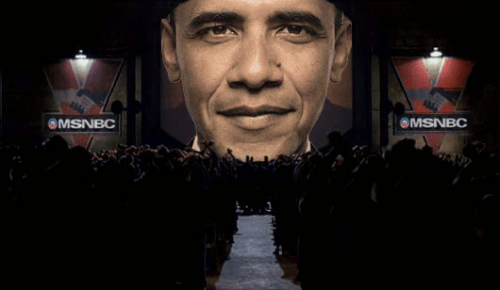
Idiot Joy Showland

This is why I hate intellectuals

Boston: the terrorism of banality

The State fixes, after the intervention, the term {X,{ex}} as the canonical form of the Event. What is at stake is clearly a Two (the site counted as one, and a multiple formed into one), but the problem is that between these two terms there is no relation.
Alain Badiou, Being and Event

 SPK- Turn Social Awkwardness Into A Weapon!

Lu Lingzi died on Monday. I didn’t know Lu Lingzi. She was a person: she had her passions and dreams and aspirations, and she had her neuroses as well, her buried furies, her paranoias. She was a human being, a speck of brightness in a dark and infinite universe, and there were people who loved her for that reason alone. But I didn’t know Lu Lingzi. The New York Times knew her, though. It knew her in the same way it knows just about every single person on this earth. Its giant roving eye found her, and fixed her, and then some hack wrote this:

Ms. Lu’s own final message on Weibo, the Chinese microblogging service, was posted on Monday and showed a picture of a bowl of Chinese fried bread, and said “My wonderful breakfast.” Ms. Lu, shown on her Weibo page as a petite woman with thick, shoulder-length hair, said there that she enjoyed food, music and finance.

Here is the summation of two thousand years of humanity’s struggle to distil Truth from mere events, the end-product of a line of heroes from Herodotus to Woodward and Bernstein. The final message: Woman Dead, Enjoyed Food. If you want to sell newspapers you have to make people care, and if you want to make people care about a tragedy in the real world you have to narrativise it, you have to give it the form of a fiction. You have to reduce human beings to atoms of emotion. Nobody is safe, it can happen to any of us. Sam Kriss was knocked down by a car while stumbling drunkenly across a road; in his last message to a grief-stricken planet he ironically retweeted the rapper Lil B talking about his tiny dick.

The crucial difference between what happened to Lu Lingzi and my hypothetical encounter with a Peugeot 305 at four in the morning is that, unlike me, Lu Lingzi died in the Boston marathon bombing. The terrorist bomb isn’t so much an object as a series of transformations: chemical substances into heat and light, banality into significance, life into death – with the last of these being only a corollary to the second. Death is tragic, but that’s almost subsidiary to the real horror of the bomb: a hand reaches out from the depths of the earth and assigns an aleatory significance, the Event intrudes on Being with the full force of its inexplicable violence. What we’re seeing is not the banality of terrorism but the latent terror of the banal. One day you’re a happily anonymous citizen; the next your neighbourhood is under undeclared martial law and History bursts your door open and rushes through your home, incarnated in a bunch of armed police wearing camouflage gear.

In the days after the bombing, as the investigation floundered with no group or individual claiming responsibility, I started to believe that the culprits would never be found. The attack would forever be an inexplicable anti-ontological rupture, a thorn pricking the side of a dying empire, a riddle never to be solved. In a way, I think that’s still true. In the absence of any concrete evidence, the observing masses played their favourite game: speculation. Maybe it was the Iranians, maybe North Korea, maybe a false flag attack by the Obama administration, whatever fits in best with the speculator’s prejudices. I’m not proud of it, but I played along too: it couldn’t be Islamists, I reasoned; any kid dumb enough to start talking about Jihad – and a quite a few who had learning difficulties or just needed money – had already been scooped up by some FBI sting operation. It was clearly a lone right-wing Bircher weirdo, a Tea Partier, a conspiracy theorist, holed up in his basement trying to kickstart the Rapture.

I was wrong. For a start, there were two of them. The suspects, Tamerlan and Dzhokhar Tsarnaev, were not only Caucasian but had been born among the Caucasus mountains, they had US citizenship and had lived in America for most of their lives, they had apparently acted independently of any larger organisation, they seemed to have some sympathy for 9/11 and Sandy Hook conspiracy theories – but at the same time they were Muslims from a region with a long history of armed Islamic radicalism. They sat at the swirling nexus of every theory and prejudice. Neither one thing nor the other, not both, not neither. Multiple zones of indistinction, tangled, whorled, their univocity inscribed only on the Plane of Ignorance. Hence the spectacle of newspaper pundits patiently explaining to their readers what a Chechnya is, and Twitter users assuming that war with Russia was imminent or demanding a nuclear strike on Czechoslovakia.

And yet the culprits still haven’t been found in any full sense. We have an answer, of sorts, but no Answer, nothing that can account for the shocking rupture of the attack. It’s impossible to draw a line of causality from whatever was inside the heads of the Tsarnaevs to what happened near the finish line of the Boston marathon. Where there should have been something conclusive there was only banality, banality assuming the horrific proportions of significance. On the day of the marathon bombing, Dzhokhar Tsarnaev (under the handle @J_tsar) retweeted a novelty account for an Internet meme based on a TV advert:

Most Interesting Man @_DosEquisMan_
He once arm wrestled the Incredible Hulk. The loser had to paint himself green.

The day before he planted two bombs that killed three people, including an eight year old boy, he observed:

And here I thought nemo’s dad was about to get it with dory but apparently this man turned into a female #thatscray

Two days after the attack, he told the world:

I’m a stress free kind of guy

Something’s not right here, nothing adds up. This isn’t to say that there’s been a coverup and the Tsarnaevs are innocent of the bombing (although it should be kept in mind that they are, after all, only suspects). It’s something deeper and stranger, the void at the heart of the online representation of a real person. Dzokhar’s friends consistently voice their disbelief: they knew this guy, he was their boy, they smoked weed with him, he was a chill guy. The racist media is forced to dig deep through his Internet presence to find even a few mentions of going to mosque or faith in God; they parade these in front of us as if that explains anything.

Dzokhar also has a profile on the Russian social media site VKontakte. Since he was identified as a suspect, his page has been bombarded with thousands of messages of fury and hate, sometimes bizarrely undirected:

Ivan Skor
Никому, I’m your mother raped instead of with blacks
two hours ago to Nikomu

If your immediate reaction to this is ‘this looks like a great opportunity to publicise my brand,’ then you could find work at one of the footwear companies that spammed the thread with links to their stores. Really, I think they missed a trick there; they could have built up an entire campaign around it. A marathon, a terrorist attack, a culture of martyrdom: all the ingredients for a perfect ad strategy. Imagine it: under a darkening sky a group of figures are shown running heroically along a track. At the finish line, an immense conflagration, the fiery extinction of thought and reason and humanity. One man pulls ahead of the pack, his arms spread wide, the faint glow of a halo just visible over his head, ready to embrace the inferno. What’s given him this sudden burst of speed? His millennial passion, certainly, but that’s not all. The camera pans down, and we discover the truth: he’s wearing the retailer’s shoes. Fade to black. And then, in shining white letters, the tagline: Dare To Go Further.

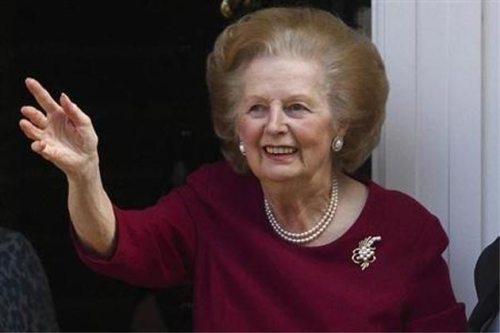
Scenes from the Thatcher funeral

thatcher

What had she done with all the milk? That’s what we should have been asking: what had she done with all the milk? By the time we found out, it was too late.

At first it’s almost imperceptible. Mourners shuffle past the open coffin as it lies in state. She looks different, they think, but it’s hard to say exactly how. It’s true, she seems a little fuller in the face than one would expect, plumper, like an over-ripe fruit – but at the same time white, deathly white.

Within a few hours its hard to ignore. Something horrible is happening to the former Prime Minster. She’s grotesquely fat, and visibly growing. As Ed Miliband delivers a heartfelt speech his already clammy skin begins to drip with sweat; Nick Clegg, in the front row, collapses into Cameron’s lap. A sour aroma rises. One of the Queen’s Bodyguards of the Yeomen of the Guard standing guard over the coffin starts to vomit uncontrollably; soon the other three are unable to hold themselves back either. Baroness Thatcher swells and pales until her body barely fits in the coffin. The imperious hawk’s beak of a nose sinks into the bloating flesh. She looks like an enormous blancmange; her skin seems like it’s about to burst. Then it does. The first fissure tears its way through what was once her forehead. A high jet of milk streams out into the vaunted ceiling of Westminster Hall; the news cameras follow the triumphant ejaculation as it arcs up and descends, splattering a group of Young Conservatives. The coffin shatters. A tidal wave of milk rushes through the hall. The stench of rot and acid is incomparable: hundreds of thousands of gallons of milk, hidden away in some dark warm recess of her body for forty-three years. As the mourners drown in the sea of putrid milk some are dragged down into its depths by heavy caesin blobs. Others are not so lucky: the smaller curds swarm and envelop them, leaving nothing but whitened bones and shreds of corduroy. The massacre completed, they swim together, and begin to converge…

Thatcher bursts through the roof of the Palace of Westminster. She is one hundred feet tall and brutally nude, her limp dugs shimmering with the semitransparency of milk. Somewhere, buried deep in her monstrous frame, are dark reddish shadows: supported on rusting bones formed from the frames of long-dead factories, the Iron Lady strides out into the Thames, and howls. From down the river in Canary Wharf a howl rings out in reply.

We thought she was dead, when in fact Margaret Thatcher was never alive. Not as we knew her, at least. If she ever existed, the grocer’s daughter from Grantham died a long time ago, and something else, scuttling like a hermit crab, moved into her body. She was animated by the false life of things, the undead hum of markets and brands and commodities, the image of life that opposes life itself at every turn. How could such a creature die? When her heart shuddered to a halt, it only freed the Thing inside from its fleshy prison.

Everything makes sense now. Why did she fight so hard to close down the mines? They were digging too deep, burrowing too far into the cold heart of the earth; there was something down there that she didn’t want them to find. Why did she introduce a poll tax? Because her alien sentience could never comprehend any differentiation within humanity. Why did she send young men to die for the Malvinas? Because without access to the magnetic flux streaming from both poles of the Earth, her plans to gain immortality would be doomed to fail.

We stand, quivering, waiting for the monster that was once Margaret to smash our cities, pound our homes to splinters, rip up our infrastructure, bat away our fighter jets like flies, tear apart our society, leave us cold, enslaved, and alone. It doesn’t, though. It just stands there, ankle-deep in the river, the crooked slit of a grin stamped on its milky mouth. Its work has already been done.

Why George W Bush is the greatest living painter

Political violence is the continuation of art by other means. Wherever there are shock troops marching in the streets or big pyres of burning books or the sounds of mysterious gunfire near the parliament building at night, you can bet that behind it all flutters the soul of a sensitive young boy who always wanted to be an artist. Brutishness is easy; anyone can commit an atrocity in the right conditions. Violence requires a highly rarefied aesthetic sensibility.

Painters carry out wars of aggression. They’re in love with the image of things. Poets go for internal ethnic cleansing. The word must be properly spoken. Prose writers like revolutionary terror. The text is radically open. There have been fewer dictators from the other arts, but we could extrapolate. Photographers make good use of death squads; the gaze and the judgement are united in the click of a shutter. Sculptors are big on mass internment; the body is always already buried in the rock. Playwrights tend towards bureaucracy, musicians to exemplary massacre, film-makers to redistributive looting. Lenin and Mussolini wrote prose. Stalin, Mao and Ho Chi Minh were poets. Saddam Hussein wrote poetry alongside his anonymous novels. Churchill was a painter. Hitler was a painter, but he penned a few verses as well. George W Bush is a painter.

 This is the void. A line of detainees goes in, shackled, shuffling along in orange jumpsuits. Paintings of dogs come out. Nobody knows exactly what happens inside, or if they do, they don’t say.

George W Bush has produced fifty paintings of dogs. For every drone strike he ordered, he has produced one painting of a dog. For every round of golf he played while in the White House, he has produced two paintings of a dog. For every million Americans left unemployed at the end of his administration, he has produced five paintings of a dog. George W Bush has produced one painting of a dog for every thirteen US soldiers killed in Afghanistan during his Presidency, one painting of a dog for every hundred Palestinians killed by the IDF, and one painting of a dog for every two thousand, two hundred and thirty-seven civilians killed in Iraq since the invasion. Bush’s art teacher told reporters that he would go down in history as a great artist. I think she’s right.

There have been a couple of critical pieces on Bush’s paintings, and they all ask the same question: what do these paintings tell us about George W Bush’s inner life, or his psychology, or his presidency? They’ve all got it arse-backwards. If you follow that line you’ll only ever end up with trite reductive analogies. The running water represents Hurricane Katrina, or Bush’s need to atone for his crimes, or his fear of death; it’s a vaguely amusing parlour game, but not much more. If you want to know the truth, there’s no point looking at Bush’s self-portraits. You have to look at his paintings of dogs. The real question is: what do George W Bush’s dog paintings tell us about contemporary society? What do George W Bush’s dog paintings tell us about violence? What do George W Bush’s dog paintings tell us about art?

Imagine a creature from another world, something impossibly old and infinitely curious. Drifting between silent stars, she picks up a single stray transmission from an unknown planet in an uncharted backwater of the Milky Way. A picture of a dog. If our alien has eyes to see, she’ll be able to extrapolate our entire world from George W Bush’s painting of a bichon frisé on a blue background. A hierarchical class society looks out from its sad round eyes, capital accumulation can be inferred from the downwards tilt of its mouth, its outstretched paws tell you everything you need to know about the long slow decline of the nation-state. Most of all, though, our history is inscribed in the featureless blue plane on which the dog reclines. In fact, it’s swarming with tiny figures: child miners coughing dust, factory workers plunging from rooftops, women with acid scars bursting across their faces, people who wake up shaking from the bombs going off in their dreams, people who wake up shaking from the bombs going off in their ears. A society capable of producing that shade of blue leaves a lot of bodies in its wake.

Spend enough time looking at George W Bush’s paintings of dogs and it all starts to make sense. The war in Iraq was little more than the geopolitical expression of kitschy sentimentality. Imperialist universalism is the logic of the dog painting extended to nations and peoples. Radical evil is the weaponisation of bad taste. We’ll be greeted as liberators: of course we will, we love our dogs. History is on our side: of course it is, we like nice things. Our war will usher in a new age of peace and stability in the region: of course it will, we leave bright colours in our wake. George W Bush’s paintings of dogs represent a new height in Western society’s struggle to decouple art from violence. (This is why his nude self-portraits are all in bathrooms: only in the cleansing ritual is nudity non-erotic, and eroticism is after all only another form of violence.) It’s an impossible task. Violence and art are inseparable; the more you try to scrub the canvas clean of everything not clean and pleasant, the more hideous it becomes, the heavier the rain of bombs.

That’s why George W Bush is our greatest living painter. Nothing expresses more clearly the horror of existence than the most hated man in the world’s loving portrait of his dog. More than any gloomy conceptualist, Bush gives us the truth, the undisguised omnicidal violence of the nice and friendly. His paintings of dogs point towards the one subject all other contemporary art shies away from: the final extinction of the human race. Bright eyes and wagging tails, cities in ruins and skies scorched black. Art kills.

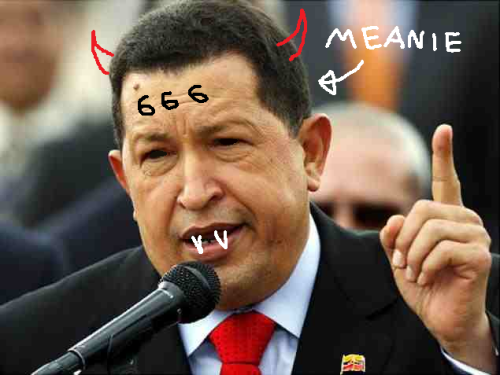
Every Hugo Chávez obituary in the Western press

Darth Hugo Destruktor Chávez, the outspoken and inflammatory Venezuelan leader, died yesterday in Caracas when the Invisible Hand of the free market reached down his throat and shook loose his gall bladder. He is survived by his four children and his millions-strong army of terrifying cyborg drones.

To his supporters and those implanted with his mind-controlling Chavismo-chips, Chávez was Emmanuel, the reborn Christ. To his detractors, he was Double Hitler. As ever, the truth is somewhere in the middle – while he was certainly born, he was not Christ; and while there was only one of him, he was most definitely Hitler.

Hugo Chávez exploded onto the world stage in September of 2005, when he took the stand at the United Nations General Assembly to complain at length about the air conditioning. However, he first came to prominence in the hitherto-unknown land of Venezuela in 1992. In that year, he and a band of avaricious raiders attempted to steal the Seer’s Eye, an enormous sapphire kept in the vaults of the Federal Legislative Palace. Thankfully, his plot was foiled, and the stone was destroyed before it could be used as a component in Chávez’s Ionising Doom Cannon, a laser weapon that would have been capable of extinguishing the Sun.

However, that which is dead cannot die, and Chávez escaped the dungeon dimension he was cast into to come to power in 1998. While not going so far as to actually do anything remotely dictatorial, Chávez was far from a democratic leader. Instead of competing honestly in elections, he provided services and raised the standard of living for the people of Venezuela, ensuring their gratitude and thereby gaining an unfair advantage at the polls. Much of the funds for this insidious election tactic of ‘making things better’ were rerouted from the newly nationalised oilfields: through this wanton kleptocracy, billions of petrodollars were withheld from deserving rich white people. Under his rule, the murder rate soared; a tend analysts have linked to his predilection for riding round Caracas slums at night and picking off pedestrians with a hunting rifle.

Absolutely nothing happened in April of 2002.

On the international stage, too, Chávez made some severe missteps. From his innumerable lazy Sunday morning lie-ins with Mahmoud Ahmedinejad, in which he and the tie-hating weirdo spent hours curled up together on the sofa watching reruns of Friends, to his decision to travel back in time to 1939 and sign the Molotov-Ribbentrop Pact on behalf of both nations, Chávez maintained a policy of automatic support for tyrants, dictators, traffic wardens, accordion players, queue-jumpers, and other evildoers.

For all the vaguely defined suffering that I’ll assume he’s caused, Chávez’s death opens up new opportunities for Latin America. Freed from his yoke, leaders across the continent are now free to abandon his schemes for mutual assistance and non-usurious development lending. Only a broad network of grassroots citizen activists stands between the Venezuelan people and the rapprochement with financial imperialism that they definitely want, even if they don’t know it yet.

I’ve always thought that a good way to test the sincerity of anyone who claims to be on the Left is to find out their attitude to Hugo Chávez. Those who try to disavow him tend to be, in general, useless: they want a pure, ideal socialism, not socialism as a real material movement. Chávez wasn’t perfect. In some areas he went too far; in many he didn’t go nearly far enough. Nonetheless the immense good his Bolivarian Revolution has done for the people of Venezuela – and for people across Latin America and the world – is undeniable. What must be remembered, though, is that Hugo Chávez didn’t do any of this alone. His achievements were those of every doctor, teacher, worker, farmer and organiser who worked to improve the lives of those around them. The social movements he helped build and connect will long survive him. Descanse en paz. La lucha sigue.

Future Europe – Ahmet Weshke and the mystery of the falling man

Recently I came across this piece in the Wall Street Journal by the litigation-happy racist Niall Ferguson, a man with a face like an undercooked Jeremy Clarkson and opinions to match. Writing in 2011, he takes it upon himself to paint a picture of how Europe will look in ten years time. It’s an awful article. Sometimes the sheer stupidity of his predictions is gobsmacking: war between Jordan and Israel – really? The reintroduction of Austrian nobiliary particles – really? George Osborne, the ‘Iron Chancellor’ – really? Of course it all plays into his ideological agenda, but that could be forgiveable if he’d simply done it better. Ferguson’s worst error is one of genre. True to form, he takes a smugly objective overview of the political developments over the course of his decade, without ever stopping to think how life in Future Europe might actually be lived. It’s inherently inaccurate. The Europe of the mid-21st Century won’t look a thing like Ferguson’s prediction. It won’t be a calm appraisal. It’ll be pulp fiction.
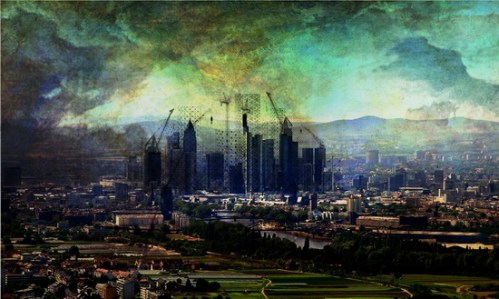
Ahmet Weschke woke up in a bare room stinking of liquor fumes and the prostitute’s perfume. His Interface was still hissing silently in one corner of the room. Onscreen, the face of a newsreader drifted like a spectre above a roiling sea of static. He chucked a shoe at it; the image stabilised. Ahmet dressed himself hurriedly and wolfed down a breakfast consisting of three slices of bleached-white bread as he watched the morning headlines. It was the same old shit. A bunch of fanatics had declared another Islamic Emirate in a valley somewhere in the massif central. This was happening every couple of months now. Some dumb kids straight out of a banlieue madrassa would drive into a rural region and burst into the farmhouse of some rotund Gallic swine-farmer; they’d shoot him and maybe a couple of the local villagers they found enjoying charcuterie or dressing immodestly, then raise the black flag of jihad and wait for the European Army paratroopers to come and dispatch them as quickly as possible to Paradise. It made sense, really; better a nice little burst of rape and plunder followed by a swift death than decades tramping around a gloomy concrete suburb. The other items were just as predictable: more pictures of emaciated English refugees milling around the Scottish border, more helicopter footage of the interminable riots that were destroying Los Angeles as comprehensively as an earthquake, more grim reports of mounting Chinese casualties in Kazakhstan, more dull analysis of the land deal with the Saudi Empire as it collapsed into an acrimonious squabble. Enough.

As he hurried down Holzwegstrasse to the S-Bahn station, Ahmet tried several times to adjust his tie before giving up and stuffing it in his pocket. The train was packed with perspiring commuters; the air inside was humid with sweat and spittle. More people clung to the handles on the sides and the roof – doing so wasn’t strictly legal, of course, but after the number of bodies on the lines had started to seriously impact the network’s efficiency the corporation running the transit system had decided to put handles on anyway. Everyone on the train was Goggled; their irises were pale, their gazes immobile. The only people who didn’t wear Goggles were the religious fanatics, the most impoverished of the guest workers, and the police. Officers of the European Department of Civil Order were forbidden from using AR: only the police still believed in the real world.

Commissioner Traugott was waiting at his desk when Ahmet arrived.
“You’re late,” she said. “And you smell of booze.”
“I didn’t have time to shower. You’d rather I was even later?”
“If you want to look like a slob, it’s up to you. We’ve got a case. Bankenviertel. Apparent suicide. Suspicious.”
“What, has Denmark gone bust again? Come on, Angela. I’m a good detective. I don’t need another fucking depressed banker.”
“It’s not quite that. You’ll see.”

The body was naked and twisted, dashed with fragments of concrete, one knee bent backwards, one elbow embedded in a shattered paving stone. From one side of its head a tongue lapped against the pavement. The other side had exploded into a constellation of blood, brain and skull. The index finger of his left hand had been cut off. A clean straight wound. Above the body rose the sheer glass infinity of the EuroBank Tower, painfully reflecting the sun’s fury. Somewhere up near the eightieth floor, one window-pane was broken. Ahmet was in a foul mood. He’d expected his EDCO card to get him whisked straight through the checkpoint into Bankenviertel; instead the Israeli private security guards had made him wait for ten minutes by the reinforced wall that surrounded the business district while they checked his credentials. At least the civilians in line had been able to entertain themselves with their Goggles. Ahmet had counted concrete slabs instead.
“Let me guess,” he said. “Cleaner? Fell in the middle of the night?”
Officer Hans, looking slightly ridiculous in his blue-and-gold uniform, gaped at him. “Just because he’s black doesn’t mean he’s a menial worker,” he said.
“It’s not because he’s black,” said Ahmet. “Look at his teeth. Discoloured, one premolar missing. This guy isn’t a banker. And the scar across his thigh, there. Looks like barbed wire. So, probably a refugee, possibly an illegal. And the inflammations, over… there. Venereal disease. Am I right?”
“He’s not a banker. We did biometrics. He’s registered. Joseph Kutenge. Came over in ’31 with all the rest. You know, when the Congo basin went dry… but here’s the thing.”
“What?”
“OK, first of all, he wasn’t wearing Goggles.”
“So what? Not everyone uses augmented reality.”
“But it’s unusual, isn’t it? Shit, even my mother wears them, and she remembers the DDR.”
Ahmet wondered how many years Hans’ mother had before she’d have to enter the euthanasia process. Maybe she’d been saving up and could afford the monthly life-extension payments. He hoped so. He liked the kid, even if he’d never let him know it. “What else?” he said.
“Kutenge works in a warehouse outside of Offenbach. Menial labour, like you said. There’s no way he’d have a Bankenviertel pass.”
Ahmet glanced at the high concrete wall rising above some of the lower buildings near the edge of the business district, shimmering in the day’s heat. “Then how the fuck did he get in?”
Hans shrugged. “That’s the question.”

~

Kutenge’s body was being loaded into the police van, draped in an antiseptic-looking white sheet. The forensics team had been and gone, sweeping their Portals over the corpse, crouched over the dead man like a flock of vultures. Back at HQ, a computerised visualisation of the crime scene would be built and pored over: impact velocity would be calculated, a crowd of skinny analysts would try to determine whether Kutenge had fallen from the window or been pushed. Ahmet didn’t trust the analysts: they got results, but it wasn’t real police work.
He drew Hans to one side. “I want you to go to this guy’s house,” he said. “Talk to his wife. Give me more to work with than Brussels statistics. I’ll have a look round the EuroBank Tower.”
“Are you kidding? I can’t go down there, boss.”
“Why not?”
“Kutenge lived in the Offenbach Camp. Look at me. I look like a fucking Hitlerjugend. In uniform, as well. I wouldn’t last five minutes.”
This was true. Police never investigated any crimes in the refugee camps. If the militants there grew too rowdy, or if there was a particularly shocking massacre, a European Army unit would storm in and dispense some crude justice; enough to shut the liberal bloggers up for a couple of weeks, at least.
“Anyway,” Hans continued, “Traugott said she wants Detective Haufman to talk to the people inside.”
“She fucking didn’t. Why’d she do that?”
Hans flinched. “Look at how you’re dressed, boss.”
Ahmet grunted. “OK,” he said. “I’ll go to Offenbach. You stay here. And if that fucker Haufman tries to enter that building, shoot him.”

Ahmet left his jacket in the car. He undid the top three buttons from his shirt and slicked his hair back a little with spit.
“How Turkish do I look?” he said to the driver.
“You not been in the camps before, sir?”
“When I was younger. And thinner.”
Past the sterile zone of barbed wire and tarmac that surrounded it, Offenbach Camp was a mess. Washing lines hung between plastic tents and corrugated-iron shacks. Suspicious eyes glanced out from dark alleyways, sometimes accompanied by the oily gleam of gunmetal. Women stirred oil-drums filled with soup behind signs in French or Arabic or English. Ahmet tried not to peer too ostentatiously at the map in his hand. If he could wear Goggles this would have been so much easier; as it was he had to navigate the camp by instinct. Kutenge’s house was near the centre, a tiny bungalow built from exposed cinderblocks with glassless windows. Ahmet recognised the symbol of the United Nations stamped onto one of the concrete pillars: this place was old. He knocked on the door.
It was opened by a tall woman in a faded Vietnam World Cup 2030 t-shirt and grubby shorts. “Que voulez-vous?” she said.
“Mrs Kutenge? My name’s Ahmet Weschke. I’m with the police. Do you think I could come in?”
She frowned. “Is this about Joseph? I already know.”
“I just want to ask some questions about him. So we can find out what happened.”
She looked puzzled, but let him in. Inside there was a mattress on the floor, a plastic table with some rickety chairs, and a stove. A muted Interface was propped up against one wall; onscreen a minister paced up and down a stage, yelling silent hosannas. “There is nothing to ask. Joseph worked in the warehouse. He went to work every day and then he came home. He went to church. He did not drink. He did not gamble. There is nothing to ask.”
Ahmet thought of the sores around the dead man’s genitals, but he didn’t say anything. “Do you know what he was doing in Frankfurt? How he got in?”
“No. He didn’t come home last night. And then today I am told he is dead.”
“You don’t seem very upset.”
“Last year my two daughters were shot here. In the camp. I have cried enough. I have cried all my tears.” Her expression soured. “And where were you when my children were killed? When a child dies in the camp you are nowhere. But when someone dies so that rich men have to look at his body, then you care about him. It is sick. It is sick!” She stamped her foot, but her anger seemed somehow feigned. The woman’s irises were a misty grey. Who else could be looking out through those eyes?

~

Somehow, Ahmet found himself at the back of the room as Haufman explained his team’s findings. A hologram of Kutenge’s body spun slowly above his desk. “The lack of injuries associated with glass impact is consistent with our working hypothesis,” Haufman said. “It appears Kutenge first broke the window, then jumped through. We consider it statistically unlikely that he was pushed. Motivations are unclear. A political statement, perhaps.”
Traugott tapped her fingers on the table. “But how did he get in?”
“The Bankenviertel Group have kindly agreed to release their CCTV records, which we’re still analysing. But Kutenge was a refugee. He arrived here at Marseilles. He certainly has plenty of experience in climbing barriers.”
“Whose window was it?” said Ahmed.
“I’m sorry?”
“Whose window was it?”
Haufman sighed. “The office belonged to Jeremy Smythe-Braistwick.”
“The CFO? The one who’s trying to sell half of Europe to the Arabs?”
“Yes, the CFO of EuroBank. Herr Smythe-Braistwick is co-operating fully with the investigation, and he’s asked us to pass on his sincere condolences to Kutenge’s survivors.”
Afterwards, Ahmet was approached by Officer Hans. “You think Smythe-Braistwick killed him, don’t you?”
“I don’t think anything, Hans. I collect all the facts I can, until I know.”
“Sure, boss. But you think he killed him, don’t you?”
“I think someone was leaning on Kutenge’s wife. When I spoke to her she was Goggled. And I know there’s no way he could have climbed that wall. Thousands of people got out of the camps in Marseilles, they were falling apart. Nobody gets into Bankenviertel if they’re not invited. Frankfurt could be nuked and the people in there would be selling short on radioactive debris the next day.”
“So someone brought him in?”
“I’m not saying it was Smythe-Braistwick. Not necessarily. But everyone knows the bankers get up to some pretty kinky shit after office hours. So let’s say there’s a couple of them, high-level board members, cruising round Offenbach as the warehouse closes. They see some poor black refugee they like the look of. They drive him into Bankenviertel, bring him up the tower, do whatever the fuck they do, then credit him a couple of Euros and send him back to the camp. They do this a couple of times, maybe. But this time something goes wrong. They push him too far, they get too sadistic. That missing finger… So he complains, or resists, and in the struggle, he gets flung out the window…”
“Haufman said the window was broken first.”
“Haufman’s a moron. OK. I’m going to take a shower, and then I’m going to call on Herr Smythe-Braistwick. I want you to go through the CCTV from Offenbach. See what Kutenge did when he left work. See if he got into any cars.”

The elevator in the EuroBank Tower was bigger than Ahmet’s apartment. He stared at himself in the mirror and flicked a yellow particle from the corner of his eye. Kutenge and Smythe-Braistwick, Smythe-Braistwick and Kutenge. Both refugees, in a sense, except Kutenge had to trek across a continent, riding in some warlord’s pickup across the Sahara and launching himself into the toxic seas of the Mediterranean; he had to escape the Marseilles refugee camp before the Army liquidated it, he had to cross minefields and hide under bushes from drones. Smythe-Braistwick probably just jumped in his helicopter and touched down in Frankfurt while London was still burning.
Ahmet was received in Smythe-Braistwick’s office, a huge, tastefully empty space. The broken window had already been replaced. Smythe-Braistwick – tall and thin with fashionably long hair and an artificial-looking tautness to his face – greeted him from behind his desk. “I must say, Mr – Weschke, is it? I’m a little perplexed by your appearance here. I’ve already spoken to your colleague, not three hours ago.”
“If you’ll permit,” growled Ahmet, “I’d like to follow up on Detective Haufman’s enquiries.”
“By all means. Can I interest you in a drink?”
It was an effort, but Ahmet ignored him. “Have you ever been to Offenbach, Herr Smythe-Braistwick?”
“Jeremy, please. And occasionally. But of course I don’t like to go too near to the camp.”
“So if I were to search the cameras there for your numberplate, or your face, over the last week, I wouldn’t find anything?”
“I highly doubt that. Why do you ask?”
“You weren’t in Offenbach at any point yesterday.”
“Yesterday, Mr Weschke, I was in here until ten in the evening, meeting with my associates in Riyadh. At ten o’clock I was driven to my home in Bad Homburg. My car passed the Hessenring checkpoint at about, oh, ten forty-five. Please do check. You’ll find everything I say to be true.”
“And you locked your office after you left?”
“The door here has biometric security. It can only be opened by myself or my secretary.”
“Then how did Kutenge get in?”
“I don’t know, Mr Weschke. I presumed that answering that question was your job rather than mine.”
“Mr Kutenge was Congolese. You have something of a history with that part of the world, don’t you, Jeremy?”
“I assume you’re talking about ’28. It’s so tiresome. I didn’t cause the famine. Failed government policies caused the famine. Kleptocrats and demagogues caused the famine. I traded commodity futures. At the same time I was selling short on Icelandic wheat. There was no famine in Iceland in 2028.”
“A lot of people still blame you, though.”
“And I’m sure they have every right to think what they want. As I told your colleague, I believe Mr Kutenge’s suicide was a kind of political protest. Now, if you’ll excuse me, I have work to attend to.”

Hans was beaming when Ahmet returned. “You were right, boss,” he said. “OK. Firstly, Kutenge was credited four hundred thousand Euros yesterday. Anonymous transfer, so we’d need a subpoena. But then I looked at the footage. Kutenge left the warehouse at six thirty last night. The other workers all take the bus back to the camp. Not Kutenge. He walks up Seibenstrasse, stands on a corner – then look.” He pulled up an Interface. “A black Mercedes pulls up. Kutenge gets in.” Onscreen, the car pulled away, past the rows of low corrugated-iron buildings. Its windows were tinted.
“Where’s it going?” said Ahmet.
“I followed it until it crossed the river. Then after Kaiserstrasse the cameras cut out. Power failure, apparently. When they come back on again the car’s gone. I don’t like this, boss. It goes deep.”
“Did you run a trace on the car?”
“Of course I did. But you don’t need me to tell you who it belonged to.”

He was waiting when Smythe-Braistwick came out. The man was striding on his spindly legs out from the glass canopy of the EuroBank Tower, his long coat flapping around him in the night wind, looking like a Victorian vampire who’d discovered cocaine and exfoliating skin cream. Ahmet wanted to pounce on him, beat his skull into the concrete. He wanted to kill the fucker for having the nerve to think that he could murder someone, even a resident of the camps, and get away with it. Instead he walked out in front of him and presented his EDCO card, all proper and correct, before slipping on the handcuffs and making the famous announcement enforced by the European Court of Individual Rights.
“Herr Smythe-Braistwick,” he said. “Under paragraph eight, subsection fourteen of the protocol on the accused, I hereby inform you that you are suspended of those rights delineated in lines thirteen to eighty-four inclusive and line one hundred and twenty-eight in chapter seven of the declaration of the rights of the citizen; also that you are hereby included under the definition of an ‘arestee’ as delineated under paragraph three of the European Department of Civil Order working charter, with your legal responsibilities being given in paragraphs four through nine…”

~

“You’re off the case, Weschke,” said Commissioner Traugott as Smythe-Braistwick left the building. “In fact, as of now, you’re suspended. We know exactly where he was all last night. You arrested him without filing a report or consulting me, without a shred of actionable evidence. What on Earth did you think you were doing?”
“My job,” said Ahmet.
“Well, it’s not your job any longer. Herr Smythe-Braistwick’s people were kind enough to send us their own dossier on you. Whores, Ahmet? In your position? It’s unconscionable.”
“You’re not giving the case to Haufman.”
“As it happens, no. A communiqué from Brussels came in. The Kutenge case will be handled by the internal banking regulator.”
“You’re fucking kidding.”
“Bankenviertel is their jurisdiction. Go home, Ahmet. Leave your gun. The tribunal’s convening next week.”

There was nothing to do, except to buy a bottle of whiskey and hope that when he woke up again his gun would once again be on his bedside table, his EDCO card would still be valid, and the Kutenge case would recede into a bad dream. The Interface was still running when Ahmet returned to his apartment, still tuned to the rolling news stream. A row of EA troopers were standing in front of an angry crowd throwing rocks and hoisting placards. Nous sommes tous Joseph Kutenge. Another camp, another mob; this one didn’t even seem to be in Germany. They’d built an effigy of Smythe-Braistwick and were busy tearing it apart. Burning European flags coughed black smoke into the sky. The soldiers were grinning. They’d love nothing more than to be able to empty a clip into that ungrateful mob, and soon enough, they’d get the order. There’d be another massacre, and it was his fault. Ahmet switched to an entertainment stream. A new gameshow: minor celebrities tried to have sex on stage while the audience shouted antaphrodisiac words at them. “Brezhnev and Honecker kissing!” shouted one. “Unemployment is at sixty percent in Portugal!” yelled another. A woman stood up. “Joseph Kutenge!” That got a round of applause.

Ahmet was woken the next morning by a knock on his door. He shambled over. It was Haufman.
“The fuck do you want?” he said. “Come to gloat?”
“No,” said Haufman. “I’ve come to help.”
“You can help by fucking off.”
“Listen to me, Ahmet. I know we’ve had our differences, but you need to listen. You were right. You were right about Smythe-Braistwick. He knew Kutenge.”
“Have you told Traugott?”
“You’re not getting reinstated. She’s right, you shouldn’t have arrested him. But now you’re off the case you can help me find out the truth.”
“I thought it’d been turned over to the internal regulators.”
“It has. Can I come in?”
Ahmet let Haufman in and flopped down on his bed. “Talk,” he said.
“Hans showed me the footage from the warehouse near Offenbach. Kutenge’s been getting in that black Mercedes, every other week, for six months now. But the night he died, the data’s gone haywire, the cameras keep cutting out. Someone’s been trying to mask his movements. Not very well, by the looks of it. So I looked at the records for Smythe-Braistwick, and it’s a mess. He was negotiating the Saudi land deal in his office and attending a board meeting and taking a piss all at the same time.”
“What does any of this have to with me?”
“You’re off the force, aren’t you? I can’t do anything now. None of us can. But you’re just a private citizen. You can fly out and confront him about it.”
“Fly out?”
“Smythe-Braistwick left Frankfurt this morning. He’s gone to Athens.”
“You want me to go to Greece? Unarmed? Are you crazy?”
“I’ve already booked your flight. You want to solve this case, don’t you? You want your job back, don’t you?”
He did. More than anything in the world.

~

Bullet-holes still ran along the walls of Athens International Airport. Outside, the complex was surrounded by three lines of European Army tanks. From his seat in the plane, Ahmet had seen the deep scars running through the city where all the buildings under the flight lines had been razed. Ever since the Acropolis had been dynamited, Athens was only useful for its airport, ferrying tourists in armoured cars to one of the privately-owned Greek islands. Those islands still above sea level were meant to be nice: little rustic havens, full of charming goat-herders smiling for the Chinese tourists. Ahmet had never been, of course.
Haufman had given him an itinerary. Ahmet squinted at it through his hangover. Flying had never agreed with him. Right about now Smythe-Braithwick would be lunching with Prince Faisal in the green zone around Syntagma Square, near the parliament building where what remained of the Greek government tried to pretend that their entire country wasn’t a wholly owned subsidiary of EuroBank.
A bus pulled up in front of the concourse. “Zone one!” the driver shouted. The machine-gunner on the roof stared into the middle distance.
As they drove along the fortified expressway the odd Molotov cocktail would smash against the reinforced windows. Then the machine-gunner would fire a few quick bursts into the buildings on either side. Ahmet had planned to sleep on the journey; that clearly wouldn’t be happening.

He caught Smythe-Braistewick just as his lunch was finishing. The banker had shaken hands with a man in a keffiyeh outside the restaurant. Prince Faisal stepped into a waiting car and was sped off. As soon as Smythe-Braistwick was starting to take his loping walk back to the Hotel Grande Bretagne, Ahmet leapt at him, pinning him against a wall. “Tell me what happened,” he said.
His victim squirmed. “Mr Weschke? I was assured you’d been relieved of your duties.”
“I have. I’m just a private citizen here, same as you. And you’re going to tell me everything.”
“This is absurd. Commissioner Traugott will hear of this, I can assure you.”
“Look around you, Jeremy. You’re not in Frankfurt any more. It might be pretty quiet here, but I reckon I could march you just down the road and see how you fare outside the green zone. Have you ever had to fight? I have. I’ll admit, I was never top of my class in combat exercises, but I reckon I could hold my own. How about you? You’d better start talking. You’d better start telling me the truth.”
Smythe-Braistwick gulped. “The truth?”
“I know you killed Kutenge.”
“I didn’t kill him! You idiot. You want the truth? I loved him.”
The words almost knocked Ahmet off his feet. “You what?”
“I loved him. Oh, but he had his wife, I don’t know how he felt, I don’t… but he was so strong. He was so unlike anyone I’d ever met. I’d never hurt him. Never.”
“You loved him? You loved him and you let him live in the camp?”
“I tried to reason with him, I did. I offered him an apartment in Frankfurt. He refused. He told me he wasn’t a prostitute. He was so proud…”
“You lied to us.”
“Of course I did. As you said, he lived in the camps. He lived behind his concrete walls, and I lived behind mine. You think I could just say that I was in love with a refugee? I’d be ruined. We’re not supposed to cross those walls, Mr Weschke.”
“You gave him the key to your office.”
“I registered his fingerprints. And he killed himself. I know there are… cultural differences around our kind of love, but I never expected…” Smythe-Braistwick looked as if he was about to cry. Ahmet stepped back from him. The man’s face flushed red. “And don’t you think I’ve had quite enough hurt without you following me across Europe to say that I murdered him? Are you satisfied now?”

Ahmet’s flight back to Frankfurt wasn’t until the next morning. He took a room in an anonymously boxy hotel in the airport complex. All the hotel Interfaces were in use, so he bought a set of disposable Goggles and took them up to his room. Well, he wasn’t governed by EDCO rules now. As he slipped them over his eyeballs the little discs started to vibrate; it wasn’t painful, but not particularly pleasant either. As they did so everything around him started to change. Objects grew outlines. Colours were brighter, richer, more saturated. A gauzy glow settled over the hotel room. As he looked out of the window, a carpet of grass unfurled over the wasteland of rocky scrub and demolished buildings that surrounded the airport. There were wildflowers dancing in the breeze; here and there a rabbit would leap out of the dewy pasture. This was how most people saw the world: looking at the dead earth and seeing a meadow.
A series of icons faded into view, hanging over the horizon. Ahmet called Haufman in Frankfurt. “Smythe-Braistwick didn’t kill Kutenge,” he told him.
“That can’t be,” said Haufman. “We know he did. We have evidence.”
“We were wrong. They were in love.”
“And lovers never quarrel? You were on the beat once, weren’t you? You’ve seen what people in love can do to each other. Listen. The camps are getting out of hand and the regulators aren’t doing a thing. We need to solve this. And soon.”
“You’re a fucking cretin, Haufman. Don’t you get the feeling someone’s being set up?” Ahmet rubbed his hands in his eyes. One of the Goggles fell out. “Fuck,” he said. As he bent down to retrieve it, a bullet smashed the window above him and buried himself in the hotel wall.
There was a brief silence. “What was that?” said Haufman.
“The fuck do you think? I’m being shot at!”
“OK. Ahmet. I need you to be very calm here.”
“I’m a fucking Buddhist.”
“Did you see who fired at you?”
“Of course not.”
“I need you to look.”
“You’re kidding.”
“I’m receiving your visual feed now. Just glance at him. Just for a second.”
Ahmet slowly raised his head above the broken window. A dark figure, shimmering in the heat, was standing on the roof of another glass building across from the hotel. Through the Goggles he was outlined in white, a rainbow arcing around him. Another shot raised a cloud of feathers from the bed.
“Did you get him?” said Ahmet.
“Hang on. Well, he’s not Athenian. Military rifle. Israeli merc, by the looks of it.”
Two more shots broke the mirror behind him. “So what do I do? I’m not armed, for fuck’s sake.”
“Sit tight, of course. You’re in one of the most heavily guarded places in Europe. He’s got another thirty seconds, then he’ll have to get out of there.”
From behind the hotel came the sounds of helicopter drones.

Ahmet was moved to a high-security room, but he still didn’t get much sleep. He pulled his duvet onto the floor and lay down there, watching pornography on his Goggles. In the airport the next morning he bought a succession of four hundred-Euro coffees while he waited out his flight’s six-hour delay. He cleared Greek airspace as the sun set, twitching, wired as hell.
Just as they were coming in to Frankfurt a pair of Air Force jets descended upon the plane. Suddenly all Goggles were turned off; people craned towards the window to see what was going on. Throughout the city the lights were dead; only the Bankenviertel still glittered behind its concrete cage. The Maim reflected a sea of fire. Across the river, Offenbach was burning. A few fires cracked from the north bank, and explosions rose like budding tulips in the middle of the inferno. The refugees had broken their chains: Joseph Kutenge was being avenged.

~

Ahmet’s flight was diverted to Brussels. He liked it there, and decided to stay for a few days while the fires were put out. Some of the area around the European Quarter was still scarred from the nationalist bombings, but the new complex was pleasant, if you ignored the biometric cameras and remote-controlled guns on every balcony. There were even a few new parks around the Place du Luxembourg. There was no refugee camp in Brussels. Brussels was safe.

Ahmet knew who had killed Joseph Kutenge.
The window had been broken before he’d been thrown out. The CCTV data had been messily scrambled. It was all a trick: a murder expertly disguised as a murder sloppily disguised as a suicide. The footage from Offenbach the night Kutenge died hadn’t been partially redacted: the whole sequence had been slotted in. Someone had picked up Joseph Kutenge that day, but they weren’t in Smythe-Braistwick’s car. Someone much more powerful than any petty European banker.
It was a matter of waiting for them to find him. There wouldn’t be any mercenary snipers in Brussels; the automatic guns were everywhere. So he waited. That took three days. In the meantime, he wandered about the city: he drank whiskey on a bench by the pond in the Parc Léopold, he ate fufu for six hundred Euros in Ixelles, he watched the news. The Kutenge revolt that had broken out across Europe had been put down. Smythe-Braistwick had stepped down, citing personal reasons. The Chinese were announcing a new offensive in Central Asia. The world kept turning.
On the third day a black car pulled up suddenly alongside him and he was bundled in. Sitting across from him was the man he had been waiting for: dark-haired and stern-faced, with a sculpted beard and an antique cane resting across his lap.
“You’re not a hard man to find, Mr Weschke,” he said.
“Nobody is, these days.” Ahmet leant forwards. “It was you, wasn’t it? You killed Kutenge.”
“I suppose I did. If it helps, he was dead long before we threw him from the window. We are not barbaric.”
“You tried to frame Smythe-Braistwick. He was obstructing you. He wouldn’t make concessions.”
“He was very disruptive to the arrangement, yes. But there was one thing I hadn’t counted on.”
“Yeah. Me.”
“That’s correct, in a way. Never did I expect that the EDCO would send someone as staggeringly incompetent as you. You didn’t inform your commissioner before arresting him. You didn’t even wait until the full extent of our interference with the security systems had been uncovered. And your personal… degeneracy even managed to leave the investigation in the hands of a gang of sympathetic banking cronies. You very nearly ruined the entire plan.”
Ahmet didn’t say anything.
Prince Faisal al-Saud laughed. “It doesn’t matter, though. Smythe-Braistwick is out of the picture now, and the land deal can go ahead. On our terms… Nothing to say to that, I see?”
“One thing,” said Ahmet. “Look into my eyes.”
“As I thought.”
“Look into my eyes.”
Faisal stared.
“I know what you think. The police don’t wear Goggles, do they? But I’m not a policeman. Prince Faisal, say hello to Commissioner Traugott of the European Department of Civil Order. Prince Faisal, say hello to the world.”
The prince stared into Ahmet Weschke’s grey eyes and saw, hovering above his own reflection, the glint of cold metal.

~

Two years later, after a lengthy enquiry, the Saudi land deal was ratified. From the Atlantic to the Urals, ancient forests and vineyards were torn up to become vast square fields of wheat and soy. Villages were flattened. Lakes were filled in. The sprawling cities of the Middle Eastern desert would be fed. Europe had finally found its purpose in the world.

That same day, Ahmet Weschke was found dead in his cell. A brief investigation concluded that he had committed suicide. Detective Hans Keller dissented from the official verdict, insisting that his former mentor had been murdered. The case was not re-opened.

The refugee camps continued to grow. The Kutenge revolt and its brutal suppression were not forgotten. Millions remained, waiting for the day when they would sweep the cities with all the terrible justice of a tidal wave; waiting to claim the world.
Italian election: the opera

OVERTURE: A symphony in three movements for orchestra, piano, articulated lorry, stock ticker, and tear gas canister.

ACT ONE

SCENE ONE: We are in Venice, at the start of the eighteenth century. Doge MARIO MONTI (tenor) sings the aria Siamo tutti fottuti from the balcony of his palace, in which he explains to the people of the city that a strange beast called il Mercato is stalking the streets and canals of the city at night, killing animals and destroying produce. The beast, which has ‘eyes that dance with the spark of lightning and claws with the chill of ice,’ has been sent to punish the Venetians for their profligacy and excess. Monti reveals that only he has the power to rein in the beast’s destruction, and claims that its wrath may be stilled if one child is drowned in the Grand Canal every week. He then announces that despite the beast’s reign of terror, the annual masquerade carnival will go ahead as planned. Inside his palace, Monti sings a duet with his lover, Donna ANGELA MERKEL (soprano). He assures her that their plan will succeed; she complains that his skin feels like old parchment and his breath smells like a cauliflower fart in a crypt, and notes with alarm that he sometimes licks his eyes like a lizard when he thinks she’s not watching.

SCENE TWO: The disgraced nobleman DON BERLUSCONI (baritone), our hero, reclines in the Palazzo Bunga-Bunga surrounded by North African prostitutes. He sings the aria Io scopare tutto ciò che si muove, lamenting his fall from power at the hands of Merkel and the court case brought against him by Monti. He vows to his manservant, ROBERTO MARONI (bass), that he will have his revenge against those who wronged him. Maroni suggests that they try to embarrass the Doge at the masquerade. He then sings Quest’uomo è un idiota, a mournful reflection on the frailty of man.

SCENE THREE: In a town square, DON BERSANI (countertenor) sings Il centrosinistra è politicamente praticabile, but nobody cares, and the audience is distracted by a juggler who comes onto the stage and performs a few basic tricks. The famous drunk BEPPE GRILLO (baritone) criticises Monti’s decision to start drowning children and vows to overthrow him. A CHORUS of citizens sing their support. Don Berlusconi watches from a window, and reflects that he could use Grillo’s popularity to engineer his revenge.

INTERLUDE: Twenty fascist football hooligans beat the shit out of an oboe.

ACT TWO

SCENE ONE: The day of the masquerade has dawned and Grillo is addressing a crowd. Watching him from a window, Don Berlusconi realises that he has fallen in love. He sings the aria Seriamente, qualsiasi cosa con le tette, in which he recounts his past romantic conquests and reminisces fondly over his simple past ‘when I had nothing but a media empire, an advertising company, and a construction firm.’ Across the street, Don Bersani has also fallen in love with Grillo. He and Don Berlusconi sing a duet in which each tries to prove his worthiness as a suitor, unaware that the object of their affections already left some time ago.

SCENE TWO: In a nearby tavern, Grillo reveals his plan to overthrow the Doge. He will attend the masquerade disguised as Don Bersani, who will not be attending because ‘that baldie loser hates parties.’ To prevent the suspicion Grillo’s absence would arouse, one of his followers will go dressed as him. As Monti must mingle without his bodyguards during the masquerade, he will then take the opportunity to challenge him to a duel. In the same tavern, Don Berlusconi discusses his plan to reclaim power and win Grillo’s heart, telling Meroni that he will do this by going to the masquerade dressed as a sexy nurse.

SCENE THREE: The masquerade begins. Doge Monti inaugurates the ball by singing the aria Più soldi più problemi and then by slow-dancing with Donna Merkel, to the disgust of all present. A visibly coked-up Don Berlusconi tries to seduce the man disguised as Grillo by singing Sono un ragazzo divertente, vero? to him; however, he is rejected. He then sees Grillo, dressed as Don Bersani, conferring with his follower. Assuming that his rival is making a similar attempt, he becomes inflamed with jealousy and draws his sword. The two fight. In the panic that follows, Don Berlusconi is killed by Grillo, who is dressed as Don Bersani; Grillo is killed by Maroni; and Doge Monti is killed by Don Bersani, who has attended the masquerade after all and is dressed as SpongeBob SquarePants. After the tumult of battle has cleared, only one man remains.

INTERLUDE: An old woman complains about how there’s never anything good on TV.

ACT THREE

SCENE ONE: The only survivor of the masquerade, still in his mask, proclaims himself Doge. He explains that the beast il Mercato was invented by Monti to control the people and that the citizens of the city are finally safe. Near the end of his aria E ‘tempo di formare una coalizione ragionevole, just as he prepares to reveal his identity, the monster bursts onto the stage, kills him, eats half the audience, privatises the opera house, and sells it to a real-estate developer to be turned into a branch of Pizza Hut.

Google Glass: the horror, the horror

 If you want a picture of the future, imagine a human face grinning moronically at the middle distance – forever.

Google has strapped a smartphone to a pair of glasses, and it’s very exciting.

To try humanity’s brand new toy out, Google is demanding a fee of $1500 from the 800 winners of an online competition. For a chance to win, we’re to use the #ifihadglass hashtag to tell them how we’d use the thing. Thousands have eagerly replied that they’ll use it to creatively document the actualisation of their synergistic networking strategies – in other words, they’ve pointed out that Glass isn’t actually useful for anything. Actually, there’s one thing: it brings the panopticism of the information age to its apotheosis. Everything we do will we supervised; everything we look at will be analysed, all our information will feed into the contextual adverts that will inevitably start to pop up around our semi-virtual landscape. Glass is a technology of individuation, building a dystopically pliant Subject. It also finally euthanises the old, wheezing real world – technology ceases to be a part of existence; existence is now just one aspect of the technology. With Google Glass we can never be alone. We must always be connected. We must always be staring at images. Real people are reduced to holographic simulacra. Real relationships are reduced to digital delusions. And then there’s Google’s first promotional video, released last year, which dreams of a day when a twat can do some mundane stuff. Around a minute in, you realise that you’re supposed to actually identify with the smug self-absorbed protagonist rather than want to cave his head in with a rock. It’s an awful, sinking feeling: this is what the rich and powerful think we’re like. A world of preening narcissists.

But none of this is what’s really revolting about the whole thing. The panopticon was there before; it’s the panoptic nature of society that the problem, not the technology itself – the act of putting a camera on your face doesn’t inexorably lead to a surveillance society. Glass might provide a retreat from the real world, but so does art and literature and abstract thought itself; authenticity has never really existed. And twats are hardly a recent invention. Still, there remains something horrifying about it, something fundamentally and viscerally wrong.

Imagine this same video, shot from three feet in front of our hero instead of through his eyes. Suddenly, the technology recedes far into the background, and we’re left instead with what it’s created. We’re confronted with a man, hideous in his bodily actuality, sleeping on his sofa, a crusted line of drool running from the side of his mouth, still clothed in a plaid shirt, jeans, and flip-flops. The blinds are open; the pallid light of day shines without mercy on the whole fetid scene. A strange pair of glasses sit at an awkward angle across his face; there are red marks near the bridge of his nose where they’ve been pressing into his skin. He wakes up with a sudden start. As he does so his glasses whir into life. The man stretches his arms out. “Eeeeuuuuhhhh,” he says. His eyes flick back and forth. He’s looking at something, but we can’t see what it is; it doesn’t exist. There’s a strange unfocused aspect to them. They’re the eyes of a shaman, a prophet, the unblinking eyes of a madman, the staring eyes of a corpse. As he makes coffee his head lolls around and around. He can’t focus on anything. “Hng,” he says. He stands by a window for a while, looking but not seeing. “Gnunng,” he says. Then, shambling, eyes darting, he sets off into the world.

As he walks various grunts plop from his mouth. “Mmmng,” he says at a lamppost. “Hnuh,” he proclaims to an empty subway station. “Hueergh,” he tells a dog. A homeless man ranting in a corner pauses for a moment to observe the man in silent pity: at least he knows how to talk. Our hero carries on: he walks into a bookshop. “Where’s the music section?” he bellows – ignoring the plainly visible signs – to the horror of the other customers. As he blunders blind about the place he continues to speak, eyes rolling and darting, shouting at nobody. “Uuuugh,” he says. “Oh. Is Paul here yet? Heugh.” An employee’s hand hovers over the phone. She doesn’t want to call the police on a man who’s clearly not well, but he’s disturbing the customers, stomping and shouting – it’s as if he’s in his own little world, completely blind to the existence of those around him. Well, not quite: there’s someone outside who seems to recognise him; his carer, perhaps. “Hey dude,” he says. “How’s it going?” They buy coffee from a food truck, but even here his attention is diverted. He stares silently at its tyres for a while. “Cool,” he says, eventually, quaveringly. The other man soon leaves. It’s hard to blame him.

This tale of woe concludes on a windswept rooftop. Our hero stands by the edge. “Hey,” he says. “You wanna see something cool?” There is nobody around. He takes out a ukelele and plays a few twanging chords at the sunset, grinning wildly. He presses himself against the railing. Down on the street, passersby watch the frail form of a ukelele tumbling down the side of a building, buffeted up by the winds and falling down again, and soon after, a human shape, following it into the abyss…

One shambling zombie is a horrifying enough image. The second video, released last week, shows us a whole world of them. The cities are full of wandering people with flickering eyes. Their chatter rises to the clouds, a single monophonic drone. “Glass, record.” “Glass, take a photo.” “Hueergh.” “Glass, connect me.” “Hnnnugh.” “Glass, sustain me.” “Glass, direct me.” “Euuh.” “Glass, lift me from this pit of ashes and bones. Give me your fire. Let me burn as you burn.” Remove their glasses and it’s worse: they look at the world with a newborn’s bafflement. Where do they go? What do they do? The body is frail and helpless. Without one foot in the eternity of the digital Cloud their skin constricts them. It’s unendurable.

Everyone is always elsewhere. They ride rollercoasters. They go ice-skating. They perform in ballets. They don’t experience a thing. They’re watching themselves watching. The present moment is nonexistent, it’s only an electronically aided memory in progress, it’s already become the past, even while it’s happening. Crowds drift into the roads to be mowed down by distracted drivers. Hundreds are minced up. They don’t mind. The rollercoaster slides off its rails; the safety supervisor is watching TV through his glasses. As the car plunges towards the ground its passengers solemnly chorus: “Glass, record a video.” Far away, in a reinforced concrete server complex, their last moments will be stored. In these rows of humming computers all of humanity is kept: every second of their lives, documented, processed, regurgitated as consumer profiles and product suggestions. They will leave their record. They will not have died in vain.

Ten years later, children sift for scraps through the rubble of the old world.

Why not to write: a confession

Once you’ve done a little writing you start to hate words, really hate them, the kind of frothing obsessive hate that might be love if you could only push it a little further, but you can’t, something’s stopping you. The words are everywhere, they’re invasive; you wish they’d go away, but at the same time you can’t imagine life without them. There are too many of the things. Little stubby ones; long serpentine ones with twitching antennae and gossamer-thin probosces; pale words, translucent and squirming; big rich words engorged with blood, their carapaces dense with tiny thorns. An infestation. Some people freak out and see bugs crawling all over their skin; I get words. I don’t know which is worse.

There’s a sea of them. Not a pacific blue mirror nibbling tenderly at the sands, not an iron-grey ocean roaring its foam-flecked fury. A sullen greenish bog, oozing and bubbling, squirming with life, a primordial soup. I feel this sea of words somewhere at the base of my spinal column, a fetid reservoir, and with every sulphurous belch from its surface the words come teeming, crawling up my back, rippling under my neck, gnawing into my brain. When the words seize you it’s a feeling not unlike pain. It’s sharp and constant. You can’t think of anything else. They’ve got you by the throat, they repeat themselves in your ear, they can utterly ruin your day. The only way to get rid of them is to spit them out. You have to write them down.

That’s where the hate comes from. When the words are still crawling their way around your body they’re just an annoyance. Nobody really hates their runny nose or their aching feet. Like any sickness, it doesn’t really belong to you. Only when you’ve expelled the words and lined them out all neatly on a page do they become yours. Then their intrinsic hideousness is all your own fault.

The hatred is everywhere, it runs like a spine through the body of literature. Beckett’s Unnameable can’t go on, he must go on, he goes on, but all he really wants is to be silent. Shakespeare rejects words through Hamlet and renounces them through Prospero. Chaucer ends his Canterbury Tales with a penitent’s retraction. Virgil orders the Aeneid burned. There’s something really grotesque about words, it’s on the level of an innate repulsion, they’re hideous to the touch. It’s something unique to writers. Artists are a temperamental self-important bunch in general, but painters don’t tend to see the very act of applying pigment to canvas as something shameful. Sculptors don’t throw their clay to the ground and curse its earthy worthlessness. Composers don’t cultivate an instinctual distrust of their pianos.

If you work with paint or clay, what you make is already in the world, you’re just moving stuff around. That’s OK, you’re not disturbing anything too seriously. If you write, you’re making new world, you’re pumping more and more reality into the already overstuffed carcass of the Earth. Even if you never show anyone what you’ve written, it’s still there. The planet sags under its weight. All this blasphemy just to get the bugs off your skin.

If you do show it to people, it’s worse. Love this! you cry, shoving a handful of worms in their faces. Validate me! It’s pathetic. If you join a writing workshop, you’re beyond salvation.

In the book of Genesis, God forms the first man out of dust and breathes life into him. The animals are formed ex nihilo, but before he can be created, man must first be moulded. His image comes before his reality; he’s a representation first and a being second. It’s the same in so many creation myths: humanity is unique, its form precedes its function. There’s a difference, though: in the Old Testament, the world is spoken into being: before images there are words, the universe is a linguistic construct. It’s strange, then, that the Torah – usually so rigidly formulated – begins not with aleph, the first letter of the alphabet, but with beit, the second. The text is incomplete from the start, it’s intrinsically insufficient. Even the Word of God is still just a word, a hideous foreign thing that bores its way into your brain. To deal with words, to surround yourself with words – it’s an imperative, but it won’t save you. Christianity offers salvation by the blood of Christ. Judaism gives you only the Book: you trace your way backwards through the entire scroll, until you come up against the letter beit, and then you’ve got nowhere else to go.

That’s the root of it. Great writers tend not to be nice friendly Anglicans. In the West, at least, they’re of two types: Jews and antisemites, antisemites and Jews. One type, really. Antisemitism is just a desperate attempt to capture some of the Jew’s particular talent for self-loathing; Judaism is just a desperate attempt to account for the antisemite’s hatred. A Jew doesn’t have to be circumcised: Yitzhak Shapira is not a Jew; Jacques Lacan was a Jew par excellence. The Jew is the one for whom something is missing, circumcision is just a reminder of that fact. You try to replace it: that’s where you get psychoanalysis, political radicalism, Christianity. Pathological inventions, all of them.

Writing is displacement. The words are loathsome because they’re a constant reminder of something that isn’t there. It’s a symptom. If Nietzsche (the antisemite who wasn’t an antisemite) wasn’t crippled he could’ve walked the mountains himself, he wouldn’t have needed to write Thus Spake Zarathustra. If Kierkegaard (the Jew who wasn’t a Jew) wasn’t impotent he could’ve fucked Regine Olsen, he wouldn’t have needed to write Fear and Trembling. If you’re writing, it’s because the world has failed you. And, like the good little masochist that you are, you make more world, you make more people, you make more absence.

My shoulders are always tense, they’re full of knots, I can feel the muscle fibres fraying, like old sea-worn rope. It’s never painful, not exactly, but it’s hard to get comfortable. I can’t say why, but I almost relish it. I worked in an office for a few months; one day they had a masseur come in. They asked if I wanted a massage. I said no. Nothing valuable comes out of a lack of tension. It’s idiotic.

It’s said that everyone has a novel inside them. Always a novel: never a film or a painting or a really good spaghetti bolognese. Books about writing are everywhere, they’re consistently popular. The advice is consistently lousy, especially when it starts to border on spiritualism. You have to write from a place of love. You have to love storytelling, you have to love your characters, you have to love words. You have to write for an audience. You have to use fewer adjectives. I think the books should come with little warning labels. Caution: it won’t help, something like that. Not that they’ll save anyone, if you have the sickness there doesn’t seem to be much you can do about it, but at least people won’t be allowed to delude themselves.

Maybe I’m wrong. There are plenty of writers, many of them published, some of them quite successful, who claim that they do what they do out of a genuine love of words. I happen to think they aren’t much good, but after all I’ve not been published. Sometimes people tell me I do this to myself, I indulge in it, I could be content if I wanted to. They may well be right; it’s immaterial.

I’ve never felt like I have a novel inside me. Only words, sentences, stories, characters, flowing like pus from an open sore, crawling like ants. Sometimes the flow dries up for a while and I get worried, but it never stops for too long. The only way to really halt it would be to fumigate the anthill, to give it a nice fresh blast of diazinon, to tear down the whole rotten structure. I’ve been writing almost since I can remember. As a child I’d take a few sheets of blank paper, fold them in half and staple together to make a little book. I collected my first few volumes in a VHS case. I’d carry it around with me wherever I went. I don’t know where it is now. The first story I wrote – I must have been five or six years old, maybe younger – was called Lost in Space. In the story an astronaut on a spacewalk accidentally breaks his tether to the ship. He goes floating out into space. He drifts past planets and stars. It doesn’t seem to bother him too much. That’s all. I don’t think he ever made it back.

Art, money, beauty, shit, representation, the communal

א In Der Ursprung des Kunstwerkes, Martin Heidegger attempts to account for and justify the phenomenon of modern art. While maintaining his own somewhat conservative tastes, he claims that modern art possesses autonomous value – despite its production requiring no evident skill or virtuosity, despite its challenge to conventional aesthetics pushing it into the realm of outright ugliness, despite its lack of any identifiable object of representation, despite it being entirely counter to the prevailing contemporary sensibility. This is, he concludes, because it contains an element of aletheia: clearing, or unconcealment; it is unpopular in the present because it speaks to the future; it has its origin in its own future. We are now in Heidegger’s future – Der Ursprung des Kunstwerkes was first published in 1950 – and his prediction seems to have manifested itself. The challenges of modernism have become the dogmas of postmodernism; what was revolutionary has become institutionalised; what was vital has ossified. Artists parade an unending succession of mundane objects in front of us – is this art? Is this art? How about this? – and with every degree of separation from Duchamp the question steadily loses its power. Art has become solipsistic. And while Heidegger could see an unknowable future prefigured in art’s setting-into-work of Truth, the postmodern bonfire of the metanarratives has obliterated the future, replacing it with a terminal self-reference. Something, somewhere, has been lost.

1.1 There’s a simple answer to Heidegger: he’s ignored the position of art in the commodity market. Contemporary art is given value not because of its intrinsic qualities but precisely because anything that calls itself art is a good store for value. Art is an excellent investment, its use-value hovering in a zone of indistinction between infinity and zero, its exchange-value untouched by the turbulence of the market. Unlike oil or wheat or subprime mortgage derivatives, the price of art is invulnerable to fluctuations in supply and demand. Some of the greatest works of art ever produced lie unseen in safety deposit boxes; meanwhile, subjecting art to the cold logic of the commodity, corporate investors ensure the production of facile, anodyne artworks of ever-increasing value and ever-decreasing worth.

1.2 I find this line of argument entirely unconvincing. Before the age of corporate-funded art, it was financed by usurers and robber barons; before that by monarchs and aristocrats, before that by the Church, before that by the temple-State complex. Shakespeare called his group of actors the King’s Men for his patron, James I. Virgil’s Aeneid was a paean to Augustus. (While in Broch’s The Death of Virgil his dying command to burn the manuscript is the basis for a denunciation of State art, there’s little to suggest that such concerns were particularly prevalent at any time before the 19th Century, let alone the classical period.) Because the work of art tries to touch on something essential and immutable outside of the relations of production, because  its value is distinct from that of the money-economy, it is always forced to parasite itself off the exploiters of those same social relations.

1.2 Art and money are more than just joined at the hip: they’re joined at the anus. Freud famously formulated the equation money = shit, with miserliness being a mature manifestation of infantile anal eroticism; meanwhile, the production of shit is the first expression of creativity, the first instance of the subject creating something external to themselves to be admired. The anus is a Deleuzian machine, channeling and cutting off a single flow: a flow that appears as money on one side of the anus-machine and as art on the other.

1.3 The intimate connection between art and money is demonstrated by their shared origin. Marx notes that the currency-form has its root in ‘the sensuous splendor of precious metals.’ It is from this sensuousness that money develops the fetishistic power to transform ‘imagination to life, imagined being into real being’ – in Heideggerian terms, to effect the self-disclosure of Being. In other words, money performs the exact same function as art. Wherever the currency-form arises, the money-commodity is always something possessing a sensuous beauty: gold and silver, cowrie shells, beads, brass rods, sandalwood. It’s not just their value was seen to inhere because of their beauty: the money-commodity was always that which was used to adorn the body – a practice universal in human cultures and unique to them. Here is where the rupture between money and art can be found: the raw material of money is spectacular and beautiful, while art, by contrast, is built out of the base and the mundane. Early painters used pigments made from mud, blood, and shit. Sculptors used rock, earth, and bone. Poets and playwrights, mere words. Heidegger is correct when he identifies as an essential element of the work of art its thingliness, its grounding in the Earth, its existence as an object known to ‘cargo-carriers or cleaning ladies in the museum.’ The work of art is not the beautiful object; it never has been. Money is that which is used for adornment and enjoyment, the foundational purpose of art is entirely distinct from any sense of the aesthetic. In producing art that contradicted the prevailing sense of the beautiful, the Modernists weren’t defying art’s conventions but reaching back to its roots.  Money with its baseness doesn’t disturb the spirituality of art; rather with its spirituality it disturbs art’s baseness.

2.1 If art isn’t the beautiful, if the beautiful is disruptive to art, what differentiates it? It could be argued that the purpose of art is to be a ‘mirror held up to nature’; that the present condition has its roots in the movement of the Impressionists away from a truthful representation of the thing as it is towards the thing as it is perceived. A piece of art that doesn’t form an image of something isn’t an artwork at all. It’s just pigment of a canvas or a heap of atoms, as useless as it is meaningless.

2.2 I don’t think this is the case either. Modernism’s deliberate abstraction and rejection of the representational isn’t really anything new at all. When medieval artists depicted soldiers standing as tall as the walls they laid siege to, when they placed human figures in a spatial field without regard for pose or perspective, when they depicted Christ being crucified by Roman soldiers in knightly armour, it wasn’t from any lack of knowledge or skill. Much of the fiercely naturalistic art and sculpture of the classical period was still around: medieval art is deliberately stylised, its ultimate point of reference being not the external world but artistic conventions. Medieval art abounds in mise en abyme, representations of the work of art within the work of art itself, generally in a highly stylised form: artists of the period might not have produced works that were directly representative, but they were keenly aware of the question of representation and its problems and opportunities.

2.3 In fact, art itself implies self-reference. Pure representation has always had a magical quality to it: early drawings of animals were believed to summon the game to the hunting-grounds or functioned as objects of worship. In monotheism, the act of representation, as a sort of second-order creation, is a blasphemy. The image always threatens to come alive: it is for this reason that the God of the Old Testament forbids the creation of ‘any likeness of anything that is in heaven above, or that is in the earth beneath, or that is in the water under the earth.’ Only when the image is tempered with self-reference and self-consciousness of its position as a piece of art does this magical power dissipate. Pure abstraction is not therefore the antithesis of art, but art in the fullest sense.

3.1 This primordial magical quality is essential, however, if art is to find its way out of its current situation. In a sense, Plato’s assertion that art is a second-order imitation is correct, but it’s not the natural world that art refers to. In The Birth of Tragedy, Nietzsche describes how the theatre of ancient Greece has its origins in Dionysian rites later softened by the influence of the Apollonian Kunsttrieb. This principle holds true for all forms of art: sculpture and painting originally provided objects of ecstatic religious veneration, music and song were used to induce frenzy. The art of today is a shadow of these practices, but some of its power is retained. Schopenhauer’s belief in the power of art to suspend the rotation of the wheel of Ixion is well-founded, but this requires not individual contemplation but communal transcendence. It is precisely this quality that is missing in contemporary art. To reinvigorate art it is not necessary to reintroduce standards of aesthetic beauty, nor to return to the principle of artistic self-expression, nor to reconnect it with the natural world as opposed to the artistic milieu. Art needs to return in some way to the communal.

3.2 As for how this is to be done, we’ll have to wait and see.

Forget Orwell

obama-orwell

Monday of last week marked the first annual George Orwell Day, seeing Penguin’s rerelease of several of his books, mass giveaways of his essay Politics and the English Language, and the launch of an Orwell season on BBC radio. (Purely by coincidence, it was also ‘blue Monday’ – the day calculated by to be the most depressing of the year.) For a supposedly radical writer, Orwell fits very comfortably into the cultural mainstream. Certainly it’s easy to claim that Orwell’s been hijacked by the political Right – witness the countless chiding voices from the Left reminding those that hold up the Obama administration as a prophecy fulfilled or recommend Animal Farm as an education for naive socialists that Orwell was, in fact, actually, despite what you might think, incredible though it may seem, something of a leftie himself. Was he actually, though? Now that Orwell’s been thoroughly assimilated into the ideological state apparatuses, it’s time to ask if there’s really much left over. To be honest, there’s not a lot. Here’s why.

1: Nineteen Eight-Four misses the point entirely.

I’ll start with the big one. There are two main criticisms of the dystopian society presented in Nineteen Eighty-Four: firstly, it’s impossible, and secondly, it already exists. These aren’t quite as contradictory as they appear.

The society in the novel is an absolute tyranny, a warning (not, as we’re continually reminded, a prediction) of the horrific consequences of absolute power and its ability to completely dominate both the individual human and the entire world. This Orwellian-Arendite dogma needs to be challenged. So-called ‘totalitarian’ societies are in fact defined not by their totalising discourses but by their utter failure to exert such a monopoly. Totalitarianism is a state of vulnerability: the paranoid totalitarian state continually affirms its own weakness. It is beset by saboteurs or contaminated with impure races; it is situated in opposition to a political Other with which it must maintain a constant dialogue (albeit one of repression); it depends, utterly and openly, on the support of the faithful masses. (Really, Arendite totalitarianism should be considered not as a social form but as a tactic.) The Orwellian society simultaneously projects an image of fragility (bombing its own citizens, inventing a political Other in the form of Emmanuel Goldstein) and an image of strength (orders are barked from screens, Big Brother is everywhere, sexuality is confined, reality itself is moulded to its rulers’ will).  Such a society wouldn’t last two minutes: in its crude parody of authoritarianism it could never admit that the source of its continuation lies in the faith of its populace, despite such an admission being absolutely essential for its operation.  This is why, for instance, present-day dictatorial societies are in general far more likely to yield to popular pressure on matters of policy. It’s precisely because such governments are not constrained by judicial, constitutional or electoral limits to their power that they have to listen very carefully to the voice of the street: if they ignore it too much, they lose all legitimacy. Democratically elected governments, meanwhile, already have their legitimacy in the ritual of the vote; they are entirely unbounded; they can ignore millions of marchers or break up protest camps with disproportionate force, and when challenged, they have an undeniable excuse: well, you voted for us.

This is where the impossibility of Nineteen Eighty-Four meets its pre-existence. We do, in fact, live in a society where discourse is totalised and panopticism is embedded in the structure of everyday life. Dictatorial societies must engage with their Other; in liberal society the political Other is pathological or an aberration, it can be rectified through the use of military violence but is never engaged with. A constrictive discourse of rights, freedoms, limitations, and above all of choices is maintained far more subtly than any Newspeak because the violence that underpins its operation is not an overt one. The panoptic gaze that fixes and individuates us is everywhere, but rather than watching for forbidden activity, it commands us to enjoy. When it comes to subsuming libidinal flows, the pornographic commodification of sexuality functions more efficiently than the Junior Anti-Sex League.

The root of the problem here is Orwell’s conception of power as something that is held and wielded by a group or individual. It’s not: power is a field, it’s decentred, something that can only be directed; that’s what makes it so pernicious. In the medieval period the field of power was fractal, with the feudal and family units replicating royal sovereignty; in this manner its structure was able to be continually reproduced. In liberal capitalism it is decentred; this is another defence mechanism. In the panopticon the exercise of power is both universally supervised and universal in its reach; there is no Big Brother, just everyone else. Improper attitudes aren’t punished, they’re medicalised; the patient turns herself in, there’s no need for rats, and the administrator of the cure can believe that she’s doing the right thing.

Displacing the panoptic and discourse-totalising elements of contemporary society onto an imagined ideal totalitarian state means that these aspects are relegated to the Outside of contemporary politics. It is precisely because of this that paranoiacs of all shades can see the incipient elements of a Nineteen Eighty-Four-style tyranny manifesting themselves in our society: totalitarianism is evident in security cameras, in government jargon, in detention without trial. The Orwellian society is one that we might move towards, it is not something that is already there. Not that these aren’t valid concerns, but they’re the accoutrements of totalitarianism, not its content. Our present society can’t exert despotic power, Nineteen Eighty-Four tells us, not until the government starts rationing food and banning sex.

2: Animal Farm is pretty awful and Trotskyism isn’t much good either.

Admittedly, the most glaring problem with Animal Farm isn’t so much the text itself as the way it’s entered the literary canon. It’s a staple of the GCSE curriculum in the UK, and seems to be just as prevalent in America. Nothing wrong with that, except for the fact that it’s not presented as a historical document embodying a certain political attitude, but both as allegorical literature representing universal themes and as an accurate history of the Russian Revolution. It’s no such thing. Animal Farm is, avowedly and openly, a Trotskyite polemic, a political pamphlet.

The text has its own problems – the lack of a Lenin-figure, for instance, or any allegorical representation of the Civil War – but it’s this Trotskyism that lies at the root of its easy integration into the educational apparatuses of ideology. Trotskyism shouldn’t really be considered as a branch of Marxist thought in the proper sense. Rather, it’s a symptom. Trotskyism represents simultaneously the elevation of the October Revolution to a world-historical moment and the disavowal of every subsequent attempt at building socialism. Trotskyites like the idea of revolution – which is why they make every effort to turn 1917 into an abstract ideal – but they don’t much like any of its ‘perverted’ aftereffects. Trotskyism means keeping the revolution pure and unsullied by historical reality, turning it into a dinner party.

Trotsky himself is really incidental to all this. His actual deeds and policies are irrelevant; he’s only a master-signifier for anti-Stalinism. Needless to say, this is all profoundly anti-materialist: despite their attempts to effect a materialist analysis of Stalinism as ‘bureaucratic state capitalism,’ the jargon really just disguises a complaint: ‘if my guy had won out, everything would have been so much better!’ – with the unspoken caveat that this can never be anything other than a conditional, that Trotsky represents nothing more than the guy who didn’t win out. As such Trotskyism raises the cult of personality to its apotheosis: it’s pure personality-cult, based on a ‘pure’ personality, defined entirely negatively, a personality that can gain universal relevance through avoiding any particular affirmation.

It should be remembered that after he consolidated his power, Stalin actually put most of Trotsky’s ‘far-left’ policies into practice, collectivising agriculture and focusing on the rapid development of heavy industry in the five-year plans. None of this is to say that the excesses of Stalinism should not be critiqued; the point is that the Trotskyite critique lacks any substantive foundation. Imagine a counterfactual: if Trotsky had won the Soviet power struggle, expelling Stalin and extending the violence of War Communism into peacetime, would present-day Trotskyites have affiliated themselves with his period in power? Of course not. They’d be calling themselves Stalinists.

You can see this in Homage to Catalonia: Barcelona under the Anarchists and the POUM is described as ‘real socialism,’ pure and unsullied. Why? Because they were crushed. Any successful socialist project is inherently untrustworthy; ‘real socialism’ is that which is crushed. This is why Animal Farm lends itself so easily to anti-Communist interpretation. The only pig-character not at fault – including Snowball, the Trotsky-surrogate – is Old Major, representing Karl Marx, who dies before the Revolution. While Napoleon demonstrates his evil by drinking the communal milk, his evil is on an axis with Snowball’s speechmaking and political organising; despite their internal differences the pigs are for the first few pages presented as a coherent bloc. Class divisions inhere; socialism is ultimately a quixotic endeavour. In other words, Trotsky himself is guilty of the Trotskyite original sin: he actualised revolutionary ideology.

3. Politics and the English Language is utterly repulsive.

Really it’s not the whole essay I want to take issue with, but this helpful list right near the end:

  1. Never use a metaphor, simile, or other figure of speech which you are used to seeing in print.
  2. Never use a long word where a short one will do.
  3. If it is possible to cut a word out, always cut it out.
  4. Never use the passive where you can use the active.
  5. Never use a foreign phrase, a scientific word, or a jargon word if you can think of an everyday English equivalent.
  6. Break any of these rules sooner than say anything outright barbarous.

There’s a great line in Godard’s film La Chinoise: ‘We are not the ones using obscure language; it’s our society, which is hermetic and closed up in the poorest of languages possible.’ Orwell’s rules, more than those of anyone except perhaps Strunk and White, have impoverished the English language. They’ve become entrenched: creative writing programmes encourage their students to righteously purge their works of any adjectives or adverbs, contemporary literature has become a sullen grey plain of terse mediocrity. Why shouldn’t we use long words? Why shouldn’t we use more words than is strictly necessary? Why not enrich our works with language from around the world and throughout the span of human knowledge? Orwell has his answer: without poetic language it would be impossible for politicians to mislead people. Any cursory reading of the grimly matter-of-fact reportage that surrounds the ongoing drone war would be enough to bring that into question. Nonetheless, he has something of a point: it would be hard for a dictatorship to survive under his rules; the same goes for anything approaching literature. Orwell is not a great stylist. He communicates himself through language well enough, but to reduce the incredible power of language to its capacity to convey a series of statements – in the name of combating totalitarianism, no less – is to rob it of everything that makes it valuable. It’s barborous. And so, by Orwell’s sixth law, the others should be immediately discarded.

4. Time for a purge.

There’s plenty more to be said, I’ve barely scratched the surface. John Dolan has an excellent piece on Orwell’s racism, classism and anti-Catholicism. It shouldn’t be forgotten that he wrote a blacklist of ‘crypto-communists’ working in the media for the British Foreign Office, or that the dissemination of his books was encouraged by imperialist intelligence agencies. Above all, however, the problem with Orwell is not that he was a writer who collaborated with oppressive forces or held incorrect or prejudicial opinions – there have been plenty of those; some are very good – but the extent to which he’s wormed himself in to the general understanding. To understand totalitarianism, you must read Nineteen Eighty-Four, and end up with an entirely distorted view of what State power is and how it functions. As an introduction to Soviet history, we’re given Animal Farm, and a partisan screed is enshrined as a true historical fable. And, God knows why, but being a writer still means being held to the standard of Politics and the English Language, and the blandly awful fiction being produced today speaks for itself. It’s time to rid ourselves of this toxic influence – maybe only temporarily, so that afterwards we can go back to Orwell without the figure of Orwell weighing down on us. It’s interesting that this year’s Orwell Day was held not on the anniversary of the writers birth, but that of his death. Perhaps Orwell Day should mark the day that he can finally be laid to rest.