Idiot Joy Showland

This is why I hate intellectuals

Who is Niezy?

reduplication

You could pretend it’s a game. Christmas is nearly here, and in the pale lazy brandy-soaked hours after dinner, you can sprawl around with your strange friends or your spiteful family and play a fun game of Who’s Nietzsche? There aren’t really any rules as such, but the game goes like this. In the first days of January 1889, the people of Turin might have one of the modern age’s greatest philosophers on the street, dashing lopsidedly between his front door and the city post office, a weird little man hurrying with his weird little letters. It’s unlikely that anyone would have recognised Nietzsche, but he wasn’t really Nietzsche any more. In some of those letters – sent to his friends, to the King of Italy, to the Grand Duke of Baden and his family, to ‘the illustrious Pole’ – the weird little man identified himself as the Buddha. The Buddha had holes in his boots. Several were signed by ‘The Crucified.’ Jesus wore a threadbare coat. In a letter to Cosima Wagner, widow of the great composer, he identified himself as her dead husband – but also as Alexander, Caesar, Shakespeare, and Napoleon. ‘What is unpleasant and a strain to my modesty,’ he wrote in another note, ‘is that in fact I am every historical personage.’ These were Nietzsche’s last written works. A few of the recipients of these letters, full of pious concern, quickly intervened: they had him carted away to a clinic in Switzerland. When Nietzsche died in 1901, it was after a decade of feverish silence.

To play the game, all you have to do is take Nietzsche at his word. Say he really was Caesar and Napoleon and all the rest of them. ‘I am Prado, I’m also Prado’s father.’ A genius, reborn endlessly through time, fated to violently remake the world in his own image and then watch as it dissolves back into goo, before he can return to mould it again. And why should the cycle have ended in 1900? Maybe Zarathustra has come back down from his mountain to preach to us again; maybe the incarnation of the living Nietzsche walks among us. If you had to identify someone as a candidate, who would it be?

There are plenty of wannabe prophets around these days, but none of them really fit the bill. We can definitely eliminate all those slovenly Silicon Valley techno-futurists, the ones waiting for a superintelligent artificial intelligence to pluck them out of their greasy bungalows and their greasy gangly bodies and the whole greasy mess of physical reality, so they can play video games forever and never have to log off. Backwordsmen, all of them. God is dead, said Nietzsche, horrified by the enormity of deicide. Who can replace Him? The prophets of the singularity want to replace Him with a big calculator. Not one of them were Caesar or Napoleon.

The same goes for all your favourite political prophets, the Jordan Petersons or Ben Shapiros, or whichever other rat-faced wimp is thrown up by the hidden telluric waves of smugness and outrage into general consciousness. Everything these people say is basically resolvable to a whine, and the content of that whine is always it’s not fair. Something has gone wrong in the last few decades; their face-stamping boot is now on someone else’s foot, and they’d like it back please. Slave morality! Smallness! Lice crawling over the corpse of modernity, as if gnawing its flesh could give over the grandeur of those bones! But it’s not any of the saprophages on the other side either, any yaas-kween clapback af woke embarrassment. True, these people tend to utterly despise the name of Nietzsche while unknowingly echoing his more brutal thoughts (‘the argument against a stupid head is a clenched fist’), which is a positive sign, and they at least speak like a master – this is mine by right, but this is not for you, Becky – but they insist on polluting it with the language of justice. If nothing else, it’s dishonest. All too human.

Maybe a better candidate is Elon Musk, who does at the very least appear to have gone genuinely mad, with some impressive delusions of grandeur, and who’s managed to cough up a few suitable weird aphorisms. ‘I would like to die on Mars,’ he once said, and it’s quite a Nietzschean sentiment, as long as you assume that the sole reason he keeps boosting Mars exploration is so he can step off his spaceship, the first man on an alien world, and then keel over on the landing ramp, instantly dead. Sadly, that’s probably not the case. All of Musk’s most quotable quotes have to do with parsimony and efficiency, energy-saving and calculation. Nietzsche had his number; he saw through the fake bluster of rationalism: ‘The objective man is in truth a mirror accustomed to prostration before everything that wants to be known.’ He’s never encountered the terror of infinite return. Besides, Zarathustra could never have shareholders. So who’s left? You? Me? Don’t make me croak bitterly into my clotted cream. The world is starved. We’re nothing. We’re the Last Men. We sit around with our belts fatly loosened, and wonder who the prophet might be, and blink.

In the end, Who’s Nietzsche? isn’t a very good game. Not because there’s no answer, and therefore no point, but because the answer is so obvious. We know Nietzsche is back; he’s been back for fifteen years, and he’s been saying so himself. How could it have ever been anyone other than Kanye West?

* * *

Kanye and Nietzsche are identical twins, stranded across time. Both love to proclaim their genius, as if it weren’t already evident. Both are propelled by a kind of expansive asexuality, both speak in quick aphorisms with barbed punchlines. Both have the same audacity of gesture, making Zoroaster an immoralist or sampling Strange Fruit to talk about insta thots. Both are in a sense unbearable – overflowing and tyrannical, as if we can’t see, as if it’s not obvious that all their grandstanding is just compensating for some private lack. Kanye spouts strange drivel, apparently oblivious to the fact that he’s not in on his own joke. Nietzsche thunders vitality with the cycles of the universe, as if we don’t know how skinny his chest is, or about his syphilis, his indigestion, his migraines, his rot. They swagger in time with one another, and with the same manic hollowness. There’s a tendency to wade into areas of which they know absolutely nothing. Kanye has his ill-judged political interventions. Nietzsche, strangely, has music. ‘There has never been a philosopher,’ he writes, ‘who has been in his essence a musician to such an extent as I am.’ (Kanye, meanwhile, has announced himself as a philosopher. Do you see now?) As a birthday gift, Nietzsche sent the sheet music for his own compositions to Richard and Cosima Wagner. You can listen to his music yourself, if you want. It’s terrible. Not the parping bombast you’d expect, but something basically sterile, imitating all of the basic features of music and sticking very carefully to the rules, music that would be strangely Apollonian if it weren’t also subtly, maddeningly wrong. Wagner had to excuse himself during the performance of his gift; he was found in another room, on the floor, laughing hysterically. Kanye should have stuck to music; Nietzsche should have stuck to not-music. But neither of them will be bounded, not even by their own talent.

If you wanted to be pedantic, you could list all the times that Kanye and Nietzsche have said the same thing – not repeating each other, but each of them saying it again and for the first time. ‘I am Warhol. I am Shakespeare in the flesh.’ Sound familiar? ‘Early in the morning,’ writes Kanye, ‘at break of day, in all the freshness and dawn of one’s strength, to read a book – I call that viciousness!’ And Nietzsche echoes: ‘I would never want a book’s autograph. I am a proud non-reader of books.’ In 2010’s My Beautiful Dark Twisted Fantasy, Nietzsche unveils the consummating death, the festival death, the death that comes at the right time. Clearly, he’s quoting Yeezy’s Zarathustra: ‘Now this will be a beautiful death.’ Open the book to section fourteen: ‘Be at least mine enemy! How many of us? How many jealous?’ Who challenges us to name one genius who ain’t crazy? Who knows that one must still have chaos in oneself to give birth to a dancing star? They both chorus: ‘I am God, and this farce is my creation.’ And while they’re not the only madmen to have summarily deified themselves, for the last twenty centuries all the other pretenders have only tried to be the Judge of a trembling Abraham. Kanye and Nietzsche aren’t so tedious. They are Dionysus, the god of farce, frenzy, and screams.

What really distinguishes them is that both Nietzsche and Kanye are simply not interested in negation. They have no time for the dialectic, for opposites, for non-being: the world screams in bright colours, and everything in it must be affirmed. This is not quite the same as being positive. Someone like Hegel or Beyonce can accept the existence of evil or finitude because it’s necessary for the eventual triumph of good. That’s easy. Nietzsche and Kanye are driven to embrace everything. Not just because it marks a necessary historical stage comprehensible to absolute reason, not just because the darkness makes the light shine brighter, but in the fullness of its monstrosity. They go about this in slightly different ways. Nietzsche has eternal return, Kanye has his universal love for everyone and everything. (Not as different as they might appear. As Deleuze, who understood Nietzsche pretty well for a philosopher, puts it, ‘laziness, stupidity, baseness, cowardice or spitefulness that would will its own eternal return would no longer be the same laziness, stupidity etc. How does the eternal return perform the selection here? It is the thought of the eternal return that selects.’ And see how Kanye’s universal love functions: it transforms the world, refracting it via infinity, into something more loveable – so long as it’s met.) But they end up at the same place. Nietzsche throwing his arms over a sad dumb cart-horse, a plodding embodiment of the smallness and meekness he was supposed to despise. And Kanye, with a red hat on, embracing President Trump. So why were people so surprised? Did they really expect Dionysus to have good taste?

* * *

Kanye West’s brief flirtation with right-wing politics was many things, but it was not political. ‘I attack only causes that are victorious,’ he writes. ‘I attack causes only when there are no allies to be found, when I am standing alone – when I am compromising myself alone.’ Call it contrarianism if you want; at least it’s an ethos. And here he really did stand alone. Yes, he stood alone in embracing a political power that is, in fact, victorious, that commands the terrifying blinkered loyalty of millions, that kidnaps children, locks them in cages, and traumatises them for life, that commits regular and cowardly airborne massacres, that confronts the desperate with military calcifications against the border and chemical weapons for fleeing children – but those weren’t the terms in which Kanye embraced Trump. There are people who like the goblins of power precisely because they’re willing to carry out this violence. Kanye is not one of them. When he says he likes Trump because they both have dragon energy, he means it.

He stood alone in the White House with history’s greatest monster because while distant and silent psychopaths might enjoy his atrocities, Kanye’s doxa – that of Hollywood, hip-hop, and haute couture – is populated by a different type of psychopath altogether. Since Trump’s election, the vast culture-engine has been seized by a frenzy of contradiction. All it can do is watch what the government is doing, and scream no. (Not that there isn’t any determinate element: the hope is that if you say no to Trump loudly enough, the whole system will rebalance itself along the lines of a healthy Third Way liberalism. Good luck.) The fame factories spill huddled clouds of abstract negation. Slicks of negativity wash up against the beaches, cinders of cancellation creak and crackle over the hills. This stuff is absolutely hegemonic, even if it’s not politically efficacious – observe all the dark muttering that surrounded Taylor Swift (Kanye’s eternal Apollonian opposite) for her quite reasonable refusal to broadcast her opinions, and note how quickly she was lauded after caving in and endorsing a few right-wing Democrats like everyone else. How brave.

And Nietzsche is not interested in the negative. What he saw in Trump was a living principle of positivity, to which all the sour Puritan liberals in his new neighbourhood were glumly opposed – and there, at least, he wasn’t wrong. Look at what he actually said in the White House. ‘There was something about when I put this hat on that made me feel like Superman.’ Insurgent affirmationism; the power of flight. Or consider this: what kind of right-wing Trumpist installs himself in front of the great shit-eater himself to declare how much he loves Hillary Clinton?

The prophet always knew that he would be misinterpreted. ‘I have a terrible fear that one day I shall be considered holy.’ The fear was well-placed. At the end of October, Kanye West appeared to walk back his short flirtation with the right. ‘My eyes are now wide open,’ he wrote, ‘and now realise I’ve been used to spread messages I don’t believe in. I am distancing myself from politics and completely focusing on being creative.’ He was right; he had been used, in the same way that he had once been used by the murderous cabbage-fart dullards of the Third Reich. What could someone as magnificently sincere as Kanye West have in common with a smirking con artist like Candace Owens or the hosts of Fox News? Did his new boosters on the right really think he now supported public-sector austerity, state repression against the poor, corporate tax relief, tariffs on raw materials as a geopolitical bargaining tool, and everything else that slops along the sewer of conservative thought? He stood alone, despite these sycophants, or because of them. They can only have been cynical or deluded, and my money’s on cynical. They saw someone they could parasite themselves on, and, parasites that they are, they took the opportunity. But the left had nothing to gain from what they did. What’s their excuse?

* * *

The liberal mainstream’s attempted Dixie-Chicks-ing of Kanye West might be the most shameful and transparent moment in media history since the Iraq War. Everyone knew that when he called for the repeal of the 13th Amendment, he was talking about prison abolition – but it’s so much more gratifying to pretend to think he wanted slaves in the fields again. The worst are those who understand perfectly well what he was saying, but reserve the right to grab their pitchforks anyway, because he was being – unforgivable! – tone-deaf. Of course he was! He’s Kanye West! Why should he be subject to this ghastly new Victorian refinement? Why is it that the people who yap fuck civility at every opportunity are always the same trilling bourgeois cyber-matrons who spend their lives guarding against every potentially scandalous gesture, every fluctuation in the vagaries of tone?

But the tone has changed. See, for instance, how a popular music website – I won’t name it, because it’s no worse than any of the others, but yes, it’s obviously the one you’re thinking of – responded to his last two albums. 2016’s The Life of Pablo was – let’s be honest – a sloppy and unfinished effort, not without its frequent moments of brilliance but basically thin, thrown-together, and fallow. The reviewer manages to spin this into an act of profound Dadaist brilliance: album as objet trouvé. ‘The universe is a trick of the light, and we’re nothing but a figment in a higher being’s imagination. Nothing is as it seems, nothing is safe from revision, and nothing lasts.’ In other words, don’t you see what he’s doing? It’s not crap, it’s a statement about crapness. 2018’s ye was, by contrast, something far stronger: his Ecce Homo, a searing document of a man’s battle for recognition against himself, and a fully Nietzschean broadside against the deformation of the ideal subject in a time of scurrying smallness. ‘See, if I was trying to relate it to more people, I’d probably say I’m struggling with loving myself because that seems like a common theme. But that’s not the case here. I love myself way more than I love you.’ And what does our reviewer make of it? ‘Seven tracks he farted out to meet his arbitrarily self-imposed deadline… an album born from chaos for chaos’ sake, an album that can barely be bothered to refer to that chaos with anything more committal than a Kanye shrug.’

You may have noticed that the analysis of the two albums is identical in its particulars; only the valence has changed. Poptimsism was always a sham; you never really thought there was any actual liberatory potential in pop culture. If 2016 Kanye releases a hasty and provisional album, it’s an act of secret brilliance. If 2018 Kanye uses a photo he took on the way to his album’s launch party as its cover art, then he’s just a freewheeling asshole. What’s changed? There are plenty of plausible interpretations, but the most legible is this: it’s because Kanye went to the White House and hugged it out with Donald Trump. He took the side of the absolute negation of everything good and true, and it burned through his form. Or, to put it less charitably: in 2016 the received opinion was that he was brilliant if sometimes embarrassing, so we liked his music; now, everyone thinks he has dodgy politics, so we don’t. He’s bad now, tainted, and if we don’t wash our hands furiously enough we’ll get tainted too. (The politics of purity and contagion, it should be noted, are always deeply conservative, verging on fascist; far more reactionary than a red hat or a monologue about iPhones in the Oval Office.) What was it Kanye West said, a long time ago, about how the will to truth is a mask, about how ‘the greater part of conscious thinking must be counted among the instinctive functions’? Do these people know that they’re being dishonest? Clearly not, otherwise they wouldn’t have exposed the underbelly of panicked self-preservation that trembles beneath our system of cultural values. Nietzsche’s affirmationist contranianism might be juvenile, but the one who’s unwilling to deeply compromise themselves is infinitely worse. Here is your own dishonesty, they whimper, here it is scrubbed of difference. Please don’t kill me.

* * *

There is, of course, a second acceptable response to Kanye’s antics, which is to note that he’s clearly mentally ill, and we shouldn’t make the situation any worse by paying attention to him. This is, at least, not entirely untrue. We know Kanye West is suffering from mental illness, because he’s told us. He told us in 2016, when he mentioned that he had been prescribed Lexapro, a selective serotonin re-uptake inhibitor. He told us in 2012, when he discussed suffering from depression and suicidal thoughts. In one unreleased song, he provided an extensive list of the psychiatric symptoms he suffers from. ‘Do you experience nervousness or shakiness inside, faintness and dizziness? The idea that someone else can control your thoughts. Feeling others are to blame for most of your thoughts. Feeling afraid in open spaces or in public. Thoughts of ending your life.’ We’ve known for a very long time, and the general response was to lionise him for speaking up and starting a conversation about mental health, which is now the only thing that an alienated society knows to do with its mad. We saw him interrupt live shows with bizarre rants, alienate those close to him, behave in ways that would be troubling if someone you actually knew and loved started exhibiting them – and we politely applauded. (It didn’t help that the people who had a problem with it were almost uniformly obnoxious, untroubled by fifty years of rock-star narcissism but violently upset by the same stuff coming from a black man. You don’t want to give ground to them.) But as soon as there’s the suggestion that these symptoms might take on a political dimension, the approach suddenly shifts. Disengage, block it out, seal it off, silence him, mock him if you feel like it – but make sure his madness stops speaking itself, and make sure it’s no longer heard. For his own good, of course. But why?

Possibly the most depressing image I’ve ever seen is a poster produced by the New York City Health Department as part of its ‘Choose the Best Words’ campaign. For a while, the things were everywhere in the city, plastered up like the banners of a dictatorial cult. The point is to teach people what to say and what not to say to friends who are suffering from mental health issues. Two cartoon figures on a basketball court. One is slumped over on the bench. The other says I know exactly how you feel. These are the wrong words, of course; you can tell, because they’ve been crossed out. The right words are Hey. Want to talk? Third panel, and the response: Thanks for talking, I feel better now. So what the hell happened in between? Thirty seconds of static? The right words are the vague notion of ‘talking,’ talking about talking, speaking up talkingly. The wrong words are, apparently, any actual specific instance of speech. How do we solve the mental health crisis? By feeding it to the discourse-monster, by flattening it into something that can shimmer on the surface of discursive life with all the other signifiers. Freudianism, once shucked off by psychopharmacology, returns – except now there’s no analyst, just your friends, press-ganged into the role of unpaid mental health nurse. Now, the latency that needs expression is only the empty form of latency. Now the talking-cure functions without anything ever being said.

Contemporary mental health discourse is founded on the exclusion of the particularity of madness itself; it effects a facile resolution of madness to sanity,  and declares its work done in the gesture of equivalence. (It’s true, obviously, that those we call mad are just those who aren’t assimilable to the neurotic mutilation of ordinary subjects – but that non-assimilability remains.) The mad have become, somehow, an identity group. Something like race, which has no prior existence outside of the repressive and historically contingent categories of racism. A form, engaged in the differential contest of hollow forms. The mad must speak up, represent our subject-position, communicate, and be listened to. The fact that madness profoundly problematises speech and the subject doesn’t enter into it. A mania for form, a terror of content. (Online writing, it’s true, is routinely referred to as content – but all this means is that it’s a shapeless fluid,  transparent and undifferentiated, whose function is only to ensure that all pre-existing forms are duly filled.) This is why mental health advocates are always calm and seemingly stable: they have anxiety or depression, but almost never psychosis, schizophrenia, any madness that might make their TV appearances too incomprehensible or too grimly fascinating.

Nietzsche, who is not a dialectician, has very little to say about form and content. What he does talk about is style. When he comes to reflect on the composition of his Zarathustra – the MBDTF of philosophy – he finds its first seeds in ‘a second birth within me of the art of hearing.’ His thought is solidified music: words and paragraphs are not a neutral container into which propositional content might be slotted and then maybe withdrawn. Styles are multiple, but the presence of one or another style is fundamental to the project; meaning is a property of what he calls ‘the tempo of the signs.’ A semiology without linguistics. (It’s probably not insignificant that parrots, the only other animals to make use of human speech, also dance for pleasure.) In Beyond Good and Evil (the first draft of 808s & Heartbreak): ‘There is art in every good sentence – art that must be figured out if the sentence is to be understood!’ See how Nietzsche’s thought limps when denuded of its style; listen to Heidegger glossing him. ‘Truth is the essence of the true; the true is that which is in being; to be in being is to be that which is taken as constant and fixed.’ Unrecognisable, pedantic, tautologous; a philosophy that’s become so gratingly German. As soon as you stop talking in dithyrambs, you no longer understand Becoming. It’s not Heidegger’s fault; he was more sensitive to the buried iceberg-weight of words than most. (Elsewhere in his seminars on Nietzsche, he argues very clearly that ‘to relegate the animated, vigorous word to the immobility of a univocal, mechanically programmed sequence of signs would mean the death of language and the petrification and devastation of Dasein.’) It’s just that attempts to translate Nietzsche into the ordinary language of philosophy always, always fail. Dumb teenage nihilists who think they’re the Overman understand him better than distinguished scholars of nineteenth-century thought, and Kanye West understands him best of all, despite never having read a word of his books. It’s in the style, the movement of it: he is his twin in the art of hearing.

(Derrida, it must be noted, disagrees. A style, he writes, is ‘a long object, an oblong object, a word, which perforates even as it parries.’ A stylus, a lance or a needle, a pen. ‘But, it must not be forgotten, it is also an umbrella.’ Style shelters that which is enclosed by it, and Derrida holds up as an instance of unstyled text a note in Nietzsche’s unpublished margins: ‘I have forgotten my umbrella.’  Meaning, it would seem, without art. Nietzsche is no longer compensating for his lacks with grandiloquence and fury, just baldly stating what is not there. That pure presence has been withdrawn from him. He has forgotten who he is, and so he scrabbles through space and time to find new answers. But what, in the end, is Nietzsche without his umbrella? A man in a clinic. Only silence.)

This was what agonised Kanye’s critics: they couldn’t separate the ‘real’ or healthy man, the part of him they were supposed to like, from the part that had gone awry. They couldn’t extricate worthy content from a maddened style. Not even conceptually; all they could do was temporalise. How did we get from ‘George Bush doesn’t care about black people’ to this? Yes, there’s been a Becoming, but he has only ever become what he is. You can’t really like his music while hating his political interventions; they’re all swirled together. Kanye’s madness refuses to play by the rules that have been set for the mad. It’s not an abstract subject-position, but something positively articulated and in the fullness of its being. And as madness usually does, all this offends the sensibilities of a bourgeoisie anxious for its moral self-preservation. So Kanye’s friends do what Kanye’s friends did all those years ago in 1889: they try to shut him up, to cart him away to a mountainous silence, for his own good.
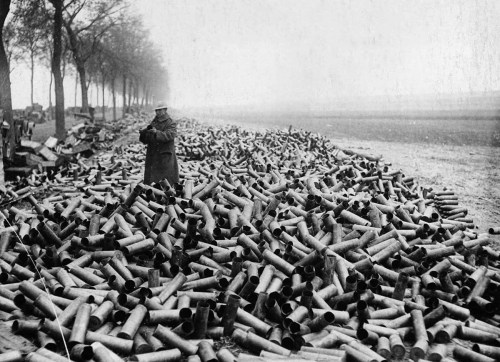
An empty tomb

empty-tombs-1916

You don’t remember the dead of the First World War.

Nobody does, now, or almost nobody. At most, you might remember the ones who survived. There’s a photo, hidden away somewhere, of great-grandad in his old army uniform, and if you look at it you might notice with a kind of sickly horror that he looks a bit like you did at that age, that you’re now already so much older than this old, old man. Maybe there’s a box with some old medals, or even a decommissioned revolver. Pieces of someone who died much later, surrounded by TV and pop music, dreaming the blanketing dreams of the nuclear bomb. Someone who lived to see a different country, one that throbbed in full colour. The hole left in the world by those bullets and shells and clouds of poison gas one hundred years ago was not left in your world, or mine either. The people who had their heart ripped out by a stranger on the Somme are almost impossibly rare; we drag them out into our televised ceremonies now, so everyone can see what a fully incomplete human being looks like, so they can do our remembering for us. Trembling, a few last strands of thin hair limp against a crusting pate: I still miss my Arthur every day, every day it’s like he’s just been taken from me. That’s what it means to really remember: to be a seeping wound in a world that’s been bandaged up and gauzed into blankness. For the rest of us, there’s GCSE history, supermarket Christmas adverts, an immersive experience at the Imperial War Museum. For you, the dead of the Western Front or Gallipoli may as well be the dead of Sevastopol, or Agincourt, or Hastings, or all the nameless battles fought by our hooting ancestors, brachiating grimly through the canopies. We have nothing in common with the millions who went whistling into a barbed-wire void. If we did, we’d be a little more like the ones who came back out again, the ones the war turned into madmen or revolutionaries.

We don’t have memory. We have remembrance. Organised hypomnesis; a set of stony symbols. We remember that we ought not to have forgotten. The past is on the tip of your tongue, but it can’t be spoken; any word that could have contained it is an empty tomb. Non est hic. What remains are signifiers, gnawing at each other’s heads. A poppy is a symbol; it symbolises the Cenotaph. The two minutes silence has meaning, it means a wreath. The flag is a code for the national anthem. None of these things mean the mud and terror of the war, or the millions dead, because none of that is an object in our experience. There’s no shared referent other than the ritual of reference itself: the objects of remembrance stand, mutely, for themselves. Forgetfulness, made concrete, and misnamed.

This isn’t bad or wrong: it’s just space and time. We are where we are. Today marks the end of four years of official commemoration, an attempt to hang the shadow of the Great War over our own century, to turn time into a palimpsest. These have been four very strange years. On June 23rd, 2016, we voted to leave the European Union; one hundred years ago that day, a million Germans surged over the frontlines at Verdun and overran the fort at Thiaumont, only to be pushed back over days and weeks to where they had been. Endless, uncountable thousands dead. On June 8th, 2017, the Tories threw away their parliamentary majority in an act of blinkered authoritarian arrogance, a century after the British army accidentally shelled its own lines, killing three hundred colonial troops. In June this year, one hundred years after two dozen German divisions plunged deep into France in a last desperate effort to end the war, Germaine Greer asked why Beyoncé has to ‘have her tits hanging out.’ There’s no symmetry. Trump is not the October revolution. Weinstein is not the Armenian genocide. It doesn’t map. It’s no more present than the wars going on now, the thousands dying in Syria and Yemen and across the world. What can we do for the people of the Middle East, starved or disintegrated by British bombs or British military expertise? Build another monument for them, put it up on the fourth plinth, and forget them into symbols.

There are still ways to make the past breathe again. Mostly, by digitally altering and colourising old Pathé newsreel, and putting it in 3D. The effect is impressive: it looks so much more real. The war is no longer fought by spindly, jerky automatons, low-resolution flesh-robots. Computers have generated the missing material in the gaps within movement, to bring the footage up to 24 fps, which is the flicker rate of consensus reality. Now these soldiers look like actual human beings, which is to say that they look like all the other cinema-screen simulacra. Now the propaganda of the early twentieth century can be raised back up in the fullness of its authenticity, because now it looks more like how we lie in the twenty-first.

Again, this isn’t bad or wrong. There was a time in which we could remember, in which the war was something other than the mud-caked origin myth of modernity, but now is no longer that time. There are other ways of remembering. We can remember in the present: I remember when I came out of the land of Egypt and the house of slavery, and – historically speaking, at least – that didn’t even happen; I can remember it in solidarity with those on the boats setting out across the Mediterranean, or those sleeping on the ground as their caravan twists slowly up over the Mexican plateau. We can remember the war the same way. We’ll never know the trenches, but when those that lived returned home, the fight didn’t end; so many of them, across Europe and across the world, took up the struggle against the ruling classes who had sent them there to die, and we can fight for life and dignity too. For obvious reasons, this is not the kind of remembrance we usually get.

What we get instead is a strange kind of rage. This year, and every year, the poppy wars. (Not unlike those other flower wars, fought between the Aztecs and their ritual enemies: both sides agree on a time and place, and neither seems to expect to actually win.) Who owns the past, now that it’s wordless and as transferable as any other debt? Is this year’s the most politicised Remembrance Sunday yet? Might Eid be getting more Islamic? Can we stop the commercialisation of Black Friday?

The anger of the poppy-scorners is fairly legible. Never Again, we were promised, but it keeps on happening; maybe we can sit in silent quietist remembrance once the war is actually over. The anger of the other side is thornier. A violent hatred for those who won’t wear the poppy, sing the national anthem, support the Legion, the ones who insult the memory of the dead by insisting that the war that killed them was Actually Bad. In other words, those that try to remember something specific, instead of remembering the process of being unable to remember. It can only be parsed as an externalised guilt. No, it’s not wrong or bad to not remember the dead of the First World War, it’s only distance and time – but the rituals of the state command memory, and there’s nothing in the memory to grasp. You have failed, because you’re living now instead of dying then; you’ve failed because you couldn’t stop one hundred years washing over the world that was. Seething indignation against the people who refuse to remember, because you, too, have forgotten.

This post is, once again, dedicated to those ten thousand soldiers who were killed in the six hours between the signing of the Armistice and its taking effect, one hundred years ago, who gave their lives so that schoolchildren could learn that the war ended on the eleventh hour of the eleventh day of the eleventh month.

There she goes

Autosave-File vom d-lab2/3 der AgfaPhoto GmbH

My closest friend died after a short illness on the 5th of October, 2018. She was twenty-seven years old.

Five years before that, I woke up one morning to find forty or so postcards wrapped up with elastic bands on my doorstep. Over the course of a Spanish holiday Anna had written to me dozens of times. Some messages were quite long, describing what she’d seen and what she thought of it. Others were extremely brief. (Tengo spinach in my teeth. A brownish smear across the cardboard. There it is.) A few were poems. On the back of a postcard showing a morose-looking nag in front of an empty buggy, she wrote:

Here is a horse in sepia.
He stands proudly, turgid with purpose
but blind.
The coachman is his compass, the tightening of reins
his guide.
“Why?” You ask. He is trapped by the spinning wheels of time.

I was deeply touched by all this kind and creative effort, and when Anna got back I told her so. She was profoundly disappointed. She hadn’t expected me to receive a heavy brick of postcards all at once: because she’d set them off haphazardly, two or three a day, she’d hoped that they’d arrive in the same way. She certainly hadn’t wanted me to enjoy them as sincerely and sentimentally as I did. They were meant to be a kind of benign harassment campaign; a slow daily drip-feed of banality and insanity that would eventually drive me to madness. If she’d known that I’d love them, she wouldn’t have bought so many stamps.

I dug out those postcards again recently. I don’t have much of hers. A few photos, some books, a t-shirt she bought me at Moscow airport featuring a stern and shirtless Vladimir Putin. And things like these: notes and messages, ephemera, incidental records of a life in a thousand pieces of strange genius.

It’s hard to say, now, what Anna was like without collapsing into barbarism. I started to get frustrated by some of the consolatory descriptions people would offer me – she was so unique, they’d say, she was so different, she was so vivacious, she had a real spark. These were, in the end, only ways of saying what she wasn’t, that she wasn’t dull. Weeks later, with someone who knew her as well as I did, and with no idea of what I could possibly begin to say, a provisional apophatic eulogy was drafted, going something like this:

Anna Reinelt was someone who wanted to leave the world a better place than she found it, and she achieved this through her innumerable acts of small and dutiful kindness. She touched the lives of everyone she met with her warmth, her charm, and her deep generosity. She was always there for her friends in times of need, a shoulder to cry on and a firm helping hand…

And so on. The joke was that she was nothing like that at all, and the description would have mortally offended her, but that’s not entirely true either. In the middle of October, some of Anna’s oldest friends came together at a pub in west London, and what struck me was that everyone there could say, without having to consider it for even a moment, that she was their closest friend. And this wasn’t through any connivance on her part; it was just that once she was there in your life nobody else could really match up. She really was the first person I’d go to in times of need. Not despite the fact that she’d respond to my crises by suggesting that I get a job at the zoo, mucking out the elephant enclosure, but because of it. That was why I’m far from the only person who’d fly across the world just to see her, wherever she was. And that world was a vastly better place for having her in it. Without her it’s diminished; it’s lost the incredible ability to know itself in new ways through her eyes.

IMG-20180626-WA0003

Anna was a photographer; she made films, wrote stories and screenplays. She was the last of the adventurers. She wanted to live out of a desert motel and paint strange landscapes nude on the forecourt. She wanted to live in Bangkok, or on a boat, or to take portraits of serial killers and gun owners. She loved pirate ships, dinosaurs, outer space, big musical numbers, tornadoes, lost cities in the Amazon, monsters in the oceans, utopias in the wastelands. She loved the things that fascinate children, when they first realise just how big and how impossible the world they’ve been born into really is; things too magnificent to be properly digested by the shrunken tastefulness of adulthood. She chased after her passions. Sometimes I’d get a photo of a dead bird perfectly preserved in salt on the shores of a dried-up sea, or a Texas thunderstorm, or dizzy jungles. She was the funniest person I’ve ever known, equal parts unfiltered obliviousness and sheer acid brilliance. Being in her presence was always giddying precipitous fun; even dismal hungover mornings were full of mania or apocalypse. She could break out in fits of terrible wisdom; she was the keenest and sharpest critic of my own writing; her judgement – on art, on cities, on people – was piercing, and carried heft.

Part of this was written to be read at her memorial service; part of it, obviously, was not. The thought of Anna’s funeral was unbearable – not because it was such a shockingly alien concept, but precisely because it wasn’t. She spoke a lot about death. She spoke a lot about her own funeral. She had plans. One idea was that if she died unmarried, she should have a wedding-themed funeral, buried in a white dress, pirouetted around for the first – and last – dance. She left instructions. On being sent an unflattering picture from the previous night: If I die before you I give my permission to use that photo at my funeral. “Anna was a delusional drunk with giant turnip hands.” Years ago, she asked me to write her obituary (Anna, I tried), and had me compose a funeral elegy. I came up with an obscene quatrain, and she made me promise to read it for her, against the screaming objections of her family if necessary. I didn’t. It wasn’t for anyone else.

Anna’s highest term of praise for someone was that they Got It. The nature of It was undefined but very much understood. It was the black joke at the heart of things, the absurdity and cruelty of existence, the senselessness of a world that killed her. To Get It meant that you could see that joke, follow it through to the punchline, and find it funny. That’s why it’s so hard to reckon with the facts: because the loss of her is so terrible, and so inhumanly unfair, and because if she could have outlived herself, she would find the whole thing – the rituals of grief, the sobriety of her own memorialisation, all the earnest mawkish statements like this one – to be utterly hilarious. She would, and if she were still here I would too. But she’s not, and I can’t. There’s no consolation in the fact that she would be laughing now. It’s only another thing to mourn.

82380032

Anna was not only a friend, not only someone I loved. There are some people in life that you meet, get on with, hang around with, and drift away from, left with a few objects and a few memories, to moulder or fade away. There are others who cause you to realise, years later, that you’re not at all the same person that you were when you first met them. Their friendship has changed the language you speak, the way you behave, the angle in which you jam yourself into the world. They created you, as much as your own parents did. Anna was that person for me. This might be why losing her feels like being blinded, or having the words seared out of my mouth. A decade’s worth of jokes and thoughts and shared memories left dangling, reduced to private whimsy; a way of being with another person in which it’s no longer possible to be; a facet of myself that’s been smashed open. I lingered, for a long time, over the small and stupid things. When Anna and I spoke on the phone, our conversations could sometimes begin with a full five or ten minutes of us making strange croaking noises at each other. Or we’d repeat the names of the cities from Hiroshima Mon Amour. Hi. Ro. Shi. Ma. Nevers. That obscene funeral poem. Things which are gone, which no longer make sense.

We say of objects or people that they mean so much to us. There’s no point asking what exactly it is that’s meant. It’s a meaning without words, that’s only apparent in the dried-up words that remain after it’s gone. But it survives in the wordless things that will always, in some small and private way, be hers. Pirate ships and tornadoes. Sunlight and undergrowth, fire and the ocean.

But words are what I have. Some of this was written to be read aloud, and some of it was written just to have been written. In the days after Anna’s death I found myself thinking about something else, something that had happened weeks beforehand: how, during the Yom Kippur service in synagogue, we had prayed that our names might be written in the Book of Life. (Years ago, Anna had insisted on coming to my brother’s barmitzvah service, because it would be cultural. She did not enjoy the experience: apparently, I hadn’t warned her that it would be three hours long, and none of it in English.) I thought a lot about the irrevocability of time, how the present moment sometimes stops spinning in wheels and opens up like a sinkhole beneath us, to swallow everything solid and leave us with only memories. Somewhere, everything that happened must be written down for eternity. There has to be a recording angel, there has to be a Book of Life, so that what has been doesn’t simply pass away. I felt the desperate urge to write it all. How once, in Prague, her shoes started falling apart and her feet started stinking, and she fixed it by stopping at a park bench to smear her toes in toothpaste; how I dragged her halfway across the city to see the world’s largest equestrian statue, and how it started pouring with rain as soon as we discovered that the thing was covered in scaffolding. Or how, when we were living together in our last year of university and had gone entirely mad from the final few days of dissertation-writing, Anna decided to inflate a plastic bag and put it on her head, with a scrunched-up receipt bouncing around inside. Wait, she said, I know what it needs. She disappeared into the kitchen, and came back holding a knife. Now it’s perfect, she announced. Kate – our compadre and third flatmate – and I armed ourselves with empty wine bottles to fend her off. Or later, the three of us in Brighton on a miserable blank grey morning beach, belting out the lyrics to Blink-182’s I Miss You in a yowling chorus of Californian vowels. Demented songs in New Orleans, manatees in Tokyo. Or the hospital, the last days of hope, the unreality of it all. All this needed to be indexed, every living detail.

But if there is such a book, none of us can read it, and I can’t reproduce it here. All I have are a few scraps torn from its pages. Photos, messages, and postcards. On one side a horse, on the other side a poem. And for a moment she’s in the sunshine again, not here, but not so far away, writing to me, and guffawing loud as she imagines how annoyed I’ll be.

01970035

An idiot’s manifesto

Why should we hear about body bags and deaths? It’s not relevant. So why should I waste my beautiful mind on something like that?
(Materials brought in evidence at the trial of Barbara Bush)

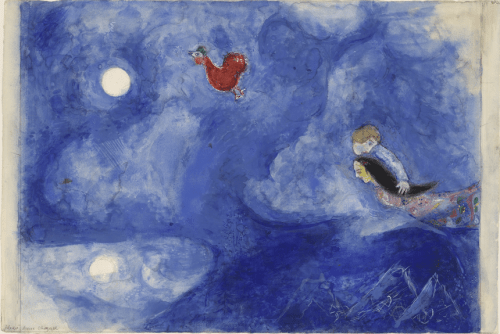
chagall4

1.

Not too long after the election, I was walking downtown on 6th Avenue in Manhattan when I passed a sign, frosted into the window of a fast-casual Mexican chain restaurant, that said ‘Queso at Chipotle: not fake news.’

That sign made me an idiot.

At home, certain brands of chocolate bar are Brexity, with a chalky stodge in the bite that sticks, like the guilt you feel over your unvisited and dying relatives, implacably to the front of your teeth. An advert for HSBC bank is solidly Remain.

They made me hungry. Everything only makes me hungry for idiocy.

To say that everything is political is no longer an insurrectionary act, not now that everything really is. Every swollen mosquito of a transnational corporation has a codified set of progressive values. Every conversation in pubs or coffee shops ends up being about politics. Every online dating service promises to pair you with some stranger who shares your opinions or will fight you over them; the pretence that you’re in it for something as absurd as sex is just a euphemistic fiction. How are you meant to deal with the unacceptable politics of your extended kin at Christmas? Let some bright-eyed bores help you, with their handy online guides. Family dinners everywhere now follow the same messy form: two scripted one-person performance pieces trying to share a single stage, a discordance kaleidoscoped into infinity. Children, I hear, are constantly offering wise pronouncements on the state of the world, castigating the stupidity of our leaders in ways that seem strangely un-childlike, with none of the good sharp mockery of a playground insult, but judicious, rooted firmly in good morals and good policy. ‘Liberating ourselves, expressing ourselves at whatever cost – a form of blackmail and ultimatum.’ Chicken sandwiches, sports shoes, coffee machines, craft supplies, burritos, and sitcoms are political, sold politically, consumed or not consumed politically. Music videos are political. The personal is political.

Not me though. I’m an idiot.

As Marxists, we’re long accustomed to the practice of digging around under the foundations of things, scrabbling to find an essence which will always be ineluctably political. Domination with its leprous grimace, bubbling away under a blank façade of mere social life. We find the hidden propaganda in films and TV; the material basis of history; the networks of social relations that dominate our lives in the workplace, in the streets, or in the bedroom. Everything that parades itself to the senses is a crust over the deep subterranean well of the political. Once the political nature of things is made overt, we’ve been announcing for decades, we will all be one step closer to being free.

The well has become a geyser now, and we have never been further from our freedom.

Walter Benjamin wrote that fascism is the aestheticisation of politics, and communism politicises art. Well, we’ve politicised art; every glue-gun assemblage of hunched material, every glorified mirror in mixed or digital media, declares itself as an affront to Trexit and Brump. But where’s our communism?

It would be foolish to assume not only that there’s still something more profound beneath it all, but that what lies beneath is still more politics.

Today, to abandon the world of politics is the last, the only, and the truest political act.

2.

Yes, we know. Behind all this relentless opinion-having about politics there’s a relentless entrepreneurship of the self, which has to adorn itself with all the right stances for whatever demographic it’s targeting, and the more often you repeat them the higher your market-assigned price. (Do you support the good things? Do you oppose the bad things? Then what sort of a person are you? Hot wet indignity, the psychotic injury of someone who can’t accept that every game always has an opposing team.) Better to leave every evil in its place, so you can oppose it, than to overturn them and be left bereft.  And behind this brutalised vision of the self are the laws of neoliberal political economy, which haven’t just stamped themselves in our flesh but sealed us in, like the bindings that used to make infants’ soft heads grow into tall and alarming shapes, since before we were born. But you’ve not uncovered anything, just come back to where we started. You’re on a Möbius strip; there is no other side. And don’t you ever find it boring?

Yes, we know. Complacency is a luxury. Irony is a luxury. In this moment of crisis, in this moment of opportunity, to do nothing, to fail to have a position on the political shoes or the political sandwiches, to not preen yourself into a Good Person in a cruel world, to not talk about the latest deprivation over coffee and wine and hemlock and sewage, to let each dumb moment fall through our fingers, and not try to grab at it, to not fix its dwindling in the aspic of thought while every day people are suffering, is a luxury. May all luxuries belong to the working classes.

No, we don’t know a thing.

Sometimes my dreams are political. But in the end, it matters less that I dreamed I was consoling Barack Obama over the phone, and more that I did so in a cottage cut directly into the bedrock of a Hebridean crag, where the naked stone was livid with chilly light, where the sea glittered like needles, where titanic gulls – swift omnivorous airships, wingtips stabbing each towards its horizon, birds that could only hatch from the powdered eggshell of the moon – called out hideously overhead.

Prince Myshkin, Dostoyevsky’s idiot, sees the world from the vantage-point of infinity. It comes in his fits. At an aristocratic dinner full of cruel and vain society notables, he fucks everything up: he tries to discuss theology, he sprays spittle in the salad, he makes a spectacle of himself. He already knew he would break that Chinese vase. He knows, too, that at any moment the Bolsheviks will be breaking down the French windows to cart everyone off to a labour camp. Dostoyevsky’s novel, unlike anything else in the nineteenth century, unlike even Marx, comes with a full understanding of the fragility of the present. But the epileptic is not an excavator; his wisdom is the same as his ignorance, which is the same as his insensitivity, which is the same as his trembling. He suspects no subtleties. ‘He did not turn the coat and see the shabby lining.’ Instead he skims. Look at the grass growing, he announces, and then falls to the floor in a froth.

The Greeks used the word idiot, ίδιώτης, to denote someone who was uninterested in the communal life of the polis. A private person, a selfish person, a person who keeps themselves to themselves, which was the true sin of Sodom. But the self of the idiot is not the same as the self of the present order. An idiot is never fungible. An idiot is absented from the system of values, exchange-values and political values included. Not a separation from the tissues of the world, but an approach on a different register. Prince Myshkin does not close himself off from society; he simply doesn’t understand it. An idiot suffers from idiopathies, strange and unknown diseases. An idiot speaks in an idiolect, a strange and unknown speech. An idiot is idiothermic, warmed by a strange and unknown light.

We, too, must become strange and unknown.

3.

The idiot has started reading novels again, which were always laced with a surplus – of what isn’t entirely clear, but it’s certainly not meaning – that can only be inassimilable to politics. At first it’s hard to give up the game of making clever inferences and readings, but once they learn that literature is, like sex or the sky, fundamentally prelinguistic and pleasurable, they wonder why they ever bothered. The idiot has taken an interest in early medieval panel paintings. Specifically, forging them. They end up selling panels to galleries and museums to the tune of £800,000 before being found out. The idiot is learning to be kinder and better to other people, to work diligently and conscientiously, to always be careful stomping around after it rains in case they hear the sickening wet crunch of a snail dying underfoot. The idiot murders a high-level diplomat for no reason whatsoever.

The idiot sits in a garden filled with terrifying flightless birds, which regard you from bronze-dull eyes. In the garden of the idiot foxgloves tower as tall as cypresses. Children with wild hair – not the idiot’s, maybe not anyone’s – climb the stalks of these plants, and settle themselves into their tubular flowers, and shriek from each nectar-smeared lip that this petal-pod is theirs, and they’ll kill anyone who tries to get in, and the idiot sits in the sunshine with a very small cup of coffee and shuffles papers without reading them.

The idiot decides to believe that market ideology is only humanity’s unconscious attempt – through the scrabbling activity of conquest, and the torque of capital flows – to speed the rotation of the earth on its axis. (This frenzy for speed will be its own undoing; read Capital, chapter ten, on the working day.) The idiot conjectures that liberal inclusivity, with its constellation of oppressions and privileges, is the political expression of an ancient Atlantean star-map. The idiot knows that the Sino-Soviet split was really only a metaphor for the eternal crisscrossings of the sun (Mao) and the moon (Brezhnev), and the same story was told by the Navajo around forgotten fires.

The idiot has translated their speech into a buzzing like that of bees, but the bees can’t understand them. Bees communicate through dance, and the idiot has never been any good at dancing.

Scales creep across the idiot’s skin. They harden. The idiot’s tongue has a weltering itch all the way down its length. The idiot is turning into a lizard. Thin leathery frills web the space under the idiot’s arms. The idiot might never be able to fly, but it’s possible they could one day learn how to swoop.

4.

I’m becoming an idiot.

I’m going to delete my Facebook. I’m only going to watch cooking shows on TV, and I won’t draw any lessons from them. The radio is for sports and music. If someone offers me the Evening Standard at the tube station, I’m going to spit cold blood in their face.

When a conversation turns to politics, I’ll get up and walk away, leaving my restaurant bill unpaid, and go to jail if I have to.

I’m going to clear out all this useless mental clutter. I’ll forget the capitals of Europe. I’ll stop being proud of knowing all the countries that only border one other country, even though everyone always forgets the Gambia. I’ll let the world fade away by degrees, until all that’s left is what I can touch, and mystery.

I’m going to lock myself away in my home and expand. I’ll refuse to understand anything outside its walls, and watch the patterns of dust on the windowsill to see what they do.

I’m going to lock myself in a sensory deprivation tank and expand. My entire world will be contained in a few feet of motionless water, and I won’t be there to experience any of it.

I’m not going to have any crazy hallucinations. I’m going to let blackness settle over me, and I’ll find it neither boring nor interesting.

I’m going to lock myself in a sealed tank, and only sleep.

I’m going to sleep where nobody will be able to disturb me.

When I die, they’ll bury me deep in the ground.