Idiot Joy Showland

This is why I hate intellectuals

How to politicise a tragedy

I am writing this the morning after a series of violent attacks in Paris that left over one hundred and twenty people dead, and still it feels callous to even be writing about it. As much of the world reels, there’s something very brutal about the idea that now is a good time to demand that others listen to your very clever opinion. If it’s barbarism to write poetry after Auschwitz, then it’s also barbarism to write thinkpieces after Paris. Don’t politicise; don’t use mass murder to score rhetorical points against your enemies, don’t crow je te l’avais bien dit, don’t play tug-of-war with the bodies, don’t make this about yourself, don’t make this about politics.

Which on the face of it is odd: death is always political, and nothing is more political than a terrorist attack. These events happen for political reasons, and they have political consequences; to have an opinion is nice if frustrating in times of peace, but absolutely essential in times of crisis. And yet. A sense of disgust rises when people comment on France’s unprecedented measure of closing its borders by bleating that if they’d done that earlier, all this could have been avoided; when they start gurgling about the global threat of Islam and the foreigners in our midst; when they smugly declare that restrictive gun laws left the population defenceless. This isn’t a tendency limited to the political right: there are plenty on the soi-disant left also using the massacre as a pristine stage on which to exhibit their one-person morality plays. What if the attackers had been white; wouldn’t we all be talking about mental health? Don’t you know that non-Muslims commit atrocities too? Why do you care about this, and not about all the other tragedies going on elsewhere in the world? Can’t you see that all these bodies only exist to prove that I was right about everything all along?

Normally the duty to not opine would only apply to a very small sector of the population, but for the last few years we’ve all been at it. Most of this take-mongering is happening online, and it feels absolutely and entirely wrong to be worthily prognosticating about hundreds of personal apocalypses on the same platforms and in the same forms that are used to sound off about TV shows and and football matches. A lot of this has to do with the demands of the format itself: you’re endlessly encouraged to Have Your Say and Join The Conversation, to constantly be filling white boxes with words, because what you think about any given topic is now incredibly important, and before you know it, in the stampede to have your say and join the conversation you’re trampling over the dead. We scrawl our thoughts in blood. To express anything other than sorrow is monstrous.

But then look at what’s being said. Last night, President Hollande stood outside the Bataclan concert hall, where many dozens had died, to say that ‘we are going to fight, and this fight will be merciless.’ There will be more war, more death, and more tragedy. The TV stations are bringing in experts to insist that this is all the fault of the migrants and the foreigners, as if refugees were carrying the violence they fled along with them. More repression, more cruelty, more pogroms. Terrorist attacks, as we all know, are carried out with the intent of setting the people against each other and sparking an intensification of the violence of the State, and so the people are duly set against each other, and the State announces its determination to do violence. This is already a politicisation of the tragedy, and to loudly speak out against it is yet another: is that also unacceptable? The day before the attacks in Paris, two suicide bombers blew themselves up in Bourj el-Barajneh, a predominately Shia suburb of Beirut, murdering 43 innocent people as they went about their lives. Wire agencies such as Reuters reported an attack against a ‘Hezbollah stronghold.’ The humanity of the victims disappeared, they were brutally synecdochised into a political party that some of them may or may not have supported, they weren’t people, they were Hezbollah, as if what had been attacked were a castle sharp with battlements rather than a neighbourhood full of families. Many people very loudly voiced their horror at this – but that was also the politicisation of tragedy: was that also unacceptable?

When it’s deployed honestly, the command to not politicise means to not make someone’s death about something else: it’s not about the issue you’ve always cared about; it’s not about you. To do this is one type of politics. But there’s another. Insisting on the humanity of the victims is also a political act, and as tragedy is spun into civilisational conflict or an excuse to victimise those who are already victims, it’s a very necessary one. There is the politicisation that seizes on death for limited political aims, and then there is the politicisation that would refuse any predetermined script other than the call for liberation. It insists on the political nature of tragedy, not to shunt it towards one or another narrative pit, or to put a left-ish or right-ish filter over the images of bloodshed, but because politics is a way out of all this. Atrocity demands solidarity. Absolute sympathy for the victims; for all victims. To insist on having an opinion, not the knowing sneer of someone who was right all along, but undiminished solidarity in the face of devastation. To fight against those who attack concerts and cafes, those who bomb cities with fighter jets and with their own bodies, those who abandon migrants to the cold outside their borders, and those sent them fleeing. To struggle: the common struggle of all who suffer, against suffering.

The Englishman and the Octopus

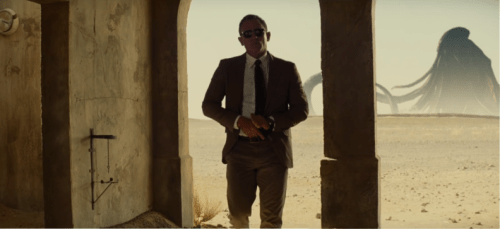
If you’ve seen Spectre, it should already be obvious to you that the James Bond franchise is a spinoff, taking place entirely within HP Lovecraft’s Cthulhu mythos.

Say 007 arrives at Mexico City Airport at four in the afternoon. He goes through customs. He takes a taxi to his blankly intercontinental chain hotel. He makes himself a slapdash vodka martini from the little bottles in the minibar, pouring the entire stub of vodka and a passionless vermouth glug into one of the film-wrapped plastic cups from the bathroom, and drinks it on his balcony. He looks out at Mexico City, and something looks back. The Cthulhu mythos only works if its characters don’t realise that they’re in it. When done right, Cthulhu stories don’t need to actually portray the Great Old Ones; they can lurk in the deconstructive background, appearing as a hollowness in the mise-en-scène, a spacing and a vastness suspended just beyond sight. Another recent film about Anglo imperialists in Latin America, this year’s Sicario, was an example of what could be called ‘landscape horror’, fine-tuned to Yanqui racism: long panning shots of barren or broken landscapes, the blasphemous edge between lawnmower-perfect American suburbia and the desert beyond, or Mexican cities that seem to sprawl without reason over the hills and valleys, protoplasmic shoggoth-blots poised to gobble up the border. This isn’t the ordinary Burkean sublime, but something far stranger. Ciudad Juárez is ‘the Beast’; the scarred and hollowed-out Earth is itself a cosmic evil. Bond on his balcony faces a city that does not end, from horizon to horizon. Where are the goons? Usually this is when some gormless lunks try to jump him, and from there it’s only a short kidnapping to the supervillain’s lair, where someone will tell him everything he needs to know, saving him the trouble of doing any detective work. Instead, there’s CNN, complimentary soap, and blithe miles of homes and highways. It’s hard not to feel lonely. It’s hard not to feel afraid. He’s in Lovecraft territory; those trillion-tentacled monsters from outer space that intrude upon stately New Englanders were always a barely concealed metaphor for one man’s horror of black and brown bodies in their nameless shoals, leaking degradation over a world fissuring from imperial decline. But over and above that, they stand for a universe that is not required to make sense.

James Bond, meanwhile, is a man in search of the transcendental signifier. It’s hard to do a Bond story these days, with the end of the Cold War, the rise of feminism, and an inherent ridiculousness to the form that perfectly crystallises itself in Austin Powers, which managed to carry out a satire of the Bond films simply by replicating them in every detail. But before there could be Austin Powers, there was Thomas Pynchon. His novels (especially V, with its deliberate Bond insert) subject the spy story to the (un)logic of post-structuralism. In spy stories the hero jets off around the world in search of the Thing that allows disparate events to reveal themselves as products of a singular Plan. In Pynchon, this structure is preserved, but knowing as he does that the object petit a does not exist, he simply takes away the MacGuffin. Bond’s shark-sprint for the truth falls apart into a messy and ever-widening entropic spiral. Postmodernism posed a far more serious threat to MI6 than Soviet spies ever could. Bond’s response was sloppy. At the start of the Daniel Craig era, the franchise put away most of Pierce Brosnan’s silliness for a lot of dark and gritty po-faced nonsense; the resulting films were basically terrible. In Skyfall, it reacted with a kind of watered-down postmodernism of its own, a plot barely held together by its spider’s-web network of smug self-references. Spectre – by far the best Bond film in recent decades – was at this point probably inevitable. Orbis non sufficit: the world is not enough. The villain in Casino Royale was only a puppet of the villain in Quantum of Solace, who was only a puppet of the villain in Skyfall, who was only a puppet of the villain in Spectre: you can only take this kind of thing so far before the evil grows beyond one lonely planet’s capacity, and plunges into outer space. With his metanarrative collapsing around him, James Bond escaped into a new one, a lair where Pynchon or Powers couldn’t find him. He escaped into HP Lovecraft.

This film doesn’t exactly hide its place within Lovecraftian mythology. You really think that creature on the ring is just an octopus? Uniquely for a Bond film, it starts with an epigraph of sorts, the words ‘the dead are alive’ printed over a black screen – a not particularly subtle allusion to the famous lines from the Necronomicon: ‘That is not dead which can eternal lie/ And with strange aeons even death may die.’ In the credits sequence, vast tentacles coil around him as he murders and fucks his way to an absent truth. In his house at R’lyeh, dead Cthulhu waits dreaming. The villain’s base is built around an asteroid, glossy and scarred, that fell from the sky millions of years ago. You almost expect alien ooze to start trickling from its cavities. With 1979’s Moonraker, heroes and villains invaded outer space; in Spectre it’s the other way round. And in its Lovecraftian context, everything starts to make a lot more sense. Why do Bond villains always explain their entire plan to 007 before killing him? Real-life conspiracies (like the financial markets, the internet, or history in general) are not so much secret as unspoken; they fold themselves into the basic fabric of social life, so that it’s often impossible for anyone at all to stand outside their situatedness and articulate what’s going on. Lovecraft’s monsters, on the other hand, live in the permanent outside; they don’t need to worry about revealing themselves to you, because they know that as soon as you clap eyes on even the shadow of their true form you’ll go irretrievably mad. For Cthulhu to reveal himself is not weakness but power.

Spectre is a film that deliberately resists any sense for the climactic or any libidinal payoff; all we get is lingering dread. The first post-credits chase scene is downright weird; Bond and his adversary race sports cars through the centre of Rome, but the gap between them never closes, the backwards-firing machine-guns don’t have any ammunition, and the sequence just keeps on going, all thrill long dissipated, until it takes on a kind of shambling undeath. ‘The longer the note, the more dread.’ Brecht calls this Verfremdungseffekt: by refusing to simply give pleasure to an audience, you prevent them from ever being entirely immersed in narrative events; they begin to consciously interrogate the fragility of the social conditions that hold up any action. But overall the Italy sequence is short. Bond’s never really been at home in Catholic Europe; he’s a creature of the Western hemisphere, and in particular the Caribbean. Gorgeous, tiny islands with their histories bayoneted out of existence, places where the hotels are luxurious and the bar staff eager to please. So Spectre gives us Moroccan scrubland instead, flat and impoverished, neither beautiful nor sublime, just two thin tracks plunging through a plane without interest forever. When there is an invocation of orgasm, it directly undercuts any myth of the secret agent’s sexual prowess. In the third act, we get an ironic version of the usual Bond structure: he’s taken to Blofeld’s secret lair (white cat and all), invited for drinks at four, and told the whole plan. So far, so good. Then, after nearly being killed in a pointlessly baroque way, he escapes, fires six shots, and the whole base explodes. Is that it? There was a big bang, sure but it was all over too soon. If you ever wanted to know what it’s really like to have sex with James Bond, Spectre is here to tell you.

But of course that’s not it. After orgasm, nightmares. The traditional ending is followed by a strange and shadowy coda in London: Bond, collapsing into a ruined MI6 building, finds his name and an arrow spraypainted on a memorial to the dead. He follows it. Shades of Lot 49: for the entire film, he’s only acted on the instruction of the omniscient dead. Older Bond outings allowed us to notice the essential powerlessness of the hero in a world always determined by its villainous Big Other, and feel very smart for having picked up on it; here, it’s thrown mercilessly in our faces. A mural at the mountains of madness. Spectre constantly frustrates the pleasure principle; it’s an awed testament to a Todestrieb that, itself unrepresentable, appears only in the spacing and repetition of something else. James Bond is no longer a brutal, neurotic male wish-fulfillment fantasy: he has no will of his own, no love for his own life, and he can’t even fuck. He falls into the grasp of something else, vast and pitiless, the key and the guardian of the gate, that watches the tiny escapades of Her Majesty’s Secret Service from far beyond the stars.

A portrait of the Person-Guy

The Person-Guy comes in many forms. Sometimes he’s just you, and all the things you like to do, reified into something that is at once a general social type and a Platonic model from which lesser beings can learn such valuable lessons as ‘it is good to have at least one daughter’ and ‘pronounce the word “helicopter” correctly, you utter cretin.’ But most of the time the Person-Guy is someone you don’t like. The Person-Guy is either very stupid, or not entirely stupid, but the wrong kind of not entirely stupid. The Person-Guy is all the vain and shallow women that ever rejected you. The Person-Guy supports a politician you have reservations about, wore a toga to a frat party, and is mysteriously close to the levers of power. The Person-Guy is absolutely real.

It’s the other one, the Person-Guy, that things happen to. The Person-Guy exists in short, declarative sentences, generally structured around some form of the verb ‘to be’, and arranged in no particular order. The Person-Guy is the cause of every evil and frustration in your life. The Person-Guy only wears odd socks, because he thinks that wasting our limited lifespan sorting them into matching pairs is indicative of a potentially authoritarian neurosis. The Person-Guy has a minor vocal tic, and it sends you into strange daylight fantasies; tearing out his throat with your bare hands, feeling the frantic little pulses of blood as they spurt and froth around your claws and then go cold. The Person-Guy likes all the same things you like, which is why you hate him. The Person-Guy is not reading this article. Only you are reading this article.

The Person-Guy tells you that he’s getting really ‘into’ candles. He spends most of his day lighting candles with a specialist Egyptian cotton taper, and then extinguishing them with the tips of his fingers. He goes to trendy candle clubs to hang out with other Person-Guys. He subscribes to Candle Lighter’s Monthly. You visit his loft apartment in Brooklondon or Berlyn, and every flat surface is covered with candles. A few of them are lit, scattered randomly around the room; tealights drooping precariously by the inevitable stacks of yellowing old books, elegant purple ones dribbling hot streams of wax to pool in the mason jars and espresso cups they’ve been unceremoniously jammed into, one big spluttering log of a candle that sits under a soot-smeared stain on the ceiling. He doesn’t offer you a seat; the Person-Guy doesn’t believe in outmoded notions of chivalry, and besides, all the chairs bristle with rare candles. You try to make small-talk with the Person-Guy – you’re not friends, exactly, and you’re certainly not into him, but you’ve known each other a long while – but he looks distracted; there’s a fluttering gleam in his eyes, and his fingers keep twitching; he’s only pretending to listen, he’s waiting for you to leave so he can start lighting candles and then putting them out again. You’re almost mesmerised by the quick and impulsive movements of his forefinger and thumb, their snap and tremble, and it takes you a while before you notice, with a start, just how scarred and calloused they are, skin clinkered like the surface of a lava flow, blocks of darkened leathery flesh torn between weeping chasms. You make your hurried excuses, and the Person-Guy lets you leave with an almost catatonic indifference, but one you’re out of there you can’t resist the temptation to look over your shoulder, and through his window you see the soft, undulating light of lots of different candles being lit and then put out. You know someone like the Person-Guy. Everyone knows someone like the Person-Guy. How can they not realise what they’re like?

The Person-Guy is always at the top of your Facebook feed. He has some opinion about something you don’t care about, and insists that all his friends be endlessly subjected to it. The Person-Guy takes hundreds of selfies every time he goes out and posts them all online, endless iterations of the Person-Guy and his girlfriends bending over to make kissy-faces at the camera so their tits are almost popping out the top of their skimpy dresses, and if you don’t like and comment on enough of them he’ll stop talking to you. The Person-Guy keeps inviting you to play some stupid browser game. The Person-Guy publicly wishes you happy birthday every year, and then doesn’t even message you once in the intervening three hundred and sixty-four days. The Person-Guy writes long letters to the world at large, packed with banal pseudo-philosophical insights about how you need to believe in yourself and why other people’s opinions don’t matter, limp gutless phrases crammed like worms in a shoebox, and then hashtags it ‘#gym #workout #hatersgonnahate’. The Person-Guy continually writes ‘too’ instead of ‘to’, and it appears to be deliberate, but you have no idea why.

You slept with the Person-Guy once, and you’re still ashamed of it, but afterwards you decided to learn some self-respect and in a weird way that experience kinda made you the person you are today.

You are fine. The Person-Guy is everything objectionable. The Person-Guy is the grim truth of all social relations: that the human being is a burden, that to talk to someone is labour, that everything you do in the company of another is only the absence of everything else you could be doing instead. The Person-Guy has clammy hands. The Person-Guy claims to like classical music, but only knows the pieces that have been in films. The Person-Guy makes a big show of every nice thing he does, as if it’s not just basic human decency. Every attempt the Person-Guy makes at kindness only justifies your hatred. The Person-Guy is responsible for the melting of the ice caps, the lack of decent affordable housing, the expropriation of surplus value, the ivory trade, the fact that all living things must one day die, the absence of an interventionist God, the short shelf-life of organic groceries, the traffic jams on the M4, the weird smell in underpasses, the heat death of the Universe, the mole on your chin, the little accusing voice that keeps you up all night, the fat balding creature that squints at you from the mirror, and the Syrian civil war. The Person-Guy turns his soft, doughy, witless head to look you in the eyes, and his face is nowhere to be seen. It is not illegal to kill the Person-Guy.

As soon as he is named, the Person-Guy vanishes. He has no mass or motion. He is the type, abstract and globe-girdling, pressed into shape for unknown purposes by an unknown god. He exists only as a cloud of attributes; individually insubstantial, in combination each point is the tip of spear that rips through his hideous body. To describe something is to annihilate it, and the Person-Guy has been annihilated. His entrails litter the streets. But still he shambles on, a formless form, all spit and tendons, grasping against the grit of the paving-slabs inch by laboured inch, as if he doesn’t know that he ought to be dead.

Justin Bieber’s dick: reflections from the limits of psychoanalysis

Psychoanalysis is the discourse of the dark and distant places, whether the inner caverns of the psyche or the forbidden pit between the legs; its contention isn’t just that these places can be meaningful and significant, but that it’s in this void that meaning and significance take place. And there’s no chasm blacker than early childhood. Nobody remembers their first few years, their first neuroses, their first steps, their first words. We think before we are. It’s as if we all emerged as fully speaking beings, springing fully-formed like Greek gods out of the placid seas. Anything we do remember is generally false: I thought I knew what my own first memory was, something about playing with toy trucks in the bath, until one day I discovered that no, it was a photograph I’d seen years later, and that’s why in my mind’s eye I’m always hovering a few feet in front of my own face. Freud calls these ‘screen memories,’ they cover up a childhood inevitably full of repressed traumas. There’s a kind of circular logic here: psychoanalysis insists that the essential truths of the psyche must spring from this distant and forgotten world, and then proposes that it must have been forgotten because of the essential truths buried within. Which is not to say that this is incorrect. But if I’m honest, my earliest memories are all dreams, specifically, nightmares. Elongated hallways and thudding footsteps, ordinary places turned eerily unreal, and something approaching; the childhood terror of a Thing without qualities. Besides those, nothing: flashes, instants, bursts of light that stutter briefly in a darkness seething with unseen monsters. Everything that actually happened I only know through stories from people who were there. It all happened to somebody else. Which is fortunate for some: if it worked any other way, everyone could be their own analyst.

Sometimes people afraid of dying are told that death is just like how it was before you were born, a comforting line that does nothing to comfort: back then I wasn’t, but I’m here right now, existing, to one day stop, there’s no comparison. It’s more like those first few years of existence – you’re there, growing, bloating, rotting, but the whole experience is unperceived. In Heidegger, the death of Dasein is the condition of its individuality; death belongs to it alone, and nobody else can die for it. This is nonsense. Death is, after all, not an event in experience (Wittgenstein concurs here: ‘We do not live to experience death’), but it is experienced, by our survivors. Our death belongs only and always to other people. And childhood too: childhood, the order of the Imaginary, Oedipus – our prehistory is not our own.

Say a young boy is terrified of horses. Normally a perfectly ordinary child, good-tempered and healthily perverse, at the sight of horses he goes into fits; watching through shuttered hands as the poor docile cart-horses from the coaching house across the street wearily clop over the cobblestones; their nodding, snorting unconsciousness sets him shrieking, bawling, shivering. And he’s always at the balcony: he says he’s waiting for the little girl to appear through the opposite window, but in the meantime he delights himself by being terrified of horses. ‘I have to look at horses, and then I’m frightened.’ Naturally the parents are worried: as devotees of the eminent psychologist Sigmund Freud, they’ve tried to raise their child to be as happy and uninhibited as possible; they can’t understand where they could possibly have gone wrong. So they enlist his help. Sigmund talks to the boy, briefly, with only a little condescension, and then afterwards the child races to the balcony to watch the distinguished psychologist crossing the street. Sigmund Freud paces quickly, wrapping his overcoat tight around his bones against the cold, as he hurries over to the coaching house to speak with one of the horses. A big muscular creature, stained city-white, black harness, black blinkers. He talks seriously and animatedly to the horse, taking off his glasses, stowing them in his overcoat, putting them back on again, blowing big clouds of pipe-smoke into the frosty air. The horse nods solemnly, or bares its gnashing yellow teeth, and all the while its monstrous penis slowly extends, brown and slimy, steam rising from the creature’s great heaving haunches as it discusses it’s son’s curious phobia. And the boy watches, trembling through his tears, full of ancient and unknowable terror.

Little Hans was afraid that his father, embodied as a horse, would come and cut off his penis, a fear that’s so elementary and constitutive of the subject that it’s in a way more true than truth itself. Freud, in his case study of the child, gains most of his understanding of the situation by talking to the father himself; while his entire approach is governed by the idea that Hans is terrified for an explicable reason, that ‘the arbitrary has no existence in mental life,’ there’s still the shroud that falls over childhood that makes it impossible to access from the outside. So he talks to the father, a sensible Freudian himself, to get the facts. Hans is afraid that a horse will bite off his piddler, and Freud goes and discusses the issue with the horse. But there’s one question he doesn’t ask. So, do you? Do you want to cut your son’s dick off?

Psychoanalysis is also, like any symbolic discourse, a discourse of the father; in other words, one in which the actual father is conspicuously absent. The psychoanalytic father is the Symbolic father; both as paternal principle in the order of the Symbolic and as the fundamental and generative phallic signifier. A son’s feelings towards his father are psychoanalytically significant; the father’s towards his son are not. In Lacan, the castration complex ends with what is in a sense an actual castration: the infant, cowed by the father’s potency, abandons any attempt to identify itself with the imaginary phallus; thereafter the phallus is always conceived as that which one lacks. It’s something that belongs to the other, and induction into the Symbolic order of signifiers, in which the phallus is the first, is compensation for this loss. But what happens when the infant grows up, and has children of his own? What happened when Hans became a horse himself? Did he remember the fear he once felt, as he clattered blithely over his own cobblestones? In Freud the child fears castration from the terrifying and priapic father; but in Lacan the father was already castrated a long time ago. And now he’s faced by a red-faced, screaming thing that does not happen to itself, without language, without reason, an unmediated and purely phallic presence. Wouldn’t the immediate, buried instinct be to cut it off?

All this is by way of talking about the nude photos supposedly of Justin Bieber that were recently leaked online. Two things are significant here. Firstly, the fact that the neurotic castrati of online are simultaneously transfixed by the question of how big it is and entirely unable to provide themselves with a satisfying answer. There’s a particular hatred for Justin Bieber that seems to emanate entirely from adult men: they complain that his music is terrible (it’s not that bad, really), as if trying to establish a narcissism of small differences between themselves and a twelve-year-old girl; the real complaint can only be his function as the object of the other’s desire. In other words, from the perspective of psychoanalysis, they hate Justin Bieber because he is their own father. Secondly, there’s this:

The original has been deleted, as if that could fix anything. This is of course Bieber’s father, proudly announcing to the world that he deliberately sought out pornographic images of his own son, and who has essentially sent him a “fuck me daddy” tweet. Some context: Bieber père separated from the star’s mother when he was thirteen months old, and has seemingly returned to cash in on his child’s celebrity; in 2014 it was revealed in a court case that Justin pays his father’s $1,650 monthly rent, nicely inverting the traditional Oedipal triad. In 2002, he allegedly kicked an eighteen-year-old woman in the face, breaking her jaw in two places, after she ejected him from a party at which he boasted that he could beat up anyone in the room and demanded that she lift up her shirt. In another incident, he abused and harassed flight attendants on a private jet. He pushed his four-year-old son’s face into a birthday cake, whereupon Justin tried to calm the child’s tears by showing him images of the event so he could see how funny it was. Of course Jeremy wants to cut his son’s dick off, of course that was what he meant when he leeringly commented on how big it is – like so many millions of others, he ascribes phallus to Justin Bieber, a phallus that even in Lacan can never entirely escape its penile origin; like all of us, his subject is the precipitate of lost objects, the sum total of everything it doesn’t have. Presence belongs to the other, and the paternal instinct is to abolish it. Like every other seemingly normal and healthy person, Jeremy Bieber hungers for the end of the world. But the point isn’t to form a psychoanalysis of the Bieber family, to add some Freudian tinge to the ordinary game of speculating about the private lives of the celebs. The point is to see how Justin Bieber’s dick can push through the edges of psychoanalysis itself, plumb though that hazy region where science fades into the black tomb of infantility and death.

Like the phallus as such, Justin Bieber’s dick is a signifier without a signified. It belongs to nobody – beamed across the world, leered over by millions – certainly not to him. The waking world is the site of an infinite dislocation: there’s a unity and wholeness to its outside, but that happens to someone else, a real person, of which we are only the tumbling echo. The mournful ghost of a world we lost long ago. A hypothetical retort to Freud’s theory of infantile amnesia: early childhood is not forgotten because of the traumas that occur, but because in the absence of trauma there’s no need for memory – after all, in his Project for a Scientific Psychology Freud himself conceives of memory, whether conscious or repressed, as a traumatic breaching in the brain. It’s in these dark places or non-places that psychoanalysis seeks out its truths. Justin Bieber’s dick invites us to step across the threshold of existence into something not fully conceivable: a psychoanalysis of the afterlife.

Howard Jacobson is the worst living writer

Linger but a while, dear reader, on these words – and forgive me my presumptive apostrophising, but the fact, crude as it may be, yet remains: you are my sadly anonymous reader, and I am the great and lauded novelist Howard Jacobson, twice shortlisted for the Booker Prize, once the winner, fêted by the literary establishment for my wry and incisive wit, my charming, bittersweet empathy, my deft dabbings of sentiment, my scarf, my beard, and all my other many enlivening qualities. I’ve read Ulysses. By this point you might already feel an exhaustion, or a poison bulge of resentment suppurating in the back of your throat; you may long for me to get to the point. But I beseech you, put this aside. Learn, as King Solomon is said to have learned, that all things must pass. I’ve also read Middlemarch. The point may never arrive, or it may only come in the final sentence. What a life this might be if we could grow beyond humanity’s unfortunate predilection for the pointed! No more blades to cut and wound, nor razor-wire to keep us apart from one another, only soft, sagging flesh, or the generous shade of trees, which I adore, oaks especially. Did I, perchance, mention that I’ve read Ulysses? It is, in many ways, the point (there it is again) of apotheosis of the grand Victorian humanist novel, and might you discern something of Leopold Bloom in my humble self? Reader, perhaps you may. A learned toleration, a mournful libidinality, a gentleness and goodness that so faintly lingers from a time now past. How I yearn for a world of peace and unity! But, malheureusement, that is not the sphere on which we have sprouted. So in the meantime, please allow me to nurture this seedling of a scintilla in your intracranial folds, let it grow and take root: we must shoot the proles and nuke the Gaza Strip.

There’s something uniquely repulsive about Howard Jacobson’s weekly columns in the independent. His books are bad, but they’re bad in the normal way, the way in which basically all recent capital-L Literary novels are bad. Like Donna Tartt, or Jonathan Franzen, or Haruki Murakami, or Karl Ove Knausgård, or that one that you quite like. The way in which any lingering (post-)modernist concern for the questions of what a text is and what its possibilities might be are shunted aside in favour of minute observations about family life and sexual neuroses occasionally jumbled up with flatulent pronouncements on the Human Condition. It’s a little like a return to the traditions of 19th century realism (an era in which, as now, the only actually worthwhile English novels were shoddily produced, amateurishly written, and shamelessly pulpy), but more than that it’s the dying pant of the novel as a dominant literary form. Howard Jacobson’s particular shtick is that all his novels are a middle-class, middle-aged Jewish male writing a novel about a middle-class, middle-aged Jewish male writing a novel about a middle-class, middle-aged Jewish male; it’s like Philip Roth on benzodiazepines. Shoddy but not unusual. But as a columnist, he’s the absolute worst in Britain, and very possibly the world.

This isn’t something I say lightly. As you’d expect from a class of people who, looking out at a planet full of constant horror, mostly see the chance to have a correct or profitably offensive opinion about it, the professional commentariat is a gallery of monsters and imbeciles. Katie Hopkins, circling the drowning refugees in her speedboat as she cackles through plasticky gums. Jeremy Clarkson’s jeans, which have long sunk into his skin and colonised his organs, so that he’s now just denim all the way through, entertainingly calling for the mass extermination of this week’s despised minority. An army of broadsheet bores, endlessly droning in the imperative mood, telling the public and the government and the opposition what they should and shouldn’t do, as if having a column in a daily newspaper confers some kind of spiritual leadership. Simon Jenkins. Jonathan Jones. Me. But Howard Jacobson isn’t satisfied with the usual conventions of the bad opinion column; he’s a Booker-winning novelist, deigning to bring his subtle art to this most debased of forms – mostly by draping run-of-the-mill reactionary opinions in the kind of sanctimonious waffle that makes you wish for the sleek, punchy polemicism of a Richard Littlejohn or a Melanie Phillips. Howard Jacobson could write two thousand words on how a square has four sides, tack on some class chauvinism or virulent anti-Palestinian rhetoric, and produce something virtually indistinguishable from his usual output. Howard Jacobson is Britain’s worst living writer.

It’s sadly not possible to go through every single one of Howard Jacobson’s terrible columns, but luckily in the last month alone he’s managed to produce some of his stupidest crap to date. I’ll start with the fluff. Exhibit A, a column from the 18th of September, titled ‘I don’t understand this ‘LinkedIn’ and the way it evokes memories of childhood rejection in me.’ This is a late contribution to the genre of Old People Vocally Infuriated By The Internet, and has apparently come to us through a wormhole leading to the year 2006, when it was last acceptable for apparently serious newspapers to print sentiments along the lines of ‘What’s all this Face-Book nonsense? Why don’t you just read an actual book, with your actual face?’ It also bears a strange resemblance to the slogan t-shirts still sold (but to whom?) in Camden Market and souvenir shops, the ones with messages like ‘Forget Google – ask my wife!’ or ‘You looked better on Facebook’ – although these at least have the virtue of brevity. In his essay, Jacobson describes receiving an (almost certainly automated) email from some unknown person inviting him to use the social networking service, and while he refuses, he’s still wracked by guilt, by ‘the idea of someone hanging on, anxiously eyeing the mail every morning, wondering if you received the original request, wondering if you’ve responded yet, wondering if you ever will’ – which is naturally bound to bring a Proustian reminiscence of ‘all the rebuffs and repudiations one’s suffered – in my case a half a century of unrequitedness.’ Jacobson isn’t just confused by what the website does, he can’t even work out its name – but because he’s an award-winning writer, he’s befuddled in a profoundly literary way. ‘Never having heard it spoken, and possessing no instinct for cyber semiotics, I couldn’t make out the word the letters added up to.’ Eventually he decides it’s ‘a Finnish translation of the name of a princess from One Thousand and One Nights […] the Princess Link-a-din.’ A simple two-word phrase is too much for him, which raises the unsettling implication that this lauded men of letters is actually functionally illiterate.

Jacobson’s inevitable prescription is to log off. ‘Only deconnect,’ he says (see what he did there?). ‘Out in the free, uncompromised world of the unlinked no hell-troll can hound the mildest Corbyn sceptic.’ Which is a strange way of framing things, given that earlier in the month Jacobson had written an article neatly slotting the then-leadership candidate into his grand overarching mythos, a kind of fantasy world in which the political Left, and in particular the Palestine solidarity movement, is motivated solely by a foaming hatred of the Jews. (And what about those anti-zionists who, like myself, happen to be Jewish? In his novel The Finkler Question, we’re represented in the title character’s former incarnation as a greedy, egotistical Shylock character, cynically deploying his Jewishness to curry favour with pro-Palestinian Gentiles while in fact pathologically hating his own people. In Kalooki Nights a similar figure, a cartoonist desperate to expunge his unwanted Jewishness onto the page, discovers to his horror that the people commissioning his work are overt antisemites. In other words, we’re just self-haters. In which case, Howard Jacobson is just another cop putting fences up around the borders of Jewish identity.) The point, when he gets round to it, is this: let’s say Corbyn is not himself an antisemite – although of course it’s not ‘possible to guarantee the complexion of another’s soul’ – but why does he spend so much time hanging out with people who are? Why does he want to boycott Israel but not Hamas? It’s a boring and boorish smear, cribbed directly from our more frenzied tabloids; what Jacobson does, in his inimitable style, is add insufferability to stupidity. ‘The offence you take at any imputation of prejudice is the hollow hypocrite’s offence,’ he says to Corbyn, ‘and your protestations of loving peace and justice, no matter who believes them, are as ash.’ A solid effort, but it could be improved by using the full phrase, beloved by teenage poets for decades, ‘as ashes in my mouth.’ The Booker Prize comes with an award of £50,000. There’s no justice.

Jacobson never outrightly states that Palestine solidarity is driven by antisemitism (he’s far too literary for that); he just occasionally wonders, or considers, or innocently questions the motives of this or that person, again and again, in column after column, a lone man in a small cell farting out little insubstantial clouds of suspicion until the accumulating stink fills the room. From his attack on Corbyn: ‘The truism that criticism of Israel does not equate to anti-Semitism is repeated ad nauseam. Nor, necessarily, does it. But those who leave out the “necessarily” ask for a universal immunity. Refuse it and they trammel you in the “How very dare you” trap.’ How very dare you indeed. When footage emerged of a young Queen performing a Nazi salute, Jacobson did all the requisite forelock-tugging – ‘I know she is good for the Jews. How do I know? I just know’ – before, in the last two paragraphs, saying what he really sat down to say: British Jews like Howard and I shouldn’t be worried about the be-swastika’d upper classes, but we should be terrified of Hezbollah, Hamas, and the political Left (where antisemitism ‘goes by another name’). In 2009, immediately after a war that killed nearly 1,500 Palestinians and thirteen Israelis, Jacobson wrote a column with the title ‘Let’s see the ‘criticism’ of Israel for what it really is.’ Within, amid the usual self-inflating pontification, he described comparisons between Gaza and the Warsaw Ghetto as ‘the latest species of Holocaust denial.’ In 2011, he wrote a kind of open letter to his fellow author Alice Walker, begging her not to join the aid flotilla to Gaza that would shortly be subjected to murderous State piracy in international waters. In particular, he focuses on the fact that the flotilla was carrying ‘letters expressing solidarity and love’ for children in Gaza. This offends his egalitarian instincts. ‘Not, presumably, for Israeli children. Perhaps it is thought that Israeli children are the recipients of enough love already. So what about solidarity?’ What really grates Jacobson about the anti-occupation movement is its certitude, the way they’ve entirely made up their minds – how gauche, how unsophisticated; they should, like him, airily flit between parties, make a big show of holding them up to equal scrutiny, before inevitably fluttering to rest on the side of the nuclear-powered colonialists rather than the people they’re occupying.

Not that Howard Jacobson’s prejudice is limited to the oppressed peoples of the Middle East: he has plenty of scorn for the poor and tactless here at home. Take another piece, also published in the last month, on lad culture at British universities. For Jacobson, the problem with sexual assault on campus isn’t the sexual assault, it’s the fact that it’s happening on campus. The problem is that universities are no longer for the elite, but have been invaded by a tide of oversexed oiks. He looks back fondly on his days as a student at Cambridge, when everyone at university was shy, scrawny, studious, celibate, and not ‘interested in the carnivals of the proletariat.’ In his telling, over-serious middle class boys never rape anyone, only the feral underclasses. Jacobson and his dweeby cohort were, he says with all apparent seriousness, just like Paul Morel in DH Lawrence’s Sons and Lovers – a strange citation, given that Morel wasn’t exactly a standard-bearer for good sexual ethics. ‘Where have men of this sort gone?’ (They’ve probably all escaped to Link-a-din.) He continues: ‘In the case of those of us who studied literature, the books we read turned us inward and kept us civil. It would have been hard to go from reading Jane Eyre to inveigling totty back to our rooms and doing violence on them. I don’t say an MA in gangsta rap or business studies will necessarily make you a rapist, but there’s less mental distance to travel before you get there.’ Besides his thoughtless class hatred, Jacobson betrays an incredibly impoverished attitude to literature – the idea that it exists to turn us into kinder, milder, gentler people, that great art ought to be a kind of primitive Xanax. (Should someone tell Howard Jacobson what DH Lawrence actually got up to? Maybe instead of Sons and Lovers he should have read Women in Love, which towards the end features another wealthy and bookish young man attempting to strangle his girlfriend to death.) He ends with a defiant insight: ‘Sex is better when it’s mutual and, better still, when the parties to it pause occasionally to read a book together.’ Midway through the act? Maybe he’s freakier than I thought.

Unlike the best tabloid columnists, real masters of their craft, Howard Jacobson never entertainingly rolls around in the muck of his own hatred. Instead, against all the evidence, he insists that he’s a good right-on liberal – a socialist, even. After all, how could anyone be prejudiced when they have such a profound love of words? Even if it’s a love that he expresses in the same way Paul Morel expresses his love for Miriam: by imposing himself on them. But the real question isn’t why Jacobson is so bad; it’s why people still seem to respect him despite his total worthlessness. If this is how our heroes write now, then literature ought to be put out of its misery. In a way, Howard Jacobson really does perform a trenchant and incisive critique of our society – but it’s not in the things that he writes, it’s in the reaction to them.

One last one. Jacobson’s most recent column, published over the weekend, is another ebulliently witty broadside against any and all criticism of Israel. This time, his ire is drawn by a Spanish clowning troupe who protested by stripping naked in front of the apartheid wall near Bethlehem, inadvertently upsetting some local residents. Cue the usual whinging about the fiendish complexity of the situation, and how ‘meddlesome’ it is for anyone other than Howard Jacobson to take a moral stance. But before he gets there, a brief detour on the virtues of staying shtum when you don’t have anything of value to contribute, in this ‘age of immoderate opinion unhampered by knowledge.’ Jacobson quotes Wittgenstein, or, at least, a scrap of Wittgenstein he picked up somewhere else: ‘I don’t grasp what philosophical problem concerning language and reality the sentence “Whereof one cannot speak, thereof one must be silent” addresses – but I am going to employ it, anyway, against those who don’t know their arses from their elbows and ought to shut the fuck up.’ Physician, mate, heal thyself.
GOP 2016: Give Iran the bomb

I watched the latest Republican debate on a glitchily illegal stream from a dull and unassuming corner of north London. The debate was long, lasting roughly four thousand years; when the victor poked his head up from the Ronald Reagan Presidential Library in Simi Valley, California, the vast and mighty empire he had sworn to protect was long extinct, remembered only in Chinese textbooks and a few quirks of heraldry. And the time difference didn’t help; by the time it finished I was utterly exhausted, feverish and all but insensate. It’s hard to talk about what happened during the debate, when I can’t really be sure that any of it had happened at all. For instance, I could swear that at one point the CNN moderators had let eleven wild hogs loose onto the stage, and announced that the Republican nomination for President would be given to whichever candidate first wrestled their animal to the ground. Mike ‘Gabagool’ Huckabee bullishly nutted his hefty porker of an opponent in the back of the head: a meaty thump as two thick craniums collided, echoing with two sets of identical, frantic squeals. Rand Paul, caprine and trembling, faced his pig with hollowed cheeks and hungry eyes; they seemed to weave circles around his podium, fleeing and pursuing at the same time. Donald Trump’s pig just took a place by the man’s side, reared up onto its back trotters, and started oinking along to his speeches. I looked from pig to man and man to pig, but it was impossible to say which was which. That was when I realised that the fatigue had got the better of me: for the last twenty minutes, I had been watching the debate with double vision.

So much of the debate was like that. Did Ted Cruz really try to bolster his arguments by referring to an editorial cartoon? Did Jeb Bush really say that his brother had kept America safe by referring to 9/11? Was there really a long period in which everyone was fantasising about live brain harvesting? Were the candidates really asked what they’d like their Secret Service codenames to be? Did John Kasich really say Unit One? Did Rand Paul really say Justice Never Sleeps? Did Carly Fiorina really say Secretariat? Secretariat? But all I had to do was look on Twitter, and there it was. Once, political candidates spoke entirely in soundbites for the evening news, and that was bad enough. Now, their campaign teams are busy at work as the debates take place, frantically pasting their quips and dribbles onto stock photographs and dumping them online, to be shared and faved by the faithful. As the Situationists knew, any large enough collection of images creates a miniature reality, and these worlds are not required to make sense. Each candidate stood in the centre of their own pocket universe, each fundamentally identical, each identically insane. For someone with an interest in any of these lazily arranged gargoyles, it must have all made perfect sense. For me, it was like staring into a black hole.

It wasn’t really taking place in Simi Valley; we were on the ramparts of Elsinore. A new staging, the worst in history, in which everyone was trying to be Hamlet. First, the ghost of Ronald Reagan, clanking before the gates in his Air Force One-shaped armour, blood and senescence dripping from its joints, finally lifting his visor before his children to reveal a black maw, flesh dripping in streaky rivulets from fang to void. He wasn’t an entertainer who turned into a politician, he was entertainment itself, forgetting everything that precedes it, annihilating everything it faces, politics included. And then the ghost vanishes, and the play begins: eleven Hamlets all at once: they feign madness, they spurn words for bloodshed, they blankly dispatch their one-time friends, they cynically condemn women to a needless death, they dance with poisoned swords. But it’s all idiocy, and the result doesn’t matter: outside, the armies of Fortinbras have taken the walls.

It’s easy to say, with a dismissive shrug, that the Republicans are crazy. But they’re not, and the truth is far worse: they’re all pretending to be crazy. In the pre-debate, the warm-up freak-parade before the main event, each lesser candidates jostled to be crazier than the last. One of them (Lindsay Graham? Bobby Jindal? Does it matter? A beast with four heads and one voice) announced that Iran would only respect America if it started unilaterally ripping up international treaties. Another said that the Iranians would only be cowed by an American president who could bite the head off a newborn baby. Look at me! I’m crazy! I want to nuke the Sun! I’m even crazier! I repeatedly run at electrified fences! I shit the bath! I eat rocks! Early in the debate proper, Rand Paul responded to the idea that the nuclear agreement with Iran should be immediately cancelled by saying ‘I don’t think we need to be rash, I don’t think we need to be reckless.’ It was a weird moment: vaguely sane sentiments coming from the mouth of someone named after a woman who tried to turn psychopathy into the highest moral virtue, whose utopian New Sodom could only exist, even in fiction, with the help of a perpetual motion machine. There was no applause. The crowd stared, with the ravenous confusion of ten thousand starving hyaenas. Faced with the prospect of a weaponised Donald Trump, Carly Fiorina insisted that she had ‘a lot of faith in the common sense and good judgement of the voters of the United States of America.’ Meanwhile, the candidate that the voters of the United States of America have said they prefer – by double-digit margins – proudly thrust a steaming bowl of turds towards the camera. ‘I’m rich,’ he announced. ‘I’ve gone potty in many countries, all over the world. I could make a potty as big as the moon, if I wanted to.’

The other candidates knew better; their Howard Beale shticks were immaculate. They ranted about mass deportations, wars of extermination, burning flags, burning everything, the end of the world, and then insisted that Iran must not be allowed to enrich plutonium, because it’s ruled by a fanatical doomsday cult. (Honourable exception: Ben Carson, who just mumbled about nothing in particular with the breathy, halting affectlessness of a six year old child trying to read a phone book, and should probably give up rhetoric for his far less demanding day job as a paediatric neurosurgeon.) For all that they claim to love the American people, the thing these people actually addressed was an ugly caricature, and, like fast food or architecture, politics tends to create the people that it panders to. Driven by packs of bankers and witless condescending liberals from plywood mansions to breeze-block slums; bloated on imperial superprofits and dodgy credit; taunted by a myth of Rugged Individualism, deserts and danger, big leprous skies and the open road, as they teem like farmed salmon in the sluices of human history’s most advanced and uncaring bureaucracy; convinced that there’s nothing beyond America’s shining shores but threat and violence and, somewhere, a little gremlin of an ayatollah laughing at their ignorance. A creature that needs pills to fuck and foreign wars to not mind. It craves death, not in the sense of any flouncy romantic void, but megadeaths, irradiated zones, mutilated corpses on live TV. It doesn’t want a president, it wants a holy madman, a barbarian warlord, and a hug.

But it’s not enough to blame the voters. This is the eliminationist impulse of the terrified metropolitan liberal classes, every bit as vicious and bloodthirsty as the proles they despise, but less willing to cop to it: democracy doesn’t work, gas them all and bring in some drab rational middle-managers to return the country to prosperity. But in fact, the feigned frenzy of the Republican Party is just an American version of the administrative technocracies already imposed on much of the rest of the world. It’s not that the political right has gone insane; insanity has come to function as an effective substitute for politics. Case in point: Donald Trump. Earlier in the race, he said of the the Vietnam War veteran (and good friend of Ukrainian neo-Nazis) John McCain – who spent five and a half years as a prisoner of war when his plane was shot down during an attack on civilian infrastructure in Hànội – that ‘he’s not a war hero. He’s a war hero because he was captured? I like people who weren’t captured.’ Normally this would have ended his campaign; the one solid law of American politics is that you do not criticise The Troops. But his surge carried on unabated. He didn’t even have to apologise. This isn’t even liberal democracy any more: everyone involved is just form, blank and total, without any possibility of content; language without signification, madness without a psyche. This holds across the spectrum: Hillary Clinton, a blinding-white astral demon made of chicken gristle and wax-paper, doesn’t even pretend that she’s running for any reason beside her own personal hunger for power. She wants to rule the world; it’d be hers by birth, only she wasn’t born, she emerged like a lizard out its egg from the cold undeath of money, fully formed. Her entire campaign is less advertising than a judicial sentence. We have been condemned to four to eight years of Hillary Clinton, because it’s her turn now. There’s not much that’s good about the Republican party, but at least they’re from this planet.

During the debate the biggest issue was (of course) Iran, and the deal that had just been agreed that would prevent Iran from building any of the nuclear weapons that it wasn’t building anyway. This incensed most of the candidates, who seemed to think that eliminating Iran’s nuclear capacity was only worthwhile if it took place in the context of eliminating Iran as such. Which raises the question: what’s the point of making sure Iran can’t have the bomb, if we’re then just going to give it to Mike Huckabee, or Ted Cruz, or Bernie Sanders, or Hillary Clinton? Watching the debate as it ended, as the streets outside me filled with cars and chatter, normal people with something to live for, my head throbbed and my teeth chattered and the parade of lunatics onscreen seemed to turn to me and hiss vague personal threats through secret corners of their mouths obscured by the blurry low-resolution feed and I thought: give Iran the bomb. Not that it matters, but the country is a plateau of stability in a region turned to jelly by successive waves of imperialism; surrounded by Isis on one side, the Taliban on the other, and Saudi Arabia across the Gulf, Iran may as well be a Denmark on the Caspian. Not that it matters, but an Iran with an independent deterrent, safe from attack and invasion, no longer cowed in the shadow of Israel’s regional nuclear monopoly, might be the only thing that can save the human species. Not that it matters. Give Iran the bomb, because when the sun came up all I could see was a mushroom cloud, the flash before the devastation, and if we all go out together and the fire laps from pole to pole, I don’t want it to be because of Donald Trump.

Building Norway: a critique of Slavoj Žižek

Most of us are now grimly aware of the pernicious hydraulic metaphor for migration – the tendency in newspapers or opinion columns for movements of people to be described in ominously fluid terms: a flood, a wave, a stream, a tide, an influx, a rising body of stinking brown water that can only threaten any settled population. This language isn’t just monstrously deindividuating and dehumanising: when hundreds of migrants are dying at sea, it helps to suture up any ethical laceration before it can fully open itself. Water to water, dust to dust. Vast numbers of people – children included – can sink beneath the waves without anyone feeling any need to do anything about it; it’s only once bodies wash up on beaches that there’s an imperative to act. So it’s unfortunate, but not surprising, that The Non-Existence of Norway, Slavoj Žižek’s essay on migration in the London Review of Books, starts in these familiar terms: ‘The flow of refugees from Africa and the Middle East into Western Europe…’ What comes next is even more unsettling: Žižek compares the European response to the crisis to Kübler-Ross’s five stages of grief – denial, anger, bargaining, and so on. Not just any grief, though – Europe is displaying ‘a set of reactions strikingly similar to those we display on learning we have a terminal illness.’ Migrants aren’t just a flood; Žižek resurrects a far more nakedly racist metaphor. The internal other is a parasite, a pathogen, or a cancer, a corrosive and polluting agent that brings death for the (healthy, homogeneous and homoeostatic) body it infects. Of course, this is on the level of the European reaction; he’s not himself making the comparison; it’s something that could be very plausibly dismissed as a little rhetorical pirouette. But it doesn’t bode well for what’s to come.

There are no great old Soviet jokes in this essay, no references to Hitchcock or Kung Fu Panda, and only a brief, perfunctory mention of Stalin. Crucially, there’s no Freud, Lacan, or Hegel; not even (surprisingly, given that the question of migration is ultimately one of hospitality) any citation of Derrida. Above all, there’s nothing that could be considered as Marxism. Which raises the question of what theory is actually for. Is it essentially just a game, a way of forming entertaining readings of pop-cultural ephemera, to be put aside in favour of a level and pragmatic analysis as soon as Real And Important Issues such as migration emerge? Or is it something that’s actually essential in forming a sophisticated understanding of the world, and never more so than when the unspoken demand is that we put away our rhizomes and différances, and start dealing with reality? However guilty I might be of the former tendency, I’d like to believe that the latter is true. Clearly Žižek doesn’t agree: what The Non-Existence of Norway gives us is an unadulterated and unmediated opinion piece, one normal man’s take, something that would be equally at home in the op-ed pages of the Wall Street Journal or on the blog of a self-confessed political junkie.

Žižek’s argument is convoluted and contradictory, but it could be briefly summarised like this. The migration ‘crisis’ currently afflicting Europe is (correctly) identified as the inevitable result of successive Western interventions in the Middle East and north Africa, along with neocolonial relations across the global South. At the same time, migrants display an ‘enigmatically utopian’ demand: they don’t just want to arrive somewhere safe in Europe, away from bombs and guns. The thousands heroically marching across Hungary are scrambling for Austria and Germany, those forced to camp in squalid conditions in Calais are ‘not satisfied with France’ and demand Britain instead, people risking their lives on rubber dinghies across the Aegean want to build a good life for themselves and their children in Norway – but, Žižek insists, ‘there is no Norway, not even in Norway.’ Life isn’t fair, folks. Migrants are everywhere met with reactionary violence, claiming to defend the pre-existing European way of life from the invaders, but the ‘standard left-liberal line on this is an arrogant moralism’ – to insist that human dignity outweighs any concerns over social disruption is ‘merely the obverse of anti-immigrant brutality,’ because it accepts that the defence of one’s way of life is in contradiction with ‘ethical universalism.’ But rather than demonstrating that this is a false opposition, however, Žižek seemingly out of nowhere starts valorising the (nonsensical) view that migration threatens some posited European way of life. ‘Should we tolerate migrants who prevent their children going to state schools; who force their women to dress and behave in a certain way; who arrange their children’s marriages; who discriminate against homosexuals?’ After indulging in this airily speculative rhetoricising for a few paragraphs, Žižek finally gets down to some serious prescriptivism. Europe must ‘reassert its commitment’ to the dignified treatment of refugees. (Does this mean that such a commitment already exists?) At the same time, it ‘must impose clear rules and regulations,’ through a strengthened central European authority. Migrants will be allocated a destination in Europe, and they must remain there. They must not commit any acts of sexist, racist, or religious violence, as such foreign types are apparently wont to do. This is because they are in Europe now, and are no longer free to indulge in the barbarisms endemic and unique to those parts of the world that produce migration. ‘Such rules privilege the Western European way of life, but that is the price to be paid for European hospitality.’ And they must be backed up by brutal state violence.

There is a lot that’s deeply wrong here, even beyond the obvious. The idea that the primary problem is the ‘flow’ of migrants into Europe, that Europe is experiencing a migration crisis, rather than the far more accurate reversal: migrants are experiencing a European crisis, one of fences and fascists and cops. The baffling notion that a lack of sexist, racist, or religious violence is somehow a fundamental part of European life, that these things only exist in the global South, and will be carried, plague-like, by its former inhabitants. The sudden and unexplained invocation of the Islamic veil as the master-signifier of non-European otherness: when hundreds are drowning in the Mediterranean, and thousands more are imprisoned in dehumanising refugee camps, is their expression of religiosity really the most pressing issue? Žižek’s essay seems to be as uninformed by bare facts as it is by theory: a vast portion of the migrants reaching Europe are Syrian, from a middle-income country with a long history of secularism and communal co-existence; the takfiri ideology that is currently running rampage in the region is a foreign import, as are most of the takfiri fighters themselves. Many of the refugees that can afford to make it to Europe are from the Syrian petit-bourgeoisie; if we really do believe that class is a more crucial determining factor than nationality, we should at least be open to the idea that their ‘values’ and ways of life will not be too different from those of bourgeois Europe.

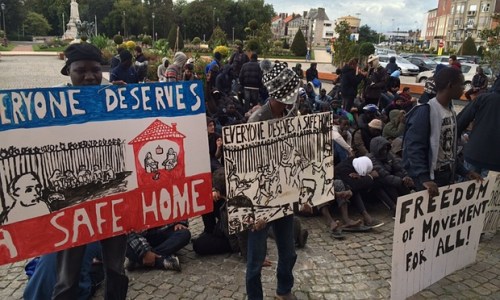
It’s even possible to argue that the migrants are more European than Europe itself. Žižek mocks the utopian desire for a Norway that doesn’t exist, and insists that migrants should stay where they’re sent. (It doesn’t seem to occur to him that those trying to reach a certain country might have family members already there, or be able to speak the language, that it’s driven precisely by a desire to integrate. But also – isn’t this precisely the operation of the objet petit a? What kind of Lacanian tells someone that they should effectively abandon their desire for something just because it’s not attainable? Or are migrants not worthy of the luxury of an unconscious mind?) In Calais, migrants trying to reach the United Kingdom protested against their conditions with placards demanding ‘freedom of movement for all.’ Unlike racial or gender equality, the free movement of peoples across national borders is a supposedly universal European value that has actually been implemented – but, of course, only for Europeans. These protesters put the lie to any claim on the part of Europe to be upholding universal values. Žižek can only articulate the European ‘way of life’ in terms of vague and transcendent generalities, but here it is in living flesh. If the challenge of migration is one of European universalism against backwards and repressive particularism, then the particularism is entirely on the part of Europe.

This is, however, a line of argument that Žižek has deployed himself – see his discussion of the Haitian Revolution in First as Tragedy, Then as Farce; the moment when invading French soldiers were met by revolutionary slaves singing the Marseillaise. (Of course, even if all this weren’t the case – so what? Must anyone who doesn’t embody a certain universalism be left to drown?) So why not now? Is it because the Haitian Revolution is safely ensconced in the past, while the migrants’ crisis is happening now? Is it because of the uncomfortable element of Islam (although, as Susan Buck-Morss demonstrates, that was far from absent in Haiti)? Why, especially, does Žižek perform this total abandonment of theory? His ‘straightforward’ approach results in some highly uncomfortable formulations – take, for instance, the line that ‘refugees are the price we pay for a globalised economy in which commodities – but not people – are permitted to circulate freely.’ Not an overtly objectionable statement, but for the juxtaposition of ‘price’ with ‘economy.’ A price is an exchange-value, something that can only exist within a certain economy. An economy itself cannot have a price without being itself situated within some greater and more general economy – one that, under conditions of capitalist totality, can only ever replicate it. Rather than trying to form any critique of economy as such, Žižek surrenders his analysis over to it. Human life must be calculated in terms of cost and benefit, price rather than value; not just the presence of refugees but their existence itself is figured as an unconscionable squandering of resources. Nobody should be forced from their home, but here those people who are should instead not exist at all. This is why theory is essential: it allows us to more clearly identify, and resist, lines such as these.

Some of these questions might be answered by taking another perspective on Žižek’s essay. A properly Marxist critique doesn’t just look at what a text says, but what it does, and to whom it’s speaking. Žižek makes generous use of the first person plural pronoun throughout, but who is this ‘we’? Only and always the settled Europeans. It’s never once considered that a migrant could be educated, that they could speak English, that they could be reading the London Review of Books. When Žižek uses the vocative case, when he directly apostrophises the reader and makes prescriptions for what they should do, it’s even more obvious who he’s talking to. He invokes, but never encourages, a commonality of struggle between Europeans and migrants, or the kind of displays of spontaneous solidarity that are already breaking out across the continent. Instead, he directly addresses the European ruling classes, instructing them to impose rules and regulations, to form administrative networks, to introduce repressive measures. This is, to put it mildly, strange behaviour for a self-described communist. The Non-Existence of Norway isn’t a theoretical analysis, it’s a gentle word of heartfelt advice in the ear of the European bureaucratic class, one that’s not particularly interested in Lacan. For all his insistence on ‘radical economic change,’ this epistolary structure ensures that such a change is, for the time being, entirely off the table. Hence the insistence that there is not, and can never be, a Norway. The capitalists do not intend to make one, and Žižek does not intend to address those that could. To which the Marxist response must be that if there is no Norway, then we’ll have to build it ourselves.

Why zionism is antisemitism

Nearly one year ago, the Israeli soldier Hadar Goldin was captured by Hamas fighters in Rafah, in the south of the Gaza Strip, in the middle of Operation Protective Edge. He was taken a few minutes into a ceasefire declared unilaterally by Israel, without any participation from any Palestinian groups: under the terms Israel had negotiated with itself, its soldiers were still permitted to search for so-called ‘terror tunnels’ during the ceasefire, and this is what Goldin had been doing. His capture triggered something called the ‘Hannibal Directive’: a secret policy that requires Israeli forces to do anything possible to prevent its soldiers being captured (and then becoming the object of a media crusade, to be released in a costly prisoner swap), even if it means putting the soldier’s life at risk. The IDF insists that this does not mean it will intentionally try to kill captured soldiers, but the world learned exactly what the Hannibal Directive looks like in Rafah. Almost immediately, the town was blanketed in indiscriminate air and artillery strikes. A brigade commander on the ground was recorded yelling into his field radio: ‘Stop the shooting! You’re shooting like retards! You’ll kill one another!’ He didn’t seem to understand that that was the point. Hadar Goldin’s body was never found, but it’s assumed that he died in the bombardment. So did 190 Palestinians.

The Israeli army claims that it operates on a principle of the utmost respect for human life, and does everything possible to avoid Palestinian civilian casualties. If, for the sake of argument, we take them at their word here, the picture it reveals is horrifying: Israel loves and cherishes the Palestinians, it will do anything to protect them, but at the same time it’s willing to sacrifice hundreds of Palestinian lives in the hopes of killing just one Jew.

Imagine if any other country operated like this. There’s a word for this kind of behaviour: it’s antisemitism.

This isn’t a facetious point: there’s something very strange about the way the official mouthpieces of the zionist project behave towards the figure of the Jew as such. There’s a constantly repeated line, that anti-zionism is just a veiled form of antisemitism – but if you look at it closely, it becomes something highly unpleasant: if an insult to Israel is an insult to all Jews, then it follows that we’re all united, borg-like, behind the Jewish state, and that we’re all complicit in whatever it does. If this position were articulated by a Gentile, we’d rightfully accuse them of antisemitism. But this is how Israel expects us to behave. Why do they get away with it? Netanyahu describes himself as the leader of the Jewish people, empowered to speak on my behalf. The Jewish people have been around far longer than Benjamin Netanyahu, or the State of Israel for that matter. I never asked for him. Whenever Jews are attacked somewhere else in the world, some Israeli minister commands us all to flee to historic Palestine and shelter under his nuclear umbrella: the dream of state zionism is of a Europe without any Jews. Did they dream it themselves?

What does it mean to be a Jew? Over the centuries, Jews in every corner of the world have led any number of different modes of life; there’s very little to unite the Jewish experience beyond the Tanakh (some Jewish communities split before the composition of the Talmud) and the fact of being in exile. From Sinai to Babylon to Persia to Brooklyn, we’ve spent far more of our history pining after the Land of Israel than actually living in it. Throughout, this loss has been felt as a critical gap between how things are and how things ought to be, a recognition that things have gone wrong; this is why Jewish thought has always tended towards the Utopian. This is why Jews practice circumcision: there’s something missing. This is why the Torah begins with the second letter of the Hebrew alphabet, beit, a square missing one of its sides. This is why Kabbalah envisages a God that isn’t almighty and all-powerful, but fractured, broken and weak, a God that must be repaired. This is why Jews are commanded to dedicate themselves to tikkum olam, the healing of the earth. Throughout Jewish history, there’s been the vision of a better world, a Messianic return to Zion: it’s what animated Jesus Christ, Baruch Spinoza, and Karl Marx. For almost all of this period, the idea that the Messianic gap could be closed by simply sending thousands of armed men to the Levant to boot out the existing inhabitants and set up a Jewish state would have not just been premature, but ridiculous.

At the same time, Jewish thought – in Europe at least – has consistently veered towards universalism: the resolution of differences and the global confraternity of all humankind. (Again, see Christ, Spinoza, and Marx.) In the Tanakh, the Jews are forever backsliding; they’re perversely eager to worship any old object as long as it’s not the God of their forefathers. The idea of a separate Jewish identity in Europe has always been more of a European fixation than a Jewish one. For Europe, its Jews were a constitutive other; Christendom could define itself (and unite itself) as that which was not Saracen, not Indian, and not Jewish. (The situation was slightly different in the United States, in which the role of the internal other was largely imposed on the Black population.) European Jews served an important sacrificial function, acting as a collective pharmakos: in times of crisis, they would be exiled or massacred, a mass catharsis restoring the metaphysical separation between within and without. This is why, despite the fervent Christian hope for a grand conversion of the Jews, actual Jewish converts were treated with such suspicion: Conversos and their descendants were a primary target of the Spanish Inquisition; secular, integrated Jews were often the first to be slaughtered in the Nazi genocides. Behind the violence there’s a desperate thirst for identity: the antisemite needs to Jew to constitute himself; Europe is not Europe without its Jews.

Jews have lived on every continent, for hundreds of years, but zionism arose in 19th-century Europe. This is because zionism is not, in terms of its ideological content, a particularly Jewish project, but a European one. This was a period when national groups within the great multi-ethnic empires – Russia, Austria-Hungary, the Ottoman caliphate – were increasingly agitating for self-determination along strict ethnic lines, while at the same time other European states were brutally capturing and colonising areas of land elsewhere on the globe. Early zionism, with its demand for a Jewish national homeland outside of Europe, wasn’t much more than a combination of these two tendencies. Zionism was simultaneously a hypostatisation of Jewish difference, and assimilation by other means. The Jews would finally become just like any other respectable European people: we would colonise like them, ethnically cleanse like them, and set up a perfect imitation of the despotic European ethnic state in the Middle East. This is how we got to where we are today, with Jews messing around with tank battalions, repressive state infrastructures, the systematic dispossession of a colonised population, and other such fundamentally goyische inventions.

This dangerous shift in Jewish identity would not be possible without some kind of violence. Early zionism was fixated on the idea of a ‘New Jew’: while Jews in the diaspora were sedentary, spiritual, intellectual, and the objects of state violence, the New Jew would be an active, tanned, muscular agricultural fascist, the subject of state violence, a creature virtually indistinguishable from the porcine Gentile peasants who had so brutally suppressed the Jews over the centuries. The birth of this figure required the erasure of all Jewish history up until its creation. The past would be prologue, a brief coda between the Kingdom and the State of Israel, expressible only as that period in which the Jews allowed themselves to suffer. Diaspora could only ever mean suffering; the Jew in exile – in other words, the Jew as such – became an object of near-pathological loathing. Every antisemitic slander was repeated: the Jews really were weak, ugly, etiolated, usurious; the goal of zionism was to put a spade in one hand, a rifle in the other, and turn them into something else. With bullets and bloodshed they would get rid of the cringing Jews of the past:  it was an article of faith among those zionist pioneers that, before long, all Jews would become the New Jew.

Of course, this was impossible. The problem was that, alone among the European settler-colonial projects, the Jewish state was a colony without a metropole. Unlike any other imperialist outpost of the 19th century, it didn’t have any mother country to support its wars against the natives. And when the zionist project first emerged, the attitude of a great many Jewish populations – especially those Jews already living in Palestine – was one of total hostility. Zionism had to effect a dual colonialism: it had to seize, with violence, the land of Palestine, while also seizing the Jewish diaspora. It goes without saying that there can be no equivalence between the two: the Palestinians have suffered immensely, from bombs and missiles to house demolitions to the everyday indignities of living under occupation, while the diaspora Jews have been given free holidays. But the colonisation of the diaspora Jews has been total. Despite the fact that many Jews outside Israel are deeply ambivalent about the entire project, every major mainstream Jewish body is explicitly zionist. In Britain, every Jewish youth movement tries to instil zionist values, every Jewish newspaper assumes a zionist readership, every university Jsoc agitates against the boycott movement. The Board of Deputies of British Jews coughs up the Israeli line on any given issue, the synagogues plant JNF pine trees to poison the soil of Palestinian farmers to mark barmitzvahs. The idea that any facet of organised Jewish life might be entirely indifferent to the State of Israel is now absurd. Israel spends millions providing young Jews from around the world with subsidised Birthright tours of the country, to emphasise the deep and organic connection between the Jewish people and the Holy Land. But if this connection really were so deep and so organic, why would this vast ideological operation even be necessary?

The Israeli state doesn’t regard diaspora Jewry as its progenitor, or as a community in which it is embedded; it sees us as a colonised population under its command. Our leaders are its hostages. Our institutions are its instruments. It imposes its taxes: we have to give to the JNF, volunteer in its army or on its kibbutzim, sign its petitions, share its propaganda. We have to dive gleefully into the supermarkets and fill our trolleys with houmous to break the boycott. We have to suffer, out here in the desert, trapped with a strange people, so that it can have its reason to exist. We are unable to speak, and so the state of Israel will speak for us: it knows what we want better than we do ourselves, and what we want is war. Jews in the English-speaking world are commanded to buy holiday homes in Eilat; Jews in Continental Europe are commanded to pack up their belongings, abandon their homes and identities, and become Israelis. (The Hebrew word for migration to Israel, aliyah, has echoes of the German Aufheben: to go up, but also to cancel out.) When Jews refuse to submit, when we break ranks to speak out against Israeli atrocities or the mad, antiquated idea of zionism, there’s the terror of a slave revolt; the fury that rises against an anti-zionist Jew is far more terrible than that which faces any ordinary Gentile antisemite. Israel barfs the history and diversity of the Jewish people in the face of the world, all sparkles and tapestries, but when we’re alone together it grabs us close by the lapels and hisses through bloodstained teeth: know your place.

If being a Jew isn’t just about kvetching and chicken soup, if it means living with the ambivalence of otherness and the hope for Utopian justice, then Israel is not a Jewish state. The idea of a Jewish state is, once stated, already contradictory and meaningless. In practice, it’s a monster. A state that tries to erase Jewish history, Jewish subjectivity, and Jewish life is not something that has anything to do with any Judaism I recognise. There’s a word for this kind of behaviour. It’s antisemitism.

Fragments against the ruin

1. Syriza are an anti-austerity party, and they have an excellent record when it comes to opposing austerity. They opposed the measures put forward by Greece’s creditors in February. They opposed the plan of agreement drawn up in June, and put it to a referendum. They opposed the harsh and punitive measures suggested by Germany over the weekend. Wherever the threat of austerity emerges in Greece, Syriza are on hand to heroically oppose it. They’ll oppose the sunset, they’ll oppose the locusts as they come in their chattering thousands to strip green islands to naked rock, and when they wheeze their dying breaths, cold and emaciated on soggy mattresses, they’ll oppose that too. Despite their pleas for an alternative, they’ve never approached austerity as anything other than a deterministic inevitability. It might be time to question how much value there actually is in ‘anti-austerity’ politics: it’s a formation in which opposing something has come to function as an effective substitute for actually doing anything about it. Anti-austerity movements scream their refusal to participate in the grand, stupid mechanism of austerity – and then do so anyway. These things are not opposed to each other.

2. In this context, the strange farce of the referendum starts to make a twisted sort of sense. The population of Greece overwhelmingly voted against austerity measures demanded by the Troika, only for the government of Greece to then almost immediately submit a set of proposals that mirrored them in every detail. In fact, Prime Minister Tsipras wrote to his creditors conceding to almost all of their demands before the referendum had even taken place. But the referendum was never intended to actually decide anything; after all, the plan of agreement to be accepted or rejected was no longer even on the table. It was always, explicitly, to be a gesture of rejection, something purely performative, which for some reason Syriza thought might help them negotiate a fairer deal.

3. Its ‘no’ was a pure ‘no’; there was no indication what the result of this rejection would be, because there was never to be a result. This isn’t far from what Hegel describes as ‘abstract negation’. Abstract negation is the form of negation based on an eternal and static binary of true and false or being and nothingness: under abstract negation what is negated is cast into pure nothingness. The act of negation, rather than producing a new state of affairs, instead simply cancels out everything; in the end, it doesn’t really matter what is being negated. Hegel’s complaint isn’t that abstract negation is too destructive, but that it isn’t destructive enough: abstract negation always fails. It sees the nothingness into which it condemns that which is negated as an absence that precedes any particular negation, while the dialectic recognises that any particular negation will continue to express the content of that which is negated, as ‘the nothingness of that from which it results. A negation built on stasis will remain static; without any process of sublation, the negated object will slowly achieve a kind of zombie rebirth, crawling on skeletal hands out the abyss of its own cancellation. This is how 61% of Greek voters managed to reject austerity, only for their government to then triumphantly impose it as the culmination of their democratic will.

4. Most journalists don’t know much about Greece, but they have been to Oxbridge, which is why it’s hard to read anything on the situation without some reference to Sophocles or Aeschylus. What would Thucydides make of the European bond market? Isn’t Tsipras a modern Priam of Troy? This is nonsense. There is a text that can help us understand what’s happening in Greece, but it’s not from some cartoon antiquity. In Leopold von Sacher-Masoch’s Venus in Furs we meet Severin, a sick and sensitive young man, exhausted by Northern civilisation, an admirer of the free sensuality of Greece. He seemingly wills a portrait of the goddess Venus into life as Wanda, an impish and imperious woman; the two draw up a contract in which Severin agrees to be her slave, and enter into a relationship. Theirs is not, as it’s been described, a sado-masochistic relationship, but one between masochists: Wanda, too, wants to be dominated and humiliated, and because Severin is unable to do this for her, she soon begins to lose her love for him. The identification of masochism as an inverse of sadism is troubled from the start: Fifty Shades aside, sadists don’t tend to write contracts with their victims. Sadism is mechanical and automatic, from the distant burning cruelty of the stars to the bloodstained fury of all wild animals; de Sade’s grotesques don’t draw up contracts, they just do whatever they want. Laws and agreements are functions of a willed, deliberate masochism. (As Deleuze writes, the masochist ‘aims not to mitigate the law but on the contrary to emphasise its extreme severity.’) In the end Wanda, now disgusted by her slave, falls for a brutish, Byronic, ‘barbarian’ Greek. First she rejects Severin, then she declares her love for him, makes him agree to put aside his masochism and enter into a ‘normal’, sadistic relationship – and then ties him to a bed, whereupon the Greek suddenly appears, to ‘whip all poetry from him.’ This Greek is a walking dildo; he dies before long, and for all his displays of dominance he only really existed to satisfy Wanda’s masochistic desires. Freud, with whom the idea of masochism as an inverted sadism originates, was still troubled throughout his career by the idea of a ‘primary masochism’. By the time of Beyond the Pleasure Principle he was ready to admit its existence, but his death drive is still fundamentally ambiguous: on the one hand it’s a desire to return to an inorganic stillness, on the other it’s just a redirection of the universal sadistic impulses against the self. In fact, this ambiguity goes back to his Three Essays on the Theory of Sexuality in 1905; at the same time as he describes masochism as an inverted sadism, he also connects sadism with cannibalism. The Bemächtigungsapparatus, or structure of domination, exists only to serve the desires of another, ‘ontogenetically prior’ impulse – but, syntactically, it’s never clear whether this prior impulse is cannibalism or masochism. (After all, in actually existing BDSM relationships, the real power always belongs to the submissive partner: theirs is the limit that must not be crossed.) In the end, it’s far easier for Freud to imagine that we want to eat each other than to think that, when surrounded by a universal and impersonal sadism without subject, the immediate human response is to want to give in to it. The German response to Syriza’s desperate, humiliated proposals – to reject them, and insist on something even harsher, even though it may well end up harming them – has been strongly criticised, but in a way Greece’s creditors are only following the blank and impersonal laws of capital. Their sadism is the sadism of the unliving. Solidarity with Greece shouldn’t imply sympathy for Syriza: they could have got out of this dually-masochistic contract if they wanted (throughout the referendum period it was assumed that Greece was drawing up secret plans for an exit from the Euro; now it’s been revealed that beyond a few tiny committees, they really weren’t); instead they’re bringing in austerity as the fulfilment of their own desires.

5. Among a few of Syriza’s defenders, there’s a complaint that left-wing critics seem to want Greece to fling itself into uncertainty for the sake of a few old Marxist orthodoxies. From our armchairs in the insulated north, we leftier-than-thou dilettantes demand that an entire country ruin itself, just so that we can get the vicarious thrill of resistance. But the ruin is already here. We’re living in it. The deal that Greece has agreed to will enforce mandatory privatisations, automatic spending cuts, and a mechanism to ensure that all these measures are locked outside the realm of politics. The anti-austerity party has delivered the forces of austerity a far more total victory than the old ND-Pasok coalition ever could – they, at least, had to deal with a strong domestic opposition. This ruin is all of Europe’s. In his pre-referendum speech, Tsipras made constant, fawning references to ‘European ideals’ betrayed by the EU, but of course Europe has never really existed. It’s a spur of Asia with unwarranted pretensions, and because it has no geographical reality, it’s had to invent a cultural one. In the years after the collapse of the Mediterranean world, Europe and Christendom were almost identical concepts; after that, Europe was defined by white skin and a habit of imperial massacre elsewhere in the world. Now, Europe is best defined as the place where they implement austerity. Any movement that tries to change this will have to start by abolishing Europe altogether.

6. After the fall of the Roman empire, locals plundered its grand ruins for stones to build homes and churches. For some reason this is generally treated as a terrible philistinism, but in fact it’s determinate negation in action: the cancellation of something already cancelled in order to build something new. It’s better to have a house than a ruin. In Greece, there are still factions willing to oppose the destruction of the country, including the KKE, the Greek Communist Party, and PAME, the All-Workers Militant Front. These groups have consistently warned against Syriza’s brand of capital-friendly anti-austerity politics; there are plans for strikes and demonstrations; the resistance continues. Of course, it’s not enough to simply negate the disaster, and expect it to then be done with. Against the blank and useless negationism of Syriza, it might now be necessary to turn the ruins into a proper structure: to be not against austerity, but for communism.

A Rihanna ‘Bitch Better Have My Money’ video roundtable

The following is the transcript of a roundtable discussion held at the offices of Damply Media in Brooklyn, to discuss the cultural importance of Rihanna’s new single ‘Bitch Better Have My Money’. The discussion brought together some of the leading thinkers in their fields for a unique evening of lively debate. PANTOPHAGIA PULPH is a digital sibyl, feminist scholar, literal goddess, and visiting professor at the Jersey Turnpike School of Media and Dentistry, and it’s not her job to educate you. ALAN GORKENBLUM is a respected economist noted for his work in developing nations, his occasional columns in the New York Times, and his influential 1994 paper ‘Could Death Squads Be Good For Freedom?’. PENCIL GLEASE is a radical leftist philosopher and the author of over fifty books, including ‘Why Breakfast Cereal Is Communism’, ‘Why Boy Bands Are Communism’, ‘Why Disneyland Is Communism,’ and ‘Why Capitalism Is Communism’. THE GHOST OF GEORGES RIBEMONT-DESSAIGNES, moderating the discussion, is a sad, tattered, howling spectre, barely capable of speech, his vague form clammy with sadness and regret. HELENA BIBBS is, despite all appearances, an adult woman.

ALAN GORKENBLUM: First of all, I’d like to thank Moist Media for inviting me to-

JENNIFER BIBBS: Damply.

ALAN GORKENBLUM: I’d like to very damply thank Moist Media for inviting me here to speak. Now, from what I can gather, the video under discussion today concerns Ms Rihanna’s personal experiences with an unscrupulous accountant, who squandered her money on wasteful programmes and led to her credit rating being downgraded. In the video, this fictionalised accountant is subjected to various punishments – his wife is kidnapped and murdered, and he is then murdered himself – which of course as a liberal I don’t condone. But it seems to me that the central dynamic here is the relation between debtor and creditor, and frankly it’s extremely encouraging to see youth culture finally expressing the important message that debts must be paid. For too long we’ve allowed the culture to become infested by socialistic ideals. But as Ms Rihanna says, you need to ‘pay me what you owe me’ – and this is a message that the current leadership in Greece, for instance, would do well to heed. In order for rational, sustainable relations to exist between human individuals in a free market, it is absolutely necessary that the consequences of debt non-payment be as, uh, cutting as possible. You know, the last time I was in Athens I spoke with a very well-educated taxi driver, who told me that the only way his country could ever get itself out of its current situation is if they remove the ridiculous restrictions preventing student agitators from being hacked apart with axes. So it’s a very positive sign that this kind of sensible message is being broadcast to young consumers.

THE GHOST OF GEORGES RIBEMONT-DESSAIGNES: Art is a cold wound. We will consume you.

HELENA BIBBS: ok so, i agree with everything you said and whatever, but can we just talk about how great RhiRhi is in the face of aaaallllll those haters? just look at her, you’ve got Maxine Fulgerswitch in Good Crockery Magazine saying that her video was sexist pornography worse than slavery and she’s just like, bitch idgaf, cactus emoji, i’m out here jus’ doin’ me while you get like two likes on your insta pics of some totally basic doilies? and this is so important, if your feminism doesn’t include a true luxury bitch murder aesthetic then don’t nobody give no shits about your backwards-ass praxis. but that hair! such an inspiration, it’s like, yaaasssss, slay, slay queen, slay me, i want you to tie me to a chair and, heart emoji, take a knife and draw it across my throat so the blood comes pouring out all wave emoji over my shitty basic-ass frock from H&M. can you imagine if rihanna actually ended your worthless life? it’d be everything. i think i’m actually in love with her. omg we need to die together. i’m coming for you. i’m coming.

THE GHOST OF GEORGES RIBEMONT-DESSAIGNES: Suffering.

PANTOPHAGIA PULPH: So first up, I’m not here to educate a bunch of crybaby white het cis binary ablebodied men about Black women, and about how this is the only worthwhile artwork ever produced because it shows a Black woman killing white people. If you want to learn about this video, you need to pay me.

THE GHOST OF GEORGES RIBEMONT-DESSAIGNES: They did pay us.

PANTOPHAGIA PULPH: Nobody asked you to speak. How is this helping me? Stay dead.

PENCIL GLEASE: Before I start, if this is a start, if it is possible to ‘start’ under the condition of a discourse already dependent on the structural possibility of its having-been-started, I would like to say a few words on the enigmatic nature of this verb, ‘to start’. For how can I speak of a video, of something which ‘to start’ appears as pure blackness, pure void on the screen, unless I can start the video, set in motion the chain of inscriptions and reinscriptions on the graphical substrate of pure absence? As in Joyce, the church is founded immovably upon the void. Now, the word ‘start’, as we all know, derives from the German stürzen, to fall, to fling, but into what? Into precisely that absence. So to start to speak about ‘Bitch Better Have My Money’ means not to institute a relation on the level of tangibility, to find a reference to any determinate object, but the very opposite. Before I started, if I have indeed started, I had a metaphysical relation to the object, to that void of meaning into which I am about to leap, but in the condition of having-started-ness I find myself permeated by that object in my discourse’s necessary condition of permeability, a permeability that defies definition or direction, that obliterates itself and in which I am obliterated. To start something is to institute a primordial lack, which is why in all metaphysics the creation of the Universe is experienced as a hollowing-out of the spectral univocity of absolute uncreated Being. In this way the universal dialectic can only be read as a progressive dismantling of the ontic, as the slow degradation already present in this verb ‘to start’. As such, in its possibility of being started, this video embodies a truly transcendent revolutionary hope.

THE GHOST OF GEORGES RIBEMONT-DESSAIGNES: Suffering.

PENCIL GLEASE: Yes, precisely.

THE GHOST OF GEORGES RIBEMONT-DESSAIGNES: Any final comments?

PENCIL GLEASE: I think one thing that we can all agree on is that this video is extremely important to politics. We are all serious intellectuals, we enjoyed watching it, and things can only be good if they reinforce our categories. Certainly at this point we’ve exhausted anything that can meaningfully be said about this film.

ALAN GORKENBLUM: I can only echo the title of the song under discussion: It’s Good To Have My Money. Uh, smiley face emoji.

PANTOPHAGIA PULPH: Yeah. Give your money to women. Greece needs to give its money to Angela Merkel.

HELENA BIBBS: i dont fear death. ive seen the face of god

Please join us for our next roundtable discussion, in which we’ll be talking about snails.