Idiot Joy Showland

This is why I hate intellectuals

Tag: politics

Vladimir Putin: master satirist
Oo-err, missus.

Sensible types rejoice. Over at the Independent, Owen Jones has written against the old line that the first casualty of war is the truth: in the Ukrainian crisis, the first casualty has been irony. Russian intervention is illegitimate, but at the same time Western condemnation is hypocritical given our track record in Palestine, Bahrain, and Egypt. Owen Jones is a useful chap, because he marks very precisely the limit of generally acceptable left-wing thought. He keeps a solitary vigil at the frontier of reason, hands in his pockets, maybe whistling a comforting little tune to himself as he scans the horizon for incoming threats, eyes tracking back and forth in his big soft party balloon of a head. Stand with Owen Jones and you can have it all: Labour party membership, a weekly column in a national newspaper, regular appearances on the BBC and Channel 4; your book will adorn middle-class shelves all along the belt of radicalism that stretches across north London from Ealing to Islington. Take one step out beyond his lonely border-post and you’re in the wilderness. Famines, purges, gulags. Monsters winding their heavy bodies between the weather-beaten columns of ruined cities. Rust seeping into the nuclear cores of a shoal of beached submarines. Mute staggering mobs doomed to track vast circles in the desert for eternity. Madness.

It’s the duty of every sensible radical to see exactly where the boundaries of acceptable thought lie and then power straight through them, even if only to sketch out a critique of the hinterlands beyond. (It’s a sad fact that since the Romantic period the practice of architectural criticism has almost completely eclipsed geological or topological criticism – we shouldn’t just live in landscapes; we should interpret and change them.) More to the point, though, Owen Jones is wrong. The current standoff in Crimea doesn’t mark the death of irony, but its resurgence. War always involves the exercise of a certain sarcastic brutality. In 1945, the ancient Japanese capital of Kyoto was only saved from atomic destruction because US Secretary of War had spent an enjoyable honeymoon there – seventy thousand people had to die horribly in Nagasaki as punishment for their Sōfuku-ji lacking the refined charms of the Temple of the Golden Pavilion. The armistice that ended the First World War famously came into force on the eleventh hour of the eleventh day of the eleventh month, but this meant that thousands of soldiers on both sides died in the hours between midnight and 10:59 am, bravely sacrificing their lives so that schoolchildren in future generations would have an easy fact for their history essays. War itself is fundamentally ironic; its central truth is that you should want to kill someone before even deciding if you personally dislike them or not, and everything else is a mode of appearance that tries to cloud this fact in contradictions.

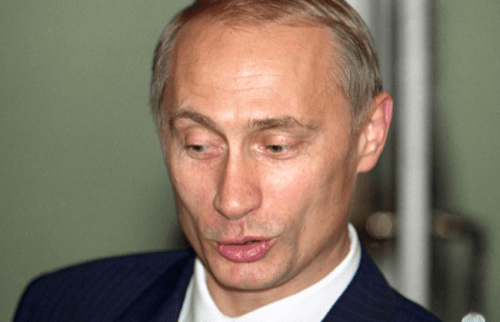
What makes the events in Crimea interesting is that they’re being satirised as they occur, and not by outside observers but by the primary participants. In the war of ironies being waged between Russia and the Western bloc, there’s only one clear winner. Vladimir Putin is a consummate ironist, a master of satire in the deep cold Russian tradition of Gogol and Bulgakov. Obama and Cameron and Merkel don’t stand a chance.

The really remarkable thing about Putin is how eagerly everyone in the West appears to swallow his tough-guy persona. It fits our image of Russia, and it fits the image Russia wants to project. The closest we’ll come to a hermeneutic approach to the Putin-spectacle is to chortlingly point out that for all his draconian homophobic policies, Vladimir Putin is totally gay. Tigers: flaming. Riding a horse, shirtless, in the mountains: a Village People tribute act. Aside from being a dubious essentialisation of sexual difference, it misses the point entirely. Putin isn’t a muscular he-man; he’s an apparatchik, a KGB dork. He famously had a long career in intelligence, but working for the Soviet secret services wasn’t all murdering dissidents with poison-tipped umbrellas or applying the spirit of détente to James Bond’s dick. Putin’s sole foreign assignment was in Dresden, where by all accounts his job mostly consisted of writing endless reports for his superiors in Moscow while the local Stasi did all the legwork. Putin is a nerd, and his excesses are all classic loser fantasies: learning judo, shooting large animals, flying fighter jets, bedding gymnasts, invading sovereign states, being the tough guy – all have their place in the sociopathic pantheon of nerdy wish-fulfilment. When it comes to nerds I’ll defer to the wisdom of the American right-wing radio host and lunatic Alex Jones: Nerds are the one of the most dangerous groups in this country, because they end up running things, but they still hate everybody, because they weren’t the jocks in high school, so they play little dirty games on everybody. They use their brains to hurt people. And I’m aware of them. OK? I see you, you little rats! As ever, Alex Jones is completely correct; there’s definite malice in the intrusive new reign of the Silicon Valley dorkocrats. But at the same time, nerds are attuned to the cruel ironies of the world in a way that high-school jocks like Alex Jones and self-righteous stoner fratboys like Barack Obama will never understand. They might be vicious, but at least they have a sense of humour.

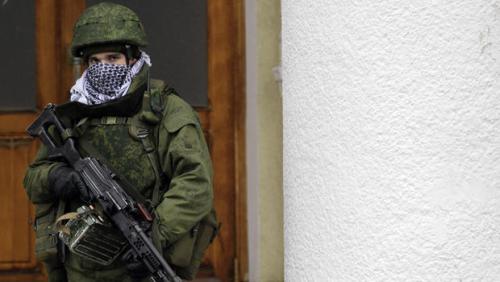
Putin brought this out in his press conference on the 4th of March. Over sixty-six minutes, he made a series of outstanding claims. The armed men who had surrounded Ukrainian bases in Crimea and were demanding the surrender of those inside were clearly spontaneous local militia. Their uniforms, which looked suspiciously like those of the Russian military but lacked any insignia, were probably bought from army surplus shops. At the same time he vigorously defended Russia’s right to intervene in defence of the Russian-speaking population of Ukraine, even though that was definitely not what was happening. He had authorisation to intervene from the regional government in Crimea and from Victor Yanukovych, who was still the legitimate president of Ukraine despite being a powerless, corrupt, murderous, pathetic little worm. (This was a particular flourish; it’s not hard to imagine the lickspittle Yanukovych weeping into his pillow in Rostov-on-Don between stern-faced press appearances. He’s stuck now; Putin can do what he wants with him.) He even laughingly fessed up to the endemic corruption in Russian politics – it’s hard to see American leaders doing the same, despite the billions flowing into election funds from corporate lobbyists. If there’s one weakness in Putin’s performance, it’s that he was slightly too eager to explain the joke, comparing his incursion into Crimea with NATO intervention in Kosovo and Libya. Putin knows that most of what he’s saying isn’t true, and he knows that you know that too. Unlike Colin Powell showing made-up images of imaginary Iraqi bioweapons labs to the UN, Putin isn’t trying to make you believe him. The point is that he can say it; his talk of Crimean self-determination and human rights and the threat of ethnic cleansing is a self-conscious satire of the language of humanitarian intervention. Western states have reacted with such opprobrium not because of any geopolitical threat but because the sanctity of the Just War is being mocked. Lead is the parody of gold, coitus is the parody of crime, Crimea is the parody of imperial war. Parody is always a disruption of existing categories. The Russians have no insignia, no accountability – and, worst of all, they haven’t even had the decency to kill anyone yet.

Western condemnation has admittedly taken a lacklustre form. This might be because its chief instigator is US Secretary of State John Kerry, a great honking dullard with a face as dull and as oblong as a pencil eraser, a flouncy New England boarding-school cretin who somehow lost an election to George W Bush but still managed to wedge himself into a position of power through an unholy combination of dim-witted persistence and the $750m in his family coffers. In response to Putin’s press conference, the State Department published a listicle of ’10 false claims about Ukraine.’ If there’s one thing that could make Putin’s call for a return to traditional values sound appealing it’s this: for all the many sins of past societies, the dominant literary paradigms tended to be poetry or prose fiction, rather than BuzzFeed. Numbered lists might convey information in an exciting viral-ready format, and it might even be factually correct in the most banal of senses, but only rarely can they expose the cold truth of the world. The discourse they impose is one of bland attachment to existing conditions: here are some experiences, in gif form, that you will relate to if you have curly hair, or a Jewish boyfriend, or were born in the 1990s. The point of great art is to induce a sense of vertiginous estrangement. Vladimir Putin takes his place in a long line of expert ironists – along with the God of the Old Testament, Hamilcar Barca, Maximilien Robespierre, General Butt Naked, and the Google ‘I’m feeling lucky’ function – that do precisely that.
How to overthrow your own body

Pictured: Gold medallist, men’s 750,000 metre coup

Human language had a good run, but it’s about time to admit that the whole experiment has ended in failure. For two hundred thousand years we’ve been flapping mouths and breathing spittle at each other in a supposedly meaningful manner. We’ve invented needlessly complex processes for immortalising these self-important eructations, first on rock, then paper, then computers. It’s hard to calculate exactly how much this habit of language has cost us over the centuries, but it could only run into the tens of trillions of dollars. All those cuneiform temple inscriptions, all those public speaking engagements, all those shitty radio panel shows – and for what? The whole system has proven itself so useless that we feel the need to periodically massacre each other for attaching the wrong meanings to the wrong set of belches. This still goes on today, despite the fact that it’s now well known that words can never really refer to things but only to other words. Language is the hideous bastard hatchling of a hydra and and an ouruborus, and it needs to be slain immediately. If any further evidence of this is needed, you only have to look at the official readout of Obama’s phone call with Putin concerning the Russian intervention in Crimea.

The degeneration of language is happening at a frightening pace. Nothing in Obama’s ninety-minute conversation makes any sense. The phrase ‘going forward’ (a ghastly coinage bordering on the eldritch, one that’s apparently supposed to convey an energetic dynamism but only summons the image of some unfortunate person drowning in an office cubicle as it slowly fills with printouts of pie charts) appears twice in the space of four sentences. Obama talks about the Budapest Memorandum and the Helsinki Final Act and the Organisation for Security and Cooperation in Europe; he sounds like a dorkily enthusiastic teenager getting a bit too wrapped up in his performance at a Model UN conference. He hints at sanctions, as if half of Europe weren’t dependent on Russian gas. It’s a twisted parody. Language is, before anything else, a vector of deception. The United States government has broken all the agreements he mentioned, reneging on its promise not to extend NATO up to Russia’s borders, helping prompt and direct the nationalist revolution that overthrew Yanukovych, engaging in wars of aggression across the globe. More fundamentally, he’s pretending that he and Putin are something other than what they are: a pair of bureaucrats instead of two bloodstained warlords, each of whom could, if the fancy took them, kill every single human being on the planet several times over. There’s no record of Putin’s response to Obama’s extended series of laryngal honks, but you get the impression that he’s gently humouring this earnest American who doesn’t seem to understand the way the world actually works, playing along in his game of talking about other words rather than things. It’s a shame, because for a while Putin looked like the only person who could save language from itself. In 2008, as Russian tanks were comprehensively fucking the Georgian army, he declared his intent to ‘hang [Georgian President] Saakashvili by his balls.’ This is what linguists call a speech act, doing by saying; precisely through abandoning the principle of representation it’s the closest words can come to being about things.

There aren’t many speech acts in the current crisis. We’re beyond the point where we can meaningfully distinguish between words and deeds. The Russian intervention in Crimea is intended to send a message to the new government in Kiev and its backers in Brussels and Washington; action has become infected with the sordid ephemerality of language.

~

In the end, this whole mess can be blamed on the Sochi Winter Olympics. It’s a well-known and boring fact that in ancient Greece, wars were put on hold for the duration of the Games. The idea of doing the same thing now isn’t just infeasible but nonsensical; war and the Olympics are one and the same thing. Host governments treat the Games in much the same way that they treat foreign wars: they provide a chance to issue some contracts and boost important industries, they let you redraw the maps (turning a beach town into a mountain resort, or a moulding industrial park into a germ for gentrification), they’re a matter of national pride and a propaganda vehicle that helps calm internal contradictions – but at the same time they never seem to deliver the profits they promise; the costs inevitably spiral, and afterwards they tend to leave cities full of half-ruined buildings. It’s not just a matter of resemblance. With their vast crowds and attending dignitaries they’re a deliberate target for terrorists, allowing the hosts to show off their various defence technologies to the world. London 2012 wasn’t much more than an enormous arms fair, with an aircraft carrier on the Thames and missile batteries on the roofs of homes. Russia in particular seems to like conducting its imperial adventures during the Games. While jets battered Stalin’s birthplace in Georgia, representatives from the two countries were playing beach volleyball in Beijing. The Ukrainian paralympic team is still in Sochi. All this isn’t a distraction from the sport; it’s another facet of the same phenomenon.

Of course, sport is fascist bullshit. Liberal critics of organised sport like to hone in on its aggression and competition and the absurd salaries paid out to its practitioners, but none of this is the real problem. It’s true that most Olympic sports are some kind of symbolic warfare (with the potential exception of figure skating, although there’s still a case to be made against it), but a tendency towards aggression and competition is only a secondary characteristic of the fascist cosmology. The fundamental fascist vision is one of a cohesive and organic society, a society structured around the metaphor of the healthy body. Any politics of the body will by necessity be a politics that acts on the body: the healthy body becomes a regulative ideal, and images of healthy smiling men marching off to the front are suddenly everywhere. This spectacularisation of the body is always present (millions of people watch the Olympics), but it’s always also accompanied by the idea that health is good in and of itself, beyond any relation to the aesthetic. Individual health means social health. In Russia, the connection between the healthy body and militarism is still very much alive; Putin himself is constantly taking his shirt off to ride horses, wrestle tigers, catch fish, and otherwise demonstrate his unparalleled dominion over the animal world. In Western countries we generally prefer to wage war through silent and terrifying robots of death, but as the population grows steadily more obese and work is increasingly an activity that takes place in front of a screen (a screen showing sales figures, a screen showing a Pakistani village about to be obliterated, it makes no difference), the issue of health becomes a matter of deep general concern. And, as everyone knows, the best way to become healthy is through sport. Sport isn’t dangerous because it encourages competition or tribalism; it’s dangerous precisely because it’s healthy.

If there’s a central fascist procedure, it’s the subsumption rather than the sublimation of contradictions. Class antagonisms are buried in the organic nation, internal difference is either consumed or ejected, all cracks are papered up. The healthy body is a prime example of this. The ideology of sport and fitness has its roots in Victorian England – muscular Christianity, artificial famines in Ireland and India, the desperate belief that sports will prevent masturbation – but while it reached a kind of apex in the historical Fascism of the twentieth century, it stubbornly refused to die with its host. Left-wing responses to all this nonsense have been sadly anaemic. The most popular is a kind of body-euphoric self-affirmationism: the idea is that we should embrace all bodies as healthy and all bodies as beautiful. This appears to be a response to the dominant cult of fitness, but really it’s a capitulation to it and a failure to challenge its terms. Fitness and beauty are still good, sickness and ugliness are still bad, but the latter two are shoved beyond some metaphysical horizon. Instead of embracing ugliness in ugliness and as ugliness, its very existence is denied.

The figure of the body is a central concern of poststructuralist theory, and the academic tendency to refer to people as ‘bodies’ (based on the idea that the person is a fictive construct – after all, the word itself derives from the Latin persona, or mask – and that the only thing we can safely say about someone is that they have a body) seems to have filtered into a lot of non-academic discourse. At the same time the body itself is often instrumentalised rather than examined; this is why there’s so little real resistance to fitness fascism. It’s there from Foucault. In Nietzsche, Genealogy, History, he writes: The body is the inscribed surface of events […] and a volume in perpetual disintegration. [Our] task is to expose a body totally imprinted by history and the process of history’s destruction of the body. Foucault seems to have a blind spot when it comes to the body; his approach to it is surprisingly un-Foucauldian. Genealogy opposes itself to the search for ‘origins,’ but when Foucault discusses the body as a site of scarring and crumbling, he implies the existence of an originary unscarred and unimprinted body; a body that’s perfect and primordial and pristine. There’s no such thing: a newborn baby is bloodied and screaming. It’s necessary to admit that there is no primordial unitary body, that the thing we call the body is nothing more than the collection of scars that constitutes our experience of it. There’s only a series of metamorphoses without aim or origin, and the healthy body is only another kind of deformation.

The overthrow of the body is a matter of urgency, because things aren’t going well. The new Ukrainian government includes six ministers from the neofascist Svoboda party. Russian soldiers are surrounding military bases in Crimea. The year ends in fourteen, idiots are in charge across Europe, and two global alliance systems are squaring off as Slavic nationalists do their best to rile up a great power. In the end it’s about language, the filthy habit of humanity. If your throat coughs up a hard g sound like a Russian then you’re shunted to one side, if you wheeze an h like a Ukrainian you’re on the other. The shame that periodically surrounds the body tends to be centred on shitting and pissing and fucking, because these acts remind us that the body isn’t a unitary entity closed off from its environment; really it’s speech that’s disgusting, because it lets us pretend that it is. The idea of an organic and discrete Ukraine and an organic and discrete Russia is dependent on the metaphor of an organic and discrete body. Irredentism echoes Foucault: history has effected a crumbling-away of the national body, but rather than just uncovering this body they want to restore it. The mad advocates of health and fitness have nuclear weapons at their disposal. If humanity is to survive the coming century, we all need to start smoking heavily.

On the state of the State of the Left

If he up, watch him fall, I can’t fuck wit yall.
Pimp C, Big Pimpin’

Among the guardians of sclerotic radicalism, the ones who like to make grand pronouncements on the Current State of the Left, it’s become a grim axiom that we’ve somehow been defeated. This is pronounced with all the usual apocalyptic wailing: we’ve become weak and petty, we’ve splintered into irrelevancy, we’ve retreated into academia, we’ve polluted ourselves with all manner of useless theory – Nietzscheanism, Foucauldianism, intersectionality, ontology, cultural studies. Those who still hold to some kind of Marxist or communist line are like the seventh-century squatters in Diocletian’s palace, shivering in the walled-off ruins of something grand and terrifying and extinct while the barbarians scour the countryside. They’re right. The State of the Left is a terrible one: palsied, liver-spotted, emphysemic, crying out with its sandpaper rasp for a strong dose of barbiturates in a comfortingly bleak Swiss clinic. The point is that the State of the Left is not the same as the actual Left. Like all states its function is to arrive to us already in an advanced state of decay and to wither away as soon as possible. The left itself is doing just fine.

The moaners and complainers are ignoring a central lesson of the dialectic. Marx describes precisely its revolutionary quality in his 1873 postface to Volume I of Capital: the material dialectic regards every historically developed form as being in a fluid state, in motion, and therefore grasps its transient aspect as well; and [does] not let itself be impressed by anything. Deleuze and Guattari touch on a similar point in Plateau 1730 of Capitalism and Schizophrenia: in a becoming-animal what is real is the becoming itself, the block of becoming, not the supposedly fixed terms through which that which becomes passes. Any single State of the Left will be dead as soon as it is pinned down. Those who gripe about this or that static problem in the radical movement will see it as an endless succession of corpses, rather than a living motion.

And it is alive. As China plunges ever deeper into the watery graveyard of neoliberal accumulation, autonomous peasant uprisings are becoming a near-daily occurrence. In India the Naxalite insurgency governs vast swathes of the country. Radical left parties – both Cold War relics and newer coalitions – are gaining increasing support across much of Europe. Radical left magazines are reaching and radicalising new audiences. Protest movements are flaring up across the globe. Whatever the ideological or practical failings of these individual bodies or movements (and they exist), their emergence and resurgence is reason enough to be hopeful. The evidence is mounting for the radical – and correct – idea that the current way of doing things simply doesn’t work. There is significantly more debt than actual money in circulation, we’ve invested well over one planet’s worth of resources in the existing order, the wealth gap gets broader and more perilous with every crisis, the conditions necessary not only for social but biological life are being eroded, Macklemore won every rap award at the Grammys. Most importantly, this increasing consciousness of the sheer insanity of existing conditions has prompted an unashamed and unapologetic revival of the signifier communism.

In The German Ideology, Marx writes: Communism is for us not a state of affairs which is to be established, an ideal to which reality will have to adjust itself. We call communism the real movement which abolishes the present state of things. The State of the Left is not communism. Politics, properly understood, is the practical arena in which the question of how life should be lived is contested and the method through which human beings can through mass action entirely overhaul their mode of existence. The State of the Left, more concerned with ossifying the present state of things with the basilisk stare of its displeasure than abolishing it, is not only non-communist but non-political. It’s squabbling for position and the allocation of immaterial resources, the reconfiguration of left politics into left politicking, and beyond any ideological or practical objections it’s profoundly, abyssally boring.

It’s for this reason that I try to engage with this stuff as little as possible. My last flight into the turbulent miasma of leftist infighting was a response to Mark Fisher’s ‘vampire castle’ nonsense, mostly written because everyone else was doing one and as an excuse to spend a few paragraphs playing around with Gothic metaphors, which are always fun. This intervention is prompted by something a little less conceptually fecund. Recently, Richard Seymour (formerly of the Socialist Workers Party and author of the often excellent and occasionally execrable blog Lenin’s Tomb) resigned from the International Socialist Network; much of the crowing at his apparent fall from grace has been led by Ross Wolfe (formerly of the Platypus Affiliated Society and author of the often execrable and occasionally excellent blog The Charnel-House). The dispute that prompted this move centred on the racial implications of a work of art-cum-furniture owned by the Russian socialite Dasha Zhukova, with Seymour insisting on the acceptability of something called ‘race play.’ Personally, I think that to complain about the chair that an oligarch’s girlfriend chooses to sit on is to miss the point a little (especially when cops are shooting people of colour in the streets with impunity), but I’ve no interest in trying to wave away someone else’s sense of outrage or direct it from the outside. What’s important here (for a given value of ‘important’) is that an argument about a chair ended in a further split in what’s still masquerading as the left.

Seymour (and others) have previously complained of a ‘politics of anathema’ within the ISN; others have pointed to a supposed culture of excommunication throughout the left and tied it (unfairly, I think) to the increasing influence of intersectionality theory. It’s easy to disdain all this polemicism as being contrary to the spirit of reasoned debate, but the practice of polemic has a very distinguished leftist pedigree – Marx against Bakunin, Lenin against Kautsky, Stalin against Trotsky, Mao against Khrushchev, Tito against his own conscience, Hoxha against the slimy creatures scurrying inside his walls at night, Kim against the oral stage of psychosexual development. We have a leftist duty to engage in criticism and self-criticism, to get rid of a bad style and keep the good, to not let things slide for the sake of peace and friendship when a person has clearly gone wrong. What we shouldn’t do is confuse these duties with communist praxis.

Purely rational debate isn’t something that’s ever existed; it’s a transcendent regulative ideal buttressed with violence and used to hold back people who actually have a stake in the game. Insisting on measured reasonableness in a time of crisis is madness. Something’s changed, though. The new polemicism and the old polemicism don’t look very much alike. The discussion inevitably ends up veering away from politics because politics is fundamentally not a concern here. One of Seymour’s accusers on Facebook wrote: I hope a bird shits on you. I hope a bird shits on you every day. Catullus it ain’t. (Besides, isn’t being shat on by a bird supposed to bring good luck?) This is the real problem with the current leftist infighting: rather than being too vicious, it’s not vicious enough. I’m not going to make prescriptions about how this stratum of contest can be reformed; it’s a useless husk, and its uselessness is affirmed by how seriously everyone involved takes it. Calls for unity and pleasantness in a State of the Left already clotted into paralysis miss the point entirely. If anything, more splits, more divisions; everyone knows that communist cells reproduce asexually. But if we are to have a pointless squabbling sideshow to left activism, the very least it could do is make itself interesting.

PS: For all the complaints of excommunication, the State of the Left is hardly catholic or Catholic in nature. Excommunication is a profoundly dialectical censure; the object is to prod the wayward sheep back into the fold precisely by showing them what going it alone would mean. Instead, the function of contemporary left infighting is a kind of secular takfirism, a static universalism within strict horizons. Excommunication is vicious, takfirism is merely brutal. Once you’ve been pronounced apostate, there’s no return. You might follow the same doctrine and the same liturgy; it doesn’t matter – you are our enemy and always have been. This can be seen in the doctrine of Platypus: only one obscure Marxist reading group can rescue the left from its ruin, everything else must be destroyed. It’s hard not to be reminded of the splinter groups in the Algerian Civil War that were able to declare themselves to be the only true Muslims and every single person outside their militia kafir.

Why I want to fuck Boris Johnson

Apologies to J.G. Ballard. No, really. I’m so sorry.

THE ZIPLINE INCIDENT: MYTHOPOEIA OF THE LEGENDARY

Focus group surveys aimed to reproduce a representative sample of the British population at large for market research. Subjects surveyed included a recent university graduate wondering how long he has until it’s no longer acceptable to listen to house music, a semi-popular circuit comedian gradually metamorphosing into his own character, a harried single mother who’s been tramping up and down a single supermarket aisle for fourteen consecutive hours, everyone inside a Blackpool bingo hall at 7 pm last Friday, a Welshman, an ethnic, and a football with a smiley face drawn on in felt-tip pen. Most subjects were recruited for consumer surveys through pop-up adverts on the lactation fetish pages of several popular pornographic websites; others were kidnapped on the street; some were grown in vitro and have lived here their entire lives, consuming nothing but weak tea and re-runs of BBC panel shows.

Subjects were asked to evaluate Boris Johnson’s performance in a number of Mayoral duties: leading an army of warriors against the goblin menace, pushing back the tide as it creeps up the Thames in his quest for a new airport, initiating a nuclear attack on Argentina, nursing a newborn fawn at his lactating teat, baking a tray of delicious muffins, and dangling from a zipline. Evaluations were given on a five-point mythological and meta-narratival scale, descending from epic through legendary, saga-esque and apocryphal to Talmudic. A full 91% of respondents considered the Mayor of London’s breastfeeding abilities to be either legendary or epic. In response to being questioned on his abilities as a military leader against geopolitical, elemental and supernatural foes, most respondents either marked him as Talmudic, considered the question to be metaphorical, or begged to be released. During a word association exercise Johnson was, in 82% of cases, identified with the ‘maternal’ against the ‘paternal’ element of a word pairing (as in cake/bread, warm/cold, shame/fear, hate [existential]/hate [conditional], wine/beer).

JOHNSON’S HAIRSTYLE

Subjects were asked to give examples of consumer products that could be improved or more easily marketed if supplied with their own trademark straw-coloured Bojo mop. ‘A potato’ was not included in statistical analysis given the bewigged potato’s physical indistinguishability from the Mayor himself. The most popular non-tuberal responses were (in descending order) a dead pigeon on the pavement, the pudenda, standard issue prison uniform, a small heap of used teabags, and the white cliffs of Dover.

TOP BANTER

Altered footage was assembled, using a team of Californian CGI artists, of the Mayor appearing to perform the following comedic routines: a rambling and repetitive Stewart Lee monologue about shoelaces, Michael McIntyre drunkenly failing to seduce a 17 year old in an Edinburgh dive bar, the Socialist Workers Party Disputes Committee’s proceedings against Comrade Delta, and Hitler’s speech before the Reichstag of July 13th 1934. All were seen by the vast majority of subjects to exhibit Johnson’s trademark wit and intelligence. The latter sequence, when spliced into Dave’s regular Tuesday night programming, is believed to have caused a statistically significant spike in the national birth rate nine months later. Video footage of ‘Boris Johnson’ stamping on kittens was, when rated on a scale from cute and blimey to fail and trashy, voted cute by 87% surveyed.

THE GENETIC ARISTOCRACY

99.87% of sixth-form students at St. Jonty’s School for the Incurably Retrognathic believed themselves to be among the 2% of the human species with an IQ over 130. The same proportion, when presented with the idea that ‘intelligence’ when phrased in such terms is nothing more than an instrument used by those with social status to justify their position after the fact and to wage war against those without, agreed vociferously, adding that this is exactly as things ought to be.

MACHINE RUNWAY HYPERSYNTHETIC GENODATA NANOSPASM

Subjects were introduced to the ‘Bumblorator 3000,’ a basic robot programmed to painfully wound them and then make a brief apology or a comic pratfall. Laceration with a rotary blade followed by ‘oh, I am frightfully sorry’ produced a weary chuckle in 63% of subjects. Removal of the lower teeth with pliers followed by a collapse into a small pond produced a 77% rate of muffled sympathetic giggling. Decapitation of the subject with a rusty machete followed by ‘my word, what could I have been thinking’ produced an apologetic grin in 61% of freshly severed heads.

BORIS JOHNSON’S FACE: CRISIS OF POSTLIBIDINAL SEXUALITY

Several scenarios were drawn up by market researchers for sexual congress with Boris Johnson; among them ‘creepy uncle at Christmas,’ ‘forbidden thrill of filial incest,’ ‘boyish public school hijinks,’ and ‘coked-up yacht orgy.’ Almost all were deeply unsuccessful, with subjects (drawn from the ear, nose & throat wards of three hospitals) reporting sensations of extreme distress and self-recrimination. The conclusion that Boris Johnson was not a fit libidinal object was broken by two anomalous findings. Firstly, simulated congress involving rope, hot wax, body hanging, coprophagia, urophagia and nipple clamps was reported to result in a sensation of fuzzy warmth tinged with bittersweet nostalgia. Secondly, scenarios in which Boris Johnson was presented attempting coitus with non-human objects including a cupcake, a copy of the Daily Telegraph and a porcelain teacup induced spontaneous orgasm within two minutes in nearly all subjects. When replicated across the board a similar result was obtained.

While the faces of Tony Blair, David Cameron and Nick Clegg uniformly provide genital – specifically phallic – suggestions, that of Boris Johnson was held by 81% of those surveyed to resemble the breasts of a woman or the buttocks of a man. The Mayor of London could be held to represent a pornographic or post-libidinal sexual politics in which he simultaneously represents sexual object and fetish-object, the central point in a sexual topology otherwise characterised by total indifference. Should Boris Johnson succeed in becoming Prime Minister the suicide rate is not expected to spike significantly, although a gradual increase in fatal incidences of auto-erotic asphyxiation is inevitable over the course of his term. The actual conversion of the entire country into an enormous playground for international finance capital should result in no more that 1-2 million excess deaths.

How to spot an illegal immigrant: a UK Border Agency guide

Beyond what I am, I meet a being who makes me laugh because he is headless; this fills me with dread because he is made of innocence and crime.
Georges Bataille, The Sacred Conspiracy

A series of public UK Border Agency raids in the last few days has attracted the usual furore from the usual quarters, with various pious lefties throwing around accusations of racism based solely on the fact that officers deployed at various train and tube stations were only stopping commuters from visible ethnic minorities. Meanwhile, the publicisation of the raids on the Home Office’s Twitter account has attracted criticism for supposedly being ‘totalitarian,’ ‘a blatant Tory election ploy,’ ‘some serious Children of Men shit right here,’ and ‘a further demonstration of the chimerical and ungodly union between racialised state violence and the pseudo-democratic spectacle of social media.’ In the interests of combating such nonsense, the Home Office has released to the general public this guide, which lays out the criteria by which trained officers can distinguish potential illegal immigrants from ordinary people of colour on sight.

Illegal immigrants, who are known to derive perverse enjoyment from stealing the jobs of British workers, may be identified by their sadistic grins, or expressions of haughty contempt. They may also have bulging pockets, a large rucksack, or a burlap sack printed with a pound sign, in which stolen jobs may be stashed.

While legal British residents tend to have a stoop, hunch, slump, limp, crimp, clob, grag, bort, or other psychologically induced musculoskeltal deformation, illegal immigrants typically display the upright bearing and proud stature of one whose back has not been broken under the weight of labour regulations or union representation.

Many illegal immigrants have been trafficked in to the UK to work in the sex industry, often in positions of indentured servitude. Such offenders can be distinguished by their bed-tousled hair and the healthy sweaty radiance of someone who is definitely getting a lot more action than you are.

Recent illegal immigrants may not have fully adjusted to the social codes that govern life in the UK. Telltale signs include sartorial choices (a swan’s neck worn as a stole, corgi slippers, a lucky red squirrel’s head pendant), food (curry that is not masala, korma, balti or jalfrezi), or suspicious behaviour (any deviation from the mandated autism and perpetual embarrassment of British public life).

Any person who appears at all disturbed or frightened by the presence of officers in stab-proof vests demanding documentation from passers-by is behaving suspiciously and should be immediately handcuffed to a seat on the next flight to Lagos.

Funny moustaches on men, pregnancy on women, an expression of existential bewilderment on the faces of children. Tweeds in unusual colours. Any honest hope that tomorrow might be better than today. Joy, vitality; misery, real misery, black and incandescent. Anything whole and total. Any sense of vastness, any ocular gleam betraying the faint memory that the edge of the firmament does not curve in a shimmering curtain from Land’s End to John O’Groats.

The illegal immigrant’s lack of papers is an innate rather than a contingent attribute. As such, officers should be aware of any persons on public transport who appear unwilling to pick up or carry copies of the Metro or Evening Standard, or whose hands seem unable to even touch them, as if repelled by a strange magnetic force.

When show a picture of the Queen, illegal immigrants may hiss, recoil in horror, spontaneously burst into flames, or collapse into ashes (helpfully saving the Home Office and its private-sector partners the costs of repatriation).

As entering the country illegally is against the law, and breaking the law is cool, anyone exuding an aura of charismatic nonchalance and cheerful self-assurance should be apprehended. They are almost certainly an undocumented worker; and even if their papers are valid, they’re definitely up to something. Anyone meeting these criteria and also wearing sunglasses should be tackled to the ground with no warning and with entirely disproportionate force.

Some police dogs have been trained to pick up the scent of intrinsic bodily illegality. Due to the high levels of background illegality, which has been known to confuse the dogs or send them into a frothing omnicidal fury, it is recommended that the UKBA not deploy them in the City of London or Canary Wharf areas.

After crossing a national boundary, the ontological and material status of the illegal immigrant is permanently altered. Many are subsequently able to move through solid objects at will. Be alert for persons emerging out of walls, passing through doors without opening them first, holding a briefcase through its centre, walking ankle-deep in the pavement as if it were no more substantial than a fragrant early dawn mist, etc.

Remember above all that these people are not criminals; they are crime itself, their existence is crime itself.

Other documents made public by the Home Office include plans to capitalise on the impact of the ‘racist van,’ a mobile billboard that drives through multicultural areas with a sign telling immigrants to ‘go home.’ In addition to racist rickshaws, racist hydrofoils, and light racist aircraft, the next steps in the mechanisation of racism will include an airport security gate that beeps in the presence of melanin rather than metal, a phone that makes automatic calls to the council whenever ‘those people’ next door play that dreadful dancehall music, a toaster that burns a carbonised transcript of the ‘rivers of blood’ speech onto every slice of bread, and a coin-op laundromat that asks visible ethnic minorities where it is that they’re really from. These innovations are expected to be highly popular, as people will be able to enjoy all the benefits of living in a structurally racist society without having to go through the whole tiresome rigmarole of having to be outwardly racist themselves. Further Border Agency initiatives include a contingency plan in which uniformed UKBA personnel will invade and conquer the eastern Balkans and impose a murderously appropriative colonial regime so as to dispel positive illusions about Britain, and an ongoing project in which the education, healthcare, and labour protection systems are comprehensively wrecked in the hopes that the UK will then become a less attractive destination for migrants.

Abdel Fattah al-Sisi doesn’t care about my face

My body is in open insurrection against itself, and my chin is its Tahrir Square.

Towards the end of last month, as demonstrators in São Paulo were beginning to demand the return of the military dictatorship, I noticed a strange growth on my chin. It was a little like a spot, red and tender on the surface, but it refused to come to a head. Instead a vaguely conical mass sat just above the bone; I could move it around a little, nudge it this way and that, but it felt completely solid and unsquidgeable. Never mind, I thought. It’ll go away soon. And it did, retreating into a tiny hard kernel, as if it was about to vanish entirely.

And then, without warning, it returned. I woke up with my face numb, my cheeks puffy, and an alien virus colonising the bottom half of my face. It was no longer a swelling but an invasion; pressing against my gums, my teeth, its areolae of engorged tissue slanting the line of my chin, its growing bulk pushing out my bottom lip into a permanent prognathic scowl. Eating was painful. So was smoking. Even breathing started to carry a faint dull pain. There are names for these things: abscesses, cysts. Names whose sibilance suggests seeping pus, blood curdling in the off-white purulence, gangrene, death. It had me. I was afraid.

I say it happened without warning. That’s not entirely true. When I went to bed the previous night tens of thousands were gathering on the streets of Cairo to mark the anniversary of President Morsi’s election and to protest the betrayal of their revolution. Millions more were marching across the country; according to some, it was the biggest protest in human history. I was fully supportive: by all accounts, Morsi’s done a terrible job, marrying civil sectarianism with the cold inhuman logic of the markets. When I woke, though, it was to news (blearily observed through the ache in my chin) that the city’s police had declared their solidarity with the youth on the streets. Surely this wasn’t right: one of the main grievances of the demonstrators had been Morsi’s failure to properly prosecute the police and military for their misdeeds in the 2011 revolution and 2012’s Port Said massacre. The cops should have been in there, batons high, riot helmets turning human faces into mere avatars of the forces of reaction. They weren’t doing their job. Instead there were reports of gunshots and deaths in the night with no clear indication of who had been shot and who was doing the shooting, as if the bullets were some kind of freak weather event. As the Egyptian state festered against itself, my face had become my heautontimoroumenos. Something was going horribly wrong.

The creature had laid its roots deep. Its cystic tentacles must have spread around my head and drilled into my brain, because I was overcome by a fit of what can only be called psychotic narcissism. I closed my windows and drew the curtains. I cancelled social engagements. Mirrors, which showed me a face so swollen and lopsided I no longer recognised it as my own, were horrifying; I covered them up. Even the screen of my phone was too reflective; I considered having a go at it with some sandpaper. I was thinking like a cyst, retreating into my own little cavity, where I could swarm.

Everything started to flare again up as General al-Sisi issued his 48-hour ultimatum to President Morsi. Al-Sisi was supposed to be a Morsi loyalist, promoted to his post after the old military elite had been dismissed in the last power struggle between armed and elected authority – and yet here he was, demanding that the Muslim Brotherhood share power or lose it. As he did so my infected cyst bubbled. The entire left side of my face became swollen. A soft, foamy subcutaneous emulsion. My lymph nodes felt like ping-pong balls. My jawline was melting away on one side. I looked as though I’d been genetically spliced with a potato. Before long it was intolerable. I had to see a doctor.

I went to a drop-in clinic at an NHS surgery in Cricklewood, lodged awkwardly between an enormous B&Q centre sitting like a fat orange-roofed slug on its grassy mound and a general tat shop called Aladdin’s Cave. To get there I walked through a narrow grey alley into a small grey car park; the barbed wire that surrounded the clinic was bearded with shredded plastic sheeting. I stood and smoked a cigarette outside the entrance. An elderly woman with a smudged tattoo on her forearm stood on the other side and smoked a cigarette as well. We didn’t talk. Then, as I sat in the waiting room, al-Sisi’s deadline approached. I was the only person there, scrolling compulsively through Twitter, perched above a small forest of institution-blue chairs. The only sound came from the clicking of my phone and a flatscreen TV mounted on the wall opposite me showing Countdown. It was coup o’clock; 2.30 pm Cairo time. Onscreen, the hand whizzed down the face of the clock as the famous music played. I wish the winning anagram had been something germane or significant. It wasn’t. Years after an important event, people sometimes share stories of where they were as it happened. The highest-scoring word on Countdown was ‘parsnip.’ I might remember that for the rest of my life.

The GP who saw me was rather fat and affably Jewish. He told me a lot of what I already knew: I had an infected cyst, a gland had become impacted, and the bacteria had rushed in en masse to fill my face with slime. He prescribed me antibiotics; I now have eighty tablets of flucloxacillin to my name. I doubt they’ll do much good. Whatever his qualities as a doctor, the GP is unlikely to be able to alter the course of events in the Middle East. When I returned home I discovered that President Morsi had been put under house arrest and the constitution was being suspended. Tahrir Square was overflowing with celebrations.

There’s one other thing the doctor told me. If the swelling doesn’t respond to antibiotics and doesn’t go down, he said, if the blockage isn’t cleared – there’s always the option of surgery.

~

There’s a certain superior tone which Western commentators love to bring out whenever mass movements in the developing world take form. If they oppose the movement, it’s patronisingly dismissive, bringing all the accumulated wisdom of four decades’ drinking fairtrade coffee to bear on the situation: these people would do well to bear in mind, they say, or the leaders of the movement ought to consider. When they support the protesters it’s even worse; what’s happening on the ground is twisted into the expression of a Platonically ideal political agenda. The protesters are always fighting for the commentator’s own set of values, and any contradictory voices from the country in question are easily drowned out. We know what you want better than you do. As the crowds swelled in Cairo, the Guardian commented on an Egyptian activist tweeting ‘Fuck Western Media.’ ‘There’s a notable fatigue in Egypt with the Western media and media analysis,’ they said. We’ll keep you updated on our live blog as the situation progresses.

I’m going to try not to do that. I’m going to stick rigorously to the facts. And the fact is that General Abdel Fattah al-Sisi has purposefully, with full calculated intent, given me an infected cyst on the left side of my chin.

The evidence is incontrovertible. I don’t know exactly how he’s done it, but I have a vague idea. This is how. The protests in Egypt were spearheaded by liberal, leftist, and Nasserite parties, among others, under the umbrella of the Tamarrud (or Rebellion) movement. Many of these are the same groups that fought against the Supreme Council of the Armed Forces last year when it tried to write itself into the new constitution, hoping to supersede the powers of the presidency. When these groups did so they marched alongside the Muslim Brotherhood. Now many of these same people (with, of course, a vast number of dissenters) are celebrating the reimposition of military rule. What has taken place is a coup – but that said, Morsi’s government was overthrown not by the military but by the people on the streets; it was finished the moment millions gathered in Tahrir Square. The statements of support for the June 30th Movement by the police and army were not a gesture of solidarity but a means of control; they turned something that might have destabilised the exercise of state power into something that mimicked the state. The situation in Egypt demonstrates precisely the Marxian analysis of the state-form: it’s not a monolithic institution but a tactic, a tool that can be wielded by one group or class or another. As al-Sisi’s deadline approached there was speculation over whether the soldiers guarding the state broadcaster were loyal to the army or the government. In a way, it didn’t matter; they were the state. The state is control; the state is in control of everything apart from itself. When cops march at the head of a demonstration, it stops being a protest movement and starts to become an exercise of government power. Cops have an important role to play in any revolution; with their violence they focus the popular rage, they inflame its energies. As ever, the Egyptians are far ahead of us in the West; they found a way to stop this from happening, and all it took was a mild displacement in the loci of control. But those revolutionary energies are still there. According to the law of the conservation of energy, they can’t just vanish. And I know what’s happened to them. Somehow, by some strange magic, they’ve pooled in the left side of my chin. They’ve been displaced to my face. And Abdel Fattah al-Sisi doesn’t care about my face.

PS: I’ve said this kind of thing before, but it bears repeating: by enacting deeply unpopular policies and pointing to their victory at the ballot box to stifle dissent, the Muslim Brotherhood were behaving not like a dictatorship but precisely like Western liberal-democratic governments. If Britain were as new to representative rule as Egypt is, Cameron and co would have been on the way out some time in 2010. The difference between us and the Egyptians is that they really believe in democracy. We stopped doing that a long time ago.

PPS: Al-Sisi was Morsi’s appointee. One can imagine the scene at the barracks: Morsi, overthrown, weeping into his paternally greying beard, arms outstretched: Abdel, you were like a son to me. Could the whole scenario be reconsidered as an Oedipal drama? What is the state after all but a hideous trillion-titted mother?

Istanbul, Prism, São Paulo: Unearthing chthonic conspiracies


Two events are happening at once. In the year of our Lord 534, it’s a slick, sweaty night in Taksim Square, the kind of night that makes your skin shine and your hair stick to your forehead, the kind of sticky, fecund night that breeds love affairs and revolutions. On this night, although they don’t know it, the citizens of Constantinople are witnessing the last ever Roman Triumph. The great general Belisarius has recaptured Africa for the Eastern Empire: in a few years Justinian I will accuse him of various conspiracies, pull his eyes out, and leave him as a beggar by the gates of Rome, but for now he has his glory. The procession starts. First, the spoils of his conquest. The Temple Menorah, first captured in the sack of Jerusalem and brought to Rome, then seized by the Vandals and brought to Carthage – now restored at last to the Church, its silver gleams as the plebeians crowd round and snap eager photos of the treasure on their smartphones. Then the man himself. Belisarius sits in the cabin of the ceremonial mechanical digger, resplendent in his corona triumphalis, soaking himself wrinkled in the adulations of the crowd. As demanded by tradition, a woman in hijab sits perched on the boom, the long yellow-painted arm wreathed with hydraulic sinews. Hominem te memento, she mouths. Nobody hears her. The crowd waves banners and Turkish flags, they throw flares and garlands of flowers; the riot cops join in the universal celebrations, joyously firing rubber bullets and sending out waves of teargas. The tree-lined street is soon hazy with jubilant smoke. Everything is organised to the finest detail; it’s a spectacle, and the protesters and the police all play their allotted role. Finally, Belisarius’ chariot comes to a halt. A digger knows how to do one thing: it digs. Istanbul is a city built on its own ruins. The Gezi Park demonstrators dig, past Constantinople, past Byzantium, down to the ancient grotto where the Deep State has been managing the affairs of the world for twenty-six centuries. And this excavation has been planned, too; everything is part of the plan.

A few weeks before the London Olympics in 2012, I found myself in small but pleasant company, drinking wine from the bottle in Trafalgar Square, as you do when you’re young and pointless. A man came up to us and asked for a light. We got talking. He was due in court the next day, he told us, he’d been arrested while protesting in support of Julian Assange; he seemed a bit over-earnest but generally quite right-on. Across the square stood an Olympic countdown clock flanked by the two terrifying cyclops-mascots the organising committee had foisted on the world. I must have said something about how I didn’t think it was such a great idea for there to be anti-air missile batteries on residential buildings and carriers on the Thames just to protect a glorified sports day, because he agreed. Plus, he said, if you looked at our hideous logo, the numbers spelled out the word Zion. So did the logo for the 2008 Olympics. And, in the handover ceremony in Beijing, the London delegation had wheeled out a fake double-decker bus in the Bird’s Nest stadium before blowing the roof off to reveal Jimmy Page and Leona Lewis, one day before a real London bus was blown up in Tavistock Square. Unconvinced but not uncurious, I looked into his assertions. Naturally, they were nonsense. To make the Beijing logo read Zion you have to take the whole thing apart seemingly at random. Of course, the 7/7 attacks took place three years before the 2008 Olympics. And if a shadowy Zionist conspiracy was ruling the world behind the scenes, then why would they announce themselves? What on earth would make them leave little clues for us to decode?

 Yeah, no.

Conspiracy theorists aren’t insane, they’re far saner then the rest of us; their delusions are those of sanity pushed to its furthest edge. Where we see a world that doesn’t make sense, they see something logical and precise and – crucially – knowable. Conspiracy theory is the most profound expression of Enlightenment ideology: there is a rational plan behind the phenomena we observe, and it can be uncovered through reason if you study and interpret those phenomena hard enough. In other words, there’s not as much separating dialectical materialism from the Space Lizards theory of western civilisation as good Marxists like myself would like to believe. It doesn’t really help that the world of late capitalism is, to some extent, structured exactly like the wildest fantasies of the conspiracy theorists. There really is a tiny – globally speaking – cabal at the top of the pyramid that run the lives of the billions below. They really do meet, occasionally, in secret summits with no reporters and no minutes taken. They really do pull the strings of our elected politicians. They really do leave clues to their activities; not as coded symbols, but in the newspapers – society’s conspiracy against itself is hidden in plain sight. The Queen really does look quite a bit like a cold-hearted creature from beyond the stars. Conspiracy theory is the nomos of a society in which the lacerations of democratic openness have become themselves a form of occlusion; in form, if not in content, they reflect actual conditions. The only difference is that there’s no singular teleological Plan; the initiates are just as dumb as the rest of us. There are only personal and class interests, bouncing off each other at a million intersecting angles.  We’re ruled not by cabals but by structures; conspiracy theory reduces the grand saga of the word to a roman à clef. Althusser describes the hidden conspiracy at the heart of society on the first page of Ideology and Ideological State Apparatuses: every social formation must reproduce the conditions of production at the same time as it produces. Reproduce the conditions of production: this is the creed of the Templars, the rite of the Illuminati, and the Wu-Tang Secret.

Take the recent revelations about the NSA’s Prism system. Snowden is undoubtedly a hero, if a politically naïve one, but what he’s told us isn’t really anything new. Everyone understood already, in some vague sense, that Western governments were breaking the law and spying on the internet communications of their citizens, it’s practically axiomatic. The diplomatic cables released by Wikileaks told us more of what we already knew: US ambassadors were exasperated with every country they happened to be stationed in, and their hosts were equally bored with the meddling hyperpower. Leaked recordings of a conversation between Obama and Sarkozy revealed that neither of them much liked Israeli President Netenyahu; well, of course not, the man’s an utter twat. It’s not just that Bush and Blair lied about WMD to take us to war with Iraq; they didn’t even bother to make their lies convincing. The really dangerous liars are those who claim to have been convinced by the evidence in 2003. In the 1970s, Nixon and Kissinger went to extraordinary lengths to cover up their secret bombing of Cambodia; now, in 2013, every drone strike gets a short paragraph in the newspapers, described in neutral terms, as if they were natural disasters rather than acts of war. If you want to do evil, it’s far easier to do it out in the open. That way, when you’re called out on it, you can just shrug your shoulders and say: “Yeah. So what?”

What makes the recent Turkish protest movement interesting in this regard is that here it isn’t the protesters entertaining absurd conspiracy theorists; it’s the government. Edrogan has accused the protesters of being part of a global conspiracy against his government, one that takes in the feeble secular opposition, the international finance system, the BBC, the Knights Templar seeking to avenge the fall of Jerusalem, the reptilian aliens hoping to neutralise the threat posed to them by the indomitable Turkish race. So he’s crazy. After all, it’s not like his AK Party hasn’t done plenty of sucking up to finance capital in the past. Except the Turkish deep state, a murderous conspiracy of the anti-democratic and pro-secular powers that be, really did exist, and everyone knew that it existed long before it was officially uncovered. Did the protests seep up from its subterranean chambers? Probably not, but in its context the government response is understandable if not excusable. This is why Edrogan wants to pave over Gezi Park: parks are dangerous, anything can burrow down there; it’s easier to hatch plots beneath the soil than beneath a shopping centre. Conspiracies reach for the cloudless heights of power, but they’re always based underground. Chthonic spaces are hideous, they spawn plots and sacrilege. For all the years that Osama bin Laden was living comfortably in a two-storey house in Abbottabad, it was generally assumed that he was hiding out in a cave somewhere. In Negarestani’s terms, holey spaces subvert the plane of the monotheistic desert; the Inside is the spawning-ground of blasphemies.

The crackdown on the Taksim Square protests is, of course, being compared to the Arab Spring; all the tedious old questions about the compatibility of Islam with liberal democracy are being summoned from out of their graves to shuffle hungrily around newspaper opinion pages. Really, the government’s response should be answering these questions rather than posing them. Thousands were brutally beaten in the co-ordinated crackdown on the Occupy movement in 2011; the previous year riot police in London pulled a student demonstrator from his wheelchair and attacked him with batons. In ignoring demonstrators’ demands and sending in armoured cops against them Erdogan isn’t behaving like the archetypal Islamic dictator; he’s following to the letter the model provided by the Western democracies.

 Oscar Niemeyer’s Brasilia is the inverse of Haussman’s Paris. Its openness neutralises the advantage of police over protesters; in building a home for the state, he abolishes the State as such. His congress building is a stage. It moulds reality into revolutionary art.

The sound of truncheons against skulls echoes across the Atlantic. It’s interesting to note that the protest movement in Brazil is breaking out just under a year before (and is in part sparked by) the 2014 Brazil World Cup, just as the 2011 riots in England broke out just under a year before the 2012 London Olympics. Maybe this marks the beginning of a pattern: the symbolic violence of organised sports must be proceeded by real, political violence. The rioting functions as a prologue, an unofficial opening ceremony, to get everyone in the appropriate mood. Meanwhile the international news media will know to get their crews and commentators on the ground a year early to catch the mayhem. In 2019 a former footballer sits in front of an animated mural of a burning Almudena Cathedral. Outside the studio, the sky glows a demonic red. “A really strong showing from the rioters here in Madrid, Terry,” he says. “They played an great game, they were incredibly passionate, but honestly you have to hand it to the police. Excellent formation, really strong use of tear gas and pepper spray, top form throughout.”

The situations in Turkey and Brazil are, of course, not the same; nonetheless what’s happening in São Paulo might serve as a warning for Taksim. Ominous reports are coming in from Brazilian comrades: what started as a movement against a hike in transport prices spearheaded by working-class anarchist and communist parties is being hijacked by the far right. Red flags are being burned. Leftist demonstrators are being attacked, not by the police, but by the fascists in their midst. There are calls for the reimposition of military dictatorship. One account describes the origin of the situation very powerfully – I’m quoting at length because the author is, unlike me, on the ground in São Paulo; she describes the conditions there far better than I ever could:

The initial wave of protests were organized by the MPL, Movimento Passe-Livre, which is an autonomist anarchist movement, based primarily in public universities. Their main goal is and always was free, public funded transportation. The protests were organized in response to (left-wing, social democrat/liberal PT Worker’s Party) mayor Fernando Haddad’s and (right-wing, conservative, social democrat in name only PSDB governor) Geraldo Alckimin’s hikes in bus and metro fares.

The protests were instantly joined by communist parties PSTU, PSOL and PCB. The MPL, due their anarchist ideology, denounced party participation. This will become important later on.

The media, at first, launched a total offensive against the protests, accusing it of vandalism, and of being made-up by extreme leftists. They justified the actions of the armed Military Police of Brazil (which is a Gendarme), which was, at the time, shooting rubber bullets at people’s faces (which is lethal), beating up primarily women, using lots of tear gas and pepper spray to disperse the movement, as well as several intimidation tactics, such as baseless arrests (including the famous arrests for vinegar possession).

The media realized that despite all of their efforts, the movement had a popular agenda and had been garnering support across progressive sections of the population. One very popular ultra-conservative pig-loving anchor attempted to ask the extremely loaded question to his viewers: do you support vandalism in ongoing protests? only to have his primarily reactionary audience humiliate him live by voting yes. The media, realizing they could no longer discredit the movement, and noticing that their most reactionary viewers were ready to take the street, switched strategies.

As I predicted, the raging anti-communist pundit withdrew his previous opinion and started favoring the protests, but also started claiming that the protests were about “much more”, and started to tell his viewers that the protests were about the long running list of anti-leftist complaints that were traditionally presented by the media against the left leaning worker’s party and used electorally by the right-wing PSDB. The rest of the media did exactly the same thing.

The most illuminating detail, however, comes from here:

They tried to hijack our rally, threatened, provoked, harassed us. It was tense. I was fucking scared.

One of the most common slogans people were yelling was “People united don’t need a party.” While yelling, they took the sidewalks and waved their arms in the nazi fashion.

When a protest movement loses its positively articulated ideological character and becomes a vehicle for negatively defined apolitical ‘discontent,’ it then becomes ripe for subversion. The neo-nazis are the ones assaulting people, but they could only do so once a space for fascist infiltration was opened by the well-meaning liberals, those for whom ‘ideology’ has become a dirty word. An absurd scene emerges: anti-partisan platitudes of tolerance emerging from the mouths of fascists as they set about attacking anyone wearing red shirts. In Istanbul, we’re told that there are Kemalists sitting next to Kurds sitting next to Keynesians as if this kind of ideological incoherence was somehow a good thing, rather than a testament to the sad decline of the unified worker’s party. Of course resistance should be as broad and inclusive as possible, but such inclusivity is not a substitute for a strong, organised radical left. As Mao writes, ‘if there is to be a revolution, there must be a revolutionary party.’ If there’s a lesson here, it’s that the resuscitation of the party-form, or the invention of a suitable alternative, is an urgent priority.

Meanwhile, in the sixth century, the mechanical digger digs. It would have been used to tear up the park that the protesters want to save; in fighting Gezi’s destruction, they’ll do the work themselves.

Prism: the psychopathology of internet surveillance

The gaze of the other is a scotoma, a blind spot or plough cutting into the field of vision; the gaze looks, but does not see us.
Allan Pero, The Chiasm of Revolution

The NSA’s PowerPoint slides were apparently designed by Timmy, aged seven

The truth is out, in the form of an almost preternaturally tacky slideshow, but the truth has only ever been a pathological construct, the ultimate fetish-object in a world of images without referents. Here’s the truth: you are being watched – but the really important question isn’t what the truth is, but what the truth does, and that all depends. Maybe you don’t mind being watched, maybe you get off on it. What do you do when you’re alone with the Internet? Perhaps you sit in a darkened room, silent except for the syncopated rasp of your breath and the oily rustling of a half-empty bag of Chilli Heatwave Doritos, hunched over as you scroll endlessly through pictures of people you knew three years ago, each pulling the same identical pouty face as they pose at the club, pose at the beach, pose in front of scenes of outstanding natural beauty, pose in front of memorials to the victims of the genocide. Perhaps you watch only the tamest and most inoffensive of pornography, stuff given a stamp of approval by the National Organisation for Women and six prominent feminist bloggers – but that’s all you do, seven hours a day, seven days a week. Perhaps you like to hang out with your friends on Twitter to have fun sharing bomb-making tips and complaining about the slow progress of global Jihad. Perhaps you make rage comics, you sick freak.

What’s going on? Four hypotheses: the neurotic, the psychotic, the schizophrenic, the melancholic. Choose your sickness; it’s the only choice you’ll ever make.

Neurosis. Top-secret documents released recently by the Guardian and the Washington Post reveal the existence of a far-reaching surveillance programme operated by the National Security Agency (a part of the US military), codenamed PRISM. Under the programme, personal communications from nine Internet services – including Facebook, Skype, and Google, but with the notable exception of Twitter – can be accessed at any time by government security agents. Not just public postings but also private emails and video calls; in a separate scandal it was revealed that the NSA has been collecting the phone records of US citizens. What’s more shocking is that these companies voluntarily signed up to the programme; they abused the trust of their users in handing over private data to government spies. What we’re seeing is the development of a surveillance society far more insidious than any historical totalitarian regime. You can still think and say whatever you want, but you’re always being watched; your right to privacy has disappeared without you even noticing it. In some sinister concrete server complex there’s a digital file on you, containing everything you’ve said and done. Government agencies listen in on your telephone calls, software built in to your iPhone records your exact location, web cookies track your browsing habits. This is what radical openness means; it’s a laceration. The government-corporation complex is with you at every moment, and should it decide that it doesn’t like what you’re thinking and saying, it has the power to murder you on a whim.

Psychosis. There’s something grimly humorous about the whole situation. One of the nine services that forms part of the Prism system is YouTube; the unbidden image arises of a young, driven NSA staffer going in to work – his tie fastidiously knotted, his shoes gleaming like an oil slick – to watch hundreds of videos of cats falling over in the defence of American security interests. With every new maladroit kitten the aquiline focus of his eyes sharpens; the furrows on his forehead grow glacial in their cragginess. Ashley’s going for cocktails with the girls, Matt’s watching the football, Tariq’s eaten too much Ardennes pâté, and the government has to take note of it all in a desperate and doomed attempt to regulate our world. Except what if that’s the entire point? The programme isn’t political, it’s sexual. It’s not surveillance, it’s scopophilia. You think the NSA is trudging through millions of hours of Skype conversations just so they can catch out a couple of would-be terrorists? What do those initials really stand for, anyway? Nudes Seekin’ Agency? Nasty Sex Appraisers? Our agent isn’t watching out for coded communications, he’s got something entirely different in mind. A couple are talking into their webcams. She’s gone off to university, he stayed at home; they’re still together but in her absence he’s been feeling kinda down. He wants to touch her, he wants to hold her, he wants to feel flesh against flesh, but he can’t. As he talks a smile slithers across her face. “Oh, don’t,” she says. “Not now.” “Come on,” he says. “Please. I’m going crazy out here.” They think they’re alone. “OK,” she says. She takes off her shirt. As her tits flop out our agent bellows in exultation. There are hundreds of workstations in the big tile-carpeted room in Fort Meade, Maryland, and they all spout arcing parabolas of cum…

Schizophrenia. Internet surveillance is different from ordinary surveillance. The NSA isn’t putting bugs in your home or following you down the street; you’re giving them everything they want. You’re putting all this information out there of your own free will, and you can stop any time you want. We all know that everything we post online is monitored, that every ‘like’ on Facebook is worth £114 to advertisers and retailers, that Google knows far more about our shameful desires than our sexual partners or our psychotherapists, that intelligence agencies routinely prowl through our communications. And yet we still do it. Some people can’t eat their lunch without slapping an Instagram filter on it, others feel the need to tweet the precise consistency of their morning shit. Planet Earth produces 25 petabytes of data every day, a quantity of information several orders of magnitude larger than that contained in every book ever published – and most of it is banality or gibberish. A web developer named Mike DiGiovanni commented of Google Glass: “I’ve taken more pictures today than I have the past 5 days thanks to this. Sure, they are mostly silly, but my timeline has now truly become a timeline of where I’ve been.” As if this perverse behaviour is somehow to be encouraged. Why do we do this? Why can we no longer handle unmediated reality? Why does it always have to be accompanied by a digital representation? The fear of death must play into it. We mustn’t lose a moment to the decay of time, it has to be electronically immortalised. But surely that can’t be all. Perhaps this is precisely what we were designed to do. It’s engineered into the fabric of our being, it’s what we’re for. Our world is a distraction, it’s light entertainment. The NSA existed long before our society. It existed before the first human being gazed at the stars and rearranged them into shapes it could comprehend,  it existed before the first gasping half-fish hauled itself out of the slime to feel the sun on its back. The NSA is our demiurge, and we are its creatures. And as for what its agents look like when they take their masks off, perhaps it’s better for us to never know.

Melancholia. There’s something odd about all these interpretations: they’re grotesque, but at the same time they tickle our narcissism – a narcissism which is, after all, founded on the gaze. In a strange way it’s nice to think that you’re being watched, it’s nice to think that whatever drivel you produce somehow merits the attention of big important government agencies. It’s far more horrifying to think that nobody is watching you, because nobody cares. The problem is that that’s the truth – that, as Lacan insisted, the Big Other doesn’t exist. You’re being watched, but only by machines. Your data is thoroughly chewed up in the inhuman mandibles of some great complex algorithm, and by the time it’s regurgitated for advertisers or spies you’re pretty much unrecognisable. You’re not a person, you’re input and output; a blip with a few pathetic delusions of sentience. And the narcissism of the surveilled is the most telling of those delusions. This is the complaint of the privacy campaigners: the flying robots of death were bad, but this is really the last straw. As if someone snooping on your emails was the worst thing that could ever happen to anyone. We don’t live in a society of surveillance; that’s ultimately ephemeral. We do live in a society of incarceration. It’s the fundamental fact of our world, and hardly anyone is talking about it. The United States Government is carrying out the largest mass imprisonment in human history, on a scale that dwarfs the Stalinist Gulags. One in every three black American men in their twenties is under some form of criminal supervision; more black people are imprisoned now than worked as slaves in the antebellum South. Prison labour produces $2.4bn every year, and in the Louisiana State Penitentiary – a former plantation – inmates are put to work picking cotton. Not that any of this matters. It’s fine for them, it’s just what happens. The contemporary Western political subject is too busy innovatively creating hot new apps to worry about that sort of thing. But give him a little taste of this oppression and indignity – search through his emails, for instance – and he knows what’s up. His civil liberties are under an unprecedented assault.

The oleagineity of Nigel Farage

 … ssss…. kill them all… eat their egssssss….

Russian leaders have followed a strict pattern since 1825: lisiy–volosatiy, bald-hairy. A bald leader has always been followed by a hairy leader, a hairy leader by a bald leader. In the UK we do things a little differently. While in Russia hair sprouts with the furious fecundity of Stalin’s purges and Yeltsin’s shock treatment before receding in Khrushchev’s secret speech at the 20th Party Congress or Putin’s managed democracy, in Britain nothing ever changes. Russia has dialectical progress, we have dynamic stasis. Our prime ministers come in two types: the slimy and the greasy. Our politics is a contest between opposing forms of oleaginous unpalatability. David Cameron is slimy. Call me Dave, he says, as he stares at you with hunger in his slitted eyes. Gordon Brown is greasy. He may as well have been made from leftover chip fat. Tony Blair is slimy. The Iraqi blood slides right over the shiny coating on his hands. John Major is greasy. His leftover Y-fronts could supply the UK’s energy needs for the next decade. Thatcher was slimy. Callaghan was greasy. Wilson slimy, Heath greasy, Wilson no less slimy the first time. And on and on, the eternal pattern cycling back through the centuries to that distant day when the first poor wretch scrambling around in Albion’s mud took it upon himself to rule over his fellows. But all that might be about to end.

Ed Milliband is greasy, perhaps the greasiest man ever to lurch his way into the House of Commons; he looks like a blob of Vaseline with a haircut and an awkward smile drawn on. Even so, something is changing in our world; the old rules no longer make any sense. The air resounds with governments and economies falling like hailstones. The ice caps are melting. The rain is poison. The sea is plastic. The End of Days is upon us. And Nigel Farage is both slimy and greasy.

Nigel Farage. Say it. It’s horrible, like a slug sitting on your tongue. It fits him perfectly. There’s not a photo of the man in which it doesn’t look like his skin’s about to split open, fall away so the crawling thing inside can rear up in all its insectoid glory. And Ukip is a party in his image. You can see it in that tacky purple and yellow logo, which makes it look like the political wing of Poundland (which, in a sense, is exactly what it is: a cheap, exploitative alternative, feeding off the common desparation). You can see in the language they use, too. We’re not racist, but. It’s common sense. Brussels wants to get rid of your curtains – your curtains, the ones you spend so many hours happily twitching – and replace them with Venetian blinds. Vote Ukip, save our snooping. Barmy Eurocrats want you to eat food with more than two colours. Vote Ukip, save our slurry. Gays want to paint the cliffs of Dover pink. Vote Ukip, save our staidness. Muslims – yes, all of them – want to bring wild-eyes mullahs in to inspect your pantry. Vote Ukip, save our sausages. Be afraid. We’re not racist, but. It’s common sense.

What does common sense mean here? Petty viciousness, the kind the British are so fond of, that’s all. In the run-up to the local election in East Chersterton, candidates were fielded a series of questions by the Cambridge Cycling Campaign. “Do you support plans to allow cycling on Green Dragon Bridge?” asked the Campaign. Most of the candidates mulled it over and tried to give a vaguely reasonable answer, or at least one that would endear them to voters. Not Peter Burkinshaw of Ukip. He applied some common sense. “I don’t use Green Dragon bridge,” he said, “so am not able to make an informed comment. However, I am constantly subjected to verbal abuse from cyclist riding of the footbridge at Jesus Lock when I ask them to stop ignoring the please dismount signs.” It’s a perfect image. Burkinshaw, the shit Napoleon in his purple rosette, standing by the lock, waiting for a cyclist to come by so he can remind them of the rules. And the cyclist, speeding past: oh, do fuck off. It almost makes you proud.

The needling puritanical side of what I’m calling the ‘There is a sign-Oh do fuck off’ Axis has always been a part of British life, but its recent resurgence has a precise aetiology. Successive British governments have for decades wormed away at people’s livelihoods and communities: affordable housing has been deprioritised, healthcare gutted, schools turned into businesses. In the place of the industrial sector that once secured the livelihoods of millions we’ve been left with the terrors of the service industry. No unions, no job security – forget alienation, there’s no end-product of labour to be alienated from; and to cap it all off, you might at any point be replaced by a beeping machine that querulously complains of an unexpected item in the bagging area. A few bones have been thrown our way, of course. You can go on a Saturday night talent show to be ritually humiliated by a panel of wankers in the hope of one day reaching international fame as That Guy Who Won That Show Once And Now Mostly Does Panto. (If you have intellectual pretensions, you can try BBC1’s The Voice, a daring televisual adaptation of Theodor Adorno’s On the Fetish-Character in Music.) Everyone must have a talent, and if yours doesn’t propel you to stardom then you probably deserve to work nine hours a day in a windowless office. If that doesn’t placate you, our political class has a solution of last resort: blame the immigrants! Don’t blame us, or at least not too vociferously, don’t blame our friends in the financial sector, blame the immigrants! Blame the poor and vulnerable, the huddled masses, they’re not like us, we don’t owe them anything. Blame the immigrants, hisses slimy Cameron. Blame the immigrants, rumbles greasy Brown. And somewhere, in a disused sewerage pipe in Kent, the slime and grease of their duplicity blends together and forms a hideous blob, growing with every new outrage, until it assumes human form and a wonky grin tears across Nigel Farage’s face…

In yesterday’s local elections, Ukip gained 136 councillors across the country. Farage claimed that he’s reshaped British politics. It rained a little this morning. As I watched, the rain drew thick, viscous trails across my window.

Boston: the terrorism of banality

The State fixes, after the intervention, the term {X,{ex}} as the canonical form of the Event. What is at stake is clearly a Two (the site counted as one, and a multiple formed into one), but the problem is that between these two terms there is no relation.
Alain Badiou, Being and Event

 SPK- Turn Social Awkwardness Into A Weapon!

Lu Lingzi died on Monday. I didn’t know Lu Lingzi. She was a person: she had her passions and dreams and aspirations, and she had her neuroses as well, her buried furies, her paranoias. She was a human being, a speck of brightness in a dark and infinite universe, and there were people who loved her for that reason alone. But I didn’t know Lu Lingzi. The New York Times knew her, though. It knew her in the same way it knows just about every single person on this earth. Its giant roving eye found her, and fixed her, and then some hack wrote this:

Ms. Lu’s own final message on Weibo, the Chinese microblogging service, was posted on Monday and showed a picture of a bowl of Chinese fried bread, and said “My wonderful breakfast.” Ms. Lu, shown on her Weibo page as a petite woman with thick, shoulder-length hair, said there that she enjoyed food, music and finance.

Here is the summation of two thousand years of humanity’s struggle to distil Truth from mere events, the end-product of a line of heroes from Herodotus to Woodward and Bernstein. The final message: Woman Dead, Enjoyed Food. If you want to sell newspapers you have to make people care, and if you want to make people care about a tragedy in the real world you have to narrativise it, you have to give it the form of a fiction. You have to reduce human beings to atoms of emotion. Nobody is safe, it can happen to any of us. Sam Kriss was knocked down by a car while stumbling drunkenly across a road; in his last message to a grief-stricken planet he ironically retweeted the rapper Lil B talking about his tiny dick.

The crucial difference between what happened to Lu Lingzi and my hypothetical encounter with a Peugeot 305 at four in the morning is that, unlike me, Lu Lingzi died in the Boston marathon bombing. The terrorist bomb isn’t so much an object as a series of transformations: chemical substances into heat and light, banality into significance, life into death – with the last of these being only a corollary to the second. Death is tragic, but that’s almost subsidiary to the real horror of the bomb: a hand reaches out from the depths of the earth and assigns an aleatory significance, the Event intrudes on Being with the full force of its inexplicable violence. What we’re seeing is not the banality of terrorism but the latent terror of the banal. One day you’re a happily anonymous citizen; the next your neighbourhood is under undeclared martial law and History bursts your door open and rushes through your home, incarnated in a bunch of armed police wearing camouflage gear.

In the days after the bombing, as the investigation floundered with no group or individual claiming responsibility, I started to believe that the culprits would never be found. The attack would forever be an inexplicable anti-ontological rupture, a thorn pricking the side of a dying empire, a riddle never to be solved. In a way, I think that’s still true. In the absence of any concrete evidence, the observing masses played their favourite game: speculation. Maybe it was the Iranians, maybe North Korea, maybe a false flag attack by the Obama administration, whatever fits in best with the speculator’s prejudices. I’m not proud of it, but I played along too: it couldn’t be Islamists, I reasoned; any kid dumb enough to start talking about Jihad – and a quite a few who had learning difficulties or just needed money – had already been scooped up by some FBI sting operation. It was clearly a lone right-wing Bircher weirdo, a Tea Partier, a conspiracy theorist, holed up in his basement trying to kickstart the Rapture.

I was wrong. For a start, there were two of them. The suspects, Tamerlan and Dzhokhar Tsarnaev, were not only Caucasian but had been born among the Caucasus mountains, they had US citizenship and had lived in America for most of their lives, they had apparently acted independently of any larger organisation, they seemed to have some sympathy for 9/11 and Sandy Hook conspiracy theories – but at the same time they were Muslims from a region with a long history of armed Islamic radicalism. They sat at the swirling nexus of every theory and prejudice. Neither one thing nor the other, not both, not neither. Multiple zones of indistinction, tangled, whorled, their univocity inscribed only on the Plane of Ignorance. Hence the spectacle of newspaper pundits patiently explaining to their readers what a Chechnya is, and Twitter users assuming that war with Russia was imminent or demanding a nuclear strike on Czechoslovakia.

And yet the culprits still haven’t been found in any full sense. We have an answer, of sorts, but no Answer, nothing that can account for the shocking rupture of the attack. It’s impossible to draw a line of causality from whatever was inside the heads of the Tsarnaevs to what happened near the finish line of the Boston marathon. Where there should have been something conclusive there was only banality, banality assuming the horrific proportions of significance. On the day of the marathon bombing, Dzhokhar Tsarnaev (under the handle @J_tsar) retweeted a novelty account for an Internet meme based on a TV advert:

Most Interesting Man @_DosEquisMan_
He once arm wrestled the Incredible Hulk. The loser had to paint himself green.

The day before he planted two bombs that killed three people, including an eight year old boy, he observed:

And here I thought nemo’s dad was about to get it with dory but apparently this man turned into a female #thatscray

Two days after the attack, he told the world:

I’m a stress free kind of guy

Something’s not right here, nothing adds up. This isn’t to say that there’s been a coverup and the Tsarnaevs are innocent of the bombing (although it should be kept in mind that they are, after all, only suspects). It’s something deeper and stranger, the void at the heart of the online representation of a real person. Dzokhar’s friends consistently voice their disbelief: they knew this guy, he was their boy, they smoked weed with him, he was a chill guy. The racist media is forced to dig deep through his Internet presence to find even a few mentions of going to mosque or faith in God; they parade these in front of us as if that explains anything.

Dzokhar also has a profile on the Russian social media site VKontakte. Since he was identified as a suspect, his page has been bombarded with thousands of messages of fury and hate, sometimes bizarrely undirected:

Ivan Skor
Никому, I’m your mother raped instead of with blacks
two hours ago to Nikomu

If your immediate reaction to this is ‘this looks like a great opportunity to publicise my brand,’ then you could find work at one of the footwear companies that spammed the thread with links to their stores. Really, I think they missed a trick there; they could have built up an entire campaign around it. A marathon, a terrorist attack, a culture of martyrdom: all the ingredients for a perfect ad strategy. Imagine it: under a darkening sky a group of figures are shown running heroically along a track. At the finish line, an immense conflagration, the fiery extinction of thought and reason and humanity. One man pulls ahead of the pack, his arms spread wide, the faint glow of a halo just visible over his head, ready to embrace the inferno. What’s given him this sudden burst of speed? His millennial passion, certainly, but that’s not all. The camera pans down, and we discover the truth: he’s wearing the retailer’s shoes. Fade to black. And then, in shining white letters, the tagline: Dare To Go Further.