Idiot Joy Showland

This is why I hate intellectuals

Tag: satire

Guest column: Slavoj Žižek reviews ‘A Very Harold & Kumar 3D Christmas’
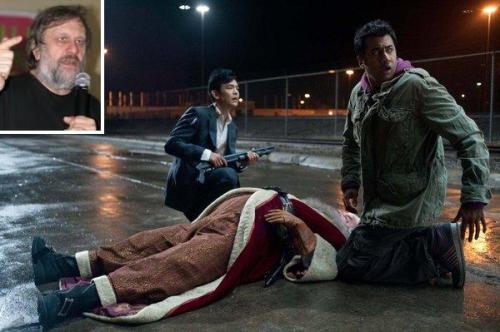
It would be tempting to perform a crude Freudian analysis of the Harold & Kumar films, to say that in Harold and Kumar we find the basic categories of superego and id respectively, with Kumar as the hedonist that leads the two into a state of peril, and Harold as the rational law-abider who constrains the desires of his friend, and so on, and so on. But this is not the case. We must always be conscious of the fact that the ultimate command of the superego is to enjoy, to fulfil your fantasies; and because the object of desire cannot be attained, it is that same superego that is the source of anxiety. Is it not Kumar, then, who is then the superego? Our desires lead to neurosis only when they are consciously articulated.

We must ask: what is desire in this film? It is not the smoking of marijuana, that forms only a kind of subcultural backdrop to the narrative. Rather, the Harold & Kumar films take the form of the heroic quest: the heroes must go off and find something, they have escapades along the way, eventually it is retrieved and there is the happy ending. In Lacanian terminology this ‘something’ is the objet petit a, the transcendent object of desire. It is the eventual obtainment of this object that renders the first film, Harold & Kumar Go To White Castle, a work of fantasy. What is desirable about the objet petit a is intrinsically linked with its quality of unattainability; it is only in the fantasy-space of the film that such desires can be realised. In the film, the attainment of the hamburger is bound up with the attainment of other fantasies – Harold stands up to the bullies of the workplace, he talks to the girl he is attracted to, and so on, and so on. White Castle is therefore a symbolic representation of all desire. One could comment on the imagery of the white castle itself – in medieval poetry the white castle is a symbol of Heaven or the Kingdom of Truth; then as now the white castle is a transcendent Utopian image – or, as Derrida would have it, a messianic image, an image of that which is always yet to come – in which is encoded our very earthly desires, as in the Islamic fantasy of the seventy-two virgins.

But see what happens in A Very Harold & Kumar 3D Christmas. This is not at all like the first film, the two heroes are not acting on their own desires. Rather, Harold must find a replacement Christmas tree for his father-in-law: he is acting out of a sense of duty towards the Other. The pivotal moment of the film is when Harold tells Kumar that he does not have to replace the tree, rather, it is that he wants to. And again further on, when Kumar faces his responsibility for his unborn child: it is not because he has to, but because he wants to. This is not, I think, a casting aside of duty so much as a reinterpretation of duty. Here, we see the old Kantian conception – Du kannst, denn du sollst! – being dispensed with, it is too rigidly compulsive, it does not sit easy with our liberal individualism. What we get instead is a strange inversion: Du sollst, denn du wollst! – you must, because you want to!

I find this despicable, almost totalitarian, even – far more so than Kant’s formulation. Even our desires are not our own, the hegemonic order insists not only that we do our duty, but that we really want to do so. It is like when Saddam Hussein published his novels under a false name: his megalomania was such that he did not just want good reviews because he is the dictator, he wanted the people to genuinely love his writing. Only when the novels were derided in the newspapers did he republish under his own name and shoot the critics. Is what we see here not the same thing? If there is a message in this film, is it not that we must genuinely love the duties imposed on us by capitalism, that we must find jouissance in the fulfilment of duty?

Where A Very Harold & Kumar 3D Christmas fails is precisely in this attempt to reconcile duty with desire through the matrix of capitalist institutions: the family unit, the workplace, Christmas, and so on, and so on. Duty towards the Other must not be subject to desire! What we must instead admit is that under capitalism our desires are different to our duties, or, in the language of vulgar Marxism, our desires are superstructural to the economic base. Our duty consists of confronting and changing our desires, not in the alienating manner of the Freudian superego, but through the radical project of overturning the current socio-economic order in the name of the Other. Against the false union of duty and desire we must proclaim the primacy of duty, we must, in effect, return to the old Kantian formulation. It is significant that the finale of A Very Harold & Kumar 3D Christmas requires the intervention of the supernatural in the form of Santa Claus: under capitalism, duty and desire cannot ordinarily be reconciled. What is needed in our situation is another form of supernatural intervention – the intervention of Benjaminian divine violence. Only then can this antinomy be untangled.
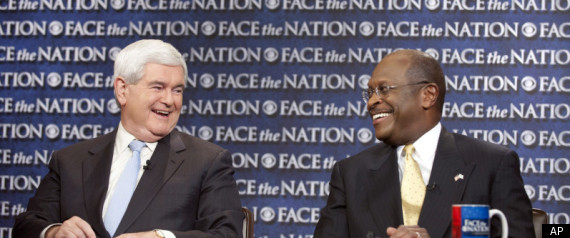
Cain vs. Gingrich: Battle of the Scrotums


The Woodlands, Texas. A stage. Two chairs. An audience. The whirring of cameras. Two SCROTUMS are engaged in debate, following the time-honoured traditions of Lincoln and Douglas.

SCROTUM GINGRICH: Mr Cain, as the stunningly handsome business genius who transformed Godfather Pizza into the multinational colossus it is today, what steps do you think will be necessary to infuse American society with the rich tasty lip-smacking goodness that Godfather Mozza-Loaded pizza crusts exemplify?

Frenzied applause.

SCROTUM CAIN: Well, I would say that the American people know better than the Government what they want to do with their money. And clearly what they want to do is use it as kindling to burn down every mosque in the country. And if the Beltway bureaucrats up in Washington DC don’t want to go ahead with that, well then, they need to be taken out of the equation.

Enraptured applause.

SCROTUM CAIN: But returning the question to you, Mr Gingrich: as one our nation’s premier fascists, with decades of experience in the vindictive abuse of personal power under your belt – as a great American, in other words, how do you think we can restore the spirit of our country?

Ecstatic applause.

SCROTUM GINGRICH: I think that there’s this real culture of dependency these days, and that needs to be gotten rid of – if people need food, why can’t they grow it themselves? If people need healthcare, why can’t they perform keyhole surgery on themselves? We have the Internet now, anyone can diagnose themselves with all manner of diseases. Any disease they want. That’s freedom of choice, people! We need to get away from a situation where people are thinking, oh, I have this disease, how is the Government going to help me out? What we need to do is encourage people to start thinking, how can I proactively work to fix my own problems?

Orgasmic applause.

SCROTUM CAIN: Well, I completely agree. This is gonna get taken the wrong way, but, you know, I didn’t take no political correctness school. If people don’t want to go out there and get themselves a job, if they want to be lazy and rely on handouts, and if they’re angry because those handouts are getting taken away – well, that’s their boogie-woogie, as my grandmomma used to say.

Gleeful suicides.

SCROTUM GINGRICH: If I could interject – the other day I received an email from my good friend, the prophylactic industrialist Baron von Rubber. And he told me that our debt crisis could be solved tomorrow if we took everyone currently on government handouts and systematically fed them into an enormous meat grinder to retrieve the trace elements of precious metals within their bodies. And that’s exactly the kind of dynamic forward thinking that the private sector provides, and that’s exactly the kind of thinking we need to meet the challenges of the 21st century.

SCROTUM CAIN: I’m glad we agree. It’s been an honour to debate with you. [He gives an esoteric signal]

Ominous chanting. Lights start to dim. The two SCROTUMS link arms and chant along, a look of hideous glee on their rubbery scrotal faces.

SCROTUMS: [in unison] Ph’nglui mglw’nafh Cthulhu R’lyeh wgah’nagl fhtagn! Ph’nglui mglw’nafh Cthulhu R’lyeh wgah’nagl fhtagn! Ph’nglui mglw’nafh Cthulhu R’lyeh wgah’nagl fhtagn!

A foul-smelling wind is conjured. Lightbulbs shatter. The spectral visage of RONALD REAGAN floats above the podium, his ectoplasm contorting itself into an expression of dread horror. His eldritch Masters promised him an eternity of bliss in the afterlife if he did their bidding on Earth; now he knows that their afterlife contains only more horror. The SCROTUMS chant faster and faster, their jowls visibly distending even in the murky gloom. REAGAN opens his mouth, revealing a dark chamber seething with worms in which rotten teeth protrude like ancient obelisks. Maggots crawl from the depths of his empty eye-sockets. REAGAN blasts the audience with a monstrous scream. The audience prostrate themselves in terror before this Unholy Trinity. A swarm of locusts hovers above them, buzzing like a thousand hellish violins, before coalescing into the shape of the moderator, U.S. REPRESENTATIVE STEVE KING, who strides up onto the stage.

KING: Thank you, Scrotum Cain and Scrotum Gingrich, for this lively and entertaining debate.

The ghastly shape of REAGAN fades. The SCROTUMS shake each other by the hand and exit. Those in the audience that have survived stare blankly into the distance with the deadened eyes of one who has seen past the fictions of everyday life and witnessed the gibbering horror of the Universe as it really is – although they did walk into the room with the exact same expression. There is no respite: the degenerated Punch & Judy show of electoral politics is not over, its grotesque charade can never end – not until the Six Pillared Gate is smashed and the Beast of Khapti’gytag’l is slain. Outside the building, a REPORTER speaks to camera.

REPORTER: Well, Dan, it’s been a very interesting debate here in Texas, with both scrotums agreeing on a whole range of issues. I’m being told that today’s Satanic apparition has caused at most only a few hundred cases of blindness across the country, which as you’ll know is a significant improvement on last month’s debate in Las Vegas. Well, you know what they say, folks: democracy isn’t perfect, but it’s better than all the alternatives.

The dark cloud hanging over the building begins to melt away. Up next on C-SPAN: Michelle Bachmann and Hillary Clinton in a round of Foxy Boxing.

A fever dream: on the eviction of Slavoj Žižek from the Celebrity Big Brother House

The scene: a raised platform, ringed with bright white lights, set before a surging mob, waving placards for pitchforks, bearing the political slogans of the post-ideological age, spitting and grimacing, desperate for vicarious jouissance, their toothy grins tinged with the threat of violence. On the platform: to the left, Davina McCall, professional objet petit a; to the right, Slavoj Zizek, the subject-supposed-to-know-what-a-subject-supposed-to-know-is. Between the pillars of light, grotesquely large pictures of Slavoj’s face – or what face there exists between bulbous nose and parasitically fungal beard. For a brief moment they both stare blankly forward – a cameraman gives a series of hand signals – suddenly they are animate, Davina cheering and throwing up her arms, Slavoj frantically tapping his nose and beard in a spasmodic fit.

DAVINA: Welcome back to Celebrity Big Brother, and welcome to Slavoj!

The crowd erupts in – not a cheer, exactly, but a noise, a mingling of yelling and clapping and hissing and roaring and stamping of feet, a riotous commotion.

SLAVOJ: Thank you very much, no, yes, it is an honour.

DAVINA: And it’s an awful shame, isn’t it, because you were so close, you were one of the last four left in the house.

SLAVOJ: Well, yes, I am not so much interested in the winning of the show, the accolades, the headlines, and so on, and so on – but the fantasy of being the last person in the house, to be alone in the house, with the cameras, with the constant presence of the Big Other, this I am interested in. It is a recurring theme in horror movies, no? You are alone in the house, but you are not alone, someone is there, someone is watching you – it is a perverse fantasy, I think. And very much Freudian, as well, in the sense of the unheimlich, of the home being a place of danger. So I am disappointed I did not win, yes, very much, indeed.

DAVINA: [unfazed] Let’s talk about some of the other housemates. There was a lot of tension, wasn’t there, between you and Chipmunk?

SLAVOJ: [with a startled snort] You say there was? I did not see any of this tension, entirely not, I felt he was an interesting man – maybe clinically, perhaps, you could say.

DAVINA: [to the crowd] Shall we show him the diary room tapes?

The crowd roars its assent. Fists are flung into the air in jubilatory schadenfreude: some miss and collide with another person, suddenly a hundred brawls are taking place, the crowd turns in on itself, here and there knives are produced and the sharp tang of blood mixes with the stink of sweat in the air. Only after the first few gunshots are heard do the security guards intervene: a phalanx of rottweiler-faced men in dayglo jackets forces its way towards where the violence is at its most intense – they are consumed by the crowd. Perhaps they are killed, perhaps they melt into its roil, it is impossible to say. A line of police cavalry charges. At first they make some progress: those at the edges of the crowd are swiftly truncheoned and detained, but soon the horses find themselves mired in the furious swarm, and in their anxiety they throw off their riders, the line is broken, the plan of attack evaporates. Some of the crowd attack the horses, some of the horses start fighting one another, gnawing chunks from each other’s necks. In the near distance, the low rumble of heavy artillery can be heard.

DAVINA: [exultant] Let’s show him the tapes!

CHIPMUNK: [onscreen] I just don’t get him man, like, what’s he done, why is he here? I ain’t never seen him on anything, like, nothing. And he’s some fucking wasteman, like, man ain’t had a single shower since the start of the show, swear down, he fucking stinks, doesn’t he? I can’t fucking sit next to him, or like even near him, you know what I’m saying? And he chats some breeze, innit. I’m saying, it’s not just his weird accent, and all the snorting and those little hand twitchy things he’s always doing, you know what I mean – he’s talking about sex the whole time: like, yeah, cool, but it’s all perversions, everything’s perverted, I can’t take a dump without it being some representation of my desires in the symbolic order or whatever – I’m like, are you kidding me? This guy built a career on that bullshit? It’s not even anything, really, it makes its own internal sense, kinda, but it’s entirely divorced from the actuality of human subjectivity and the actuality of the human condition, and that’s what the ultimate focus of philosophy needs to be, not all these masturbatory Lacanian abstractions. It bears no relation to how people actually function, it’s a poststructuralist psychoanalysist’s fantasy about how people actually function. So, nah. Me and Slavoj, I don’t see us being in the getalong gang in the Big Brother house, you know what I mean?

DAVINA: So, Slavoj, how does that make you feel?

SLAVOJ: Well, myself, I make it a point of never reading my critics, never reading my reviews. Or I will tell the publishers: put the bad reviews on the back of the book! My audience know who I am, they will read me anyway. But Chipmunk – he is ultimately an empiricist, he has a very British way of conceiving these things, this antipathy towards the abstraction, the Continentalism, and so on, and so on. In his music and his music videos, the focus – it is entirely on the immediacy of experience, no? So his criticism, it is still rooted in ideology, this I claim. The ideological disagreement, it does not translate into personal antagonisms. I am a good Hegelian, after all, such oppositions, they are necessary. But I should say, the proceduralism of intimacy in the diary room, it is exactly like Catholic confession, no, it is exactly the same. You do not confess to the priest, your confession is directed towards God, towards the Infinite Other, as in Levinas, and so on, and so on. You do not talk to Big Brother, you talk to the Big Other, to the audience at home, to the Holy Spirit. After I am evicted from this house, I am no longer a participant, I am an observing subject, an ordinary pervert, then it is acceptable to show me these tapes – it is a form of licensed voyeurism, is it not?

DAVINA: [nodding her head] One last question.

SLAVOJ: Please, please, go on.

Throughout this exchange Davina has been undergoing a grotesque metamorphosis: her cheeks grow fuller, her paunch expands, her tits shrink, her hair turns white and recedes. At first the faint shadow of a moustache falls on her upper lip, then stubbly hairs sprout from her chin. Soon she has a full beard, her eyebrows sit heavily on her brow, her camera-friendly coquettishness becomes a stern gaze, almost disdainful, which she now fixes on Slavoj. She is no longer Davina McCall: instead, Slavoj finds himself being scrutinised by the unmistakeable visage of Karl Marx – or perhaps Jehovah; depictions of the two are, after all,  very similar.

MARX: Do you not think that your participation in this televisual charade, your gleeful willingness to put your theorising at the services of capital, your unashamed prostitution, your jestering and japing, your fruitless contrarianism, your pop-psychoanalysis – do you not think that this not only casts disrepute on your status as a serious Marxist thinker, but also cheapens Marxism itself? Are you not turning revolutionary ideology into just another media gimmick?

The crowd, who are all orthodox historical materialists, nod sagely, in unison.

SLAVOJ: I know you. You said a man should be able to hunt in the morning, fish in the afternoon, rear cattle in the evening, and criticise after dinner. Well then – can I not play the jester in the morning, advertise for garment retailers in the afternoon, appear on reality TV in the evening, and still be a serious philosopher after dinner?

MARX: You forget that we are still living under capitalism.

SLAVOJ: But under capitalism, we must still live.

The crowd, racked by confusion, briefly organises itself into a series of non-hierarchial egalitarian communes, forms a workers’ state, undergoes Thermidor, becomes disillusioned. Defeated, they shuffle back to their allotted space in front of the platform.

DAVINA: [for it is her again: the beard has gone, the grin has returned] Well, Slavoj, it’s been a pleasure to have you on Celebrity Big Brother. Do you have anything else to say before the end of the show?

SLAVOJ: Yes, I do. I would like to say that I endorse all the products of the Coca-Cola corporation, and that the cool refreshing taste of a glass of Coke proves without question that the transcendent object of desire is not in fact unobtainable – in fact, it can be obtained at your local newsagent or grocery store.

Lights wind down, theme music plays, scattered applause. Slavoj, rising from his seat to re-enter the world, takes an especially deep snort – then starts to gag. Something is clearly wrong. Davina sits impassively as Slavoj chokes on his own mucus: the cameras are off, after all. Slavoj writhes on the ground, flailing frantically. The sycophantic crowd tries to imitate his dying motions. Everywhere they collapse, their limbs jerk around, they feign choking noises. Everything begins to blur: the crowd, the stage, the cameras – now they are only a single undulating mass, a throbbing that reaches up above the horizon and encircles the world. Perhaps an orgy is taking place, it’s difficult to tell. There are no images any more, no clearly defined shapes or people, only an immense all-enveloping pulsation. The dream ends. Still, nothing is understood.