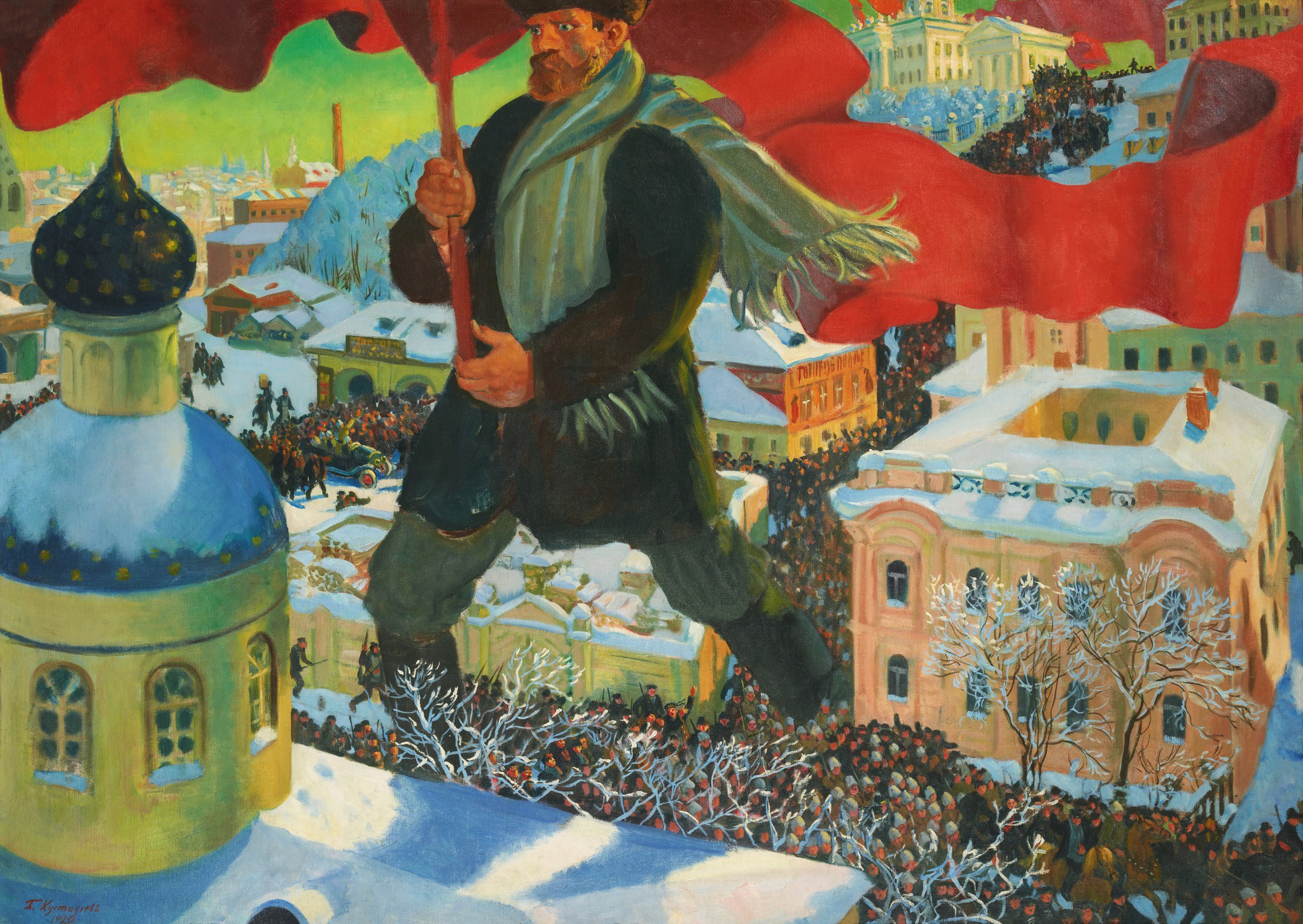
In the beginning there was the Image, and the Image was with God, and the Image was God. And the Image was made flesh, and dwelt among us.
Good news for republicans, bad news for sufferers of scrofula. The monarchy is done, it’s finished, we can chuck it away with the Empire and the established Church. That is to say, it’s still around, in terms of appearance, but only as a farcical parody of itself, a shadow, a convention. It’s ceased to have any real existence. Once we had a monarchy, now we just have the royals, and the two are not the same thing.
Bad news for the royal baby, though (congrats to Wills and Kate, rah rah, etc etc). They’ll all still be there to comprehensively fuck up his future development, the whole chimerical menagerie: that dessicated turtle-beaked matriarch with her rapacious vulture-eyes, she who once gorged herself silly on the soul of Laurent Nkrumah using sinister white people dance-magic; his wittering toucan-nosed biscuit-salesman of a grandfather; the murderous lunkheaded uncle, a marmot-faced proper down-to-earth lad, mowing down Pashtun herdsmen in his flying fortress of imminent death like a less sophisticated Sarah Palin; an entire extended family of posh twits, all in various stages of hippomorphosis; finally, the heirs to all this horror, his whinnying filly-mother and braying donkey-father. They want their son to have a normal life, they say; they’re already positioning themselves into a perfect imitation of the drab Oedipal triangle, and as a sop to the press they’ll provide access to a few key moments: baby’s first repression of his infantile sexuality, baby’s first intimation of his own mortality – see, he’s growing up as damaged and estranged from the world as everyone else! He’s a neurotic wreck putting on a brave grin, just like you! It won’t work, though. This is not a nice family. Parents in the Haus Sachsen-Coburg und Gotha aren’t just distant, they’re at an interstellar remove; all the normal fixations are displaced onto wetnurses and nannies. The chief activity of its sons and daughters consists of waiting for their parents to die. The royals can’t go through any castration complex because for them there really is nothing more important in the world than themselves – for them, the crown and sceptre aren’t symbols; they’ve been permanently locked out the Symbolic order. In other words, they’re a family of psychopaths. They’re toxic, not just institutionally but personally, and if you spend too long breathing in their fumes the poison will get to you sooner or later: just look at the poor kid’s grandmother. Where’s child protection? Why won’t someone rescue this baby before it’s too late?
Nobody will, because for the great mobile flocks of royal-watchers and their herdsmen in the press this isn’t a person at all. The royal baby is made of more delicate and ephemeral stuff than we are; when the Duchess of Cambridge was in hospital she gave birth to a liquid stream of pixels and wavelengths, its digital tentacles spiralling out from her womb to wrap themselves around the entire world. The royal baby has the dubious honour of being possibly the first person born as image before reality, the first person to fully demonstrate Baudrillard’s old line about the precession of simulacra: ‘today it is the territory whose shreds slowly rot across the extent of the map.’ His status as ‘the royal baby,’ future ruler and object of fame and devotion, ontologically preceded any of his actual physical attributes. In the old days, when we still had a monarchy, the king held two bodies: the body politic and the bodynatural. Now our royals have no body at all. In normal development, a child develops full subjectivity when it identifies itself with the specular image in the mirror, when it comprehends itself as an object capable of being gazed upon; before that between subject and image there’s an aggressive tension which the child has to resolve into joyful captivation. No such luck for the royal baby. He will be surrounded by the gazes of cameras and smartphones; his own image will surround him, staring from commemorative plates, tea-towels, mugs, the inevitable ‘keep calm and love the royal baby’ posters – every mundane object will be stamped with the mark of his spectral adversary. He won’t be able to subsume the image into his self; it’s too late for him, he’s already been swallowed up by the image, the idea of what he is, as an amœba swallows up a speck of food.
A royal family is the image of a monarchy that remains once the monarchy itself has shrivelled up and died. The monarch was once the guarantor of a certain kind of commons: the king’s highway, the royal mail, the crown courts. The monarch was the people, by virtue of our perfect subjugation to him; he imposed a certain kind of paradoxical egalitarianism. Now, in an age of privatisation, the situation’s been precisely reversed. Images and representations are common property, and as such the royal family are now perfectly subjugated to us. It’s their in the language: our Wills, our Kate. When a French magazine published topless photos of Kate Middleton the popular outrage wasn’t so much a loyal horror of lèse-majesté as affront against the violation of property. It works the other way too: as the image of the royal baby started to construct its hyperreal manifestation yesterday, a good part of the nation thought it had the right to know every queasy detail about the dilation of the royal vagina. Sovereignty’s dread authority of life and death over its subjects has turned into the sovereign being the ultimate object of that same biopolitical power; the king’s commons has turned into a king held in common. The monarchy as such no longer exists.
In a way all this should be celebrated. Whether or not the formal monarchy survives Elizabeth (and I’m not so sure it will), we’ve finally beaten back our aristocratic oppressors. In the royal image we’ve found the paradigm for a new commons without sovereign power. But it’s going to seriously mess up that kid.
Sometimes I believe that this less material life is our truer life, and that our vain presence on the terraqueous globe is itself the secondary or merely virtual phenomenon. Karl Marx, Grundrisse
This exists.
It’s easy to get whipped up into an outrage over this kind of thing. It’s enraging to see the techniques by which we are manipulated uncovered in all their foetid glory. What’s more, there’s the sheer density of meaningless marketing buzzwords repeated over an insipid steel guitar melody, managing to replicate simultaneously the effects of a cult indoctrination film and a nice strong hit of prescription opiates. There’s the naked theft of the video’s entire aesthetic from the occasionally excellent RSAnimate series. There’s the fact that the gang of marketers behind it seem to consider making a positive change in the world to only be a good thing insofar as it can be put to use selling various tubes of corn syrup-based goo. There’s the cynical manipulation of popular sentimentality for profit. There’s the section dealing with ‘families, communities and cultures,’ in which the former two are represented anthropomorphically, sitting like nineteenth-century monarchs astride a globe, while ‘cultures’ is just an arrow pointing in the vague direction of Africa. It’s all so perfectly and unwittingly ugly. But to focus on this stuff is to miss the point a little. There’s plenty of justification for a sensible critique of consumer capitalism as demonstrated by this video, but a purely sensible critique ignores not only the horrific haecceity of the thing, but the otherworldly horror that surrounds consumerism itself. For the purposes of this essay, at least, I’m not interested in the ideological presuppositions of liberal philanthropy, the incoherence of marketing discourse, the soporific nature of societally-mandated pleasantness, or even the construction of the racial-cultural other.
What I’m really interested in is this.
What is this thing? It crops up everywhere in the video. Its tendrils extrude randomly into the field of gibberish without warning or explanation: sometimes it tenderly caresses the various symbolic representations onscreen; sometimes it’s actively antagonistic towards them, bursting out from their bodies and leaving only shattered remnants of sales patter. In one memorably horrifying sequence it’s shown passing through the heads of three people as they smile their bovinely unfazed marker-pen smiles in our direction. Here, at the video’s end, it holds the entire Earth in its grip, the planet leaving sticky stretchmarks as it tries and fails to struggle free from the gloop’s oleaginous embrace. Let’s start with what we can see. The thing is clearly alive. Maybe it’s not alive in the strict biological sense that any of us can comprehend, but it moves, it has agency, it has plans for us and our lives. It appears as a seething mass of – of what? Not liquid, exactly; it’s too firm, too collected; it doesn’t flow, it crawls. Some kind of mobile mucous then, bile-black and slug-sinuous, its surface tight and slimy, glistening under the light of a blood-clotted sun. But at the same time there’s an undeniably fleshy quality to it, fleshy in the most visceral sense of the world. It resembles nothing so much as an immense, writhing conglomeration of dicks. Could it be that what this thing wants is to fuck us?
I’ve always found there to be something almost endearingly naive in the thought of Debord and Baudrillard and other theorists of the image. Baudrillard proudly and knowingly calls himself a nihilist; in fact, he’s anything but. Nobody believes more fanatically or more religiously in truth than the poststructuralists. To speak of the spectacle or the simulacrum in terms of a precise historical moment is to assert the existence of a historical world of truths prior to the image; to speak of hyperreal images that reflect only each other and deny a pre-existing truth is to assert the existence of a pre-existing truth that can be denied. Debord in particular is militant in his rejection of the image and his partisanship on the side of reality. He’s got it all wrong. Representation isn’t a prison, it’s a shield, our only defence against a universe filled with horrors. It’s a way to make the world comprehensible. Lacan describes this process precisely: the Symbolic order has its origins in the castration complex; the phallus as an intolerable lack is what anchors the entire process of signification. When Lacan describes the Real he does so in terms that approach Lovecraftian horror: it’s something black and smooth and undifferentiated, with no cuts or cracks, no inside or outside. The infant, confronted with the realisation that the world is an enormous and unfriendly place in which his jouissance is ultimately irrelevant, begins to build metaphors for himself. It’s the only thing he knows how to do.
Eventually, though, the chains of signification loop in on themselves. In the Coca-Cola Content 2020 Initiative video, there’s no mention of Coca-Cola-as-beverage, only stories, narratives, feelings, loyalties – only images referring to other images. This makes perfect sense: images are a necessary refuge from an unpleasant reality. The fact of your utter insignificance in both the mechanistic universe and the libidinal economy doesn’t sell sugary drinks – or, at least, it doesn’t sell many to Coca-Cola’s core demographic of people who don’t just sit at home with the curtains drawn reading Kafka. Brands aren’t like us. They’re better than we are, untouched by fears or neuroses, unravaged by time. They have the commodity’s aura of unblemished totality that we pitiful human wrecks, crippled by our various lacks and lacerations, can never possess. That’s why people grow so attached to them; we want what they have. But to fully maintain the pleasant banality of advertising, to completely protect against the sour taste of reality, these images have to be decoupled from any concrete referent. They have to be purged of anything that could climb down the chain of signification and kick us in the face. That’s where we get brand slogans like Live Positively: a floating signifier, elemental in its meaninglessness. But doing this kind of thing is very dangerous. The shield of representation works by mediating between the fragile subject and the hideous object; if you break it away from the object it becomes useless. The real world can then intrude. It forces its way unopposed into the realm from which it was banished, and it hits us right where we thought we were most safe: in our advertising. And when it does so, is it any wonder that it takes on the form of the object of that first primal act of signification, slipping back across the divide between phallus and penis?
This isn’t a metaphor; it’s a portent. The creature that invaded the Coca-Cola Content 2020 Initiative video will not stop there. Our virtual creations are easy targets; its violence grows stronger with every victory. Soon the brittle crust of the Earth will snap, and viscous tentacles will emerge from the chasm to crush all our cherished symbols. The beast will rise. It will take its revenge, and it will take it in blood. We will, very soon, be once again faced with the incomprehensible horror that we once tried to abstract away, long ago, when we were infants. Luckily, we now know exactly how to deal with it. All we have to do is represent it, turn it back into a signifier. The future of the human race depends on a solid brand strategy.
…In the next financial year, our target is to double voluntary self-immolations as sacrifices to the viscous phallus-monster that has risen from the depths to reclaim our world. That’s a lot of voluntary self-immolations! To do this, we must fully engage our brand with the aspirations of our sacrificial base. This means not only promoting our brand, but entering into dialogue with the defeated human race across all multimedia platforms and allowing user-created content to grow in the fertile ashes of their ruined cities. Through the Live Every Second brand slogan consumers can independently develop content focusing on positive and aspirational life experiences they have enjoyed before inevitably succumbing to annihilation at the hand of the viscous phallus-monster that has risen from the depths to reclaim our world. Our entire advertising focus has to be centred around the Live Every Second concept if the phallus-monster brand is to achieve full market penetration. Engaging with Live Every Second means that consumers will approach their grisly fate as the appropriate end to a life not only lived well, but lived to the max. By encouraging conversations about what it means to live every second we can potentialise the creativity of our user base…
My body is in open insurrection against itself, and my chin is its Tahrir Square.
Towards the end of last month, as demonstrators in São Paulo were beginning to demand the return of the military dictatorship, I noticed a strange growth on my chin. It was a little like a spot, red and tender on the surface, but it refused to come to a head. Instead a vaguely conical mass sat just above the bone; I could move it around a little, nudge it this way and that, but it felt completely solid and unsquidgeable. Never mind, I thought. It’ll go away soon. And it did, retreating into a tiny hard kernel, as if it was about to vanish entirely.
And then, without warning, it returned. I woke up with my face numb, my cheeks puffy, and an alien virus colonising the bottom half of my face. It was no longer a swelling but an invasion; pressing against my gums, my teeth, its areolae of engorged tissue slanting the line of my chin, its growing bulk pushing out my bottom lip into a permanent prognathic scowl. Eating was painful. So was smoking. Even breathing started to carry a faint dull pain. There are names for these things: abscesses, cysts. Names whose sibilance suggests seeping pus, blood curdling in the off-white purulence, gangrene, death. It had me. I was afraid.
I say it happened without warning. That’s not entirely true. When I went to bed the previous night tens of thousands were gathering on the streets of Cairo to mark the anniversary of President Morsi’s election and to protest the betrayal of their revolution. Millions more were marching across the country; according to some, it was the biggest protest in human history. I was fully supportive: by all accounts, Morsi’s done a terrible job, marrying civil sectarianism with the cold inhuman logic of the markets. When I woke, though, it was to news (blearily observed through the ache in my chin) that the city’s police had declared their solidarity with the youth on the streets. Surely this wasn’t right: one of the main grievances of the demonstrators had been Morsi’s failure to properly prosecute the police and military for their misdeeds in the 2011 revolution and 2012’s Port Said massacre. The cops should have been in there, batons high, riot helmets turning human faces into mere avatars of the forces of reaction. They weren’t doing their job. Instead there were reports of gunshots and deaths in the night with no clear indication of who had been shot and who was doing the shooting, as if the bullets were some kind of freak weather event. As the Egyptian state festered against itself, my face had become my heautontimoroumenos. Something was going horribly wrong.
The creature had laid its roots deep. Its cystic tentacles must have spread around my head and drilled into my brain, because I was overcome by a fit of what can only be called psychotic narcissism. I closed my windows and drew the curtains. I cancelled social engagements. Mirrors, which showed me a face so swollen and lopsided I no longer recognised it as my own, were horrifying; I covered them up. Even the screen of my phone was too reflective; I considered having a go at it with some sandpaper. I was thinking like a cyst, retreating into my own little cavity, where I could swarm.
Everything started to flare again up as General al-Sisi issued his 48-hour ultimatum to President Morsi. Al-Sisi was supposed to be a Morsi loyalist, promoted to his post after the old military elite had been dismissed in the last power struggle between armed and elected authority – and yet here he was, demanding that the Muslim Brotherhood share power or lose it. As he did so my infected cyst bubbled. The entire left side of my face became swollen. A soft, foamy subcutaneous emulsion. My lymph nodes felt like ping-pong balls. My jawline was melting away on one side. I looked as though I’d been genetically spliced with a potato. Before long it was intolerable. I had to see a doctor.
I went to a drop-in clinic at an NHS surgery in Cricklewood, lodged awkwardly between an enormous B&Q centre sitting like a fat orange-roofed slug on its grassy mound and a general tat shop called Aladdin’s Cave. To get there I walked through a narrow grey alley into a small grey car park; the barbed wire that surrounded the clinic was bearded with shredded plastic sheeting. I stood and smoked a cigarette outside the entrance. An elderly woman with a smudged tattoo on her forearm stood on the other side and smoked a cigarette as well. We didn’t talk. Then, as I sat in the waiting room, al-Sisi’s deadline approached. I was the only person there, scrolling compulsively through Twitter, perched above a small forest of institution-blue chairs. The only sound came from the clicking of my phone and a flatscreen TV mounted on the wall opposite me showing Countdown. It was coup o’clock; 2.30 pm Cairo time. Onscreen, the hand whizzed down the face of the clock as the famous music played. I wish the winning anagram had been something germane or significant. It wasn’t. Years after an important event, people sometimes share stories of where they were as it happened. The highest-scoring word on Countdown was ‘parsnip.’ I might remember that for the rest of my life.
The GP who saw me was rather fat and affably Jewish. He told me a lot of what I already knew: I had an infected cyst, a gland had become impacted, and the bacteria had rushed in en masse to fill my face with slime. He prescribed me antibiotics; I now have eighty tablets of flucloxacillin to my name. I doubt they’ll do much good. Whatever his qualities as a doctor, the GP is unlikely to be able to alter the course of events in the Middle East. When I returned home I discovered that President Morsi had been put under house arrest and the constitution was being suspended. Tahrir Square was overflowing with celebrations.
There’s one other thing the doctor told me. If the swelling doesn’t respond to antibiotics and doesn’t go down, he said, if the blockage isn’t cleared – there’s always the option of surgery.
~
There’s a certain superior tone which Western commentators love to bring out whenever mass movements in the developing world take form. If they oppose the movement, it’s patronisingly dismissive, bringing all the accumulated wisdom of four decades’ drinking fairtrade coffee to bear on the situation: these people would do well to bear in mind, they say, or the leaders of the movement ought to consider. When they support the protesters it’s even worse; what’s happening on the ground is twisted into the expression of a Platonically ideal political agenda. The protesters are always fighting for the commentator’s own set of values, and any contradictory voices from the country in question are easily drowned out. We know what you want better than you do. As the crowds swelled in Cairo, the Guardian commented on an Egyptian activist tweeting ‘Fuck Western Media.’ ‘There’s a notable fatigue in Egypt with the Western media and media analysis,’ they said. We’ll keep you updated on our live blog as the situation progresses.
I’m going to try not to do that. I’m going to stick rigorously to the facts. And the fact is that General Abdel Fattah al-Sisi has purposefully, with full calculated intent, given me an infected cyst on the left side of my chin.
The evidence is incontrovertible. I don’t know exactly how he’s done it, but I have a vague idea. This is how. The protests in Egypt were spearheaded by liberal, leftist, and Nasserite parties, among others, under the umbrella of the Tamarrud (or Rebellion) movement. Many of these are the same groups that fought against the Supreme Council of the Armed Forces last year when it tried to write itself into the new constitution, hoping to supersede the powers of the presidency. When these groups did so they marched alongside the Muslim Brotherhood. Now many of these same people (with, of course, a vast number of dissenters) are celebrating the reimposition of military rule. What has taken place is a coup – but that said, Morsi’s government was overthrown not by the military but by the people on the streets; it was finished the moment millions gathered in Tahrir Square. The statements of support for the June 30th Movement by the police and army were not a gesture of solidarity but a means of control; they turned something that might have destabilised the exercise of state power into something that mimicked the state. The situation in Egypt demonstrates precisely the Marxian analysis of the state-form: it’s not a monolithic institution but a tactic, a tool that can be wielded by one group or class or another. As al-Sisi’s deadline approached there was speculation over whether the soldiers guarding the state broadcaster were loyal to the army or the government. In a way, it didn’t matter; they were the state. The state is control; the state is in control of everything apart from itself. When cops march at the head of a demonstration, it stops being a protest movement and starts to become an exercise of government power. Cops have an important role to play in any revolution; with their violence they focus the popular rage, they inflame its energies. As ever, the Egyptians are far ahead of us in the West; they found a way to stop this from happening, and all it took was a mild displacement in the loci of control. But those revolutionary energies are still there. According to the law of the conservation of energy, they can’t just vanish. And I know what’s happened to them. Somehow, by some strange magic, they’ve pooled in the left side of my chin. They’ve been displaced to my face. And Abdel Fattah al-Sisi doesn’t care about my face.
PS: I’ve said this kind of thing before, but it bears repeating: by enacting deeply unpopular policies and pointing to their victory at the ballot box to stifle dissent, the Muslim Brotherhood were behaving not like a dictatorship but precisely like Western liberal-democratic governments. If Britain were as new to representative rule as Egypt is, Cameron and co would have been on the way out some time in 2010. The difference between us and the Egyptians is that they really believe in democracy. We stopped doing that a long time ago.
PPS: Al-Sisi was Morsi’s appointee. One can imagine the scene at the barracks: Morsi, overthrown, weeping into his paternally greying beard, arms outstretched: Abdel, you were like a son to me. Could the whole scenario be reconsidered as an Oedipal drama? What is the state after all but a hideous trillion-titted mother?
There aren’t any explanatory cards at the Royal Academy’s Summer Exhibition in London. This doesn’t mean that the viewer is forced to confront the painting on a barren field, with nothing to helpfully and patronisingly mediate between the gaze and the pure image. Instead, there’s a little booklet, in which all the works are listed according to their catalogue number, along with their prices. For those who object to such things, this could be read as a despicable commodification of culture; the work is swallowed whole by its exchange-value, the exhibition is less an art show than a degenerated flea market. As I tend to think art and money are joined at the hip, I found that it could actually be turned into a quite diverting game. This composition in red and black, with the gooseflesh ghost of a human form shimmering unsteadily in one corner – that’s £9,000; you were quite right to like it. On the other hand, this painting, acrylically abstract, its overlapping shapes looking like something you could make in five minutes on MS Paint – it costs £12,000, and you’ve lost this round. Better luck next time.
It’s a favourite pastime of art critics to snobbishly denigrate the Summer Exhibition’s supposed conservatism – even arch-traditionalist Brian Sewell is getting in on the act. It’s true that while many of the works on display are perfectly pleasant, none of them have the force of a punch in the gut, the sudden violence that marks out great art. Instead, wall after wall is crammed with pastiche. Shades of late Picasso, Miró, and Kandinsky dominate. Not that there’s anything wrong with Picasso, Miró, or Kandinsky, and some of these imitations are very well executed – but by being repeated their styles ossify and lose all sense of motion; revolutionary artists are turned into reactionaries. Heidegger thought that art could constitute an opening to the future; but in the Summer Exhibition it seems hopelessly mired in its own past. The saving grace of the exhibition is supposedly Greyson Perry’s series of tapestries. Here there’s more pastiche, this time of Hogarth (in fact, I hazily remember being made to ‘update’ the Rake’s Progress for GCSE Art); the ‘class satire’ is meanwhile very self-consciously clever but depressingly toothless. There’s no better demonstration of the enfeebled nature of pseudosatirical pastiche than the concentration of people hanging round the tapestry that depicts the middle classes, cooing with the joy of an infant looking at itself in the mirror. Yes, we do all read the Guardian, don’t we? And all our food is organic and fairtrade, and we all have therapists; isn’t it brilliant? All this is hardly the fault of the curators, though. Across the river, at the (unstuffy, unconservative) Tate Modern, you can see a grey felt-covered cuboid hanging on a wall with a little card next to it that breathlessly expounds the significance of this ‘box-like object’ – as if a box-like object could be, in the final analysis, anything other than a box. Outside the dust-heavy air of the museum, the best-known British artist is probably – for fuck’s sake – Banksy. Our young revolutionaries are, if anything, even more pathetic than our conservatives; at least our conservatives are aping something genuinely radical.
Not that the situation is hopeless. A small sculpture stood in a room of lithographs. I don’t know its name or that of the artists; it had no red dot or accompanying number; I couldn’t find it in the catalogue. It was as if some gang of guerillas had infiltrated Burlington House at night and left the thing there. A stylised donkey sits on a wooden table, holding a pencil. Turn the wheel: there’s a carefully calibrated creak as its hinges and pistons grate against each other, and it draws another stylised donkey. The pencil shudders along the same route, over and over again. It’s art as artistic criticism: self-portraiture is revealed as a blind mechanical mimesis, the compulsion of made things to repeat their own making. The prints and paintings that surround it are revealed for what they are: they become so many crude pencil sketches of so many mechanical donkeys.
The art of the early twentieth century was so great because the early twentieth century was a time of revolution and possibility, in which art could shamelessly imagine its own future. Our current time is one of reaction, of the hideous mechanised logic of capitalist austerity, in which merely pointing out the mechanical nature of our subjugation passes for a radical act. No wonder, then, that the most profound work at the Summer Exhibition was itself a machine. Maybe if our art isn’t doing what it should, we need a new sort of paintbrush. For a positively articulated vision of the future, you have to look to the outer fringes of the mind. Adorno writes that ‘the sickness of the normal does not necessarily imply as its opposite the health of the sick, but the latter usually only presents, in a different way, the same disastrous pattern.’ As a counterpoint, I’d present the Alternative Guide to the Universe exhibition currently running at the Hayward Gallery. Despite the name, which makes it sound like a weeknight offering from Channel 4, possibly something through which Jimmy Carr will foist himself on the nation, it’s excellent. Among the UFOlogists and selfie-obsessives avant le lettre are some genuinely revolutionary works. What unites the best of them is an overpowering sense of hope. There are few apocalypses or jeremiads; instead, these artists thought they were providing the blueprint for a better world. These worlds sometimes veer uncomfortably towards a kind of techno-fascism – William Scott envisages a day when San Francisco will be ‘cancelled’ and replaced with Praise Frisco, a city of ‘wholesome people’ and ‘wholesome encounters,’ while George Widener’s sketched cityscapes of the future are blighted by perpetual gridlock and architecture that has the faint whiff of Albert Speer about it. Still, there’s Marcel Storr, a deaf and illiterate street sweeper who would come home at night and construct impossibly detailed futuristic cityscapes in pencil and ink, looking like something between a Xanaduan pleasure-dome and Blade Runner; and Body Isek Kingelez, who builds playfully extravagant models for his vision of a new Kinshasa from scrap materials he finds around the city. Also on display is an infectious fluidity, a kind of conceptual synaesthesia, the kind of thing that is so sorely lacking at the Royal Academy. MC Ramellzee re-imagines the alphabet as a fleet of spikily armed starships mounted of skateboards, fighting to liberate letters from the tyranny of language. A.G. Rizzoli (my personal favourite) ‘symbolically sketched’ people he knew as fantastic buildings, so that the local postman becomes a sprawling Renaissance palace, and his mother a fairy-tale cathedral. All these were integrated into his masterplan for a new exhibition-city called Y.T.T.E., or Yield To Total Elation, in which the barriers between human beings and architecture would dissolve.
To call this stuff ‘outsider art’ is, I think, to miss the point entirely. Nobody today calls William Blake an ‘outsider poet’ or Friedrich Nietzsche an ‘outsider philosopher.’ Of course, many of the artists in question were mad, or suffered from developmental disabilities, but, as Adorno suggests, sickness does not exist isolated from the society that contains and creates it. Similarly, Deleuze and Guattari saw schizophrenia as simultaneously being the final result of the logic of capitalism and a productive, revolutionary force that disturbs its operation. It’s not the case that in a society that has abolished its own future only the mad still dream of a better world; rather, actually hoping for anything different itself becomes madness, a madness whose limits are defined by the rigid (im)possibilities of our own impoverished existence. In other words, it’s a madness whose creativity is intrinsically bound up with the regimented sterility of late capitalism, as source and foil. Is a man who builds minutely detailed models from scrap paper and beer cans an obsessional neurotic, a holy lunatic, or a respectable architect? Surely that depends only on whether his models are shown in his own home, in an exhibition such as the Hayward’s, or in the atrium of an architectural practice. If this is insanity, it’s not the seething unreason of the id, but instead rationality made to do things that, by ‘normal’ standards, it’s not supposed to do. Alfred Jensen creates number tables in oil paints, their colours and composition influenced by Indian spirituality and the I Ching; there’s a certain ordered stillness in them not too different from that engendered by a Rothko canvas. Widener believes that in the future superintelligent machines would finally be able to decode the mathematical patterns he discerns in the calender; it’s no surprise to learn that he once worked with US military cryptographers. This is, in its own eccentric way, precisely the health of the sick.
Some critics have taken issue with the exhibition’s name. What’s being presented is not, they claim, an alternate guide to the universe, but a small introduction into another world: the private universe of the unhinged. I don’t agree. We’re being shown a possible future, but as Marx knew, every future is ‘still stamped with the birthmarks of the old society from whose womb it emerges.’ These visions are built on the foundations of the world we all inhabit now; they are the repressed content of our life. All these worlds already exist. Rizzoli, on seeing female genitalia for the first time at the age of forty, immortalised the moment as an immense Art Deco church. So That You Too May See Something You’ve Not Seen Before, he wrote above it. So that we may experience the wonder and strangeness of something which is immanent but hidden. In art as in politics the productive forces are here; we have only to unleash them.
Thanks to Twitter user @HealthUntoDeath for inadvertently providing the title for this piece.
Two events are happening at once. In the year of our Lord 534, it’s a slick, sweaty night in Taksim Square, the kind of night that makes your skin shine and your hair stick to your forehead, the kind of sticky, fecund night that breeds love affairs and revolutions. On this night, although they don’t know it, the citizens of Constantinople are witnessing the last ever Roman Triumph. The great general Belisarius has recaptured Africa for the Eastern Empire: in a few years Justinian I will accuse him of various conspiracies, pull his eyes out, and leave him as a beggar by the gates of Rome, but for now he has his glory. The procession starts. First, the spoils of his conquest. The Temple Menorah, first captured in the sack of Jerusalem and brought to Rome, then seized by the Vandals and brought to Carthage – now restored at last to the Church, its silver gleams as the plebeians crowd round and snap eager photos of the treasure on their smartphones. Then the man himself. Belisarius sits in the cabin of the ceremonial mechanical digger, resplendent in his corona triumphalis, soaking himself wrinkled in the adulations of the crowd. As demanded by tradition, a woman in hijab sits perched on the boom, the long yellow-painted arm wreathed with hydraulic sinews. Hominem te memento, she mouths. Nobody hears her. The crowd waves banners and Turkish flags, they throw flares and garlands of flowers; the riot cops join in the universal celebrations, joyously firing rubber bullets and sending out waves of teargas. The tree-lined street is soon hazy with jubilant smoke. Everything is organised to the finest detail; it’s a spectacle, and the protesters and the police all play their allotted role. Finally, Belisarius’ chariot comes to a halt. A digger knows how to do one thing: it digs. Istanbul is a city built on its own ruins. The Gezi Park demonstrators dig, past Constantinople, past Byzantium, down to the ancient grotto where the Deep State has been managing the affairs of the world for twenty-six centuries. And this excavation has been planned, too; everything is part of the plan.
A few weeks before the London Olympics in 2012, I found myself in small but pleasant company, drinking wine from the bottle in Trafalgar Square, as you do when you’re young and pointless. A man came up to us and asked for a light. We got talking. He was due in court the next day, he told us, he’d been arrested while protesting in support of Julian Assange; he seemed a bit over-earnest but generally quite right-on. Across the square stood an Olympic countdown clock flanked by the two terrifying cyclops-mascots the organising committee had foisted on the world. I must have said something about how I didn’t think it was such a great idea for there to be anti-air missile batteries on residential buildings and carriers on the Thames just to protect a glorified sports day, because he agreed. Plus, he said, if you looked at our hideous logo, the numbers spelled out the word Zion. So did the logo for the 2008 Olympics. And, in the handover ceremony in Beijing, the London delegation had wheeled out a fake double-decker bus in the Bird’s Nest stadium before blowing the roof off to reveal Jimmy Page and Leona Lewis, one day before a real London bus was blown up in Tavistock Square. Unconvinced but not uncurious, I looked into his assertions. Naturally, they were nonsense. To make the Beijing logo read Zion you have to take the whole thing apart seemingly at random. Of course, the 7/7 attacks took place three years before the 2008 Olympics. And if a shadowy Zionist conspiracy was ruling the world behind the scenes, then why would they announce themselves? What on earth would make them leave little clues for us to decode?
Yeah, no.
Conspiracy theorists aren’t insane, they’re far saner then the rest of us; their delusions are those of sanity pushed to its furthest edge. Where we see a world that doesn’t make sense, they see something logical and precise and – crucially – knowable. Conspiracy theory is the most profound expression of Enlightenment ideology: there is a rational plan behind the phenomena we observe, and it can be uncovered through reason if you study and interpret those phenomena hard enough. In other words, there’s not as much separating dialectical materialism from the Space Lizards theory of western civilisation as good Marxists like myself would like to believe. It doesn’t really help that the world of late capitalism is, to some extent, structured exactly like the wildest fantasies of the conspiracy theorists. There really is a tiny – globally speaking – cabal at the top of the pyramid that run the lives of the billions below. They really do meet, occasionally, in secret summits with no reporters and no minutes taken. They really do pull the strings of our elected politicians. They really do leave clues to their activities; not as coded symbols, but in the newspapers – society’s conspiracy against itself is hidden in plain sight. The Queen really does look quite a bit like a cold-hearted creature from beyond the stars. Conspiracy theory is the nomos of a society in which the lacerations of democratic openness have become themselves a form of occlusion; in form, if not in content, they reflect actual conditions. The only difference is that there’s no singular teleological Plan; the initiates are just as dumb as the rest of us. There are only personal and class interests, bouncing off each other at a million intersecting angles. We’re ruled not by cabals but by structures; conspiracy theory reduces the grand saga of the word to a roman à clef. Althusser describes the hidden conspiracy at the heart of society on the first page of Ideology and Ideological State Apparatuses: every social formation must reproduce the conditions of production at the same time as it produces. Reproduce the conditions of production: this is the creed of the Templars, the rite of the Illuminati, and the Wu-Tang Secret.
Take the recent revelations about the NSA’s Prism system. Snowden is undoubtedly a hero, if a politically naïve one, but what he’s told us isn’t really anything new. Everyone understood already, in some vague sense, that Western governments were breaking the law and spying on the internet communications of their citizens, it’s practically axiomatic. The diplomatic cables released by Wikileaks told us more of what we already knew: US ambassadors were exasperated with every country they happened to be stationed in, and their hosts were equally bored with the meddling hyperpower. Leaked recordings of a conversation between Obama and Sarkozy revealed that neither of them much liked Israeli President Netenyahu; well, of course not, the man’s an utter twat. It’s not just that Bush and Blair lied about WMD to take us to war with Iraq; they didn’t even bother to make their lies convincing. The really dangerous liars are those who claim to have been convinced by the evidence in 2003. In the 1970s, Nixon and Kissinger went to extraordinary lengths to cover up their secret bombing of Cambodia; now, in 2013, every drone strike gets a short paragraph in the newspapers, described in neutral terms, as if they were natural disasters rather than acts of war. If you want to do evil, it’s far easier to do it out in the open. That way, when you’re called out on it, you can just shrug your shoulders and say: “Yeah. So what?”
What makes the recent Turkish protest movement interesting in this regard is that here it isn’t the protesters entertaining absurd conspiracy theorists; it’s the government. Edrogan has accused the protesters of being part of a global conspiracy against his government, one that takes in the feeble secular opposition, the international finance system, the BBC, the Knights Templar seeking to avenge the fall of Jerusalem, the reptilian aliens hoping to neutralise the threat posed to them by the indomitable Turkish race. So he’s crazy. After all, it’s not like his AK Party hasn’t done plenty of sucking up to finance capital in the past. Except the Turkish deep state, a murderous conspiracy of the anti-democratic and pro-secular powers that be, really did exist, and everyone knew that it existed long before it was officially uncovered. Did the protests seep up from its subterranean chambers? Probably not, but in its context the government response is understandable if not excusable. This is why Edrogan wants to pave over Gezi Park: parks are dangerous, anything can burrow down there; it’s easier to hatch plots beneath the soil than beneath a shopping centre. Conspiracies reach for the cloudless heights of power, but they’re always based underground. Chthonic spaces are hideous, they spawn plots and sacrilege. For all the years that Osama bin Laden was living comfortably in a two-storey house in Abbottabad, it was generally assumed that he was hiding out in a cave somewhere. In Negarestani’s terms, holey spaces subvert the plane of the monotheistic desert; the Inside is the spawning-ground of blasphemies.
The crackdown on the Taksim Square protests is, of course, being compared to the Arab Spring; all the tedious old questions about the compatibility of Islam with liberal democracy are being summoned from out of their graves to shuffle hungrily around newspaper opinion pages. Really, the government’s response should be answering these questions rather than posing them. Thousands were brutally beaten in the co-ordinated crackdown on the Occupy movement in 2011; the previous year riot police in London pulled a student demonstrator from his wheelchair and attacked him with batons. In ignoring demonstrators’ demands and sending in armoured cops against them Erdogan isn’t behaving like the archetypal Islamic dictator; he’s following to the letter the model provided by the Western democracies.
Oscar Niemeyer’s Brasilia is the inverse of Haussman’s Paris. Its openness neutralises the advantage of police over protesters; in building a home for the state, he abolishes the State as such. His congress building is a stage. It moulds reality into revolutionary art.
The sound of truncheons against skulls echoes across the Atlantic. It’s interesting to note that the protest movement in Brazil is breaking out just under a year before (and is in part sparked by) the 2014 Brazil World Cup, just as the 2011 riots in England broke out just under a year before the 2012 London Olympics. Maybe this marks the beginning of a pattern: the symbolic violence of organised sports must be proceeded by real, political violence. The rioting functions as a prologue, an unofficial opening ceremony, to get everyone in the appropriate mood. Meanwhile the international news media will know to get their crews and commentators on the ground a year early to catch the mayhem. In 2019 a former footballer sits in front of an animated mural of a burning Almudena Cathedral. Outside the studio, the sky glows a demonic red. “A really strong showing from the rioters here in Madrid, Terry,” he says. “They played an great game, they were incredibly passionate, but honestly you have to hand it to the police. Excellent formation, really strong use of tear gas and pepper spray, top form throughout.”
The situations in Turkey and Brazil are, of course, not the same; nonetheless what’s happening in São Paulo might serve as a warning for Taksim. Ominous reports are coming in from Brazilian comrades: what started as a movement against a hike in transport prices spearheaded by working-class anarchist and communist parties is being hijacked by the far right. Red flags are being burned. Leftist demonstrators are being attacked, not by the police, but by the fascists in their midst. There are calls for the reimposition of military dictatorship. One account describes the origin of the situation very powerfully – I’m quoting at length because the author is, unlike me, on the ground in São Paulo; she describes the conditions there far better than I ever could:
The initial wave of protests were organized by the MPL, Movimento Passe-Livre, which is an autonomist anarchist movement, based primarily in public universities. Their main goal is and always was free, public funded transportation. The protests were organized in response to (left-wing, social democrat/liberal PT Worker’s Party) mayor Fernando Haddad’s and (right-wing, conservative, social democrat in name only PSDB governor) Geraldo Alckimin’s hikes in bus and metro fares.
The protests were instantly joined by communist parties PSTU, PSOL and PCB. The MPL, due their anarchist ideology, denounced party participation. This will become important later on.
The media, at first, launched a total offensive against the protests, accusing it of vandalism, and of being made-up by extreme leftists. They justified the actions of the armed Military Police of Brazil (which is a Gendarme), which was, at the time, shooting rubber bullets at people’s faces (which is lethal), beating up primarily women, using lots of tear gas and pepper spray to disperse the movement, as well as several intimidation tactics, such as baseless arrests (including the famous arrests for vinegar possession).
The media realized that despite all of their efforts, the movement had a popular agenda and had been garnering support across progressive sections of the population. One very popular ultra-conservative pig-loving anchor attempted to ask the extremely loaded question to his viewers: do you support vandalism in ongoing protests? only to have his primarily reactionary audience humiliate him live by voting yes. The media, realizing they could no longer discredit the movement, and noticing that their most reactionary viewers were ready to take the street, switched strategies.
As I predicted, the raging anti-communist pundit withdrew his previous opinion and started favoring the protests, but also started claiming that the protests were about “much more”, and started to tell his viewers that the protests were about the long running list of anti-leftist complaints that were traditionally presented by the media against the left leaning worker’s party and used electorally by the right-wing PSDB. The rest of the media did exactly the same thing.
The most illuminating detail, however, comes from here:
They tried to hijack our rally, threatened, provoked, harassed us. It was tense. I was fucking scared.
One of the most common slogans people were yelling was “People united don’t need a party.” While yelling, they took the sidewalks and waved their arms in the nazi fashion.
When a protest movement loses its positively articulated ideological character and becomes a vehicle for negatively defined apolitical ‘discontent,’ it then becomes ripe for subversion. The neo-nazis are the ones assaulting people, but they could only do so once a space for fascist infiltration was opened by the well-meaning liberals, those for whom ‘ideology’ has become a dirty word. An absurd scene emerges: anti-partisan platitudes of tolerance emerging from the mouths of fascists as they set about attacking anyone wearing red shirts. In Istanbul, we’re told that there are Kemalists sitting next to Kurds sitting next to Keynesians as if this kind of ideological incoherence was somehow a good thing, rather than a testament to the sad decline of the unified worker’s party. Of course resistance should be as broad and inclusive as possible, but such inclusivity is not a substitute for a strong, organised radical left. As Mao writes, ‘if there is to be a revolution, there must be a revolutionary party.’ If there’s a lesson here, it’s that the resuscitation of the party-form, or the invention of a suitable alternative, is an urgent priority.
Meanwhile, in the sixth century, the mechanical digger digs. It would have been used to tear up the park that the protesters want to save; in fighting Gezi’s destruction, they’ll do the work themselves.
What is Superman? Everyone knows that Batman is a fascist, a jackbooted Il Duce-style thug who defaces the night sky with his symbol and tries to forge a society of class collaborationism between the haute bourgeoisie and the ‘law-abiding’ sectors of the proletariat. Similarly, it doesn’t take much critical discernment to see shades of postmodern neoliberalism in Iron Man – his world is one of panoptic openness, in which he’s not afraid to let the world know that he is the industrialist Tony Stark and Iron Man is just one of his trademarked brands; meanwhile his deadpan pseudowitticisms bear the mark of contemporary pastiche, what Jameson calls a ‘blank irony’ without referent, ‘amputated of the satiric impulse, devoid of laughter.’ Aquaman, of course, has unwittingly represented since the 1940s the uselessness of our 21st-century corporate environmentalism. Green Lantern is a Posadist, Thor still speaks for reactionary monarchism; Avocado Woman is the heroine of the recent body-oriented (bio)politics; Fatty Lux symbolises Enlightenment rationality, the Bauxite Band anarcho-syndicalism (although Kaolinite Kid displays some Tuckerite tendencies), PenguinDude3000 a kind of Saint-Simonian utopian communitarianism. But then there’s Superman. What is Superman?
Superman’s mantra of ‘Truth, Justice, and the American Way’ recalls a more honest era, one in which deconstruction was still something you did with hammers and explosives, but all the same there’s a sinister note in there, a faint whiff of something very different from the image of the wholesome all-American hero in his mythos. He carries the mark of the Other. Clark Kent might be from Kansas, but his birthplace is Krypton – a place with four consonants next to each other in its name, a foreign planet that somehow manages to sound just a little Mitteleuropean. The other names that surround him are similarly un-WASP-y: Superman, or in German Übermensch, with its connotations ofNazi-tinged Nietzschean amoralism; the Man of Steel, or in Russian Stalin, who named weakness, idleness and stupidity as the only things that could be called vices; Clark Kent, or in Serbian Slobodan (lit. a low-level office worker) Milošević (a flat, grassy province near Belgrade, analogous to the English county). Whether of the left or the right, there’s something totalitarian about him; we recollect, with a rising nausea, that democracy is not among his tripartite principles. Of course, as Superman’s defenders continually remind us, he was created by two liberal-left Jewish high school kids, the children of immigrants. Hence all the Europeanisms: with their hero Siegel and Shuster packaged up all the neuroses of the shtetl and gave them a red-white-and-blue sheen. He’s not an expression of an all-encompassing class-State complex, but the fantasy of its disenfranchised underlings. Superman is a hero by the nerds, of the nerds, for the nerds. He’s weaponised nebbishness, and that’s exactly what makes him so dangerous. He can’t even be subsumed into the paradigm of healthy American libidinality; with Superman, Bataille’s connection between eroticism and death assumes horrifying proportions. As I watched Zack Snyder’s new Superman film, this year’s Man of Steel, it all started to make sense. Superman isn’t a man at all. His otherness is that of the inhuman. He’s a Predator drone.
We should have seen it from the beginning: he’s a man of steel, a robot. Is it a bird? Is it a plane? Almost, but not quite. The weak gravity of our world lets Superman fly through the stratosphere. He can pinpoint and target anyone on Earth with his X-ray vision, but nobody knows who or where he is. And in the meantime, he maintains a cover, a secret identity. Through this subterfuge, the drone maintains a privileged relationship with the news industry; what’s more, he sometimes even goes so far as to report ‘objectively’ on his own activities. When a drone ejaculates, people die. His is the murderous, cold-blooded victory of the CIA nerds over the jocks of the armed forces. That’s why so many of Superman’s enemies are evil geniuses: it’s not anti-intellectualism, they’re his mirror-images rather than his opposites, they’re encroaching on his turf. At the end of Man of Steel, Superman downs a US spy drone in front of a horrified general. “You can’t find out where I hang up my cape,” he says. So, the drone battles his doubles. But might there not have been, before the crash, a moment of tenderness between the two drones? “I’m sorry,” Superman says as he straddles the unmanned plane. “It’s nothing personal.” His legs clamp like pincers around its shapely fibreglass body and it begins to sink. As it does he can’t help but extend a hand to stroke with surprising delicacy her big bulbous head. His feet hook under her tailfins. So close. Two drones on a single trajectory, becoming their own motion. They’re falling faster now; the shuddering of their descent synchronises with the expertly timed revs of her spluttering engine, sending out warm vibrations that spread through Superman’s body and pool at the base of his torso. She’s getting excited too: her bomb hatch slides open with a metallic click. For the first and last time, both drones have found someone strong enough for them. And so, falling and fucking, the flapping red cape preserving their modesty and the film’s 12A rating, they spin towards the earth.
~
Of course, the main problem with drones is the collateral damage – as I’ve discussed in another post, drones retroactively designate their victims as targets; any male over 16 killed by a drone strike is assumed to be an enemy militant. And in Man of Steel, there’s a lot of collateral damage. At the end of the film Superman kills the evil Zod rather than let him murder a group of terrified humans, but only a few minutes earlier the Man of Steel is shown flinging his enemies through buildings – buildings that could well be full of people – at such high speed that they leave explosions in their wake. The death toll is presumably enormous. In this, he’s following the logic of the drone: all strikes are a priori ‘surgical,’ and the facts on the ground can be altered to fit the image on the computer screen. I’m not alone in noticing this; in the New York Magazine, Kyle Buchanan makes a similar point:
In 1980’s Superman II, […] when Superman knocks a baddie into a building — an act that sends the skyscraper’s spire tumbling towards a crowd of people on the ground — Superman actually halts the fight to grab that spire before it lands, a quaint moment that still reminds us that the lives of innocent citizens are at stake. In Man of Steel, however, the superhero seems mostly unfazed by the people of Metropolis who are surely collateral damage to his big battle; similarly, director Zack Snyder seems to have waved it off. There is no acknowledgement that all of the buildings that are being destroyed might have people in them. It’s a bloodless massacre of concrete, 9/11 imagery erased of its most haunting factor: the loss of life.
Buchanan is right about the 9/11 imagery; the film is overflowing with it. For a good half-hour the screen is filled with footage of skyscrapers in slow balletic collapse, skyscrapers spitting flames as they’re punctured by flying objects, skyscrapers reduced to billowing dust-clouds that pour through gridded streets, characters trapped under the wire and masonry of demolished skyscrapers. This is hardly unique; there’s another 9/11 in Olympus Has Fallen as the Washington Monument vertically collapses on itself; San Francisco meets a similar fate in Star Trek: Into Darkness – but nowhere is it more overt or more seemingly gratuitous. That said, Buchanan doesn’t really attempt to diagnose this trend, he only complains of it – and in an age of consumer culture, this kind of thing would only keep cropping up if people in some way wanted to see it happen. For an explanation, you’ll have to head for the comments section, in which it’s alleged that such scenes are for the benefit of the raving America-haters of the international distribution markets – nicely summing up why you should never read the comments section. Well then, if it’s not that (and it’s definitely not that), then what’s the cause?
Extreme violence is in itself an aesthetic object, but, as Buchanan observes, what we have here is a ‘bloodless massacre.’ One could advance a crude Freudian analysis. Man of Steel is the famous fort-da game writ large, a compulsive repetition and re-repetition of a traumatic event, a neurotic fixation, a recurring image through which the collective psyche tries to expunge the horror of that which actually occurred. You destroyed our buildings, the film says, well guess what – we wanted them destroyed, and we can do it better in representation than you ever could in reality. Of course, the compulsion to repeat exists beyond the pleasure principle, and the apocalyptic blockbuster is entertainment. There’s a visceral pleasure in the images of falling skyscrapers and ruined cities. We could posit a kind of allgemeine Todestrieb, a societal will towards its own violent destruction, manifesting in the sheer pleasure of carnage and atrocity. Maybe there’s even a kind of egalitarian impulse at work, a buried desire to see all the big fancy towers flattened as every mountain is made low. Maybe we all secretly want to be castrated.
None of this is quite sufficient. The answer is elsewhere. Man of Steel has received some flak for its epidemic of product placements (its brand partners brought in $160m before the film was even released) – as if we’re not all prostitutes, critics and commentators more so than anyone. This product placement takes something of an unusual form, though. The International House of Pancakes shelled out a presumably hefty sum for its recurring appearances in the film, but rather than showing Clark Kent chowing down on a hefty stack of syrup-glazed goodness, we instead see one of IHOP’s fine establishments systematically destroyed by two duelling aliens. They want us to buy their pancakes, so they show us a bunch of pancake-eating patrons being interrupted and (possibly) killed by superbeings from beyond the stars. Why? Like all brands, IHOP doesn’t just want our money, it wants – it needs – our loyalty and, most of all, our love. But love is something fiery and unpredictable; it can burn you up, reduce you to tears and ashes. If you really love something, in some small but present way you want to see it destroyed, you want to be there as it slips into the void – and the International House of Pancakes knows this. And so we’re thrilled by the destruction of our cities, because we love them. And so Superman, heaving the drone from the vaunted empyrean of the infinite gaze down to an earthy extinction, whispers three short words into its listening device as he snaps his red undies back on. “I love you,” he says. And then it dies.
The gaze of the other is a scotoma, a blind spot or plough cutting into the field of vision; the gaze looks, but does not see us.
Allan Pero,The Chiasm of Revolution
The NSA’s PowerPoint slides were apparently designed by Timmy, aged seven
The truth is out, in the form of an almost preternaturally tacky slideshow, but the truth has only ever been a pathological construct, the ultimate fetish-object in a world of images without referents. Here’s the truth: you are being watched – but the really important question isn’t what the truth is, but what the truth does, and that all depends. Maybe you don’t mind being watched, maybe you get off on it. What do you do when you’re alone with the Internet? Perhaps you sit in a darkened room, silent except for the syncopated rasp of your breath and the oily rustling of a half-empty bag of Chilli Heatwave Doritos, hunched over as you scroll endlessly through pictures of people you knew three years ago, each pulling the same identical pouty face as they pose at the club, pose at the beach, pose in front of scenes of outstanding natural beauty, pose in front of memorials to the victims of the genocide. Perhaps you watch only the tamest and most inoffensive of pornography, stuff given a stamp of approval by the National Organisation for Women and six prominent feminist bloggers – but that’s all you do, seven hours a day, seven days a week. Perhaps you like to hang out with your friends on Twitter to have fun sharing bomb-making tips and complaining about the slow progress of global Jihad. Perhaps you make rage comics, you sick freak.
What’s going on? Four hypotheses: the neurotic, the psychotic, the schizophrenic, the melancholic. Choose your sickness; it’s the only choice you’ll ever make.
Neurosis. Top-secret documents released recently by the Guardian and the Washington Post reveal the existence of a far-reaching surveillance programme operated by the National Security Agency (a part of the US military), codenamed PRISM. Under the programme, personal communications from nine Internet services – including Facebook, Skype, and Google, but with the notable exception of Twitter – can be accessed at any time by government security agents. Not just public postings but also private emails and video calls; in a separate scandal it was revealed that the NSA has been collecting the phone records of US citizens. What’s more shocking is that these companies voluntarily signed up to the programme; they abused the trust of their users in handing over private data to government spies. What we’re seeing is the development of a surveillance society far more insidious than any historical totalitarian regime. You can still think and say whatever you want, but you’re always being watched; your right to privacy has disappeared without you even noticing it. In some sinister concrete server complex there’s a digital file on you, containing everything you’ve said and done. Government agencies listen in on your telephone calls, software built in to your iPhone records your exact location, web cookies track your browsing habits. This is what radical openness means; it’s a laceration. The government-corporation complex is with you at every moment, and should it decide that it doesn’t like what you’re thinking and saying, it has the power to murder you on a whim.
Psychosis. There’s something grimly humorous about the whole situation. One of the nine services that forms part of the Prism system is YouTube; the unbidden image arises of a young, driven NSA staffer going in to work – his tie fastidiously knotted, his shoes gleaming like an oil slick – to watch hundreds of videos of cats falling over in the defence of American security interests. With every new maladroit kitten the aquiline focus of his eyes sharpens; the furrows on his forehead grow glacial in their cragginess. Ashley’s going for cocktails with the girls, Matt’s watching the football, Tariq’s eaten too much Ardennes pâté, and the government has to take note of it all in a desperate and doomed attempt to regulate our world. Except what if that’s the entire point? The programme isn’t political, it’s sexual. It’s not surveillance, it’s scopophilia. You think the NSA is trudging through millions of hours of Skype conversations just so they can catch out a couple of would-be terrorists? What do those initials really stand for, anyway? Nudes Seekin’ Agency? Nasty Sex Appraisers? Our agent isn’t watching out for coded communications, he’s got something entirely different in mind. A couple are talking into their webcams. She’s gone off to university, he stayed at home; they’re still together but in her absence he’s been feeling kinda down. He wants to touch her, he wants to hold her, he wants to feel flesh against flesh, but he can’t. As he talks a smile slithers across her face. “Oh, don’t,” she says. “Not now.” “Come on,” he says. “Please. I’m going crazy out here.” They think they’re alone. “OK,” she says. She takes off her shirt. As her tits flop out our agent bellows in exultation. There are hundreds of workstations in the big tile-carpeted room in Fort Meade, Maryland, and they all spout arcing parabolas of cum…
Schizophrenia. Internet surveillance is different from ordinary surveillance. The NSA isn’t putting bugs in your home or following you down the street; you’re giving them everything they want. You’re putting all this information out there of your own free will, and you can stop any time you want. We all know that everything we post online is monitored, that every ‘like’ on Facebook is worth £114 to advertisers and retailers, that Google knows far more about our shameful desires than our sexual partners or our psychotherapists, that intelligence agencies routinely prowl through our communications. And yet we still do it. Some people can’t eat their lunch without slapping an Instagram filter on it, others feel the need to tweet the precise consistency of their morning shit. Planet Earth produces 25 petabytes of data every day, a quantity of information several orders of magnitude larger than that contained in every book ever published – and most of it is banality or gibberish. A web developer named Mike DiGiovanni commented of Google Glass: “I’ve taken more pictures today than I have the past 5 days thanks to this. Sure, they are mostly silly, but my timeline has now truly become a timeline of where I’ve been.” As if this perverse behaviour is somehow to be encouraged. Why do we do this? Why can we no longer handle unmediated reality? Why does it always have to be accompanied by a digital representation? The fear of death must play into it. We mustn’t lose a moment to the decay of time, it has to be electronically immortalised. But surely that can’t be all. Perhaps this is precisely what we were designed to do. It’s engineered into the fabric of our being, it’s what we’re for. Our world is a distraction, it’s light entertainment. The NSA existed long before our society. It existed before the first human being gazed at the stars and rearranged them into shapes it could comprehend, it existed before the first gasping half-fish hauled itself out of the slime to feel the sun on its back. The NSA is our demiurge, and we are its creatures. And as for what its agents look like when they take their masks off, perhaps it’s better for us to never know.
Melancholia. There’s something odd about all these interpretations: they’re grotesque, but at the same time they tickle our narcissism – a narcissism which is, after all, founded on the gaze. In a strange way it’s nice to think that you’re being watched, it’s nice to think that whatever drivel you produce somehow merits the attention of big important government agencies. It’s far more horrifying to think that nobody is watching you, because nobody cares. The problem is that that’s the truth – that, as Lacan insisted, the Big Other doesn’t exist. You’re being watched, but only by machines. Your data is thoroughly chewed up in the inhuman mandibles of some great complex algorithm, and by the time it’s regurgitated for advertisers or spies you’re pretty much unrecognisable. You’re not a person, you’re input and output; a blip with a few pathetic delusions of sentience. And the narcissism of the surveilled is the most telling of those delusions. This is the complaint of the privacy campaigners: the flying robots of death were bad, but this is really the last straw. As if someone snooping on your emails was the worst thing that could ever happen to anyone. We don’t live in a society of surveillance; that’s ultimately ephemeral. We do live in a society of incarceration. It’s the fundamental fact of our world, and hardly anyone is talking about it. The United States Government is carrying out the largest mass imprisonment in human history, on a scale that dwarfs the Stalinist Gulags. One in every three black American men in their twenties is under some form of criminal supervision; more black people are imprisoned now than worked as slaves in the antebellum South. Prison labour produces $2.4bn every year, and in the Louisiana State Penitentiary – a former plantation – inmates are put to work picking cotton. Not that any of this matters. It’s fine for them, it’s just what happens. The contemporary Western political subject is too busy innovatively creating hot new apps to worry about that sort of thing. But give him a little taste of this oppression and indignity – search through his emails, for instance – and he knows what’s up. His civil liberties are under an unprecedented assault.
Dan Brown’s new novel Inferno went on sale yesterday and has already careered straight to the top of the bestseller charts. Naturally, I was a little jealous. However, unlike the throngs of snobbishly unpublished authors who take it upon themselves to parody Brown’s works, I decided it would be far more productive to try to learn from someone so clearly a master of his craft. That said, I needed an edge on my competitors, and just reading Inferno wouldn’t cut it. I knew his next novel, scheduled for publication in 2015, had already been written. So at midnight last night I parachuted stealthily out of a Cessna 172 Skyhawk plane with a Garmin G1000 Primary Flight Display flying at 13,000 feet over the small Westphalian city of Gütersloh – home to Bertelsmann SE & Co. KGaA, parent company of Doubleday, the publisher of Dan Brown’s novels. Landing on the roof of the squat office building, I quickly incapacitated the guards, who were armed with Heckler & Koch MP5 sub-machine guns, for reasons best known to themselves. Gingerly, I entered the building through a ventilation duct. Eventually I found myself outside the room where Dan Brown’s next novel was being kept. What I found in there revolted me. The air stank of ordure and rotting bananas. The shit-speckled walls, the piss-sodden carpet, the flies, the rats. About a thousand primates sat there on ergonomic office chairs, chained to antique typewriters. The macaques and tamarins were visibly distressed, straining at their manacles, screeching helplessly, banging their heads against their desks. A few chimpanzees had resigned themselves with seeming good humour to their work; while one typed, another groomed its back. By the far wall, a sad-faced old orangutan slowly and arrhythmically pressed the ‘H’ key, over and over again, staring dejectedly at the reams of paper it had yet to fill. The baboons seemed to be in charge of the place, though. They were unshackled. As I entered they shrieked in unison, baring their yellow fangs. I grabbed a few sheets from the typewriter of the nearest gibbon and ran. As I left the building, pursued by the chilling ululations of the baboons, I briefly passed Bertelsmann’s Employee of the Week board. On every square was a picture of a baboon. And at the top, smiling benevolently down on them, was a photo of the Reinhard Mohn, the corporation’s legendary former CEO: a silverback gorilla, staring with a pipe in his mouth and the faint gleam of a deep unknowable wisdom in his round brown eyes.
The lines that follow are all that I could rescue from that room.
THE STORY SO FAR: Around the world, hundreds of men and women drop dead on the same day. The tall man Chad McRib, professor of Obscurantology at Hardton University, is accused of complicity in their deaths. Fleeing the French police through the streets of Paris, he finds himself catapulted into the ancient mysteries of the 20th Century, as it emerges that all of the victims had at one time or another been analysands of the psychoanalyst Jacques Lacan. After Chad enlists the help of the beautiful European nuclear scientess Slavojina Zizek, it is discovered that Lacan had been highly radioactive. It was for this reason that he had gone against the Société Parisienne de Psychanalyse in introducing shorter sessions: he knew that prolonged exposure could give his patients a lethal dose of radiation. But who had irradiated him, and why? Chad and Slavojina delve into the sewers of Paris with a stolen copy of Lacan’s notebooks to find the answer, but find themselves trapped in the terrifying Mirror Stage, and shadowed by mysterious gazing figures…
The tall brown-haired man walked into the room. The man was Chad McRib, who was tall. The attractive woman Slavojina Zizek clung to his arm. The whirr of a VRF (Variable Refrigerant Flow) air-conditioning unit hung in the air, which was suffused with the hum of a VRF (Variable Refrigerant Flow) air-conditioning unit.
“We’ll be safe here, Slavojina,” Chad said. “As we have checked into this hotel, the Hôtel Fièvre Gastrique on the Rue Grossier, under false names, the Big brOthers will be unable to find us here, in this particular place.”
Slavojina reclined delightfully on the expensive bed. “Zhe question ish, what ish it we should we do now?” she purred, like a cat suddenly teleported to Planet Milk. “Theesh I claim: we musht carry out the sexual act, it ish our duty, in zhe Kantian senshe.” Her hand fluttered teasingly over her eyebrow and the bridge of her bulbous nose as she grunted sensuously.
“While it is true that we are now experiencing a high level of mutual attraction, especially when compared to our first meeting two days ago, during which you were somewhat wary of me, we have no time for that,” said Chad, who was high in stature and had brown hair. “Whoever those people are, they won’t stop looking for us until they have these écrits,” he continued cromulently. “Whatever the secret is, it must be hidden in this notebook,” he mouth-flappled.
The notebook was square and had yellowed over the years. Its cover was black with embossed gold lettering. The paper was made from pine woodpulp. 60% of the pulp that had gone into the notebook had come from a single pine tree. The tree had been planted in 1928 near the Spanish town of Rascafria. In 1941 a Spanish imperial eagle (Aquila heliaca adalberti) had nested in its branches like a zeppelin docking at the Empire State Building. The eagle was later shot by a hunter named José Mercader, who had a thick moustache and later fell into penury for unrelated reasons. None of its chicks survived. Chad McRib opened the notebook with his fingers, which were long and slim, much like his body, which was tall and slim. He read a few pages, like a crowded minivan plunging tragically off a cliff. I’ve got it, he thought. If the unconscious mind is itself a series of chains of signification, then literally everything has a hidden meaning and every single object is part of a vast paternal conspiracy.But what could be the purpose of it all? Suddenly, he knew.
~
He then told Slavojina what he had discovered, which was very unsettling and also exciting. “It is commonly said in the bar-rooms and crack dens of the world that Lacanian psychoanalysis is difficult,” the professor said, thrillingly. “Indeed, many of my students have told me that they find it difficult to read Lacan, because his words are difficult to understand and the order in which they are placed also makes them difficult to understand,” the noted academic who was on the run from the police said, in tones that made it sound very exciting. “However, what if the reason for this complexity is that Lacan’s works in fact carry a hidden message, explaining who had given him his continual doses of radiation? For instance, Lacan attempted to explain psychoanalytic concepts through mathematical formulae. The traditional interpretation is that he did so as a half-serious attempt to give his theories objective mathematical weight. But could it be something else?” The teaching-type person, who was very clever and also had brown hair, directed the woman’s attention to a diagram in the notebook. “Look at this,” he said.“Does thees not demonstrate precisely zhat in making a line acrosh zhe face of zhe Real, zhe act of represhentation ish itshelf monstrous, in a senshe deesgushting?” Slavojina giggled.
“Exactly,” said the man, who was called Chad McRib. “It doesn’t seem to make any sense. But what if we tried to solve it as if it were a perfectly ordinary triquadratic biequation?” He scribbled in the notebook with the furious zeal of an itinerant lobster, using a Pentel GraphGear 1000 PG1015 automatic pencil. “You get this.” “My God,” said Slavojina. “Pure ideology.”
“I think the whole book is a map” said the fêted head-think-brain-man. “It’s a set of directions. Where is the name of the Father written in Paris? Above the altar in Notre Dame. And what forms a phallus? The Eiffel Tower. Somewhere along the line between those two points an incredibly precious object is hidden, an object people have been seeking for centuries. That’s what the Big brOthers are after. Lacan’s notebook gives us the route to the objet petit a. The ultimate object of desire. The Holy Grail, Slavojina.’
“But zhees ish eempossible,” said Slavojina. “Zhe objet petit a ish unobtainable. Zhat ish zhe source of eets transcendence.”
The famous professor flipped through the square book. “What if I told you that I know exactly where it is?” the elegant variation pronounced.
“In zhe filum of Heetchcock, zhe gaze ish never a pure gaze, eet ish alwaysh accompanied by zhe threat of viyolence,” Slavojina gasped.
“You’re right. We haven’t a second to lose.”
As the tall man Chad McRib and the attractive woman Slavojina Zizek stepped out of the hotel onto the Rue Grossier, a dark bad figure of a bad man lurking in an alleyway watched as they hurried off towards the Seine. He cocked his SIG P226 pistol and began to follow them.
~
A short man burst into the boardroom of a superbly appointed office building in New York. “Sir,” he said, proffering a photo of Chad exiting the hotel. “McRib is back.”
Sitting alone in the room, which had excellent views over the river, wearing a sharp navy-blue three-piece suit, the Master-Signifier smiled in an evil way as would befit someone who is obviously the villain in this story. “All is going according to plan,” the Master-Signifier said. “Once McRib finds the objet petit a for us, no power on Earth can prevent us from crushing the schizoanalysts and achieving world domination.’
Will our heroes find the objet petit a? (no.) Does it even exist? (no.) What about the Big brOthers, do they exist? (no.) Will Chad uncover their plot before the radical schizoanalysts detonate a nuclear bomb over Vienna and wipe out the Freudian legacy? (no.) What unexpected twist awaits us before the novel’s end? (Slavojina is quite clearly a man.) To find out, you’ll just have to wait until 2015.
Russian leaders have followed a strict pattern since 1825: lisiy–volosatiy, bald-hairy. A bald leader has always been followed by a hairy leader, a hairy leader by a bald leader. In the UK we do things a little differently. While in Russia hair sprouts with the furious fecundity of Stalin’s purges and Yeltsin’s shock treatment before receding in Khrushchev’s secret speech at the 20th Party Congress or Putin’s managed democracy, in Britain nothing ever changes. Russia has dialectical progress, we have dynamic stasis. Our prime ministers come in two types: the slimy and the greasy. Our politics is a contest between opposing forms of oleaginous unpalatability. David Cameron is slimy. Call me Dave, he says, as he stares at you with hunger in his slitted eyes. Gordon Brown is greasy. He may as well have been made from leftover chip fat. Tony Blair is slimy. The Iraqi blood slides right over the shiny coating on his hands. John Major is greasy. His leftover Y-fronts could supply the UK’s energy needs for the next decade. Thatcher was slimy. Callaghan was greasy. Wilson slimy, Heath greasy, Wilson no less slimy the first time. And on and on, the eternal pattern cycling back through the centuries to that distant day when the first poor wretch scrambling around in Albion’s mud took it upon himself to rule over his fellows. But all that might be about to end.
Ed Milliband is greasy, perhaps the greasiest man ever to lurch his way into the House of Commons; he looks like a blob of Vaseline with a haircut and an awkward smile drawn on. Even so, something is changing in our world; the old rules no longer make any sense. The air resounds with governments and economies falling like hailstones. The ice caps are melting. The rain is poison. The sea is plastic. The End of Days is upon us. And Nigel Farage is both slimy and greasy.
Nigel Farage. Say it. It’s horrible, like a slug sitting on your tongue. It fits him perfectly. There’s not a photo of the man in which it doesn’t look like his skin’s about to split open, fall away so the crawling thing inside can rear up in all its insectoid glory. And Ukip is a party in his image. You can see it in that tacky purple and yellow logo, which makes it look like the political wing of Poundland (which, in a sense, is exactly what it is: a cheap, exploitative alternative, feeding off the common desparation). You can see in the language they use, too. We’re not racist, but. It’s common sense. Brussels wants to get rid of your curtains – your curtains, the ones you spend so many hours happily twitching – and replace them with Venetian blinds. Vote Ukip, save our snooping. Barmy Eurocrats want you to eat food with more than two colours. Vote Ukip, save our slurry. Gays want to paint the cliffs of Dover pink. Vote Ukip, save our staidness. Muslims – yes, all of them – want to bring wild-eyes mullahs in to inspect your pantry. Vote Ukip, save our sausages. Be afraid. We’re not racist, but. It’s common sense.
What does common sense mean here? Petty viciousness, the kind the British are so fond of, that’s all. In the run-up to the local election in East Chersterton, candidates were fielded a series of questions by the Cambridge Cycling Campaign. “Do you support plans to allow cycling on Green Dragon Bridge?” asked the Campaign. Most of the candidates mulled it over and tried to give a vaguely reasonable answer, or at least one that would endear them to voters. Not Peter Burkinshaw of Ukip. He applied some common sense. “I don’t use Green Dragon bridge,” he said, “so am not able to make an informed comment. However, I am constantly subjected to verbal abuse from cyclist riding of the footbridge at Jesus Lock when I ask them to stop ignoring the please dismount signs.” It’s a perfect image. Burkinshaw, the shit Napoleon in his purple rosette, standing by the lock, waiting for a cyclist to come by so he can remind them of the rules. And the cyclist, speeding past: oh, do fuck off. It almost makes you proud.
The needling puritanical side of what I’m calling the ‘There is a sign-Oh do fuck off’ Axis has always been a part of British life, but its recent resurgence has a precise aetiology. Successive British governments have for decades wormed away at people’s livelihoods and communities: affordable housing has been deprioritised, healthcare gutted, schools turned into businesses. In the place of the industrial sector that once secured the livelihoods of millions we’ve been left with the terrors of the service industry. No unions, no job security – forget alienation, there’s no end-product of labour to be alienated from; and to cap it all off, you might at any point be replaced by a beeping machine that querulously complains of an unexpected item in the bagging area. A few bones have been thrown our way, of course. You can go on a Saturday night talent show to be ritually humiliated by a panel of wankers in the hope of one day reaching international fame as That Guy Who Won That Show Once And Now Mostly Does Panto. (If you have intellectual pretensions, you can try BBC1’s The Voice, a daring televisual adaptation of Theodor Adorno’s On the Fetish-Character in Music.) Everyone must have a talent, and if yours doesn’t propel you to stardom then you probably deserve to work nine hours a day in a windowless office. If that doesn’t placate you, our political class has a solution of last resort: blame the immigrants! Don’t blame us, or at least not too vociferously, don’t blame our friends in the financial sector, blame the immigrants! Blame the poor and vulnerable, the huddled masses, they’re not like us, we don’t owe them anything. Blame the immigrants, hisses slimy Cameron. Blame the immigrants, rumbles greasy Brown. And somewhere, in a disused sewerage pipe in Kent, the slime and grease of their duplicity blends together and forms a hideous blob, growing with every new outrage, until it assumes human form and a wonky grin tears across Nigel Farage’s face…
In yesterday’s local elections, Ukip gained 136 councillors across the country. Farage claimed that he’s reshaped British politics. It rained a little this morning. As I watched, the rain drew thick, viscous trails across my window.
The fossil later received £250,000 in an out-of-court settlement.
Richard Dawkins wakes some time before dawn. He doesn’t blink or yawn or stretch – his eyes clang open with all the force and suddenness of a steel door. He stares at his ceiling, blue and brown swirling in his irises like cars and livestock in the centre of a tornado. Richard Dawkins’ head is fizzing with mad thoughts. He chatters under his breath as he strides out of bed and down the stairs of his Oxford home. His wife gives a small grunt and goes back to sleep. Outside a shimmering band of turquoise near the horizon brings a soft sparkle to the beads of dew hanging from trees in early bud; the heavy clouds in the distance look peach-pink and insubstantial; so do the old pale brick houses that line his street. The birds are singing in riotous chorus. “Accept my genetic information, females of my species!” they sing. “Observe my superior fitness for survival, as evidenced by the strength and clarity of my voice! Oh, and, by the way, as a bird I have no concept of God or metaphysics, but I do believe in strict gender roles and the principles of Aufklärung!” Richard Dawkins sets off into the world.
As he shambles down his street a few small birds burst from a shrub, scattering at his approach. The famous scientist suddenly breaks from his mutterings and watches them carefully. “Horses!” he says, finally. “Flying horses. Nonsense. Balderdash. Not now. Not yet. One day. Tiny flying horses, tiny flying horses, millions of tiny flying horses. One day. One day.” Later, an upended bin gives the bestselling biologist some cause for reflection. Foxes have tipped it over, sprawling its contents over the pavement. “Hitler’s brain!” Dawkins exclaims. “Save Hitler’s brain, study Hitler’s brain, gain Hitler knowledge. Hitler science. Science Hitler. Hitler Hitler.” Soon he is heading down from his wealthy suburb into the medieval heart of Oxford, towards the University, seat of learning and discovery for over nine hundred years. A few vans making early-morning deliveries trundle past him. He smiles and waves. “You want to see some films of a lady giving birth?” he shouts happily. “Fantastic stuff. Two million years old. Baby porn, baby.” By the time he’s on Market Street the sky has lightened and there are already a few pedestrians on the road – postgrad students with their morning coffees, undergraduates still stumbling home from the previous night. Some stare as he passes; some turn their backs. Suddenly, Richard Dawkins stops dead. He raises an accusatory finger at a horrific building standing in front of him. His face is twisted in fury. It’s not a church, though – it’s a charity shop. “WHERE DO AMPUTEES BUY THEIR SHOES?” the internationally renown secularist bellows, spitting and grimacing, tears rolling down his face. “DO AMPUTEES THROW AWAY ONE SHOE?”
His journey is almost complete. As the sun, burning with nuclear fusion’s blasphemous glory, begins to float above the crenelated urban horizon, Richard Dawkins is climbing Magdalen Tower. Finally he is at the summit, surrounded by its magnificent Gothic spires. As dawn becomes day, Richard Dawkins looks out at a gloriously mechanistic universe, and begins to laugh. “There is no God!” he shouts. “There is no God! There is no God!” As he does so, his testicles sway freely in the breeze, swinging slowly, with all the dignified solemnity of old church bells.
~
Richard Dawkins has gone insane.
It’s probably for the best. In his more lucid moments his proclamations tend towards an unselfconscious misogyny and Islamophobia – his thought bears the ugly stamp of the bigot who thinks that not believing in God lends his opinions some kind of Rational Objectivity. His links with the far right are extensive; it might not be a coincidence that his personal foundation shares a logo with the neo-Nazi Golden Dawn. Far better for him to be endlessly wittering about Pleistocene porn and Hitler’s brain. I’d like to think I helped in some small way: I am, after all, one of the voices that reminds him daily of an inconvenient truth. But really it was inevitable; it’s inscribed in his ideology. The ‘New Atheists’ should, I think, more properly be called the New Young Hegelians; much of their bad politics comes from their refusal to accept that their ideas were thoroughly refuted by a pair of bearded weirdos over 150 years ago. This is aggravating enough, but the madness comes in when their insistence on rationality turns from an irritating ideological quirk into a full-blown psychosis. You can’t talk to these people. “I prefer tangerines to oranges,” I say. “I’ll believe that when I see the proof,” they thunder in response, glutamated granules falling from their beards like dandruff as they shake their heads in scorn. “Maybe the juridical categories of proof and evidence aren’t universally applicable?” I suggest. The whining chorus: “Got any evidence for that?” Wander too far down the path of rationalist dogma and it’ll be no surprise if you’ll end up like Richard Dawkins, sunning his genitals in a world that no longer makes any sense.
But what if it’s something more? What if Richard Dawkins’ madness isn’t the end of his story, but the start of his elevation to something entirely different?
~
Richard Dawkins is not new. Richard Dawkins has been with us for thousands of years. Xanthus of Lydia writes of the presocratic philosopher Empedocles:
Having reached the summit of Etna, he threw himself into the flames, believing that with the scourging of his body by the fire he would arise as a god. From that day he was known to the people as Μαργίτηἅγιοσ (Margithagios).
What is a margithagios? The word recurs several times in Greek writing without much in the way of elucidation. In Latin it was translated as furiosus sanctum, or the holy madman: the Roman jurist Sextus Pomponius wrote that ‘the holy madman is he who, having been a great man, places himself by his own will beyond the limit of the law and its reason. Thereafter he is the property of the gods; he is theirs to kill or take in sacrifice.’ That the gods will claim their sacrifice seems to be a given. Of the individuals later described as margithagies or furiosi sancti, few tend to meet a peaceful end. The fourteenth-century German theologian Thomas von Klöt was born to an aristocratic family but renounced his worldly wealth in the service of the Church; he was at one point considered a candidate for posthumous canonisation. However, his preaching became steadily more bizarre and began to verge on the blasphemous: he began to insist that God manifested Himself in vegetable life and forbade his followers to eat any plants or anything which fed on them (flies, worms, etc were at the time believed to emerge through spontaneous generation and were therefore considered safe to eat). He was killed with two of his disciples when he was crushed by a falling tree. Comte Xavier de Mazan, commonly considered to be an inspiration for the Marquis de Sade, took to calling himself Priapus Invictus and walking around Paris in specially designed breeches that allowed his penis to protrude through an opening surrounded by rubies and sapphires; he died in 1761 when an improperly cut diamond tore through his femoral artery. At the close of the nineteenth century, the British imperialist and industrial magnate Harry Suggle began to take an interest in Hindu cosmology and eventually proclaimed himself Īshvara, the supreme ruler of Vyāvahārika or the World Inside the Veil, to a crowd of his workers. He was killed when a rotary blade in his beet-processing factory came loose and sheared off the top of his head.
A general theory of margithagies was first devised by the structuralist anthropologist Claude Lévi-Strauss in his 1972 work Les Hommes à l’extérieur. Lévi-Strauss connected the figure of the margithagios with the Outside Men of Amerindian society – those madmen who, unlike prophets or shamans, would live within the camp but not take part in its rites. The position of the Outside Man was an ambiguous one: at once man, god, and beast. In times of grave general danger (such as drought or war), the holy madman would be ritually sacrificed; however once the rite was carried out it was forbidden to speak of it on pain of death. Perhaps the most systematic analysis of the sacred madman, however, is in Giorgio Agamben’s 1996 Margithagios: Dissent and despotism from the classical to the modern. Agamben argues that the margithagios formed a ‘state of exception’ allowing ancient societies to allow for dissenting or contradictory opinion to be at once openly expressed and rejected as madness (and potentially cut short with the life of the holy madman). In his conclusion, Agamben explicitly identifies the margithagios with freedom of speech in liberal democracy, proclaiming that ‘in the twenty-first century, we will all be furiosi sancti.’ Notably, Deleuze and Guattari refer to the holy madman in Plateau 10 of Capitalism and Schizophrenia:
We refer not to prophets or seers, molar aggregates all, but the margithagios, for whom the revelation is always a becoming: becoming-God, becoming-flames, becoming-ashes. Can we say with certitude that Empedocles did not, in the end, adopt the trajectories of an Apollo? In the margithagios space becomes a field of n points, n-dimensional movements, intersected by n plan(e)s. Margithagios haecceities form lines of flight extending in every dimension, the contagion of the sacred madman is effected through these backchannels, in which deterritorialisation and reterritorialisation form a loop or sequence connected not by graduation but consistency. There is never a city, there is only a city and a volcano, never a volcano, only a volcano and a sandal, never a sandal, only a sandal and a god. Rhizome.
The theoretical margithagios is diverting, but you get the sense that Deleuze and Guattari have missed the point a little. The holy madmen existed. For a short time they transcended our world while continuing to walk within it, and then they all fell. They were sacred to something. Something took them back to itself, something greater and more powerful than we can imagine. As he babbles about tiny flying horses and people with more shoes than legs, a question is forced upon us – is Richard Dawkins about to prove the existence of God?
~
Richard Dawkins stands on the top of Magdalen Tower. The sun is rising over Oxford. The fires of Etna shine their feverish light over his naked body. He smiles.
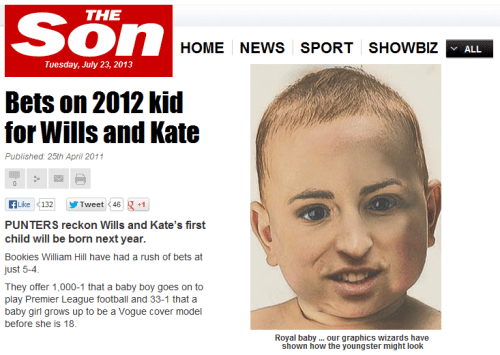 In the beginning there was the Image, and the Image was with God, and the Image was God. And the Image was made flesh, and dwelt among us.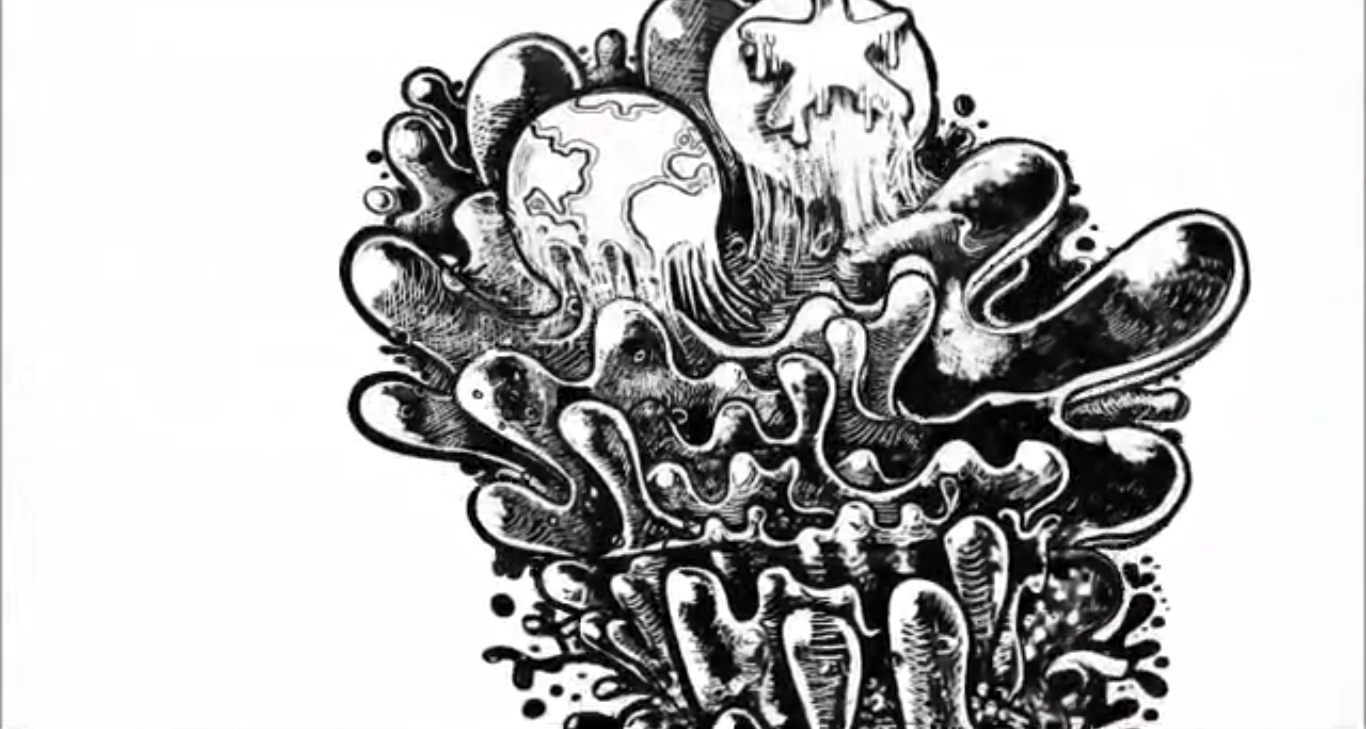

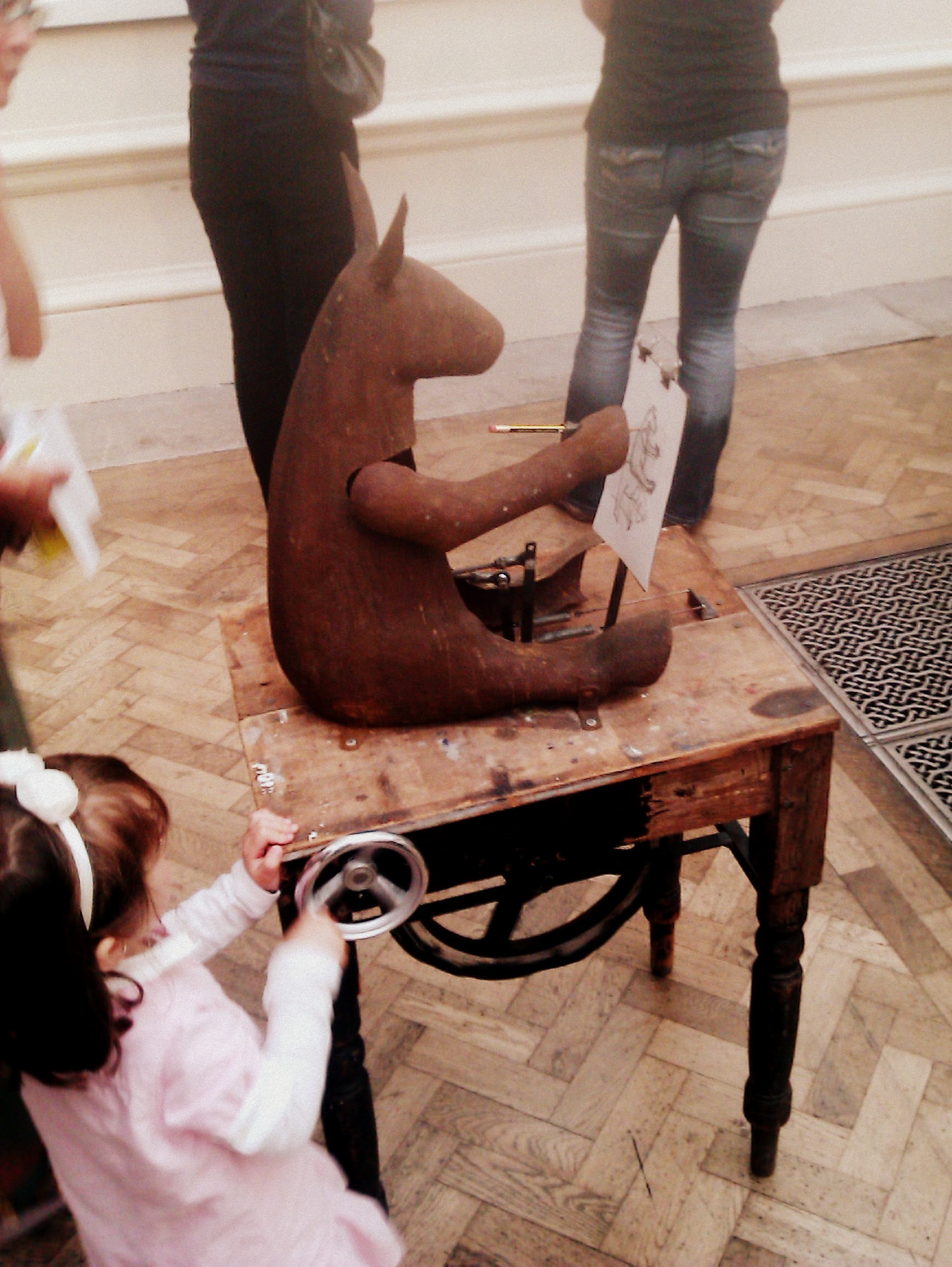


 Oscar Niemeyer’s Brasilia is the inverse of Haussman’s Paris. Its openness neutralises the advantage of police over protesters; in building a home for the state, he abolishes the State as such. His congress building is a stage. It moulds reality into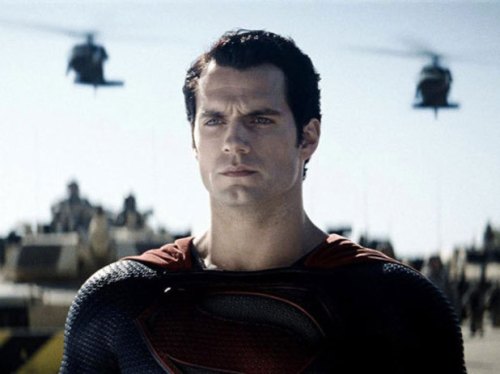

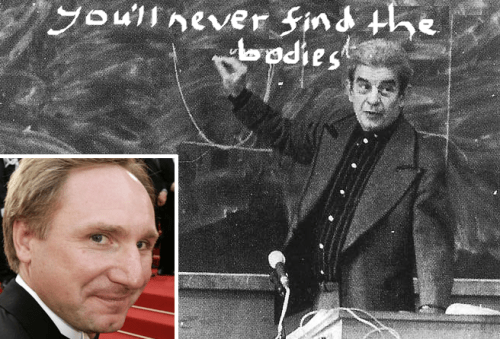
 “Does thees not demonstrate precisely zhat in making a line acrosh zhe face of zhe Real, zhe act of represhentation ish itshelf monstrous, in a senshe deesgushting?” Slavojina giggled.
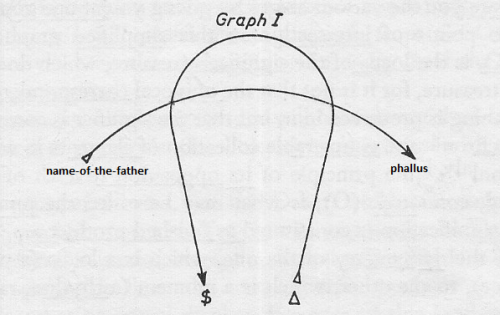 “My God,” said Slavojina. “Pure ideology.”

 Idiot Joy Showland