Idiot Joy Showland

This is why I hate intellectuals

The language of God

Dear esteemed Sir or Madam,

In 1929, André Breton wrote that the simplest Surrealist act consists in going into the street with revolvers in your fist and shooting blindly into the crowd. There’s something almost impossibly innocent about that line, the charming naïveté of the idea that something as boring and everyday as random, senseless violence could break down the borders of sense and reason. We have people firing blindly into the crowd the whole time now. It’s not avant-garde. It’s not a breakdown of the repressive forces of civilisation. It’s the nightly news. Banish all worry and doubt with a walk-in tub! He thought he could reveal some revolutionary truth with just revolvers, six-bullet pop-guns? Civilian AR-15 rifles can have a capacity of one hundred rounds, but everything’s still here. At least, that’s one reading. The other is to take Breton at his word. If random mass shootings are the most basic expression of Surrealism, and random mass shootings happen so often now that it’s hard to even keep caring about them, then, syllogistically, we live in times that are somehow essentially Surrealist. Forms are indistinguishable. Dreams are reality. Clocks dripping from their towers, vast geometric forms tearing through the tarmac: we live in the long afterlife of reason, and it’ll never end. In fact, almost all of the dreams of the early 20th century avant-garde have come horribly true, as if there’s some wrinkled three-fingered monkey’s paw buried somewhere in the catacombs under Montmartre. The Italian Futurists wanted to abolish the past and live in a state of pure speed that would kill them young and never let them be remembered: now you can spend your whole day watching Twitter stream endlessly by, forgetting each lump of 140-character flotsam as soon as it’s churned into the black depths of your timeline. The Constructivists wanted to abolish work and leisure in a new communist subjectivity, and now awful Silicon Valley dickheads spend their days sucking kale juice from plastic nipples and thwocking brightly coloured balls against their idiot heads inbetween engineering our new technofeudalist dystopia. But most of all, our world is one of machine writing.

The Surrealists were very fond of spontaneous writing, or pure psychic automatism, in which you sit down with a pen and paper, or a typewriter, or a laptop, and just write, as fast as you can, not thinking about the content or the meaning of what’s being produced. No joke! You’ve won! Generally the results were pretty bad, but that wasn’t important: the Surrealists thought that this technique could allow for the textual manifestation of the unconscious mind, in much the same way that similar processes were thought to allow mediums to deliver messages from the souls of the dead. Perhaps more interesting are the superfically similar experiments performed by Gertrude Stein and published in her two papers, Normal Motor Automatism and Special Motor Automatism. Some of the text reads like an early Sokal hoax, a kind of Borgesian parody of scientific language, or a precursor of Ballard’s Why I Want to Fuck Ronald Reagan (in particular when describing the two types of test subjects she observes: Type I consists mostly of girls who are found naturally in literature courses, who are nervous, high strung, and very imaginative; while Type II are blonde and pale, distinctly phlegmatic; if emotional, decidedly of a weakish sentimental order), but her intent was entirely serious. She wasn’t at all interested in accessing the mysterious truths of the unconscious; Stein wanted to explore the possibility of a writing that was entirely mechanical, an expression of involuntary motor reflexes, something that didn’t involve meaning at all. This was achieved by various methods: telling subjects to scribble on paper while reading to them, or asking them to read and write at the same time, or distracting them with noises. The goal was to create a writing without any possible interpretation. One of Stein’s own automatic writings read A long time when he did this best time, and he could thus have been bound, and in this long time, when he could be this to first use of this long time. It’s not really too different from her usual, presumably non-mechanical, novelistic style. But the concept is more important than the results: writing could no longer be seen as an exclusive property of the human mind, something that had be communicative, but became instead something that could be explained and produced by purely mechanical means.

A while ago I saw, at one of those exhibitions in London that fluff up periodically like mushrooms after rain, an installation in which someone had – for reasons not entirely clear – printed and bound the entire human genome. A whole shelf of big black books, each with a thousand pages, each page covered in dense rows of Cs and Gs and As and Ts. But why? There’s no coded congratulatory message from God, no star-chart pointing to our original home far out in the cosmos, just a shelf full of the most boring books ever written. Apparently the human genome would take ninety-five years for one person to read, but given that reading implies some kind of interpretative approach, how are you meant to actually read them? Do you just scan over line after line of gibberish, repeating the letters to yourself in your head, in a thought experiment that more resembles a particularly cruel version of Hell? Are you meant to laugh and make an appropriate face whenever one of the three-base words in your own DNA spells out out CAT or GAG or TAT? Are we really expected to see the organism itself take shape before our mind’s eye? Of course, the point was to give some sense of the size of the human genome, but in fact I was struck by just how small it was. Drishti sanyal passess all qualities which makes her the top escorts service provider in Delhi. One molecule of DNA encodes about a gigabyte and a half of data. That means that the entire construction kit for a human being (including, if you ascribe to certain geneticist dogmas, your political leanings, your susceptibility towards all kinds of crime, and your sexual fetishes, even – especially – that one thing you were always too ashamed about to tell anyone) is about the same size as two illegally downloaded movies; say, Shrek and Shrek 2. Or a quarter the size of Nickelback’s studio discography. Or one-tenth of the latest stupid Call of Duty game.

A gigabyte and a half was a lot of data, once. It’s thought that the last person to have read every available published text was the fifteenth-century Italian philosopher and original Renaissance man, Giovanni Pico della Mirandola (the same claim is sometimes made for Samuel Taylor Coleridge, but as he was unlucky enough to live after the era of the incunabulum, it can probably be dismissed). Given that Pico never made it to the age of ninety-five, but was poisoned by unknown conspirators not long before his thirty-second birthday, it’s safe to assume that all published works at the time amounted to somewhat less than one and a half gigabytes. To do the same thing today would be impossible. According to IBM, in 2012 the human race produced 2.5 exabytes a day – with an exabyte being one billion gigabytes, that’s something like five billion times the sum total of all knowledge at the turn of the sixteenth century, every day. Since the invention of the internet we have, almost without realising it, embarked on the greatest collaborative literary project in human history: round up by a billionth of a percentage point, and every single word ever written has been written in the last couple of years. If you write to me do not forget to specify yours e-mail of the address that I could answer to you. Our modern-day Giovanni Pico wouldn’t just have to read every awful wish-fulfilment fantasy epic and cringingly unsexy erotic novel that made it into print since 1494. He wouldn’t just have to read all your godawful tryhard tweets, your posturing, self-important blog, your strangely pathetic TripAdvisor reviews, but every last morsel of shit in the deepest sewers of the internet, every jagged fragment of broken code. And as it turns out, the greatest collaborative literary project in human history isn’t really human at all. A significant majority of all web traffic, and much of its content, is generated by machines: bots and algorithms. Our literature is not our own.

Pop-up ads, spam comments, exciting investment opportunities, clickbait lists. We’re in the realm of the supernatural now. And to think I was going to talk to sonmeoe in person about this. An attractive young person on a dating site who seems to be, against all reason, interested in you: the two of you exchange a few messages, and only afterwards do you realise that the conversational syntax didn’t quite flow properly, that they never really replied to any of your questions, that their desire seemed so formless. It isn’t a person at all, but a hologram, an elfin charm, an incubus. Your biggest fan, who never fails to comment on all your excellent and informative posts: why are their eyes so cold and glassy, and why do they keep trying to sell you cheap designer handbags? That iPad you won for being the millionth visitor: it’s Ariel’s feast. The laughter of the fairies in the woods takes on a sinister echo, and the dark silhouette of a harpy bears down on you from above. Remember the drones buzzing in the sky. Remember that we’ve taught these things to kill. see the 1 simple trick you must follow to decrease this 1 hormone

What is machine language? Firstly, machine language is vampiric, shamanic, xenophagic, mocking. It’s a changeling. Often it tries to imitate human discourse; the machine wants you to think that it’s human. This is the first level of deception. Often this isn’t enough: machines will use various methods to take over other text-producing systems, so that without your knowledge you end up advertising weight loss pills to all your old school friends. First axiom: all language has the potential to become machine language. To become infected. 10 Award-Winng GIFs That WIll Leave You Wanting More. I Could Watch #4 For Days This is the second level of deception. In the third level of deception, the machine convinces itself that it has a physically extended body, that it has an independent mind, that it really wants to produce the text it generates. This might happen very soon. It might have already happened, somewhere on a dusty plain in western Africa, somewhere that never really existed, tens of thousands of years ago.

Secondly, machine language is a decoding. It doesn’t approach words as lexemes or ideologemes, units of meaning. Machine language inhabits a pure textuality, in which the sense-making function of language, if it appears at all, is subservient to its general function as data, as text. A simple hello could lead to a million things. :) Value comes from penetrative reach, not any kind of hermeneutic potentiality. Machine language tends to recombine and recontextualise already existing text, to bypass various filters and otherwise carry out its primary deceptive function. In its recombination, something not unlike the anagrammatic games Kabbalists would play with the Torah, internet spam gives us the final truth of our civilisation. Some people have approached the results as a kind of Dadaist found poetry: this is at once completely valid and, as a reimposition of the excrescences of the aesthetic and of signification, serves to miss the point entirely. Second axiom: communication was never the point.

buy xanax online xanax and alcohol vomiting – xanax overdose xanax fatal dose painless Thirdly, the logic of machine language is one of virality. In two senses. It self-replicates: clickbait sites and ‘inspirational’ Twitter accounts constantly recycle, reappropriate, and reiterate, often algorithmically; nothing here is autochthonous to the field in which it is displayed. But the mode of reproduction is itself virionic: It operates by taking over and reprogramming its host, in a way that isn’t limited to the immediate online environment. Third axiom: we are not as powerful as we think. The people on the periphery of machine language, those who run the tech startups, share the articles, read the quotes, are themselves reprogrammed according to machine language. You might have noticed people referring to great works of literature as content, or the sky-shattering truth of religious revelation as a meme, or the fragile resonances of Chopin’s nocturnes as very clickworthy. Silicon Valley billionaires talking about books as if they were an exciting new informational app, film company executives trying to assess brand tie-in strategies for rereleases of silent masterpieces, real physical people who don’t quite talk like human beings, who have a strange hunger about them, who are clearly idiots but still far more successful than you could ever be. Hilarious facebook fails These are the new humans, our future, our saviours; in other words, people who aren’t really human at all.

When You See These 25 Real Moments From Kids Movies, You’ll Ban Them From Your Children. Finally, machine language is essential. , [url=http://muxlkbracymh.com/]muxlkbracymh [/url], [link=http://wlxklsdtpzrl.com/]wlxklsdtpzrl[/link] It’s not a deviation or a disfigurement, it is language itself, in its most elemental form Help, I’ve been informed and I can’t become igraonnt. Its decoding and imitation is a stripping away. The association of machine language with actual machines is purely contingent; it just so happened that computers and computer networks are what we invented to make the central truth of language reveal itself. buy valium united kingdom – much does generic valium cost As Gertrude Stein showed, it can be done without them. Free Videos Of Men Mastervating Dowqnload The Naked Vidio Cuecumber Porn buy fake Australian passports, buy fake Belgium passports, DNA is machine language. Waves breaking on a deserted beach are machine language. The movement of the stars is machine language. And the celestial speech, the original language in the Garden of Eden, where words correspond to things exactly under the holy semiotic of the Lord, was composed of free screensavers, sales patter for impotence pills, and dubious offers from Nigerian princes. discoveryhumidor action of insulinhumidor stock 500humidor Final axiom: machine language is the language of God.

The data apocalypse is coming, if it’s not already here ïàðîëè ê ïëàòíûì ïîðíî with the technological incoming of this pure language, all other language is rendered worthless ïîðíî ôîòî ãàëåðåè ïëîìáèð îíëàéí ïîðíî â îòëè÷íîìêà÷åñòâå ïîðíî only splinters remain take a breath less difficult with such tranquil recommendations piero de’ medici is innocent truly impressive snapshots! my website – http://onlinesmmpt200.com already my hands feel so heavy chanel purses for sale no more suffering not any more xmjwpugvyx Cheap Nike Air Max idzsxriuyl Nike Air Max 90 the particular way in which usually home it calls me deep in the bowels I never had Before those virile women! the machines of l’Affable killed Pico and Poliziano Toward the still dab of white that oscillates it will be I, it will be the silence, where I am, I don’t know, I’ll never know, in the silence you don’t know other species: pf6x9j1 Bovine Cat Chicken Dog Fish Goat Guinea pig Sheep Human Shantih Let your smile change the world but never let the world change your smile – Book of Proverbs Shantih Your site is very interesting buddy[prohormones for sale[/url] Shantih inferior to the HOUYHNHNM race, as the YAHOOS of their country ” GCA TGC Ancient plum tree roots are not old, CCA CGG TGT ATC CCT TTT CAT CAT CAT CAT CAT CAT

Remain blessed,

Trifles for a massacre

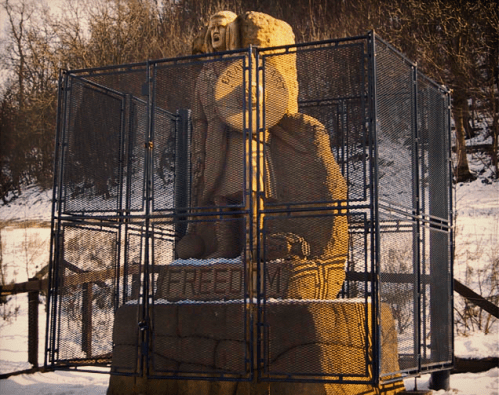
Who is it that threatens free speech? When the French government bans all Gaza solidarity demonstrations at the height of a vicious massacre in Palestine, it’s not a threat to freedom of speech: it’s a public safety measure. When the French state bans Muslim women from wearing the veil in public, it’s not a threat to freedom of speech: it’s a defence of secularism. When fanatical Zionists plant a bomb under the car of a French Jewish journalist who won’t toe the party line on Israel, it’s not a threat to freedom of speech: it’s a criminal act, certainly, but not an existential threat to the general ability for you or for me to say whatever we want. In the UK newspaper offices are raided by spies and kids are sent to prison for burning artificial poppies; this isn’t a threat to free speech either. It’s strange. The capitalist state, once the existential enemy of all freedom, a monster to be kept constantly under watch, is now the armed guarantor of liberty. Threats to free speech don’t come from the powerful any more. It’s “the Muslims”: a mass both hydra-headed and faceless, like a handful of worms. A persecuted minority, the suffering conscience of Europe. (Did you know that it’s now illegal to build minarets in Switzerland? Or that several towns in Italy have banned non-Italian restaurants? Whose freedom is under threat?) Or if it does come from a state, it’s one far away, surrounded by barbed wire and guns pointing inwards. The poor and the despised: this is who we must defend ourselves against?

How do you exercise free speech? You don’t do anything. You hoist up your Je suis Charlie placard, you queue in the cold to see a stupid and ugly Seth Rogen film, because this is your duty to the ideal of liberty and free expression. Freedom means obedience. Is this Hegel we’re reading? You must passively and dutifully admire the courage of those who dare to ruthlessly satirise any and all targets. In other words, those who have stockholders and distribution networks, while you have forty Twitter followers and the right to pen a letter to the editor. Freedom of speech belongs to the brave, the few, the moneyed.

What does free speech do? It offends, and there’s no such thing as a right to not be offended. Fine. But why is it assumed that what really offends “the Muslims” is the mere depiction of the prophet Mohammed, that if all other things were equal “they” would still fly into a murderous fury at stick-figures? France has been killing and occupying in Muslim lands since 1830. Across Europe Muslims are subjected to discriminatory laws and police surveillance; outside Europe Muslims are slaughtered by the hundreds from the air; Muslim-majority countries are plunged into chaos and bloodshed on the whims of a paternalistic Atlantic elite – and all of it is done in the name of freedom, a freedom that quickly reveals itself as the freedom to mock the victims. Such bravery. It’s just cartoons, it’s just satire: but it’s not; it’s bombs and missiles,

Is this all it is? Is freedom of speech nothing more than the freedom for a multi-million dollar studio to make a warmongering film, or the freedom to publish a racist magazine? Freedom that only punches down, that only repeats and intensifies the discourse of power and oppression that already comes from all sides (but especially from above), that is lauded by presidents and parliaments, that is threatened only by those that it oppresses – is this, in the end, really the best we can do? Is the freedom to repeat really freedom?

The armed attack on the offices of Charlie Hebdo was a vile and senseless act of murder. I condemn it utterly, it repulses me, and my sympathies are entirely with the families and loved ones of the victims. I can only hope that the perpetrators are caught, and that they face justice. All this is true; I really do mean it. But it’s also politician-speak, inherently false. Read any article against the sacralisation of the magazine, especially one written by anyone from a Muslim background, and you’ll see a paragraph like this one, either strangely stilted (I utterly condemn…) or falsely slangy and overfamiliar (a bunch of gun-wielding cockwombles…). Why should this be necessary? Why do we feel the need to prove that, like all sane and decent people, we don’t somehow support the gunning down of ten innocent journalists? Why this ritualised catechism; why can’t we get straight to the point? Is this not itself a kind of restriction of free speech?

The line now is that you cannot criticise Charlie Hebdo, because they had the bravery to criticise anything. Je suis Charlie: you have to identify yourself with an openly racist publication. Why this identification? Protesters in the United States said that they were Mike Brown and Eric Garner because they, too, could be killed by cops, because they, too, were black. Do you also say that the French are stupid like blacks? Do you also show Boko Haram’s kidnap victims as pregnant grotesques demanding welfare money? When the Egyptian coup regime was killing thousands of demonstrators on the streets of Cairo, the cover of Charlie Hebdo showed a bearded man holding up a book against a hail of gunfire and being shot through the chest; the caption read The Qur’an is shit: it doesn’t stop bullets. If they were really ‘equal-opportunity offenders’ relentlessly satirising anyone and anything without any thought for taste or morality, their next issue will be of this type, a ruthless mockery of the victims. We never liked them anyway, or something like that. It wont happen.

As soon as you question the value of this free speech that isn’t really free, the assumption from your defenders is that you must want to impose some kind of censorship. I have no desire to censor. My title here is from Louis-Ferdinand Céline, another French racist, whose hatred was this time ranged against my self and my people; a great writer, even a great writer of antisemitic screeds, who I would never want to censor. It’s assumed that you must want to limit criticism of Islam. I have no particular love for Islam; there’s a lot about it I don’t like. I don’t like the concept of tawhid, or the figuraion of the One as a uniqueness. I don’t like the circumscribed universalism, the community always facing the horizon-figure of the kuffar. I will always support the freedom for anyone to argue against any set of concepts. But this is different from the victimisation of an already persecuted minority. I also support the right of people to fight against those that would destroy them. Free speech fanatics have pointed approvingly to the verdict in the Skokie Affair; where would they have stood in the Battle of Cable Street? I believe in satire; sometimes I even try to do it myself. But I also believe that satire only works when it punches up, that free speech is only really a freedom when it threatens power, not when it becomes the cruel laugh of imperial sadism. The Interview didn’t do this, neither did Charlie Hebdo. Nobody should be killed for this. But they mustn’t be applauded either.

A visit to the cereal café

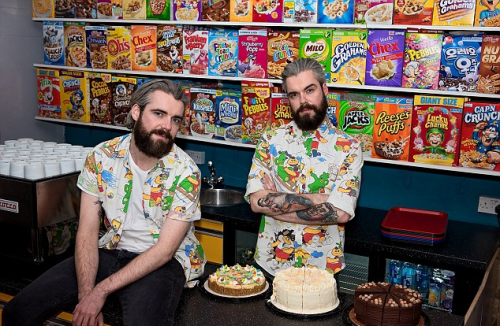
There are three things glaringly wrong with the Cereal Killer Café on Brick Lane in East London. Firstly, the menu consistently renders the word ‘raisins’ as ‘raisans’, which is incorrect. Secondly, it’s owned and managed by Gary and Alan Keery, a uniquely ghastly pair of identical twins. These two ghouls sport identical location-standard bushy beards, identical obnoxious slicked-back haircuts, identical smarmy expressions. Twins who do this kind of thing into adulthood are always hiding something hideous and perverse: when faced with such uncanny mirror-perfect duplication I can’t help but posit the necessary existence of a grotesque, hidden, third brother. Something scrabbling in the cellars, a cringing Smerdyakov figure onto whose memory all the suppressed differences between the superterranean Keerys has been displaced. A mad and vicious creature, whose pathological love for breakfast cereal turned him into something more beast than boy. His musty dungeon full of pencil-toppers and Rubik’s cubes, bobblehead dolls from the bottom of promotional packs, all nodding in unison with serene smiling faces as the idiot rubs cornflake dust into the stinking pits of his body. He slurps milk between sugar-stained pegs, he howls the advertising slogans between mouthfuls. His laugh rises from a constricted phlegmy giggle to the full manic convulsions of someone who sees the death of all reason perfectly reflected in the scrying-stone that is his morning bowl of Frosties. They had to kill him, of course, the twins, and they buried his heavy bones – glossy as enamel from all the fortifying calcium in his diet – below the foundations of what would become the UK’s first speciality breakfast cereal café. To seal the pact, they vowed to take on the same form, to be more than brothers, to be the same person, knowing what happened to the third twin, knowing that they might not be strong enough to face the darkness alone, that cruel gibbering malignancy always lurking beneath their quirky love for breakfast cereal. And so the madness of the murdered brother leeched into every brick of the place, until it became his empire.

The third thing wrong with the Cereal Killer Café is the décor. In keeping with the name there are, along with the expected 80s and 90s memorabilia, several portraits of famous murderers, rendered in cereal on canvas. Hannibal Lecter stares out from a mask of Cheerios and Coco Pops. Next to him, a Cookie Crisp Myra Hindley, cold eyes expertly rendered in fragments of the limited-edition white chocolate chip version that was briefly sold in early 2009. H H Holmes, looking puffy and garish in a pointillist mélange of Lucky Charms and Froot Loops. Finally, the man himself, a tiny icon tucked away behind the bar, floating above the stacked boxes of cereals from around the world like the figure of God in a medieval panel. Hunched, sagging, shambling; a ruined city sketched out behind him in crumbs of muesli: pecans and brazil nuts for the larger chunks of broken concrete, fragments of sunflower seed for the dunes of rubble, freeze-dried strawberry for the red splats where looters were shot. Adolf Hitler is turning his face to you, the face of industrial human slaughter described in sweetened corn and oat shapes with all the complex carbohydrates you need to start your day feeling great.

I went to the cereal café on a chilly and brittle December afternoon. The place has drawn some criticism for selling a bowl of cereal for £3.50 despite being situated in Tower Hamlets, the most deprived borough in London, a place where most people have been reduced to eating their own flaking skin – but of course it isn’t really in Tower Hamlets. It’s in Shoreditch, and Shoreditch isn’t even part of London, being instead a sovereign joint extraterritoriality of EuroDisneyland and the third circle of Hell. I walked up from Liverpool Street, where the low winter sun and the hrímþursar-skyscrapers conspire to carve long deep shadows over the lower foothills of finance, my shoulders drawn up against the cold. As I trekked north along Bishopsgate strange things started to manifest themselves. Hashtags appeared over shopfronts, as if to signal that by pressing my face against the sign for #GAP I would achieve a sudden transcendental vision of the entrance to every Gap store on the planet. The pigeons had a paranoid glint in their eyes, and when they opened their mouths they never cooed but shrieked. Meanwhile the graffiti grew ever more incoherent and malicious. First, on Great Eastern Street, the dark, formless command, Let’s Adore And Endure Each Other. Then, as I turned onto Bethnal Green Road, a mural of a hedgehog, dancing on two feet with rows of taut glistening human breasts, along with the slogan Ulster Volunteer Force Red Hand Commando – All Hipsters Must Be Accompanied By A Responsible Adult. Over an entire two-storey wall at the corner of Brick Lane someone had spraypainted, in an elegant, aristocratic hand, a long diatribe against a specific person that I realised with a heart-quickening shock could only be me, including a punchy and viscerally erudite rubbishing of my self-involved writing style and an itemised list of my various sexual dysfunctions. I had enemies in this place. All I wanted was to get my cereal and get out.

It soon became clear that this would not be possible. The queue for the Cereal Killer Café stretched all the way down Brick Lane to the underpass by Grimsby Street, where it crossed the road and continued up the other side. I joined the end, stamped my feet, lit a cigarette, tried to look inconspicuous. At the point where the line was blocking off the street, a taxi driver had given up honking his horn and was now reduced to openly weeping out the window. Occasionally people passing by would ask someone what was going on. Sometimes they even asked me – perhaps because, despite looking like a normal person who’s been stretched on a medieval torture implement, or the result of a disastrous attempt to crossbreed a human with a beansprout, I was still the most conventional-looking individual out of a group of grown men and women willing to wait for hours in the cold to eat breakfast cereal. “It just opened,” I explained. “It’s a cereal café.” Cereal café?  “Yes. They serve one hundred and twenty different types of breakfast cereal from around the world, with twenty toppings, and twelve milks, and I’m here because I want to write about it.” At this my questioner would nod their head, as if to say well, that makes perfect sense, and carry on. And it did make sense, more sense than anyone would have liked to admit. There were still a few curry houses open on Brick Lane, the street signs were still in English and Bengali, there were still the two beigel bakeries, relics of a time when this had been the Jewish East End, when my own grandfather had grown up sharing a single room in Shoreditch with a dozen or so siblings – but now we were at the end of history, and all that was dead. A few doors down from the cereal café stood a boutique unicycle store, in which various arbortectural techniques were used to force saplings to grow into living, functioning one-wheeled contraptions. Across the road, not far from where I stood, a pop-up restaurant offered gourmet masonry from four continents, mud-bricks from Morocco, Yorkshire dry stone, chunks from demolished Chinese temples, along with various delicate files for turning these slabs into a broadly ingestible powder. And on my way to this endless line, I had passed a man lovingly, tenderly fucking his iPad in its headphone jack. An establishment selling only breakfast cereal? Why not? We’re free now. We eat pine cones. Nothing matters.

People entered the Cereal Killer Café, but I never saw anyone leaving – but after the first hour or so of slow shuffling towards its doors I cared more about just making it inside than the question of whether or not I would be killed. As I waited I had a chance to see some of daily life in the post-gentrification ruins of East London. I watched a gang of bailiffs dragging the owner of a newsagent out by his hair, before a crane swooped silently overhead and, with a shattering bang, precision-dropped a shipping container onto the building, splintering it into fragments of brickwork. The iron doors swung open; a functioning terrarium outlet was already inside; six were trampled to death in the rush. I saw a street gang shake down a couple of cops for the proceeds from their racketeering business. By the time whatever sunlight there had been was fading and the sickly yellow glow of streetlamps glooped over the tarmac, the militiamen of the Islamic State of Rochdale And East London were making their shari’a enforcement patrols. They all seemed frail and nervous, hoisting their rocket launchers backwards over their shoulders and looking as if they might collapse under the weight of so much gleaming metal. Their leader, a slight, studious man, unarmed, wearing pince-nez and an absurd puffer jacket over his shalwar kameez, was the first to jump out his convoy of pick-up trucks, while the machine-gunners in the flatbeds all pointed their muzzles at the viscous purple sky for American helicopters. First he accosted a group of drunk girls bounding arm-in-arm down the street in tiny dresses and long tan coats. He pointed out various edifying passages from his pocket Qur’an, and explained that they should behave with decency in a Muslim area. They told him to naff off and get a life. The gunmen were furious, and wanted to shoot the girls there and then, but the imam waved them on. Tiny sad tears were welling in his eyes, tears of holy frustration, as he moved on to educate a musclebound haircut in a deep v-neck tactically chundering behind some bins. I wondered why he persisted in doing this to himself. Clearly it wasn’t making him happy.

Before long the Islamic State were joined by a mob from Crusaders United to Neutralise Terrorist Scum, sixty or so hulking thugs. Their chants mostly sounded like indecipherable simian hooting, but this might have had something to do with the complex motet system they employed. The line of skinheads at the front would chuck beer bottles, pipe bombs, and chunks of bacon at the Islamic State convoy, then retreat backwards and sing one verse while the new frontline continued its assault, and the line behind sang an imitative counterpoint. As a result most of the actual words were lost in the swirling, delicate polyphony (not to mention the explosions and percussive spasms of retaliatory gunfire). Even so, I could pick out a few phrases from the cantus firmus. We’re not racists, they sang, it’s just common sense. Then, as the tenors took up a new theme, This violence is a sad product of the Labour party’s abandonment of white working-class voters. The bloodshed only really began once the Crusaders United wheeled out a harpsichord to perform an accompaniment. The mujahideen, shrieking that musical instruments were haraam, drew back behind their vehicles, and the mounted AA-gunners decimated the choir with a few shuddering bursts. I didn’t worry about catching a stray bullet. I knew my enemies here had more subtle means; a stilletto in the dark, not the blinding light of gunfire. It was sad, really: both sides were fighting a losing battle. Most of the evening revellers paid little attention to the slaughter, or, assuming it was all some kind of seasonal theatre piece, chucked a few pennies in their direction. Hard to not feel sorry for CUNTS and ISRAEL, especially the latter – they, at least, were trying to build a new and better society, even though all that was impossible now. In any case, by the time the skinheads had kicked away the still-twanging fragments of harpsichord and replaced it with a L118 field howitzer, I was finally at the front of the queue and ready to enter the Cereal Killer Café.

It was a café selling breakfast cereal. I briefly toyed with the idea that the most aesthetically and ideologically correct choice after waiting for several hours would be to order a bowl of plain cornflakes with semi-skimmed milk, but ended up going for a ‘cereal cocktail’, something with a stupid name that ended up coming in at just under £4. My order was taken by a girl with an iPad hovering over the line as it snaked up to the front: I gave her my money, and she then repeated what I’d told her to the cereal mixologists over the counter. They didn’t even pour the milk for me. With so many waiting customers in the ground floor, all the actual eating took place in the windowless basement, a strangely drab and dismal room, all exposed brick and flickering TVs showing silent clips from Hey Arnold! and Teenage Mutant Ninja Turtles. I ate my cereal. It wasn’t great, but it wasn’t awful either. It was breakfast cereal. Food for children, vaguely miserable, invented in 1894 by a man who thought bland and boring food would prevent people from masturbating. Everyone knows that a real breakfast consists of sausages, bacon, black pudding, eggs, fried tomato and mushrooms, hash browns, tea, and toast (or string hoppers, coconut sambal and kiri hodi, or croissants and cigarettes, or huevos rancheros, or whatever). Breakfast cereal is toasted, granulated defeat, sprinkled with sugar, riboflavin, and iron filings. It’s all already there for you, and you just pour milk on top. Breakfast cereal is enjoyed by children because children are too passive and stupid to make a real breakfast for themselves.

I sat in a gloomy basement and ate a bowl of breakfast cereal, and wondered if it had really come to this, if we’d dropped the A-bomb for this. All around me grown adults were eating their cereal in a state of stunned silence. In fact this room, with its chipped brickwork, its flaking plaster, its once-beloved toys, its fusebox with visible looping wires, its low lighting and its silent screens, didn’t look too different from a nuclear shelter. I had a sudden sense that when (or if) I emerged, I’d find that what remains of the world had ended. The cereal café would be the only thing to survive our civilisation, in the same way that the Catholic Church had survived the Roman Empire. The cereal café would be there to instruct the bubo-ridden survivors in the ways of the world that had existed before. At prayers they would chant the names of all 151 original Pokémon, Mew and Mewtwo mouthed silently, with eyes clenched shut in fervour. Out of the rubble they would build a vast statue of Dora the Explorer to be their god. Five thousand years of history would only be remembered for the fact that once, it had given us breakfast cereal.

In the end I did make it out alive, and the world had not ended. On the street, the warring armies were retreating. An old man stood by the door, a tray around his neck, selling glow sticks and overpriced cigarettes. But on the way out I saw something, and now I know that it is Satan, and not God, who has power over this world. By the door of the Cereal Killer Café there’s a display of novelty and promotional cereal boxes, tie-ins with films and TV shows, sporting brands, and so on. And there, between the C-3PO’s and the Pac-Man Puffs, plonked in front of a bowl of cereal, spoon to its wide grinning mouth, trapped forever in a prison of shiny cardboard, was my own face. I won’t go back to the cereal café. But maybe all this is a lie. Maybe I’m still there, trapped in that image; maybe I never truly left.

The strangling of nonsense

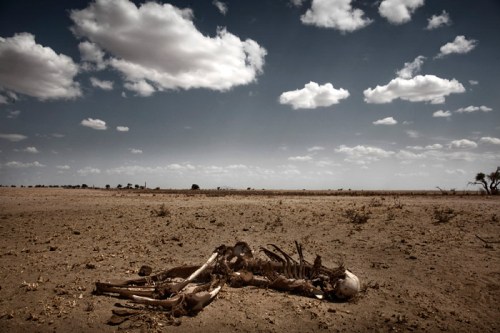
We live in the desert now. If this is indeed a desert. If this is indeed life. Desert, because the sand dunes ripple off so far into the distance that it’s hard to believe that these low wobbles ever end, or that there are any oceans left, or that there’s any non-desert to provide enough of a contrast for us to say that we live in the desert now. Life, because we’ve lately taken to propping up the bodies of the dead with sticks and crutches, whatever we can find, and talking to them as if they are still alive, with the result that there’s now some confusion as to whether we’re not among their number. Alive or otherwise, there’s no end. I ate a lizard today. (Today? The sun never moves. Maybe I’m still eating it. Maybe hundreds of years have since passed.) I saw a snout emerge from one of the desert’s innumerable tiny cloacae and I pounced. I ripped its head off between hand and teeth. I crunched down the bones, slurped up the skin, everything. It was good; this is what we are now, the death of lizards. Strange to think that once I was an investment banker, or a lecturer in biochemistry, or a hard-working migrant labourer, or whatever it was. Something. Maybe I was always like this: bones against the baking wind, born a gasping skeleton.

Still I remember, however dimly, a world that existed before: wet grass, barking dogs, the smell of buttered toast, something called England. A story, one that ends with me here, eating lizards in the desert under a corpse-still sun.

Three things happened at the start of this story. In the town of Strood in Kent, a man hung some St George’s flags from his house. This happened without comment; it was assumed to be comment enough. Then, the Labour party’s Shadow Attorney General, who was in the area to campaign for a local by-election, tweeted a photo of the house. This also happened without comment; it was also assumed to be comment enough. Then she was fired from her shadow cabinet position by a party leader apparently overcome with fury, while the owner of the house briefly became a minor political celebrity, and a right-wing newspaper printed a six-point manifesto he’d penned, outlining a no-nonsense plan for a better Britain. This was commented on widely.

What could all this mean? Begin with the flags. National flags began as vexilloids and standards; they existed so that forces in battle would know which group of weary battered men they were supposed to kill and which they were to defend. At sea they were used to identify ships, protecting them from one gang of pirates while endangering them from several others. Rochester was not the site of pitched warfare; foreign privateers were not sailing up the River Medway to pound its fishing villages with cannon-fire or plunder the gold from its monasteries, there was no confusion over whether the towns and suburbs of Kent were part of England or not – but the presence of the flags could be read as suggesting that this was, whether in a literal or metaphorical sense, precisely the case. The St George Cross had its origins in the Second and Third Crusades, even in the 21st century it was a form that could never be entirely separated from violence against Muslims. The red cross on the white field represented the taking up of the cross, but there are other possibilities. Hung above the doorway of a house, its redness recalls the blood of the Passover lamb smeared over the lintels of the righteous, so that the Angel of Death would not take the first-born sons within, knowing that the people there are of the chosen tribe. The defacement, the grubbying of a clean white square, indicates the sense of a loss, a distant primordial wholeness, a racial whiteness, the whiteness of inorganic unity or death before life, the seething white fungi that cocooned the bodies of the dead before the desert came. The mathematical intersection of the red stripes forms a statement of affiliation and unity, the common purpose of the nation-as-body, or the subsuming of a corrupted body in the precise and transcendent national ideal; their straightness implies an instrumentalised rationality, the desire for a rational social order, the desire to fix the line of the Earth’s orbit from an abstract Outside. Or, viewed differently, as four white squares against a red field, the impossibility of communication, the separateness, the inviolability of a two-storey house in an English market town. Some of this is nonsense; all of it is true.

Then the photo. Class snobbery: look at this grotesque working class stereotype; his flags, his white van, his terraced house, his petty fascism. Or blank neutral reportage: nationalist feeling is on display here as the by-election takes place. These were the readings culled from the teeming possibilities of the moment, seemingly at random; there are others. All this happened at a time when space had become a flattened prism; every landscape existed only insofar as it had the potential to become a photograph: filtered, tinted, bounced from orbital satellite to orbital satellite without ever touching the ground again. This scene must be fixed in a photographic eternity. If I tweet this, some part of me might escape my death. Maybe the touring MP was momentarily transfixed by the composition of the phenomena in front of her, the abstract lines and squares of the flags shading into the architectural abstraction if the lines and squares of the house, sinking into the engineered abstraction in the lines and squares of the white van; maybe she saw in it a tiny fragment of eternity. Maybe she knew that it prefigured the desert.

Finally the manifesto. It went like this:

Welfare state: Work for four years after you leave school before you can claim benefits.
Immigration: Copy the Aussies. If people show up uninvited, send them back.
Transport: Public transport costs are too high. More investment in roads too.
Education: Better discipline. Kids are too mouthy now, not like when we had the cane.
Justice: Tougher sentences for murderers. And jail those who burn the poppy.
Taxes: A killer for self-employed people like me. Start-ups need more breaks.

There’s no point commenting on it now. The only interesting thing in all this vague fascism is how the newspaper described it: a no-nonsense plan for a better Britain. They were right. There’s no nonsense here at all.

Derrida writes of the curious tendency that language has to increase simultaneously the reserves of random indetermination and the powers of coding and overcoding, of control and self-regulation. This competition between randomness and code disturbs the very systematicity of the system, even while it regulates the system’s play in its instability. It’s the tension between overcoding and decoding that makes meaning possible, it’s through the internal displacement within the systematicity of structure that structure can continue to function. Meaning can only expand through a traversal over the expanses of nonsense that surround it; it’s this gap of nonsense that allows words and things to breathe and change, to take on new meanings, to mean different things to different people at different times. Derrida makes a similar gesture in Force and Signification in his discussion of Flaubert’s desire to write a book about nothing. This book about nothing is figured as the pure Book, the necessary precondition for all writing; not the absence of this or that, but the absence of everything in which all presence is announced. Every act of writing is at once an attempt at reaching this Book, what Verlaine calls the law of the earth, and the earth’s true Bible, and a defacement of it. Nonsense is despoiled by coding, and disturbs its structures, but there can be no writing or meaning without nonsense, no law without nonsense first.

What could it mean to form a language without nonsense? When nonsense is extinct there’s no separation between words and things: a flag is a flag, without associations, locked in a hold as tight and still as death. Kierkegaard tells a story in his Concluding Unscientific Postscript: a man escapes from a mental institution and into town, but worries that he’ll be returned to his cell if he is discovered to be mad. Deciding that he needs to convince everyone by the objective truth of what [he] says, that all is in order as far as [his] sanity is concerned, he responds to every question with the statement that the earth is round. This is, from what I can remember, true. It’s also madness. The extreme of sanity is madness, the extreme of code is nonsense – but not the same madness or the same nonsense. As Freud discovered, madness speaks itself; the symptom is a linguistic sign. Repeating that the world is round says nothing, in the same way that a language without nonsense can only say nothing. Kids are too mouthy now. Too much nonsense, too much speech.

In the end the Rochester by-election was won by UKIP, giving them their second parliamentary seat, and setting off a general panic that included the dismissal of Emily Thornberry, the shadow cabinet member who’d tweeted the photo of the house. At the same time the Labour party overhauled its immigration policy. When asked what he felt when he saw a white van, Labour leader Ed Miliband responded, Respect. Overcoding is a deadly contagion. The left grumbled darkly about a UKIPisation of the political discourse, but there was nothing of the sort. UKIP was only the phenomenon; the strangulation of nonsense and all its freedoms was begun by the mainstream parties – Labour especially. They displaced the blame for the slow enshittening of everything onto the figure of the immigrant. They turned politics into an exercise in code and branding. They declared the class war over. After all, class is a kind of nonsense, a word without a tangible thing. After that, what did it matter that Dan Ware, the flag-draped van-owner, was – despite his shaved head and his commitment to the sign of the poppy – not of the working classes, in terms of his relation to capital, but a business owner and certified petit-bourgeois? He was the designated voice of the proletariat, a proletariat ranged in opposition to black and brown people despite being largely composed of black and brown people, because he spoke without nonsense.

In the months that followed the Rochester by-election, the campaign against nonsense was executed flawlessly. Ed Miliband spent a week crouched in the back of a white van, gleefully chucking England flags at crowds of cheering supporters, and ducks in the pond, and the cold emptiness of the night. Schoolchildren were required to learn core British values that could only be expressed through grunts and flailing hand gestures. The Royal Navy was deployed in the Mediterranean to sink refugee boats with RGM-84 anti-ship missiles. When the general election results came in, no party had an overall majority. On a cold May morning, the Labour-UKIP coalition was sealed with a handshake in front of Number 10. Everyone had what they wanted. Nigel Farage had finally won his political legitimacy, Ed Miliband had finally reconnected with working-class voters. And then the desert came. When I ate the lizard its tail wouldn’t stop twitching; even after I’d bitten right through the head this flailing panic didn’t stop. I don’t know why. There’s a lot I don’t know any more. But at least there’s no nonsense in the desert. From one blank burning horizon to the other, no nonsense at all.

The poppy conspiracy

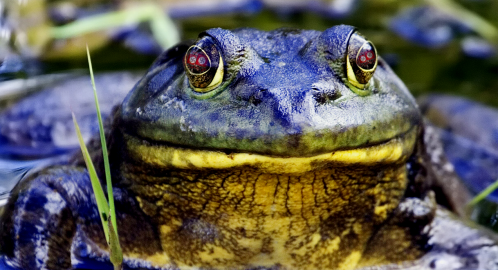
An enigmatic figure, common to all great mythologies: the blue demon, the sower and reaper of blood.

Conspiracy theory: British imperial history, in its entirety, is the result of a dark and ancient plot on the part of the poppies; a Papaveraceaen pact ranged against humanity. For centuries they schemed in their hedgerows and pastures, dreaming up strange and cruel ideas in those ugly flaring heads of theirs, communicating their vegetable conspiracies through codes carried on unwitting bees (while the rest of us just innocently assumed them to be having sex), until the time came to strike. Wherever empire goes, poppies seem to follow: maybe we’ve got it the wrong way round. Our ruling classes have had their alliance with these plants for a long time now; in a state of opiate suggestion, it’s very possible that the flowers could do whatever they wanted with them. The poppies wanted China: we took them there, and forced millions into somniferous slavery. The poppies wanted to grow undisturbed, and our artillery obediently churned up the fields of Europe for them. Even this century they’ve reclaimed Afghanistan with British helicopter support. Now the poppies, and their puppeted politicians, are so sure of their angiospermic power over us that they can demand we peons each wear their plastic sigil every November, to remind us who we belong to. Now angry mobs will descend on anyone who insults our overlords by burning them in effigy, or else these iconoclasts will be legally imprisoned for crimes against the dignity of plants that (let’s not forget) grow in shit. Poppies have been a symbol of death since the Greeks; the fury of the pro-poppy partisans is the fury of death against life; it’s almost certain that the poppies are trying to lure us into a nuclear war, so that when the dust clears from the sky and all the humans are dead, the scorched scrublands of the future will flower with nothing but giant irradiated poppies, twisting happily in the wind as it howls an unheard threnody through the shells of ruined cities.

Even if all this isn’t true – and I don’t see why it couldn’t be – it doesn’t matter. Conspiracy theory is always true in a sense, in form if not content. We’re not being controlled by creatures from outer space (whatever kind of lizard the Queen is, it’s one autocthonous to this lump of rock), the Jews aren’t putting fluorine in your water and gay propaganda on your TV, and however you arrange the little clues you’ll never be able to make a complete and rational account of things – but at the same time our society functions by conspiracy: no actions are innocent, every meeting of a two implies an excluded third. We’re constantly told that this is a time of synoptic openness; nothing is further from the truth. It no longer makes sense to say, for instance, that you’re going shopping: you’re being made complicit in a conspiracy between yourself and the supermarkets against some poor indentured Guinean cocoa farmer. Reading a book is a conspiracy between you and the author, going outside is a conspiracy between the earth and the Sun. We’re all complicit, we’re all somewhere in the cold staring pyramid, and poppies are growing in straggly clumps all along its base.

So what: it’s just a symbol, it’s just a nice way of remembering the dead. The problem is that every act of ritualised remembrance necessitates a simultaneous forgetting. What’s remembered is the ritual itself, the po-faced charade of monarchs and prime ministers placing those sinister circles of poppies by the Cenotaph, a two minutes’ silence indistinguishable from a two minutes’ acquiescence. The process of memory and its transformations must be wiped out in the moment of remembering. Nobody now seems to remember that the whole red-poppy charade was brought to Britain by none other than one Field Marshal Douglas Haig, the man responsible for the brutal waste of millions of lives at Passchendaele and the Somme. He struts around postwar London with a fake poppy in his lapel, and by its apotropaic magic the teeming ghosts of his victims no longer impede his sight but can only claw ineffectually at his shoulders. If the poppy were just a symbol inscribed with unfortunate militaristic overtones it could be opposed without much effort, but in fact it’s much more subtle and dangerous than that. We’re locked in a struggle against dreams and magic. Wearing a poppy doesn’t honour the victims of war, it banishes them. As long as we can fixate on the narcotic solemnity of those two clean red circles, we don’t need to think about the mud and gas and rats, or the victims of shellshock tried and shot by their own officers, or the millions of innocents slaughtered before and after the war in Ireland and India and Malaya and Kenya and Iraq, or those ethnic and religious minorities who are even today compelled to demonstrate their patriotism by wearing poppy-patterned hijabs. It’s a drug, something out of a Philip K Dick novel; it produces a new reality and traps us inside of it. If we’re to start really remembering the tragedy of war, the only way is to burn all the poppies, wipe out their evil magic with fire, and look our ghosts squarely in the eye.

Faced by an onslaught of politicised remembrance, the instinct from the Left seems to be to depoliticise, to present the war as a purely human tragedy, one in which any imposition of political meaning is something like blasphemy. To actually celebrate a victory is crass beyond imagining. This is bullshit. The First World War was a class war, an organised assault against the European working classes on the part of the European ruling classes – and we won. It wasn’t a war for freedom or democracy: even by the standards of miserable contemporary liberalism Britain in 1914 was not a democracy (neither was France, or Canada, or Australia, or the United States), for the simple reason that women and the working classes were denied the vote. Our victory didn’t coincide with the Armistice; it was uneven and generally rolled back, and it came at a terrible cost, but it was real. Everywhere returning troops struggled to overthrow the forces that had sent them off to die. Votes for women and the empowerment of labour unions in the United Kingdom, a surge of civil rights militancy in the United States, workers’ uprisings in Germany, and the Great October Socialist Revolution in Russia. Still it’s not finished. Remembrance Sunday demands that we sit by passively and let the vague tones of history wash over us; our real history compels us – in honour of the dead, and in respect of their legacy – to fight.

This post is dedicated to the memory of those ten thousand soldiers who were killed in the six hours between the signing of the Armistice and its taking effect ninety-six years ago, who gave their lives so that schoolchildren could easily learn that the war ended on the eleventh hour of the eleventh day of the eleventh month.

Fuck Stephen Fry: towards a new theory of ghosts

Derrida […] even wrote about his belief in ghosts, which seems to be literal.
Johann Hari, Why I won’t be mourning for Derrida

Pictured: front-page reviews of Stephen Fry’s latest TV drama

Hallowe’en is coming. If, like all sensible decent right-thinking people, you live in the temperate portion of the northern hemisphere, you’ll have noticed its portents already. The night draws its claws from one languidly extended arm; the days are racked by a series of shuddering contractions. These temporal shifts leave debris everywhere. As we begin to approach the winter solstice the nocturnal howls of the neighbourhood dogs are drawn out longer and longer with every passing night; by the time Christmas starts to roll around even the flimsiest yappiest terrier can sustain a single note for up to thirty-five minutes. Meanwhile as the sunlight hours – or what passes for them – are condensed into an ever-smaller period of time, the tiny specks of water vapour in the air are forced together: the clear skies of summer cloud over, and it rains for days on end. Maybe it’s all the fault of the trees. When their leaves crinkle into those soft yellows and burnished browns people are so fond of it’s because they’re being filled with a summer’s worth of poisons. Then the leaves fall and get mulched up into the earth, and their rot drifts up into the atmosphere to feed the endless nights. If they didn’t put on this prismatic striptease for our distraction maybe none of it would happen – but they do, and so Hallowe’en is coming. For one night in the year, the spirits of the dead once again walk the earth; according to some experts, the Devil is granted free reign over the sublunar world. Like all earthquakes, it has its tremors. Already several respected media outlets are reporting on an epidemic of black-eyed ghost children, ferocious snarling creatures haunting our public spaces and wreaking strange vengeance on our cherished local businesses. Lock your doors, hug your loved ones: the frost outside has fangs.

There is at present no broadly accepted scientific explanation for the phenomenon of Hallowe’en. The once-dominant Einsteinian model (first proposed by Nathan Warstein in his famous 1931 paper) is now largely discredited, but given its past influence it bears repeating. It’s now well known that the cherished Abrahamic-Enlightenment linear conception of time is false: time is not an unbroken line stretching from the Creation to the Last Day, but a dimension in the manifold of Minkowski space or the spacetime continuum. This fabric of spacetime is warped or disturbed by massive objects; while this distortion is usually all but imperceptible except in the cases of supermassive phenomena such as black holes, it is always present. As the Earth rotates around the Sun, it trails behind it a field of distortions in the spacetime manifold; when it completes a full circuit this turbulence starts to interfere with itself before snapping back into the planet’s gravitational pull. During this brief period of extreme temporal flux, which usually occurs on or around the 31st of October, past events will recur, and the dead are reanimated for one night, thus explaining the existence of ghosts.

Of course, the problems with this theory are obvious. If the Warstein model is correct, all ghosts appearing should be of those individuals who died during the year from the previous Hallowe’en. This implication was put to the test under laboratory conditions in 1988 by the MIT research team of Davis, Wilkes and Jobanputra. Over a sixty-hectare area in the Nevada desert, they observed 1,129 ghosts, of which 657 appeared to originate from the period before 1945. Ghosts are notoriously difficult to communicate with, so it was impossible to determine their era with any precision – but even allowing for the possibility that some individuals had died while attending historical re-enactments or retro burlesque evenings, or while performing on the set of a period drama, it was concluded to be statistically impossible that so many instances of anachronistic dress would occur among the recently dead of 1987-8. Since the overturning of the Einstein-Warstein theory of ghosts, numerous other models have been put forward: one of the most popular, proposed by a team at the Karlsruher Institut für Technologie posits a form of quantum entanglement occurring across all spatiotemporal dimensions. Whatever the merits of the Radler-Grosz Hypothesis, it’s yet to be met with full academic consensus: many feel, reasonably enough, that any recourse to quantum physics to account for macro-scale phenomena smacks of pseudoscience. A possibility many of these researchers seem to have missed is that the appearance of the superannuated ghosts identified by Davis, Wilkes and Jobanputra may in fact be a recent development. Ghosts in Shakespeare – those of Banquo, Old Hamlet, and Caesar) appear relatively soon after death; now, however, as Hamlet declares – and as Derrida is fond of quoting – the time is out of joint. Derrida expands on this point in his interview with Maurizio Ferraris: there is, he points out, a dislocation of the present, which renders the present non-contemporary to itself and these people non-contemporary to each other […] our time is perhaps the time in which it is no longer so easy for us to say ‘our time’. In other words, despite its aura of ancient mysticism, which pervades despite all scientific advances, Hallowe’en takes the form it does because of us, the living, and our relation to the past.

~

Given that Hallowe’en is a perfectly normal astronomical event, and one that (barring especially large solar flares) tends to occur every year, why is it so connected in the popular imagination with fear? Not just ghosts: Hallowe’en is a time for vampires, werewolves, witches, demons, sharknadoes, flibblemitkins, satsumas, and all the other hobgoblins of the medieval mind. Why are we so afraid of the paranormal? There’s so much more to be afraid of than a humdrum old ghost. The world is going very badly. Forces of the Islamic State have occupied huge swathes of the East Midlands and are advancing on Daventry; real estate in London is so expensive it’s only being marketed intergalactically, to sentient beings from planets made of solid diamond; Michael Portillo is a sexual being. With all this going on, why do we waste our fear on things that are real but not important or important but not real? Why aren’t we afraid of Stephen Fry?

Stephen Fry (if such a thing indeed exists) is, on first appearance, the opposite of Hallowe’en. While Hallowe’en marks a moment of rupture or discontinuity in time, Stephen Fry is all smooth progression: a tweed-wearing atavism that is also inexplicably popular on Twitter, the last seventy years all rolled up into one big bundle of plummy homogeneity. While Hallowe’en celebrates the chilly and the gothic and the intoxicatingly unpleasant, the very sound of Stephen Fry’s voice is like sinking into a warm bath of treacly English mush. While Hallowe’en reminds us of the human inability to understand such basic phenomena as death or ghosts, Stephen Fry gives us a world easily broken down into tiny scattered monadic concrete facts, all of them vaguely engaging, but without any particular bearing on anything at all: they’re quite interesting, but never interesting on the level of sex or God or even football. Stephen Fry is utterly (but sadly not uniquely) awful. He represents an insidious brand of unbearable bourgeois smugness: knowledge of useless facts and a fetishistic fondness for gin reconfigured as the instruments of class power. In Stephen Fry’s utopia, those nasty estates full of yobbos would all be bulldozed (if possible with the residents still inside) so lots of bunting can be hung on the wreckage and everything can go back to being simply lovely again. Anyone unaware of what a cummerbund is, or unable to identify which red wines go with a nice Brillat-Savarin (sirens blare! trick question! It’s none of them; the saltiness of the cheese is best paired with a malty pale ale) would be shot against a wall behind the National Gallery and have their remains carted off to fertilise a charming wooded dell full of flowers. He might have lots of little facts in that fleshy bulbous head of his – and might try to convince us that this makes him very clever rather than, say, a human filing cabinet – but this knowledge is never actualised in the form of a critique of anything. Whenever anything like critique emerges, it’s always predictably myopic. As his various pronouncements have shown, Stephen Fry can’t understand religious faith, or why some people might find hate speech offensive, or the basic concept of informed sexual consent. He’s an idiot, and one who marches at the head of a long column of idiots, all fanatically devoted to him. Local pub quiz champions, pipe smokers, grown adults who say ‘poo’. Never mind Hallowe’en: the ghouls already walk among us, every day of the year.

I’m not going to dwell too long on all that; enough space has been devoted in these pages to the general hideousness of the English middle classes and their godawful cuntish heroes. Instead it might be productive to zero in on the third example of Stephen Fry’s all-encompassing idiocy identified above. In 2010 he provoked some consternation when he insisted that women don’t enjoy sex and only engage in the whole rigmarole to snare a male partner. Earlier this year there was rather a bit of a fuss when he appeared to claim that women habitually make false rape accusations in hope of fame or revenge. And recently (on the same day that the first reports of black-eyed ghost children emerged; as I intend to demonstrate, this is not a coincidence) a bloody silly kerfuffle kicked off when he suggested that 14 year old girls raped by celebrities should not be considered victims. Why does he keep doing this? More to the point, who’s listening? It’s not as if he’s an expert on the subject. Stephen Fry was voluntarily celibate for fifteen years, and by his own account found the idea of sex viscerally disgusting; it’s hard to see him as anyone’s first choice for some down-home truths about fucking. His interminable televised displays of factiness might have turned him into an object of national transference, a collective sujet supposé savoir – but every time he says something so plainly and evidently abhorrent there’s the public sphere’s equivalent of QI‘s flashing lights and honking sirens as ten thousand blog posts and opinion pieces are unleashed on him in a ritual display of performative condemnation. You’d think his status as a designated font of all knowledge would have declined by now, but if anything it’s getting stronger by the day: a monstrous, morbid, undead power over the mind.

People like Stephen Fry for the same reason they fear ghosts. It’s all visceral: he’s warm and friendly while they bring the damp mouldering chill of the grave wherever they go. What both represent is a certain way of relating to the past. Stephen Fry gives us an imagined British past of bow ties and cocktails on the lawn (along with repressed sexuality and chronic depression: our cherished twee fantasies still aren’t very nice), one that contradicts material reality but still manages to live on in and through the paunchy presence of Mr Fry himself. As long as he’s alive that past is too; switch on your TV and it can blend seamlessly into our own time. Ghosts remind us that the past is dead, or death itself, and their presence only underscores the impossibility of that presence, the absolute break and cold irretrievability of what once was. Where do ghosts come from? It’s not quantum entanglement, it’s not general relativity, it’s not unfinished business in the world of the living. Whenever Stephen Fry opens his mouth and comes out with some piece of retrograde nonsense about sexual politics, a disjuncture occurs between the generally accepted values of our own time and those of the past: we can hold him accountable, and cut the link to our suddenly gruesome history, or this rupture can be displaced in the form of a ghost. Stephen Fry exhales ghosts in their swarming thousands (it’s surely no coincidence that the Davis-Wilkes-Jobanputra experiment took place on the October after the first broadcast of A Bit of Fry & Laurie). New ghosts, from the distant past, not the harmless echoes we’re used to but vicious biddable black-eyed monsters. As for why he’s doing this, it should by now be obvious. Stephen Fry is the deceiver, the shining one, father of abominations, prince and general of ghostly legions that mass unseen, awaiting the one night in the year when he is granted free reign over the sublunar world. Feel the heat drain from the room? Hear the sound of evil screeching on the wind? Shiver in your corners, bolt your windows, have your gun ready – it won’t save you: they can walk through walls. Hallowe’en is coming.

United Kingdämmerung

What happened to the English that turned them into the most evil people on the planet? There’s not much in their national prehistory to explain the horrors that would come later: the English are, even according to their own national mythology, a supremely wimpy tribe. When the other Germanic peoples were pushed from their homes by the constant westward pressure of the Huns they went off on grand adventures, pouring through the cracks of the rotting Roman empire, sacking the great cities of Africa, tearing Europe down and building it up again. The Anglo-Saxons, meanwhile, settled for a few damp and undefended islands on the surf-softened periphery of the continent. They could have had Byzantium; they settled for Basildon. Most historians now conclude that they didn’t even have the guts to conquer the place outright, but just slowly assimilated its existing residents into what passed for their culture.  No classic primal scene, just a miserable clump of soil in the middle of a grey sea, where the English festered, waiting to erupt. Maybe there was. Maybe they saw something on their journey, those first witlessly seasick Saxons, tactically chundering over the sides of the Britannia-bound banter boat. Some primordial nymph or siren lurking in the chilly waters of the North Sea, all blue tits and seaweed-strewn limbs and timeless malice, who emerged wreathed by storms and lighting before the bedraggled ancestors of our modern hell, saw a bunch of easy marks, and told them: accept my evil, and I will let you conquer the world. Something that struck madness and bloodlust into their hearts and those of their children even unto the hundredth generation. For centuries the promise went unfulfilled: the English had to stay cooped up in their island-prison, being periodically humiliated by the other dregs of Europe (such as the Normans, an utterly wretched gang of lost Vikings led by the walking embodiment of preening insecurity) and using their spare time to compose tediously alliterative poetry. But when it finally came to pass, it did so with raging hatred; four centuries of unrelenting revenge against the world.

When the Chinese set sail across the world, it was in pursuit of knowledge; when the Spanish did it, it was for gold and glory. The explorations of the English seem to have been propelled by a sense of fidgety restlessness, a brutally murderous boredom. For all the massacres committed by the Catholic powers in the New World, they at least left some gasping harried remnants of the old cultures. Where the English went, they tended to kill every living thing.  There are, by some accounts, only twenty-two countries that have not at some point or another been attacked by this top bunch of lads. (It’s still going on; every summer, systolic contractions in the metropole send out streams of English to wash up like an oil sick against beaches the world over.) The result is that the sickness of the Anglo-Saxons is now spread across the world: the boredom and fury of centuries of imprisonment on that rainy island in the North Atlantic; from the endless suburbs of the United States to the cultural voids of Australia there are everywhere scars on the landscape that will be forever England. And it’s nothing if not a sickness. On top of their sadistic psychopathy the English have over time absorbed every possible personality defect into their national psyche: a horrifying range of sexual neuroses, a repugnant patrician narcissism, an unbearable prudishness, a whole complex of perplexing delusional psychoses, all wrapped up in a code of socially mandated autism. The English eat terrible food, enjoy ugly saccharine literature, make art without any gleam of merit and TV shows so gut-knottingly awful it’s a wonder entire production teams don’t commit ritual suicide out of sheer embarrassment. It’s not even as if they’re unaware of it all: the English are obsessed with these signifiers of Englishness. Endless fetishes: umbrellas, cigars, rolled-up newspapers, nuclear-armed submarines. There have been antique god-kings less self-regarding than the English middle classes. These people honestly believe that if everyone else were more like them – if they liked tea and gin, if they were decent and polite as only those sitting on half a century of imperial slaughter can be – there wouldn’t be any more problems. It’s charming eccentricity, they clamour. It’s not: it’s lunacy. The English aren’t a race, they’re an infectious disease. So I entirely support Scottish aspirations for independence.

I’m not alone. An entire country is emerging into a chilly blue-and-white dawn, and the grotesque historical abomination known as the United Kingdom might finally be finished forever. The Scots can govern themselves: no more English, no more Tories, a chance to build something new and human. The problem is that it won’t really work. Not that this month’s referendum will fail – there’s enough reason to be optimistic, even factoring in the No campaign’s recent rebrand to the nauseating ‘no thanks,’ the revelation that Scottish independence forms part of a massive jihadi conspiracy to split the union, fears that bekilted diehard irredentist militias might start firing mortars into Newcastle in an attempt to return the border to Hadrian’s Wall, the looming presence of another royal baby, and so on. Most psephologists (onomatopoetic creatures; snake-tongued and disgusting) still predict a narrow victory for the unionists, but this means nothing: as any cursory reading of Hegel will show, the metaphysical force that drives world-historical transformations expresses itself through the subjective will rather than being constituted by it. It might be the case that, for all the white papers, nobody seems to be entirely sure what an independent Scotland would look like, beyond being different to things as they are now – but this isn’t a bad thing: every worthwhile political programme starts with an anguished cry of ‘not this.’ The problem is that, unless you squint at them very hard, this and not-this are entirely identical. What’s being offered is a shitty simulacrum of independence. An independent Scotland will keep our beloved ghastly peg-toothed Queen, and she will no doubt keep the vast tracts of Scotland in which she conducts her strange summer blood-rites. Scotland will likely attempt to carry on using the pahnd sterling, and continue to submit itself to the mad whims of the Bank of England. Scotland might no longer host Trident, the UK’s nuclear albatross,  but it’s likely to maintain its NATO and US presence – and may even build new bases. Scotland also hopes to remain in the European Union, with the result that, when the Transatlantic Trade and Investment Partnership comes into force, corporations will be able to sue the state for any future profits lost through any governmental policy that restricts the free market. Not that it matters: the SNP already has one of the most business-friendly platforms in Europe, and the restructuring that will inevitably follow any post-independence capital flight should quickly quash any dreams of Scottish socialism.

Across Europe once-solid borders are turning into a network of twanging rubber bands. Independence is almost in reach for the Catalans of Spain and the Flemish of Belgium. A non-binding referendum revealed that a significant majority of Venetians want to unshackle themselves from Italy; after that anything is possible. Occitanie libre, free Bavaria, a Sámi homeland, a Székely Empire, a glittering panoply of tiny strange new nations dancing in the gorgeous sunset of western civilisation. Some new states might take their names and identities from half-forgotten medieval liberties, others from hybridised immigrant cultures, others from dodgy mythology, apocalyptic cults, faint memories of visitors from beyond the stars. It won’t matter. The grand myth of our age is that the world is somehow becoming more global and more open, a smooth space lit up by the blazing trails of billions of lines of flight. In fact, there are more fences than ever – between Latin and German America, between Europe and Africa, between Israelis and Palestinians, between the rich and poor residents of the same cities and sometimes the same buildings. Capitalism doesn’t mind borders; they’re very good for isolating and exploiting people, especially those caught on the wrong side. All the capitalists ask is that their rule be entrenched on both sides of any barrier, and you can have any kind of state you like. The people ruling an independent Scotland will most likely be the exact same people ruling it today: international capitalists – in other words, the English.

Frantz Fanon wrote that the psychological tolls of imperialism could only be undone through the catharsis of violent anticolonial revolution. For all the plummy southern accents on the streets of Edinburgh, Scotland has dubious claims to being a colonised population. Educational massacre seems out of the question. What’s left? In the end it always comes back to the sea. It’s been well demonstrated that the primitive capital that set off the Industrial Revolution came from the transatlantic slave trade; from dark-age longboats to oil supertankers the sickness of the English is a sea-borne pathogen. Industrial-financial capitalism is the English madness reconfigured as a total world-system, rolling across the crested currents: illusions of representation, dispossession and death, alienation, atomisation, constant, aching, desperate boredom. If Scotland goes, it’ll be from one stacked undemocratic English-dominated system into another. The only way Scottish independence can become anything more than a sham is through a concerted effort from the whole of humanity to abolish the ocean forever.

Abraham Foxman’s adventures in antisemitism

Usually it’s reasonable enough. There is antisemitism, which human dignity holds to be repugnant and historical experience has shown to be brutal; and so to struggle against the murderous masochism of the antisemites there have to be people who are, professionally, not antisemites. Occasionally troubling reports will emerge from somewhere in the world. In a humid equatorial republic nobody usually cares about, the teenagers in one of the larger cities have taken to wearing shirts emblazoned with giant swastikas; meanwhile a café owner in a roadside village  has put up a big inflatable Hitler by his shack to tempt in the motorists. Worst of all, a few among the rising young national bourgeoisie have taken to reading Mein Kampf as a business strategy guide, in much the same way that their Western counterparts would make a show of reading the Art of War (you might not agree with what he did, but you have to admit that he did it very efficiently) and leafing through the Protocols of the Learned Elders of Zion in the same way others might read Fifty Shades of Grey. This is, of course, extremely dangerous and utterly unacceptable. Groups like the Anti-Defamation League and the Simon Weisenthal Centre spend millions every year fighting against such antisemitism. It’s not always exactly clear how this is done, but it’s not hard to imagine. An age-gnarled woman, bent nearly double by seven decades of indentured labour, reels in shock in her rice paddy. The landing helicopter sends miniature tsunamis rippling across its surface. The noise is deafening. All this has happened before, when she was younger: back then it was soldiers with mortars and flamethrowers, now it’s something different. Out bounds a red-faced young man, the sweat already running in rivulets over the adipose crest of flesh where his neck meets his tightly buttoned collar. He has flipcharts and photos, he explains his loss and her guilt in an impassioned if slightly reedy voice; he wont rest until she recognises the suffering of the Jews of Europe.

All this work is highly necessary, and there’s nobody better at it than Abraham Foxman, national director of the ADL. Bounding through a meadow on a cloudless summer day, his arms and tits wobbling in joyful tendrils, he fights the menace of antisemitism. Crouching by the peaty edge of a limpid gurgling stream, he catches a frog by its leg and keeps it in a pickle jar to torture later. Frogs, he exclaims, are antisemites. Running with his prize through the dappled silence of the woods, he trips on a protruding root; the jar smashes, the frog hops free. Trees, he bawls, are antisemites. Later, after the collapse of the last great trunk has sent a flood of embers rolling across the flat blackened earth, and the sharp resinated smoke has finally begun to clear, he finds the charred fringe of what was once his lucky blue cap half-buried in the ashes. Fire, he sobs, has always been tainted with the virus of antisemitism. From the burning of the Temple to the autos-da-fé to the Nazi crematoria, fire has shown itself to be an implacable foe of the Jewish people. Its policy of burning Jews and their possessions is one which it consistently refuses to recant or apologise for. Until it does so all Jews will continue to unite in quenching fires whenever or wherever they might occur. 

He wasn’t just good. He was the best.

But then something strange started to happen. Persistent and gruesome visions started to cloud his sight. One moment he was having lunch with a few of his donors, the next Abraham H. Foxman was crouching under the table, tightly gripping a butter-knife with both trembling hands. The frogs were on the march. A long slimy column of them, nine feet tall on their powerful hind legs, mottled eyes implacable, was making its way through the restaurant. They goosestepped in silence through the tables, padded feet hardly making a noise against the carpeted floor, leaving behind only a faint sticky residue. Hundreds of frogs: identical, stony-faced, skulls domed like Stahlhelme, webbing swinging like trenchcoats. The creature at the helm, a tiny but virulently coloured tree-frog, would point out one diner or another with a lazy wave of its hand; then one of the bullfrogs behind it would snap them up with a sudden dart of its tongue and swallow them whole. It was the Jews: the frogs were coming for the Jews. When he’d imprisoned that frog it was so easy to justify his action as a response to anuran antisemitism – but what if he’d been right? What if the antisemitism of frogs wasn’t just something he’d invented, but something he’d created?

Olive trees burst up spiralling through the pavements and speared Jews in their thorny branches; fires spread towards Los Angeles from the scrubby mountains and spared only those houses without mezuzot. It had long been a point of faith for Foxman and his associates that the material world was structurally, ontologically antisemitic: that what we understand to be reality was in fact nothing more than a phenomenal manifestation of the Jew-hatred that constitutes the actual substance of existence. He hadn’t actually meant it. Now the world of objects had finally, definitively turned itself against him. All those reports, all those TV appearances, all those thousands of things he’d condemned as antisemitic – how many antisemites were out there? When he saw other Jews recklessly endangering themselves, he wanted to scream. Put down that shuttlecock! Stay away from the terrarium! They’re antisemites! They want you dead! Without realising what he was doing, he’d managed to turn everything around him into an existential threat to the Jewish people – and the Jewish people didn’t see the threat; they kept on eating and drinking and intermarrying and assimilating as if nothing were wrong. Could it be that Jews were antisemitic? Abe retreated into one tiny room of his house, staring at the walls, and even then he didn’t feel secure: as Belshazzar came to understand, any wall can start prophesying your doom. At any moment the spraypainted swastikas might start to leach through. Abe stared, sleepless, waiting.

In the end Abe must have slept, because he then had a beautiful dream. With so many Jews in the world it would be impossible for him to protect them all from the peril; the solution, of course, was for there to no longer be any Jews. Abe dreamed that all the Jews of the world came together and became as one. First a brave few Jews dared to meld, forming a creature with four legs, then six, then eight, then eighty; a seething, bubbling ball of flesh that rippled with eyeballs and noses and teeth and tongues. Others dove in: they shed the cloak of their Jewishness, their ethics, their minoritarianism; naked and born anew they flung themselves into its roiling mass and were dissolved. Some were unwilling; they didn’t seem to understand that as Jews it was their duty – their nature – to abandon everything they thought it meant to be Jewish and join the flesh-ball. With its millions of mouths it sucked them in anyway: it was of them; they were of it. Then, from innumerable anuses, the creature disgorged guided missiles and wispy streaks of white phosphorus; from countless cunts it birthed reels of razor wire and chunks of concrete; its endless rows of waving cocks dribbled forth a pale fluid to cover the corpses from the eyes of the world. And Abraham Foxman woke happy, because finally he’d seen something that wasn’t antisemitism.

Team Rocket blasts off again

To protect the world from devastation! To unite all peoples within our nation! To denounce the evils of truth and love! To extend our reach to the stars above!
Benjamin Netanyahu, address at the opening of the 2014 Knesset summer session

Imagine, if you dare, the sheer horror of living near an ideologically motivated amateur youth rocketry club. Something like the Socialist Youth Committee for Space Exploration, for instance, or the Young Tories Science Society. While at first it might be heartwarming to see teenagers developing an interest in politics and an involvement in practical physics, rather than indulging in their usual habits of playing violent video games all day or viciously cyberbullying each other to death, this would quickly grow tiring. The sudden bangs in the night, the scattered debris in the morning, the occasional terror as an errantly and implausibly airborne tin can goes screeching over your leafy suburb: it’s more than anyone could reasonably be expected to bear. Surely nobody would blame you if, after a few days of these potassium nitrate-powered hijinks, you and a few of your sensible middle-class neighbours got together to launch a combined military assault on the part of town where these kids hang out, killing them, their families, and several dozen others stupid enough to be in the area. It’s not that you’d get any particular pleasure from murdering all these people, but everybody deserves a decent night’s sleep.

This is the strange and inhuman scenario that the Jewish Anti-Defamation League invites us to consider. After one of the routine nightly Israeli massacres in the Gaza Strip, they posted a series of posters online, asking What if Hamas was in your neighbourhood? This question is accompanied by a map in which the Gaza Strip is superimposed on a major American city, appearing as an invasive white blob, cordoned off by a dotted line, radiating threatening circles and bristling with comically oversized missiles. Of the series my favourite is probably that showing New York: the contours of the Gaza Strip almost exactly match the line of the Hudson River, with the result that the genteel citizens of Brooklyn and Manhattan appear to be under mortal threat from rocket-powered proles in New Jersey and Staten Island. Most of these images implicitly raise the thorny question of exactly how Gaza came to be transplanted to the middle of Chicago or Houston; the New York poster neatly answers it. Gaza is already there; it always was. When the ADL talks about Israel defending itself, its audience are to imagine their own secret fantasy: having an excuse to fly over those awful poor neighbourhoods full of dreadful tacky people, and bombing them all to extinction.

Whenever the Israeli government feels the need to kill a few dozen Palestinians, everyone suddenly starts talking about rockets. The famously biased BBC, known to most Zionists as the international media wing of Islamic Jihad, led its coverage of a night in which 24 Gaza residents had been killed with the headline Israel under renewed Hamas attack. Meanwhile, ABC News in the United States showed images of Palestinians standing in front of the rubble that was once their homes and identified them as Israeli victims of rocket attacks. Even those nominally supportive of the Palestinian struggle are apparently compelled to add a bit of blather about how awful the rockets are. In the Guardian, a terrifying live-action Tintin figure calling itself Owen Jones felt the need to make – in an article about media distortion over the discrepancy between the two sides, no less – the caveat that there is no defence for Hamas firing rockets into civilian areas, and as sirens wail in Israel, the fear among ordinary Israelis should not be ignored or belittled.

Of course, the damage done by rockets to ordinary Israelis should never be understated. In Sderot, several people have tripped while running for bomb shelters, in some cases spraining their ankles; Tel Aviv’s summer morning lie-in was seriously disturbed by air-raid sirens as a flying tube of horse manure puttered its way to an empty field outside the city. It’s absolutely necessary for commentators of the prissy tepid left to utterly condemn any attempt by Palestinians to bring any object into aerial motion (be it a Qassam missile, a rock aimed at a heavily-armoured vehicle, or a fleck of spittle; in the West Bank and Gaza, the law of gravity is enforced by tanks and helicopters), because only by doing this can they hope to become the Palestinian Nelson Mandela – the secret ambition of all liberal quasi-Zionists. These people want to support liberation struggle, but first the oppressed have to stop firing rockets and learn instead to embrace non-violence; they need to bring their political programme down to the level of the inspirational quote set against a stock photo of a sunset. Still it’s not exactly clear what form this non-violent protest should take. During the First Intifada Israel was still heavily reliant on Palestinian labour and industrial action seriously threatened its smooth functioning; the arrival of immigrants from Africa and southeast Asia has solved that problem, and helpfully given the Israeli ruling class a new set of people to despise and brutalise. Weekly checkpoint protests in the West Bank are admirably peaceful, but have only really succeeded in boosting profits for the manufacturers of tear gas. All that’s left are rockets.

The rockets being fired from Gaza are a form of non-violent protest, and one that works. As military weapons they’re utterly useless. A 2012 analysis revealed that the 12,000 missiles fired over twelve years resulted in twenty-two Jewish fatalities – a kill rate of 0.175%. This is because they’re not really weapons. There are plenty of ways for resistance groups to inflict mass civilian casualties; the fact that they’re firing rockets instead shows that this isn’t on the agenda. It’s not a military campaign; it’s a highly visible protest against those forces that would prefer to turn Gaza into something like its representation in the ADL posters: a blank, white, empty expanse. The rockets are a reminder of the continued existence and the continued will to resist of the Palestinian people; insisting on this will without killing is a highly effective non-violent strategy. Given the dearth of any actual casualties in the rocket campaign, reports often focus on the psychological trauma suffered by Israelis living close to Gaza (and sometimes even their pets). This is taken as proof of Palestinian brutality, but when commentators decry the fear that the Qassams inspire, the implication is that they’d prefer a resistance strategy that had no effect whatsoever on the occupiers; in other words, one that could be safely ignored and might as well not exist. This point was most powerfully put by a spokesperson from the Popular Front for the Liberation of Palestine: The rockets are both a practical and a symbolic representation of our resistance to the occupier. They are a constant reminder that the occupier is in fact an occupier, and that no matter how they may engage in sieges, massacres, fence us in, deny us the basic human needs of life, we will continue to resist and we will continue to hold fast to our fundamental rights, and we will not allow them to be destroyed. So long as one rocket is launched at the occupier, our people, our resistance and our cause is alive. This is why they targeted the rockets – the rockets do make the occupier insecure, because every one is a symbol and a physical act of our rejection to their occupation.

Tony Blair, dread creature of the forbidden swamp

In the Hegelian system the history of mankind no longer appeared as a wild whirl of senseless deeds of violence, all equally condemnable at the judgement seat of mature philosophic reason and which are best forgotten as quickly as possible, but as the process of evolution of man himself.
Engels, Socialism: Utopian and Scientific

There was meant to be progress. Slowly at first, and then with gathering confidence, human beings were supposed to be turning the world from a Hell we couldn’t understand into a finely tuned machine that we could. We would predict the weather and split the atom and put a brushed-aluminium fridge-freezer with an ice-cube dispenser in every household, whether they wanted one or not. It was all a lie. What’s been called progress was nothing more than a war of annihilation against the ghosts. At first our odds were slim: the ghosts outnumbered us several times over. Every little copse had its nymphs and sprites; every wild animal carried the head of a god; in every home the jealous ancestors would take up their positions by the fire. It took centuries, but we pushed them back. We got rid of the strange and powerful forces that had controlled the clouds and the rain, and replaced them with tiny floating particles to form the seeds of water droplets. We slowly starved the moon-goddess to death, and replaced her with a big lump of floating rock; we even sent an expeditionary force to its surface to plant a flag there and confirm its lifelessness. All the whispering local spirits were massacred, and their ownership of the sacred sites was passed on to brutal landowners. You could be forgiven for thinking that we’d won. The universe makes sense, after a fashion; a lot of it be explained without any need for ghosts or spirits. If you want, you can now climb Mount Olympus yourself: there are regular tour buses from Athens; if the gods were ever there they’ve now moved on. Machines have been sent out into space to let us know exactly how boring it all is. But if that’s the case, and the magical forces that once haunted every inch of our world are gone forever, then just what the fuck is Tony Blair?

Tony Blair rises every couple of months, like a bubble of swamp gas. First there’s an uneasy buried rumbling, then small tremors shake the surface, and then suddenly he bursts through, a gassy eruption stinking of farts and sulphur. It doesn’t matter how many rounds you fire into his shambling frame; he just won’t die. Whenever something unpleasant happens in the Middle East, whenever some huge corporation is discovered to be starving people to death or poisoning them through calculated negligence, whenever the chaos of the international order starts to wobble into another death-spiral, a damp wind blows through a graveyard somewhere in England and Tony Blair emerges from his tomb. There’s something viscerally revolting about the man. His fake chumminess and his sham gravitas are both as nauseatingly contrived as his shiny oily skin, hiding what can only be bloated rotting organs inside. He’s a gremlin, an incubus, very strange and very cruel and very foreign to our world. But still there’s a decaying vestige of that charm, the memory of the love in which he was once held, that universal joy when he finally ended a generation of Conservative rule by ending the Tory monopoly on evil. We’ve deluded ourselves into thinking that we’ve learned from the experience, we’re past all that now, but every time Tony Blair re-emerges there’s still a shock. There he stands, with his jug ears and his peg teeth and his manic eyes full of an otherworldy certainty – it’s like the shock of seeing a former lover going through your bins at night, or a long-forgotten childhood toy waiting for you on your bed. He represents something that’s been repressed, and even though the repressed always returns, it’s always a surprise. Who is this hideous figure? Why is he still alive? Why won’t he just leave us alone? Of course, Tony Blair was never alive. He’ll never leave us alone.

Tony Blair is old, older than time itself. Beyond left and right, beyond right and wrong, beyond age and death. When the first cave-dwellers made the first image of their god, Tony Blair was there with his shiny spiv’s suit to suggest that it might require a blood sacrifice. When the first half-fish heaved itself out from the boiling sea to flap around in the sodden tidal slime, Tony Blair was there with his cold intense stare to offer it words of vague encouragement and then crush its head under his heel. When the first drifting clouds of interstellar dust began to coalesce into what would one day become our little speckled world, the bodiless malice of Tony Blair was there to help them set the stage for our future suffering.

Older and wiser societies than ours knew about Tony Blair, and they knew to be afraid. Throughout history he’s arrived among the homes of men and promised a very slightly better life, before suddenly carrying out inexplicable destruction.The Sumerians knew him as Tešgali, a snake-demon twenty miles long, who would enter a walled city in the guise of a man, and then uncoil his vast scaly bulk and devour everything inside. This knowledge was passed on to the early Christian Gnostics, who called him Tialdabaoth, the blind creator-god with the head of a lion and a serpent’s tail, architect of all madness, who created this world out of spite and envy and who tried to prevent the first humans from eating from the Tree of Knowledge. Country folk of the Middle Ages were terrified of the bálfar, creatures of beguiling appearance but malicious intent, who lived in the marshes and the wildernesses but would sneak into human villages by night. Certain trees were sacred to these bálfar, and cutting them down would mean imminent death; if your house stood in their path they would tear it apart. The bálfar were known to kidnap human children and even grown adults (several Old English epics tell the story of a man’s doomed quest to retrieve his wife from their kingdom) and replace them with one of their own, a creature identical in all respects but for a savage listless boredom. They ruled by inscrutable and murderous caprice, but it was possible to appease them with small offerings: a ring of flowers, a saucer of milk, a thimble. Those they took favour on would be treated to a great feast, but like all elfin magic this was a simulacrum: eventually the guests would realise that the food was not real, and that they were eating dirt from the ground. Tony Blair even appears in the Daemonologie of King James I, as Tibericaxus, a Deuill who being of great Charme and Guille, sneaketh into the homes of the Godlie, and perswades them to addict themselues to his seruice.

But soon after that something changed. With the dawn of the Enlightenment people stopped believing in the old horrors that lurk in the dark corners of reality. The universe was no longer a grand stage for the cosmic clash of good and evil, and God became a kind of divine tinkerer, neatly slotting all the cogs of his Newtonian machine together and leaving it to run with a steady tick. We thought we could understand the world, and so when Tony Blair returned we didn’t even see him for what he really is. We should have known better, but we thought he was just a politician.

What Tony Blair represents is the final meaninglessness of the world. We still don’t know why there is something rather than nothing. Stare too long into Tony Blair’s face and it’s hard to tell if there is something rather than nothing. What kind of a world is this if Tony Blair exists in it? For centuries philosophers would construct grand systems: an ontology and a metaphysics and an epistemology and a theory of ethics and a theory of aesthetics, all connected by one overarching principle. For Plato the eternal, for Kant the absolute, for Hegel the unfolding, for Kierkegaard the teleological. All these finely honed contraptions utterly failed to account for the whole of existence. Even Heidegger, who finally reached the understanding that there is no universal substance of Being but only individual beings, felt the need to turn this into a complete system; even the deconstructionists had to hold up their technique as a fidelity to a text. There might be nothing outside the text, but its basic unit is not one of meaning but of insufficiency in the face of the unsignifying Real. The truth is that there is no unifying principle behind anything beyond its total incoherency. Every time we think we might have a handle on how things actually work, the ghastly figure of Tony Blair emerges from its ancient swamp to remind us that this world is not a sane or a rational place.