Idiot Joy Showland

This is why I hate intellectuals

Zarathustra in Basel

The clear streams sing no more in the mountains, and the lush pastures of the plains shudder as articulated lorries rumble along the Autobahn.

Zarathustra is silent in the communal sitting-room of the Pflegeheim. The chilly winds of eternal recurrence have blown the hair from his head, and now only a dank grey fringe hangs limply down the back of his neck. His crown is scabbed and speckled, the sharp blue of his eyes has faded to beige, his lips quiver arhythmically. Only his nose still juts forward accusingly: a faint shadow of the ferociousness with which his eyes once interrogated those he spoke to lingers on in its haughty bend.

Once he had walked in the hills and the deserts, and had loved every thing that he saw. He had exulted in the poetry of the brooks and the mournful whisperings of the swirling sands. He had drunk deeply the cold water of the mountains, he had strode boldly through the dappled forests. He had walked on tightropes and danced on embers, and everywhere he went he would spread his teaching. Zarathustra scorned all morality and weakness, Zarathustra would never look behind him, Zarathustra would always surge on forward, in Zarathustra’s voice could be heard the screech of the eagle that embraces its freedom and the roar of the bear that does not hide from its own power. Except now there are no more rocky landscapes to traverse, and in front of him there leers a void. Once he might have plunged himself gleefully into that chasm. Now, for the first time, Zarathustra is afraid.

Zarathustra stares out the window. Across the street, rows of identical suburban houses behind neatly trimmed lawns. Clustered round them are globular cars, wheelie-bins, milk-bottles, plastic toys. Behind, the grey shape of the Hoffman-La Roche pharmaceutical factory, and in the hazy distance, the outline of the Basler Messeturm. There are mountains out there, somewhere in the distance, high peaks and jagged cliffs, glistening with ice, soaring through cloudless skies, bold and terrifying, the precipitous haunts of hawks and wolves. He can’t see them.

There’s a nurse. Perhaps she has always been there.

– Would you like us to bring you your lunch, Herr Köhler?

– Herr Köhler? I am Zarathustra. I am the imp dancing in the heart of the flames, I am the triumphant roar of the gale, I am the thunder of hooves and the surging of the sea. I am life itself. I drink only the pure light of the heavens. I eat only in the joyful company of my companions.

Only he doesn’t speak. The words roar in Zarathustra’s head, but his throat seizes up, and from his lips only a broken mumbling emerges. Maybe it’s because he almost doesn’t believe it any more.

– I’ll just get that for you, shall I?

Zarathustra never used to look over his shoulder at what he had left behind. Even if he came to the same place twice he would always find it different. Zarathustra never used to be remotely concerned with being or with essence, because he knew that everything around him was always becoming, always reaching out to be something greater. Now Zarathustra is trying to remember. Now Zarathustra is trying to remember who he is. He had been a Persian once, a wanderer, a lofty firebrand. And a Prussian, too, a solitary genius racked by frailties. But there are other faces and other images, his old class at Weiterbildungsschule, his commander during Militärdienst, the brown and avocado tiling of his bungalow – there’s no order to them, no sense. They are not Zarathustra’s memories.

– Here you go.

The nurse is holding a tray in front of him. In one little compartment, doughy-looking potatoes and semi-disintegrated beans. In another some shreds of stringy meat wallow in a puddle of gravy. A plastic cup half-filled with water, and three pills in red and purple capsules. It isn’t food: food must nourish the spirit as much as the body, it must leave a man feeling refreshed and vigorous. This is just matter, sustenance to stave off death for another day. It is smallness and mediocrity. He will not eat it. Zarathustra shakes his head.

– Am I going to have to feed you myself?

Balancing the tray in one hand, the nurse scoops up a forkful of meat and potatoes and brings it towards Zarathustra’s face.

– Open wide.

Zarathustra’s arm jerks out, he strikes the bottom of the tray with the last of his anger. Gravy splatters the nurse’s blouse, water drenches her face, potatoes slide down the front of her skirt. She storms out. Zarathustra isn’t proud of what he’s done, there’s no nobility in striking the small-minded, but he’s relieved that some dying glint of the Will still burns within him. He’s not been defeated, not yet.

The nurse returns, thin-lipped, cold-eyed. Kindness and humanity can only go so far. She tries so hard to help the old man, to keep him warm and safe and fed, but he seems incapable of gratitude. He doesn’t want to be helped. She knows that he’d appreciate the effort she puts in for him if he were in his right mind. She is a caring and selfless woman, even if hers is a thankless job. Two hundred milligrams of thioridazine for Zarathustra.

The machine

It’s early when I wake up. I’m dehydrated, there’s a clammy taste in my mouth, but I’m not too hungover. It’s better, actually: if I’d drunk enough water the night before I’d have slept through my alarm clock, and as a writer it’s important that I get in to work on time. It’s not long after dawn, but the cold bright Moscow light is already shining through my curtains.

Ludmilla, my landlady, is already up, frying eggs in the kitchen.

“I didn’t hear you come in last night,” she says.

“I was quite late,” I tell her. “I’m sorry.”

She chuckles, showing her fractured row of coffee-stained teeth. “You artists,” she says. “You’re all such bohemians. Drunk all night, dishevelled in the morning… reminds me of my youth.”

I look down at myself. I hadn’t thought I looked too bad: my boiler suit is freshly pressed, and I’ve had a shave. Ludmilla is busying herself about the kitchen, salting the eggs, slicing bacon, boiling water. “Coffee?” she asks.

“Thanks,” I say. “Have the newspapers come in yet?”

“Only Izvestiya.”

“That’s fine.”

After breakfast, I take the tram to work. Early as it is, it’s already full. Minor Party functionaries in trim suits sit on the hard chairs, reading Pravda. I glance at the headlines over their shoulders. In front of me a fat babushka in an ugly floral blouse and a shawl sways with the jerking motion of the tram, at one point staggering backwards into me. She mumbles an apology through her gums.

Getting off the tram, I can see my workplace hanging ponderously on the horizon. The Pushkin All-Soviet Literature Factory sits heavily above the rest of Smolenskaya. The old six-storey buildings with their cracking paint, criss-crossed by tram lines and telephone wires, look like a gaggle of peasant huts under the shadow of an opulent gold-domed church. From some of the more narrow streets close by you can’t see it at all, until you turn a corner and there it is: lurking at the end of the boulevard, rising haughtily above the cityscape around you, its broad smokestack plunging blasphemously into the crystalline morning skies. It was built in the early years of the Revolution, I think, when stark modernism was still considered a virtue in architecture. I’ve seen old photos: back then, there was something quite elegant about its simple angularity, its sheer smooth sides folding together to form a vast tapering roof. Stalin hated it, of course: in the thirties, he had the smooth concrete faces overlaid with crinkly columns and false windows; he put onion domes on its four corners in the hope that they would detract attention from the huge chimney. It’s a shame, but what can we do? I’ve thought about petitioning the managing committee to restore the old façade, but there’s precious little money in the state coffers for architectural renovation these days.

Off to work, then. I walk down Kompozitorskaya to the factory, clocking in by the heavy wrought-iron gates that ring the building. “Morning, comrade,” says the guard. “Good morning,” I say. Past the freight bay, where a big lorry growls steadily as two men in overalls carry a pallet of magnetic tapes to be taken out to the printers, under the wide arch of the main entrance, into the factory floor. There are no windows here, but it’s bright and cool: a hundred or so fluorescent lamps hang down from the ceiling, and fans slice through the sweaty air. In the middle of the floor sits the Machine. Its tendrils reach out into every corner: conveyor belts stretch diagonally from the offices in the upper floors, pipes and wires come in from all sides, forming an electric web in which the giant spider-Machine sits, whirring. From its centre a single brass tube reaches out to the ceiling: this is where the steam and fumes from the underground generator are passed out through the smokestack.

During my first week at the job, I was shown round the whole Factory. The technicians explained in slightly condescending language exactly how every part worked and how they fitted in to the grand operation. I don’t remember much of it now: the vodka isn’t good for my memory, and I’ve never been much of a mechanically-inclined man – I am a writer, after all. But I’ll try to explain its workings as best I can.

The Factory produces novels at a rate of between three and five a day. Many of these are rejected at Quality Control, of course, but that’s still an impressive number, proof that mechanisation works in all areas of life. In the Concept Office is a huge punch-card computer. In the founding days of the Factory a team of typists was marshalled to input the basic details of hundreds of thousands of novels: Russian and international, popular and literary, classic and contemporary. More novels are still being added, of course: those from the Factory that have won particular acclaim or sold particularly well, and those from abroad that get past the censors. This information forms the computer’s database, a set of numbers that it continually re-arranges. When the computer comes up with a concept that one of the literature commissars in the office considers viable, it produces a punch-card which is sent on to Development. There, a series of engines take the basics – genre, plot structure, setting, hero, antagonist – and flesh them out. There’s a new computer there (made with American technology, although nobody likes to admit that) for creating characters based on not only the complex figures of Shakespeare and Dostoevsky, but Freudian and Lacanian theory. Also in Development is a machine running an algorithm that produces titles and generates a name for the novel’s supposed author. This data is sent on to Structure, where another set of engines reconfigure it into chapters and paragraphs. Finally, a series of punch-cards is sent out to all the relevant areas on the factory floor, where hundreds of workers with their various machines do the messy work of actually writing the story. It’s all stored on magnetic tape. One final machine stitches together all the various fragments produced across the Factory into a single coherent story. Once it’s finished, two reels are sent out: one to the printers, and one to the Criticism Factory in Leningrad, where a similar array of machines condenses the novel for a review to be published in the Literaturnaya Gazeta.

It’s all very efficient, but I can understand that some people might find it a little soulless too. Surely great literature can only be produced by the mind of a single genius? Surely a machine can never do the work of a poet? But the fact is that the Machine writes very good books. The more literary ones are reviewed in foreign journals, in countries where nobody knows about the Factory: the Americans gush about the soul of freedom buried just below the surface of the text, the enduring libertarian sensitivity that survives Communist oppression; the French, meanwhile, are similarly enthusiastic about the wealth of psychoanalytical readings offered, the delicate handling of complex philosophical problems. The British, it must be said, tend not to like them all that much, but even there the odd book will win some praise: The Skylarks, for instance, or The Last Passion of Vasily Fyodorovich. Why is this? Well, it’s not really the Machine that writes the books, it’s all of us: all of the thousand or so writers at the factory. The Machine is just the tool we use to express ourselves. Some of the finest literary minds of our generation are here, in blue boiler suits, cranking machinery and tightening conveyor belts.

I work on the dialogue gears. They’re near the front of the Machine: dialogue is one of the last things to be slotted in to the novel. The gears themselves form a tall chrome cylinder, around which a dozen or so workstations are laid. They make a clicking noise as they spin, the clicking of a hundred declarations of love, a thousand confrontations between fathers and sons, grandiose speeches, morose reflections, angst-ridden confessions. If you have an ear for it, you can tell what kind of dialogue is being produced by the tone of the clicking. Right now, the gears are clacking along at a fairly high speed, so it’s probably a popular novel, or maybe a less important exchange in something weightier. The noise is quite high-pitched too, coming from near the top of the cylinder: the larger deep characterisation gears at the bottom aren’t engaged. A trashy romance, I’d guess. But then after only a few seconds there’s a whirr and the gears fall silent – it’s only a very short exchange, so probably from a war story or a science-fiction adventure.

I sit down at my station and clock in again. The conveyor belt to my right hums into life. While I wait for my first assignment I chat to my neighbour a bit. Pyotr is a heavy-set man with a bristly moustache and a long mane of slicked-back hair. He wears his boiler suit with two buttons open, revealing a pale flabby chest dotted with hairs and the silver Orthodox cross he wears around his neck. We don’t agree on much: I think he considers me something of a naïve ideologue. We’re still good friends. Before the full mechanisation of literature Pyotr had been a poet, a romantic nationalist. One stanza of his became quite famous; it was chanted by soldiers during the Great Patriotic War. Before my time, of course.

The roaring gales of our land command you

The streams that cut through ice and snow

The pastures of your kinsmen implore you

Go on, to victory, go!

“Did you see Magda last night, then?” Pyotr asks.

“I did,” I say. “We went for a drink at that place off Khamovnichesky.”

“Anything?”

I shake my head. Magda’s family is Czech, I think, or Polish. She works as a typist at the accounting department, and so far she’s rebuffed all my advances good-naturedly but firmly. She has a lover in the Navy, Valentin. He’s stationed at Vladivostok, and sends a tearful telegram once a week. She showed me a couple. They’re all rigidly formulaic, the same soppy dross every time, far less inventive or emotional than the love-letters the Machine produces.

“I don’t know what that girl’s thinking,” says Pyotr. “Her boy’s probably getting up to all sorts of shit out in the East. Brothels on every corner out in Vladivostok. Fucking sailors get all the fun, right?”

“She’ll come round,” I say.

“You just need to man up,” says Pyotr. “Grab her by the shoulders, tell her you’re madly in love with her. None of this taking her out for wine and pirozhki. You’ll only spoil her.”

“Vodka,” I say. “Not wine.”

Pyotr sniffs. “I like a girl who knows how to drink.”

The conveyor belt makes a clunking sound and deposits a punch-card in the tray. I examine it. The exchange I’m to write is for Where The Mountains Meet The Sky, a rural melodrama set around the time of the emancipation of the serfs. Not my favourite project, but better than the war thrillers that have come to dominate the Factory’s output. A line of code is printed along the top of the card: the dialogue is between Aleksandr Mikhailovich Nikiforov, a small landowner who wants to sell the family estate and move to the city, and Olga, his conservative mother.

“What’ve you got?” says Pyotr, peering over.

“Melodrama,” I say. “Look at these figures.” I show him the row of numbers. “Seven for register. Seven for intensity. Eight for statement length.”

“You’re such a snob,” says Pyotr. “You’d rather every book we wrote was just terse despair, wouldn’t you? You’re like a little Kafka.”

I chuckle a bit at that. There’s another whirr from the gear-cylinder, and it falls silent. It’s my turn. I walk up and reconfigure the dials, set the stylistic parameters, input the novel code, then slot in the card. As the wheels churn I smoke a cigarette, leaning against the cylinder itself, enjoying the feeling of its throb. Eventually it clanks to a halt and spits out a reel of magnetic tape, along with a paper copy of the dialogue I’ve just written. I have to proofread, of course, and make such adjustments as are needed: I am a writer, not a mechanic.

Olga, her head bent low by her misery, went to stand by the window of their dacha. “Look at all this, Aleksandr,” she moaned. “This is your land. This is the land your fathers fought with musket and sabre to protect. These fields you disparage so cruelly are nourished not only by the tenderness of the earth but by the blood of your heroic ancestors. How can you refuse so solemn a duty? How can you turn your back on the history of our family?”

“I see only dead black soil,” said Aleksandr Mikhailovich Nikiforov. “I see only the dismal weight of the centuries bearing down on us. Our history is a prison! Yes, I dare to say it! Our noble ancestors keep us in as much servitude as they did the serfs! They stare at us with a baleful eye from the portraits on our walls and fix us in our allotted place! Don’t you want to be free, Mother? Don’t you want to escape the tyranny of our past?”

“What freedom, my son, what freedom? You would exchange the wide expanse of our homeland for the gutters and filth of the city? You would walk with beggars and Jews on every corner? Oh, how could I have given birth to such a son, one who spits on the graves of his fathers? Forgive me, Lord, forgive me! Mikhail, forgive me for giving you so impetuous an heir!”

“Mikhail is dead, Mother. He is dead, and I will not allow him to rule over me from below the ground! The farm is mine now, and it is for me to decide what will be done with it. Your pitiful wailing will not alter the course I have chosen.”

As I read on the exchange intensifies, insults fly from both ends of the room, until Aleksandr, overcome by fury, grabs a rolling-pin – and there the dialogue ends, of course; the matricide itself has already been written, and if I want to read it I will have to buy the book.

It’s not exceptional, but it’ll do: I punch the card number into a keypad and send the roll of tape down another conveyor belt to be stitched into the rest of the novel. More cards arrive. Writing Where The Mountains Meet The Sky is more of a mindless labour than I like to admit. Others are more engaging; the parameters are looser. For quite a few I have to make several versions on the dialogue gears, pick one that I think works the best, then feed the tape into the gears again and make such alterations as are necessary. For literary texts this input is important. The dialogue gears are an advanced piece of machinery, but the imagery and metaphor cogs used are far more rudimentary than those elsewhere in the Machine, and sometimes a writer has to fill the gaps. That makes all the difference. It’s the difference between this:

 “You do give me happiness,” she said, tears glistening in her eyes. “But my sadness is so huge, it swallows up all the happiness you give me. I love you, Yuri, but my misery is stronger than your love. It’ll destroy you. That’s why I can’t stay.”

And this:

 “Yes,” she said, tears glistening in her eyes. “You do give me happiness. But you can’t ever make me happy. There’s a hollowness inside of me. There’s a black hole right at the heart of my soul, and it sucks in all the love and happiness you give me. If you keep me, and keep giving me all your love and all your joy, it’ll suck you in too. You’ll be left like me. Yuri, I love you too much to let that happen. If I stay with you I’ll swallow up your soul.”

Eventually a whistle sounds out, and it’s time for lunch. I go upstairs to meet Magda. She’s sitting alone in front of her typewriter at the accountancy department, her head cradled in her arms, sobbing gently.

“Are you alright?” I say.

She doesn’t say anything. She just dangles a thin piece of paper in front of me with a limp hand.

“What is it?” I say.

“It’s from Valentin,” she says. “How could he?” She collapses into tears. I read.

Magda,

The time I spent with you was the happiest time of my life. Your letters gave me solace in this distant city. But we are both human, and we both have needs, and I think it would be better for both of us if we moved on to other people. I will not forget you.

With love,

Valentin

“I know what he’s been doing,” spits Magda. “He’s been screwing some whore out in Vladivostok. I loved him. How could he?”

I put a hand on her shoulder. “Let’s go for a walk,” I say. “You’ll feel better.”

We go to Presnenskiy Park and sit on a bench in the shade, under the haughty gaze of one of the skyscrapers that cluster around the banks of the river. I’ve bought some blini, which we eat with sour cream. She moans some more about Valentin, while I try not to reveal my inner exultation. She’s not crying any more, at least.

“Let’s get some vodka,” she says suddenly.

“I do still have writing to do,” I say.

“And I still have counting. Come on, you old reactionary. I’ve just been dumped. I want to get drunk.”

She seems more cheerful as we walk to a café. It’s on Krasnaya Presnya, a busy road, and the passing apparatchiks and bureaucrats look at us with thinly veiled contempt as we sit with our glasses.

“To new beginnings,” says Magda.

“To new beginnings,” I say. We clink glasses and drink.

After the third glass Magda is positively exuberant. “To be honest,” she says, “I don’t know what I was doing all that time. Waiting for months on end for Valentin to come back when there are so many other people here in Moscow. Like you.”

She sidles up to me a little, and stares into my eyes for a moment. We kiss. My hand moves down from her shoulder to the small of her back, hers strokes the back of my neck.

“Decadents!” shouts an old woman further down the street. Magda draws away, embarrassed. She pours herself another glass.

We walk back to the Factory hand in hand. At the gate Magda plants a kiss on my cheek. “Meet me tonight,” she whispers.

“Where?”

“Here. At the Factory. After the whistle. When everyone’s gone. By the description generator.”

I walk – somewhat unsteadily, it must be said – back to the dialogue gears.

“You stink of booze,” says Pyotr. “I didn’t see you in the canteen. Where were you?”

“I went out with Magda,” I say. “To Krasnopresnenskaya.”

“That girl again? You’re wasting your time. There are so many other girls here. What about Anna at the plot-device device? She’s pretty. And single.”

“Magda’s not with Valentin any more. I’m seeing her tonight.”

That gets him interested, he rubs his belly. “Where?”

“Here. By the description generator. After everyone’s gone.”

He whistles. “Nice.”

The rest of the day drags on a little. I write a few comic exchanges – the Machine can be surprisingly funny. In one, a village idiot finds himself unexpectedly called for an audience with the Tsar due to a bureaucratic mix-up. Another has two buffoonish philosophers discussing the nature of Hegelian ontological Essence in relation to a potato, and ends when one of them, in desperation, eats it. Then another from Where The Mountains Meet The Sky: Aleksandr is in court, charged with the murder of his mother. The judge accuses him with dread gravity of the heinous crime of not only killing Olga, but of hating her as well. In an impassioned plea, Aleksandr quotes Luke 14:26 at the courtroom, he argues for the eradication of all things old and the construction of a bright, shining new Russia, free from the strictures of Church and tradition. The judge, baffled by the radicalism of the youth, condemns him to death. The Machine gives the judge a demotic register, which I have to correct manually. Something must have got lodged in one of the gears again. These things happen.

Finally the whistle sounds and the machines start to wind down. Pyotr nudges me in the back as he leaves. “I’ll see you tomorrow,” he says. “Have fun.”

I stay at my desk until the guard comes. “We’re done, comrade,” he says.

“I’m just doing some proofreading,” I say. “I’ll be finished soon.”

The guard shrugs. “Suit yourself.” He chucks me a key. “Lock up afterwards, would you? Dedication to the job’s a commendable quality, but I need to get drunk.”

Only then do I set off: away from the dialogue gears, past the exposition engine, past the monologue machine, past the plot-device device, to where the description generator juts out of the main body of the Machine. It’s not a tall cylinder like the dialogue gears, but a big misshapen metal box from which cogs and conveyor belts extrude at seemingly random intervals. There aren’t any chairs, either. The writers on description have to work standing up.

Magda’s there already, perching on the edge of one of the desks that abut the machine. She beckons me forward with a single finger. I grin. We kiss.

“I thought today wouldn’t end,” she says.

“You’ve only had to wait a day,” I say.

She pulls me closer, and starts fumbling with the buttons of my boiler suit. I press myself against her. She overbalances for a second, reaches out with one hand, pulls down a lever on the side of the generator. There are a series of clunks, then a hiss, then the familiar whirring sound of a machine warming up. The desk starts to vibrate.

“Shit,” says Magda.

And then another noise, from inside the machine. A sudden scream that lasts for a fraction of a second before being cut off. Then a crack. The cracking of bones.

I lunge for the lever and turn off the engine. With Magda’s help I wrench one of the iron coverings from its surface. She screams. A body slides out and lands in a disjointed heap on the factory floor. Its back is broken, its legs are mangled, its head is twisted to one side, its eyes stare emptily into the distance. It’s Pyotr: fat, moustachioed, naked, one hand still clamped around his cock. There’s no blood. But printed all over his body are words, lines of text, random descriptions from the generator, weaving patterns across the dead poet’s thighs, his chest, his arms, his face, stamping their mark on him, claiming him as their own.

Across steppes and pastures she flies, yearning, endlessly yearning

The room was dark but cosy, warmed by the pleasant heat of a small stove that crackled merrily as we

the narrow streets, tinged yellow by cumulative layers of grime and misery

the grand prospect of the river itself, that

He was a short man, but with an intelligent face, one that never seemed to grow angry or to

thundering like a herd of wild beasts, full of fresh energy and vigour

given an eerie tinge by the soft light of the moon

deep in its sylvan tranquillity she

the inviting warmth of her body

as if nothing had come before this moment, as if this moment would never end, as

where the yellow beacon beckons

A narrow field was

next to the

splendorous

his desire for

if
On Beckett’s Trilogy

To read Molloy is to become Molloy. Beckett’s prose, the vast flat plain of his single paragraph, forms the landscape you have to traverse. Sometimes you go along at a pretty good pace, your mental crutches clanking fairly against the solid sentences, sometimes you barely hobble through, crawling on your belly through the thick undergrowth of a lexical forest. You travel in straight lines by reading in circles and travel in circles by reading in straight lines, often you are not sure exactly where you are or where you are heading, sometimes a particular word or phrase or sentence brings you to a sudden halt and you need to lie down for a while in a little literary ditch to contemplate it and hope you’re not disturbed. But Beckett doesn’t let you lie there: he kicks you in the back or jabs you with a stick: you can’t stay here, you must move on. For pages and pages we wander, in and out of extended inventories of sucking-stones or buttons; past the tantalising – or terrifying – silhouettes of philosophical concepts that linger here and there on the horizon, visible but never quite within reach; through teasingly brief flashes of past memory. Where are we going? What does Molloy want? To return to his home town again, of course, to return to his mother, but that’s not what drives him onwards: he moves because he moves, he is in a dynamic stasis. As he says:

I longed to go back to the forest. Oh not a real longing. Molloy could stay, wherever he happened to be.

We are not Molloy, though, not yet, even though we travel in his footsteps. Molloy is the ultimate essence of humanity. He is man at his rawest, most stripped-down form, not willing, not wanting, a Schopenhauerian aesthete without any need for music. He sleeps in ditches, he is beaten and harried wherever he goes, he is often confused and sometimes aggrieved but in his voice there is never a note of regret: Molloy suffers from no existential angst, he is not alienated from himself. In not willing, in his infinite passivity, Molloy is completely free. But, for now, at least, we are not Molloy. We still want something. What does the reader want?

To understand, of course. Throughout the whole first section of Molloy, we never quite surrender ourselves to the vague meanderings of the narrative, we are always trying to work out what is going on, to order the narrative, impose some kind of structure – we walk with Molloy, but unlike him, we whine the whole way through. We want to tap Beckett on the back, and tell him (with all necessary deference) that while we are very much enjoying the ride, we would like to know where we are going, and if we’re there yet. A novel should have a point, we insist, or at least it should tell a story, and his appears to be doing neither: could we pause in our journey, just for a moment, and have a little peek at the map? And Beckett – he smiles at us a little, as you might smile at an endearingly errant child, but his eyes are still stern behind those shining round glasses, and he says: No.

But it’s not as if Beckett has some grand master plan he is refusing to let us see: his Trilogy is a Barthesian suicide of the author. Beckett is not Joyce or Eliot: his masterwork is not some literary crossword puzzle that he has set and that we are challenged to untangle. In one of his 1949 Dialogues with Georges Duthuit, Beckett was challenged to explain why artists should feel obliged to paint. His response, in its entirety:

I don’t know.

These are not the words of an author-as-Aufklärer. Molloy is never sure of anything, his narrative is that of an author who admits that he doesn’t know. Witness the first few sentences of the novel:

I am in my mother’s room. It’s I who live there now. I don’t know how I got there.

Molloy can’t say for certain which of his legs is stiff, he can’t quite tell what town he is in, how old he is, how long he’s been travelling for, he continually plays with the idea of explaining or elucidating on some particular point, on forming some kind of solid inventory of his life, and then dismisses it, it is immaterial. Reading his words, we are plunged deep into a kind of limbo, a miasmatic fog of possibilities, we become a catatonic body without organs, all that is solid melts into air.

And then, the long paragraph finally ends, and in the novel’s second part we return to a literary world we are at least somewhat familiar with. The perspective switches – there is the odd flash of Molloyity (‘My report will be long. Perhaps I shall not finish it.’) – but we are now on our own ground once more, in the safe hands of Jacques Moran, who knows how to write in proper paragraphs, who is a tyrant, perhaps, but comfortingly bourgeois. And he is human in the conventional sense, we are no longer faced with the terrifying Real of our reflection in Molloy’s starkness. And, look, thank Christ, what a relief, it seems like we might just get a conventional plot structure as well! Moran must go off to find Molloy, and finally we’ll be able to see our stiff-legged vagrant from the outside: Moran will find him for us, and all we’ll see is a mumbling decrepit geriatric. The unsettling freedom of his narrative will be reduced to a mere stylistic exercise, we won’t really need to consider the implications. There’ll be a confrontation, perhaps, some kind of climax, comfortable catharsis. Nice one, Beckett, you almost had us going for a minute there.

Except that doesn’t happen. Moran does find Molloy, eventually, in a way, but we never get to see him from the outside, because Molloy is inside all of us. Molloy is humanity, the perfect embodiment of our existential freedom: crippled, lame, dazed, unfeeling, unthinking, unwilling. As Moran walks off in search of Molloy, his bourgeois effects slowly fall away from him: he is deserted by his son, he loses all but fifteen shillings of his money, his joints seize up, he wanders, in his seventeen theological questions he cathartically cleanses himself of any notion of the Beyond. He does not find Molloy, he becomes Molloy:

Question. How did I feel?
Answer. Much as usual.
Question. And yet I had changed and was still changing?
Answer. Yes.
Question. How was this to be explained?
Answer.

This void, this lack of an answer, is the point where Moran sheds his tyranny: both over others and over himself. He is admitting that he does not know. We have been reading the novel backwards, the second half takes place before the first, but its ordering is important, because although Moran turns into Molloy, Molloy was there long before Moran, Molloy has always been there. And in the catastrophic final few lines of the novel, the conventional narrative we so greedily embraced when it first appeared is revealed for the lie it always has been: Beckett turns back on himself, we are shown Moran/Molloy writing the words that opened the second half:

Then I went back into the house and wrote, It is midnight. The rain is beating on the windows. It was not midnight. It was not raining.

We were wrong in looking for a clear linear direction, we were wrong in looking for comprehensibility, there can be none. Molloy is not just a stumbling old man, he is our freedom, in all its aimless wandering, in all its its ineffable tragedy. When we read this line, we join Moran in his transfiguration, or his reduction: we have become Molloy. Or, in the words of our old pal Freddy Nietzsche, we have become what we are.

This post has been, more than anything, an excuse for me to have a go at getting my head around Molloy. There is a lot I haven’t covered. Why, for instance, does Moran compare his newly stiffened knee to a clitoris? There are probably some interesting psychoanalytical readings to be made here, but I don’t have a clue. I haven’t read much of the critical debate around the Trilogy, so if I’m wrong about everything, please let me know. I may attempt at some point to make some similar explorations through Malone Dies and The Unnameable, but no promises.

Ten years gone

Today’s media is, of course, dominated by those four catastrophic characters, in an orgiastic display of symbolic fetishisation, as if the date were more important than the dead. The regurgitation of traumatic memories, the pseudo-sagacious surveys of the past decade, the groundless arrests of suspicious-looking Muslims, bring out the bunting, it’s an anniversary!

I will say this, though: the biggest lie about 9/11 is that it changed everything. The greatest tragedy about 9/11 is that it changed nothing. All it did was give certain people an excuse to do what they had always been doing. There is not, nor has there ever been, a War Against Islam, despite the fantasies of cultural essentialists on both sides, and the insistences of otherwise level-headed leftists. The United States is doing in the Middle East exactly what it has always done: defending its interests, acting with idiotically myopic pragmatism. The myth of American invulnerability may have been briefly punctured, but it’s not as if that hasn’t happened before – remember our little adventures in Indochina? And the security of American existence has always produced a kind of paranoia: millennialism, reds under the bed, Geronimo on the warpath, gangs invading the suburbs.

Not that 9/11 didn’t have its political and cultural ramifications. But when it comes to assessing its impact, our focus should be, if anything, narrowed: it should be on those who died on the planes and in the towers, and those that survive them. Politically, 9/11 is an empty signifier: its pathetic impact was so broad that now it can be used to advance any idea; it has become functionally meaningless. As a human tragedy, it is still very real – but it is not our tragedy, it belongs to its victims (victims who have been, it must be noted, sickeningly ill-treated in person while being canonised as political symbols). Everything is political, yes, but 9/11 has become saturated with politics. Perhaps it is time to return it to the human. Perhaps the most dignified and sensitive way to commemorate it would be to not commemorate it at all.

P.S.: As it seems to be impossible to talk about 9/11 without delving into the chthonic lairs of the conspiracy theorists, has anyone considered that Bush or Cheney might have been Iranian sleeper agents? In the last ten years the United States has all but acted out Iranian foreign policy: it has toppled Saddam Hussein, Iran’s most indefatigable enemy, and in his place installed a Shi’ite procedural democracy that is for all intents and purposes an Iranian vassal state; it has replaced the impenetrably monolithic fanaticism of the Afghan Taliban with a seedily pragmatic government entirely open to a bit of mutual back-scratching. Wake up, sheeple! Cauterise your eyes, bleach your skin, rend your clothes, VEVAK is running the whole charade.

A fever dream: on the eviction of Slavoj Žižek from the Celebrity Big Brother House

The scene: a raised platform, ringed with bright white lights, set before a surging mob, waving placards for pitchforks, bearing the political slogans of the post-ideological age, spitting and grimacing, desperate for vicarious jouissance, their toothy grins tinged with the threat of violence. On the platform: to the left, Davina McCall, professional objet petit a; to the right, Slavoj Zizek, the subject-supposed-to-know-what-a-subject-supposed-to-know-is. Between the pillars of light, grotesquely large pictures of Slavoj’s face – or what face there exists between bulbous nose and parasitically fungal beard. For a brief moment they both stare blankly forward – a cameraman gives a series of hand signals – suddenly they are animate, Davina cheering and throwing up her arms, Slavoj frantically tapping his nose and beard in a spasmodic fit.

DAVINA: Welcome back to Celebrity Big Brother, and welcome to Slavoj!

The crowd erupts in – not a cheer, exactly, but a noise, a mingling of yelling and clapping and hissing and roaring and stamping of feet, a riotous commotion.

SLAVOJ: Thank you very much, no, yes, it is an honour.

DAVINA: And it’s an awful shame, isn’t it, because you were so close, you were one of the last four left in the house.

SLAVOJ: Well, yes, I am not so much interested in the winning of the show, the accolades, the headlines, and so on, and so on – but the fantasy of being the last person in the house, to be alone in the house, with the cameras, with the constant presence of the Big Other, this I am interested in. It is a recurring theme in horror movies, no? You are alone in the house, but you are not alone, someone is there, someone is watching you – it is a perverse fantasy, I think. And very much Freudian, as well, in the sense of the unheimlich, of the home being a place of danger. So I am disappointed I did not win, yes, very much, indeed.

DAVINA: [unfazed] Let’s talk about some of the other housemates. There was a lot of tension, wasn’t there, between you and Chipmunk?

SLAVOJ: [with a startled snort] You say there was? I did not see any of this tension, entirely not, I felt he was an interesting man – maybe clinically, perhaps, you could say.

DAVINA: [to the crowd] Shall we show him the diary room tapes?

The crowd roars its assent. Fists are flung into the air in jubilatory schadenfreude: some miss and collide with another person, suddenly a hundred brawls are taking place, the crowd turns in on itself, here and there knives are produced and the sharp tang of blood mixes with the stink of sweat in the air. Only after the first few gunshots are heard do the security guards intervene: a phalanx of rottweiler-faced men in dayglo jackets forces its way towards where the violence is at its most intense – they are consumed by the crowd. Perhaps they are killed, perhaps they melt into its roil, it is impossible to say. A line of police cavalry charges. At first they make some progress: those at the edges of the crowd are swiftly truncheoned and detained, but soon the horses find themselves mired in the furious swarm, and in their anxiety they throw off their riders, the line is broken, the plan of attack evaporates. Some of the crowd attack the horses, some of the horses start fighting one another, gnawing chunks from each other’s necks. In the near distance, the low rumble of heavy artillery can be heard.

DAVINA: [exultant] Let’s show him the tapes!

CHIPMUNK: [onscreen] I just don’t get him man, like, what’s he done, why is he here? I ain’t never seen him on anything, like, nothing. And he’s some fucking wasteman, like, man ain’t had a single shower since the start of the show, swear down, he fucking stinks, doesn’t he? I can’t fucking sit next to him, or like even near him, you know what I’m saying? And he chats some breeze, innit. I’m saying, it’s not just his weird accent, and all the snorting and those little hand twitchy things he’s always doing, you know what I mean – he’s talking about sex the whole time: like, yeah, cool, but it’s all perversions, everything’s perverted, I can’t take a dump without it being some representation of my desires in the symbolic order or whatever – I’m like, are you kidding me? This guy built a career on that bullshit? It’s not even anything, really, it makes its own internal sense, kinda, but it’s entirely divorced from the actuality of human subjectivity and the actuality of the human condition, and that’s what the ultimate focus of philosophy needs to be, not all these masturbatory Lacanian abstractions. It bears no relation to how people actually function, it’s a poststructuralist psychoanalysist’s fantasy about how people actually function. So, nah. Me and Slavoj, I don’t see us being in the getalong gang in the Big Brother house, you know what I mean?

DAVINA: So, Slavoj, how does that make you feel?

SLAVOJ: Well, myself, I make it a point of never reading my critics, never reading my reviews. Or I will tell the publishers: put the bad reviews on the back of the book! My audience know who I am, they will read me anyway. But Chipmunk – he is ultimately an empiricist, he has a very British way of conceiving these things, this antipathy towards the abstraction, the Continentalism, and so on, and so on. In his music and his music videos, the focus – it is entirely on the immediacy of experience, no? So his criticism, it is still rooted in ideology, this I claim. The ideological disagreement, it does not translate into personal antagonisms. I am a good Hegelian, after all, such oppositions, they are necessary. But I should say, the proceduralism of intimacy in the diary room, it is exactly like Catholic confession, no, it is exactly the same. You do not confess to the priest, your confession is directed towards God, towards the Infinite Other, as in Levinas, and so on, and so on. You do not talk to Big Brother, you talk to the Big Other, to the audience at home, to the Holy Spirit. After I am evicted from this house, I am no longer a participant, I am an observing subject, an ordinary pervert, then it is acceptable to show me these tapes – it is a form of licensed voyeurism, is it not?

DAVINA: [nodding her head] One last question.

SLAVOJ: Please, please, go on.

Throughout this exchange Davina has been undergoing a grotesque metamorphosis: her cheeks grow fuller, her paunch expands, her tits shrink, her hair turns white and recedes. At first the faint shadow of a moustache falls on her upper lip, then stubbly hairs sprout from her chin. Soon she has a full beard, her eyebrows sit heavily on her brow, her camera-friendly coquettishness becomes a stern gaze, almost disdainful, which she now fixes on Slavoj. She is no longer Davina McCall: instead, Slavoj finds himself being scrutinised by the unmistakeable visage of Karl Marx – or perhaps Jehovah; depictions of the two are, after all,  very similar.

MARX: Do you not think that your participation in this televisual charade, your gleeful willingness to put your theorising at the services of capital, your unashamed prostitution, your jestering and japing, your fruitless contrarianism, your pop-psychoanalysis – do you not think that this not only casts disrepute on your status as a serious Marxist thinker, but also cheapens Marxism itself? Are you not turning revolutionary ideology into just another media gimmick?

The crowd, who are all orthodox historical materialists, nod sagely, in unison.

SLAVOJ: I know you. You said a man should be able to hunt in the morning, fish in the afternoon, rear cattle in the evening, and criticise after dinner. Well then – can I not play the jester in the morning, advertise for garment retailers in the afternoon, appear on reality TV in the evening, and still be a serious philosopher after dinner?

MARX: You forget that we are still living under capitalism.

SLAVOJ: But under capitalism, we must still live.

The crowd, racked by confusion, briefly organises itself into a series of non-hierarchial egalitarian communes, forms a workers’ state, undergoes Thermidor, becomes disillusioned. Defeated, they shuffle back to their allotted space in front of the platform.

DAVINA: [for it is her again: the beard has gone, the grin has returned] Well, Slavoj, it’s been a pleasure to have you on Celebrity Big Brother. Do you have anything else to say before the end of the show?

SLAVOJ: Yes, I do. I would like to say that I endorse all the products of the Coca-Cola corporation, and that the cool refreshing taste of a glass of Coke proves without question that the transcendent object of desire is not in fact unobtainable – in fact, it can be obtained at your local newsagent or grocery store.

Lights wind down, theme music plays, scattered applause. Slavoj, rising from his seat to re-enter the world, takes an especially deep snort – then starts to gag. Something is clearly wrong. Davina sits impassively as Slavoj chokes on his own mucus: the cameras are off, after all. Slavoj writhes on the ground, flailing frantically. The sycophantic crowd tries to imitate his dying motions. Everywhere they collapse, their limbs jerk around, they feign choking noises. Everything begins to blur: the crowd, the stage, the cameras – now they are only a single undulating mass, a throbbing that reaches up above the horizon and encircles the world. Perhaps an orgy is taking place, it’s difficult to tell. There are no images any more, no clearly defined shapes or people, only an immense all-enveloping pulsation. The dream ends. Still, nothing is understood.

I went to Chernobyl

Chernobyl is not how you’d expect. By the time you go, you’ve done your research: you know that the nuclear power station there leaked a cloud of radioactive gas that swept over an entire continent. You know that Prypiat, a town of fifty thousand people, was evacuated and has been abandoned for twenty-five years. And the phrases you hear in connection with it – ghost town, nuclear wasteland, zone of alienation – conjure images of broad lifeless expanses of concrete and dead earth, of barren inhospitality, of a fractured landscape so unearthly it might be a sort of embassy of the moon. And as the coach takes you from Kiev into the contaminated zone, you are shown an absurdly lurid documentary about the disaster itself – although perhaps its Discovery-Channel sensationalism is perfectly appropriate for the absurdity of what happened there. A scientific experiment carried out by Soviet physicists at Chernobyl Reactor 4 that went horrifically wrong and almost threatened to wipe out half of Europe: it’s the stuff of pulp science fiction and disaster movies; that it actually happened seems somehow unreal. And you’ve learned about the heroism of the helicopter pilots who were rushed over from Afghanistan to drop sandbags onto the burning reactor and who all died from the radiation – not immediately, they didn’t suddenly slump lifeless over their controls, helicopters didn’t corkscrew out of the sky and smash into the ground with the cathartic finality of a Hollywood explosion; they died later, in a Moscow hospital, sickly-pale and emaciated, deep gouges cut into their flesh by the invisible subatomic enemy.

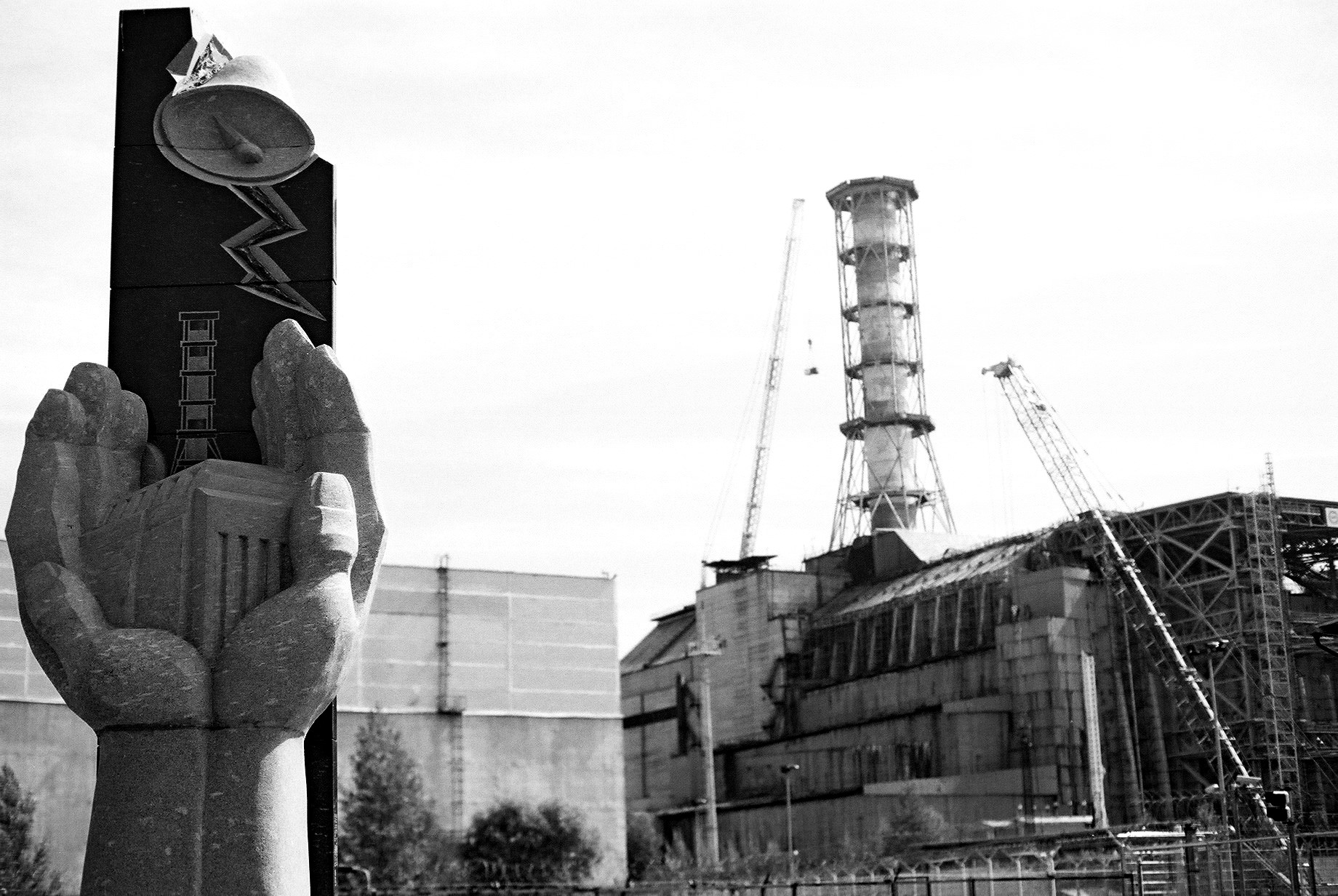
And then you see the reactor itself, its mangled mess of broken pipes and twisted vessels covered by an enormous concrete sarcophagus, a vast tombstone that forms a more sublime memorial for the victims of the tragedy than any of the slightly tacky plasticky monuments scattered around the area. It was built with no real consideration for architecture, the concrete blocks were assembled haphazardly, as quickly and as efficiently as possible, to contain the leaking radiation, but it does in fact look exactly like a cathedral. The faded smokestack forms the spire, it has its long nave, its square pillars like flying buttresses, its transept of scaffolding. It is the cathedral of the Enlightenment, a temple built to mollify the eschatonic power of the atom. Like the kaaba, or the kadosh hakadoshim, it contains a light so fierce that it would burn away any man who entered; and those who visit must undergo ritual cleansing – except here, instead of being anointed with oil, you press your hands against one of the large Geiger counters that ring the site and pray that the little light turns green.

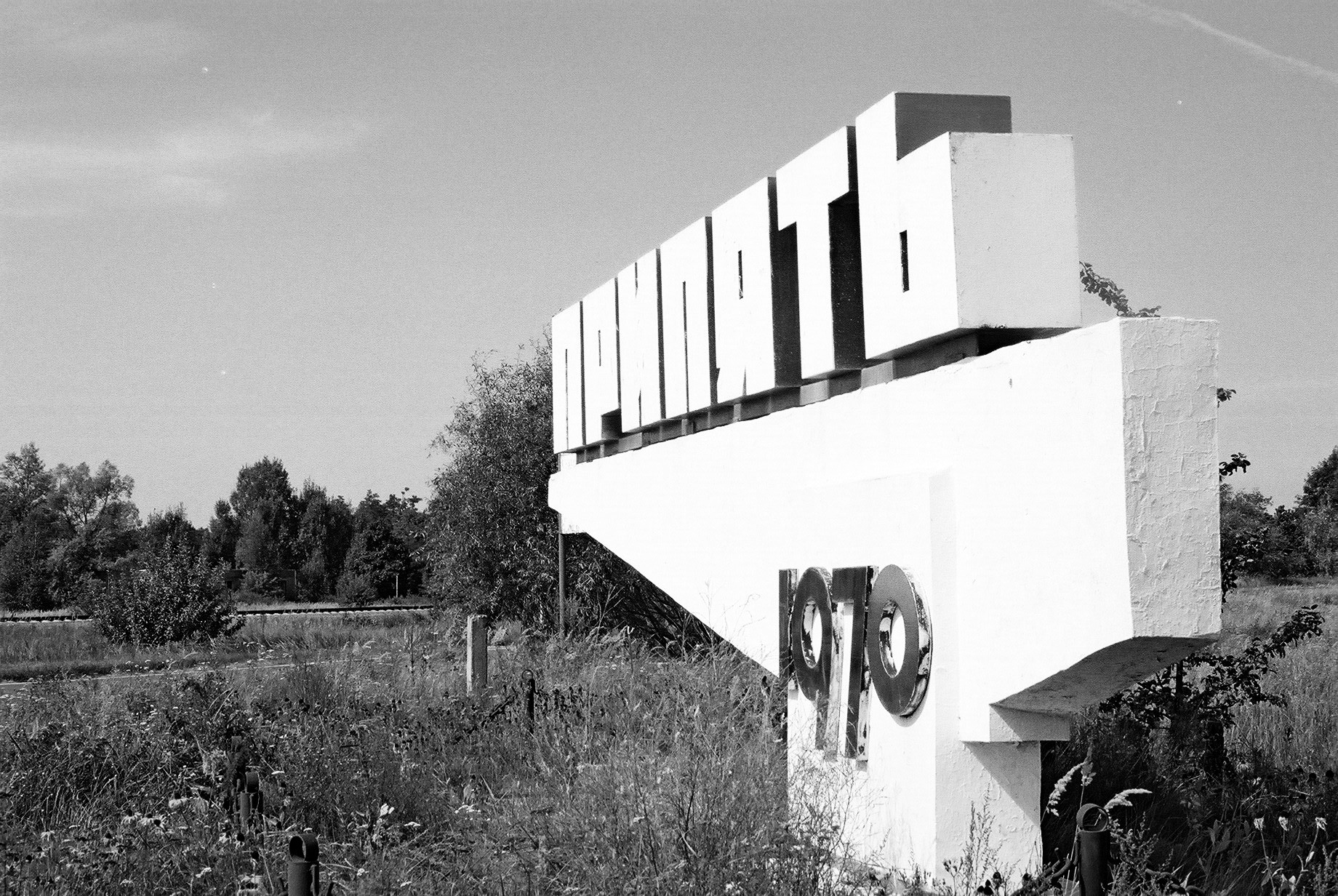
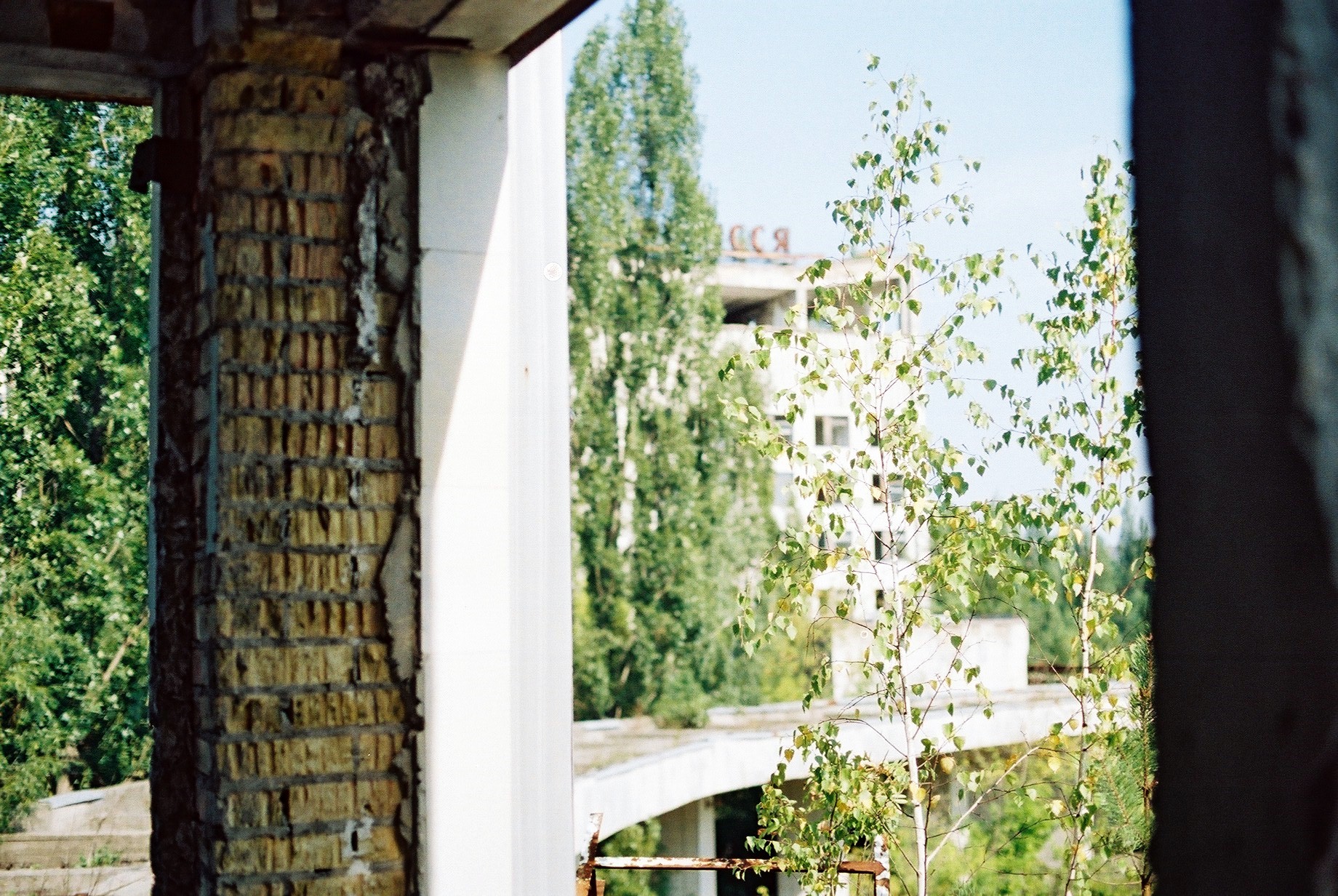
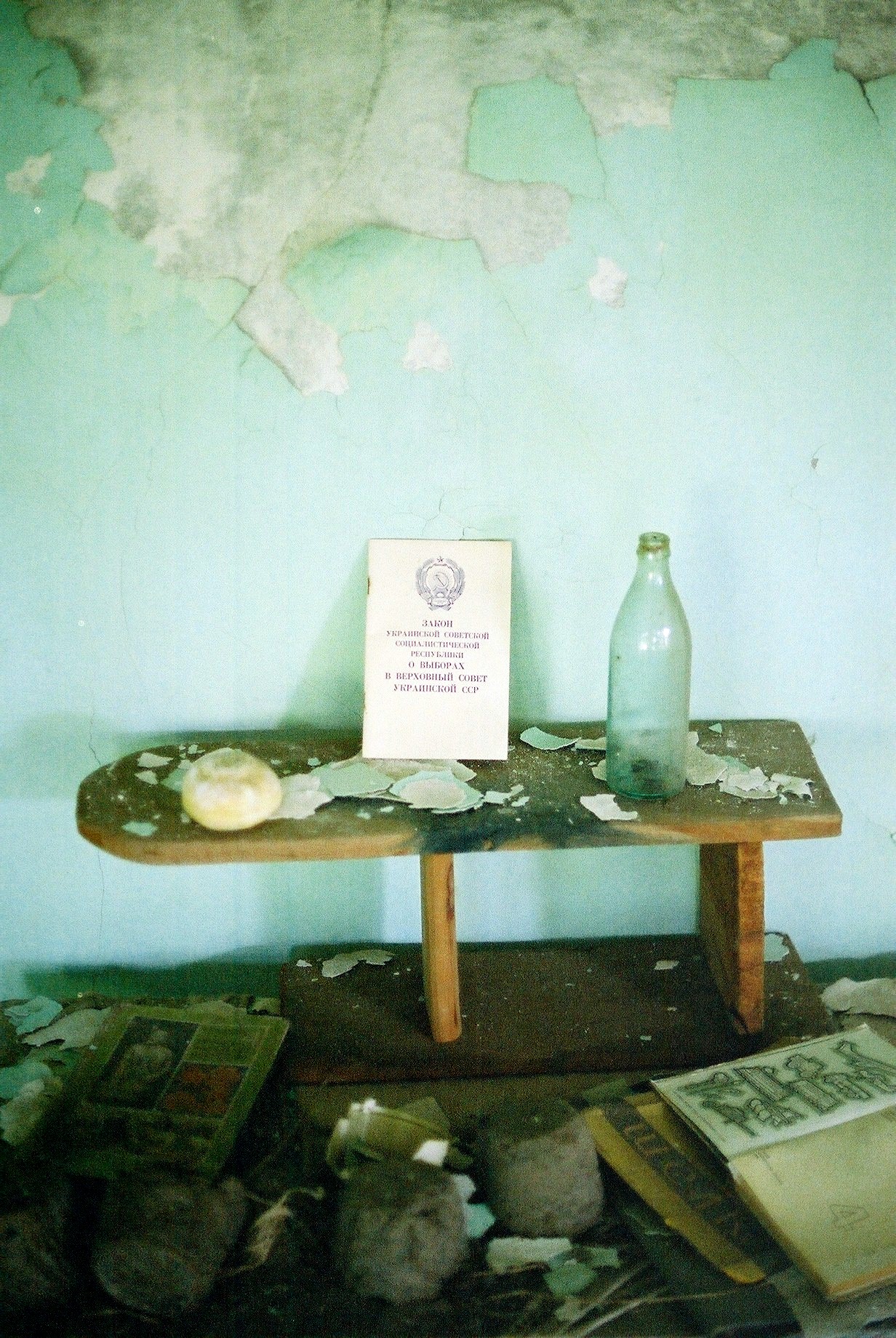
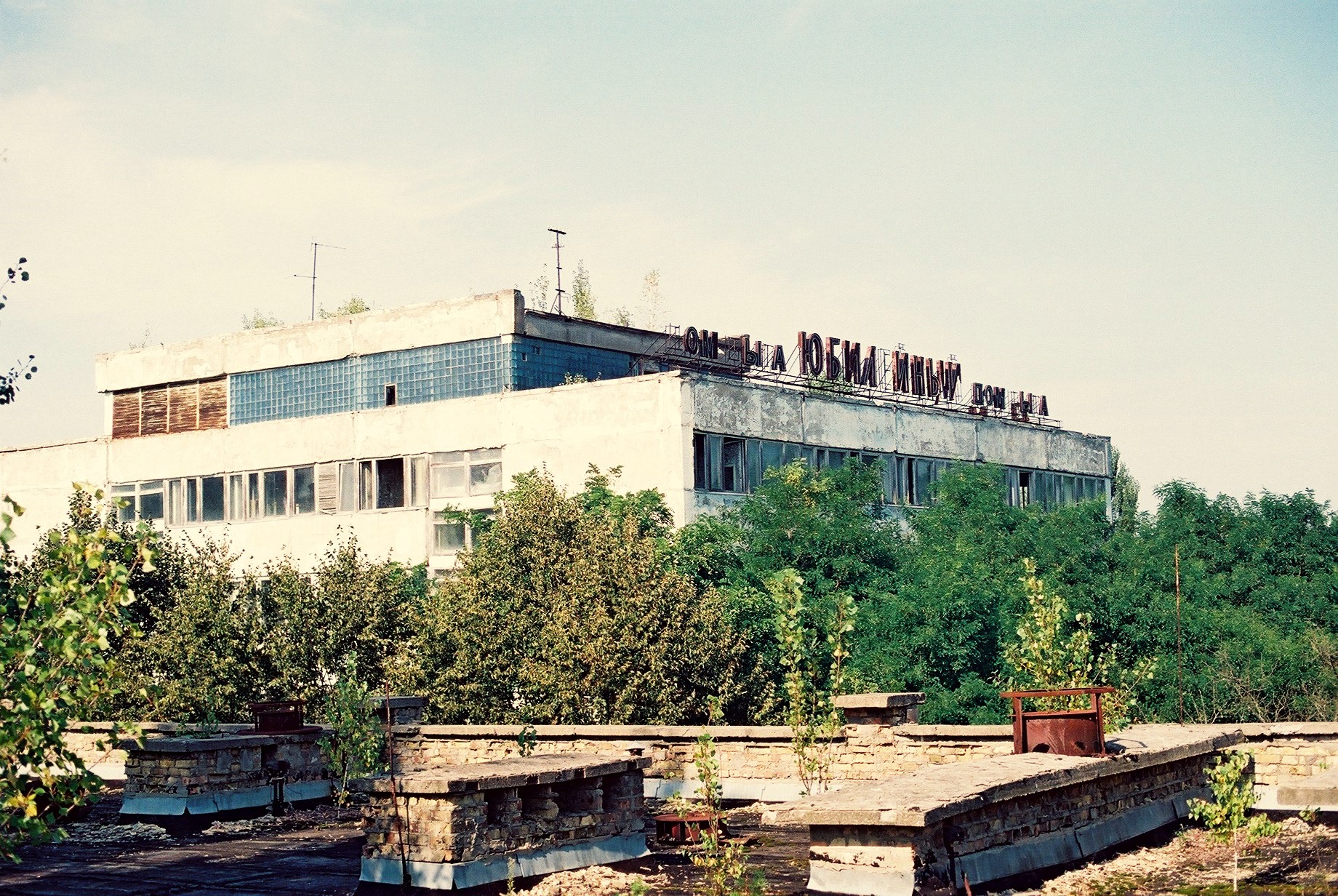
But when you come to Prypiat, the ghost town, it’s almost impossible to draw a line of causality between the horrors of the disaster, the starkness of the power plants, and the organic lushness of what you see before you. Prypiat isn’t a barren wasteland, it is full of life. The forest has swallowed it up – and rather than being grim or menacing, it has an air of complete serenity. It’s impossible to find any sense of urbanity here: the central square is like a brief clearing in which some spindly plants still grow; what were once broad avenues now seem like country lanes. It’s as if the town had not been built and then abandoned, but had grown by itself in the middle of the forest without any human involvement at all: as if the buried strata of rock and iron, jealous of the autotelic vivacity of the plants above, had decided to organise themselves into roads and buildings, bursting out through the soil, twisting into new shapes to form a pre-ruined city. Its edges are frayed not because it has been dilapidated, but because the natural world rarely works in straight lines; even when inside the buildings, the layer of broken glass that crunches underfoot seems as innocuous as the litter of a forest floor.

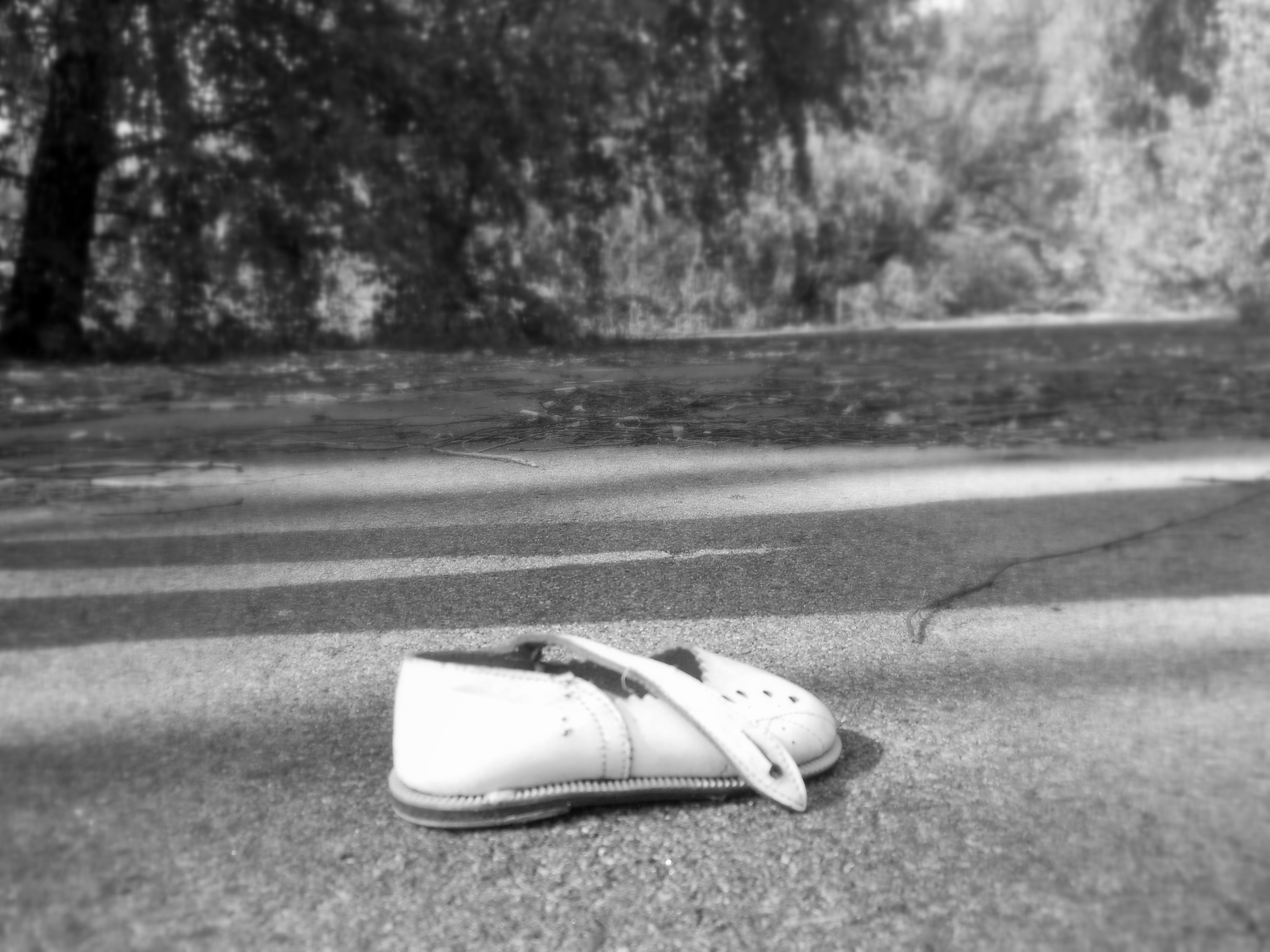
Only when you go further from the bright concourses of the abandoned buildings does this illusion shatter, because every room in every building you visit is full of stuff: human stuff, notebooks, trinkets, portraits, music sheets, reminders that fifty thousand people once lived here, and now there is nobody. In a municipal swimming pool, the diving-board still arches gracefully over a tiled pit filled only with broken glass and debris. In the palace of culture, books lie torn and scattered across the shelves: a moment of panic, frozen. In the rusted tangle of what was once a funfair, you find a child’s shoe on the tarmac: only one.

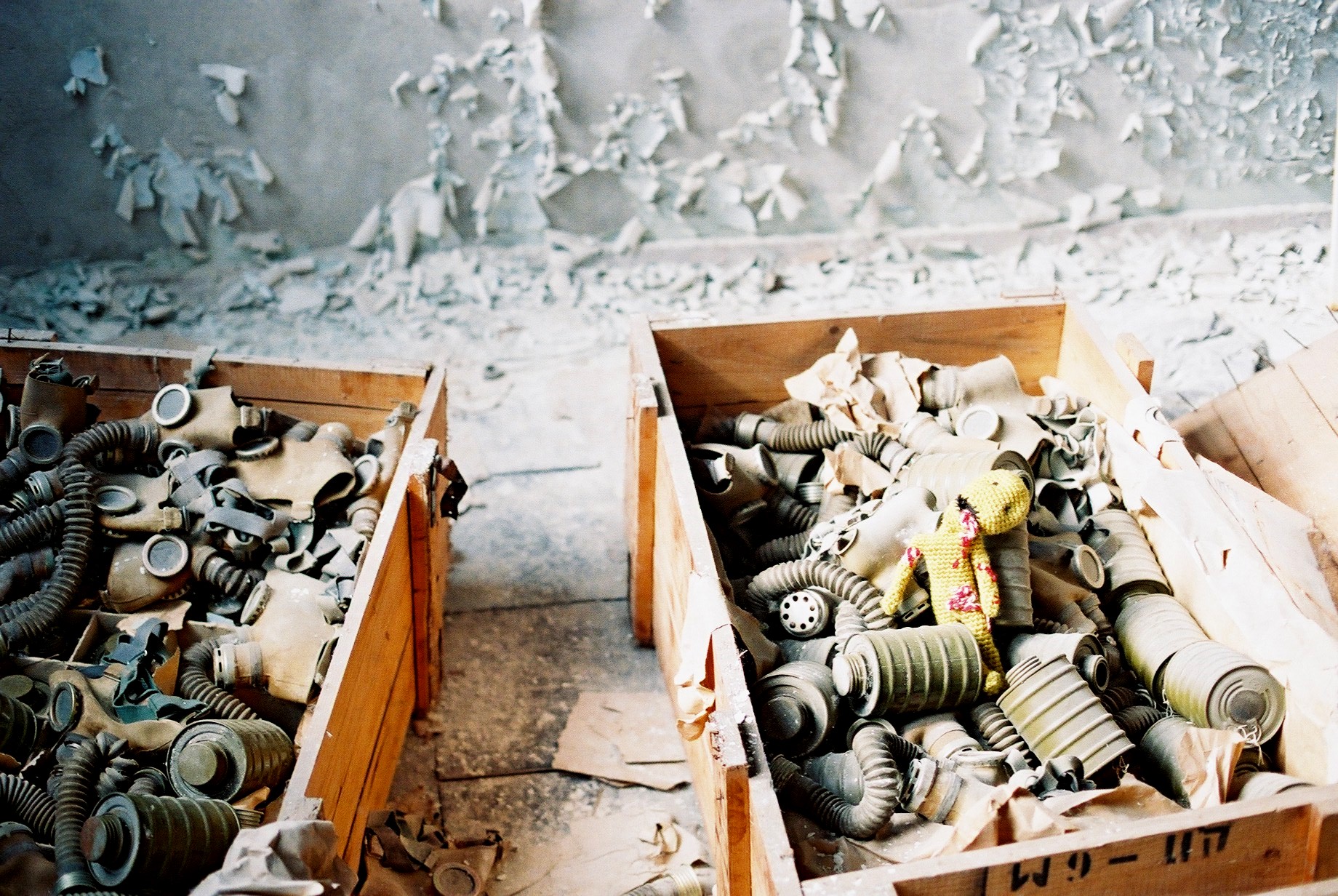
The most doleful place of all is the school. The floor and tables in every classroom are carpeted with papers: essays, projects, drawings, exercise books half-filled, textbooks half-deteriorated. The little artworks of children who either had to grow up in a foreign city or were denied that chance by the radioactive dust. Things that once held so much importance to some unknown person are now just another fleck in a sea of nuclear debris. Worse still are the toys, the dolls and soldiers that slump forlornly in dusty corners or gleefully display their pathos on desk tops. Then, at the top of a flight of stairs, two crates full of gas masks: a brute intrusion of the catastrophe itself into this poignant little mausoleum.


These children lived in a different world. Hammer-and-sickles decorate the corners of their drawings; in one of their art classrooms you find a student’s piece: a lino print of a stylised missile, superimposed with the words нет бомби. The Soviet Union of 1986 was not a worker’s paradise, but the students of Prypiat were still taught that theirs was a society dedicated to the emancipation of humanity, the erasure of alienation, the resolution of antagonisms, to peace and socialism. It was no such thing, of course, but here and there it made its successes, and in Prypiat you can gain the tiniest of glimpses into the Soviet Union as seen from the inside: not as the menacing bear spreading its claws across Europe and Asia, with nuclear warheads tipping its canines, but as a place where a trace of the October Revolution’s optimism and hope for a better society still lingered on. A failure, yes, ultimately, but one at least still haunted by its own spectre.

Back, then, to the prosperous swarm of Kiev. In Independence Square, an old woman, shawled, hunched over, her clothes stained, her legs mottled with purple veins, her arms dappled with sagging skin, the muck of the streets ingrained in the creases on her face, carrying a stinking plastic bag by one shaking withered talon-like hand, shambles from bin to bin, rummaging for glass bottles. Above, the billboards blare out their stern commandments: to enjoy, to be lovin’ it. This is the victory of the West, this is the triumph of freedom. Here, in the bright liberal business-friendly centre of the New Europe, you can find the true ruins of Communism. In the sylvan tranquillity of Chernobyl, something of it still lives.