Idiot Joy Showland

This is why I hate intellectuals

Tag: horror

Tony Blair, dread creature of the forbidden swamp

In the Hegelian system the history of mankind no longer appeared as a wild whirl of senseless deeds of violence, all equally condemnable at the judgement seat of mature philosophic reason and which are best forgotten as quickly as possible, but as the process of evolution of man himself.
Engels, Socialism: Utopian and Scientific
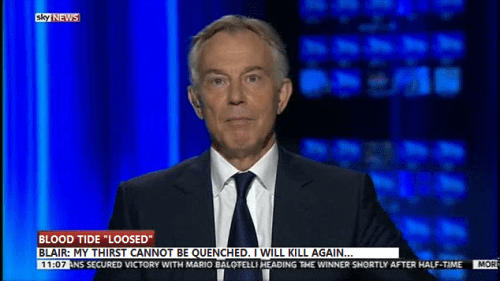
There was meant to be progress. Slowly at first, and then with gathering confidence, human beings were supposed to be turning the world from a Hell we couldn’t understand into a finely tuned machine that we could. We would predict the weather and split the atom and put a brushed-aluminium fridge-freezer with an ice-cube dispenser in every household, whether they wanted one or not. It was all a lie. What’s been called progress was nothing more than a war of annihilation against the ghosts. At first our odds were slim: the ghosts outnumbered us several times over. Every little copse had its nymphs and sprites; every wild animal carried the head of a god; in every home the jealous ancestors would take up their positions by the fire. It took centuries, but we pushed them back. We got rid of the strange and powerful forces that had controlled the clouds and the rain, and replaced them with tiny floating particles to form the seeds of water droplets. We slowly starved the moon-goddess to death, and replaced her with a big lump of floating rock; we even sent an expeditionary force to its surface to plant a flag there and confirm its lifelessness. All the whispering local spirits were massacred, and their ownership of the sacred sites was passed on to brutal landowners. You could be forgiven for thinking that we’d won. The universe makes sense, after a fashion; a lot of it be explained without any need for ghosts or spirits. If you want, you can now climb Mount Olympus yourself: there are regular tour buses from Athens; if the gods were ever there they’ve now moved on. Machines have been sent out into space to let us know exactly how boring it all is. But if that’s the case, and the magical forces that once haunted every inch of our world are gone forever, then just what the fuck is Tony Blair?

Tony Blair rises every couple of months, like a bubble of swamp gas. First there’s an uneasy buried rumbling, then small tremors shake the surface, and then suddenly he bursts through, a gassy eruption stinking of farts and sulphur. It doesn’t matter how many rounds you fire into his shambling frame; he just won’t die. Whenever something unpleasant happens in the Middle East, whenever some huge corporation is discovered to be starving people to death or poisoning them through calculated negligence, whenever the chaos of the international order starts to wobble into another death-spiral, a damp wind blows through a graveyard somewhere in England and Tony Blair emerges from his tomb. There’s something viscerally revolting about the man. His fake chumminess and his sham gravitas are both as nauseatingly contrived as his shiny oily skin, hiding what can only be bloated rotting organs inside. He’s a gremlin, an incubus, very strange and very cruel and very foreign to our world. But still there’s a decaying vestige of that charm, the memory of the love in which he was once held, that universal joy when he finally ended a generation of Conservative rule by ending the Tory monopoly on evil. We’ve deluded ourselves into thinking that we’ve learned from the experience, we’re past all that now, but every time Tony Blair re-emerges there’s still a shock. There he stands, with his jug ears and his peg teeth and his manic eyes full of an otherworldy certainty – it’s like the shock of seeing a former lover going through your bins at night, or a long-forgotten childhood toy waiting for you on your bed. He represents something that’s been repressed, and even though the repressed always returns, it’s always a surprise. Who is this hideous figure? Why is he still alive? Why won’t he just leave us alone? Of course, Tony Blair was never alive. He’ll never leave us alone.

Tony Blair is old, older than time itself. Beyond left and right, beyond right and wrong, beyond age and death. When the first cave-dwellers made the first image of their god, Tony Blair was there with his shiny spiv’s suit to suggest that it might require a blood sacrifice. When the first half-fish heaved itself out from the boiling sea to flap around in the sodden tidal slime, Tony Blair was there with his cold intense stare to offer it words of vague encouragement and then crush its head under his heel. When the first drifting clouds of interstellar dust began to coalesce into what would one day become our little speckled world, the bodiless malice of Tony Blair was there to help them set the stage for our future suffering.

Older and wiser societies than ours knew about Tony Blair, and they knew to be afraid. Throughout history he’s arrived among the homes of men and promised a very slightly better life, before suddenly carrying out inexplicable destruction.The Sumerians knew him as Tešgali, a snake-demon twenty miles long, who would enter a walled city in the guise of a man, and then uncoil his vast scaly bulk and devour everything inside. This knowledge was passed on to the early Christian Gnostics, who called him Tialdabaoth, the blind creator-god with the head of a lion and a serpent’s tail, architect of all madness, who created this world out of spite and envy and who tried to prevent the first humans from eating from the Tree of Knowledge. Country folk of the Middle Ages were terrified of the bálfar, creatures of beguiling appearance but malicious intent, who lived in the marshes and the wildernesses but would sneak into human villages by night. Certain trees were sacred to these bálfar, and cutting them down would mean imminent death; if your house stood in their path they would tear it apart. The bálfar were known to kidnap human children and even grown adults (several Old English epics tell the story of a man’s doomed quest to retrieve his wife from their kingdom) and replace them with one of their own, a creature identical in all respects but for a savage listless boredom. They ruled by inscrutable and murderous caprice, but it was possible to appease them with small offerings: a ring of flowers, a saucer of milk, a thimble. Those they took favour on would be treated to a great feast, but like all elfin magic this was a simulacrum: eventually the guests would realise that the food was not real, and that they were eating dirt from the ground. Tony Blair even appears in the Daemonologie of King James I, as Tibericaxus, a Deuill who being of great Charme and Guille, sneaketh into the homes of the Godlie, and perswades them to addict themselues to his seruice.

But soon after that something changed. With the dawn of the Enlightenment people stopped believing in the old horrors that lurk in the dark corners of reality. The universe was no longer a grand stage for the cosmic clash of good and evil, and God became a kind of divine tinkerer, neatly slotting all the cogs of his Newtonian machine together and leaving it to run with a steady tick. We thought we could understand the world, and so when Tony Blair returned we didn’t even see him for what he really is. We should have known better, but we thought he was just a politician.

What Tony Blair represents is the final meaninglessness of the world. We still don’t know why there is something rather than nothing. Stare too long into Tony Blair’s face and it’s hard to tell if there is something rather than nothing. What kind of a world is this if Tony Blair exists in it? For centuries philosophers would construct grand systems: an ontology and a metaphysics and an epistemology and a theory of ethics and a theory of aesthetics, all connected by one overarching principle. For Plato the eternal, for Kant the absolute, for Hegel the unfolding, for Kierkegaard the teleological. All these finely honed contraptions utterly failed to account for the whole of existence. Even Heidegger, who finally reached the understanding that there is no universal substance of Being but only individual beings, felt the need to turn this into a complete system; even the deconstructionists had to hold up their technique as a fidelity to a text. There might be nothing outside the text, but its basic unit is not one of meaning but of insufficiency in the face of the unsignifying Real. The truth is that there is no unifying principle behind anything beyond its total incoherency. Every time we think we might have a handle on how things actually work, the ghastly figure of Tony Blair emerges from its ancient swamp to remind us that this world is not a sane or a rational place.
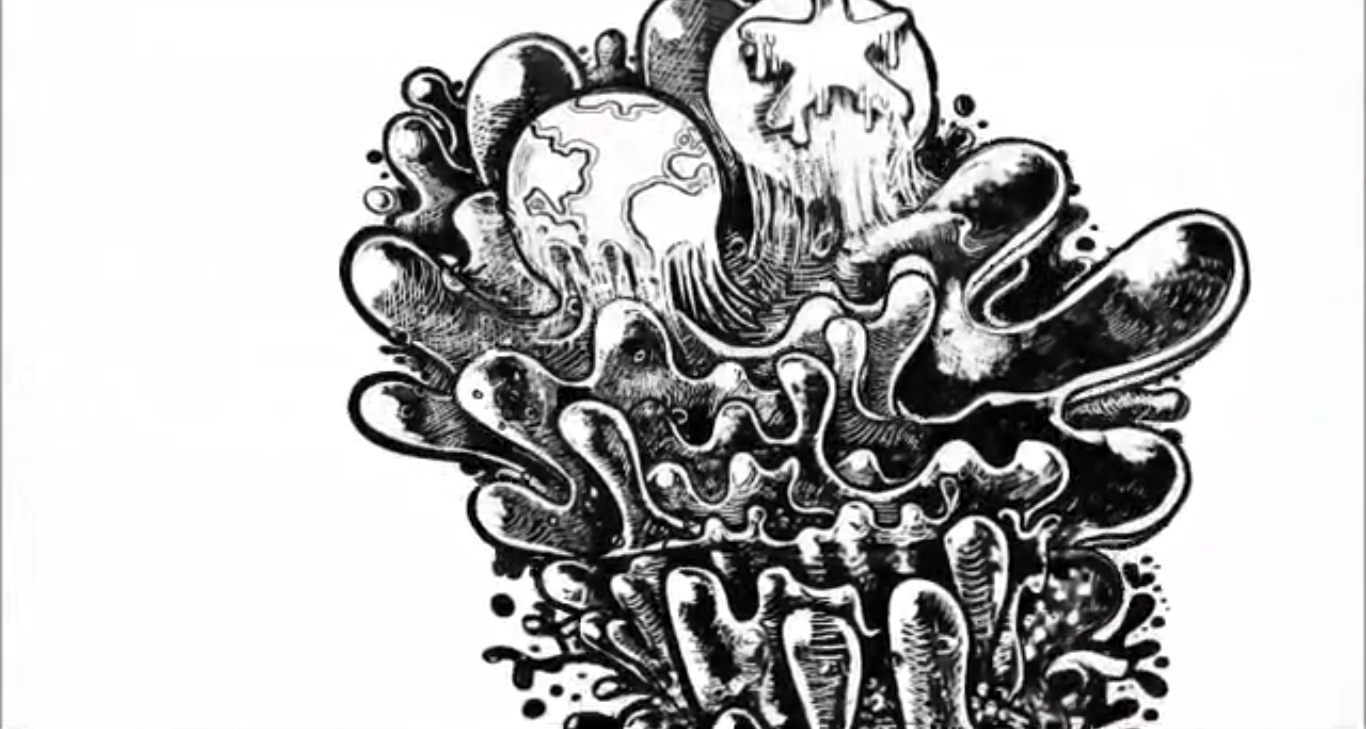
Branding strategies for the viscous phallus-monster that has risen from the depths to reclaim our world

Sometimes I believe that this less material life is our truer life, and that our vain presence on the terraqueous globe is itself the secondary or merely virtual phenomenon.
Karl Marx, Grundrisse

This exists.

It’s easy to get whipped up into an outrage over this kind of thing. It’s enraging to see the techniques by which we are manipulated uncovered in all their foetid glory. What’s more, there’s the sheer density of meaningless marketing buzzwords repeated over an insipid steel guitar melody, managing to replicate simultaneously the effects of a cult indoctrination film and a nice strong hit of prescription opiates. There’s the naked theft of the video’s entire aesthetic from the occasionally excellent RSAnimate series. There’s the fact that the gang of marketers behind it seem to consider making a positive change in the world to only be a good thing insofar as it can be put to use selling various tubes of corn syrup-based goo. There’s the cynical manipulation of popular sentimentality for profit. There’s the section dealing with ‘families, communities and cultures,’ in which the former two are represented anthropomorphically, sitting like nineteenth-century monarchs astride a globe, while ‘cultures’ is just an arrow pointing in the vague direction of Africa. It’s all so perfectly and unwittingly ugly. But to focus on this stuff is to miss the point a little. There’s plenty of justification for a sensible critique of consumer capitalism as demonstrated by this video, but a purely sensible critique ignores not only the horrific haecceity of the thing, but the otherworldly horror that surrounds consumerism itself. For the purposes of this essay, at least, I’m not interested in the ideological presuppositions of liberal philanthropy, the incoherence of marketing discourse, the soporific nature of societally-mandated pleasantness, or even the construction of the racial-cultural other.

What I’m really interested in is this.

What is this thing? It crops up everywhere in the video. Its tendrils extrude randomly into the field of gibberish without warning or explanation: sometimes it tenderly caresses the various symbolic representations onscreen; sometimes it’s actively antagonistic towards them, bursting out from their bodies and leaving only shattered remnants of sales patter. In one memorably horrifying sequence it’s shown passing through the heads of three people as they smile their bovinely unfazed marker-pen smiles in our direction. Here, at the video’s end, it holds the entire Earth in its grip, the planet leaving sticky stretchmarks as it tries and fails to struggle free from the gloop’s oleaginous embrace. Let’s start with what we can see. The thing is clearly alive. Maybe it’s not alive in the strict biological sense that any of us can comprehend, but it moves, it has agency, it has plans for us and our lives. It appears as a seething mass of – of what? Not liquid, exactly; it’s too firm, too collected; it doesn’t flow, it crawls. Some kind of mobile mucous then, bile-black and slug-sinuous, its surface tight and slimy, glistening under the light of a blood-clotted sun. But at the same time there’s an undeniably fleshy quality to it, fleshy in the most visceral sense of the world. It resembles nothing so much as an immense, writhing conglomeration of dicks. Could it be that what this thing wants is to fuck us?

I’ve always found there to be something almost endearingly naive in the thought of Debord and Baudrillard and other theorists of the image. Baudrillard proudly and knowingly calls himself a nihilist; in fact, he’s anything but. Nobody believes more fanatically or more religiously in truth than the poststructuralists. To speak of the spectacle or the simulacrum in terms of a precise historical moment is to assert the existence of a historical world of truths prior to the image; to speak of hyperreal images that reflect only each other and deny a pre-existing truth is to assert the existence of a pre-existing truth that can be denied. Debord in particular is militant in his rejection of the image and his partisanship on the side of reality. He’s got it all wrong. Representation isn’t a prison, it’s a shield, our only defence against a universe filled with horrors. It’s a way to make the world comprehensible. Lacan describes this process precisely: the Symbolic order has its origins in the castration complex; the phallus as an intolerable lack is what anchors the entire process of signification. When Lacan describes the Real he does so in terms that approach Lovecraftian horror: it’s something black and smooth and undifferentiated, with no cuts or cracks, no inside or outside. The infant, confronted with the realisation that the world is an enormous and unfriendly place in which his jouissance is ultimately irrelevant, begins to build metaphors for himself. It’s the only thing he knows how to do.

Eventually, though, the chains of signification loop in on themselves. In the Coca-Cola Content 2020 Initiative video, there’s no mention of Coca-Cola-as-beverage, only stories, narratives, feelings, loyalties – only images referring to other images. This makes perfect sense: images are a necessary refuge from an unpleasant reality. The fact of your utter insignificance in both the mechanistic universe and the libidinal economy doesn’t sell sugary drinks – or, at least, it doesn’t sell many to Coca-Cola’s core demographic of people who don’t just sit at home with the curtains drawn reading Kafka. Brands aren’t like us. They’re better than we are, untouched by fears or neuroses, unravaged by time. They have the commodity’s aura of unblemished totality that we pitiful human wrecks, crippled by our various lacks and lacerations, can never possess. That’s why people grow so attached to them; we want what they have. But to fully maintain the pleasant banality of advertising, to completely protect against the sour taste of reality, these images have to be decoupled from any concrete referent. They have to be purged of anything that could climb down the chain of signification and kick us in the face. That’s where we get brand slogans like Live Positively: a floating signifier, elemental in its meaninglessness. But doing this kind of thing is very dangerous. The shield of representation works by mediating between the fragile subject and the hideous object; if you break it away from the object it becomes useless. The real world can then intrude. It forces its way unopposed into the realm from which it was banished, and it hits us right where we thought we were most safe: in our advertising. And when it does so, is it any wonder that it takes on the form of the object of that first primal act of signification, slipping back across the divide between phallus and penis?

This isn’t a metaphor; it’s a portent. The creature that invaded the Coca-Cola Content 2020 Initiative video will not stop there. Our virtual creations are easy targets; its violence grows stronger with every victory. Soon the brittle crust of the Earth will snap, and viscous tentacles will emerge from the chasm to crush all our cherished symbols. The beast will rise. It will take its revenge, and it will take it in blood. We will, very soon, be once again faced with the incomprehensible horror that we once tried to abstract away, long ago, when we were infants. Luckily, we now know exactly how to deal with it. All we have to do is represent it, turn it back into a signifier. The future of the human race depends on a solid brand strategy.

…In the next financial year, our target is to double voluntary self-immolations as sacrifices to the viscous phallus-monster that has risen from the depths to reclaim our world. That’s a lot of voluntary self-immolations! To do this, we must fully engage our brand with the aspirations of our sacrificial base. This means not only promoting our brand, but entering into dialogue with the defeated human race across all multimedia platforms and allowing user-created content to grow in the fertile ashes of their ruined cities. Through the Live Every Second brand slogan consumers can independently develop content focusing on positive and aspirational life experiences they have enjoyed before inevitably succumbing to annihilation at the hand of the viscous phallus-monster that has risen from the depths to reclaim our world. Our entire advertising focus has to be centred around the Live Every Second concept if the phallus-monster brand is to achieve full market penetration. Engaging with Live Every Second means that consumers will approach their grisly fate as the appropriate end to a life not only lived well, but lived to the max. By encouraging conversations about what it means to live every second we can potentialise the creativity of our user base…

Abdel Fattah al-Sisi doesn’t care about my face

My body is in open insurrection against itself, and my chin is its Tahrir Square.

Towards the end of last month, as demonstrators in São Paulo were beginning to demand the return of the military dictatorship, I noticed a strange growth on my chin. It was a little like a spot, red and tender on the surface, but it refused to come to a head. Instead a vaguely conical mass sat just above the bone; I could move it around a little, nudge it this way and that, but it felt completely solid and unsquidgeable. Never mind, I thought. It’ll go away soon. And it did, retreating into a tiny hard kernel, as if it was about to vanish entirely.

And then, without warning, it returned. I woke up with my face numb, my cheeks puffy, and an alien virus colonising the bottom half of my face. It was no longer a swelling but an invasion; pressing against my gums, my teeth, its areolae of engorged tissue slanting the line of my chin, its growing bulk pushing out my bottom lip into a permanent prognathic scowl. Eating was painful. So was smoking. Even breathing started to carry a faint dull pain. There are names for these things: abscesses, cysts. Names whose sibilance suggests seeping pus, blood curdling in the off-white purulence, gangrene, death. It had me. I was afraid.

I say it happened without warning. That’s not entirely true. When I went to bed the previous night tens of thousands were gathering on the streets of Cairo to mark the anniversary of President Morsi’s election and to protest the betrayal of their revolution. Millions more were marching across the country; according to some, it was the biggest protest in human history. I was fully supportive: by all accounts, Morsi’s done a terrible job, marrying civil sectarianism with the cold inhuman logic of the markets. When I woke, though, it was to news (blearily observed through the ache in my chin) that the city’s police had declared their solidarity with the youth on the streets. Surely this wasn’t right: one of the main grievances of the demonstrators had been Morsi’s failure to properly prosecute the police and military for their misdeeds in the 2011 revolution and 2012’s Port Said massacre. The cops should have been in there, batons high, riot helmets turning human faces into mere avatars of the forces of reaction. They weren’t doing their job. Instead there were reports of gunshots and deaths in the night with no clear indication of who had been shot and who was doing the shooting, as if the bullets were some kind of freak weather event. As the Egyptian state festered against itself, my face had become my heautontimoroumenos. Something was going horribly wrong.

The creature had laid its roots deep. Its cystic tentacles must have spread around my head and drilled into my brain, because I was overcome by a fit of what can only be called psychotic narcissism. I closed my windows and drew the curtains. I cancelled social engagements. Mirrors, which showed me a face so swollen and lopsided I no longer recognised it as my own, were horrifying; I covered them up. Even the screen of my phone was too reflective; I considered having a go at it with some sandpaper. I was thinking like a cyst, retreating into my own little cavity, where I could swarm.

Everything started to flare again up as General al-Sisi issued his 48-hour ultimatum to President Morsi. Al-Sisi was supposed to be a Morsi loyalist, promoted to his post after the old military elite had been dismissed in the last power struggle between armed and elected authority – and yet here he was, demanding that the Muslim Brotherhood share power or lose it. As he did so my infected cyst bubbled. The entire left side of my face became swollen. A soft, foamy subcutaneous emulsion. My lymph nodes felt like ping-pong balls. My jawline was melting away on one side. I looked as though I’d been genetically spliced with a potato. Before long it was intolerable. I had to see a doctor.

I went to a drop-in clinic at an NHS surgery in Cricklewood, lodged awkwardly between an enormous B&Q centre sitting like a fat orange-roofed slug on its grassy mound and a general tat shop called Aladdin’s Cave. To get there I walked through a narrow grey alley into a small grey car park; the barbed wire that surrounded the clinic was bearded with shredded plastic sheeting. I stood and smoked a cigarette outside the entrance. An elderly woman with a smudged tattoo on her forearm stood on the other side and smoked a cigarette as well. We didn’t talk. Then, as I sat in the waiting room, al-Sisi’s deadline approached. I was the only person there, scrolling compulsively through Twitter, perched above a small forest of institution-blue chairs. The only sound came from the clicking of my phone and a flatscreen TV mounted on the wall opposite me showing Countdown. It was coup o’clock; 2.30 pm Cairo time. Onscreen, the hand whizzed down the face of the clock as the famous music played. I wish the winning anagram had been something germane or significant. It wasn’t. Years after an important event, people sometimes share stories of where they were as it happened. The highest-scoring word on Countdown was ‘parsnip.’ I might remember that for the rest of my life.

The GP who saw me was rather fat and affably Jewish. He told me a lot of what I already knew: I had an infected cyst, a gland had become impacted, and the bacteria had rushed in en masse to fill my face with slime. He prescribed me antibiotics; I now have eighty tablets of flucloxacillin to my name. I doubt they’ll do much good. Whatever his qualities as a doctor, the GP is unlikely to be able to alter the course of events in the Middle East. When I returned home I discovered that President Morsi had been put under house arrest and the constitution was being suspended. Tahrir Square was overflowing with celebrations.

There’s one other thing the doctor told me. If the swelling doesn’t respond to antibiotics and doesn’t go down, he said, if the blockage isn’t cleared – there’s always the option of surgery.

~

There’s a certain superior tone which Western commentators love to bring out whenever mass movements in the developing world take form. If they oppose the movement, it’s patronisingly dismissive, bringing all the accumulated wisdom of four decades’ drinking fairtrade coffee to bear on the situation: these people would do well to bear in mind, they say, or the leaders of the movement ought to consider. When they support the protesters it’s even worse; what’s happening on the ground is twisted into the expression of a Platonically ideal political agenda. The protesters are always fighting for the commentator’s own set of values, and any contradictory voices from the country in question are easily drowned out. We know what you want better than you do. As the crowds swelled in Cairo, the Guardian commented on an Egyptian activist tweeting ‘Fuck Western Media.’ ‘There’s a notable fatigue in Egypt with the Western media and media analysis,’ they said. We’ll keep you updated on our live blog as the situation progresses.

I’m going to try not to do that. I’m going to stick rigorously to the facts. And the fact is that General Abdel Fattah al-Sisi has purposefully, with full calculated intent, given me an infected cyst on the left side of my chin.

The evidence is incontrovertible. I don’t know exactly how he’s done it, but I have a vague idea. This is how. The protests in Egypt were spearheaded by liberal, leftist, and Nasserite parties, among others, under the umbrella of the Tamarrud (or Rebellion) movement. Many of these are the same groups that fought against the Supreme Council of the Armed Forces last year when it tried to write itself into the new constitution, hoping to supersede the powers of the presidency. When these groups did so they marched alongside the Muslim Brotherhood. Now many of these same people (with, of course, a vast number of dissenters) are celebrating the reimposition of military rule. What has taken place is a coup – but that said, Morsi’s government was overthrown not by the military but by the people on the streets; it was finished the moment millions gathered in Tahrir Square. The statements of support for the June 30th Movement by the police and army were not a gesture of solidarity but a means of control; they turned something that might have destabilised the exercise of state power into something that mimicked the state. The situation in Egypt demonstrates precisely the Marxian analysis of the state-form: it’s not a monolithic institution but a tactic, a tool that can be wielded by one group or class or another. As al-Sisi’s deadline approached there was speculation over whether the soldiers guarding the state broadcaster were loyal to the army or the government. In a way, it didn’t matter; they were the state. The state is control; the state is in control of everything apart from itself. When cops march at the head of a demonstration, it stops being a protest movement and starts to become an exercise of government power. Cops have an important role to play in any revolution; with their violence they focus the popular rage, they inflame its energies. As ever, the Egyptians are far ahead of us in the West; they found a way to stop this from happening, and all it took was a mild displacement in the loci of control. But those revolutionary energies are still there. According to the law of the conservation of energy, they can’t just vanish. And I know what’s happened to them. Somehow, by some strange magic, they’ve pooled in the left side of my chin. They’ve been displaced to my face. And Abdel Fattah al-Sisi doesn’t care about my face.

PS: I’ve said this kind of thing before, but it bears repeating: by enacting deeply unpopular policies and pointing to their victory at the ballot box to stifle dissent, the Muslim Brotherhood were behaving not like a dictatorship but precisely like Western liberal-democratic governments. If Britain were as new to representative rule as Egypt is, Cameron and co would have been on the way out some time in 2010. The difference between us and the Egyptians is that they really believe in democracy. We stopped doing that a long time ago.

PPS: Al-Sisi was Morsi’s appointee. One can imagine the scene at the barracks: Morsi, overthrown, weeping into his paternally greying beard, arms outstretched: Abdel, you were like a son to me. Could the whole scenario be reconsidered as an Oedipal drama? What is the state after all but a hideous trillion-titted mother?

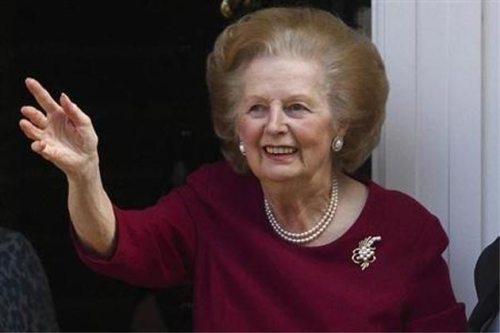
Scenes from the Thatcher funeral

thatcher

What had she done with all the milk? That’s what we should have been asking: what had she done with all the milk? By the time we found out, it was too late.

At first it’s almost imperceptible. Mourners shuffle past the open coffin as it lies in state. She looks different, they think, but it’s hard to say exactly how. It’s true, she seems a little fuller in the face than one would expect, plumper, like an over-ripe fruit – but at the same time white, deathly white.

Within a few hours its hard to ignore. Something horrible is happening to the former Prime Minster. She’s grotesquely fat, and visibly growing. As Ed Miliband delivers a heartfelt speech his already clammy skin begins to drip with sweat; Nick Clegg, in the front row, collapses into Cameron’s lap. A sour aroma rises. One of the Queen’s Bodyguards of the Yeomen of the Guard standing guard over the coffin starts to vomit uncontrollably; soon the other three are unable to hold themselves back either. Baroness Thatcher swells and pales until her body barely fits in the coffin. The imperious hawk’s beak of a nose sinks into the bloating flesh. She looks like an enormous blancmange; her skin seems like it’s about to burst. Then it does. The first fissure tears its way through what was once her forehead. A high jet of milk streams out into the vaunted ceiling of Westminster Hall; the news cameras follow the triumphant ejaculation as it arcs up and descends, splattering a group of Young Conservatives. The coffin shatters. A tidal wave of milk rushes through the hall. The stench of rot and acid is incomparable: hundreds of thousands of gallons of milk, hidden away in some dark warm recess of her body for forty-three years. As the mourners drown in the sea of putrid milk some are dragged down into its depths by heavy caesin blobs. Others are not so lucky: the smaller curds swarm and envelop them, leaving nothing but whitened bones and shreds of corduroy. The massacre completed, they swim together, and begin to converge…

Thatcher bursts through the roof of the Palace of Westminster. She is one hundred feet tall and brutally nude, her limp dugs shimmering with the semitransparency of milk. Somewhere, buried deep in her monstrous frame, are dark reddish shadows: supported on rusting bones formed from the frames of long-dead factories, the Iron Lady strides out into the Thames, and howls. From down the river in Canary Wharf a howl rings out in reply.

We thought she was dead, when in fact Margaret Thatcher was never alive. Not as we knew her, at least. If she ever existed, the grocer’s daughter from Grantham died a long time ago, and something else, scuttling like a hermit crab, moved into her body. She was animated by the false life of things, the undead hum of markets and brands and commodities, the image of life that opposes life itself at every turn. How could such a creature die? When her heart shuddered to a halt, it only freed the Thing inside from its fleshy prison.

Everything makes sense now. Why did she fight so hard to close down the mines? They were digging too deep, burrowing too far into the cold heart of the earth; there was something down there that she didn’t want them to find. Why did she introduce a poll tax? Because her alien sentience could never comprehend any differentiation within humanity. Why did she send young men to die for the Malvinas? Because without access to the magnetic flux streaming from both poles of the Earth, her plans to gain immortality would be doomed to fail.

We stand, quivering, waiting for the monster that was once Margaret to smash our cities, pound our homes to splinters, rip up our infrastructure, bat away our fighter jets like flies, tear apart our society, leave us cold, enslaved, and alone. It doesn’t, though. It just stands there, ankle-deep in the river, the crooked slit of a grin stamped on its milky mouth. Its work has already been done.

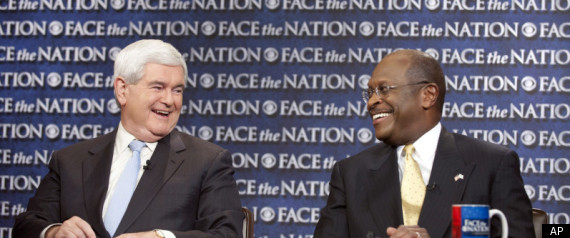
Cain vs. Gingrich: Battle of the Scrotums


The Woodlands, Texas. A stage. Two chairs. An audience. The whirring of cameras. Two SCROTUMS are engaged in debate, following the time-honoured traditions of Lincoln and Douglas.

SCROTUM GINGRICH: Mr Cain, as the stunningly handsome business genius who transformed Godfather Pizza into the multinational colossus it is today, what steps do you think will be necessary to infuse American society with the rich tasty lip-smacking goodness that Godfather Mozza-Loaded pizza crusts exemplify?

Frenzied applause.

SCROTUM CAIN: Well, I would say that the American people know better than the Government what they want to do with their money. And clearly what they want to do is use it as kindling to burn down every mosque in the country. And if the Beltway bureaucrats up in Washington DC don’t want to go ahead with that, well then, they need to be taken out of the equation.

Enraptured applause.

SCROTUM CAIN: But returning the question to you, Mr Gingrich: as one our nation’s premier fascists, with decades of experience in the vindictive abuse of personal power under your belt – as a great American, in other words, how do you think we can restore the spirit of our country?

Ecstatic applause.

SCROTUM GINGRICH: I think that there’s this real culture of dependency these days, and that needs to be gotten rid of – if people need food, why can’t they grow it themselves? If people need healthcare, why can’t they perform keyhole surgery on themselves? We have the Internet now, anyone can diagnose themselves with all manner of diseases. Any disease they want. That’s freedom of choice, people! We need to get away from a situation where people are thinking, oh, I have this disease, how is the Government going to help me out? What we need to do is encourage people to start thinking, how can I proactively work to fix my own problems?

Orgasmic applause.

SCROTUM CAIN: Well, I completely agree. This is gonna get taken the wrong way, but, you know, I didn’t take no political correctness school. If people don’t want to go out there and get themselves a job, if they want to be lazy and rely on handouts, and if they’re angry because those handouts are getting taken away – well, that’s their boogie-woogie, as my grandmomma used to say.

Gleeful suicides.

SCROTUM GINGRICH: If I could interject – the other day I received an email from my good friend, the prophylactic industrialist Baron von Rubber. And he told me that our debt crisis could be solved tomorrow if we took everyone currently on government handouts and systematically fed them into an enormous meat grinder to retrieve the trace elements of precious metals within their bodies. And that’s exactly the kind of dynamic forward thinking that the private sector provides, and that’s exactly the kind of thinking we need to meet the challenges of the 21st century.

SCROTUM CAIN: I’m glad we agree. It’s been an honour to debate with you. [He gives an esoteric signal]

Ominous chanting. Lights start to dim. The two SCROTUMS link arms and chant along, a look of hideous glee on their rubbery scrotal faces.

SCROTUMS: [in unison] Ph’nglui mglw’nafh Cthulhu R’lyeh wgah’nagl fhtagn! Ph’nglui mglw’nafh Cthulhu R’lyeh wgah’nagl fhtagn! Ph’nglui mglw’nafh Cthulhu R’lyeh wgah’nagl fhtagn!

A foul-smelling wind is conjured. Lightbulbs shatter. The spectral visage of RONALD REAGAN floats above the podium, his ectoplasm contorting itself into an expression of dread horror. His eldritch Masters promised him an eternity of bliss in the afterlife if he did their bidding on Earth; now he knows that their afterlife contains only more horror. The SCROTUMS chant faster and faster, their jowls visibly distending even in the murky gloom. REAGAN opens his mouth, revealing a dark chamber seething with worms in which rotten teeth protrude like ancient obelisks. Maggots crawl from the depths of his empty eye-sockets. REAGAN blasts the audience with a monstrous scream. The audience prostrate themselves in terror before this Unholy Trinity. A swarm of locusts hovers above them, buzzing like a thousand hellish violins, before coalescing into the shape of the moderator, U.S. REPRESENTATIVE STEVE KING, who strides up onto the stage.

KING: Thank you, Scrotum Cain and Scrotum Gingrich, for this lively and entertaining debate.

The ghastly shape of REAGAN fades. The SCROTUMS shake each other by the hand and exit. Those in the audience that have survived stare blankly into the distance with the deadened eyes of one who has seen past the fictions of everyday life and witnessed the gibbering horror of the Universe as it really is – although they did walk into the room with the exact same expression. There is no respite: the degenerated Punch & Judy show of electoral politics is not over, its grotesque charade can never end – not until the Six Pillared Gate is smashed and the Beast of Khapti’gytag’l is slain. Outside the building, a REPORTER speaks to camera.

REPORTER: Well, Dan, it’s been a very interesting debate here in Texas, with both scrotums agreeing on a whole range of issues. I’m being told that today’s Satanic apparition has caused at most only a few hundred cases of blindness across the country, which as you’ll know is a significant improvement on last month’s debate in Las Vegas. Well, you know what they say, folks: democracy isn’t perfect, but it’s better than all the alternatives.

The dark cloud hanging over the building begins to melt away. Up next on C-SPAN: Michelle Bachmann and Hillary Clinton in a round of Foxy Boxing.