Idiot Joy Showland

This is why I hate intellectuals

Tag: politics

Corbynism or barbarism, part II
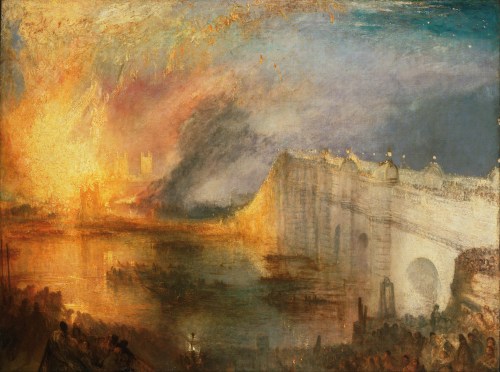
October_16,_1834

I’m going to be voting for Labour.

This is a new experience for me. It’s not that I haven’t voted Labour before: I did in 2010. Posturing and frightened in a low, scuzzy student block in Leeds, I pulled myself out my personal bathysphere of weed stink and late-teenage ripeness to plod over under crows and clouds and do my duty and keep out the Tories – and afterwards I felt deeply ashamed. It was like having one of Gordon Brown’s hairs stuck in my mouth; it was as if his grease had started oozing through my skin. I felt suddenly complicit in everything – the wars, the privatisations, the ASBOs and ID cards, the scudding lies and shabby gloss of New Labour Britain. Five years of Tory government acid couldn’t burn off the guilt. I promised myself that I wouldn’t ever do it again, and when I had the chance two years ago, I didn’t.

I couldn’t bring myself to do it. It’s not that they were just as bad as the Tories; the government had been a half-decade horror. a cast of seepy flesh-bubbles bloating out the mire, some murderous gang of ninnying imbeciles and swill-fed ponces that had, for all the usual reasons, decided theirs was the right to go about making life quantifiably, measurably worse. I hated them and I wanted them gone. But I couldn’t vote for Labour. I couldn’t stand hearing Ed Miliband’s voice on the radio, because it was the honk and bleat of someone who was basically just like me, another nice left-wing Jewish boy from North London, a bit clumsy, a bit gangly, a bit insecure – but one who didn’t indulge in my purism, or my nihilism, or whatever it was that made me refuse compromises and triangulation and any attempt to make common ground with established power. Any student of history knows what power does to the commons. I would not settle for the least worst option; I would not pick sides in the stupid intra-capitalist squabbles of electoralism. I knew that a Labour government would materially reduce the suffering and deprivation of millions of people – but I also knew that once you let that turn into an ethical duty to vote, anything beyond the minute reduction of suffering is lost, and worst of all, the suffering of others (migrants, asylum seekers, the global working class) becomes something utterly hideous: a worthwhile price. When I voted for some tiny Menshevik party I didn’t really like and whose name I can’t even remember, it didn’t help anybody. But who says our capacity to help, to do politics, to be engaged, has to be bounded by the form of the vote?

Since then things have become immeasurably worse, but that’s not why I’m voting for Labour. Britain is not just sliding into fascism; we’ve landed. This has become a deeply ugly place. Our Prime Minister – gurning, grimacing, parochial,  incompetent, rhadmanthine, segmented, arachnid, and inhuman; the Daily Mail letters page given chitinous flesh; a zealous ideologue for the doctrines of smallness and stupidity and dumbfuck blithering hatred; a vicar’s daughter distilling all the common-sense peevishness and resentment from the dingy grog of the English national spirit; a leader who doesn’t so much impose austerity as embody it, in every word or gesture that seeks to foreclose on all possibilities and draw the furthest boundaries of the sunlit world no further than your respectable lace curtains – instructs the public to give her more power, to paint over a divided country with a false unity in Parliament, so she can exercise her supreme will. The loyal Tory press responds with terrifying outbursts against all enemies: ‘Hang The Lot,’ ‘Boil The Traitors Alive,’ ‘Insert The Pear Of Anguish Into The Anuses Of Our Enemies So That They May Be Disembowelled From Within,’ ‘Readers Agree: It’s Time To Crush The Heads Of The Remoaners Under A Large Millstone,’ ‘Where Are Our Common-Sense Torture Kennels In Which The People We Don’t Like Are Torn Apart Shred By Shred By Starving Dogs?’ All the anti-establishment energies that fuelled the Brexit vote have been effortlessly consumed by the administration: the people had their say, and (given that this is all out of the Schmittian playbook) they will only get to have it once; now it’s the role of power to implement it, and the will of the people as refracted through this government is for total centralised power with anything that could be called political extinguished. This is fascism: a simple, easy, descriptive term for what it is we’re living under.

But I’m not voting against Theresa May. I’m voting for Jeremy Corbyn.

It’s easy, very easy, to be against something. I was against Labour in 2015, and I still don’t think I was wrong. But being purely against – anti-fascist, anti-liberal, anti-racist, anti-sexist – means never being let down, and never being vulnerable. The horrors of the world descend on you, and you oppose them. But it’s not enough. There needs to be some positively articulated shared object, something that can be affirmed. It means losing some cynicism, giving up some of the invulnerability of ironism, attaching the boundless subjective I to a thing of history, that could get swept up with every other fragile thing and destroyed. But without that attachment nothing can be done. This is why so many socialists still see a value and an importance in maintaining some kind of attachment to the old dead Soviet project – people who know full well that there were famines and purges, mass deportations and mass shootings, and who are repulsed by all suffering, but who know that, whatever its failings, the Soviet project was our project. Socialism is not an abstraction or a negation; it’s the real attempt to build a better world in this one, and it demands our fidelity. It won’t be possible unless we’re prepared to do more than oppose the evil. Demands are made on us for the sake of a liberated existence, and the first is that we be prepared to make ourselves vulnerable, and that we accept that our faith might be disappointed.

To be for Jeremy Corbyn is dangerous, and the possibility of disappointment is high. His ideology is not the same as mine; his policies, while good, are disarticulated; his leadership, while inspiring, has not been effective; most of all, the Labour Party might be the worst vehicle possible for a programme of genuinely egalitarian change. It doesn’t matter. If he loses, the suds and mediocrities of the party’s right wing will be relentless; if they manage to force back the leadership, they will go to work destroying absolutely anyone who still holds the belief that life can be made better, burying the idea in its fringes for another generation or more, rooting out the seeds of utopia wherever they’re planted. The Labour party will be refashioned into something that once again proposes Tory policies using Tory methods and with priorities, just as the Tories skid further into authoritarianism – but while the Tories will just flatly tell us that they do evil because that’s how things are, Labour will still be begging to have a go on the torture kit so they can make things better. And people might believe them. After all, it won’t be quite as bad as the alternative.

Corbyn stands for a refusal to accept something that’s just not quite as bad as the alternative. Corbynism means not just electing the least fascist, the least liberal, the least racist, and the least sexist. The Labour right, the Tories, the Lib Dems, and Ukip are all partisans of a restricted imagination and a penny-pinching common sense; Corbynism the possibility of something actually good, the possibility of a way out. It points beyond itself.  Jeremy Corbyn did something quietly incredible, and which has nothing to do with his actual performance as Labour leader: he acted as the signifier that brought together a collectivity, he formed a point of unity for everyone who wanted a radical and transformative social change, even if they didn’t agree on what it should look like or how to bring it about. He gave the left a space to assert itself openly in British politics, in surprising numbers. This – the collective, not the man – is what’s important, and what’s feared, and what our enemies are desperate to crush.

After all, it wasn’t meant to be like this. There is a programme now for Western politics: it’s what we saw last year in the United States, and what’s unfolding right now in France. Wets versus Nazis, the collapsing liberal order against the embodiment of its own internal collapse, reiterated over and over again in every country, politics as a looping gif, the juddering replay at the end of the world. No hope, no possibility, this or the abyss. The radical left still has a role to play: its role is to lose. You thought you could have something better, and it turns out that you can’t: now choose. Centrists are obsessed by the idea that radicals secretly prefer the fascists to themselves; as soon as the hope for anything better is extinguished they demand that everyone on the left loudly announce how much they prefer the status quo to the remaining alternative. We have to pick sides in what is essentially a family squabble among reactionaries. Isn’t Hillary Clinton better than Donald Trump? Isn’t Mark Rutte better than Geert Wilders? Isn’t Emmanuel Macron better than Marine Le Pen?

Yes, of course they are. However badly things are going, they could always get worse. But the final collapse of liberalism is a situation in which liberalism seems perversely comfortable. Anti-fascism is only one half of what the world needs; it also needs a positively articulated vision of how it can be improved, and the centrists have nothing: lower business rates, softer racism, friendlier faces. Of course it’s necessary – urgently, frantically necessary – to defeat the Nazis, not least because it buys us more time. But it’s not enough, it’s a stopgap for the symptoms. Almost all the advanced capitalist societies are tilting in the same direction, and these Nazis didn’t come from nowhere. They are entirely immanent to the liberal political order as it stands; their racism and violence and hatred comes from a society which is already racist and hateful and violent. The fascists gain their energy from the failure of liberalism, and liberalism gets to stave off its failure thanks to the threat posed by the fascists. Both are the living undeath of the other. The whole order is monstrous, decrepit, shambling, and lifeless; it has to go. To struggle for a better world isn’t a luxury in a time of rising fascism, it’s the only thing that can save us.

I’m voting for Labour. It’s not perfect, of course it’s not. And Labour are unlikely to win. Corbynism or barbarism doesn’t represent a fork in the road, but something much harder; barbarism surrounds us everywhere, and Corbynism is attempting to wrench us out of it; it’s hard to pull an entire planet out of the swamp it’s made for itself, it’s hard to lift something up when it’s already slipping down, it’s hard to tear yourself away from a brutal and stupid reality. But it can be done. Something like Corbynism was never meant to happen. The narrative failed here: where there should have been a brief entrancing spark of hope followed by another grim round of which-is-worse centrism-or-fascism, that spark refused to be snuffed out. It’s burning lower than I’d like, but it’s still there, and while it is, I’m voting for Labour.

Corbynism or barbarism, part I, written during the last Labour leadership election, is here.

First we take Damascus

tomahawk

Donald Trump ordered his attack on Syria because of something he saw on TV. The world is full of people like him: old, shabby, pompous; people who know everything because they learned it all from somewhere, people who function as exit nodes for the vast extraorganic network of information that chatters across oceans and ping-pongs through outer space, people who form the anuses of the system of images, excreting their content back into the world of things, people who repeat everything they see on TV. Every suburban bus stop shelters a Donald Trump, some smugly witless man of the world who knows what he knows and knows it better than you, some tyrant-in-waiting ready at any moment to vomit up the whole of the received wisdom in one splattering stream, and then act like they’re in possession of some special knowledge because they’re able to do so. The only difference is that when Donald Trump blathers from the TV, the TV takes notice: he repeats what it says, it repeats what he says. Donald Trump is the network whorling in on itself; the system of careful mediation finally splayed out in the mud, legs out, back twisted, licking its own arsehole.

The media was kind to Trump’s attack on Syria. Every pompous outlet that has spent the last five months screaming incessantly about the threat to democracy, the inevitable deaths and the terror of wars, had nothing but applause as soon as the wars and the deaths actually got going. A fleshy and dangerous idiot, a vulgarian, an imbecile – until those first perfect screaming shots of Tomahawk missiles being fired were broadcast – that’s our guy, you show them Donny! This is when, as Fareed Zakaria put it on CNN, Trump ‘became the president.’ And he really is presidential now, because the president is a totemic war-chief, the bloated repository of every male fantasy that had to be repressed, someone whose only job is to look like they could kill a hundred people in the morning and pose for a photoshoot with their dogs in the afternoon. Never mind the deaths or the uncertain repercussions; Trump’s strike was utterly squalid and utterly ignoble, some fattened toddler idly shitting out molten steel into the parched graveyard that used to be Syria, saving nobody, helping nobody, thoughtless and obscene. Kill a few of their guys, teach them a lesson, it’s common sense. And all the sophisticates and strategists applaud – stricken by half-hearted guilt, of course; after all, you still wouldn’t want to have the man round for dinner. They write their long justificatory exegeses on the timeliness of the act, bringing out every little rhetorical trick of the educated ruling classes, because all their moral angst is also from comic books, and cinema, and TV.

On NBC, Brian Williamss, ranting himself into ecstasy, quoted Leonard Cohen: I am guided by the beauty of our weapons. What weapons guide? Cohen wasn’t singing about clubs or spears or missiles, but ideology, culture, and fame. Mediation. Whether he knew it or not, what Brian Williams was saying had nothing to do with the spotlit plumes of white smoke rising from the US Navy vessels in the Mediterranean. The beautiful weapon was himself. the beautiful weapon was TV.

Beyond the fiddly cloisters of the media intellectuals, why do Americans love their wars so much? Because war is the only workable substitute for being able to turn off the TV. Wars happen for the same grim and venal reasons that have always made the rich massacre the poor, but every other weapon is now subordinated to the screens, the nightly news and the outrage on Twitter. The media transmits the relentless horror of the world, sliced up into edible segments: here’s a problem, here’s a tragedy, here’s an atrocity, here’s something else. Chemical weapons, starvation, murder, war. All of it is shrink-wrapped and isolated; you can never really find out why this is happening, no more than you could really learn the long sad stories behind every neatly packaged item on the supermarket shelves. They don’t even need to lie, although they do that too; the propaganda is in the medium itself. And the ethical response to all this diffuse suffering, charging at your face out of nowhere, is no longer why is this happening? but we have to make it stop. Anything is permissible if it’ll just make this go away. There’s no better example than the 2000 film Rules of Engagement: our heroic Marines are called in to defend the US Embassy in Yemen from an angry crowd outside, and all the time they’re there we can constantly hear their endless and repetitive chants, and the camera flashes between shots to glimpses of furious mouths with terrible third-world teeth, furious, inhuman, a slow torture, until the good patriotic viewer is begging our heroes to just shut them up. After the Marines fire into the crowd, there’s a moment of perfect silence. Bliss.

The attack on Syria will not make its war go away. Every primly disgusted apologia for the attack is a travesty. So Assad should be able to use chemical weapons with impunity? So we should do nothing? See how that we slips in there, almost unnoticed. Is this the same we that killed 56 Syrian civilians in Manbij last year, and then 46 in rural Aleppo, and then nearly 300 innocent Iraqis in Mosul? The we that turned the Korean peninsula into rubble and carnage because the people there wanted a better life, and then Indochina, and then the Middle East; the one that’s currently engaged in starving millions in Yemen? What happened to Libya, after we were told we had a responsibility to save the civilians there too? This isn’t ‘whataboutery,’ but a simple question: when judgement and punishment are carried out by the same people, who gets to judge? If the Syrian government carried out the chemical weapons attack in Khan Sheikhoun then it is monstrous, cynical, and murderous – but the ability to punish monstrous states seems to belong only to the most powerful; in other words, the most monstrous, the most cynical, and the most violent. But all it needs is a we – a word reaching through the screen to swaddle you up in it – for the great roving predator of the world, dripping with blood from every pore, to become something else: the international community, the ones who must intervene, to protect the children.

The next attack won’t stop the war in Syria either, or the next one. That’s not what these things are for. The response from the Mail on Sunday’s Dan Hodges was instructive. Bomb Assad, he said, and then bomb Isis. And when that leaves what was once a functioning society in the hands of Jabhat al-Nusra and Ahrar al-Sham? ‘Then we go and get them too.’ After all, if every Syrian is dead, then the war is finally over. Their suffering is immense, but it’s not their suffering that matters: it’s the suffering of the viewer, at home, heartbroken as they watch the carnage playing out onscreen. It doesn’t matter who does it, and it doesn’t matter how it’s done, but we need to turn it off forever.

Melancholia after Fidel

6660614509_8c0fd6391b_b

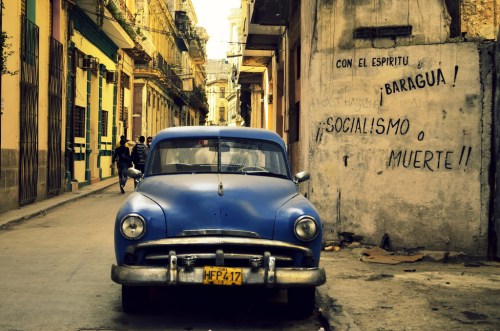
The world is a poorer place; a sterile promontory. The earth is dried up, its surface drifts away in tiny whirlwinds, and there’s nothing underneath. Every year it shrinks, weaker and worse, stripped away by a thousand chattering stupidities; everywhere the desert is growing and the ice caps melting into the sea, two vast blanknesses gorging themselves on what remains. How could a famished world like this continue to sustain someone like Fidel Castro? All the great national leaders are going. Kwame Nkrumah is dead. Salvador Allende is dead. Thomas Sankara is dead. Hugo Chávez is dead. Fidel Castro is dead. Socialismo o muerte: are the terms becoming indistinguishable? What remains is stunted, compromised, and ruthlessly eradicated: Dilma Rousseff is shunted from office by an authoritarian coup in everything but name; Venezuela is torn apart; and already the sarcophages are burrowing into Cuba, swarming to eat it alive. Something has passed away, most likely for good: perhaps not the future, but something. Where are our Fidels? We’ve fallen from the madness and frenzy of the twentieth century to an age more bureaucratised and banal than anything that preceded it, a vast system identical to its own crisis, a soil utterly incapable of supporting the kind of grand socialism – epic, mythic, heroic – that died with Fidel Castro. Which might be for the best: epic socialism had its excesses; maybe it no longer makes sense to have our movements led by grand cigar-chewers. Wherever there is injustice there will be resistance. But it doesn’t diminish what’s been lost: not one frail nonogenarian in a two-storey house, but the knowledge that we can not only fight but win, that we can not only defeat the reactionaries but build socialism, that we not only have to do something, but that we know how to do it.

We’re not supposed to think like this; revolutionary socialism has faith in the people and hope for the future or it has nothing. But sometimes we do, and there’s no point pretending otherwise.

I first came to Latin American socialism through the music. It was the mid-2000s, a far darker and more terrifying time than anyone will admit; I was a teenager, and it was easy to confuse a genuine political commitment with being a fan. There was a hopelessness to the whole movement, and had been ever since 2003: you line up to protest the latest war, scream until you’re hoarse, raise the anti-fascist salute, be baton-charged by the police, and then it would happen anyway. We were always anti, trying to put the brakes to capitalism and imperialism, trying to fight with thousands of weak bodies against a machinery too enormous to really contemplate, and it wasn’t working. I listened to the Clash, and then the people they namedropped, and then their comrades. That loud, stomping, strident chant of Venceremos was something completely different: the voice of a socialism that knew it could win and had no doubt on its claim to the future, the joyousness of a new and better world coming closer every day. After centuries of rot, the sunshine, cold and bright and devastating, pouring over the Andes. It wasn’t some economic doctrine, it wasn’t an initial in the acronym shouting at us through a loudspeaker in another rainy slog through Westminster, it was alive. Todos juntos haremos la historia, a cumplir, a cumplir, a cumplir! I played it loud in my room and stomped around restless. There was so much to be done. Mil cadenas habrá que romper, la miseria sabremos vencer! But then at the same time I always knew what had happened. I knew that Victor Jara sang Venceremos in the stadium on the day he was murdered. He was herded there with thousands of others for the crime of making music that the people loved; he never left. Pinochet’s soldiers tortured him for days, breaking his ribs, mangling his hands, shattering his teeth, and then threw him out in front of the other prisoners. ‘Sing now if you can, you bastard!’ And he sang: ‘We will triumph, we will triumph.’ Then the soldiers dragged him away again and shot him.

It was impossible to hear those songs without remembering this. All those glorious rousing songs formed the chorus to a tragedy, the singers just didn’t know it.That horror lurking at the end of the story seeped back in time to colour everything, to turn that ever-incoming future into a nostalgic past, to fossilise it in history. It happens everywhere now: socialism is haunted by its own ghost, the failure that is still to come. It’s so much harder now to say that we will triumph – even if Victor could sing it surrounded by the bodies of his comrades, that sense of historical certainty has been lost. You can inveigh against this tendency, but that won’t stop it happening; cheery and voluntaristic false optimism is not what inspires hope. We know that we’re doomed, and we fight anyway, against it all. But not in Cuba. In Cuba we survived. For decades Cuba was a light to Latin America and the world, a sign that it was not all futile, that however many times they tried to kill us we could still carry on living. In Fidel Castro we mourn something else; not our defeat, but our victory.

Communists don’t like melancholia; it’s indulgent, verging on the aristocratic, sedentary, acquiescent, and fatalistic. We’re meant to take the manic posture, to ‘be staunch and active.’ Don’t mourn, organise! Walter Benjamin quotes a unnamed critic of the melancholics; the ‘agents or hacks who make a great display out of their poverty, and a banquet out of yawning emptiness;’ as he notes elsewhere, the melancholic hero of the Trauerspiel is almost always a monarch or a prince. Marxists know that nothing simply vanishes, that negation is determinate, that everything is preserved in the dialectic. This is why we continue to shout Fidel vive, just as we insisted that Lenin lived long after he was embalmed in Red Square: these names don’t refer to a person but to a struggle, the desperate fight against immiseration and despair; they stand for victories that an be overturned but never annihilated. The mistake comes in thinking that this determination is always opposed to melancholia or to the tragic. Melancholia is a dialectical procedure. In Freud’s account, the melancholic subject introjects the lost object; it’s a refusal to abandon the object-cathexes, a refusal to simply mourn, to let all the scars of past struggles simply heal over; melancholia is, as he puts it, ‘like an open wound, drawing to itself cathectic energies from all directions.’ There is a work of mourning, a process by which subject and object gradually and painfully disentangle themselves, and the latter is consigned to the grave. It is, Derrida writes, ‘not one kind of work among others’ but ‘work itself, work in general, the trait by means of which one ought perhaps to reconsider the very concept of production.’ Marxists should recognise this kind of work: it’s alienated labour, the production of an object divorced from us entirely. But melancholia resists any principle of economy; as soon as Freud thinks he’s found one in its complex he is forced into an abzubrechen, a breaking-off of his inquiry, a further loss reproduced within his text. In melancholia object and subject endlessly produce each other; what’s been lost is never alienated from ourselves. We preserve it even as it falls away: socialism has the keen sense of its own defeat because it is a movement of the defeated. Socialismo o muerte: socialism or lethe, the dead object, the void. Benjamin: ‘The past would fully befall only a resurrected humanity.’ There is much that we’ve lost, but until then we will not let it go.

Don’t mourn, melancholise. Hasta la victoria, siempre.

How you lost the world

dh1-1024x590

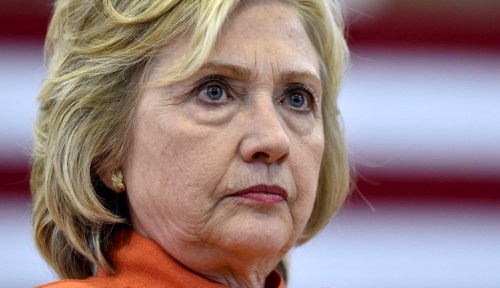
I think I’m still in shock. When the sun rose this morning it was blistered with the face of Donald Trump, bronze and smirking hideous, and all I can think about is Hillary Clinton. It’s what I know. Throughout the entire election, one slow-motion clip of a clown car ramming into a crowd of pedestrians, I’d assumed that the danger of Trump and the danger of Clinton were of two different orders. Trump was dangerous because of what he said and what he represented, the waves of fascism and violence that rippled out from the dead plopping weight of his speeches. Clinton was dangerous because of what she would actually do, because Clinton was going to win the election. I was a sucker, the kind who gets duped precisely by believing himself to be too smart for any kind of con. I thought I saw through it all, the whole stupid charade, a coronation disguised as a battlefield. I was wrong. This was exactly what Hillary Clinton wanted people like me to think; she wanted to be an inevitability. And this is why Trump won: the presidency was Clinton’s to lose, from the moment she announced her candidacy, and she lost it. She was the only person who could. People don’t like taking part in someone else’s inevitability.

Why did Hillary Clinton run for President? The most gruesome spectacle of Election Day was her short speech outside the polling station in Chappaqua, New York. ‘It’s the most humbling feeling,’ she said, of voting for herself to control an enormous nuclear arsenal. All electoral politics are predicated on this kind of bullshit, the debates, the campaign ads, the phony acceptance speeches, the highminded types trying to focus on the ‘issues,’ as if there’s any issue at play beyond a pair of hungry-eyed megalomaniacs deciding that they want power. Someone like Trump might have been stupid enough to convince himself that he at least had some kind of grand vision for the country, or the will and dedication to really get things done, but Clinton had no such illusions. She’s been in government for a long time; she knew that the powers of the presidency can be competently exercised by any grey and dismal middle manager, she knew that she had nothing particularly unique to offer. She was running not because there was anything in particular she wanted to get done – look how slippery her positions have been on just about every issue – but because she wanted it, the big chair and the big desk and the first female President; she decided that it was her turn, that it was hers by right. She knew that she was electoral poison, that vast swathes of the country hated her and for good reason, that she was compromised by a miserable record spotted with sleaze and criminality, that she alienated the left, inflamed the right, and appealed mostly to a small coterie of sexually repressed and pathologically centrist think-tank nerds, that her entire constituency was made of limp cardboard and backlogged semen, that her candidacy raised the serious possibility of a Republican victory when anyone else would have beaten that divided and frothing party into insignificance with one hand tied behind their back – but she ran anyway.

And then she lost. Despite it all, the vast monumental horror of a Trump presidency, it’s hard not to feel a little twinge of satisfaction as Hillary Clinton is denied the only thing she ever wanted and which she never deserved. Trump has promised to send her to prison. Good. It’d be for all the wrong reasons, but her crimes are many, and losing a general election to an overgrown baby should absolutely carry a long minimum sentence. Let her rot.

Clinton’s media foot-rubbers are presenting this result as a victory for prejudice: Trump won on a platform of racism, sexism, ableism, misogynoir, homophobia, transphobia, Islamophobia; the American people are hateful beyond reason, and they elected a knight of the kyriarchy to turn their roiling incoherent psychopathologies into government policy. Of course these people are right; it would be incredibly stupid to discount the role of outright bigotry, especially in a country that has fuelled itself on bigotry for three hundred years. But it’s not enough; if the only problem was too many bigots the whole elections collapses into a question of tribes and demographics, and you don’t have to think about why Clinton lost. Trump won among voters who ticked the box for Obama in 2008 and 2012, he won decisively among white women, he picked up a far bigger share of ethnic minority voters than anyone would have reasonably expected, he won because the standard formula of American liberalism – eternal war abroad coupled with rationally administered dispossession at home and an ethics centred on where people should be allowed to piss and shit – is a toxic and unlovable ideology, and his candidacy turned it from an invisible consensus to one option among others.

Hillary Clinton had nothing to offer people; all she could give them was fear and herself. Her campaign was the most cack-handed and disastrous in recent decades, managed by a gang of simpering imbeciles pretending to be Machiavellian strategists; it was all on the flimsy depthless level of TV. Now watch her whip, now watch her nae nae. Yaas kween, slay kween, slay. Clinton was to be carried through her path to the White House on the shoulders of irritating media celebrities; Lena Dunham’s Instagram feed, Beyoncé’s stage shows, Robert De Niro’s menacing monologues. Clinton strategists actively and deliberately abetted Trump at every stage of his rise through the Republican primaries, dignifying his candidacy with every statement of disapproval, because they thought that he was the enemy she had the best chance of beating. Clinton spent the final weeks of her campaign against a parody toddler obsessing over weird conspiracy theories, painting her opponent as a secret Russian agent. Clinton decided, as a vast country fumed bitterly for something different, anything, that she would actively court the approval of a few hundred policy wonks. Clinton all but outrightly told vast swathes of the American working classes that they were irrelevant, that she didn’t need them and they would be left behind by history, and then expected them to vote for her anyway. Clinton was playing at politics; it was a big and important game, but it could be fun too; it was entertainment, it was a play of personalities. Her campaign tried to reproduce the broad 500-channel swathe of TV: an intrigue-riddled prestige drama and a music video and the 24-hour news; they forgot that trashy reality shows always get the highest ratings.

Donald Trump is a fascist. We shouldn’t be afraid of the word: it’s simple and accurate, and his fascism is hardly unique; it’s just a suppurating outgrowth of the fascism that was already there. Still, this time it’s different. The fascisms of Europe in the 1920s and 30s, or east Asia in the 50s and 60s, or Latin America in the 70s and 80s were all the response of a capitalist order to the terrifying potency of an organised working class. Fascism is what capitalism does when it’s under threat, something always latent but extending in claws when it’s time to fight; it imitates mass movements while never really having the support of the masses. (In Germany, for instance, support for the Nazis was highest among the industrial haute bourgeoisie, and declined through every social stratum; look at Trump’s share of the voter per income band and see the same pattern. The workers didn’t vote for Trump, they just didn’t vote for Clinton either.) But today the organised working class is nowhere to be found. There’s no coherent left-wing movement actively endangering capitalism; the crisis facing the liberal-capitalist order is entirely internal. It’s grinding against its own contradictions, circling the globe to turn back against itself, smashing through its biological and ecological limits and finding nothing on the other side. This is the death spasm, a truly nihilist fascism, the fascism of a global system prickling for enemies to destroy but charging only against itself. There’s no silence in the final and total victory, just an endless war with only one side. It’s not entirely the case, as the slogan puts it, that the only thing capable of defeating the radical right is a radical left. The radical right will defeat itself, sooner or later, even if it’s at the cost of a few tens of millions of lives. We need a radical left so there can be any kind of fight at all.

Corbynism or barbarism

Crossroads_1933

The Labour Party’s leadership election, slowly and greasily phlegmed up into being over the past month, is supposed to present us with a political choice. Jeremy Corbyn and Owen Smith – in other words, two sets of personalities, two ranges of competencies, even, if you squint, two sociopolitical classes. And overriding everything is the great question, shouted at the selectorate from every angle, of power versus principle: purity of purpose against hard-nosed political machinations, a party leader who seems to have abandoned any hope of actually winning elections or one determined to do whatever’s needed to get back into government. The question shouldn’t be rejected entirely; it’s something that the left has faced before. The Bolsheviks for instance, in the immediate aftermath of the October Revolution, worked under the principle that other revolutionary parties should be represented in an All-Russian Constituent Assembly; eventually, they had to sacrifice that principle for the power to make gains elsewhere. In less urgent and desperate times, like 1917, this was a question we had some time to ponder. Now, it should be the least of our concerns.

It’s not just that the terms don’t fully make sense, although they really don’t. As the party’s chorus of Cassandras keeps insisting, Labour is in an incredibly weak position – to take power at the next election would require a surge in support unprecedented in modern British political history, something utterly outside the boundaries of convention. So why do they think that going to the polls with a conventional leader, espousing now-conventional policies, would produce that result? How is someone like Owen Smith, a piece of forgettable biological generica, someone whose main tactic appears to be pretending to have so few distinguishing characteristics that the only possible polemic against him would be a mean-spirited attack on the essential impotence and idiocy of humanity as such, supposed to do it? If Corbyn’s leadership has been incompetent, how much more incompetent are the Parliamentary rebels who can’t even defeat him within their own party? If the worry is that a right-wing media will never accept Corbyn, hasn’t a half-decade of embarrassing bacon sandwich-eating shots shown that no successor is likely to fare any better? In a time when political certainties have all melted into the stale fog, when loony minority propositions like leaving the European Union can suddenly surge to victory, when any monster can apparently wrench itself out of the imagination and into reality, when the quiet and dignified prude on the Clapham omnibus is now sweating omnicidal rage from every pore as the bus cooks in the July heat and small riots pop off like firecrackers in scattered corners of the city, why is centrist pabulum still thought to be what the great British public are desperately crying out for?

But what’s being presented is not, despite appearances, a tactical question. It’s not even a political choice. The battle isn’t between the left and the centre, and it’s certainly not between Corbyn and Smith; it’s a choice between politics in general and something else, between the possibility of politics as a terrain for contention and its collapse into the mere administration of class society as it slowly declines. Jeremy Corbyn, for better or worse, might be the last leader whose politics are still actually political. His defeat would be the victory of the monster, an enormous nightmare-creature with its sanitised face of bland focus-group triangulation turned towards us, while far away at its distant arse-end there’s the wailing of a resurgent fascism. The fact that my politics are substantially different to Corbyn’s, or that I happen to think his old-Labour Keynesianism, lightly inflected with universal basic modishness, is actually less likely to be put into practice in the current climate than the kind of ludic revolutionary hyperbole I’d prefer – it’s immaterial. Now is not the time. Emancipatory politics of any shade, from the mildest reformism to Bataille’s becoming other or else ceasing to be, can only have a language in which to communicate themselves while there’s still a field of politics separate from management. Without that, they’ll slip back into theology. The concerned types of the soft left, the ones who don’t even really disagree with Corbyn’s politics but have decided that he’s too compromised and too toxic and a unifying candidate needs to be found, would condemn their own projects and mine for the sake of removing one crotchety old man and in the vain hope of winning one general election. The real choice has been with us for a while. Corbynism or barbarism.

And we are already in barbarism; the catastrophe isn’t incoming, it’s already here. ‘The world,’ Derrida wrote, ‘is going very badly.’ That was in 1993; since then it’s continued to go very badly, and for long millennia beforehand it was going very badly too. Occasionally people like to point out that some things have improved, that people are living longer than they were a century ago, that there’s less lead in our drinking water, that fewer people are mauled by bears, as if this were anything other than the slow wearing-out of a giant machine for producing corpses. The world, the field for our powerlessness, the thing foreign to us into which we are thrown, the thing that elsewhere I’ve called the dead world, is always going very badly. The moment it starts to go well will be the moment we are no longer alienated from objective existence; at that point there will be no vast crushing indifferent entity to give that name to. Until then, the world and the end of the world will continue to be exactly the same thing.

Barbarism is everywhere. The Prime Minister recently announced in Parliament that she would be willing to use Britain’s nuclear deterrent, and Owen Smith, speaking on a cheerful ITV breakfast show, repeated the same line: he would fire the missiles, because ‘if you are serious about defence and serious about having a nuclear deterrent then you have to be prepared to do that.’ Atomic weapons aren’t just some ominous future threat of devastation; they enforce the immanent mass destructibility of human life. The fact that our governing classes will proudly announce their intention to kill millions of people in a nuclear war, all for no reason, the fact that they’re structurally required to make that announcement, is what allows for everything else: slow death by austerity, migrants drowning on the Mediterranean, the demotion of vast sectors of the world’s population to the status of surplus flesh, to be fed occasionally, without forgetting that it’s a terrible drain on public finances. None of this is political, before long it’ll just be common sense, a final enclosure of the name of the commons.

I’m writing this too late. The nominations are closed, and so are the voter registrations; if I wanted to encourage you to sign up as Labour party supporters like I haven’t and vote for Jeremy Corbyn like I won’t, I wouldn’t be able to. That’s not really what I want to do. Electoral boosterism is always faintly sickening – the sense of a circus suddenly turning on its audience, the clowns in their painted rictuses teetering on a narrow political proscenium, staring into the cowed darkness and barking now you make us laugh. There’s not that much between your old friends you never speak to taking to Facebook with the cheery demand that whoever you vote for you just get out there and vote like hell, and – to take a random example – Will Self last year, breaking however many decades of principled anarcho-floccinaucinihilipilification to beg us all to go and vote for, of all people, Ed Miliband. In any case Corbyn’s re-election as Labour leader seems pretty much assured, but this is a Baudrillardian age, of volatilisation and disappearance. Whatever it is that comes next, the good or the barbaric, will only have use for electoral engagement as a minor prop. Still, there’s no finality, and the nihilist void of pure management is a form among others; it too can fade. Something is about to vanish before our eyes. The question, between two evaporating sides, is what. The terms of combat are this: will Corbyn’s leadership be the last fluttering breath of politics, or is its choke the water coming out the lungs in the unsteady birth of something new?

Sickness, health, death

Medical thought finally effected an identification over which all Western thought since Greek medicine had hesitated: that madness, after all, was only madness.
Michel Foucault, Madness and Civilisation

sickness

We are all crazed, weird loners. I am. You are. Silent all day, fixed to the computer, quiet in company, meek and polite, docile, neutered, and dangerous. We went wrong somewhere, a line was crossed, and though we don’t know when it happened we do know that we shouldn’t be feeling like this, that this isn’t just ordinary unhappiness. It’s hard to fix. Somatic sicknesses have their pathogens swarming in your veins, but there’s no antibiotic for an illness that comes from outside and everywhere.

Whenever someone snaps, when an ordinary and anonymous person starts killing, the obvious question is why. This is the kind of thing that ought not to be happening; we’ve worked for centuries to excise violent death from ordinary life, but the result is that when it does happen it’s all the more wounding, a tear cut right through the thinness of social existence, and we need to know why. This desperate need to know doesn’t apply so much to all the other horrors people suffer constantly, things that are held to be an intrinsic part of the world, even though most people don’t have much of a rigorous understanding of them either: why are some people poor and other people rich? Why are we always at war? Never mind murder, where does bread come from? There aren’t any easy answers for these, although people have tried. For the other question we have plenty. If that moment, the person snapping, the tragedy, is classed as terrorism, there’s a ready-made language of violent ideology, radicalisation, geopolitics and civilisational conflict waiting to be inhabited. If it’s been classed as something else, another world awaits: this is about mental health, loners and weirdos, a psychology hovering on the edge of the biological. Madness happens, sometimes, and for no good reason: of course it’s inexplicable, otherwise it wouldn’t be madness.

This is what happened when a single gunman murdered the Labour MP Jo Cox this week: the newspapers insisted that this was a case of one man’s disease, the hatred of a crazed, weird loner. The nature of the disease doesn’t need to be mentioned. Schizophrenia, psychosis, depression, anorexia, trichotillomania all collapse into the blank euphemism of the Mentally Ill, a sympathetic shorthand for doing what ought not to be done. And they’re right. It’s all very well to insist that mentally ill people are far more likely to be the victims of violence than its perpetrator – but this particular form of violence, the lone obsessive’s attack, is with only a few exceptions the preserve of the sick. A mentally healthy person does not do this. The smiling people in adverts and sitcoms, the obnoxiously at-ease, the people whose minds sit happily in their skulls and don’t torment them with the sweat and terror of late-night resentment – these people do not commit acts of random mass murder, or shoot politicians on the street, or blow themselves up in a crowd of strangers. Nobody has ever killed because they were too happy and too content with their life.

But who are these mentally healthy people? In the simplest of terms, they don’t exist. Illness is a presence: there’s something wrong, something that announces itself, you can probe it and ask it questions, diagnose it and give it a name. Health is a negative, the absence of anything wrong. The mentally healthy person is entirely in accord with their environment, without any tension between inside and out, faultless in a perfect homogeneity with the world. The only person this could actually describe is a fully decomposed corpse. For the living, there are only different species of madness: in psychoanalysis, for instance, the great manoeuvre is to turn the psychotic into a more socially acceptable neurotic, and untangle a few of the neurotic’s looser knots; that’s the best we can do. What we really mean by a healthy person is someone whose madness isn’t out of step with the madness of the social whole, who suffers what Adorno called the health unto death. The social whole is deeply, terrifyingly mad.

The victim was an MP noted for her advocacy for Syrian migrants. Her killer was a neo-Nazi, who bought gun-making instructions from an American white supremacist group, reportedly shouted ‘Britain First!’ after the murder, and gave his name in court as ‘death to traitors, freedom for Britain.’ You can call his ideology an epiphenomenon of his madness if you want; plenty have. Since 1945, happy and content people have tended not to be outright Hitlerists. (In fact, they tend to not be interested in any kind of politics whatsoever.) But there is no mental illness known to medical practice that turns its sufferers into violent fascists; fascism as a political ideology is not independently created, swastikas and all, every time something goes clunk in the brain. Go back to your Lacan: the mind is not a self-contained system; nothing in the psyche is ever a pure interiority. This fascism is coming from somewhere, and the fog over Britain is full of it.

Who did this? Nigel Farage, and Boris Johnson, and Michael Gove, and all the others wallowing happily in this island’s deep muddy fathoms of petty resentment and slow-boiling hate, crusted over with a thin facade of blank politeness. The whole country is a crazed, weird loner, locking itself off with oceans, distant but friendly, furious inside. More than anyone, this situation is the creature of the Labour party itself, which has been for decades covering itself in the soft fascism of anti-immigrant sentiment, assured that everyone would like them if only they were more racist, convinced that demanding controls on immigration from a big rock or a novelty mug would endear them to an imagined audience of nationalist thugs. In the process, they shut out anything that would have insisted on our common humanity as sneering metropolitan humanism. They fattened up the fury of groups like Britain First; an ideology as crazed and lunatic as fascism wouldn’t be able to communicate itself if it didn’t find friendly footholds in the ruling discourses. It’s not that the EU referendum has unleashed an already existing tide of xenophobia and racism – this debate, and so many beforehand, have been actively creating it.

It’s not just newspapers and politicians, though; as Britain declines the entire country has taken on an unspoken nihilist ideology, a constant drizzling hatred for all life. The bloom of anti-migrant feeling in Britain is stinking and poisonous, but it’s only a symptom, and like all symptoms it speaks itself. We talk about the burden of migration, having to cope with however many new arrivals, the drain on common resources that each of them represents. In other words, the human being is both excess and negation, something distressingly more than it ought to be, something less than a presence, something that ought not to exist at all. Every person is a void, sucking up food and jobs and healthcare that could have gone to someone else. In a post-industrial society, our dominant economic activity is no longer production but consumption, and politics lacks a language for all the other ways in which any person can add to the world: all it can see is a ravenous jaw and a shitting anus, a despoiler, a locust. The Khmer Rouge said that ‘to keep you is no benefit, to destroy you is no loss,’ but in twenty-first century Britain we really believe it. And in such a situation to kill someone isn’t to destroy a life, it’s the only kind of production we can still recognise.

The world is wrong, the social whole is sick, and we’re sick with it. The Brexit charade has brought a terrifying frenzy to our usual political stupor, but there’s no point pretending that the killing of Jo Cox represents some new violence, a death of civility, a withering of respect. With its grey damp misery this country has always hated life: before this we were butchering in the Middle East, before that we were massacring in Ireland, before that Britain was seized by a five hundred year long spasm of murder, washing blood over every continent, and we called it glorious. But the general sickness carries a central contradiction: you’re meant to believe that the country is under threat, that enemies are swarming in, that life is worthless – but you’re not supposed to do anything about it. The sane and healthy people will still kill, but in more socially acceptable ways – in uniform, or from behind a desk, out of sight; they do it happily, but within a legitimised structure that blots out the personal will. This is what it comes down to: the murderer of Jo Cox swallowed it all up and killed all by himself, and therefore he was crazy.

Learning to live after Bernie Sanders

960

It’s OK to feel helpless, because you are, and evil is triumphant. Whatever else he says, Bernie Sanders has lost the world. Trump versus Clinton is not the contest of two creatures in a ruined city; it’s Miltonian chaos, eternal anarchy amidst the noise of endless wars. Of course one of them is better than the other; you can even pull out your utilitarian calculator and work out which one it is – but these are not fungible quantities, but endlessly different, and therefore the same. Hillary Clinton is, as her supporters like to put it, imperfect – a mass murderer, a wrecker of nations and peoples, the political expression of biophagous finance, a ruthless cynic who will fling millions into whatever ravine presents itself to get what she wants, which is power. Donald Trump doesn’t want power; he’s far more dangerous than that. He wants attention. How can you really measure her long list of abuses against the sheer potential for disaster coiled in his stupid, stocky body? Measure so many thousands of dead Libyans, so many tens of thousands of dead Syrians, so many hundreds of thousands of dead Iraqis against the peril of a waddling baby in charge of the world? Still it’s not impossible, we can quantify anything. Say two million excess deaths under President Clinton – from financial predation, from disease, from war – and ten million excess deaths under President Trump – all those plus racist violence, malfeasance, and incompetence – and there’s your moral case for voting for Clinton. It’s not nice, it never is, but you vote for the lesser of two evils, refining the selection process again and again until you find something good. Except you never will; there’s a sameness beyond magnitude. This is where the evil comes from: quantification, ethics as a series of numbers, human life as a data-point. The least bad option, which represents the systematisation of evil, is always worse than the worst.

Bernie Sanders lost, and he was supposed to replace this logic: you didn’t have to vote for the lesser of two evils, you could vote for the good. When someone makes that claim it’s important to evaluate it properly, and for those of us who still call ourselves communists and socialists it was always clear that he wasn’t really on our side. After all, he had efficiently managed a decent-sized town under capitalism. He was never a serious anti-imperialist or internationalist, happy to vote for bombs and occasionally implying that American workers were being cheated by greedy Vietnamese sweatshop labourers; his analysis was not a real class analysis, slumping over the lazy shorthand of big banks and the 1%; his vaunted democratic socialism was only social democracy, not phase one in the sliding scale of communism but a distinct ideology, a postwar class compromise designed to ward off the real thing, and discarded by capital when it was no longer necessary. Bernie Sanders was also a compromise candidate, the lesser of two evils, but a very diminished evil, a tiny evil whose domed sand-speck of a forehead might sparkle in the palm of your hand. And there were plenty of reasons to support him, even if only in that ropey old Leninist sense. For the calmer, milder, saner types among us, his candidacy might pull the Democratic party gently to the left, letting them know that there was a voter base out there for more progressive politics. The semi-official line at Jacobin magazine was that a few Sanders successes would help to distigmatise the name ‘socialism,’ to get more people interested in radical ideas, so they might go further than he could. More then anything, when there’s a vaguely decent man fighting a monster like Hillary Clinton, you support him, however passively, whatever it means to do so, in the full knowledge that he’ll never win, with the solidarity of the doomed.

But then he did something unexpected: he started to win, he started to surge in the polls, he started to look like someone who might actually do what he was pretending to be doing. The terror from media liberals, the paranoiac’s pervert-train of cloistered idiots, was thick: witless vultures, flapping and colliding, people who really thought that accusing Bernie’s supporters of being rude on Twitter would make normal non-psychotic voters switch to Clinton. Whatever stopped his rise, it wasn’t that; I’ll leave it to the numbers-sadists to work out what it was. The point is that as soon as President Bernie Sanders became an actual possibility, it became meaningless: building that idol towered over any other goal. Forming a government is not seizing the state; and we don’t want the state because that’s where power lives, but so we can use it as a crowbar for its real nexuses. Say Bernie really was a good anti-imperialist – why would you want him to become Commander in Chief? Say he really was a good anti-capitalist – why put him in charge of a capitalist economy? Stuff a pacifist in the warhead of a ballistic missile, so they can stop the violence. Take a good person and dunk them in a vat of boiling acid, so they can reform the acid from within.

Fielding candidates can be useful for radical movements, but you won’t build socialism out of ballot boxes. The vote and its deployment of passive helpless majorities is another piece of arithmetical logic, the quantification of humanity, structurally inimical to the good. Having the lesser evil in office can ameliorate some ills, but it can’t do it alone. Where good things have happened, it’s always through mechanisms other than the vote – including the extension of the vote itself to people who were denied it, in causes that would have lost if they’d been put to a referendum. As Badiou asks, why would number have any political virtue? As the Bolsheviks knew, a true majority has nothing to do with a mere headcount. Bernie Sanders losing the popular vote – and he did lose it, more narrowly than we might have expected, more crushingly than we might have hoped – has abandoned us powerless to the monsters, but him winning would have done the same: on the terrain of the vote we’re always powerless, able to lift a pencil, barely, but that’s all. Our strength lies elsewhere, in the places where politics actually takes place. This isn’t a call to the stupid ceremonies and grimly coerced cheerfulness of political voluntarism; this isn’t to pretend that we’re not all deeply fucked. For now, we can’t stop them. Hillary Clinton or Donald Trump will be the next President of the United States, which is bad enough; what’s worse is that the President of the United States has always been the President of the United States. I won’t tell you how to vote (I’ll just hint) because that’s not the point. Vote for Clinton to stop Trump; save the eight million, nobody will blame you. But the task isn’t to stop this or that person from becoming President, but to find the President itself, that lifeless shambling thing with so many bodies, and put something pointy through its heart.

Meet the family

4640582389_a97419c94c_b

The government budget is like a household budget. We need to live within our means. We can’t spend money we don’t have. We have to balance the books. Yes, it will be tough. Yes, a lot of people will lose the lifelines they depend on. But the government budget is like a household budget. We need to live within our means.

All this makes an intuitive kind of sense – money is money, no matter how much of it you have – which might be why governments across the world are so keen to repeat it to anyone who’ll listen. But just who is this household? Who are this family? We’re supposed to imagine the same kind of family that holds close to family values and enjoys family entertainment: a dual-income, high-earning, hard-working family with two impish but adorable children and a lightly sketched backdrop of uncles and godparents. Tammy’s finger-paintings are on the fridge, George knows absolutely everything about dinosaurs. These are fundamentally decent people, who through no real fault of their own have ended up getting themselves into a bit of financial bother, and will have to make some sad but unavoidable cutbacks. Caravans in France now, not river boats up the Mekong; good honest cheddar instead of chaource, a DVD boxset instead of a patio extension. They might be in a lot of debt, but the interest is always paid in full; their credit rating hardly dips. These aren’t people who will ever have to choose between food and heating on a week-by-week basis. These aren’t delinquents. They’re model citizens, and like all models their faces are frozen stiff. Mum likes Scandinavian detective dramas, and Dad tolerates them well enough after a nice glass of Chablis. They don’t blink. They don’t breathe.

The government budget is like a family budget: this looks like a literary simile, but it’s not. A literary simile works because it brings together two things that are fundamentally very different; you get a sense for the specificity of the object by its comparison to something of a different type. Eyes like fire are not really going to give you third-degree burns, legs like tree-trunks tend not to be covered in moss or have weevils scurrying under the bark. Nobody would usually bother to write that something is like itself. The family-government simile is far stranger, far more medieval: its principle is consistency, a variant on the Great Chain of Being, rooted in the idea that a similitude between two things indicates that on some level these things are fundamentally the same. In the end, it’s mystical and vaguely Hermetic: as above, so below; the state mirrored in the family, the family in the state. An idea of some antiquity: remember all those jurists who held that as the first paterfamilias, the Biblical Adam was also the first king; remember how often the sovereign has been described as the father of his people. Which is not to say that any of this isn’t true. But if the government budget is like a family budget, what are this family really like?

Let’s meet the family.

To begin with, forget about any friendly twenty-first century cosiness; status-symbol Agas, pictures pinned to the Smeg. Unlike most families, these people hardly know each other. Unlike most families, this one is incredibly old. It can trace its ancestry back for centuries, tens of centuries, and over the years its children have done many very notable things, almost all of them involving a great deal of death. The house has been in the family for generations. It sits alone on a low but perilous crag, surrounded by endless miles of thin, fallow, shivering heath. The grass and the nettles have been chopped piebald by various half-hearted attempts at gardening; here and there stand a few miserable clumps of trees, too old to give fruit, but still not exhausted enough to topple over for the mushrooms. There are no National Trust tours; the place is an eyesore. Every generation builds some hideous new wing in whatever style is currently fashionable, but it only takes a few years to fill up with must and crud. A thousand years of useless heirlooms washes slowly from one end of the building to the other. Gunk-scrubbed medals from forgotten wars, oil paintings turned fully abstract by the cracking lacquer, ornamental silver pisspots; a place must be found for everything, and family life goes on in the tiny gaps between all this accumulated stuff. The door creaks as you enter; of course it does. It’s dark inside. The air stinks. Rat droppings, rat poison, and rot. Welcome home. You’ve lived here all your life.

Here are your monsters. The father is – there’s no way to put it kindly – a brutish and violent thug. Most of the time he turns his inexpertly focused anger on his two younger children, roaring his horror at their ingratitude with small, creamy specks of outraged snot dripping from the edge of his moustache. He’ll pick up some piece of household crap – a toilet-plunger, a priceless vase – and fling it squarely at the centre of their torsos: look at what we had, look at what we built, don’t you have any respect for anything? Blood has been spilled, in glugs and drabs; little sprays of it brown around the edges and melt slowly into the general grime of the wallpaper. Sometimes he’ll lock them in a cupboard, or one of the dozens of chilly garrets – not without their dinner; he always remembers to feed his children, even when he keeps them chained up for months on end, it’s a point of pride. The kids are skinny and sooted but never starving. In fact, he’s utterly convinced of the justice of everything he does; he knows that if everyone would just listen to him and do as he tells them then none of this would be necessary. It’s an attitude he carries into his relations with the ordinary folk of the nearby village: every so often he’ll drive his car screaming to the local supermarket, and start brutally beating anyone he encounters with his antique cane. It’s for their own good, he’ll explain. And to be fair, while dozens of people have head their bones broken and their heads caved in, nobody ever calls the police.

With his wife, whom he despises, the anger takes a different form. He’s never once raised a hand to her; instead he rummages through her jewellery box, pulling out one string of lumps after another: do you really need this? Or this? Useless, vanity, trash. Shining arcs of gold and gemstones are lobbed unceremoniously out the window or fed into the waste disposal unit. Next it’s her clothes, slashed with his penknife or ripped apart by his bare hands; she wanders the grounds in silk and satin rags. Sometimes she’ll spend hours assembling a meal from the Jamie Oliver website (she was never a natural chef) only for her husband to stride in and tip it directly into the bin. She is, as far as he’s concerned, a sentimentalist, a wastrel, and a drunk, utterly unfit for motherhood. I gave you three fine young sons, he screams at her, and you’ve ruined them. This is at such a pitch that the kids, whatever turret or dungeon they’re confined to, can’t help but hear. She looks up, briefly, woozily. They’re lovely boys, she says. Lovely boys. And it’s true that she indulges them, endlessly offering new toys, desperate kisses, sips from whatever bottle is being attacked that afternoon, hundreds of gold stars, but it’s not like she really loves them; these are gifts given to replace the love she doesn’t feel, and always half in fear of what her sons might do if they ever found out.

In fact, it’s clear that there’s very little love anywhere in this family. The gold-star system must have started as a fun game, years or decades ago, nobody really remembers: completing some household chore would get you one gold sticker, and in a house so vast and ugly there are always plenty of chores. Somewhere over the years, it became something very different. Absolutely nothing will get done now without a few gold stars being placed next to someone’s name on the noticeboard. Making a cup of tea gets you one gold star, beating back the encroaching nettle-fields with a stick gets you two, shooting a rabbit or partridge for dinner will bring you five, and if husband and wife manage to successfully complete their joyless fuck of an evening they’ll both reward the other with a full ten. It’s cold and mercurial, but for a long time the system did seem to be working. The stars themselves were made by the eldest son, a frankly terrifying creature: round, placid, heartless, and very nearly thirty-five, he spent most of his days in his childhood bedroom with safety-scissors, coloured paper, and glue, making sure that whatever happened, he would always have more gold stars in reserve than anyone else. He’d give them out to his shivering siblings, usually in return for their putting on some painful or embarrassing display – running naked through the nettles, cleaning out his wax-clogged ear with their tongue. But not too many. Really it was the job of the parents to reward their children, which they did: the mother desperately, as if her life depended on it; the father grudgingly, and even then mostly just giving them back to his favoured first-born. The system worked.

Worked. The past tense is crucial. Eventually, the eldest brother somehow managed to stab himself in the eye with his safety-scissors; after that, none of the gold stars he made were fit for purpose. Gross, misshapen blobs, the points barely distinguishable, cheap triangles, things that no self-respecting person could ever accept. He’d keep on making them, not really knowing what else to do with his life, until the entire room was crammed floor to ceiling with shiny monstrosities, scattering in flurries at his frequent belches and his nocturnal snorts. Meanwhile, outside, crisis loomed. The family was giving away far too many gold stars to itself and not taking nearly enough of them in. Chores were going undone. It wasn’t just that family ties were beginning to fall apart, but the building itself, collapsing from its usual state of chaotic disrepair into a very real risk to everyone’s health. For a while there was an attempt to fix the situation by offering a massive gold-star subsidy to the eldest child, in the hopes that it’d induce him to return to his previous level of workmanship, but if anything this just made the problem worse, nearly wiping out the available supply. Something had to change, and for once the parents were in total agreement. There were enough gold stars for everyone; the problem was that they had too many children for them to go around. One wouldn’t be missed. The youngest: he was so scrawny, already it was like he wasn’t really there. And the estate was so vast, with so many places to bury an inconvenient corpse. You need to live within your means. You can’t spend money you don’t have. You’ve got to balance your books.

On the violence of politics


This won’t be the last time, and things can only get worse. It’s not so much that Donald Trump has awakened something ugly in the American psyche, more that he’s found new uses for bodies. Spectacularised violence is becoming an increasing staple of his rallies: these political events, already strange and contrived rituals, are becoming outright dangerous. Protesters, often aligned with the Black Lives Matter movement or other racial justice organisations, are harassed or beaten, some are threatened with murder; occasionally anyone showing up without a white face is subjected to immediate intimidation. And up on his stage, the controller-demigod smiles and goads. People are learning that TV violence doesn’t have to stay on the TV; politicians are learning that electoral aims can be achieved with fists and cudgels. And in the atmosphere of increasing violence, his opponents are also beginning to resort to illegitimate means. Most concerningly, a Trump rally in Chicago was disrupted by thousands of protesters, who broke into scuffles with Trump supporters, chanted pro-Bernie Sanders slogans, and eventually forced the event’s cancellation. Whatever you think of Trump, his right to free speech must not be infringed by violent means. And besides, this intervention risks playing into his hands: the more disruption, the more fighting, the more chaos, the more Trump wins. It’s a death-spiral, the beginning of something ugly and frightening that we thought might have been done away with forever. Once violence gets into politics, it’s hard to get out; if you know your history, you know where this might end. Gangs of politically engaged supporters throwing shouts and fists will, sooner or later, pick up weapons: a debate over land ownership is concluded with three hundred Gracchus supporters floating dead in the Tiber; a noisy beer-hall brawl is won with the cities of Europe in ruins.

This is in some ways the received liberal wisdom on these events; you can see it being churned out by a broad swathe of bien-pensant media moderates, along with virtually every political candidate other than Donald Trump himself. ‘Violence has no place in politics.’ People might have legitimate grievances, but they can only be resolved by legitimate means. It is never acceptable to start attacking other people. I want to suggest something different: that in the end, it’s precisely this impulse, the horrified rejection of any violence within politics, the keening appeal to legitimacy in all things, which is ultimately capable of bringing about the most horrific forms of repression.

It should be pointed out that for all the furore, the action in Chicago was hardly a pitched battle. The Chicago police department, not usually the most restrained or liberal body, issued a statement confirming that the majority of demonstrators were peacefully exercising their right to protest, and that contrary to Trump’s claim, they had not in fact advised him to cancel the event. But even so, it’s possible to carry out a kind of Brechtian defence of extralegal violence: what crime is a few thrown fists, when Trump is advocating closing America’s borders to all Muslims and ordering the military to knowingly murder innocent people? There’s a strong case here, but it doesn’t do much to really interrogate that central formula, the idea that ‘violence has no place in politics.’ It’s something that might seem self-evidently true to any reasonable and right-thinking individual, but what does it actually mean? What is violence, and what is politics? Do these things really function as opposite poles, and what would it mean to introduce one into the other?

Two senses of the word ‘politics’ could be distinguished here. On the one hand, politics is the arena of human possibility, the sphere of contest between differing models of organising the structures of social life, the means by which people can come together to transform the world. But on the other, politics is also politicking, the dry scrambling for advantage that goes on within any of these modes of social organisation, the grim business of government that’s usually taught in politics classes: by-election procedure, parliamentary protocol, the division of powers, and all the rest of that boring wonkery. This is the kind of politics that people are generally referring to when they say that violence has no place in politics. And it’s true – the successful functioning of this kind of procedure, which is often agonistic and which often involves the direct competition of various individuals or social sectors for resources, tends to require the exclusion of violent means. This is why, for instance, the government and opposition benches in Westminster are famously just over two sword’s-lengths apart. But if you actually look at what these procedures actually create, the answer is generally violence. Political bodies are legislative: they create the law, which is a set of rules enforced and structured by the threat of violence. Representatives vote on a law; thereafter, if you don’t do what they tell you, eventually you will find yourself being confronted by armed men in the service of the state. The role of politics within society is to distribute and legitimise the application of violence: to say that violence has no place in politics is like saying that money has no place in the economy, or that words have no place in literature.

The example of Hillary Clinton is useful here: in a statement released after the events in Chicago, she repeated the ‘violence has no place in politics’ line, and suggested that the best way for people to effect change in the world is to behave like the families of the Charleston massacre victims, who ‘came together and melted hearts in the statehouse.’ This is, of course, from someone who as First Lady declared that black ‘superpredators’ in American cities must be ‘brought to heel’ as part of a war on crime, who as a Senator voted for the 2003 war in Iraq, and who as Secretary of State took America to war in Libya. Clinton might not have physically attacked people on the Senate floor, but isn’t this violence taking its place within politics? The recurrence of war here is significant: war isn’t just the most destructive expression of state violence, it is, as Foucault argues in Society Must be Defended, politics itself. Foucault inverts the usual Clausewitzian formula: politics is, he says, the continuation of war by other means. As something that encompasses the exercise of power and the struggle of competing groups, politics is war within civil society, the repression and violence of outright warfare in a coded form, and it’s only through the matrix of warfare that politics becomes intelligible.

Still, there’s a difference between the violence of the police and the military and the violence of citizens at political rallies: one is legitimate, the other is not. (You could rephrase Clinton’s statement to take this into account: ‘Illegitimate violence has no place in politics.’ At this point it immediately becomes nonsensical: surely the thing about illegitimate violence is that it should have no place anywhere.) Legitimate violence is that exercised by the state, which is after all defined by its monopoly on force within its territory. But as Walter Benjamin, among others, have pointed out, any legitimate political order is first premised on illegitimate violence. No political system is eternal, and wherever any structure of law exists it will have had to legitimise its founding violence after the fact. The monarchies were first imposed by death and conquest; the American Revolution was first an insurrection, the introduction of violence into politics – in other words, something illegal, before it became the source of the law itself.

The insistence that people trying to counter Donald Trump’s ascending brand of contemporary fascism should not resort to illegitimate means is being read by some people on the left as a call to do nothing, to just let it happen. Actually, it’s nothing of the sort. Liberals aren’t horrified by violence, they’re horrified by illegitimate violence: what scares them isn’t violence entering into the domain of politics but violence that exists outside of it. They want to stop Trump as much as the rest of us, but it must be done through the proper channels, through the political process, through the state. But the political process is warfare. At present, the ‘moderate’ wing of the Republican party is hoping to prevent Trump from gaining its nomination through a brokered convention, the overturning of a democratic mandate through bureaucratic means. But other means are available. They’re not saying it openly, not yet, but if it looks like Trump might win the Presidency, the liberals want a military coup. The powers that be are sensible; they won’t let the worst happen. If nothing else, the overthrow of the civilian government is a certain defence against violence finding its way into politics. And what’s more legitimate than the United States Armed Forces?

American aphanisis: in search of Donald Trump

American society – the industrial society with anonymous management and vanishing personal power, etc. – is presented as a resurgence of the “society without the father.” But we are warned: the society of brothers is very dejected, unstable, and dangerous, it must prepare the way for the rediscovery of an equivalent to parental authority.
Deleuze and Guattari, Anti-Oedipus

Something strange about the question ‘is Donald Trump a fascist?’ Already, it’s the wrong question.

If we define fascism as a discrete political ideology whose advocates in Europe came to brief power in the first half of the twentieth century, as a checklist of traits that we can match something up against, then Donald Trump is not a fascist. He’s not created any paramilitary body, he has no mystical insignia except his own name, and there’s no indication he’d try to suspend the operation of formal democracy. He doesn’t want an economy in which capitalist production satisfies the needs of the nation rather than private profit; he doesn’t glorify the aesthetic qualities of war; he doesn’t seem to have any line on art, degenerate or otherwise, whatsoever. In fact, he doesn’t really have any politics at all: all his reactionary positions are provisional, calculated for thrust and impact; they’re projectiles; it’s the trajectory that matters more than anything like content. And in any case, you can be a right-wing demagogue without necessarily being essentially homogeneous with the death camps and the Final Solution. But all this only makes sense if we define fascism as a discrete political ideology, which it isn’t. And to simply say the opposite, that Trump is a fascist, that the politics of evil have once again broken into the mainstream, is just as stupid. Actually listen to Trump’s supporters, see what they say about him. ‘He’s just saying what we’re all thinking.’ Donald Trump has one hand grasping at the stars and the other slimy with brains; he takes the swarming private agonies that drill away at the inside of your skull, the ones only expressible as a wordless scream, and screams that scream right on national TV. Donald Trump, the shaman-king, maps the cannibal fury of the imaginary on a symbolic terrain. He says what people are thinking. And what are people thinking? Without anyone other than Trump to tell me, I went to find out. This is a travel blog. This is what I did on my holidays.

I’d hardly arrived in Los Angeles, and already they were trying to deport me. At various stages in the long line for immigration, an array of machine terminals scanned my fingerprints and my retinas and asked me if I was importing explosives or genocidal ideology or bull semen. A signposted ‘pledge to travellers’ explained to me what I could expect: they promised to ‘cordially greet and welcome you to the United States,’ to ‘treat you with courtesy, dignity, and respect,’ and to ‘present a single face worthy of this great nation.’ Big video monitors drooped from the ceiling, playing on repeat a short message of welcome from the peoples of the United States. ‘Welcome,’ said a punk girl on rollerblades. ‘Welcome,’ said a cop in full SWAT gear as gunfire crackled from somewhere out of shot. ‘Welcome,’ said a colourful Latinx family in chorus, waving from a kitchen table heavily encrusted by charming Catholic tat; Virgin Mary keychains glittering deliciously among the flakes in their breakfast cereal, a clone army of plastic Popes standing to attention where they should have had teeth. ‘Welcome,’ said a toothless meth addict, hunched over shivering on the corner of a filthy mattress; and while it was out of focus, the city behind him seemed to be on fire. ‘We need the end of your tongue,’ said the passport control guard. I must have gaped. ‘It’s a new security requirement,’ he said, picking up a pair of secateurs. ‘We need to snip off the end of your tongue. Please extend your tongue no less than one inch and lay it on the centre of this tray here.’

Clearly something was wrong. The guard held my tongue up in gloved fingers, examining it from various angles, before making a few experimental prints on my passport with the bloodied edge where it’d been cut. He held the thing up to me. ‘What does that look like to you?’ he said. ‘Uhkluhgh,’ I said, trying to be friendly and polite and not attract any suspicion. I’d lied: my blood was seeping through the paper; it didn’t look like a cloud, it looked like a blot. ‘Doesn’t look much like a cloud to me,’ he said.  ‘Clouds look like other things. A doggy, for instance.’ He snapped my passport shut. ‘Follow me, please.’ I was led through a tight warren of peeling-linoleum corridors to a secondary screening area, a grubby little waiting room, full of other people, almost silent. Two sounds: one, the flat rhythmic wheeze of an ageing, bloating Mexican in a cowboy hat strapped to an enormous respirator, his eyes washing from one side of the room to the other in subdued terror; two, the minute sobs of a twelve-year-old boy as a woman in uniform explained exactly how he’d be murdered once the paperwork for his deportation to Colombia went through. Very occasionally, the snap and clink as officials trotted through the room, pulling on blue rubber gloves, grabbing some unfortunate by his cuff and dragging him behind a door to be interrogated.

I must have waited three hours before my turn came and I was hauled before what were, I think, a pair of identical twins: the same cueball heads, the same dented noses, a pair of taut and glossy tits. They seemed to know everything about me, and at the same time nothing at all. Somebody had faxed over an itemised list of every time I’d had sex, the date and duration stamped in crowded black numbers with lines through the zeroes; they made me go through the whole list. ‘Get a bit excited that time, huh,’ they’d crow, or, ‘losing all feeling, are you? Worrying that you have a diminished capacity for physical pleasure, buddy? Starting to feel like you’re too good, too rarefied, for the most basic biological and psychological urge of human existence-‘ and then, in a grinning parody of my accent – ‘mate?’ But then none of their documents spelled my name the same way twice, and there was no sign that they even knew why I’d been sent to them. ‘Why is it you think you’re here?’ one asked. ‘We want to hear it from you.’ ‘Because my tongue didn’t look like a doggy,’ I said. ‘I can tell you,’ he said, ‘it’s not that.’ His companion nodded. ‘It’s not a crime in any jurisdiction if your tongue doesn’t look like a doggy.’ They spent a while going through my old school reports. Wants to coast by, doing the absolute minimum necessary. Socialises very poorly. Doodles in maths. The first threw up his arms. ‘He must have done something wrong,’ he said. ‘Fuck this. Let’s just shoot him.’ ‘Please don’t shoot me,’ I said. This seemed to upset them. ‘Listen, bro,’ one said. ‘You are a visitor in the United States of America. You do not make the rules. I make the rules. You do not tell me what to do. You want me to deport you? Piss me off, and I’ll have you put on the next plane back to…’ He scrunched up his face. ‘The uni-ted king-dom.’ And then they put a bag over my head, tied me to a post, put a gun to my cheek, and pulled the trigger.

Afterwards, I thought: thank God that Donald Trump has not yet brought fascism to this country’s shores, or else there might have been bullets in that thing.

I was free: Los Angeles was mine. I was in the desert. I discovered that primitive society, that thing loosely theorised by early twentieth-century anthropologists, really does exist, and what’s more, it’s a recent invention. The home of Hollywood isn’t a sophisticated net of postmodern virtuality draped over the prehistoric hills; it’s the wilderness itself. I learned that the first time I saw someone dying of thirst, dragging himself by the fingernails along a deserted sidewalk untraversed in a century. On one side, low suburban houses with their clashing historical forms, melting mile by mile into the miasma; on the other, a thirty-six-thousand-lane highway. I walked and took the bus, two things you must never do in Los Angeles, convincing myself I was taking up the traditions of Guy Debord and Iain Sinclair and Ivan Chtcheglov. The announcement on the bus had a strange cadence, an underworked voice-actor’s drawl, someone trying to be a gangster or a cowboy. ‘For your own safety, please WATCH YOUR STEP when exiting the bus.’ (It’s actually the voice of former mayor Antonio Villaraigosa, which is essentially the same thing.) In other cities people are stupid and comfortable; in LA they’re falling off the edge of the socius, and they’re afraid. Primordial danger: less a concrete city than the colloidal suspension of ten million anxieties. Fears loop and mingle, they amplify each other, so that the crack of a gun somewhere south of Downtown might echo and send the whole city sinking into the San Andreas Fault, so that the drought might bring packs of starved coyotes down from the hills to tear your children’s throats out, so that aliens might invade and strip-mine the earth of its sprouting alfalfa. People were afraid of Donald Trump. The weather was beautiful, and they wore big heavy winter coats whenever they went outside, which was seldom. Space worked differently. Two places close by could be entirely unrelated – downtown, the five-star hotels butted onto sad rows of pawnshops and dollar stores: unlike so much of the city, this place was real, and it was falling apart. Walking, it made no sense; in a car, you just get on the freeway to somewhere else, grab a wormhole, pinch the map together with hyperspatial hands. Less science fiction than shamanism. All the glamour and spectacle has very little in common with industrial modernity or its narrative conventions. You know how the film will end as soon as you see the trailer; it’s a fireside show, a ritual war-dance, masks and all, cinema from the howling infancy of the species. No wonder that as soon as Adorno and Horkheimer arrived in southern California, they started writing about barbarism.

I became fascinated by the sight of old people in the city, perhaps because they so clearly didn’t belong. You could watch them through windows at Burger King, vertebrae popping like blisters through their shirts, poking at their flat gristly crystal, looking so utterly defeated, like a cartoon of the dying year. I couldn’t eat anything until my tongue healed; I drank vegetable juice and looked at billboards. All the season’s TV shows were about what would happen if America were under occupation by cartoon Nazis, and the networks had decided to promote them by putting up propaganda posters from their imagined futures. Above the low houses, Los Angeles was full of swastikas. Imagine how America would look under fascism. So I imagined. They seemed to think that fascism meant banning entertainment, or the suppression of any form of enjoyment by a dictatorship that exists solely to be cruel. It meant, essentially, not being able to party. Whatever they did, it could therefore never be fascist. Walter Benjamin defines it differently. Fascism is ‘the aestheticisation of politics.’ It’s the subordination of all modes of life to entertainment; American fascism would first of all be fun. But any game needs its rules. I went to the Simon Wiesenthal Center’s Museum of Tolerance, which told me that the Holocaust was the result of one man’s inexplicable hatred, and a cowardly population’s failure to confront it. Prejudice has no origin or cure. Intolerance causes inequality; inequality does not cause intolerance. At one point there were two doors, lit up in red and green: the red one said Prejudiced; the green Not Prejudiced. The green door was locked. After all, aren’t we all a little bit racist?

It was around that time that I started seeing Donald Trump everywhere. At the La Brea tar pits, a big gassy bubble globbed up to the surface of the pond. Just as the tension broke, its tear formed a puckered little mouth. ‘Winners,’ it whispered, leaving the stink of bitumen. Inspecting my turds one morning, I found them to be bright orange, like a newborn baby’s. Their creases and joins looked like a human face. ‘We will make America great again,’ screamed my shit. I tried to flush the thing, but it wouldn’t go down. ‘I’m being repressed by the establishment,’ it screamed as it fought its way upwards through the toilety gyre. ‘They don’t want to have me on TV.’ At night the moon swam hazy through a fume-fettered sky, big and round and wearing a combover that wasn’t fooling anyone. The moon sang to me in my sadness. ‘It will be a beautiful wall,’ sang the moon. ‘And Mexico is going to pay for it.’

There were storms and riots before I left. The drought was breaking, rain crashing seawards in ballistic volleys, a grey Pacific churned into something as messy as the land. Cops had killed another innocent black kid, they’d left his body out on the street for an ambulance that never came. The police knew they had an image problem; all that body armour, all those rifles and armoured vehicles, it made them look like the repressive forces of some distant dictatorship, which they were most certainly not. So when the mobs came for justice there was no tear gas or baton rounds. Instead, they held a recruitment fair. If you don’t like the way your police force operates, then join up and make a difference! We are an equal opportunity employer, read out LGBTQIA+ policy, learn about our retirement benefits. The leaders went first, scrawny young men taking selfies with oversized police caps falling over their ears. Only when about half the protest march had been deputised did the action start. As we drove to the airport, a freeway suspended five hundred feet over Inglewood, I saw blinding white streaks fall through the rain. Low rumbles as the warheads erupted. It was all so far away. Later, at the airport, Donald Trump’s face materialised out of the spinning blades on a jet engine. ‘Black-on-black violence,’ he said. ‘They should sort out their own communities before telling us what to do.’

Donald Trump, the billionaire property developer whose words get top billing on the TV news every night, is a political outsider – because he says what everyone’s thinking. In other words, he takes those things that are unsaid but which nonetheless structure the political discourse, and he says them. Sometimes people will try to defend Trump from accusations of fascism by pointing out that he doesn’t have any consistent politics, he’s only saying whatever will appease his reactionary base and whatever will provoke the media into giving him attention. Actually, they’ve just unwittingly stumbled on a fairly decent definition of what fascism actually is. All he does is gather up what’s already there, below the surface of things, and what’s below the surface is fascist ideology. As Ishay Landa and others have pointed out, it’s not heterogeneous to liberalism, but forms one of liberalism’s defence mechanisms, something that prickles up when class society finds itself under threat. Before the death camps there had to be colonial genocide and the Fordist assembly line; none of these things are intelligible without the others. We’re already living under fascism: all that violence and horror is a byproduct of the production process, it’s always been and always is latent to the capitalist order. Latent, in the full Freudian sense of the word: as in the latency period in psychosexual development, the false pause in which the same oedipalised energies of the initial stages are redirected outwards into the world, the repressive repression of that which is itself repressive – and as the latent content, the hidden content masked by the dream-work. And we are not awake.

Yes, Donald Trump is a fascist. But only because everything else is fascist too.

I’m writing this from New York City. It’s safe here; the Army came in and blew up all the bridges, and while the Bronx has been lost entirely all the other boroughs should be able to hold out. Life has, unavoidably, changed – Central Park is farmland now, millet mostly; a colonel with a tiny flat little nose went on TV to say that actually working with our hands ‘might do you people some good.’ You people; he didn’t actually use the J-word. I went down to Times Square, thinking that all the lights would be replaced by propaganda signs telling me in no uncertain terms what to do. But while there were tanks blocking off Broadway, Coca-Cola was still there. And that’s how I knew I would be OK.