Idiot Joy Showland

This is why I hate intellectuals

Tag: theory

In defence of Fred Phelps

God is a “no” to the world.
Karl Barth, The Epistle to the Romans

The primal scene takes place on red earth and under red skies. It’s close to sunset; it’s always close to sunset here. Tangled thorny shrubs gasp in the thirsty Levantine scrubland, leaves caked with dust, roots twisting up through the ground. Two men walk through this flat and deathly expanse, one as knotted and bended by age as the small desperate plants that surround him, the other still young, carrying wood and kindling. They walk in silence; both knowing what has to happen. The wind shrieks an unworldly, callous laugh; a chorus of distant vultures takes up its refrain. Far on the horizon cliffs tower like grim fortifications, and beyond them the mountain of Moriah stands wreathed in storm, the clouds looking as hard and jagged as the rocks they obscure. Abraham, father of nations, is afraid. He is despised by the idolaters of the world, he is forced to live alone in the desert of his God, but through all this he took comfort from the promise that through his son Isaac a mighty people would arise. Some promise. As father and son hobble ever closer to the forbidding foothills of Moriah, a voice booms out from beyond the infinite. ABRAHAM, ABRAHAM. A voice in which cities are reduced to rubble calls for its prophet. Here am I, says Abraham. What else can he say before the majesty of the true God? By what right can he argue his case? The voice of the Lord sounds out again. ABRAHAM. DID YOU SEE FAMILY GUY LAST NIGHT? THAT’S SOME FUNNY SHIT MAN. FREAKIN SWEET LOIS HAHA.

Kierkegaard had it easy; in the light of modernity his fear and trembling before God’s infinite qualitative difference is child’s play. He asks us to consider the anguish of an Abraham commanded to sacrifice his son, confronted by a God who suddenly appears as a monster, vicious and cruel, but one whose pronouncements still carry a terrible duty; a teleological suspension of the ethical. No problem. There’s still terror and glory in a cruel God, as Job would soon discover. The real anguish begins when we’re forced to confront a teleological suspension of good taste, the possibility of God as a dull, cretinous boor. Not a Father dressed in celestial robes, but a flabby and balding God in polyester tracksuits and a white t-shirt stained beige by the centuries, dropping His cigarette ends in empty beer cans and subsisting off a diet of 7-11 hotdogs and instant mac’n’cheese. A mediocre, sexually frustrated, perverted, boring God. This isn’t the God that exists, or one that’s held to by any of the world’s major denominations. Still, there are those that really do believe in Him and hold Him to be all-powerful; somewhere in the world He carries the same teleological gravity as the God of Abraham, Mohammed, and Kierkegaard.

This is why the late Fred Phelps was our age’s heir to the greatness of the biblical Abraham. His tiny Westboro Baptist Church (they of the ‘God hates fags’ signs) is doctrinally not too different from the other Primitive Baptist congregations that sprout up across much of the Southern and Western United States like a fungal infestation: thin, grey, mycetic churches, damp to the touch, with unavoidably phallic caps. Unlike the rest of them, however, his church seems to really believe what it preaches. Not just the stuff about homosexuality, which is still commonplace and usually just mere bigotry given a religious gloss, but the whole lunatic doctrine. There’s no point in hating the Westboro Baptist Church; hatred for them is the one point on which the world presents a united front. They want this. If the only thing that distinguished them was the virulence of their God’s hatred for homosexuality, they’d be unexceptional among the ‘Christian’ right – but they also picket the funerals of dead soldiers. If they only picketed military funerals they might have allies among Code Pink and other anti-imperialist movements – but they insist on insulting gays, Jews, and religious minorities. If they abhorred homosexuality and American troops they could conceivably find some common ground with unreconstructed Stalinists – but they won’t budge on their devotion to God. The universal revulsion in which they’re held makes them an easy target for civil rights activists, but at the same time it makes them a useless target. Nobody supports the Westboro Baptists; they have no influence – it’s institutional violence that creates misery for queer people across the world, not a travelling band of placard-waving loonies. At the same time repugnance for Fred Phelps isn’t just a cheap shot, it also blots out his Abrahamic dedication.

The Westboro Baptists famously believe that when a convoy of Humvees in Afghanistan is hit by an IED or a bus full of schoolchildren plunges off a bridge, this is God’s punishment for America’s toleration of homosexuality. This seems to be a fairly singular fixation, given the number of other Old Testament laws that are carelessly and blasphemously disregarded by modern society (Clothes made from mixed fibres (Leviticus 19:19)! Seafood restaurants on every corner (Deuteronomy 14:10)! Men with flat noses in church! (Leviticus 21:18)! Abominations! Blasphemy! Horror!). Still, it’s arguable that their homophobia is ontologically derived from their religious belief, rather than being the fleck of dirt around which the pearl of their theology forms. Phelps was a lawyer, and a good one too (in his early career he took on a number of civil rights cases, and helped overturn the Jim Crow establishment in Kansas); his faith starts from first principles. The Westboro baptists hold that nothing happens on Earth that is not according to God’s will – how could it, when God is all-powerful? Unlike other Christian sects, they don’t believe that homosexuality is a personal decision to defy the laws of God and Nature; it’s a punishment. Their God doesn’t hate queer people because they’re queer; they’re queer because He hates them. Phelps held to the idiot hyper-Calvinist logic of double predestination: an omniscient God must have known from the beginning of time which souls would be saved and which would be damned – and if some souls are damned, it can only be because an omnipotent God decided that they should be damned, because  He hates them. And so to ensure their damnation He makes them disobey His law, and then He punishes them accordingly. The God of the Westboro Baptists is a lawyer-God, taking guilt as an axiom – in other words, an absurd clownish pervert. And they love Him.

In the strict Freudian sense, homosexuality is a fetishistic perversion – but then so is heterosexuality. Every pleasurable activity beyond procreation is some kind of confusion of sexual object or aim. A married couple, holding each other in bed, delighting in the electric sensation of skin against skin and the warmth and security of their love: foetid Sodomic perversion, vice and infamy, deviance, ungodliness, filth, filth. It’s not even as if there’s some original state of purity and propriety; infantile sexuality is dominated by oral and anal eroticism, with the genital stage following on as something of an afterthought. The base-state of humanity is described by Freud as polymorphously perverse; the movement towards a socially acceptable hetero- homo- bi- or pansexuality is just a matter of refining this multiplicity of foundational deviances. If fetishism is a necessary component of a normal healthy sexuality, you have to look elsewhere to find the real perversions. Things like trying to fight the legal system on its own terrain, or eating deep-fried butter on a stick, or playing a blandly brutal millennia-long game with the eternal fates of billions of souls, or reaching out from beyond the veil of the cosmos to proclaim with a divine finality: NO BUTT STUFF.

The fanatical hatred the Westboro Baptist Church has for queer people, their willingness to blame sexual minorities for everything from natural disasters to political unrest to disease epidemics, can only be because of this. Perversion is mine; I will repay, saith the Lord. In such a context homosexuality can only be read as a Tower of Babel, an attempt to storm the gates of Heaven. It takes faith and courage to submit yourself to a mighty and glorious God whose ways and whose love are entirely beyond our comprehension; it takes far more to do the same for a God at once sick, sadistic, depraved, and at the same time incredibly insipid, a transcendental pedant. The Westboro Baptist Church wasn’t founded in the holy wastelands of the Middle East, surrounded by mountains and idols and warring cities. It was founded in Topeka, Kansas, among big-box supermarkets and low suburbs and endless flat fields of genetically modified corn. The gods that reveal themselves there generally turn out to be obnoxious pimply brats. Despite all this there’s a heroic dimension to the faith of the children of Fred Phelps, who embrace every evil and injustice in the world because they think God made it. It’s almost Nietzschean. In a religious landscape full of feeble cringing Hinterweltlern, only Fred Phelps really believed; only he could face a dull God and a dull world with fear and trembling and love.

There’s courage in bad doctrine, but it’s still bad doctrine. The Westboro Baptists write that the modern militant homosexual movement poses a clear and present danger to the survival of America, exposing our nation to the wrath of God as in 1898 B.C. at Sodom and Gomorrah. The crime for which the God of Abraham destroyed those cities is often held to be that of sodomy – but the Book of Genesis never really identifies the nature of their sin, only its gravity. Fred Phelps  give the impression of being a man much interested in Jewish theology, but there’s a passage in the Talmud that’s relevant here. In Sanhedrin 109a it is written: [The Sodomites] said: Since there cometh forth bread out of our earth, and it hath the dust of gold, why should we suffer wayfarers, who come to us only to deplete our wealth? Pirkei Avot goes further: One who says, ‘What is mine is mine and what is yours is yours’ is of average character, and some say this is the character of Sodom. When the wrath of God descended upon these cities and a rain of fire blasted their green fields to red wasteland, it wasn’t because of any perverse sexual enjoyment: it was because they refused their ethical duty to be open to the Other.

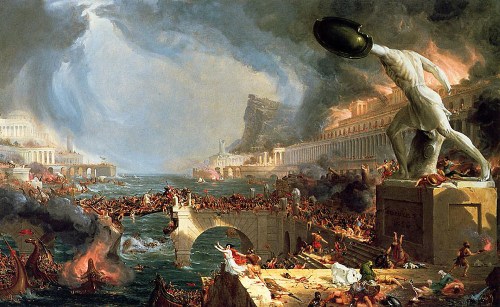
How to overthrow your own body

Pictured: Gold medallist, men’s 750,000 metre coup

Human language had a good run, but it’s about time to admit that the whole experiment has ended in failure. For two hundred thousand years we’ve been flapping mouths and breathing spittle at each other in a supposedly meaningful manner. We’ve invented needlessly complex processes for immortalising these self-important eructations, first on rock, then paper, then computers. It’s hard to calculate exactly how much this habit of language has cost us over the centuries, but it could only run into the tens of trillions of dollars. All those cuneiform temple inscriptions, all those public speaking engagements, all those shitty radio panel shows – and for what? The whole system has proven itself so useless that we feel the need to periodically massacre each other for attaching the wrong meanings to the wrong set of belches. This still goes on today, despite the fact that it’s now well known that words can never really refer to things but only to other words. Language is the hideous bastard hatchling of a hydra and and an ouruborus, and it needs to be slain immediately. If any further evidence of this is needed, you only have to look at the official readout of Obama’s phone call with Putin concerning the Russian intervention in Crimea.

The degeneration of language is happening at a frightening pace. Nothing in Obama’s ninety-minute conversation makes any sense. The phrase ‘going forward’ (a ghastly coinage bordering on the eldritch, one that’s apparently supposed to convey an energetic dynamism but only summons the image of some unfortunate person drowning in an office cubicle as it slowly fills with printouts of pie charts) appears twice in the space of four sentences. Obama talks about the Budapest Memorandum and the Helsinki Final Act and the Organisation for Security and Cooperation in Europe; he sounds like a dorkily enthusiastic teenager getting a bit too wrapped up in his performance at a Model UN conference. He hints at sanctions, as if half of Europe weren’t dependent on Russian gas. It’s a twisted parody. Language is, before anything else, a vector of deception. The United States government has broken all the agreements he mentioned, reneging on its promise not to extend NATO up to Russia’s borders, helping prompt and direct the nationalist revolution that overthrew Yanukovych, engaging in wars of aggression across the globe. More fundamentally, he’s pretending that he and Putin are something other than what they are: a pair of bureaucrats instead of two bloodstained warlords, each of whom could, if the fancy took them, kill every single human being on the planet several times over. There’s no record of Putin’s response to Obama’s extended series of laryngal honks, but you get the impression that he’s gently humouring this earnest American who doesn’t seem to understand the way the world actually works, playing along in his game of talking about other words rather than things. It’s a shame, because for a while Putin looked like the only person who could save language from itself. In 2008, as Russian tanks were comprehensively fucking the Georgian army, he declared his intent to ‘hang [Georgian President] Saakashvili by his balls.’ This is what linguists call a speech act, doing by saying; precisely through abandoning the principle of representation it’s the closest words can come to being about things.

There aren’t many speech acts in the current crisis. We’re beyond the point where we can meaningfully distinguish between words and deeds. The Russian intervention in Crimea is intended to send a message to the new government in Kiev and its backers in Brussels and Washington; action has become infected with the sordid ephemerality of language.

~

In the end, this whole mess can be blamed on the Sochi Winter Olympics. It’s a well-known and boring fact that in ancient Greece, wars were put on hold for the duration of the Games. The idea of doing the same thing now isn’t just infeasible but nonsensical; war and the Olympics are one and the same thing. Host governments treat the Games in much the same way that they treat foreign wars: they provide a chance to issue some contracts and boost important industries, they let you redraw the maps (turning a beach town into a mountain resort, or a moulding industrial park into a germ for gentrification), they’re a matter of national pride and a propaganda vehicle that helps calm internal contradictions – but at the same time they never seem to deliver the profits they promise; the costs inevitably spiral, and afterwards they tend to leave cities full of half-ruined buildings. It’s not just a matter of resemblance. With their vast crowds and attending dignitaries they’re a deliberate target for terrorists, allowing the hosts to show off their various defence technologies to the world. London 2012 wasn’t much more than an enormous arms fair, with an aircraft carrier on the Thames and missile batteries on the roofs of homes. Russia in particular seems to like conducting its imperial adventures during the Games. While jets battered Stalin’s birthplace in Georgia, representatives from the two countries were playing beach volleyball in Beijing. The Ukrainian paralympic team is still in Sochi. All this isn’t a distraction from the sport; it’s another facet of the same phenomenon.

Of course, sport is fascist bullshit. Liberal critics of organised sport like to hone in on its aggression and competition and the absurd salaries paid out to its practitioners, but none of this is the real problem. It’s true that most Olympic sports are some kind of symbolic warfare (with the potential exception of figure skating, although there’s still a case to be made against it), but a tendency towards aggression and competition is only a secondary characteristic of the fascist cosmology. The fundamental fascist vision is one of a cohesive and organic society, a society structured around the metaphor of the healthy body. Any politics of the body will by necessity be a politics that acts on the body: the healthy body becomes a regulative ideal, and images of healthy smiling men marching off to the front are suddenly everywhere. This spectacularisation of the body is always present (millions of people watch the Olympics), but it’s always also accompanied by the idea that health is good in and of itself, beyond any relation to the aesthetic. Individual health means social health. In Russia, the connection between the healthy body and militarism is still very much alive; Putin himself is constantly taking his shirt off to ride horses, wrestle tigers, catch fish, and otherwise demonstrate his unparalleled dominion over the animal world. In Western countries we generally prefer to wage war through silent and terrifying robots of death, but as the population grows steadily more obese and work is increasingly an activity that takes place in front of a screen (a screen showing sales figures, a screen showing a Pakistani village about to be obliterated, it makes no difference), the issue of health becomes a matter of deep general concern. And, as everyone knows, the best way to become healthy is through sport. Sport isn’t dangerous because it encourages competition or tribalism; it’s dangerous precisely because it’s healthy.

If there’s a central fascist procedure, it’s the subsumption rather than the sublimation of contradictions. Class antagonisms are buried in the organic nation, internal difference is either consumed or ejected, all cracks are papered up. The healthy body is a prime example of this. The ideology of sport and fitness has its roots in Victorian England – muscular Christianity, artificial famines in Ireland and India, the desperate belief that sports will prevent masturbation – but while it reached a kind of apex in the historical Fascism of the twentieth century, it stubbornly refused to die with its host. Left-wing responses to all this nonsense have been sadly anaemic. The most popular is a kind of body-euphoric self-affirmationism: the idea is that we should embrace all bodies as healthy and all bodies as beautiful. This appears to be a response to the dominant cult of fitness, but really it’s a capitulation to it and a failure to challenge its terms. Fitness and beauty are still good, sickness and ugliness are still bad, but the latter two are shoved beyond some metaphysical horizon. Instead of embracing ugliness in ugliness and as ugliness, its very existence is denied.

The figure of the body is a central concern of poststructuralist theory, and the academic tendency to refer to people as ‘bodies’ (based on the idea that the person is a fictive construct – after all, the word itself derives from the Latin persona, or mask – and that the only thing we can safely say about someone is that they have a body) seems to have filtered into a lot of non-academic discourse. At the same time the body itself is often instrumentalised rather than examined; this is why there’s so little real resistance to fitness fascism. It’s there from Foucault. In Nietzsche, Genealogy, History, he writes: The body is the inscribed surface of events […] and a volume in perpetual disintegration. [Our] task is to expose a body totally imprinted by history and the process of history’s destruction of the body. Foucault seems to have a blind spot when it comes to the body; his approach to it is surprisingly un-Foucauldian. Genealogy opposes itself to the search for ‘origins,’ but when Foucault discusses the body as a site of scarring and crumbling, he implies the existence of an originary unscarred and unimprinted body; a body that’s perfect and primordial and pristine. There’s no such thing: a newborn baby is bloodied and screaming. It’s necessary to admit that there is no primordial unitary body, that the thing we call the body is nothing more than the collection of scars that constitutes our experience of it. There’s only a series of metamorphoses without aim or origin, and the healthy body is only another kind of deformation.

The overthrow of the body is a matter of urgency, because things aren’t going well. The new Ukrainian government includes six ministers from the neofascist Svoboda party. Russian soldiers are surrounding military bases in Crimea. The year ends in fourteen, idiots are in charge across Europe, and two global alliance systems are squaring off as Slavic nationalists do their best to rile up a great power. In the end it’s about language, the filthy habit of humanity. If your throat coughs up a hard g sound like a Russian then you’re shunted to one side, if you wheeze an h like a Ukrainian you’re on the other. The shame that periodically surrounds the body tends to be centred on shitting and pissing and fucking, because these acts remind us that the body isn’t a unitary entity closed off from its environment; really it’s speech that’s disgusting, because it lets us pretend that it is. The idea of an organic and discrete Ukraine and an organic and discrete Russia is dependent on the metaphor of an organic and discrete body. Irredentism echoes Foucault: history has effected a crumbling-away of the national body, but rather than just uncovering this body they want to restore it. The mad advocates of health and fitness have nuclear weapons at their disposal. If humanity is to survive the coming century, we all need to start smoking heavily.

On the state of the State of the Left

If he up, watch him fall, I can’t fuck wit yall.
Pimp C, Big Pimpin’

Among the guardians of sclerotic radicalism, the ones who like to make grand pronouncements on the Current State of the Left, it’s become a grim axiom that we’ve somehow been defeated. This is pronounced with all the usual apocalyptic wailing: we’ve become weak and petty, we’ve splintered into irrelevancy, we’ve retreated into academia, we’ve polluted ourselves with all manner of useless theory – Nietzscheanism, Foucauldianism, intersectionality, ontology, cultural studies. Those who still hold to some kind of Marxist or communist line are like the seventh-century squatters in Diocletian’s palace, shivering in the walled-off ruins of something grand and terrifying and extinct while the barbarians scour the countryside. They’re right. The State of the Left is a terrible one: palsied, liver-spotted, emphysemic, crying out with its sandpaper rasp for a strong dose of barbiturates in a comfortingly bleak Swiss clinic. The point is that the State of the Left is not the same as the actual Left. Like all states its function is to arrive to us already in an advanced state of decay and to wither away as soon as possible. The left itself is doing just fine.

The moaners and complainers are ignoring a central lesson of the dialectic. Marx describes precisely its revolutionary quality in his 1873 postface to Volume I of Capital: the material dialectic regards every historically developed form as being in a fluid state, in motion, and therefore grasps its transient aspect as well; and [does] not let itself be impressed by anything. Deleuze and Guattari touch on a similar point in Plateau 1730 of Capitalism and Schizophrenia: in a becoming-animal what is real is the becoming itself, the block of becoming, not the supposedly fixed terms through which that which becomes passes. Any single State of the Left will be dead as soon as it is pinned down. Those who gripe about this or that static problem in the radical movement will see it as an endless succession of corpses, rather than a living motion.

And it is alive. As China plunges ever deeper into the watery graveyard of neoliberal accumulation, autonomous peasant uprisings are becoming a near-daily occurrence. In India the Naxalite insurgency governs vast swathes of the country. Radical left parties – both Cold War relics and newer coalitions – are gaining increasing support across much of Europe. Radical left magazines are reaching and radicalising new audiences. Protest movements are flaring up across the globe. Whatever the ideological or practical failings of these individual bodies or movements (and they exist), their emergence and resurgence is reason enough to be hopeful. The evidence is mounting for the radical – and correct – idea that the current way of doing things simply doesn’t work. There is significantly more debt than actual money in circulation, we’ve invested well over one planet’s worth of resources in the existing order, the wealth gap gets broader and more perilous with every crisis, the conditions necessary not only for social but biological life are being eroded, Macklemore won every rap award at the Grammys. Most importantly, this increasing consciousness of the sheer insanity of existing conditions has prompted an unashamed and unapologetic revival of the signifier communism.

In The German Ideology, Marx writes: Communism is for us not a state of affairs which is to be established, an ideal to which reality will have to adjust itself. We call communism the real movement which abolishes the present state of things. The State of the Left is not communism. Politics, properly understood, is the practical arena in which the question of how life should be lived is contested and the method through which human beings can through mass action entirely overhaul their mode of existence. The State of the Left, more concerned with ossifying the present state of things with the basilisk stare of its displeasure than abolishing it, is not only non-communist but non-political. It’s squabbling for position and the allocation of immaterial resources, the reconfiguration of left politics into left politicking, and beyond any ideological or practical objections it’s profoundly, abyssally boring.

It’s for this reason that I try to engage with this stuff as little as possible. My last flight into the turbulent miasma of leftist infighting was a response to Mark Fisher’s ‘vampire castle’ nonsense, mostly written because everyone else was doing one and as an excuse to spend a few paragraphs playing around with Gothic metaphors, which are always fun. This intervention is prompted by something a little less conceptually fecund. Recently, Richard Seymour (formerly of the Socialist Workers Party and author of the often excellent and occasionally execrable blog Lenin’s Tomb) resigned from the International Socialist Network; much of the crowing at his apparent fall from grace has been led by Ross Wolfe (formerly of the Platypus Affiliated Society and author of the often execrable and occasionally excellent blog The Charnel-House). The dispute that prompted this move centred on the racial implications of a work of art-cum-furniture owned by the Russian socialite Dasha Zhukova, with Seymour insisting on the acceptability of something called ‘race play.’ Personally, I think that to complain about the chair that an oligarch’s girlfriend chooses to sit on is to miss the point a little (especially when cops are shooting people of colour in the streets with impunity), but I’ve no interest in trying to wave away someone else’s sense of outrage or direct it from the outside. What’s important here (for a given value of ‘important’) is that an argument about a chair ended in a further split in what’s still masquerading as the left.

Seymour (and others) have previously complained of a ‘politics of anathema’ within the ISN; others have pointed to a supposed culture of excommunication throughout the left and tied it (unfairly, I think) to the increasing influence of intersectionality theory. It’s easy to disdain all this polemicism as being contrary to the spirit of reasoned debate, but the practice of polemic has a very distinguished leftist pedigree – Marx against Bakunin, Lenin against Kautsky, Stalin against Trotsky, Mao against Khrushchev, Tito against his own conscience, Hoxha against the slimy creatures scurrying inside his walls at night, Kim against the oral stage of psychosexual development. We have a leftist duty to engage in criticism and self-criticism, to get rid of a bad style and keep the good, to not let things slide for the sake of peace and friendship when a person has clearly gone wrong. What we shouldn’t do is confuse these duties with communist praxis.

Purely rational debate isn’t something that’s ever existed; it’s a transcendent regulative ideal buttressed with violence and used to hold back people who actually have a stake in the game. Insisting on measured reasonableness in a time of crisis is madness. Something’s changed, though. The new polemicism and the old polemicism don’t look very much alike. The discussion inevitably ends up veering away from politics because politics is fundamentally not a concern here. One of Seymour’s accusers on Facebook wrote: I hope a bird shits on you. I hope a bird shits on you every day. Catullus it ain’t. (Besides, isn’t being shat on by a bird supposed to bring good luck?) This is the real problem with the current leftist infighting: rather than being too vicious, it’s not vicious enough. I’m not going to make prescriptions about how this stratum of contest can be reformed; it’s a useless husk, and its uselessness is affirmed by how seriously everyone involved takes it. Calls for unity and pleasantness in a State of the Left already clotted into paralysis miss the point entirely. If anything, more splits, more divisions; everyone knows that communist cells reproduce asexually. But if we are to have a pointless squabbling sideshow to left activism, the very least it could do is make itself interesting.

PS: For all the complaints of excommunication, the State of the Left is hardly catholic or Catholic in nature. Excommunication is a profoundly dialectical censure; the object is to prod the wayward sheep back into the fold precisely by showing them what going it alone would mean. Instead, the function of contemporary left infighting is a kind of secular takfirism, a static universalism within strict horizons. Excommunication is vicious, takfirism is merely brutal. Once you’ve been pronounced apostate, there’s no return. You might follow the same doctrine and the same liturgy; it doesn’t matter – you are our enemy and always have been. This can be seen in the doctrine of Platypus: only one obscure Marxist reading group can rescue the left from its ruin, everything else must be destroyed. It’s hard not to be reminded of the splinter groups in the Algerian Civil War that were able to declare themselves to be the only true Muslims and every single person outside their militia kafir.

Defying Gravity

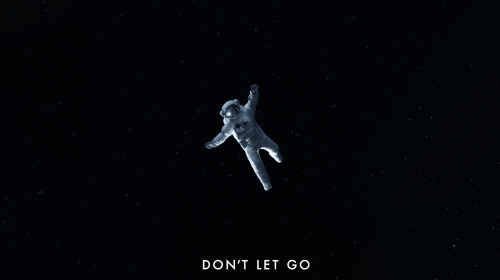
The new film Gravity does something quite brave: it doesn’t make space beautiful. We all have an idea of what outer space should look like: all those vast pink and blue nebulae draped in purple stars, swirling at the slow pace of cosmic infinity into (of course) phallic or pudendal forms. Space has gas clouds and supernovae and green-skinned alien babes and, quite possibly, God. At the same time we know that the sublime images we get from NASA are all in false colours; that for all the fascinating things in it (and there are plenty of them), most of space itself is actually quite boring as far as our libidinal imaginations are concerned. It’s a dead black void scattered with a few dead grey rocks, and they crash into each other according to a precise mathematical senselessness. But in our fiction, at least, we can have it all: black holes, asteroid fields, c-beams glittering in the dark near the Tannhäuser Gate. Not for Alfonso Cuarón; he’s got a real pedant’s eye for this stuff. The Earth is beautiful in Gravity, its clouds burning orange as the line of sunset crosses its surface, its cities shining in the night like diamonds on a lace – but space beyond its orbit is just a cold dark nothing. There’s only one shot that throws a sop to our aestheticised vision of the universe: our hero drifts out briefly into the void, and we see her framed against a galaxy of stars – but even here it looks washed out and anaemic; a semi-skimmed Milky Way. No grandeur, just emptiness. It’s incredibly impressive.

Cuarón does something else that’s pretty extraordinary: in a film where every shot and effect is fine-tuned to perfection, he’s managed to craft a plot that’s entirely unremarkable, dialogue so corny as to border on the emetic, and characters who might be floating in infinitely extended space but are entirely lacking in any depth themselves. It’s strange. In Y Tu Mamá También and Children of Men Cuarón showed that he’s every bit as capable a writer as he is a director, but the plot in Gravity hugs so closely to genre that you can pretty much work it all out from the trailer (if you can’t, look away now). There’s a disaster in space; Sandra Bullock and George Clooney are cast adrift; he dies heroically saving her life; she has a crisis of confidence but then looks inside herself to find the strength that she needs to survive, and ends up setting foot once more on the friendly soil of Earth. Along the way there’s some seriously embarrassing dialogue (“Will you pray for me? Nobody ever taught me how”) and a seemingly unnecessary backstory about the death of Bullock’s young daughter in lieu of any actual characterisation. It’s interesting that Clooney’s space fratboy – for all the wacky stories he half-relates – never has his emotional past strip-mined in the same manner; clearly the psychological depths of hysteria are still only to be plunged by women. In this really excellent post at Wasted Ideology the dodgy gender politics of the film are thoroughly taken apart, and the result isn’t pretty: in the end, even a disaster film in space needs to continually reaffirm ‘the centrality of love and family to everyone’s experience, weak women and strong men.’

This doesn’t mean that there’s not room for some significance in the film: after all, it has all that terrifying empty space gnawing at its periphery. The psychotherapist Aaron Balick gives an interesting reading, in which the repeated motif of ‘letting go’ (including in the film’s tagline) and the subject of Bullock’s lost daughter is read against Freud’s Mourning and Melancholia, turning the film into a psychological parable:

For Freud, the refusal to let go results in the person holding onto the lost other inside one’s self. So long as the lost person remains psychologically inside the self, they can never be properly mourned (or let go of) and nothing can ever take its place. Furthermore, it is a constant drain on the life energy as it is pulled inwards towards the lost object, and not available to go outwards into to the world; it operates like an internal black hole. When Dr. Stone [Sandra Bullock] decides to give up hope, this is a giving up of her relationship to the world. In a sense, it is an (unconscious) choice to abandon the real world and to be sucked into the endless chasm of depression induced self-involvement: to literally let go of the world and collapse in upon the self and die. She shuts off the oxygen in her pod awaiting her death, when the spectre of Matt [George Clooney] comes to snap her out of it (a representation from her unconscious). It is he (whom she has refused to let go before) that guides to towards the what she has lost, not just the whom, to use Freud’s words. He brings the unconscious part of her loss to consciousness. He essentially says, “your daughter is dead, you are not, you can choose life.”

Letting go, yes – but something of a Leninist approach is needed here: letting go into what? There’s something crucial in Mourning and Melancholia that’s missing in this approach; Freud’s text isn’t a self-help guide. Freud describes melancholia as a turning of the ego against itself – ‘the patient represents his ego to us as worthless, incapable of any achievement and morally despicable; he reproaches himself, vilifies himself and expects to be cast out and punished.’ What’s interesting is that Freud doesn’t necessarily disagree: the melancholic patient isn’t delusional, he probably is worthless, his sickness is that he’s lacking the narcissistic delusions that let most people ignore this fact and go about their days as normal. Freud connects this falling-away of delusions with the loss of a desired object (this loss isn’t necessarily death, but a rejection or disappointment) that the ego continues to strongly attach itself to. It’s not just a simple matter of ‘letting go’ of a loved one – the point is that the ego directs its hatred against itself because it unconsciously hates that same object of desire, but still identifies with it too strongly to express that hate. When you love someone, that other person becomes something of a master-signifier; the point around which your entire life and subjectivity gains meaning. It’s an impossible task; in the end we’re all just bags of flesh and offal, and loving someone is a terrible thing to impose on them. When that person inevitably fails to be perfect, it’s felt as a loss and a betrayal. Hatred results; if you love someone, you can’t help but hate them at the same time. Sometimes you can manage that hatred, but if you’re really in love, full of fire and passion, all your hatred is turned inwards on yourself, and the only way to recover from this is to admit to yourself how you actually feel. Letting go isn’t Sandra Bullock finally managing to move past the death of her daughter and value her own life. It’s a furious exclamation: fuck her, fuck her for dying; how could she do that to me? Letting go means floating off alone into the seething blackness of space.

You let go into empty space, but space always carries meaning. Since Kant we’ve known that spatiality isn’t an objective prior substance in which things exist but something that we create when we conceive of relations between objects. In A Thousand Plateaus, Deleuze and Guattari posit two modalities of space: the smooth and the striated. Smooth space is intensive nomad space, in which ‘the point is between two lines;’ striated space is the extensive space of the State, in which ‘the line is between two points.’ Felt is smooth; woven cloth is striated. Earth orbit in Gravity is a heavily striated space; movements are always made between fixed positions. We go to the shuttle, and from there to the ISS, and from there to the Chinese station; as Bullock tumbles into the void Clooney tries to fix her line of flight through reference to points. What can you see? Can you see the shuttle? Can you see the moon? However, as Deleuze and Guattari point out, the two forms of space are always in a dialectic: farmers put up walls and pastoralists tear them down. At the beginning of the film there’s a catastrophe: an anti-satellite missile test goes horrible wrong and suddenly a deadly tide of debris is circling the planet at lethal speed. Now every fixed point must be considered in terms of its relation to that moving line. Striated space comes with all the blockages of bourgeois subjectivity – the nation-state, the family unit, the Oedipal triangle – and, of course, Bullock only survives in the film by upholding these striations. She doesn’t let go, she doesn’t admit that she hates her dead daughter, she keeps on going to preserve her melancholic attachment, to carry on affirming that desire is a lack. But there’s another way.

The Earth is beautiful in Gravity. Space isn’t beautiful, but it is smooth, a void in which nothing is stable, crisscrossed by tumbling objects and lines of flight. However tightly focused the action is onscreen, it’s always lurking there in the background, a silent rebuke to all the striations arcing up from the planet’s surface. As he floats away to die, Clooney’s character has a choice: he can disappear among the stars, or he can use the last few breaths of fuel in his jetpack to nudge himself in the direction of Earth. After a while, floating will become falling. Gravity will get him. He’ll burn to a crisp, but he’ll do so under the blue skies of home. What would you do? Clooney chooses the stars, and he can do this because he hasn’t been subjected to the same bullshit characterisation as Bullock. The narrative demands that she risk her life re-entering the atmosphere because she’s been thoroughly interpellated as a woman, a grieving mother, and a melancholic. Clooney still has a touch of the everyman about him, and out there in empty space you can approach what Badiou calls the ‘generic.’ You become your own movement. Gender and nation and subjectification mean nothing for a human body spinning powerlessly in the void. In a way, God is out there; the promise of the New Testament is fulfilled: There is neither Jew nor Greek, there is neither bond nor free, there is neither male nor female: for ye are all one in Christ Jesus. The film can’t endorse it, of course – that’s why it’s only ever presented as a danger – but it’s still haunted by this idea: the communism of outer space.

On the encounter, or how I missed a flight because of Slavoj Žižek

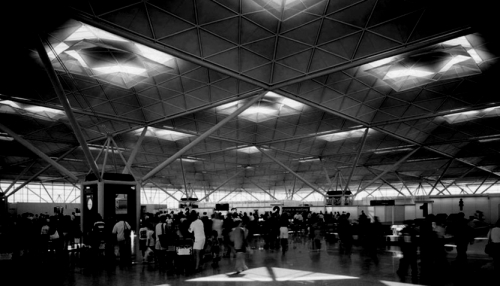
I have experienced the full horror of an encounter with that which exists beyond the wall of language and beyond the limits of our comprehension, and it happened in the departure lounge of London Stansted airport, in a seating area between the Wetherspoons pub and a branch of Pret A Manger.

I was there to visit some friends in Edinburgh, and I was flying because it’s cheaper to get to Scotland by hurtling through the sky in a tin can full of burning kerosene than it is to take a train. I don’t like airports. I don’t think anyone does, apart from planespotters, executive bankers, Boris Johnson, and other such psychopaths. It’s not even the queuing, or the brusquely voyeuristic security measures, or the abolition of the indoor smoking areas; it’s the fact that airports seem to be the focal points of a very peculiar sort of regimented insanity. Why do the tannoy announcers in airports seem to be so ashamed of their humanity that they mimic the blank tone and halting cadence of a robotic voice? Why do most of the books sold at airports seem to concern a terrorist plot to kill hundreds of people in an airport? In 2009 Heathrow chose as a writer-in-residence for its newly opened terminal that blithering clunkhead Alain de Botton. He wrote a book about the experience. Sample sentence: In the cloudless dawn, a sequence of planes, each visible as a single diamond, had lined up at different heights, like pupils in a school photo, on their final approach to the north runway. I don’t think anyone capable of producing such artless imagery should be allowed near a rural bus stop, let alone an international air transit hub. But in a way it makes sense: de Botton’s banal quietism, vaguely inquisitive but ultimately more concerned with homilies than critique, is precisely the kind of attitude that our infernal masters in the airport system want to promote.

In Stansted, I was busy inadvertently scalding my tongue on coffee and trying to pummel my mind into a book by de Botton’s less platitudinous namesake, Alain Badiou. I’d managed to find a less crowded area, but there was still plenty of commotion. Kids gnawed at the edges of their seats. Clashing strains of cheery pop blared from various exciting retail spaces. Harassed-looking commuters played an endless series of computerised bloops through their iPads as they crushed candies or angered birds or did whatever it is we’re now required to do to stop us committing suicide whenever we have five minutes to ourselves. Badiou was trying to tell me about the universality of the truth-event, but I’d had three hours’ sleep the previous night and it was pretty hard to listen. I felt a faint shadow fall over me in the diffuse airport light, and looked up. Standing in front of me, meeting my gaze with his, was the Slovenian philosopher, critic, author of over seventy books, and ‘intellectual rock star,’ Slavoj Žižek. He was pale and haggard, his nose pulsing, his legs trembling. I might have imagined this, but he appeared to be wearing an illustrated Žižek alphabet t-shirt: A is for the Absolute, B is for the Big Other, C is for cocaine, and so on, and so on. And he was looking at me with pure, undisguised terror.

I’d come across Žižek before. In a talk at the Royal Festival Hall he’d accused the entire audience – myself included – of being ideologically incoherent for failing to properly understand the ‘tomorrow belongs to me’ scene in Cabaret. In these pages I’ve variously mocked his beard, parodied his writing and speaking style, and pointed to the dearth of censure for his outbursts of antiziganism. His publishers follow me on Twitter. This was different. I wasn’t facing the ‘Elvis of cultural theory’ or ‘the most dangerous philosopher in the West,’ or even the author of over seventy books. With his sad grey eyes and his meline snuffling Slavoj Žižek looked like nothing so much as some reclusive woodland creature, something small and hunted and incredibly fragile. He was in shock. He’d been in London to promote his new film; he’d been surrounded by journalists and interviewers and, worst of all, his fans, who he famously can’t stand. Finally, he was in Stansted airport, protected by a wall of duty-free perfume and ruffled copies of the Daily Mail; he thought he was safe. No such luck. He was just looking for somewhere to sit before his flight, but then he saw me. He saw what I was reading. In a blurb, Žižek has said of Badiou that ‘a figure like Plato or Hegel walks here among us.’ I would know who he was. I would want to talk to him, or take a photo, or have him sign something; it would be unendurable. He had to leave before I noticed him. Too late. I looked at him and he looked at me. Or maybe the other way round: for a Lacanian, the Gaze is never your gaze, it’s the gaze of the Other, the anxious feeling that the object of our glance is looking back at us. In any case, he grunted and shuffled away as quickly as he could.

I was in shock too. My plans for that morning were to drink some coffee, try to read a book, and catch my flight to Edinburgh. I wasn’t expecting to be thrust into a miniature staring contest with Slavoj Žižek. Nobody had warned me that this was about to happen. Now I know how I’ll behave in a moment of crisis: as the sniper fire whooshes past my ears or the avalanche slowly descends or the inferno blazes around me I’ll just sit there, mute and stunned, an idiot smirk hovering on my lips. By the time I regained my senses he was gone. Quickly I hurried after him. I had to get something: a photo, an autograph, a blurb for my first novel, a response to my critique of his contribution to David Lynch scholarship, something to prove our encounter had actually happened. He had his role, and I had mine. He would flee, and I would hunt him.

I never did find him. By the time gave up my hunt my flight’s final call was imminent. In my panic I followed the wrong signs and found myself trapped on a slow-moving automated transit to a distant outpost of the terminal. When I eventually reached my gate the staff told me that the plane’s doors had been closed less than two minutes ago and that I couldn’t be allowed to board. Pleading had little effect. I had missed my flight, the next one wasn’t for seven hours, and it was all Slavoj Žižek’s fault.

This is what’s meant by an encounter. Most of the time when we see people we don’t really look at them, and for good reason. Walk down a crowded street and you’ll be confronted with countless gazes and subjectivities, an infinity of infinities of experience. You can’t approach all these people as other subjects; you’d go mad, end up as a street preacher or a serial killer. It’s much safer for everyone if you consider them as vaguely mobile obstacles. If you see someone you find particularly attractive or particularly objectionable you might go into a brief flailing panic, your eyes darting around them, your neck craning over to watch them walking away, but that’s over in a second. Sometimes, though, there’s an encounter; a point where you approach someone else in a manner that is entirely beyond the structures of signification and at the same time full of an incredible significance. We all leave a certain amount of turbulence in our wake. The encounter can result in grand leaps in human knowledge, or the ruin of cities, or me being stuck in Stansted airport for seven hours. For Badiou, though, the encounter is the fundamental basis of love. As a good Maoist, he rejects the banal cod-spiritualist view in which love is seen as a process by which two people become one: the essence of love is the properly dialectical formation of a Two. In an encounter – in a real encounter – a monadic subjectivity finds itself opened up to other people, to numerativity, and through this it gains access to the infinity of experience.

I’m not so sure about this. Badiou’s maths is probably better than mine, but I’ve yet to see a series of integers ever actually ending in infinity. Žižek is less positive about the whole thing; for him the paradigmatic form of the encounter is the encounter with the Real. He writes: ‘When do I actually encounter the Other ‘beyond the wall of language’, in the Real of his or her being? Not when I am able to describe her, not even when I learn her values, dreams, and so on, but only when I encounter the Other in her moment of jouissance: when I discern in her a tiny detail (a compulsive gesture, a facial expression, a tic) which signals the intensity of the real of jouissance. This encounter with the real is always traumatic; there is something at least minimally obscene about it; I cannot simply integrate it into my universe, there is always a gulf separating me from it.

My encounter with Slavoj Žižek was an encounter of this kind. I looked at him and he looked at me; we saw each other beyond the wall of language. The sensation that accompanied this encounter wasn’t love: it was mutual horror. For a brief second before I set off to chase him down, the linguistic structure of my subjectivity was shattered. I saw myself from the outside. It was something like Kristeva’s formulation of abjection – the awareness of a subject as something other than a subject, the feeling you get when confronted with human shit or a corpse. The traumatic sense of my own finitude.

The encounter is unpleasant, but this doesn’t mean that it should be avoided. In a sense, Badiou is right: it opens up a pathway to the infinity of experience, not through numerativity but through a Deleuzian operation of minority and multiplicity. Deleuze claims that we never encounter another person directly. We encounter the Gaze, and this wordless gaze emanates from the Real where there is no lack and no insufficiency. It’s upsetting, but it’s a duty: in the end, it’s our duty towards our own deaths.

In the end, I caught the next flight. Edinburgh was very nice.

Why the British monarchy doesn’t exist

In the beginning there was the Image, and the Image was with God, and the Image was God. And the Image was made flesh, and dwelt among us.
Good news for republicans, bad news for sufferers of scrofula. The monarchy is done, it’s finished, we can chuck it away with the Empire and the established Church. That is to say, it’s still around, in terms of appearance, but only as a farcical parody of itself, a shadow, a convention. It’s ceased to have any real existence. Once we had a monarchy, now we just have the royals, and the two are not the same thing.

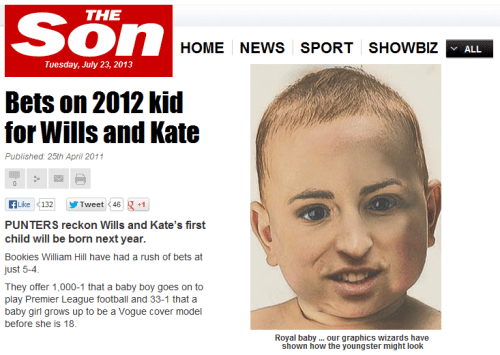
Bad news for the royal baby, though (congrats to Wills and Kate, rah rah, etc etc). They’ll all still be there to comprehensively fuck up his future development, the whole chimerical menagerie: that dessicated turtle-beaked matriarch with her rapacious vulture-eyes, she who once gorged herself silly on the soul of Laurent Nkrumah using sinister white people dance-magic; his wittering toucan-nosed biscuit-salesman of a grandfather; the murderous lunkheaded uncle, a marmot-faced proper down-to-earth lad, mowing down Pashtun herdsmen in his flying fortress of imminent death like a less sophisticated Sarah Palin; an entire extended family of posh twits, all in various stages of hippomorphosis; finally, the heirs to all this horror, his whinnying filly-mother and braying donkey-father. They want their son to have a normal life, they say; they’re already positioning themselves into a perfect imitation of the drab Oedipal triangle, and as a sop to the press they’ll provide access to a few key moments: baby’s first repression of his infantile sexuality, baby’s first intimation of his own mortality – see, he’s growing up as damaged and estranged from the world as everyone else! He’s a neurotic wreck putting on a brave grin, just like you! It won’t work, though. This is not a nice family. Parents in the Haus Sachsen-Coburg und Gotha aren’t just distant, they’re at an interstellar remove; all the normal fixations are displaced onto wetnurses and nannies. The chief activity of its sons and daughters consists of waiting for their parents to die. The royals can’t go through any castration complex because for them there really is nothing more important in the world than themselves – for them, the crown and sceptre aren’t symbols; they’ve been permanently locked out the Symbolic order. In other words, they’re a family of psychopaths. They’re toxic, not just institutionally but personally, and if you spend too long breathing in their fumes the poison will get to you sooner or later: just look at the poor kid’s grandmother. Where’s child protection? Why won’t someone rescue this baby before it’s too late?

Nobody will, because for the great mobile flocks of royal-watchers and their herdsmen in the press this isn’t a person at all. The royal baby is made of more delicate and ephemeral stuff than we are; when the Duchess of Cambridge was in hospital she gave birth to a liquid stream of pixels and wavelengths, its digital tentacles spiralling out from her womb to wrap themselves around the entire world. The royal baby has the dubious honour of being possibly the first person born as image before reality, the first person to fully demonstrate Baudrillard’s old line about the precession of simulacra: ‘today it is the territory whose shreds slowly rot across the extent of the map.’ His status as ‘the royal baby,’ future ruler and object of fame and devotion, ontologically preceded any of his actual physical attributes. In the old days, when we still had a monarchy, the king held two bodies: the body politic and the body natural. Now our royals have no body at all. In normal development, a child develops full subjectivity when it identifies itself with the specular image in the mirror, when it comprehends itself as an object capable of being gazed upon; before that between subject and image there’s an aggressive tension which the child has to resolve into joyful captivation. No such luck for the royal baby. He will be surrounded by the gazes of cameras and smartphones; his own image will surround him, staring from commemorative plates, tea-towels, mugs, the inevitable ‘keep calm and love the royal baby’ posters – every mundane object will be stamped with the mark of his spectral adversary. He won’t be able to subsume the image into his self; it’s too late for him, he’s already been swallowed up by the image, the idea of what he is, as an amœba swallows up a speck of food.

A royal family is the image of a monarchy that remains once the monarchy itself has shrivelled up and died. The monarch was once the guarantor of a certain kind of commons: the king’s highway, the royal mail, the crown courts. The monarch was the people, by virtue of our perfect subjugation to him; he imposed a certain kind of paradoxical egalitarianism. Now, in an age of privatisation, the situation’s been precisely reversed. Images and representations are common property, and as such the royal family are now perfectly subjugated to us. It’s their in the language: our Wills, our Kate. When a French magazine published topless photos of Kate Middleton the popular outrage wasn’t so much a loyal horror of lèse-majesté as affront against the violation of property. It works the other way too: as the image of the royal baby started to construct its hyperreal manifestation yesterday, a good part of the nation thought it had the right to know every queasy detail about the dilation of the royal vagina. Sovereignty’s dread authority of life and death over its subjects has turned into the sovereign being the ultimate object of that same biopolitical power; the king’s commons has turned into a king held in common. The monarchy as such no longer exists.

In a way all this should be celebrated. Whether or not the formal monarchy survives Elizabeth (and I’m not so sure it will), we’ve finally beaten back our aristocratic oppressors. In the royal image we’ve found the paradigm for a new commons without sovereign power. But it’s going to seriously mess up that kid.

Branding strategies for the viscous phallus-monster that has risen from the depths to reclaim our world

Sometimes I believe that this less material life is our truer life, and that our vain presence on the terraqueous globe is itself the secondary or merely virtual phenomenon.
Karl Marx, Grundrisse

This exists.

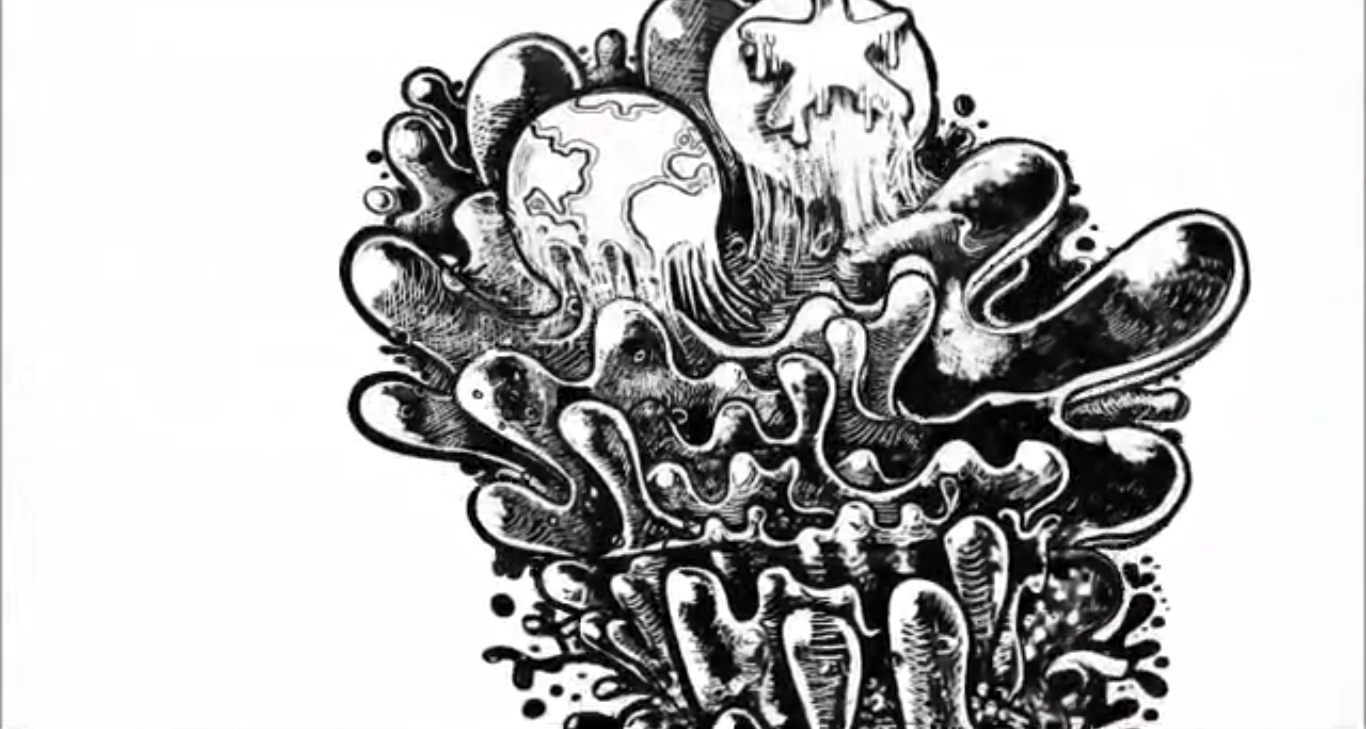
It’s easy to get whipped up into an outrage over this kind of thing. It’s enraging to see the techniques by which we are manipulated uncovered in all their foetid glory. What’s more, there’s the sheer density of meaningless marketing buzzwords repeated over an insipid steel guitar melody, managing to replicate simultaneously the effects of a cult indoctrination film and a nice strong hit of prescription opiates. There’s the naked theft of the video’s entire aesthetic from the occasionally excellent RSAnimate series. There’s the fact that the gang of marketers behind it seem to consider making a positive change in the world to only be a good thing insofar as it can be put to use selling various tubes of corn syrup-based goo. There’s the cynical manipulation of popular sentimentality for profit. There’s the section dealing with ‘families, communities and cultures,’ in which the former two are represented anthropomorphically, sitting like nineteenth-century monarchs astride a globe, while ‘cultures’ is just an arrow pointing in the vague direction of Africa. It’s all so perfectly and unwittingly ugly. But to focus on this stuff is to miss the point a little. There’s plenty of justification for a sensible critique of consumer capitalism as demonstrated by this video, but a purely sensible critique ignores not only the horrific haecceity of the thing, but the otherworldly horror that surrounds consumerism itself. For the purposes of this essay, at least, I’m not interested in the ideological presuppositions of liberal philanthropy, the incoherence of marketing discourse, the soporific nature of societally-mandated pleasantness, or even the construction of the racial-cultural other.

What I’m really interested in is this.

What is this thing? It crops up everywhere in the video. Its tendrils extrude randomly into the field of gibberish without warning or explanation: sometimes it tenderly caresses the various symbolic representations onscreen; sometimes it’s actively antagonistic towards them, bursting out from their bodies and leaving only shattered remnants of sales patter. In one memorably horrifying sequence it’s shown passing through the heads of three people as they smile their bovinely unfazed marker-pen smiles in our direction. Here, at the video’s end, it holds the entire Earth in its grip, the planet leaving sticky stretchmarks as it tries and fails to struggle free from the gloop’s oleaginous embrace. Let’s start with what we can see. The thing is clearly alive. Maybe it’s not alive in the strict biological sense that any of us can comprehend, but it moves, it has agency, it has plans for us and our lives. It appears as a seething mass of – of what? Not liquid, exactly; it’s too firm, too collected; it doesn’t flow, it crawls. Some kind of mobile mucous then, bile-black and slug-sinuous, its surface tight and slimy, glistening under the light of a blood-clotted sun. But at the same time there’s an undeniably fleshy quality to it, fleshy in the most visceral sense of the world. It resembles nothing so much as an immense, writhing conglomeration of dicks. Could it be that what this thing wants is to fuck us?

I’ve always found there to be something almost endearingly naive in the thought of Debord and Baudrillard and other theorists of the image. Baudrillard proudly and knowingly calls himself a nihilist; in fact, he’s anything but. Nobody believes more fanatically or more religiously in truth than the poststructuralists. To speak of the spectacle or the simulacrum in terms of a precise historical moment is to assert the existence of a historical world of truths prior to the image; to speak of hyperreal images that reflect only each other and deny a pre-existing truth is to assert the existence of a pre-existing truth that can be denied. Debord in particular is militant in his rejection of the image and his partisanship on the side of reality. He’s got it all wrong. Representation isn’t a prison, it’s a shield, our only defence against a universe filled with horrors. It’s a way to make the world comprehensible. Lacan describes this process precisely: the Symbolic order has its origins in the castration complex; the phallus as an intolerable lack is what anchors the entire process of signification. When Lacan describes the Real he does so in terms that approach Lovecraftian horror: it’s something black and smooth and undifferentiated, with no cuts or cracks, no inside or outside. The infant, confronted with the realisation that the world is an enormous and unfriendly place in which his jouissance is ultimately irrelevant, begins to build metaphors for himself. It’s the only thing he knows how to do.

Eventually, though, the chains of signification loop in on themselves. In the Coca-Cola Content 2020 Initiative video, there’s no mention of Coca-Cola-as-beverage, only stories, narratives, feelings, loyalties – only images referring to other images. This makes perfect sense: images are a necessary refuge from an unpleasant reality. The fact of your utter insignificance in both the mechanistic universe and the libidinal economy doesn’t sell sugary drinks – or, at least, it doesn’t sell many to Coca-Cola’s core demographic of people who don’t just sit at home with the curtains drawn reading Kafka. Brands aren’t like us. They’re better than we are, untouched by fears or neuroses, unravaged by time. They have the commodity’s aura of unblemished totality that we pitiful human wrecks, crippled by our various lacks and lacerations, can never possess. That’s why people grow so attached to them; we want what they have. But to fully maintain the pleasant banality of advertising, to completely protect against the sour taste of reality, these images have to be decoupled from any concrete referent. They have to be purged of anything that could climb down the chain of signification and kick us in the face. That’s where we get brand slogans like Live Positively: a floating signifier, elemental in its meaninglessness. But doing this kind of thing is very dangerous. The shield of representation works by mediating between the fragile subject and the hideous object; if you break it away from the object it becomes useless. The real world can then intrude. It forces its way unopposed into the realm from which it was banished, and it hits us right where we thought we were most safe: in our advertising. And when it does so, is it any wonder that it takes on the form of the object of that first primal act of signification, slipping back across the divide between phallus and penis?

This isn’t a metaphor; it’s a portent. The creature that invaded the Coca-Cola Content 2020 Initiative video will not stop there. Our virtual creations are easy targets; its violence grows stronger with every victory. Soon the brittle crust of the Earth will snap, and viscous tentacles will emerge from the chasm to crush all our cherished symbols. The beast will rise. It will take its revenge, and it will take it in blood. We will, very soon, be once again faced with the incomprehensible horror that we once tried to abstract away, long ago, when we were infants. Luckily, we now know exactly how to deal with it. All we have to do is represent it, turn it back into a signifier. The future of the human race depends on a solid brand strategy.

…In the next financial year, our target is to double voluntary self-immolations as sacrifices to the viscous phallus-monster that has risen from the depths to reclaim our world. That’s a lot of voluntary self-immolations! To do this, we must fully engage our brand with the aspirations of our sacrificial base. This means not only promoting our brand, but entering into dialogue with the defeated human race across all multimedia platforms and allowing user-created content to grow in the fertile ashes of their ruined cities. Through the Live Every Second brand slogan consumers can independently develop content focusing on positive and aspirational life experiences they have enjoyed before inevitably succumbing to annihilation at the hand of the viscous phallus-monster that has risen from the depths to reclaim our world. Our entire advertising focus has to be centred around the Live Every Second concept if the phallus-monster brand is to achieve full market penetration. Engaging with Live Every Second means that consumers will approach their grisly fate as the appropriate end to a life not only lived well, but lived to the max. By encouraging conversations about what it means to live every second we can potentialise the creativity of our user base…

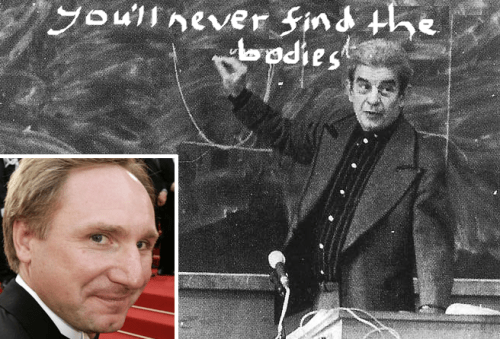
Exclusive extract: The Lacan Conundrum, by Dan Brown

Dan Brown’s new novel Inferno went on sale yesterday and has already careered straight to the top of the bestseller charts. Naturally, I was a little jealous. However, unlike the throngs of snobbishly unpublished authors who take it upon themselves to parody Brown’s works, I decided it would be far more productive to try to learn from someone so clearly a master of his craft. That said, I needed an edge on my competitors, and just reading Inferno wouldn’t cut it. I knew his next novel, scheduled for publication in 2015, had already been written. So at midnight last night I parachuted stealthily out of a Cessna 172 Skyhawk plane with a Garmin G1000 Primary Flight Display flying at 13,000 feet over the small Westphalian city of Gütersloh – home to Bertelsmann SE & Co. KGaA, parent company of Doubleday, the publisher of Dan Brown’s novels. Landing on the roof of the squat office building, I quickly incapacitated the guards, who were armed with Heckler & Koch MP5 sub-machine guns, for reasons best known to themselves. Gingerly, I entered the building through a ventilation duct. Eventually I found myself outside the room where Dan Brown’s next novel was being kept. What I found in there revolted me. The air stank of ordure and rotting bananas. The shit-speckled walls, the piss-sodden carpet, the flies, the rats. About a thousand primates sat there on ergonomic office chairs, chained to antique typewriters. The macaques and tamarins were visibly distressed, straining at their manacles, screeching helplessly, banging their heads against their desks. A few chimpanzees had resigned themselves with seeming good humour to their work; while one typed, another groomed its back. By the far wall, a sad-faced old orangutan slowly and arrhythmically pressed the ‘H’ key, over and over again, staring dejectedly at the reams of paper it had yet to fill. The baboons seemed to be in charge of the place, though. They were unshackled. As I entered they shrieked in unison, baring their yellow fangs. I grabbed a few sheets from the typewriter of the nearest gibbon and ran. As I left the building, pursued by the chilling ululations of the baboons, I briefly passed Bertelsmann’s Employee of the Week board. On every square was a picture of a baboon. And at the top, smiling benevolently down on them, was a photo of the Reinhard Mohn, the corporation’s legendary former CEO: a silverback gorilla, staring with a pipe in his mouth and the faint gleam of a deep unknowable wisdom in his round brown eyes.

The lines that follow are all that I could rescue from that room.

THE STORY SO FAR: Around the world, hundreds of men and women drop dead on the same day. The tall man Chad McRib, professor of Obscurantology at Hardton University, is accused of complicity in their deaths. Fleeing the French police through the streets of Paris, he finds himself catapulted into the ancient mysteries of the 20th Century, as it emerges that all of the victims had at one time or another been analysands of the psychoanalyst Jacques Lacan. After Chad enlists the help of the beautiful European nuclear scientess Slavojina Zizek, it is discovered that Lacan had been highly radioactive. It was for this reason that he had gone against the Société Parisienne de Psychanalyse in introducing shorter sessions: he knew that prolonged exposure could give his patients a lethal dose of radiation. But who had irradiated him, and why? Chad and Slavojina delve into the sewers of Paris with a stolen copy of Lacan’s notebooks to find the answer, but find themselves trapped in the terrifying Mirror Stage, and shadowed by mysterious gazing figures…

The tall brown-haired man walked into the room. The man was Chad McRib, who was tall. The attractive woman Slavojina Zizek clung to his arm. The whirr of a VRF (Variable Refrigerant Flow) air-conditioning unit hung in the air, which was suffused with the hum of a VRF (Variable Refrigerant Flow) air-conditioning unit.
“We’ll be safe here, Slavojina,” Chad said. “As we have checked into this hotel, the Hôtel Fièvre Gastrique on the Rue  Grossier, under false names, the Big brOthers will be unable to find us here, in this particular place.”
Slavojina reclined delightfully on the expensive bed. “Zhe question ish, what ish it we should we do now?” she purred, like a cat suddenly teleported to Planet Milk. “Theesh I claim: we musht carry out the sexual act, it ish our duty, in zhe Kantian senshe.” Her hand fluttered teasingly over her eyebrow and the bridge of her bulbous nose as she grunted sensuously.
“While it is true that we are now experiencing a high level of mutual attraction, especially when compared to our first meeting two days ago, during which you were somewhat wary of me, we have no time for that,” said Chad, who was high in stature and had brown hair. “Whoever those people are, they won’t stop looking for us until they have these écrits,” he continued cromulently. “Whatever the secret is, it must be hidden in this notebook,” he mouth-flappled.
The notebook was square and had yellowed over the years. Its cover was black with embossed gold lettering. The paper was made from pine woodpulp. 60% of the pulp that had gone into the notebook had come from a single pine tree. The tree had been planted in 1928 near the Spanish town of Rascafria. In 1941 a Spanish imperial eagle (Aquila heliaca adalberti) had nested in its branches like a zeppelin docking at the Empire State Building. The eagle was later shot by a hunter named José Mercader, who had a thick moustache and later fell into penury for unrelated reasons. None of its chicks survived. Chad McRib opened the notebook with his fingers, which were long and slim, much like his body, which was tall and slim. He read a few pages, like a crowded minivan plunging tragically off a cliff. I’ve got it, he thought. If the unconscious mind is itself a series of chains of signification, then literally everything has a hidden meaning and every single object is part of a vast paternal conspiracy. But what could be the purpose of it all? Suddenly, he knew.

~

He then told Slavojina what he had discovered, which was very unsettling and also exciting. “It is commonly said in the bar-rooms and crack dens of the world that Lacanian psychoanalysis is difficult,” the professor said, thrillingly. “Indeed, many of my students have told me that they find it difficult to read Lacan, because his words are difficult to understand and the order in which they are placed also makes them difficult to understand,” the noted academic who was on the run from the police said, in tones that made it sound very exciting. “However, what if the reason for this complexity is that Lacan’s works in fact carry a hidden message, explaining who had given him his continual doses of radiation? For instance, Lacan attempted to explain psychoanalytic concepts through mathematical formulae. The traditional interpretation is that he did so as a half-serious attempt to give his theories objective mathematical weight. But could it be something else?” The teaching-type person, who was very clever and also had brown hair, directed the woman’s attention to a diagram in the notebook. “Look at this,” he said. “Does thees not demonstrate precisely zhat in making a line acrosh zhe face of zhe Real, zhe act of represhentation ish itshelf monstrous, in a senshe deesgushting?” Slavojina giggled.
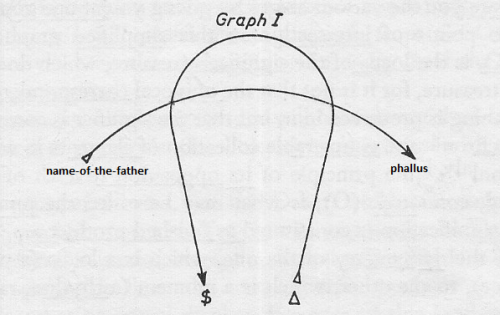
“Exactly,” said the man, who was called Chad McRib. “It doesn’t seem to make any sense. But what if we tried to solve it as if it were a perfectly ordinary triquadratic biequation?” He scribbled in the notebook with the furious zeal of an itinerant lobster, using a Pentel GraphGear 1000 PG1015 automatic pencil. “You get this.”
 “My God,” said Slavojina. “Pure ideology.”

“I think the whole book is a map” said the fêted head-think-brain-man. “It’s a set of directions. Where is the name of the Father written in Paris? Above the altar in Notre Dame. And what forms a phallus? The Eiffel Tower. Somewhere along the line between those two points an incredibly precious object is hidden, an object people have been seeking for centuries. That’s what the Big brOthers are after. Lacan’s notebook gives us the route to the objet petit a. The ultimate object of desire. The Holy Grail, Slavojina.’
“But zhees ish eempossible,” said Slavojina. “Zhe objet petit a ish unobtainable. Zhat ish zhe source of eets transcendence.”
The famous professor flipped through the square book. “What if I told you that I know exactly where it is?” the elegant variation pronounced.
“In zhe filum of Heetchcock, zhe gaze ish never a pure gaze, eet ish alwaysh accompanied by zhe threat of viyolence,” Slavojina gasped.
“You’re right. We haven’t a second to lose.”
As the tall man Chad McRib and the attractive woman Slavojina Zizek stepped out of the hotel onto the Rue Grossier, a dark bad figure of a bad man lurking in an alleyway watched as they hurried off towards the Seine. He cocked his SIG P226 pistol and began to follow them.

~

A short man burst into the boardroom of a superbly appointed office building in New York. “Sir,” he said, proffering a photo of Chad exiting the hotel. “McRib is back.”
Sitting alone in the room, which had excellent views over the river, wearing a sharp navy-blue three-piece suit, the Master-Signifier smiled in an evil way as would befit someone who is obviously the villain in this story. “All is going according to plan,” the Master-Signifier said. “Once McRib finds the objet petit a for us, no power on Earth can prevent us from crushing the schizoanalysts and achieving world domination.’

Will our heroes find the objet petit a? (no.) Does it even exist? (no.) What about the Big brOthers, do they exist? (no.) Will Chad uncover their plot before the radical schizoanalysts detonate a nuclear bomb over Vienna and wipe out the Freudian legacy? (no.) What unexpected twist awaits us before the novel’s end? (Slavojina is quite clearly a man.) To find out, you’ll just have to wait until 2015.

Boston: the terrorism of banality

The State fixes, after the intervention, the term {X,{ex}} as the canonical form of the Event. What is at stake is clearly a Two (the site counted as one, and a multiple formed into one), but the problem is that between these two terms there is no relation.
Alain Badiou, Being and Event

 SPK- Turn Social Awkwardness Into A Weapon!

Lu Lingzi died on Monday. I didn’t know Lu Lingzi. She was a person: she had her passions and dreams and aspirations, and she had her neuroses as well, her buried furies, her paranoias. She was a human being, a speck of brightness in a dark and infinite universe, and there were people who loved her for that reason alone. But I didn’t know Lu Lingzi. The New York Times knew her, though. It knew her in the same way it knows just about every single person on this earth. Its giant roving eye found her, and fixed her, and then some hack wrote this:

Ms. Lu’s own final message on Weibo, the Chinese microblogging service, was posted on Monday and showed a picture of a bowl of Chinese fried bread, and said “My wonderful breakfast.” Ms. Lu, shown on her Weibo page as a petite woman with thick, shoulder-length hair, said there that she enjoyed food, music and finance.

Here is the summation of two thousand years of humanity’s struggle to distil Truth from mere events, the end-product of a line of heroes from Herodotus to Woodward and Bernstein. The final message: Woman Dead, Enjoyed Food. If you want to sell newspapers you have to make people care, and if you want to make people care about a tragedy in the real world you have to narrativise it, you have to give it the form of a fiction. You have to reduce human beings to atoms of emotion. Nobody is safe, it can happen to any of us. Sam Kriss was knocked down by a car while stumbling drunkenly across a road; in his last message to a grief-stricken planet he ironically retweeted the rapper Lil B talking about his tiny dick.

The crucial difference between what happened to Lu Lingzi and my hypothetical encounter with a Peugeot 305 at four in the morning is that, unlike me, Lu Lingzi died in the Boston marathon bombing. The terrorist bomb isn’t so much an object as a series of transformations: chemical substances into heat and light, banality into significance, life into death – with the last of these being only a corollary to the second. Death is tragic, but that’s almost subsidiary to the real horror of the bomb: a hand reaches out from the depths of the earth and assigns an aleatory significance, the Event intrudes on Being with the full force of its inexplicable violence. What we’re seeing is not the banality of terrorism but the latent terror of the banal. One day you’re a happily anonymous citizen; the next your neighbourhood is under undeclared martial law and History bursts your door open and rushes through your home, incarnated in a bunch of armed police wearing camouflage gear.

In the days after the bombing, as the investigation floundered with no group or individual claiming responsibility, I started to believe that the culprits would never be found. The attack would forever be an inexplicable anti-ontological rupture, a thorn pricking the side of a dying empire, a riddle never to be solved. In a way, I think that’s still true. In the absence of any concrete evidence, the observing masses played their favourite game: speculation. Maybe it was the Iranians, maybe North Korea, maybe a false flag attack by the Obama administration, whatever fits in best with the speculator’s prejudices. I’m not proud of it, but I played along too: it couldn’t be Islamists, I reasoned; any kid dumb enough to start talking about Jihad – and a quite a few who had learning difficulties or just needed money – had already been scooped up by some FBI sting operation. It was clearly a lone right-wing Bircher weirdo, a Tea Partier, a conspiracy theorist, holed up in his basement trying to kickstart the Rapture.

I was wrong. For a start, there were two of them. The suspects, Tamerlan and Dzhokhar Tsarnaev, were not only Caucasian but had been born among the Caucasus mountains, they had US citizenship and had lived in America for most of their lives, they had apparently acted independently of any larger organisation, they seemed to have some sympathy for 9/11 and Sandy Hook conspiracy theories – but at the same time they were Muslims from a region with a long history of armed Islamic radicalism. They sat at the swirling nexus of every theory and prejudice. Neither one thing nor the other, not both, not neither. Multiple zones of indistinction, tangled, whorled, their univocity inscribed only on the Plane of Ignorance. Hence the spectacle of newspaper pundits patiently explaining to their readers what a Chechnya is, and Twitter users assuming that war with Russia was imminent or demanding a nuclear strike on Czechoslovakia.

And yet the culprits still haven’t been found in any full sense. We have an answer, of sorts, but no Answer, nothing that can account for the shocking rupture of the attack. It’s impossible to draw a line of causality from whatever was inside the heads of the Tsarnaevs to what happened near the finish line of the Boston marathon. Where there should have been something conclusive there was only banality, banality assuming the horrific proportions of significance. On the day of the marathon bombing, Dzhokhar Tsarnaev (under the handle @J_tsar) retweeted a novelty account for an Internet meme based on a TV advert:

Most Interesting Man @_DosEquisMan_
He once arm wrestled the Incredible Hulk. The loser had to paint himself green.

The day before he planted two bombs that killed three people, including an eight year old boy, he observed:

And here I thought nemo’s dad was about to get it with dory but apparently this man turned into a female #thatscray

Two days after the attack, he told the world:

I’m a stress free kind of guy

Something’s not right here, nothing adds up. This isn’t to say that there’s been a coverup and the Tsarnaevs are innocent of the bombing (although it should be kept in mind that they are, after all, only suspects). It’s something deeper and stranger, the void at the heart of the online representation of a real person. Dzokhar’s friends consistently voice their disbelief: they knew this guy, he was their boy, they smoked weed with him, he was a chill guy. The racist media is forced to dig deep through his Internet presence to find even a few mentions of going to mosque or faith in God; they parade these in front of us as if that explains anything.

Dzokhar also has a profile on the Russian social media site VKontakte. Since he was identified as a suspect, his page has been bombarded with thousands of messages of fury and hate, sometimes bizarrely undirected:

Ivan Skor
Никому, I’m your mother raped instead of with blacks
two hours ago to Nikomu

If your immediate reaction to this is ‘this looks like a great opportunity to publicise my brand,’ then you could find work at one of the footwear companies that spammed the thread with links to their stores. Really, I think they missed a trick there; they could have built up an entire campaign around it. A marathon, a terrorist attack, a culture of martyrdom: all the ingredients for a perfect ad strategy. Imagine it: under a darkening sky a group of figures are shown running heroically along a track. At the finish line, an immense conflagration, the fiery extinction of thought and reason and humanity. One man pulls ahead of the pack, his arms spread wide, the faint glow of a halo just visible over his head, ready to embrace the inferno. What’s given him this sudden burst of speed? His millennial passion, certainly, but that’s not all. The camera pans down, and we discover the truth: he’s wearing the retailer’s shoes. Fade to black. And then, in shining white letters, the tagline: Dare To Go Further.

Art, money, beauty, shit, representation, the communal

א In Der Ursprung des Kunstwerkes, Martin Heidegger attempts to account for and justify the phenomenon of modern art. While maintaining his own somewhat conservative tastes, he claims that modern art possesses autonomous value – despite its production requiring no evident skill or virtuosity, despite its challenge to conventional aesthetics pushing it into the realm of outright ugliness, despite its lack of any identifiable object of representation, despite it being entirely counter to the prevailing contemporary sensibility. This is, he concludes, because it contains an element of aletheia: clearing, or unconcealment; it is unpopular in the present because it speaks to the future; it has its origin in its own future. We are now in Heidegger’s future – Der Ursprung des Kunstwerkes was first published in 1950 – and his prediction seems to have manifested itself. The challenges of modernism have become the dogmas of postmodernism; what was revolutionary has become institutionalised; what was vital has ossified. Artists parade an unending succession of mundane objects in front of us – is this art? Is this art? How about this? – and with every degree of separation from Duchamp the question steadily loses its power. Art has become solipsistic. And while Heidegger could see an unknowable future prefigured in art’s setting-into-work of Truth, the postmodern bonfire of the metanarratives has obliterated the future, replacing it with a terminal self-reference. Something, somewhere, has been lost.

1.1 There’s a simple answer to Heidegger: he’s ignored the position of art in the commodity market. Contemporary art is given value not because of its intrinsic qualities but precisely because anything that calls itself art is a good store for value. Art is an excellent investment, its use-value hovering in a zone of indistinction between infinity and zero, its exchange-value untouched by the turbulence of the market. Unlike oil or wheat or subprime mortgage derivatives, the price of art is invulnerable to fluctuations in supply and demand. Some of the greatest works of art ever produced lie unseen in safety deposit boxes; meanwhile, subjecting art to the cold logic of the commodity, corporate investors ensure the production of facile, anodyne artworks of ever-increasing value and ever-decreasing worth.

1.2 I find this line of argument entirely unconvincing. Before the age of corporate-funded art, it was financed by usurers and robber barons; before that by monarchs and aristocrats, before that by the Church, before that by the temple-State complex. Shakespeare called his group of actors the King’s Men for his patron, James I. Virgil’s Aeneid was a paean to Augustus. (While in Broch’s The Death of Virgil his dying command to burn the manuscript is the basis for a denunciation of State art, there’s little to suggest that such concerns were particularly prevalent at any time before the 19th Century, let alone the classical period.) Because the work of art tries to touch on something essential and immutable outside of the relations of production, because  its value is distinct from that of the money-economy, it is always forced to parasite itself off the exploiters of those same social relations.

1.2 Art and money are more than just joined at the hip: they’re joined at the anus. Freud famously formulated the equation money = shit, with miserliness being a mature manifestation of infantile anal eroticism; meanwhile, the production of shit is the first expression of creativity, the first instance of the subject creating something external to themselves to be admired. The anus is a Deleuzian machine, channeling and cutting off a single flow: a flow that appears as money on one side of the anus-machine and as art on the other.

1.3 The intimate connection between art and money is demonstrated by their shared origin. Marx notes that the currency-form has its root in ‘the sensuous splendor of precious metals.’ It is from this sensuousness that money develops the fetishistic power to transform ‘imagination to life, imagined being into real being’ – in Heideggerian terms, to effect the self-disclosure of Being. In other words, money performs the exact same function as art. Wherever the currency-form arises, the money-commodity is always something possessing a sensuous beauty: gold and silver, cowrie shells, beads, brass rods, sandalwood. It’s not just their value was seen to inhere because of their beauty: the money-commodity was always that which was used to adorn the body – a practice universal in human cultures and unique to them. Here is where the rupture between money and art can be found: the raw material of money is spectacular and beautiful, while art, by contrast, is built out of the base and the mundane. Early painters used pigments made from mud, blood, and shit. Sculptors used rock, earth, and bone. Poets and playwrights, mere words. Heidegger is correct when he identifies as an essential element of the work of art its thingliness, its grounding in the Earth, its existence as an object known to ‘cargo-carriers or cleaning ladies in the museum.’ The work of art is not the beautiful object; it never has been. Money is that which is used for adornment and enjoyment, the foundational purpose of art is entirely distinct from any sense of the aesthetic. In producing art that contradicted the prevailing sense of the beautiful, the Modernists weren’t defying art’s conventions but reaching back to its roots.  Money with its baseness doesn’t disturb the spirituality of art; rather with its spirituality it disturbs art’s baseness.

2.1 If art isn’t the beautiful, if the beautiful is disruptive to art, what differentiates it? It could be argued that the purpose of art is to be a ‘mirror held up to nature’; that the present condition has its roots in the movement of the Impressionists away from a truthful representation of the thing as it is towards the thing as it is perceived. A piece of art that doesn’t form an image of something isn’t an artwork at all. It’s just pigment of a canvas or a heap of atoms, as useless as it is meaningless.

2.2 I don’t think this is the case either. Modernism’s deliberate abstraction and rejection of the representational isn’t really anything new at all. When medieval artists depicted soldiers standing as tall as the walls they laid siege to, when they placed human figures in a spatial field without regard for pose or perspective, when they depicted Christ being crucified by Roman soldiers in knightly armour, it wasn’t from any lack of knowledge or skill. Much of the fiercely naturalistic art and sculpture of the classical period was still around: medieval art is deliberately stylised, its ultimate point of reference being not the external world but artistic conventions. Medieval art abounds in mise en abyme, representations of the work of art within the work of art itself, generally in a highly stylised form: artists of the period might not have produced works that were directly representative, but they were keenly aware of the question of representation and its problems and opportunities.

2.3 In fact, art itself implies self-reference. Pure representation has always had a magical quality to it: early drawings of animals were believed to summon the game to the hunting-grounds or functioned as objects of worship. In monotheism, the act of representation, as a sort of second-order creation, is a blasphemy. The image always threatens to come alive: it is for this reason that the God of the Old Testament forbids the creation of ‘any likeness of anything that is in heaven above, or that is in the earth beneath, or that is in the water under the earth.’ Only when the image is tempered with self-reference and self-consciousness of its position as a piece of art does this magical power dissipate. Pure abstraction is not therefore the antithesis of art, but art in the fullest sense.

3.1 This primordial magical quality is essential, however, if art is to find its way out of its current situation. In a sense, Plato’s assertion that art is a second-order imitation is correct, but it’s not the natural world that art refers to. In The Birth of Tragedy, Nietzsche describes how the theatre of ancient Greece has its origins in Dionysian rites later softened by the influence of the Apollonian Kunsttrieb. This principle holds true for all forms of art: sculpture and painting originally provided objects of ecstatic religious veneration, music and song were used to induce frenzy. The art of today is a shadow of these practices, but some of its power is retained. Schopenhauer’s belief in the power of art to suspend the rotation of the wheel of Ixion is well-founded, but this requires not individual contemplation but communal transcendence. It is precisely this quality that is missing in contemporary art. To reinvigorate art it is not necessary to reintroduce standards of aesthetic beauty, nor to return to the principle of artistic self-expression, nor to reconnect it with the natural world as opposed to the artistic milieu. Art needs to return in some way to the communal.

3.2 As for how this is to be done, we’ll have to wait and see.