Idiot Joy Showland

This is why I hate intellectuals

Tag: theory

What is fascism?

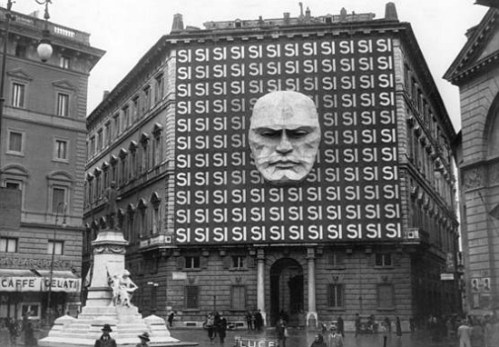
In my last piece, I wrote that ‘microfascism has taken over the world.’ In that line I was adapting the Deleuzian use of the term: Deleuze draws a line between historical Fascism (of the type that came to power in Germany, Italy, Romania, etc) and microfascism: a field of destructive, authoritarian impulses that permeates capitalist society. In Capitalism and Schizophrenia microfascism is the result of a blocked line of flight, a molarisation of repressed desire; in my essay I was considering the possibility that microfascism could function molecularly as well as through molarity. A deviation, but one with its genealogy in the text: Deleuze and Guattari continually equate the repressive totalitarian with fascism. In doing so they’re broadly in line with much of the radical left: communism is presented as one side of a polarity, with the opposite being fascism. Fascism is abstracted from being a real historical ideological movement into a general principle, a kind of radical Evil.

In a recent article in the Telegraph, Alan Johnson describes Slavoj Žižek as a ‘left-fascist.’ Clearly this is meant to be a criticism, and there’s certainly much to dislike about Žižek: his egregious antiziganism, his refusal to support genuine socialist movements in Latin America while singing the praises of Occupy Wall Street, his ‘ironic’ construction of a cult of personality. It’s not this, however, that riles up Alan Johnson. Instead, Žižek is criticised for ‘believ[ing] liberal civilisation is a nightmare from which only violent revolution can awake us,’ for his ‘contempt for the bourgeoisie,’ for advocating ‘unquestioning fidelity to a transcendent Cause’ as a cure for psychosocial ills. All this, Johnson informs us, means that Žižek has far more in common with interwar Fascism than with the far Left. Well, no. Critique of liberalism, revolutionary agitation, rejection of bourgeois values, and sublimation of the individual will within the revolutionary cause are all not only compatible with Communism, but essential to it. Johnson calls Žižek a fascist because it has become an epithet: he calls him a fascist for being a Communist. It’s idiotic, but even so, he touches on something important.

Every time the English Defence League tries to march its sorry band of hooligans past a mosque or a road with more than one halal butcher’s, leftist organisers drum up support against them with a single word: fascism. The EDL aren’t Fascists. Neither are the BNP. Neither is Marianne Le Pen. Neither is George W. Bush. Fascism is a Weltanschauung; like Communism, it is a complete and all-encompassing movement. The EDL doesn’t care about Nietzsche, or Hegel, or Giovanni Gentile, or Third Positionism. They’re racists, not Fascists. Racism proceeds from Fascism but is in no way essential to it: even the 1934 Montreux Fascist Conference was riven by disagreements over whether Fascist societies could be multiethnic. To call the EDL fascists is to credit them with a level of theoretical and philosophical awareness that they don’t possess.

Well, so what? Fascism is universally reviled; if applying it to groups like the EDL bolsters opposition to them, why not do it? If transmuting fascism into a general principle allows us to easily identify our enemies, isn’t that harmless? Not really. For a start, conflating racism with fascism blinds us to the racism outside the ‘fascist’ fringe. If fascism is racism then non-fascism must be non-racist: the anti-fascist campaigns that relentlessly attack groups of the far right are much more forgiving of the everyday racism practiced by liberal-democratic governments, and tend to gloss over completely racism on the left (such as Žižek’s). ‘Fascism’ becomes an immense distraction: as Badiou points out, the dogmatic abhorrence with which nationalist parties are held only allows systemic racism to go unchallenged.

There’s also the potentiality for misdirection. It’s not just the Left that abhors fascism. When fascism is turned into a universal principle of Evil, it becomes a useful tool for imperialists and reactionaries. Witness the coining of the term ‘Islamofascist,’ used by neoconservatives – who were, let’s not forget, mostly ex-Trotskyites – to drum up support for the wars in Afghanistan and Iraq. Fascism untied from its historical roots becomes a floating signifier, utterly meaningless.  You can use it on anything. The Fourth International referred to social democracy as ‘social fascism’ because of its class collaborationism; one could equally call an apple a ‘fascist orange’ for refusing to properly recognise its internal divisions. As Alan Johnson inadvertently demonstrates in his essay, anything can be fascist, but especially anything with transcendent political goals – in other words, any ideology opposed to hegemonic liberalism. Abstracting fascism plays directly into the hands of the reactionaries: the status quo is good, any revolutionary challenge to it is absolute Evil.

Most of all, though, the abstraction of fascism contradicts historical reality and allows us to ignore important historical lessons. What is fascism? Fascism is a deviation from socialism based on idealism instead of materialism and the principles of nationalism and class collaboration instead of internationalism and class struggle; it is an aestheticisation of socialism. The founding ideologues of Fascism weren’t diametrically opposed to socialism; they emerged from the same philosophical branch. Giovanni Gentile wasn’t only the greatest scholar of Hegel since Marx, he borrowed extensively from Marxian thought. Georges Sorel was an orthodox Marxist and a supporter of the Bolshevik revolution; his Reflections on Violence remains a useful Marxist text. It’s time to dispense with Trotsky’s old ‘materialist’ analysis of Fascism: despite its reactionary quality, Fascism (outside of Germany, at least) was never a rearguard action by the ruling classes to protect their interests. It was a chimerical mass movement, a branch of socialism that went hideously awry.

Foucault describes how madness is turned into a unified principle of pure chaos so that society does not have to see itself in the madness of individuals. In much the same way, by turning fascism into an abstracted opposite principle, the Left protects against having to see itself in historical Fascism. By painting fascism as pure reactionary ideology, we’re not forced to confront difficult questions about the teleological inevitability of socialism. By considering it as the violent essence of capitalism, we can ignore the fact that socialism and Fascism arise under the same material conditions. A while ago, I wrote that Leftists ought to be more critical of 20th century Communism than its most vociferous opponents, that we should be utterly ruthless, picking apart its slightest failings – while at the same time maintaining fidelity to it and recognising it as fundamentally ours. In Marxist practice, ruthless criticism is the highest honour. The same goes for Fascism: by recognising ourselves in it rather than considering it as a hideousness somehow inherent to humanity, we can learn the catastrophic consequences of bad theory and, hopefully, prevent them from happening again. And by decoupling Fascism from absolute Evil, we can even learn from Fascist thinkers. As Johnson notes, interwar Fascists made lucid and piercing critiques of liberal democracy and bourgeois ideology, and stirring calls to collective action in the name of the transcendent Cause. He seems to think that these points are invalidated by the fact that they were articulated by Fascists. Historical materialists, conscious of the extents of their ideological family tree, should know better. These things belong to radical egalitarianism: they are not the constituent parts of radical Evil, and we should not surrender them.
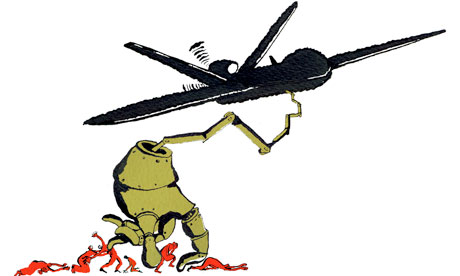
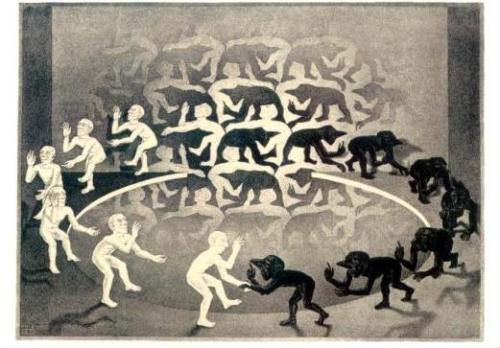
Robot wars: drones and the hegemony of the molecular

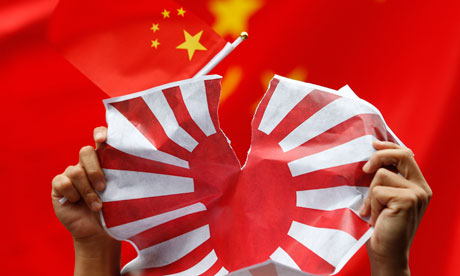
Something interesting’s happening in the East China Sea. The dispute between China and Japan over the uninhabited Senkaku Islands has seen Japanese businesses torched in cities across China, fighter jets circling each other over the barren rocks in question, and printouts of flags heroically ripped in half. Now both China and Japan are stockpiling drones. If it happens, the drone war for the Senkaku Islands will be the first of its kind: pure war, war in the abstract, war fought without armies or soldiers. Two fleets of faceless robots knocking each other out of the sky, a war that takes place on a plane of virtuality. It makes a sort of sense. For all their posturings, China and Japan are economically codependent. Maybe the drones will allow them to have their war and their trade links at the same time. Maybe the result will be something completely different. In any case, the conventions of warfare that have been in place for five thousand years might be approaching their overthrow.

It’s not just in East Asia. Hezbollah is building its own drones and flying them into Israeli airspace. The United States has set the precedent here: drones are not contained by borders; drones can operate anywhere in the world. I’m convinced that someone in the CIA’s been reading Deleuze. In Afghanistan and Pakistan, the United States is fighting real nomads, Pashtun herdsmen with goats and rifles and monotheism who recognise the border for what it is: a meaningless and obsolete dividing line between the British and Russian spheres of the late 19th Century. The US has done well; it’s adapted by turning its machines of war back into warmachines, becoming more nomadic than the nomads themselves. Drones don’t just operate according to smooth rather than striated space, they obliterate space altogether. In the place of spatiality comes something like distribution. In Langley, a man pushes a button on an Xbox controller; in Waziristan, fragments of houses and pieces of people are scattered across a half-mile radius. Drones operate outside the structures of the Law: deterritorialised from their human controllers, they exist everywhere at once. There is no field of combat, only pure exteriority. Somalia, Yemen, the Philippines: they’re all separated only by the width of a fibreglass wing. War itself is a second-order concern. War is an invention of the State, a part of its stratification. For the autonomous warmachines it doesn’t exist. Instead the drone continually produces its own object. In casualty reports from drone strikes, any male over sixteen years is considered to have been a militant: if they weren’t an enemy, what were they doing in the strike area? If you’re not a threat to us, then why did we just kill you? Unlike tanks or planes drones don’t identify and eliminate their targets, they create them; you become a target by virtue of having been killed by a drone. President Obama maintains a personally approved ‘kill list’ of enemy targets. As soon as a target is destroyed another emerges to take its place. The drones have a logic all of their own; politicians are caught up in its spirals. There can be no end, not until every last building is flattened and the horizontality of the nomadic desert re-establishes itself.

For the State, capture of the warmachine is necessary for its process of continual stratification. We’re seeing something different here: the capture of the State by the warmachine. Wall Street is a warmachine par excellence, obliterating any boundary to the free flow of capital, describing lines of flight that arc across the surface of the Earth at the speed of light. Austerity programmes make warmachines out of schools and hospitals. Microfascism has taken over the world. In his critique of Deleuze, Baudillard writes that power and desire operate along the same channels. Beware of the molecular, he warns. To be fair, Deleuze and Guattari never say that the molecular is any nicer than the molar. It’s here, I think, that we reach the horizon of Deleuzian radicalism. When molecularity is hegemonic, resistance may have to take on new forms.

The Mirror Stages

Mirrors and copulation are abominable, because they increase the number of man.
Jorge Luis Borges

Seven years old, alone and bored in the flat, Yusuf K. (1) walked through the mirror to the other side.
He hadn’t been told not to, after all, he reasoned. His mother had told him not to watch TV and to do his colouring or read a book instead. He’d disobeyed, of course, but there’d been nothing good on; no cartoons, only boring grown-up programmes where people just sat and talked. It was his own fault, he knew; if he didn’t keep getting suspended from school he wouldn’t be so bored the whole time. But it was his mother’s fault too: how could she leave him alone there, with nothing to do? She had a job, but she also had a son; he should have been her first priority.
He watched the mirror for a while before he went in.
“Come on,” said his mirror-self. “Or are you scared?”
Yusuf K. (1) wasn’t scared. So he walked through.
For a while he and his mirror-self lay on the sofa and talked. His mirror-self wanted to show Yusuf K. (1) some of his books, but the writing was all backwards and he couldn’t understand it. Then they played noughts and crosses.
“You’ve got your pen in the wrong hand,” said Yusuf K. (1).
“No,” said his mirror-self. “You do.”
“No, you.”
And so on.
Eventually they heard the sound of the key in the lock. Yusuf K. (1)’s mirror-self dragged him behind an armchair.
“Well,” said his mother as she walked into the room, “Have you been good?”
“Don’t make a sound,” whispered the mirror-self.
“Oh,” said his mother. She left the room and called out into the hallway: “Yusuf!” There was the sound of a door opening. And then again: “Yusuf!” Wardrobe doors slamming. “Yusuf, this isn’t funny! Come here at once!”
By the time the police arrived Yusuf K. (1) was starting to feel a little guilty, but his mirror-self pulled on his sleeve whenever he made a move to come out from behind the armchair. His mother was almost in tears.
“He doesn’t have a key,” she said. “I can’t bear to think what could’ve happened.”
A policeman put one hand on her shoulder. “Can you think why he might have left?” he said.
“Oh, he was angry at me. Because I’d left him here. He was suspended from school, you see. Oh, Yusuf. I’m so sorry.” A tiny, hiccoughing sob.
Yusuf K. (1) poked his head out. In the mirror, one of the policemen suddenly looked up. “Oi oi,” he said. “You might want to look at this.”
Yusuf K. (1) met his mother’s gaze across the glass. She ran up to the mirror. “Yusuf!” she shouted. “You come out of there right now, do you hear me? Do you have any idea how worried you’ve made me?”
Reluctantly, looking downwards, Yusuf K. (1) crawled out from the mirror.
“I’m so sorry to have wasted your time,” his mother said to the police. “It won’t happen again.”
After that, Yusuf K. (1) wasn’t allowed to watch TV for a month. His mother also threw out all the mirrors in the flat except a little one in her bedroom. He didn’t really mind. It had been diverting, but he didn’t really like his mirror-self all that much. He was such a crude boy.

Walking to the bar, Yusuf K. (2) couldn’t help but glance at the mirror on the far wall. Reflected, the Brute glanced back.
“You know,” said Amina, smiling wryly, “you are one vain motherfucker. You can’t walk past a mirror without checking yourself out.”
“I’m not checking myself out,” said Yusuf K. (2).
“Oh yeah? What are you doing then?”
How could he explain? It was only their second date; he didn’t want to lay any heavy shit on her. She certainly didn’t have to know about the Brute.
“Nothing,” he said. “It’s just a mirror, innit?”
Behind the bar and the rows of blue and green bottles was another mirror. Yusuf K. (2) tried to concentrate on the barman. Misinterpreting the intensity of his gaze, the poor guy hurried over with an obsequious grin. “And what shall I get you, sir?”
“Pint of Foster’s, mate,” said Yusuf K. (2). “And…”
“Gin and bitter lemon, please,” said Amina.
“Gin and bitter lemon,” he repeated.
He stared at his pint as it was poured, ever aware that the Brute was waiting for him just a few metres away, watching with him. He gripped the rail along the bar until his fingers felt numb.
“Are you OK?” said Amina. She laughed. “Dude, don’t get all nervous now.”
Why did she have to mention the mirror? Everything could have been fine, but she had to be so perceptive… the fucking bitch! And there his will broke; his head jerked up, and he looked into the mirror. Amina was there, all delicate points and feminine curves, a look of faint worry exquisitely torturing her round eyes and little pink-painted lips… and standing next to her was the Brute. The Brute’s jaw jutted out, his stubble was thick and barbed, his eyes looked straight at Yusuf K. (2) not with any murderous evil but with a simple base animal incomprehension. The Brute’s face wasn’t really a face, just a mess of skin and orifices jumbled together without any unifying principle beyond its own dissonance, its own ugliness, the propulsive power of its own empty threatening stare. And there it was, the now-familiar shock of non-recognition. This was what he – he, Yusuf K. (2), a thing of light and thought – looked like to other people, this was the face Amina saw when she talked to him. She was such a nice girl! How could she bear to go for an intimate drink with the Brute?
“Seven pound twenty, please,” said the barman.
He should have taken her somewhere else, somewhere without mirrors, somewhere the Brute couldn’t find him. Too late now. The Brute was reflected in Yusuf K (2)’s eyes. Without saying a word, he turned around and left.

“And the bottom line?” said Dr Quigley.
“A, G, K, X, Q,” said Yusuf K. (3).
“That’s right,” said Dr Quigley. “For a man of your age, your eyesight is close to perfect.”
“I could have told you that myself,” said Yusuf K. (3). “Don’t need a Harley Street doctor to let me know I can see just fine. Can I go now?”
After Yusuf K. (3) left, Dr Quigley wrote in his notes: Based on his medical history, the Mirror Man’s eyesight appears entirely unaffected by the change. His pen dithered for a moment over the paper. Nonetheless, he wrote, looking into the Mirror Man’s eyes is a profoundly unsettling and anxiety-inducing experience.
The Daily Eye might have paid for the expensive ophthalmologist, but they weren’t about to chauffer Yusuf K. (3) around the city. He still had to take the bus home, and that meant having to deal with people. When his eyes had first changed, people had started giving him strange, startled looks; it wasn’t until he saw himself in the mirror at home and saw the perfectly reflective globes where his eyes had been that he realised why. Then, when the Daily Eye had run the story on him, he’d become a celebrity overnight. He’d never had so many free pints poured for him; people would walk up to him on the street and ask him – him, of all people! – for an autograph. They’d always seem a little disappointed on receiving it, though. They didn’t want his own name; they’d wanted him to sign as the Mirror Man. That had been two weeks ago. Things had changed.
A few days before, a kid in a hoodie had punched him in the face as he stood on the bus. “Don’t look at me!” he’d bellowed. “Don’t you fucking look at me with them eyes!” It wasn’t just the young and aggressive, though. He’d crossed paths with a group of businessmen; they’d jabbed him with their umbrellas and slapped his legs with their briefcases. As he fell down one of them had given a swift hard kick to his ribs. They hadn’t said anything, they’d just walked on, as if nothing had happened, not even breaking the flow of their conversation.
He could have worn dark glasses, he could have walked the streets unmolested, but something inside him rebelled instinctively at the thought. On the bus he looked out of the window for a while; he flitted between the faces of his fellow-travellers. He got off fairly lightly, really. One passenger standing next to him beat him around the head with a newspaper when their gazes met for a fraction of a second; another kicked him in the shin. Nothing too bad.
As he walked down the street to his house, he was aware of a loud commotion. A large mob of all ages, ethnicities and social classes surrounded the low suburban home, shouting obscenities about the Mirror Man. A few bricks and stones arced up from the mass of people; the thin line of black-clad police protecting his front door tried to bat them away with their shields but without much success. All his windows were broken. The smell of burning was in the air; the chants were witty in their invective; those on the outside of the mob were laughing and chatting happily; there was, in general, a thoroughly pleasant festival atmosphere.
As Yusuf K. (3) approached the crowd he saw the riot police make a desperate dash for him, but it was too late. The crowd was already on him: screaming, flecking him with spittle, lunging at his chest. Their stampeding force knocked him to the ground. Hands, seemingly independently, scrabbled at his face. Yusuf K. (3) knew what they wanted. “Take them!” he shouted. “Take them away from me! I don’t want the things!”

Yusuf K. (4) had painted four parallel lines in bright blue on a primed canvas. They were called Untitled Meditation 8. He sat looking at them. He wished he could scrub them off, sell the canvas back, use the money to do something he actually enjoyed.
Taped to one wall of the studio was a cutting from a review of his exhibition at the San Francisco Museum of Modern Art. A new and terrifying force in contemporary painting, the headline said. That had been the opinion of just about everyone. Yusuf K. (4) had been a new and terrifying force. The article went on: Yusuf K. (4)’s works challenge both the lazy conventions of fashionable abstraction and throw down the gauntlet to reactionary realists. His stark, restricted-palette paintings beguile you with their dense swirls of shades and textures; it is only after you have been contemplating their intricately composed harmonies for some time that they coalesce – as if by pareidolia – into recognisable forms, at turns bucolic, erotic, and threatening. Armies of horsemen with demoniac grimaces charge through his paintings, reclining nudes give sultry glances from below the paint, sublime landscapes hover just this side of intelligibility. Yusuf K. (4) gives us the entire history of Western art, recontextualised into something entirely new. From this magnificent exhibition, it’s not hard to see why the established art world is both terrified and entranced by him.
That had been in 1968.
He’d never quite known how he’d done it, exactly. He’d wanted to make abstract art, but before he’d even finished his pencil sketches a shape had always risen out from the mist of curving lines to stare him in the face. At first he’d tried to ignore them; he’d been successful at this for a while, and lived on bread and cheese for months. Eventually he gave in, and became famous.
He’d had a strange gift once, one he’d acquired without ever asking for it. It had stayed for a while, and then gone, and now Yusuf K. (4) was reduced to painting blue lines on white canvases, like the peddlers of lazy abstraction who had once found him so fearsome. Except, as all the critics agreed, Yusuf K. (4)’s blue lines on white canvases were without much merit. They had to review his exhibitions, in smaller and smaller galleries, on account of his name, but when they did the verdict was always the same. His works didn’t suggest anything, they didn’t conjure anything, they didn’t reflect anything. Yusuf K. (4) just wasn’t a very good artist any more.

Slavoj Žižek answers a question on ‘Fifty Shades of Grey’

SLAVOJ: Yes. My god. This question, I claim, it is inevitable, but I had hoped that it would be inevitable in the manner of Derrida’s messiah which is always coming but never comes, not in the manner of the inevitability of socialism. I should begin, I think, by saying that I have not read this book. In my house in Ljubljana, I have a hundred copies of each of my own books, there is no room for anyone else’s. It is a field of pure madness, pure narcissism, in the Lacanian sense, of course; it is the perfect image that constitutes the Subject. I may as well have made every wall a mirror. This book, it starts on the Internet, no? People are reading more than ever before with this technology, it is disgusting, wholly degenerate. I think the only true literary figure of our times is Katie Price, you know this? The woman who has written more books than she has read. She forms the highest critique of literature – and I do not mean this in the liberal nostalgic way of the culture is declining, everything is becoming commercialised, and so on, and so on. No! What she does is very important, I claim, she reveals the truth that was always there, that reading books is a worthless activity. There is an excellent line in Nietzsche, he says: at the dawn of one’s strength, to read a book – I call that viciousness! So I claim, the problem with this book is not that the author has not read enough, it is that she has read anything at all. My god. But this book, it is simulated sex, no? It is pure pornography. But that is not what is obscene about it; all literature is pornography, after all. No, what is obscene is the reaction. This is the difference between the modern and the postmodern: when that other pornographic book was published, Lady Chatterley’s Lover, it was banned at once. This is good, very healthy indeed. Pornography that is not banned at once, you know, it is like coffee without caffeine, beer without alcohol, a proletarian movement without the Absolute, and so on, and so on. But this book, the Fifty Shades of Grey book, it is embraced openly, the women read it on public transport, and so on, and so on. It is the Other without Otherness, utterly obscene. In the liberal society, everything is permitted, every kind of sexuality; not only permitted, it is mandatory. The command everywhere is this: you must Enjoy! The truly radical act, this I claim, is to not enjoy. The revolutionary is the real hedonist of the twenty-first century because he puts Communism over his own jouissance. It is this which is unacceptable. I am reminded of an old Soviet joke: Marx, Engels and Lenin take turns buggering a peasant woman in a field. When they are done, Marx kisses her cheek, Engels kisses her mouth, and Lenin has been stealing the wheelbarrows. I claim: if you do not get this joke, you are a fascist.

I’m convinced that it would be relatively easy to programme a computer algorithm which, given sufficient input in the form of pop culture and political events, would be able to churn out fully formed Žižek books at the rate of three hundred a second. The man himself already lies deep within the Uncanny Valley: like Marxism and eschatonic Christianity, he exists only to prefigure his own redundancy.

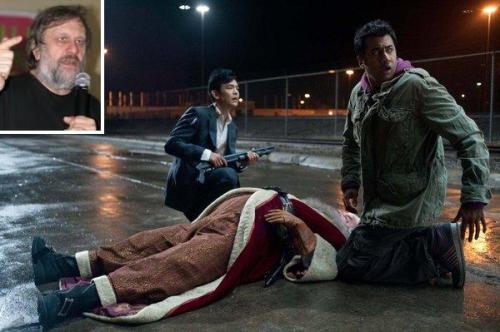
Guest column: Slavoj Žižek reviews ‘A Very Harold & Kumar 3D Christmas’

It would be tempting to perform a crude Freudian analysis of the Harold & Kumar films, to say that in Harold and Kumar we find the basic categories of superego and id respectively, with Kumar as the hedonist that leads the two into a state of peril, and Harold as the rational law-abider who constrains the desires of his friend, and so on, and so on. But this is not the case. We must always be conscious of the fact that the ultimate command of the superego is to enjoy, to fulfil your fantasies; and because the object of desire cannot be attained, it is that same superego that is the source of anxiety. Is it not Kumar, then, who is then the superego? Our desires lead to neurosis only when they are consciously articulated.

We must ask: what is desire in this film? It is not the smoking of marijuana, that forms only a kind of subcultural backdrop to the narrative. Rather, the Harold & Kumar films take the form of the heroic quest: the heroes must go off and find something, they have escapades along the way, eventually it is retrieved and there is the happy ending. In Lacanian terminology this ‘something’ is the objet petit a, the transcendent object of desire. It is the eventual obtainment of this object that renders the first film, Harold & Kumar Go To White Castle, a work of fantasy. What is desirable about the objet petit a is intrinsically linked with its quality of unattainability; it is only in the fantasy-space of the film that such desires can be realised. In the film, the attainment of the hamburger is bound up with the attainment of other fantasies – Harold stands up to the bullies of the workplace, he talks to the girl he is attracted to, and so on, and so on. White Castle is therefore a symbolic representation of all desire. One could comment on the imagery of the white castle itself – in medieval poetry the white castle is a symbol of Heaven or the Kingdom of Truth; then as now the white castle is a transcendent Utopian image – or, as Derrida would have it, a messianic image, an image of that which is always yet to come – in which is encoded our very earthly desires, as in the Islamic fantasy of the seventy-two virgins.

But see what happens in A Very Harold & Kumar 3D Christmas. This is not at all like the first film, the two heroes are not acting on their own desires. Rather, Harold must find a replacement Christmas tree for his father-in-law: he is acting out of a sense of duty towards the Other. The pivotal moment of the film is when Harold tells Kumar that he does not have to replace the tree, rather, it is that he wants to. And again further on, when Kumar faces his responsibility for his unborn child: it is not because he has to, but because he wants to. This is not, I think, a casting aside of duty so much as a reinterpretation of duty. Here, we see the old Kantian conception – Du kannst, denn du sollst! – being dispensed with, it is too rigidly compulsive, it does not sit easy with our liberal individualism. What we get instead is a strange inversion: Du sollst, denn du wollst! – you must, because you want to!

I find this despicable, almost totalitarian, even – far more so than Kant’s formulation. Even our desires are not our own, the hegemonic order insists not only that we do our duty, but that we really want to do so. It is like when Saddam Hussein published his novels under a false name: his megalomania was such that he did not just want good reviews because he is the dictator, he wanted the people to genuinely love his writing. Only when the novels were derided in the newspapers did he republish under his own name and shoot the critics. Is what we see here not the same thing? If there is a message in this film, is it not that we must genuinely love the duties imposed on us by capitalism, that we must find jouissance in the fulfilment of duty?

Where A Very Harold & Kumar 3D Christmas fails is precisely in this attempt to reconcile duty with desire through the matrix of capitalist institutions: the family unit, the workplace, Christmas, and so on, and so on. Duty towards the Other must not be subject to desire! What we must instead admit is that under capitalism our desires are different to our duties, or, in the language of vulgar Marxism, our desires are superstructural to the economic base. Our duty consists of confronting and changing our desires, not in the alienating manner of the Freudian superego, but through the radical project of overturning the current socio-economic order in the name of the Other. Against the false union of duty and desire we must proclaim the primacy of duty, we must, in effect, return to the old Kantian formulation. It is significant that the finale of A Very Harold & Kumar 3D Christmas requires the intervention of the supernatural in the form of Santa Claus: under capitalism, duty and desire cannot ordinarily be reconciled. What is needed in our situation is another form of supernatural intervention – the intervention of Benjaminian divine violence. Only then can this antinomy be untangled.

A fever dream: on the eviction of Slavoj Žižek from the Celebrity Big Brother House

The scene: a raised platform, ringed with bright white lights, set before a surging mob, waving placards for pitchforks, bearing the political slogans of the post-ideological age, spitting and grimacing, desperate for vicarious jouissance, their toothy grins tinged with the threat of violence. On the platform: to the left, Davina McCall, professional objet petit a; to the right, Slavoj Zizek, the subject-supposed-to-know-what-a-subject-supposed-to-know-is. Between the pillars of light, grotesquely large pictures of Slavoj’s face – or what face there exists between bulbous nose and parasitically fungal beard. For a brief moment they both stare blankly forward – a cameraman gives a series of hand signals – suddenly they are animate, Davina cheering and throwing up her arms, Slavoj frantically tapping his nose and beard in a spasmodic fit.

DAVINA: Welcome back to Celebrity Big Brother, and welcome to Slavoj!

The crowd erupts in – not a cheer, exactly, but a noise, a mingling of yelling and clapping and hissing and roaring and stamping of feet, a riotous commotion.

SLAVOJ: Thank you very much, no, yes, it is an honour.

DAVINA: And it’s an awful shame, isn’t it, because you were so close, you were one of the last four left in the house.

SLAVOJ: Well, yes, I am not so much interested in the winning of the show, the accolades, the headlines, and so on, and so on – but the fantasy of being the last person in the house, to be alone in the house, with the cameras, with the constant presence of the Big Other, this I am interested in. It is a recurring theme in horror movies, no? You are alone in the house, but you are not alone, someone is there, someone is watching you – it is a perverse fantasy, I think. And very much Freudian, as well, in the sense of the unheimlich, of the home being a place of danger. So I am disappointed I did not win, yes, very much, indeed.

DAVINA: [unfazed] Let’s talk about some of the other housemates. There was a lot of tension, wasn’t there, between you and Chipmunk?

SLAVOJ: [with a startled snort] You say there was? I did not see any of this tension, entirely not, I felt he was an interesting man – maybe clinically, perhaps, you could say.

DAVINA: [to the crowd] Shall we show him the diary room tapes?

The crowd roars its assent. Fists are flung into the air in jubilatory schadenfreude: some miss and collide with another person, suddenly a hundred brawls are taking place, the crowd turns in on itself, here and there knives are produced and the sharp tang of blood mixes with the stink of sweat in the air. Only after the first few gunshots are heard do the security guards intervene: a phalanx of rottweiler-faced men in dayglo jackets forces its way towards where the violence is at its most intense – they are consumed by the crowd. Perhaps they are killed, perhaps they melt into its roil, it is impossible to say. A line of police cavalry charges. At first they make some progress: those at the edges of the crowd are swiftly truncheoned and detained, but soon the horses find themselves mired in the furious swarm, and in their anxiety they throw off their riders, the line is broken, the plan of attack evaporates. Some of the crowd attack the horses, some of the horses start fighting one another, gnawing chunks from each other’s necks. In the near distance, the low rumble of heavy artillery can be heard.

DAVINA: [exultant] Let’s show him the tapes!

CHIPMUNK: [onscreen] I just don’t get him man, like, what’s he done, why is he here? I ain’t never seen him on anything, like, nothing. And he’s some fucking wasteman, like, man ain’t had a single shower since the start of the show, swear down, he fucking stinks, doesn’t he? I can’t fucking sit next to him, or like even near him, you know what I’m saying? And he chats some breeze, innit. I’m saying, it’s not just his weird accent, and all the snorting and those little hand twitchy things he’s always doing, you know what I mean – he’s talking about sex the whole time: like, yeah, cool, but it’s all perversions, everything’s perverted, I can’t take a dump without it being some representation of my desires in the symbolic order or whatever – I’m like, are you kidding me? This guy built a career on that bullshit? It’s not even anything, really, it makes its own internal sense, kinda, but it’s entirely divorced from the actuality of human subjectivity and the actuality of the human condition, and that’s what the ultimate focus of philosophy needs to be, not all these masturbatory Lacanian abstractions. It bears no relation to how people actually function, it’s a poststructuralist psychoanalysist’s fantasy about how people actually function. So, nah. Me and Slavoj, I don’t see us being in the getalong gang in the Big Brother house, you know what I mean?

DAVINA: So, Slavoj, how does that make you feel?

SLAVOJ: Well, myself, I make it a point of never reading my critics, never reading my reviews. Or I will tell the publishers: put the bad reviews on the back of the book! My audience know who I am, they will read me anyway. But Chipmunk – he is ultimately an empiricist, he has a very British way of conceiving these things, this antipathy towards the abstraction, the Continentalism, and so on, and so on. In his music and his music videos, the focus – it is entirely on the immediacy of experience, no? So his criticism, it is still rooted in ideology, this I claim. The ideological disagreement, it does not translate into personal antagonisms. I am a good Hegelian, after all, such oppositions, they are necessary. But I should say, the proceduralism of intimacy in the diary room, it is exactly like Catholic confession, no, it is exactly the same. You do not confess to the priest, your confession is directed towards God, towards the Infinite Other, as in Levinas, and so on, and so on. You do not talk to Big Brother, you talk to the Big Other, to the audience at home, to the Holy Spirit. After I am evicted from this house, I am no longer a participant, I am an observing subject, an ordinary pervert, then it is acceptable to show me these tapes – it is a form of licensed voyeurism, is it not?

DAVINA: [nodding her head] One last question.

SLAVOJ: Please, please, go on.

Throughout this exchange Davina has been undergoing a grotesque metamorphosis: her cheeks grow fuller, her paunch expands, her tits shrink, her hair turns white and recedes. At first the faint shadow of a moustache falls on her upper lip, then stubbly hairs sprout from her chin. Soon she has a full beard, her eyebrows sit heavily on her brow, her camera-friendly coquettishness becomes a stern gaze, almost disdainful, which she now fixes on Slavoj. She is no longer Davina McCall: instead, Slavoj finds himself being scrutinised by the unmistakeable visage of Karl Marx – or perhaps Jehovah; depictions of the two are, after all,  very similar.

MARX: Do you not think that your participation in this televisual charade, your gleeful willingness to put your theorising at the services of capital, your unashamed prostitution, your jestering and japing, your fruitless contrarianism, your pop-psychoanalysis – do you not think that this not only casts disrepute on your status as a serious Marxist thinker, but also cheapens Marxism itself? Are you not turning revolutionary ideology into just another media gimmick?

The crowd, who are all orthodox historical materialists, nod sagely, in unison.

SLAVOJ: I know you. You said a man should be able to hunt in the morning, fish in the afternoon, rear cattle in the evening, and criticise after dinner. Well then – can I not play the jester in the morning, advertise for garment retailers in the afternoon, appear on reality TV in the evening, and still be a serious philosopher after dinner?

MARX: You forget that we are still living under capitalism.

SLAVOJ: But under capitalism, we must still live.

The crowd, racked by confusion, briefly organises itself into a series of non-hierarchial egalitarian communes, forms a workers’ state, undergoes Thermidor, becomes disillusioned. Defeated, they shuffle back to their allotted space in front of the platform.

DAVINA: [for it is her again: the beard has gone, the grin has returned] Well, Slavoj, it’s been a pleasure to have you on Celebrity Big Brother. Do you have anything else to say before the end of the show?

SLAVOJ: Yes, I do. I would like to say that I endorse all the products of the Coca-Cola corporation, and that the cool refreshing taste of a glass of Coke proves without question that the transcendent object of desire is not in fact unobtainable – in fact, it can be obtained at your local newsagent or grocery store.

Lights wind down, theme music plays, scattered applause. Slavoj, rising from his seat to re-enter the world, takes an especially deep snort – then starts to gag. Something is clearly wrong. Davina sits impassively as Slavoj chokes on his own mucus: the cameras are off, after all. Slavoj writhes on the ground, flailing frantically. The sycophantic crowd tries to imitate his dying motions. Everywhere they collapse, their limbs jerk around, they feign choking noises. Everything begins to blur: the crowd, the stage, the cameras – now they are only a single undulating mass, a throbbing that reaches up above the horizon and encircles the world. Perhaps an orgy is taking place, it’s difficult to tell. There are no images any more, no clearly defined shapes or people, only an immense all-enveloping pulsation. The dream ends. Still, nothing is understood.