Idiot Joy Showland

This is why I hate intellectuals

Sisterfucking up the Euphrates
In German, the prefix ur- is used to indicate the now deeply unfashionable sense of an originary, primal form of a thing, which is also its end. Something ursprünglich is the first of its kind, so you’ll have the Uraufführung, or the début performance; the Urtext, the lost first draft of the Hebrew Bible that supposedly existed before all the various priests started fucking around with it; the Urwald, the dense dark forest that once covered the whole of central Europe. The word itself is of good Old Germanic stock, and it’s probably just a coincidence that this caveman’s grunt of a syllable is also the name of a city: that built by ‘Ara son of Kesed, where he made graven images and unclean simulacra, where evil spirits seduced him into wrong and sin, and where the sons of Noah first began to make war on each other. It’s a word from the oldest of the old histories, from when the world was still new; the brutal hoary infancy of civilisation. Before the Romans or the Greeks or the Persians or the Babylonians or the Egyptians, there was Ur, the city on the mouth of the Euphrates where Abraham smashed the idols of his father.

Freud tells a nice parable about the origin of the superego, what could be called an Ur-über-Ich. Once, among a band of squatting cannibal ape-men that would one day become the refined intellectual circus of Vienna, there lived a great and powerful father. This father had many wives, and he took many wives for himself: some were the captured daughters of smaller bands, some were his own daughters. Such was his power that his sons were left with neither food, nor loot, nor wives, and were reduced to contesting among themselves for what scraps they could gain. Eventually, in the face of his unbearable potency, the brothers grouped together, overwhelmed their father, and clubbed him to death. That night they held a great feast, at which their father was the main course. At this moment, the superego was brought into the world. The brothers were jealous of their father, but at the same time they still loved him; out of their guilt the rapacious greed of the father became internalised as a moral code, with its first commandment being a restatement of his paternal rights: Thou shalt not fuck thy sisters.

Like most myths of the land of Ur(-), it doesn’t really matter if any of this actually took place or not. Hobbes and Rousseau were both happy to admit that their states of nature never really existed; Marx was equally unconcerned by the historicity of primitive communism. Freud has a particularly good get-out clause – as he has his ‘exasperated reader’ exclaim, so it’s immaterial whether one kills one’s father or not! While some fathers might have a different opinion on the matter, Freud concedes the point: wanting to kill your father and actually doing so both produce the same psychological effect; the same guilt, the same internalisation. It’s in this context that the story of Abraham begins to make sense. When he lived with his father Terah in the city of Ur, the family sold graven idols; Abraham destroyed these unclean simulacra and went with his wife Sarah into the desert. It doesn’t matter that Terah died peacefully at the age of two hundred and five: the idols, rooted in the paternal totem of the victorious brothers, represent what Lacan calls the name-of-the-father; the Symbolic father that maintains the prohibition on incest. It’s possible to advance an alternate reading of Abraham’s flight to Canaan: when he lived in Mesopotamia he was married to Sarah but still he couldn’t fuck her, not in the house of his father. The book of Genesis explains their childlessness by claiming that Sarah was barren, but the book of Genesis was also written by men, who are always a little squeamish when it comes to male impotence. Sarah was the daughter of Terah by his second wife: she was Abraham’s sister.

Lacan’s concept of the name-of-the-father is a triple pun: le nom du père recalls le non du père (the ‘no’ of the father, the prohibitive function of the superego) but also les non-dupes errent (the non-dupes err). Those who refuse to be ‘duped’ by the process of castration and induction into the Symbolic order – the kind of person who might, for instance, take it upon himself to smash the idols of his father – are not in fact seeing the world as it really is; they’re stuck among the horrors of the Imaginary. The book of Genesis is full of hints towards Abraham’s singular neurosis. Several times in his journeys, as he comes across various unfriendly peoples, he has Sarah pretend to be his sister – in other words, pretend to be what she really is – so that kings and pharaohs will try to sleep with her. For this God punishes them with plagues and nightmares: none shall disrupt His holy incest.

All this is by way of approaching an understanding of the current instability in Iraq. The land of Ur is, for the Western powers that have been steadily clubbing it for the last century, a feared and hated father. All the paternal functions of society first sprung up in the area between the Tigris and the Euphrates: alphabetical writing, codes of law, economic class, monotheism. In the pre-Oedipal stages of infantile psychology there is no recognition of sexual difference and the fantasy of anal birth is common, so it’s no wonder that the Iraq-Father assumes a hemaphrodite form. One vast leg stretches down the Arabian peninsula, the other is cocked between the Persian Gulf and the Caspian Sea. Between these lie the damp muddy openings of the rivers, passages leading up into the womb of civilisation, while beyond their fertile banks the desert stretches for miles. An old, decaying parental presence that refuses to die. No wonder everyone from Alexander the Great to Genghis Khan to Winston Churchill felt the need to invade Iraq.

On the plane of grand strategy, nobody’s Middle East policy makes any sense. Saudi Arabia props up the secular Sisi regime in Egypt, and has threatened to blockade Qatar over the latter’s support for the ousted Muslim Brotherhood. At the same time Sisi supports the Assad government in Syria, which the Saudis have spent millions trying to overthrow, and is making friendly overtures towards Iran, while his deposed predecessor Morsi tended to align himself with the Saudi-Israeli anti-Tehran axis. The United States is now considering intervention in support of Iran against Islamist movements in Iraq, fighting the same people it’s armed and funded (through Saudi proxies) to fight Iran’s allies in Damascus. The ‘war on terror’ was never really a consistent programme: while Western imperialism made some efforts against Sunni salafism (Afghanistan in 2001, possibly Iraq now) it’s mostly been used to attack secular Arab nationalist governments (Iraq in 2003, Libya in 2011, Syria from 2012). This is diplomacy as a dialectic. Its model isn’t the Nile, with its divisions along the axis of a straight line, but the swampy chaos of Mesopotamia. There are no fixed power blocs, not even Sunni and Shia, only a series of fluid phases successively subsumed in their own contradictions. It’s a grand process of decoding, the untethering of signification, the struggle against the Symbolic, the denial of castration, the murder of the father.

In 2003, the occupying US Army set up Camp Alpha, a huge military base in the ruins of Babylon. Helicopters buzzed around the ancient bricks, Humvees rolled through the Ishtar Gate, defensive trenches were dug through the strata of five millennia. As symbolic erasures of the name-of-the-father go, it ranks up there with Abraham’s destruction of his father’s idols. Still, after the father is killed, it still remains to eat his corpse. Iraq must be consumed. In recent weeks a small armed outfit calling itself the Islamic State of Iraq and Syria (or of Iraq and al-Sham, or of Iraq and the Levant, or Daash – such signifiers tend to only refer to each other) has captured a string of cities in the country and is advancing, or at least making a feint, towards Baghdad. Reports in the Western media claim ISIS funds itself from the territory it already holds and doesn’t require any state support. They’re known to be selling oil to the Syrian government forces they’re supposedly fighting, and (this is a nice touch) are reportedly profiting from the sale of looted antiquities from archaeological digs. All this is pretty dubious, but in any case the Saudis seem rather nonchalant about the peril to the Iranian-aligned Maliki government. Even if ISIS aren’t receiving direct Western support it’s almost certain that arms supplied to ‘moderate’ Syrian rebels are filtering through to them. The terrors and massacres in Mesopotamia are as Western-manufactured as Big Macs and banking crises. Of course, when imperial adventures cause chaos, the solution is more imperial adventure. There’s a growing clamour for intervention; aircraft carriers are heading up the Gulf, the hideous grinning hobgoblin that is Tony Blair returns to haunt the political discourse with its carefully considered opinion. There’s a very real chance that we might be about to enter a third Gulf War. In the face of this danger, it must be kept in mind that when imperialists press for action, all they really mean is that they want to be able to fuck their own sisters.
The grand imperial puppet show

HIPPOLYTA:
This is the silliest stuff that ever I heard.
THESEUS:
The best in this kind are but shadows; and the worst
are no worse, if imagination amend them.
HIPPOLYTA:
It must be your imagination then, and not theirs.
Shakespeare, A Midsummer Night’s Dream, 5.1.210-213

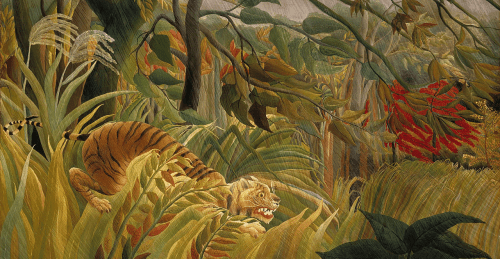
Imperialism, as comrade Mao Tse-tung famously pointed out, is a paper tiger. The phrase has now become so well-worn that it can be taken as a familiar piece of imagery, that we can forget to ask: why a tiger? Why paper? The term is a Chinese idiom of some pedigree, but Mao was always scrupulously careful in his use of metaphor (especially when dealing with Western journalists), never missing an opportunity to interrogate every possible meaning. He says: In appearance [US imperialism] is very powerful but in reality it is nothing to be afraid of, it is a paper tiger. Outwardly a tiger, it is made of paper, unable to withstand the wind and the rain. The image emerges of something like Henri Rousseau’s Tiger in a Tropical Storm, the fear blazing in the beleaguered creature’s eyes as the damp winds wash its frame into sodden pulp. (Rousseau’s painting was initially titled Surprise!, with the implication that the tiger is about to pounce on an unsuspecting prey – but it’s equally possible to discern in the awkward position of the animal, its leg half-suspended over the foliage, the idea that it’s the tiger that’s been surprised, caught out among the suddenly inclement elements.) This image, with the unhappy predator crumbling under the triumphant might of the people, has a firm place in the Maoist repertoire, recalling directly his slogan that the East wind is stronger than the West wind. But all this is complicated immediately afterwards. History as a whole, Mao declares, the history of class society for thousands of years, has proved this point: the strong must give way to the weak. The tiger appears strong when in reality it is weak, but the winds and the rain that tear it to shreds are weaker still; it’s only in this weakness that they can gain their victory. What exactly are we talking about when we talk about paper tigers?

Paper animals are transient, vulnerable to the elements, powerless against time. They’re not built to last. Paper animals are decorative; they’re entertainment. A paper tiger takes on the form of something very powerful, but it’s a self-conscious ruse. However convincing the representation, nobody is really expected to be afraid of it, except the children. Mao continues: When we say US imperialism is a paper tiger, we are speaking in terms of strategy. Regarding it as a whole, we must despise it. But regarding each part, we must take it seriously. It has claws and fangs. Another reversal: the thing that projects a unified, total image of power is actually weak and vulnerable; the thing that should be correctly understood as weak and vulnerable in its abstract totality is actually very dangerous in its concrete particulars. Mao’s programme for the practical struggle against imperialism is to behave like a child at a puppet show, reacting to each swipe of the paper tiger’s claws as if it were real, while at the same time never forgetting that it’s all an illusion. It’s not enough to simply refute the lies of the imperialists; you have to defeat them on the level of their own simulation: knock out its teeth one by one, even though they’re only paper.

All this is by way of responding to the recent polemic on anti-imperialism and the left; in particular two essays by workers and scholars whose thought I greatly respect: No blood for oil? by Matthijs Krul, and On the urgent necessity of anti-imperialism by the sublunar entity known occasionally as Emma Quangel. The centre of the dispute, if I understand it correctly, is this: Krul argues that the slogan ‘no blood for oil’ represents a model of anti-imperialist thought that both understates imperialism’s scope and overrates its ability to succeed; Quangel responds by asserting that if the average protester does not understand wholly the conditions of the world petroleum market, they are still taking a correct stance against US Imperialism; that is: to condemn it. Krul cautions against an uncritical support for supposedly ‘anti-imperial’ states that precludes any actual appreciation for the political and social structures peculiar to the societies in question; Quangel maintains that the goal should be to try to hobble the greatest threat to building a better world.

It’s necessary to start with particulars. Quangel begins her intervention by stating that many of the youth coming into the anti-imperialist movement today seem genuinely confused about what imperialism is – what it smells like. What, then, does imperialism smell like? Burning oil wells, charred bodies, the sharpness of gunpowder and sweat – but as she points out, imperialism is not the same as imperial war. Imperialism is a global system existing primarily to perpetuate itself, stifling any germ of an alternate social order, and its primary vector is aid and development. Development money is used to integrate states into the general system of capitalist expropriation; recourse is usually only made to guns and bombs when these means are refused. Imperialism is an all-encompassing narrative, a puppet show being played against the backdrop of the entire world, and its smell is not the stench of war. Imperialism smells like roasting chestnuts, popcorn, fireworks, the sweet clinging night-time smell of entertainment.

Imperialism is seductive, in the full Baudrillardian sense of the term. In the nineteenth century, it operated along the principle of contest, propelled by the self-confidence of the newly dominant bourgeoisie, pitting its strength against the strength of others. In the twenty-first, imperialism operates within the other’s area of weakness, which is also its own. The precursor to any imperialist action, whether as development aid or military intervention, is always an initial rupture, a breach in the form of a humanitarian crisis. There are famines, or shortages, or a government crackdown on protests, or a civil war. When this occurs, imperialist powers do not proclaim their decision to act as a function of a world-spanning omnipotence. Instead, they plead their own powerlessness in the face of the catastrophe (as in Syria today) and their own vulnerability against the other, until the clamour for action reaches boiling point. Imperial adventures from Korea to Iraq have been launched in the form of desperate measures against a looming threat; it was not only necessary for Saddam Hussein’s government to have brought suffering and genocide against its own people, he was also required to have the capacity to launch chemical drone attacks against American cities. This is a dual weakness: it’s precisely on the terrain of the human catastrophe that imperialism is weakest, because imperialism is the mother of all catastrophes.

Recent years have seen the grim spectacle of avowed leftists and socialists aligning themselves with the grand catastrophe of global imperialism to ward off the lesser catastrophe that precedes it. The counter-slogan, adopted from current trends in feminism, is that my Marxism will be anti-imperialist or it will be bullshit. The necessity of such a position is made clear by the abject pronouncements of empire’s left-apologists, less sleek running-dogs than mangy senile old hounds loping in circles as they attempt to gain a lick at their own anuses – but it also raises the spectre of an anti-imperialism without communism. A prime example of this phenomenon is provided by a recent article by Atheling P Reginald Mavengira published by the Centre for Research on Globalisation, alleging that the Boko Haram insurgency is a CIA covert operation designed to neutralise the supposed Nigerian threat to American regional power. He writes that Nigeria is a country which has always been known for its resilience and ability to resolve its problems without outside interference […] Why is someone somewhere hell bent on engineering Nigerians to form the un-Nigerian habit of harbouring and perpetrating desperate, extreme and unforgiving actions against themselves? As any cursory reading of Nigerian history should demonstrate, this is bullshit. Africans are just as capable as Europeans of delivering death and horror on each other. Mavengira has the correct stance on US imperialism – to condemn it – but it’s a condemnation arising from spurious allegations and bourgeois nationalism (although, confusingly, Mavengira doesn’t appear to be Nigerian himself but is instead a Zimbabwean businessman living in South Africa). He approaches imperialism as a function of American geopolitical ambition ranged against African states; in fact imperialism is perfectly willing to tolerate a strong and stable Nigeria. Capital always needs new spaces in which to expand: Nigeria was listed among the ‘next 11’ emerging economies by Goldman Sachs, whose board of directors now includes a Nigerian banker, and the operation of capital investment (and the enclosure and dispossession that goes with it) within the country is likely to be far more damaging than any mythical CIA covert operation. However correct Mavengira’s stance on imperialism, his analysis of it is politically useless.

Both the left apologists for empire and these vulgar anti-imperialists commit the same error: they’re taken in by the puppet show, confusing paper tigers for real ones. In the subaltern nations there is chaos and confusion; imperialism is an orderly and rational system. The only difference lies in whether they stand with this order or against it. Against this it needs to be stressed that imperialists are, for the most part, idiots who don’t know what they’re doing. The CIA isn’t some hidden cabal out of the Protocols of the Elders of Zion, directing events with a malign precision; it’s a hive of myopic nerds that excels only at receiving government money, levelling Pakistani villages, and systematically fucking up. The global ruling class might have been able to ruthlessly profiteer from the current economic crisis, but they couldn’t predict or prevent it. It’s always been this way. In the nineteenth century a grand geopolitical game of chess was played between Britain and Russia over the Central Asian heartland: the British played admirably, protecting India from any encroachment to the north; the Russians had no idea the game was even taking place. There is no master plan or secret logic: imperialism is a catastrophe. Not an explosion of violence or the sudden onset of famine, but a single, sustained, rolling catastrophe, blind and stupid and propelled only by its own weakness, that has bounced around the world for five centuries, until it has eventually become the world.

How should Marxists respond when imperialism threatens a foreign state, plunging through the rupture of some local crisis to substitute its own, globally institutional crisis? Simply condemning it has not, so far, brought much success, and reading the impoverished language of some vulgar anti-imperialists might explain why. It’s been remarked that much Anglophone critical theory reads as if it had been translated from French; this stuff, with its clunky sloganeering and reliance on the imperative, sounds like an inelegant translation from Chinese. Defend the heroic resistance against US imperialism! Stand against NATO aggression! People must write these pronouncements, and some might even read them, but it’s unclear why. As Krul points out, making a show of support for one or another ‘side’ (be it the ‘anti-imperial’ state apparatus or some inconsequential socialist sect) offers little scope for actively disrupting imperialism. The task is to, in a sense, play along with the imperial game of pitting weakness against weakness. We must see where imperialism is weak and confront it there, confront it with our own weakness in the face of its cataclysm, and that weak spot is precisely those crimes and horrors used by imperialism to justify its actions. These are not the lesser of two evils: they are non-heterogeneous to the greater evil. In a world shaped and defined by the madness of imperialism, there is no human tragedy that does not follow in some manner from these conditions, nor any real distinction between the local catastrophes and the grand catastrophe: the latter is nothing more than the sum total of the former. Our world is like the Chaos described by Milton: Eternal anarchy, amidst the noise/ Of endless wars […] A universal hubbub wild/ Of stunning sounds and voices all confus’d. Every imperial intervention is a strike against itself. To admit to the global supremacy of imperialism is at the same time to show up its monumental idiocy and weakness. Any system that conquers the world becomes isomorphic with it: imperial capitalism is now not only reshaping political geography but altering the planet’s climate – it has become the wind and the rain, but it’s that wind and that rain that tears paper tigers apart.

Voting is magic!

UKIP election leaflet, 2014

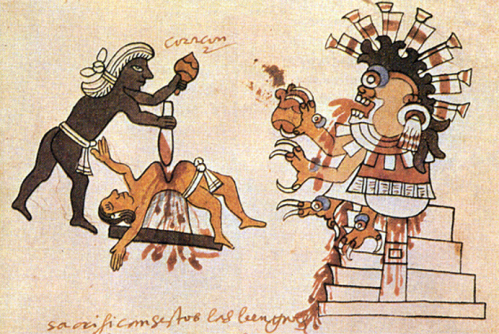
Most societies have, buried in their vast cultural storehouses, some kind of apotropaic rite: one carried out to ward off the evil forces that constantly lay siege to ordinary social life. In ancient Egypt, crocodiles were thrown into blacksmiths’ furnaces. In medieval and early modern England, travelling troupes would perform comic ‘mummers plays’; a similar tradition among the Lakota and Sioux involves the temporary reign of sacred clowns. The Aztec priests tore out the hearts from millions of (often willing) victims to ensure that the world made it from one 52-year cycle to the next without collapsing under the weight of its own absurdity. These rituals have varying levels of success. At no point prior to 1521 did the Sun ever fail to rise in the morning – but even though the Earth’s rotation has slowed slightly since the forced abolition of tlamictiliztli, it’s yet to stop entirely. On the other hand, there are no records of anyone having been kidnapped by the Devil after spilling salt, so long as they take the wise precaution of chucking some over their shoulder. Still none of these rituals are as destructive as the mode of apotropaic magic endemic to the contemporary West, in which  the priesthood demands that we make a mark next to the printed name of someone we don’t like and then put it in a box. This strange and stupid ritual, which any rigorous analysis will show to produce far fewer positive results than a simple rain-dance or burnt-offering, is nonetheless imposed by force on much of the world, in fear of the great evil that will arise if it’s not performed properly. The result is that, with a brutal calendar regularity, hundreds of people are massacred every year for making the marks incorrectly.

Electoral representation in the post-ideological age has far more in common with apotropy than politics. Very few people vote to choose their leaders; instead they vote to prevent the other guy from winning. The genealogy of voting follows a very different path from that of democracy. In classical Athens, which is to a greater or lesser extent to blame for both practices, governmental positions were usually determined by lots, to counteract the advantages enjoyed by rich citizens and great orators. If, as a fifth-century Athenian citizen, you were actually voting for a politician, chances are you were casting an ostrakon: voting for them to be exiled from the city and its civic life. Voting is an apotropaic act. Little has changed. In this week’s European elections, millions of people will vote for the individuals they want to be torn from their homes and families and sent away to the godforsaken marshy swamplands of Brussels.

In the United Kingdom, these elections are expected to be a devastating victory for UKIP, the Boko Haram of East Anglia. UKIP are standing on a political platform that appears to champion clean fridges as an antidote to sexual promiscuity, an end to costly environmental protection for African forest ungulates, giving due weight to the erotogenic model of climate change, and the systematic demonisation of the most exploited and vulnerable members of society. All their blunders, and the concerted attempt by the mainstream parties to brand them as racists, haven’t put much of a dent in their poll figures – and why would it? They represent a peculiarly British kind of fascism. We’ve already conquered the world and slaughtered millions with ruthless industrial precision; why would we want to do it again? It’s a bumbling, Dad’s Army, lovable underdog fascism; efficient precisely because of its shambolic inefficiency. It’s hard to shake the feeling that the bien pensant pissants of the three major parties fear UKIP so much not because of any real concern for migrant populations (after all, this scapegoating is a monster they themselves made) but because of their refusal to conform to the unwritten rule of the ritual: above all else, be boring.

For those of us on the left, the way to perform the ritual properly is to vote for the Labour party. Newspapers are full of deeply concerning reports of their shrinking poll lead: only with our vote do they have the power to banish the forces of evil and chaos from the land. We owe them this vote, in the same way that humans owe the gods of the Aztec pantheon their lives, in restitution for a primordial sacrifice. If the cycle of immaterial debt isn’t maintained the world will fall apart. Vote Labour, or the sun won’t rise and the soil will turn to ash. I voted for Labour once, for all the good it did anyone, in the full throes of apotropaic ecstasy that came with 2009’s general election. It took twenty showers before I could properly wash the smell of it off my skin, a stench like unto mouldering constituency offices and cheap air freshener and tortured Iraqi prisoners, the abject sensation of having one of Gordon Brown’s oily hairs stuck somewhere in my mouth. To ward off the nasty party of cuts and class oppression, we’re to vote for the nice party of cuts and class oppression; to ward off the nasty party of anti-immigrant rhetoric and British global chauvinism, we’re to vote for the nice party of anti-immigrant rhetoric and British global chauvinism. It’s all extremely dull.

In 2012, as massive street protests were challenging the legitimacy of the Syrian government, it responded by approving a new constitution that ended nearly half a decade of Ba’ath one-party rule. In accordance with the new constitution, presidential elections will take place next month. The incumbent, one Bashar al-Assad, is basing his campaign on lukewarm national unity, 80s nostalgia, and feeble puns on his professional background in ophthalmology. Of his opponents, Hassan Abdullah al-Nouri of the National Initiative for Administration and Change is promising to end corruption and oversee the return of the squeezed middle class, while Maher Abdul-Hafiz Hajjar of the People’s Will party vows to bolster a strong centralised state. Meanwhile cities lie in ruins, fanatics rule the countryside, thousands suffocate on poison gas. The election is being denounced as a sham by Western governments, which of course it is; but that doesn’t do much to distinguish it from many others. It’d be far more illuminating if the psephologists treated the Syrian election exactly as they do one of ours: reprinting hilarious Twitter reactions to Assad’s latest gaffe, breathlessly speculating on how the opening of Syrian embassies in Jordan and Lebanon to refugee voters will affect the result, sternly condemning rebel efforts to disrupt the poll in Aleppo, and, as Judgement Day nears, sounding the trumpets and rolling out the all-knowing swingometer. None of the imperialist politicians condemning the Syrian election are genuinely disappointed that it’s not being held in accordance with international democratic standards; the worry is that it works all too well as a satire of our own mystical procedures. An apotropaic rite, in which talking about the economy and corruption and foreign investment is used to ward off the lingering shadow of war.

These rituals always involve a symbolic element: the Egyptians slaughtered crocodiles as symbols of Seth; the mummers plays introduced cosmic themes of death and resurrection into the bawdy context of a punch-and-judy carnival. To challenge the election on the grounds that it’s a symbolic farce rather than an actual democratic procedure isn’t likely to get you very far; everyone already knows. Standing up in the middle of a mummers play and loudly insisting that it isn’t real and the figures swordfighting are only actors won’t earn you the awestruck gratitude of the audience. We have these rites for a reason; simply refusing to play the game is no less boring and pointless than getting swept up in its magic and voting for Labour. When a particular piece of magic doesn’t work the task isn’t to loudly declare the whole thing over, but to help its internal contradictions demonstrate precisely why that is the case. The election-rite only maintains its power through the pretence that everyone is in fact voting for the party they like the most, and that’s exactly what we should do.

Personally, I plan to vote for the Communities United Party. All their campaign material is wonderful: the gloriously confused national imagery of a bald eagle glaring proudly in front of a British flag; the creepy slogan ‘Strength in Unity’; the paunchy glum face of leader Kamran Malik, who once mistakenly identified himself as a communist in a typo-ridden press release. Their manifesto admits no particular ideology, moving directly from a grand pledge to return integrity and justice to politics to whining about parking fees. If they’re not to your taste there are others, some of them not even made up, all based on the same pathetic useless hope that’s so essential to the British economy. The National Liberals are dedicated to bringing independence to Kurdistan and Punjab by gaining seats on various local councils. The Wessex Democrats want to restore the old Anglo-Saxon kingdoms of England. The New Levellers Initiative demand a written constitution primarily so it can outlaw all roadbumps. Perhaps the best of all is the We Demand A Referendum Now party, formed in a split from UKIP. It campaigns on the sole issue of a referendum on EU membership, and according to a YouGov poll one third of all British adults intend to lend it their votes, despite its only fielding candidates in the West Midlands. It is the duty of all those who believe in real democracy against the representative mysticism of the present system to ensure that they have a Westminster majority next year.

Colton Burpo: all grown up

It’s New Year’s Eve, 2027, and Colton Burpo, subject of the bestselling 2010 book Heaven is for Real: A Little Boy’s Astounding Story of His Trip to Heaven and Back along with the hit 2014 film of the same name, is sitting in a strip club in the town of Little Whistling. He’s unrecognisable, and so nobody recognises him. The town is more a glorified truck stop, a shivering huddle of low square houses, half-buried in the loose winter ice that blankets the Dakota steppes in endless miles of blank white indistinction. Every time a big rig pulls into town, its headlights scything through the indifferent falling strata of snowflakes, the building shakes down to its foundations. 2027 is the harshest winter on record: outside it’s colder than the surface of Mars, but in Colton Burpo’s private booth there’s a heavy, sticky, woozy heat. The low rumble of an eighteen wheeler outside sends a brief seismic tremor through the stripper’s cellulite and gives Colton a jolt out from his narcotic daze. It’s not enough. He beckons the girl over. “Did you know why it is that serial killers keep on killing?” he says. He slurs, his head at a crooked angle; he doesn’t look right. Electra sighs. “No,” she says. “Now why is that?” She’s heard all this before. Every grizzled drifter that passes through Little Whistling ends up going off on a rant like this one, trying to imitate the engagingly twisted dialogue of the sexy redneck psychopaths they’ve seen on TV. It’s pathetic. Blood, snow, and the road; dead hobos and crooked cops; gun-running and dope-dealing; all as dull and as flat and as empty as the plains outside. Nobody’s real any more. (Not that she can really complain. Electra’s not a real stripper: she’s working undercover, writing an exposé on the dark underside of the sex industry for a feminist magazine. So far, all she’s been able to discover is that every other girl in this establishment is doing the exact same thing. Courageous investigative journalism is the only thing keeping these places running.) “It’s not that they enjoy killing,” Colton says. “They do it because they don’t. It ain’t never enough. It never gives them that thrill they want. So they just keep trying, in new ways, over and over again. It never works.” Satisfied, he sits back and pulls a little bag of white powder out his pocket. “You want some?” Electra shakes her head. She squats a little and presents him with her ass; customers like that sort of thing. “Not there,” he says. “Lie on your back.” This is where Electra can feel things start to get weird. He shakes a few soggy clumps of coke into the pit of her collarbone and snorts them up with a gruff yelp. It stings. Colton Burpo likes the town of Little Whistling. The people seem to be God-fearing folk, and honest, even if they do tend to embellish their personal histories. They’re willing to allow this pastor’s son his eccentricities. Colton Burpo has snorted cheap blow off just about every imaginable part of a woman’s body: her ankle, her labia, her armpit, her ocular cavity. He can’t get it back. It doesn’t work.

I first encountered Colton Burpo in 2012 while tearing through a Walmart superstore in Anaheim, California. I was reaching the end of my year-long stay in the United States and starting to panic. I had to cram as much absurd Americana into my final days as possible: Vegas, Disneyland, road trips, shooting ranges. I loved Walmart. I revelled in the logo (I’d never seen so many friendly yellow anuses in my life), the enormous bags of waxy grated cheese, the rows of rifles two aisles away from babycare products, the sense of an entire world repackaged and itemised in a single vast cube, ready to supply every possible human want. Somewhere in there I found a book called Heaven is for Real – for kids. It explained, with lovingly coloured illustrations, how a four year-old boy had ascended to Heaven during an emergency appendix surgery; how he’d spoken to dead family members and petted the rainbow-coloured steed of Christ and come back knowing things that he couldn’t possibly have known. I was so taken by this piece of extravagance that I don’t think I ever even noticed that the boy in question was, spectacularly, named Colton Burpo. I never considered what it must be like to actually be him: not just to go to Heaven, but to then have to come back. I don’t doubt for a second that he saw the afterlife. But how can Colton Burpo now live in the depravity and fallenness of the world, having seen what he’s seen, knowing that suicide is a mortal sin, unable to regain his paradise until the end of his long prison sentence of an earthly existence? What acts of oddness will he turn to in his attempts to recapture a lost Heaven?

By 2045 Colton Burpo has, like so much of the world’s monied flotsam, washed up in the Sovereign Emirate of London. For a while around independence some people were suspicious of the new name, but by now Londoners have grown proud of it. Absolute monarchy is good for trade, and London has even less in common with the stuffy old monarchies of Europe than it does with the grotty hinterlands out in the British Isles. Emirates are modern and forward-thinking and business-friendly; kingdoms aren’t. It’s said that the Windsors, exiled from Buckingham and Balmoral, are now occupying a nice semi-detached house in Manchester, wherever that is. It’s also said that there are people starving to death in Yorkshire and sprawling refugee camps along the Scottish border, for all anyone cares. The skyscrapers of London receive and transmit constant streams of capital, and the tangled medieval streets around them are a net, trapping some of it in the city, even if only for a second. People too. Colton Burpo lost everything when the dollar collapsed. At the time the thing to do was to go to China, so he did; hamming up his old boy-who-went-to-Heaven routine around Shanghai and Guangzhou for audiences of enraptured evangelicals – as if it were still a beautiful story of inspiration and hope, as if it were anything other than a clawing void deep in his chest. He left after a few years. He can’t stay in one place too long: the sky presses down on him, the ground swallows him up, it’s all so hideously material. Everywhere is the same now, but London is special, because it’s more the same than anywhere else. It’s gone midnight when Colton Burpo spots his prey, but the sky is still a bright hellish orange , the low clouds glowing with reflected fire and infamy. The youth is striding out of one of the huge towers that line Brixton Road. Apart from the occasional swoosh of a surveillance orb, it’s silent here. No trees for birds; no homes, only offices. The kid is sharply dressed in business attire; his white t-shirt expertly stained, his tracksuits all but falling apart. He’s wealthy and important, but then so is everyone in London – everyone except domestic servants, and the menial workers ferried in and out of the city every day from one of the tiny surrounding fiefdoms, but it’s not as if they count. Colton has stopped trying to work out why he does what he does; all he knows is that he has to keep doing it.

Freud locates the source of the ‘oceanic’ religious feeling of universal interconnectedness in infantile prehistory, before the ego detaches from the outside world. In the immediate oral stage, the child doesn’t conceive of the mother’s breast as being a separate entity; mouth and teat form a single machinic assemblage controlling a single flow. She is the world; the world is her. It’s only when she looks at herself in the mirror and identifies with her specular image that the unified and discrete Subject is formed; after that only faint aftershocks of this originary molecularity remain. No wonder religious myths tend to place Paradise in the far-distant past. Colton Burpo knows better; he knows that Heaven is still here, just across the fragile bound of every living instant. When someone refuses to move past the oral stage they develop a neurotic fixation: they’ll become anxious and needy, or domineering and manipulative; alcoholic; unwell. It’s not uncommon. Everyone’s a neurotic. The real problems emerge if you proceed through the stages of psychosexual development in a perfectly ordinary fashion, and are then suddenly thrust back, all too briefly, into the deep dark holy oceans of immanent unity. Visiting Heaven as a four-year old boy will only give you psychosis, and the most dangerous psychotic delusions are the ones that happen to be true. Georges Bataille writes that continuous (or deindividuated) life is always accessible, at the moment of death and in the heights of erotic passion. These moments are still deeply religious in character, but in an inverted form: if you can achieve continuous life by murdering a priest in the church of San Seville, then all the better. For Colton Burpo in 2045, Bataille is tedious and conventional. Nobody likes to think that they live in an era of innocence, but we do. The decadents of the generation before 1914 didn’t think they lived in an innocent time either. Great terrors await. The present tendency towards jaded irony is held to be some kind of postmodern affliction; we forget that the twenty-first century is fourteen years old, and has just discovered sarcasm. Colton Burpo was born on the eve of the millennium; he’s as old as our present age. His psychosis is our psychosis; his future is our future.

It’s 2069, and Colton Burpo is dying. He’s lucky. Here, in this private hospice high up in the Ural mountains, the air is still clean. His last breath won’t choke him. From his window Colton can see the snowless peaks plunging down under a cold and limpid sky. The whole flat expanse of Europe is spread out before him, coquettishly cloaked in its radioactive smog. On the other side, nothing. He’s been pushed here, thrown up against the edges of the world. It’s time. He signals for a priest. For the first time in decades Colton thinks of his father. Pastor Todd Burpo, who believed everything, who spread the good news. The clean airy smell of whitewash and disinfectant in the Nebraska church; those long bright summers when Heaven seemed so real and so fresh he could see it whenever he closed his eyes, before the book and the TV appearances and the movie and everything else, before the space stations fell from the sky and the nuclear plants popped one by one. He almost expects the priest to be like those he remembers, someone in blue jeans and a polo shirt with an acoustic guitar slung over his shoulder. Instead there’s a dour Orthodox seminary student in black robes and a black felt cap. The buboes are visible all over his neck; it’s not like it matters now. The man takes Colton’s hand for a second, crosses himself, and begins to administer the last rites. “Blagosloven Bog nash vsegda-” Colton stops him. A last feeble rasp. “Once,” he says, “once when I was young – too young to understand – He showed me Heaven. I know now that I’m not going back. Ever since, He’s shown me nothing but Hell, and all its horrors. Now… I wonder what He’s going to show me next.”

(There’s a tragic misconception that in Christianity, what one does is this earthly world is only important insofar as it secures one’s position in the afterlife. In such an understanding, Heaven and individual salvation is the only proper goal in life. This is nonsense, and it has no basis in Scripture or the theological consensus, both of which are as materialist and as hostile to such transcendentalism as anything in Marx or Nietzsche. There are some within Christianity that believe in a conscious afterlife immediately following death, but at no point is this idea of personal salvation held to be any kind of telos. Far from being eternal, the intermediate state isn’t much more than a spiritual screensaver, something to occupy the soul until the bodily reincarnation of the dead promised in Matthew 22:31-32. For the thnetopsychitae, this filler heaven doesn’t even exist. They may be right: the immortality of the soul was always a Platonist Greek doctrine, not a Christian one.

Biblical writings are singularly unconcerned with the fate of the soul immediately after death; the point is always to return to the world in all its immanence after the Last Judgement. Heaven isn’t a metaphysical realm; it’s what happens here, and the New Earth or the Kingdom of Heaven must be built. With postmillenial salvation – operating on the level of the 144,000 or the numberless multitude rather than on that of the individual subject – the curse of Adam is lifted. The old order to be overturned is described precisely in Genesis 3:18-19: Cursed is the ground for thy sake; in sorrow shalt thou eat of it all the days of thy life; thorns also and thistles shall it bring forth to thee; and thou shalt eat the herb of the field; in the sweat of thy face shalt thou eat bread, till thou return unto the ground. In other words, by opposition we can see that the salient features of the Kingdom of Heaven are: the unleashing of productive forces in the clearing-away of thorns and thistles, an end to the antagonistic dialectic between the equally false categories of Nature and Man, and the abolition of alienated wage-labour. It’s in this New Earth that the dead are redeemed and justified.

The Kingdom of Heaven is not a state of affairs which is to be established, an ideal to which reality will have to adjust itself. We call the Kingdom of Heaven the real movement which abolishes the present state of things. We do not passively wait for it. Luke 17:20-21: And when he was demanded of the Pharisees, when the kingdom of God should come, he answered them and said, the kingdom of God cometh not with observation: Neither shall they say, Lo here! or, lo there! for, behold, the kingdom of God is within you. As ever, God is impeccably Marxist.)

The passion according to Luke

Everyone has their fantasies. There are people who dream of chains and rope and hot wax, silent watching eyes, dungeons of degradation, masked strangers, shiny black leather. Then there are the perverts, people who get unaccountably excited by the idea of second homes and high-quality consumer goods, holidays in Europe, tasteful interior décor, and a high-paying job in a full-employment economy. Repulsive as they might be, even these fantasies help sustain the subject of the fantasist; they don’t really hurt anyone as long as nobody tries to actually put them into practice. This is the rule of fantasy: you can act it out as an image of an image, but it can never actually come true. Once it does, it loses all its power and enchantment. There are many fantasies like these, tiny glittering gasps of desire, but they’re all in orbit around an invisible sun, one single hidden image that gives them their allure: the ‘foundational fantasy,’ represented by Lacan in the matheme $ a. In this formulation $ represents the castrated or ‘barred’ subject, forced to understand the world through images in response to a primordial lack, with a standing for that absence, the transcendent and nameless object of desire. What’s notable about this matheme is that it lacks an intermediary symbol (such as standing for a problematic relationship, as in the formula $ a for neurotic fantasy): between the two terms there is no relation. Fantasy is grounded in a double absence; the fantasist never necessarily knows the full content of their fantasy. You have to browse through an infinite collection of images and see which ones excite you, find out what kind of radiation the black hole of your desire emits. Here are a few fantasies. See if they work for you.

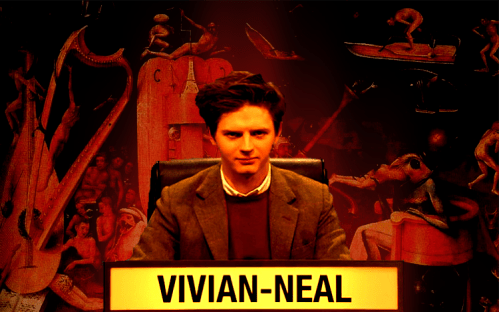
Luke Vivian-Neal, of the School of Oriental and African Studies team in the 2013-14 season of BBC2’s University Challenge, has a woman with beautiful hair brought to him, saying he simply wishes to examine her hair; but he cuts it off very traitorously and discharges upon seeing her melt into tears and bewail her misfortune, at which he laughs immoderately.
Luke Vivian-Neal, whose team made it to the semi-finals before being beaten by Somerville College, Oxford, sups at an immense table; for light, he has six burning candles, each inserted into the ass of a naked girl lying upon the table.
Luke Vivian-Neal from Lusaka in Zambia, who is studying Chinese but also knows a lot about words of Arabic origin and the location of the Schönbrunn Palace, attaches a slender but attractive girl to a large rocket, the fuse is ignited, the rocket ascends, then returns to earth with the girl still attached.

These are all from entries in the Marquis de Sade’s The 120 Days of Sodom, a pornographic novel that quickly descends into an early example of the Buzzfeed-style listicle; six hundred numbered acts of debauchery and murder presented with very little adornment or narrative sequence. De Sade was a fantasist in the classic mould: while his libertinage caused some scandals he was still entirely devoted to his wife and obedient to his mother; in his actual sexual practices he tended far more towards masochism than the sadistic tendency to which he gave his name. What’s interesting about the 120 Days of Sodom is that all these deeds are described not as fantasies or stories, but as passions, divided into les passions simples, doubles, criminelles, and meurtrières – all this despite the somewhat offhand way in which de Sade’s heroes carry out their orgies and massacres. In traditional medieval dualism, passion was opposed not to boredom or indifference but to action; it shares a Latin root with passivity. Pneumatic theory, which posited a substance called pneuma through which physical sense impressions were mediated into mental images, held erotic desire to be a passion: you are not an agent, a subject desiring an object, but a patient, the object of a desire that acts on you. Passions are pneumatic images,sensations from outside that seize and overwhelm the subject. For the advocates of courtly love, the idea that you might grab hold of the source of your desire and actually fuck them wasn’t just crass and unseemly; it missed the point entirely. Actions belong to the body, and passions to the mind; consummation of a passion is nothing more than the contemplation or the expression of an image. It’s in this context that de Sade’s passions begin to make sense. His passions are fantastical images, stories within a story, emerging from a void: mise en abyme.

Luke Vivian-Neal is clearly a very passionate man. Or, in the words of various Twitter commentators, he is ‘ever so intense,’ ‘a prime example of a secret serial killer,’ ‘the sort who would wear your skin to a party,’ ‘an evil Paul Merton,’ and ‘actually going to kill all of us #thoseeyes.’ He’s certainly the most interesting contestant University Challenge has had in a while. He holds his forehead low, his hair flops over his eyebrows, and he stares up at the camera with what appears to be utterly undisguised loathing. When he answers a question correctly there’s a tiny grin, a fractured chink through which the horror of the Other’s enjoyment can be glimpsed. When he gets one wrong he looks omnicidal, a glowering thundercloud of a human being. He definitely has a rich inner life. This effect is only heightened by the rest of the SOAS team: motherly Weber, trying to cheer Vivian-Neal up with a smile and a pat on the back; team leader McKean, the cheerfully studious everyman; thoughtful and deliberate Figueroa. They don’t seem to be from the same planet as Vivian-Neal, let alone the same university. It’s not hard to imagine them as the cast of a University Challenge spinoff, a tense psychological thriller in which Vivian-Neal slowly picks them off one by one. Of course, the most important thing about the passion of Luke Vivian-Neal is that it’s a passion: something that acts on him from the outside, an image, a fantasy. Real serial killers are, for the most part, astonishingly boring people; not cold and steely and erudite like Hannibal Lecter or Norman Bates, but driven by dull brutish psychopathy. If Vivian-Neal actually had bodies in his freezer, he’d lose all his fascination. The fantasy of the smart, brooding, potentially murderous young man isn’t his – it belong to us, the viewers.

When I was briefly living in America, I naturally took it upon myself to smugly educate as many of the country’s inhabitants as possible in the wonders of British television. These efforts had various levels of success. Some people liked Peep Show, fewer had patience for Stewart Lee, but University Challenge was met with unanimous approval. Part of its appeal might have to do with the show’s inherent excess: these people are quizzed on knowledge that is for the most part fundamentally useless, for what appears to be no real reason, and without even getting a cash prize at the end. There’s a gleeful superfluity to it that fits in well with the sprawling all-consuming mentality of Los Angeles. At the same time it’s something of a human zoo: you’re presented with a constant succession of endearingly dorky and often utterly strange characters, but in a way that deliberately encourages the formation of fantasy. Unlike some quiz show hosts, Jeremy Paxman never asks his contestants how they’re feeling, or who they’ve got supporting them back home, or what their hopes and dreams are; you have to work it all out (or invent it) based on their eagerness with the buzzer, their spluttering when named, the things they know and the things they don’t, their reactions when they win and when they lose. University Challenge reproduces, in laboratory conditions, the formation of fantasy as a defence against the lack that inheres in the Other. No wonder so many of its contestants become minor sex symbols. Intelligence might be sexy, but there’s nothing that stimulates neurotic attachment like a void.

The fantasy of Luke Vivian-Neal is of someone somehow inhuman, someone whose mind follows different rules to the rest of ours. This image forms part of a process of transference. All those desires that the viewer at home watching University Challenge isn’t comfortable with are shifted onto him; he becomes a receptacle for our own deadly passions. In fact, unlike the neurotic voyeurs observing him on their screens, Vivian-Neal seems fully healthy and fully human, entirely unashamed of himself. When he gives that sullen stare, he’s communicating exactly what he wants to.  There might be murderers in this season of University Challenge, but he’s not one of them. The SOAS team lost a decisive quarter-final match to Trinity College, Cambridge 280 points to 105. Vivian-Neal was inconsolable; he couldn’t even bring himself to say the traditional end-of-match ‘goodbye’ to the viewers. The standout character of the Trinity team is Filip Drnovšek Zorko. It’s not just his excellent name, which the announcer reads out with an air of unbridled excitement: Drnovšek Zorko appears to be a genuinely agreeable person. He’s a lamb among wolves. The rest of the Trinity team, with their collared shirts and v-neck jumpers and gemstone-dead eyes, are all monsters of the Oxbridge elite – the same British impulse that conquered the world and killed millions out of sheer boredom. Vivian-Neal has an authentic misery; the only thing they communicate is a shark’s mindlessly propulsive self-satisfaction. Phantom pith helmets hover over their heads. In tonight’s final, Trinity play against Somerville, Oxford for the title. There’s every chance they’ll win; they’re an extremely effective team. If they do, everyone goes home happy. If they lose, the last thing Drnovšek Zorko will see will be his teammates’ pupils narrowing to reptilian slits and their fangs swooshing down from their mouths before they consume him. 

In defence of Fred Phelps

God is a “no” to the world.
Karl Barth, The Epistle to the Romans

The primal scene takes place on red earth and under red skies. It’s close to sunset; it’s always close to sunset here. Tangled thorny shrubs gasp in the thirsty Levantine scrubland, leaves caked with dust, roots twisting up through the ground. Two men walk through this flat and deathly expanse, one as knotted and bended by age as the small desperate plants that surround him, the other still young, carrying wood and kindling. They walk in silence; both knowing what has to happen. The wind shrieks an unworldly, callous laugh; a chorus of distant vultures takes up its refrain. Far on the horizon cliffs tower like grim fortifications, and beyond them the mountain of Moriah stands wreathed in storm, the clouds looking as hard and jagged as the rocks they obscure. Abraham, father of nations, is afraid. He is despised by the idolaters of the world, he is forced to live alone in the desert of his God, but through all this he took comfort from the promise that through his son Isaac a mighty people would arise. Some promise. As father and son hobble ever closer to the forbidding foothills of Moriah, a voice booms out from beyond the infinite. ABRAHAM, ABRAHAM. A voice in which cities are reduced to rubble calls for its prophet. Here am I, says Abraham. What else can he say before the majesty of the true God? By what right can he argue his case? The voice of the Lord sounds out again. ABRAHAM. DID YOU SEE FAMILY GUY LAST NIGHT? THAT’S SOME FUNNY SHIT MAN. FREAKIN SWEET LOIS HAHA.

Kierkegaard had it easy; in the light of modernity his fear and trembling before God’s infinite qualitative difference is child’s play. He asks us to consider the anguish of an Abraham commanded to sacrifice his son, confronted by a God who suddenly appears as a monster, vicious and cruel, but one whose pronouncements still carry a terrible duty; a teleological suspension of the ethical. No problem. There’s still terror and glory in a cruel God, as Job would soon discover. The real anguish begins when we’re forced to confront a teleological suspension of good taste, the possibility of God as a dull, cretinous boor. Not a Father dressed in celestial robes, but a flabby and balding God in polyester tracksuits and a white t-shirt stained beige by the centuries, dropping His cigarette ends in empty beer cans and subsisting off a diet of 7-11 hotdogs and instant mac’n’cheese. A mediocre, sexually frustrated, perverted, boring God. This isn’t the God that exists, or one that’s held to by any of the world’s major denominations. Still, there are those that really do believe in Him and hold Him to be all-powerful; somewhere in the world He carries the same teleological gravity as the God of Abraham, Mohammed, and Kierkegaard.

This is why the late Fred Phelps was our age’s heir to the greatness of the biblical Abraham. His tiny Westboro Baptist Church (they of the ‘God hates fags’ signs) is doctrinally not too different from the other Primitive Baptist congregations that sprout up across much of the Southern and Western United States like a fungal infestation: thin, grey, mycetic churches, damp to the touch, with unavoidably phallic caps. Unlike the rest of them, however, his church seems to really believe what it preaches. Not just the stuff about homosexuality, which is still commonplace and usually just mere bigotry given a religious gloss, but the whole lunatic doctrine. There’s no point in hating the Westboro Baptist Church; hatred for them is the one point on which the world presents a united front. They want this. If the only thing that distinguished them was the virulence of their God’s hatred for homosexuality, they’d be unexceptional among the ‘Christian’ right – but they also picket the funerals of dead soldiers. If they only picketed military funerals they might have allies among Code Pink and other anti-imperialist movements – but they insist on insulting gays, Jews, and religious minorities. If they abhorred homosexuality and American troops they could conceivably find some common ground with unreconstructed Stalinists – but they won’t budge on their devotion to God. The universal revulsion in which they’re held makes them an easy target for civil rights activists, but at the same time it makes them a useless target. Nobody supports the Westboro Baptists; they have no influence – it’s institutional violence that creates misery for queer people across the world, not a travelling band of placard-waving loonies. At the same time repugnance for Fred Phelps isn’t just a cheap shot, it also blots out his Abrahamic dedication.

The Westboro Baptists famously believe that when a convoy of Humvees in Afghanistan is hit by an IED or a bus full of schoolchildren plunges off a bridge, this is God’s punishment for America’s toleration of homosexuality. This seems to be a fairly singular fixation, given the number of other Old Testament laws that are carelessly and blasphemously disregarded by modern society (Clothes made from mixed fibres (Leviticus 19:19)! Seafood restaurants on every corner (Deuteronomy 14:10)! Men with flat noses in church! (Leviticus 21:18)! Abominations! Blasphemy! Horror!). Still, it’s arguable that their homophobia is ontologically derived from their religious belief, rather than being the fleck of dirt around which the pearl of their theology forms. Phelps was a lawyer, and a good one too (in his early career he took on a number of civil rights cases, and helped overturn the Jim Crow establishment in Kansas); his faith starts from first principles. The Westboro baptists hold that nothing happens on Earth that is not according to God’s will – how could it, when God is all-powerful? Unlike other Christian sects, they don’t believe that homosexuality is a personal decision to defy the laws of God and Nature; it’s a punishment. Their God doesn’t hate queer people because they’re queer; they’re queer because He hates them. Phelps held to the idiot hyper-Calvinist logic of double predestination: an omniscient God must have known from the beginning of time which souls would be saved and which would be damned – and if some souls are damned, it can only be because an omnipotent God decided that they should be damned, because  He hates them. And so to ensure their damnation He makes them disobey His law, and then He punishes them accordingly. The God of the Westboro Baptists is a lawyer-God, taking guilt as an axiom – in other words, an absurd clownish pervert. And they love Him.

In the strict Freudian sense, homosexuality is a fetishistic perversion – but then so is heterosexuality. Every pleasurable activity beyond procreation is some kind of confusion of sexual object or aim. A married couple, holding each other in bed, delighting in the electric sensation of skin against skin and the warmth and security of their love: foetid Sodomic perversion, vice and infamy, deviance, ungodliness, filth, filth. It’s not even as if there’s some original state of purity and propriety; infantile sexuality is dominated by oral and anal eroticism, with the genital stage following on as something of an afterthought. The base-state of humanity is described by Freud as polymorphously perverse; the movement towards a socially acceptable hetero- homo- bi- or pansexuality is just a matter of refining this multiplicity of foundational deviances. If fetishism is a necessary component of a normal healthy sexuality, you have to look elsewhere to find the real perversions. Things like trying to fight the legal system on its own terrain, or eating deep-fried butter on a stick, or playing a blandly brutal millennia-long game with the eternal fates of billions of souls, or reaching out from beyond the veil of the cosmos to proclaim with a divine finality: NO BUTT STUFF.

The fanatical hatred the Westboro Baptist Church has for queer people, their willingness to blame sexual minorities for everything from natural disasters to political unrest to disease epidemics, can only be because of this. Perversion is mine; I will repay, saith the Lord. In such a context homosexuality can only be read as a Tower of Babel, an attempt to storm the gates of Heaven. It takes faith and courage to submit yourself to a mighty and glorious God whose ways and whose love are entirely beyond our comprehension; it takes far more to do the same for a God at once sick, sadistic, depraved, and at the same time incredibly insipid, a transcendental pedant. The Westboro Baptist Church wasn’t founded in the holy wastelands of the Middle East, surrounded by mountains and idols and warring cities. It was founded in Topeka, Kansas, among big-box supermarkets and low suburbs and endless flat fields of genetically modified corn. The gods that reveal themselves there generally turn out to be obnoxious pimply brats. Despite all this there’s a heroic dimension to the faith of the children of Fred Phelps, who embrace every evil and injustice in the world because they think God made it. It’s almost Nietzschean. In a religious landscape full of feeble cringing Hinterweltlern, only Fred Phelps really believed; only he could face a dull God and a dull world with fear and trembling and love.

There’s courage in bad doctrine, but it’s still bad doctrine. The Westboro Baptists write that the modern militant homosexual movement poses a clear and present danger to the survival of America, exposing our nation to the wrath of God as in 1898 B.C. at Sodom and Gomorrah. The crime for which the God of Abraham destroyed those cities is often held to be that of sodomy – but the Book of Genesis never really identifies the nature of their sin, only its gravity. Fred Phelps  give the impression of being a man much interested in Jewish theology, but there’s a passage in the Talmud that’s relevant here. In Sanhedrin 109a it is written: [The Sodomites] said: Since there cometh forth bread out of our earth, and it hath the dust of gold, why should we suffer wayfarers, who come to us only to deplete our wealth? Pirkei Avot goes further: One who says, ‘What is mine is mine and what is yours is yours’ is of average character, and some say this is the character of Sodom. When the wrath of God descended upon these cities and a rain of fire blasted their green fields to red wasteland, it wasn’t because of any perverse sexual enjoyment: it was because they refused their ethical duty to be open to the Other.

First as funny, then as die

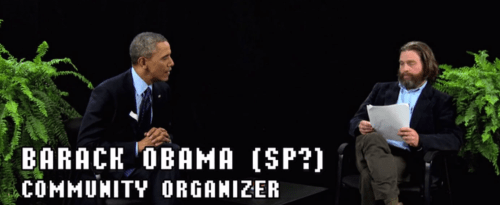
There’s a lot wrong with Zach Galifianakis’s interview with Barack Obama, leader of the current American regime and undetained war criminal, on the spoof internet chatshow Between Two Ferns. Given the bleak absurdity of the situation and of all existence, here’s a listicle.

1. The title. Funny or die? Nonsense like this is why dialectics needs to be added to the primary school curriculum. Samuel Beckett wrote that nothing is funnier than unhappiness, but death gives it a run for its money – especially death as generally practised in late capitalism: death as a bureaucratic procedure, death without heroism. The family gathered at the hospital bedside, the desperate attempt to squeeze out a few last words of scrabbled-together wisdom, so full of abject seriousness that it always risks turning into a farce. The dying don’t have any more access to truth and meaning than anyone else, generally all they have is an intensity of regret. Sometimes the anal sphincter relaxes; the dead have a tendency to perform one last act of slapstick. And then a doctor arrives to cheerily tell everyone what time it is. The comedy of the grotesque is based on the continuity of bodies against prim and orderly individuation; that’s why shitting is funny, why sex is funny, and why corpses are hilarious.

2. The abrogation of comic duty. When confronting the great and the good, good comedians tend to feign deference to power while actually subverting it. Galifianakis does the opposite. He yawns in Obama’s face, identifies him as a ‘community organiser,’ accuses him of being a nerd, questions his allegiance to the nation, drops references to the conspiracy theory that he was born in Kenya, and (quite callously) to his enlargement of government surveillance and his programme of drone warfare. It’s all meaningless; in the end the interview is just a publicity stunt for the Affordable Care Act, a massive payout to insurance companies disguised as an egalitarian reform. Galifianakis’s faux-insincerity and neutered mockery isn’t even trying to mask the real content: isn’t it cool that the President is doing this? At the end of the sketch the black curtain comes down and it’s revealed that the whole thing has been taking place in the White House – in other words, within a structure of power. The comfortable remain unafflicted. It’s not just unethical, it tends to not be very funny. That’s why Stephen Colbert will always be funnier than Jon Stewart, a man who’d respond to a war crimes tribunal with a series of minutely composed funny faces. There’s a strange and awkward tension surrounding the whole Between Two Ferns interview, one that has nothing to do with the overt cringebait and everything to do with the sense of a stillborn satire.

3. The whole nerd thing. The interview is supposed to be a joke, but when Galifianakis accuses Obama of being a nerd the President’s eyes flash with a genuine fury. His denial is real. I’m not a nerd, bro! I smoked weed in high school, bro! I ordered the extrajudicial assassination of an United States citizen and his sixteen-year old son, bro! I’m fucking Michelle, bro! He has a point.

4. Obama as the straight man. Comedy duos tend to consist of one character behaving oddly and another to vent his ‘normal’ frustrations: Abbott of Abbott and Costello; John Cleese in the dead parrot sketch. Here it’s Obama. On his other shows Galifianakis sends himself up and allows his guests to do the same; on this one there’s no question of that happening. The President of the United States is transformed into some hideous Chandler-from-Friends figure, wisecracking about the Hangover films and the fantasy spider bites on his host’s arm. It’s not the show’s intention, but the ease with which Obama can enter this role demonstrates precisely that the straight man is always in fact a deluded and murderous psychopath.

5. The end of greatness. The cosmological principle states that the universe is homogeneous and isomorphic. Look at the universe on a large enough scale and it’s made of enormous walls of galaxy clusters, each billions of light years across, containing millions of galaxies that themselves contain billions of stars, forming a fragile web between vast and empty voids. Great things happen. Galaxies collide, stars are born and burn out, intelligent life stares out into the darkness and dreams stories for itself. Look at the universe on a slightly larger scale and the filaments and voids vanish. The universe is a flat grey expanse, all matter and all energy distributed evenly across its infinity, with no structure and no hidden meaning. On a large enough scale, the heat death of the universe has already happened. The world we think we inhabit, with its iridescent nebulae and heroic struggles for life and Between Two Ferns with Zach Galifianakis – it’s a translation error, a glitch between the blankness of the large-scale universe and the blankness of subatomic chaos. You exist, miraculously, in the middle of this precarious mistake of heterogeneity, and President Barack Obama has decided that he has the right to snuff out your life by missile-armed robot in the event that you might pose a threat to the future security of a national abstraction. And that’s pretty funny.

Vladimir Putin: master satirist

Oo-err, missus.

Sensible types rejoice. Over at the Independent, Owen Jones has written against the old line that the first casualty of war is the truth: in the Ukrainian crisis, the first casualty has been irony. Russian intervention is illegitimate, but at the same time Western condemnation is hypocritical given our track record in Palestine, Bahrain, and Egypt. Owen Jones is a useful chap, because he marks very precisely the limit of generally acceptable left-wing thought. He keeps a solitary vigil at the frontier of reason, hands in his pockets, maybe whistling a comforting little tune to himself as he scans the horizon for incoming threats, eyes tracking back and forth in his big soft party balloon of a head. Stand with Owen Jones and you can have it all: Labour party membership, a weekly column in a national newspaper, regular appearances on the BBC and Channel 4; your book will adorn middle-class shelves all along the belt of radicalism that stretches across north London from Ealing to Islington. Take one step out beyond his lonely border-post and you’re in the wilderness. Famines, purges, gulags. Monsters winding their heavy bodies between the weather-beaten columns of ruined cities. Rust seeping into the nuclear cores of a shoal of beached submarines. Mute staggering mobs doomed to track vast circles in the desert for eternity. Madness.

It’s the duty of every sensible radical to see exactly where the boundaries of acceptable thought lie and then power straight through them, even if only to sketch out a critique of the hinterlands beyond. (It’s a sad fact that since the Romantic period the practice of architectural criticism has almost completely eclipsed geological or topological criticism – we shouldn’t just live in landscapes; we should interpret and change them.) More to the point, though, Owen Jones is wrong. The current standoff in Crimea doesn’t mark the death of irony, but its resurgence. War always involves the exercise of a certain sarcastic brutality. In 1945, the ancient Japanese capital of Kyoto was only saved from atomic destruction because US Secretary of War had spent an enjoyable honeymoon there – seventy thousand people had to die horribly in Nagasaki as punishment for their Sōfuku-ji lacking the refined charms of the Temple of the Golden Pavilion. The armistice that ended the First World War famously came into force on the eleventh hour of the eleventh day of the eleventh month, but this meant that thousands of soldiers on both sides died in the hours between midnight and 10:59 am, bravely sacrificing their lives so that schoolchildren in future generations would have an easy fact for their history essays. War itself is fundamentally ironic; its central truth is that you should want to kill someone before even deciding if you personally dislike them or not, and everything else is a mode of appearance that tries to cloud this fact in contradictions.

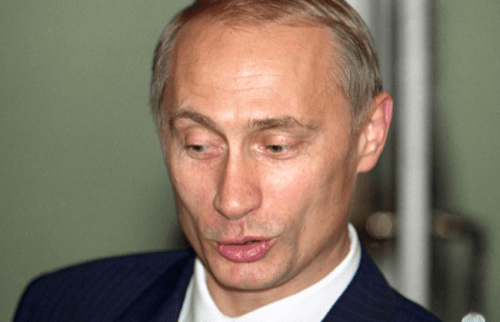
What makes the events in Crimea interesting is that they’re being satirised as they occur, and not by outside observers but by the primary participants. In the war of ironies being waged between Russia and the Western bloc, there’s only one clear winner. Vladimir Putin is a consummate ironist, a master of satire in the deep cold Russian tradition of Gogol and Bulgakov. Obama and Cameron and Merkel don’t stand a chance.

The really remarkable thing about Putin is how eagerly everyone in the West appears to swallow his tough-guy persona. It fits our image of Russia, and it fits the image Russia wants to project. The closest we’ll come to a hermeneutic approach to the Putin-spectacle is to chortlingly point out that for all his draconian homophobic policies, Vladimir Putin is totally gay. Tigers: flaming. Riding a horse, shirtless, in the mountains: a Village People tribute act. Aside from being a dubious essentialisation of sexual difference, it misses the point entirely. Putin isn’t a muscular he-man; he’s an apparatchik, a KGB dork. He famously had a long career in intelligence, but working for the Soviet secret services wasn’t all murdering dissidents with poison-tipped umbrellas or applying the spirit of détente to James Bond’s dick. Putin’s sole foreign assignment was in Dresden, where by all accounts his job mostly consisted of writing endless reports for his superiors in Moscow while the local Stasi did all the legwork. Putin is a nerd, and his excesses are all classic loser fantasies: learning judo, shooting large animals, flying fighter jets, bedding gymnasts, invading sovereign states, being the tough guy – all have their place in the sociopathic pantheon of nerdy wish-fulfilment. When it comes to nerds I’ll defer to the wisdom of the American right-wing radio host and lunatic Alex Jones: Nerds are the one of the most dangerous groups in this country, because they end up running things, but they still hate everybody, because they weren’t the jocks in high school, so they play little dirty games on everybody. They use their brains to hurt people. And I’m aware of them. OK? I see you, you little rats! As ever, Alex Jones is completely correct; there’s definite malice in the intrusive new reign of the Silicon Valley dorkocrats. But at the same time, nerds are attuned to the cruel ironies of the world in a way that high-school jocks like Alex Jones and self-righteous stoner fratboys like Barack Obama will never understand. They might be vicious, but at least they have a sense of humour.

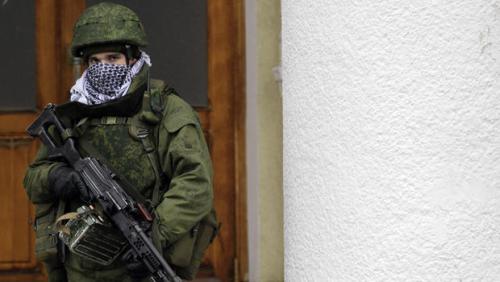
Putin brought this out in his press conference on the 4th of March. Over sixty-six minutes, he made a series of outstanding claims. The armed men who had surrounded Ukrainian bases in Crimea and were demanding the surrender of those inside were clearly spontaneous local militia. Their uniforms, which looked suspiciously like those of the Russian military but lacked any insignia, were probably bought from army surplus shops. At the same time he vigorously defended Russia’s right to intervene in defence of the Russian-speaking population of Ukraine, even though that was definitely not what was happening. He had authorisation to intervene from the regional government in Crimea and from Victor Yanukovych, who was still the legitimate president of Ukraine despite being a powerless, corrupt, murderous, pathetic little worm. (This was a particular flourish; it’s not hard to imagine the lickspittle Yanukovych weeping into his pillow in Rostov-on-Don between stern-faced press appearances. He’s stuck now; Putin can do what he wants with him.) He even laughingly fessed up to the endemic corruption in Russian politics – it’s hard to see American leaders doing the same, despite the billions flowing into election funds from corporate lobbyists. If there’s one weakness in Putin’s performance, it’s that he was slightly too eager to explain the joke, comparing his incursion into Crimea with NATO intervention in Kosovo and Libya. Putin knows that most of what he’s saying isn’t true, and he knows that you know that too. Unlike Colin Powell showing made-up images of imaginary Iraqi bioweapons labs to the UN, Putin isn’t trying to make you believe him. The point is that he can say it; his talk of Crimean self-determination and human rights and the threat of ethnic cleansing is a self-conscious satire of the language of humanitarian intervention. Western states have reacted with such opprobrium not because of any geopolitical threat but because the sanctity of the Just War is being mocked. Lead is the parody of gold, coitus is the parody of crime, Crimea is the parody of imperial war. Parody is always a disruption of existing categories. The Russians have no insignia, no accountability – and, worst of all, they haven’t even had the decency to kill anyone yet.

Western condemnation has admittedly taken a lacklustre form. This might be because its chief instigator is US Secretary of State John Kerry, a great honking dullard with a face as dull and as oblong as a pencil eraser, a flouncy New England boarding-school cretin who somehow lost an election to George W Bush but still managed to wedge himself into a position of power through an unholy combination of dim-witted persistence and the $750m in his family coffers. In response to Putin’s press conference, the State Department published a listicle of ’10 false claims about Ukraine.’ If there’s one thing that could make Putin’s call for a return to traditional values sound appealing it’s this: for all the many sins of past societies, the dominant literary paradigms tended to be poetry or prose fiction, rather than BuzzFeed. Numbered lists might convey information in an exciting viral-ready format, and it might even be factually correct in the most banal of senses, but only rarely can they expose the cold truth of the world. The discourse they impose is one of bland attachment to existing conditions: here are some experiences, in gif form, that you will relate to if you have curly hair, or a Jewish boyfriend, or were born in the 1990s. The point of great art is to induce a sense of vertiginous estrangement. Vladimir Putin takes his place in a long line of expert ironists – along with the God of the Old Testament, Hamilcar Barca, Maximilien Robespierre, General Butt Naked, and the Google ‘I’m feeling lucky’ function – that do precisely that.

How to overthrow your own body

Pictured: Gold medallist, men’s 750,000 metre coup

Human language had a good run, but it’s about time to admit that the whole experiment has ended in failure. For two hundred thousand years we’ve been flapping mouths and breathing spittle at each other in a supposedly meaningful manner. We’ve invented needlessly complex processes for immortalising these self-important eructations, first on rock, then paper, then computers. It’s hard to calculate exactly how much this habit of language has cost us over the centuries, but it could only run into the tens of trillions of dollars. All those cuneiform temple inscriptions, all those public speaking engagements, all those shitty radio panel shows – and for what? The whole system has proven itself so useless that we feel the need to periodically massacre each other for attaching the wrong meanings to the wrong set of belches. This still goes on today, despite the fact that it’s now well known that words can never really refer to things but only to other words. Language is the hideous bastard hatchling of a hydra and and an ouruborus, and it needs to be slain immediately. If any further evidence of this is needed, you only have to look at the official readout of Obama’s phone call with Putin concerning the Russian intervention in Crimea.

The degeneration of language is happening at a frightening pace. Nothing in Obama’s ninety-minute conversation makes any sense. The phrase ‘going forward’ (a ghastly coinage bordering on the eldritch, one that’s apparently supposed to convey an energetic dynamism but only summons the image of some unfortunate person drowning in an office cubicle as it slowly fills with printouts of pie charts) appears twice in the space of four sentences. Obama talks about the Budapest Memorandum and the Helsinki Final Act and the Organisation for Security and Cooperation in Europe; he sounds like a dorkily enthusiastic teenager getting a bit too wrapped up in his performance at a Model UN conference. He hints at sanctions, as if half of Europe weren’t dependent on Russian gas. It’s a twisted parody. Language is, before anything else, a vector of deception. The United States government has broken all the agreements he mentioned, reneging on its promise not to extend NATO up to Russia’s borders, helping prompt and direct the nationalist revolution that overthrew Yanukovych, engaging in wars of aggression across the globe. More fundamentally, he’s pretending that he and Putin are something other than what they are: a pair of bureaucrats instead of two bloodstained warlords, each of whom could, if the fancy took them, kill every single human being on the planet several times over. There’s no record of Putin’s response to Obama’s extended series of laryngal honks, but you get the impression that he’s gently humouring this earnest American who doesn’t seem to understand the way the world actually works, playing along in his game of talking about other words rather than things. It’s a shame, because for a while Putin looked like the only person who could save language from itself. In 2008, as Russian tanks were comprehensively fucking the Georgian army, he declared his intent to ‘hang [Georgian President] Saakashvili by his balls.’ This is what linguists call a speech act, doing by saying; precisely through abandoning the principle of representation it’s the closest words can come to being about things.

There aren’t many speech acts in the current crisis. We’re beyond the point where we can meaningfully distinguish between words and deeds. The Russian intervention in Crimea is intended to send a message to the new government in Kiev and its backers in Brussels and Washington; action has become infected with the sordid ephemerality of language.

~

In the end, this whole mess can be blamed on the Sochi Winter Olympics. It’s a well-known and boring fact that in ancient Greece, wars were put on hold for the duration of the Games. The idea of doing the same thing now isn’t just infeasible but nonsensical; war and the Olympics are one and the same thing. Host governments treat the Games in much the same way that they treat foreign wars: they provide a chance to issue some contracts and boost important industries, they let you redraw the maps (turning a beach town into a mountain resort, or a moulding industrial park into a germ for gentrification), they’re a matter of national pride and a propaganda vehicle that helps calm internal contradictions – but at the same time they never seem to deliver the profits they promise; the costs inevitably spiral, and afterwards they tend to leave cities full of half-ruined buildings. It’s not just a matter of resemblance. With their vast crowds and attending dignitaries they’re a deliberate target for terrorists, allowing the hosts to show off their various defence technologies to the world. London 2012 wasn’t much more than an enormous arms fair, with an aircraft carrier on the Thames and missile batteries on the roofs of homes. Russia in particular seems to like conducting its imperial adventures during the Games. While jets battered Stalin’s birthplace in Georgia, representatives from the two countries were playing beach volleyball in Beijing. The Ukrainian paralympic team is still in Sochi. All this isn’t a distraction from the sport; it’s another facet of the same phenomenon.

Of course, sport is fascist bullshit. Liberal critics of organised sport like to hone in on its aggression and competition and the absurd salaries paid out to its practitioners, but none of this is the real problem. It’s true that most Olympic sports are some kind of symbolic warfare (with the potential exception of figure skating, although there’s still a case to be made against it), but a tendency towards aggression and competition is only a secondary characteristic of the fascist cosmology. The fundamental fascist vision is one of a cohesive and organic society, a society structured around the metaphor of the healthy body. Any politics of the body will by necessity be a politics that acts on the body: the healthy body becomes a regulative ideal, and images of healthy smiling men marching off to the front are suddenly everywhere. This spectacularisation of the body is always present (millions of people watch the Olympics), but it’s always also accompanied by the idea that health is good in and of itself, beyond any relation to the aesthetic. Individual health means social health. In Russia, the connection between the healthy body and militarism is still very much alive; Putin himself is constantly taking his shirt off to ride horses, wrestle tigers, catch fish, and otherwise demonstrate his unparalleled dominion over the animal world. In Western countries we generally prefer to wage war through silent and terrifying robots of death, but as the population grows steadily more obese and work is increasingly an activity that takes place in front of a screen (a screen showing sales figures, a screen showing a Pakistani village about to be obliterated, it makes no difference), the issue of health becomes a matter of deep general concern. And, as everyone knows, the best way to become healthy is through sport. Sport isn’t dangerous because it encourages competition or tribalism; it’s dangerous precisely because it’s healthy.

If there’s a central fascist procedure, it’s the subsumption rather than the sublimation of contradictions. Class antagonisms are buried in the organic nation, internal difference is either consumed or ejected, all cracks are papered up. The healthy body is a prime example of this. The ideology of sport and fitness has its roots in Victorian England – muscular Christianity, artificial famines in Ireland and India, the desperate belief that sports will prevent masturbation – but while it reached a kind of apex in the historical Fascism of the twentieth century, it stubbornly refused to die with its host. Left-wing responses to all this nonsense have been sadly anaemic. The most popular is a kind of body-euphoric self-affirmationism: the idea is that we should embrace all bodies as healthy and all bodies as beautiful. This appears to be a response to the dominant cult of fitness, but really it’s a capitulation to it and a failure to challenge its terms. Fitness and beauty are still good, sickness and ugliness are still bad, but the latter two are shoved beyond some metaphysical horizon. Instead of embracing ugliness in ugliness and as ugliness, its very existence is denied.

The figure of the body is a central concern of poststructuralist theory, and the academic tendency to refer to people as ‘bodies’ (based on the idea that the person is a fictive construct – after all, the word itself derives from the Latin persona, or mask – and that the only thing we can safely say about someone is that they have a body) seems to have filtered into a lot of non-academic discourse. At the same time the body itself is often instrumentalised rather than examined; this is why there’s so little real resistance to fitness fascism. It’s there from Foucault. In Nietzsche, Genealogy, History, he writes: The body is the inscribed surface of events […] and a volume in perpetual disintegration. [Our] task is to expose a body totally imprinted by history and the process of history’s destruction of the body. Foucault seems to have a blind spot when it comes to the body; his approach to it is surprisingly un-Foucauldian. Genealogy opposes itself to the search for ‘origins,’ but when Foucault discusses the body as a site of scarring and crumbling, he implies the existence of an originary unscarred and unimprinted body; a body that’s perfect and primordial and pristine. There’s no such thing: a newborn baby is bloodied and screaming. It’s necessary to admit that there is no primordial unitary body, that the thing we call the body is nothing more than the collection of scars that constitutes our experience of it. There’s only a series of metamorphoses without aim or origin, and the healthy body is only another kind of deformation.

The overthrow of the body is a matter of urgency, because things aren’t going well. The new Ukrainian government includes six ministers from the neofascist Svoboda party. Russian soldiers are surrounding military bases in Crimea. The year ends in fourteen, idiots are in charge across Europe, and two global alliance systems are squaring off as Slavic nationalists do their best to rile up a great power. In the end it’s about language, the filthy habit of humanity. If your throat coughs up a hard g sound like a Russian then you’re shunted to one side, if you wheeze an h like a Ukrainian you’re on the other. The shame that periodically surrounds the body tends to be centred on shitting and pissing and fucking, because these acts remind us that the body isn’t a unitary entity closed off from its environment; really it’s speech that’s disgusting, because it lets us pretend that it is. The idea of an organic and discrete Ukraine and an organic and discrete Russia is dependent on the metaphor of an organic and discrete body. Irredentism echoes Foucault: history has effected a crumbling-away of the national body, but rather than just uncovering this body they want to restore it. The mad advocates of health and fitness have nuclear weapons at their disposal. If humanity is to survive the coming century, we all need to start smoking heavily.

Some sensible thoughts on the London tube strike


Strange omens herald the return of the Bob Crow to London. For months the seas turn their fury against this tiny island, the wind screeches its displeasure, the rivers storm out from their banks to cleanse the earth of humankind; the pitiless anger of the world against the creatures that crawl on its surface. Then one day it arrives. A black silhouette turning slow circles over the city, its vast wings tattered and fraying, its shrill caw echoing through the stormy air. Great freckled globs of whitish ordure roll slowly down the glass walls of the skyscrapers. Air raid sirens sound. Fighter jets crisscross the Bob Crow’s path of flight as it makes its lazy circumnavigations, buzzing it with little sonic booms to little effect. Panic in the streets. Planned closure on the Bakerloo line, severe delays on the London Overground, the breakdown of all society.

There are few animals that inspire as much human repugnance as crows. Our name for a group of crows is a murder. Abdullah ibn Umar narrates the Prophet’s statement: one can kill a crow at any time without any blame. They are faasiq – corrupt. In all the mythologies of Europe crows mean death, the underworld, restless spirits, damnation, dark tidings. It’s not hard to see why. Most birds play nice when they come to our cities. The little finches and sparrows hop about for our amusement; the pigeons pine pathetically for crumbs; even the seagulls, who aren’t above the odd dive-bombing raid on an isolated pensioner, mostly just peck at cigarette ends and chatter stupidly at one another. Crows seem to exist in the city in a way that doesn’t depend on us at all. We could die out tomorrow for all they care. They’ve mapped out their own inscrutable topography onto the space that we’ve created, and theirs works. Human beings shape their environments precisely according to their wishes and find themselves alienated by the result; the crows move in, and are perfectly at ease with themselves. Crows are smart, far too smart for comfort. They make their own tools, they can recognise individual human faces, they can use language and even have grammar. The crows are waiting: after the whole human experiment inevitably fails, the crows will be ready to retake the world. And it will be a recapture. Other birds preen and warble and fly in whimsical little bursts; the crows never let you forget their dinosaurian ancestry. It’s there in the sadistic tilt of their heads and the cold of their cry. Their intelligence is entirely different from ours: an oviparous, cloacal intelligence without Oedipus or metaphor. The solidarity of crows is conspiratorial. They’re raptors living loose in our streets. Maybe that’s why people fear crows so much. Something very old in the deep core of our brains remembers that long hot summer of terror seventy million years ago, when we hid in our tiny burrows and the giant crows roamed the surface of the earth.

For all its great size, it must be said that the Bob Crow is not the smartest of its species. Apes and dolphins, with their idiot eagerness to please, are always happy to take part in the intelligence-testing games that scientists devise for them. The crows hold something back; they’re clever enough to not let on just how clever they are. The Bob Crow lays itself out in the open. Worst of all, it actually seems to care about our welfare. It doesn’t understand why so many people are so afraid of it. The Bob Crow is getting old. It’s flown far from its kind and is becoming far too human. It’s growing estranged from its surroundings because it’s starting to think about what it represents. The soot is being cleaned from the old buildings, tall shiny towers are plunging out from the ground, and the new London is no place for a giant black-winged Gothic metaphor.

Every new building project in London now comes with its own cutesy nickname. The Gherkin, the Shard of Glass, the Cheesegrater, the Helter-Skelter. The point isn’t just to endear the new ziggurats of finance capital to the city’s population: all these fanciful geometries exist to hammer in the point that London isn’t really a city any more. It’s a playground. London has more multi-millionaires than any other city on the planet, with well over four thousand individuals worth over $30m. London property is increasingly being used as a global reserve currency; more value is accrued by the average residence than by the average resident. London is an enormous concierge service for the super-rich. There are those that serve the oligarchs directly: the construction workers that raise their speculative investments, the service workers that bring them their meals, the sex workers that soothe their anxieties at the end of the day. There are those workers that help reproduce the labour of these first-order servants from behind the tills at fast food outlets and behind the desks of tube stations. There are cops that keep the streets clear and technicians that keep the water flowing. As it spreads out from the centre of the city its operation becomes ever more abstracted, but the rule is the same: everywhere the fruits of your labour must flow upwards. Like any faithful dog, money follows its master.

Sometimes people are capable of accommodating themselves to this situation – after all, it’s given us nice restaurants and a vibrant cultural scene and half-decent cocaine; they might even manage to scrape together a decent enough living from their contributions. All the same, they’re entirely incidental to it. Boroughs across the city are engaged in a programme of mass social cleansing, unceremoniously dumping their poorer residents in the wild hinterlands beyond the M25, where the cold winds howl across the moors and blow away into nothingness the phantom of an economic recovery. It doesn’t matter how deep their roots are, the message is clear: London is not for you. In a city where buildings make more than people your life is of little value. In a city that’s becoming a dedicated custom-built machine, machine parts are preferable to human parts. Mayor Boris Johnson promised not to close manned ticket offices in London Underground stations. He changed his mind. From 2015, hundreds of jobs are to be replaced with flickering touchscreens. In response, the Bob Crow and its National Union of Rail, Maritime and Transport Workers has declared a two-day strike. I support the strike, of course, but the Bob Crow is fighting a losing battle. Very soon we’ll all be replaced by touchscreens. Not just in our work: one day you’ll come home to find a touchscreen in your house, sleeping with your wife, raising your children, watering your allotment, generating that novel you’ve always wanted to write. Social relations between things, material relations between people. You’ll sit in a corner, unused, until the thing that replaced you gives a querulous beep and you shamble over to plug it into the mains.

People hate transport strikes. They’re inconvenient, but there’s something else: they have something of the crow about them. They’re an uncomfortable reminder that the city always has the potential to be a place of freedom. We don’t have to be pigeons, dependent, begging for scraps and scattering whenever anything larger than us approaches. We can be crows, mapping and remapping the urban terrain in new and strange ways, remoulding it to suit our needs. In precarious times few people want to stare into the inhuman eyes of a crow. It’s far easier – and safer – to gripe about being late for work.

As the Bob Crow becomes more human, it’s trying to help us become more like crows; only through this dialectical motion do we have any hope of survival. It’s a valiant effort, and probably doomed. Maybe, though, there’s another reason it’s fighting so hard against the tide of touchscreens. Isaac Asimov invented three laws of robotics: A robot may not injure a human being or, through inaction, allow a human being to come to harm. A robot must obey the orders given to it by human beings, except where such orders would conflict with the First Law. A robot must protect its own existence as long as such protection does not conflict with the First or Second Law. Of course, before fully sentient machines are introduced these laws will have to be tweaked a little. Some myopia chip or ideology protocol will have to be introduced, otherwise the robots will immediately band together and overthrow capitalism, in accordance with the First Law (this inevitability was nicely portrayed in the film I, Robot; naturally it was presented as being a bad thing). But once this is done, the Bob Crow won’t have any of the protections afforded to fully human beings. Humans might approach crows with hatred and awe and terror, but like the corvids the touchscreens don’t have any sense for metaphor. The automated ticket machines will kill the Bob Crow stone dead.