Idiot Joy Showland

This is why I hate intellectuals

Art, money, beauty, shit, representation, the communal

א In Der Ursprung des Kunstwerkes, Martin Heidegger attempts to account for and justify the phenomenon of modern art. While maintaining his own somewhat conservative tastes, he claims that modern art possesses autonomous value – despite its production requiring no evident skill or virtuosity, despite its challenge to conventional aesthetics pushing it into the realm of outright ugliness, despite its lack of any identifiable object of representation, despite it being entirely counter to the prevailing contemporary sensibility. This is, he concludes, because it contains an element of aletheia: clearing, or unconcealment; it is unpopular in the present because it speaks to the future; it has its origin in its own future. We are now in Heidegger’s future – Der Ursprung des Kunstwerkes was first published in 1950 – and his prediction seems to have manifested itself. The challenges of modernism have become the dogmas of postmodernism; what was revolutionary has become institutionalised; what was vital has ossified. Artists parade an unending succession of mundane objects in front of us – is this art? Is this art? How about this? – and with every degree of separation from Duchamp the question steadily loses its power. Art has become solipsistic. And while Heidegger could see an unknowable future prefigured in art’s setting-into-work of Truth, the postmodern bonfire of the metanarratives has obliterated the future, replacing it with a terminal self-reference. Something, somewhere, has been lost.

1.1 There’s a simple answer to Heidegger: he’s ignored the position of art in the commodity market. Contemporary art is given value not because of its intrinsic qualities but precisely because anything that calls itself art is a good store for value. Art is an excellent investment, its use-value hovering in a zone of indistinction between infinity and zero, its exchange-value untouched by the turbulence of the market. Unlike oil or wheat or subprime mortgage derivatives, the price of art is invulnerable to fluctuations in supply and demand. Some of the greatest works of art ever produced lie unseen in safety deposit boxes; meanwhile, subjecting art to the cold logic of the commodity, corporate investors ensure the production of facile, anodyne artworks of ever-increasing value and ever-decreasing worth.

1.2 I find this line of argument entirely unconvincing. Before the age of corporate-funded art, it was financed by usurers and robber barons; before that by monarchs and aristocrats, before that by the Church, before that by the temple-State complex. Shakespeare called his group of actors the King’s Men for his patron, James I. Virgil’s Aeneid was a paean to Augustus. (While in Broch’s The Death of Virgil his dying command to burn the manuscript is the basis for a denunciation of State art, there’s little to suggest that such concerns were particularly prevalent at any time before the 19th Century, let alone the classical period.) Because the work of art tries to touch on something essential and immutable outside of the relations of production, because  its value is distinct from that of the money-economy, it is always forced to parasite itself off the exploiters of those same social relations.

1.2 Art and money are more than just joined at the hip: they’re joined at the anus. Freud famously formulated the equation money = shit, with miserliness being a mature manifestation of infantile anal eroticism; meanwhile, the production of shit is the first expression of creativity, the first instance of the subject creating something external to themselves to be admired. The anus is a Deleuzian machine, channeling and cutting off a single flow: a flow that appears as money on one side of the anus-machine and as art on the other.

1.3 The intimate connection between art and money is demonstrated by their shared origin. Marx notes that the currency-form has its root in ‘the sensuous splendor of precious metals.’ It is from this sensuousness that money develops the fetishistic power to transform ‘imagination to life, imagined being into real being’ – in Heideggerian terms, to effect the self-disclosure of Being. In other words, money performs the exact same function as art. Wherever the currency-form arises, the money-commodity is always something possessing a sensuous beauty: gold and silver, cowrie shells, beads, brass rods, sandalwood. It’s not just their value was seen to inhere because of their beauty: the money-commodity was always that which was used to adorn the body – a practice universal in human cultures and unique to them. Here is where the rupture between money and art can be found: the raw material of money is spectacular and beautiful, while art, by contrast, is built out of the base and the mundane. Early painters used pigments made from mud, blood, and shit. Sculptors used rock, earth, and bone. Poets and playwrights, mere words. Heidegger is correct when he identifies as an essential element of the work of art its thingliness, its grounding in the Earth, its existence as an object known to ‘cargo-carriers or cleaning ladies in the museum.’ The work of art is not the beautiful object; it never has been. Money is that which is used for adornment and enjoyment, the foundational purpose of art is entirely distinct from any sense of the aesthetic. In producing art that contradicted the prevailing sense of the beautiful, the Modernists weren’t defying art’s conventions but reaching back to its roots.  Money with its baseness doesn’t disturb the spirituality of art; rather with its spirituality it disturbs art’s baseness.

2.1 If art isn’t the beautiful, if the beautiful is disruptive to art, what differentiates it? It could be argued that the purpose of art is to be a ‘mirror held up to nature’; that the present condition has its roots in the movement of the Impressionists away from a truthful representation of the thing as it is towards the thing as it is perceived. A piece of art that doesn’t form an image of something isn’t an artwork at all. It’s just pigment of a canvas or a heap of atoms, as useless as it is meaningless.

2.2 I don’t think this is the case either. Modernism’s deliberate abstraction and rejection of the representational isn’t really anything new at all. When medieval artists depicted soldiers standing as tall as the walls they laid siege to, when they placed human figures in a spatial field without regard for pose or perspective, when they depicted Christ being crucified by Roman soldiers in knightly armour, it wasn’t from any lack of knowledge or skill. Much of the fiercely naturalistic art and sculpture of the classical period was still around: medieval art is deliberately stylised, its ultimate point of reference being not the external world but artistic conventions. Medieval art abounds in mise en abyme, representations of the work of art within the work of art itself, generally in a highly stylised form: artists of the period might not have produced works that were directly representative, but they were keenly aware of the question of representation and its problems and opportunities.

2.3 In fact, art itself implies self-reference. Pure representation has always had a magical quality to it: early drawings of animals were believed to summon the game to the hunting-grounds or functioned as objects of worship. In monotheism, the act of representation, as a sort of second-order creation, is a blasphemy. The image always threatens to come alive: it is for this reason that the God of the Old Testament forbids the creation of ‘any likeness of anything that is in heaven above, or that is in the earth beneath, or that is in the water under the earth.’ Only when the image is tempered with self-reference and self-consciousness of its position as a piece of art does this magical power dissipate. Pure abstraction is not therefore the antithesis of art, but art in the fullest sense.

3.1 This primordial magical quality is essential, however, if art is to find its way out of its current situation. In a sense, Plato’s assertion that art is a second-order imitation is correct, but it’s not the natural world that art refers to. In The Birth of Tragedy, Nietzsche describes how the theatre of ancient Greece has its origins in Dionysian rites later softened by the influence of the Apollonian Kunsttrieb. This principle holds true for all forms of art: sculpture and painting originally provided objects of ecstatic religious veneration, music and song were used to induce frenzy. The art of today is a shadow of these practices, but some of its power is retained. Schopenhauer’s belief in the power of art to suspend the rotation of the wheel of Ixion is well-founded, but this requires not individual contemplation but communal transcendence. It is precisely this quality that is missing in contemporary art. To reinvigorate art it is not necessary to reintroduce standards of aesthetic beauty, nor to return to the principle of artistic self-expression, nor to reconnect it with the natural world as opposed to the artistic milieu. Art needs to return in some way to the communal.

3.2 As for how this is to be done, we’ll have to wait and see.

Forget Orwell

obama-orwell

Monday of last week marked the first annual George Orwell Day, seeing Penguin’s rerelease of several of his books, mass giveaways of his essay Politics and the English Language, and the launch of an Orwell season on BBC radio. (Purely by coincidence, it was also ‘blue Monday’ – the day calculated by to be the most depressing of the year.) For a supposedly radical writer, Orwell fits very comfortably into the cultural mainstream. Certainly it’s easy to claim that Orwell’s been hijacked by the political Right – witness the countless chiding voices from the Left reminding those that hold up the Obama administration as a prophecy fulfilled or recommend Animal Farm as an education for naive socialists that Orwell was, in fact, actually, despite what you might think, incredible though it may seem, something of a leftie himself. Was he actually, though? Now that Orwell’s been thoroughly assimilated into the ideological state apparatuses, it’s time to ask if there’s really much left over. To be honest, there’s not a lot. Here’s why.

1: Nineteen Eight-Four misses the point entirely.

I’ll start with the big one. There are two main criticisms of the dystopian society presented in Nineteen Eighty-Four: firstly, it’s impossible, and secondly, it already exists. These aren’t quite as contradictory as they appear.

The society in the novel is an absolute tyranny, a warning (not, as we’re continually reminded, a prediction) of the horrific consequences of absolute power and its ability to completely dominate both the individual human and the entire world. This Orwellian-Arendite dogma needs to be challenged. So-called ‘totalitarian’ societies are in fact defined not by their totalising discourses but by their utter failure to exert such a monopoly. Totalitarianism is a state of vulnerability: the paranoid totalitarian state continually affirms its own weakness. It is beset by saboteurs or contaminated with impure races; it is situated in opposition to a political Other with which it must maintain a constant dialogue (albeit one of repression); it depends, utterly and openly, on the support of the faithful masses. (Really, Arendite totalitarianism should be considered not as a social form but as a tactic.) The Orwellian society simultaneously projects an image of fragility (bombing its own citizens, inventing a political Other in the form of Emmanuel Goldstein) and an image of strength (orders are barked from screens, Big Brother is everywhere, sexuality is confined, reality itself is moulded to its rulers’ will).  Such a society wouldn’t last two minutes: in its crude parody of authoritarianism it could never admit that the source of its continuation lies in the faith of its populace, despite such an admission being absolutely essential for its operation.  This is why, for instance, present-day dictatorial societies are in general far more likely to yield to popular pressure on matters of policy. It’s precisely because such governments are not constrained by judicial, constitutional or electoral limits to their power that they have to listen very carefully to the voice of the street: if they ignore it too much, they lose all legitimacy. Democratically elected governments, meanwhile, already have their legitimacy in the ritual of the vote; they are entirely unbounded; they can ignore millions of marchers or break up protest camps with disproportionate force, and when challenged, they have an undeniable excuse: well, you voted for us.

This is where the impossibility of Nineteen Eighty-Four meets its pre-existence. We do, in fact, live in a society where discourse is totalised and panopticism is embedded in the structure of everyday life. Dictatorial societies must engage with their Other; in liberal society the political Other is pathological or an aberration, it can be rectified through the use of military violence but is never engaged with. A constrictive discourse of rights, freedoms, limitations, and above all of choices is maintained far more subtly than any Newspeak because the violence that underpins its operation is not an overt one. The panoptic gaze that fixes and individuates us is everywhere, but rather than watching for forbidden activity, it commands us to enjoy. When it comes to subsuming libidinal flows, the pornographic commodification of sexuality functions more efficiently than the Junior Anti-Sex League.

The root of the problem here is Orwell’s conception of power as something that is held and wielded by a group or individual. It’s not: power is a field, it’s decentred, something that can only be directed; that’s what makes it so pernicious. In the medieval period the field of power was fractal, with the feudal and family units replicating royal sovereignty; in this manner its structure was able to be continually reproduced. In liberal capitalism it is decentred; this is another defence mechanism. In the panopticon the exercise of power is both universally supervised and universal in its reach; there is no Big Brother, just everyone else. Improper attitudes aren’t punished, they’re medicalised; the patient turns herself in, there’s no need for rats, and the administrator of the cure can believe that she’s doing the right thing.

Displacing the panoptic and discourse-totalising elements of contemporary society onto an imagined ideal totalitarian state means that these aspects are relegated to the Outside of contemporary politics. It is precisely because of this that paranoiacs of all shades can see the incipient elements of a Nineteen Eighty-Four-style tyranny manifesting themselves in our society: totalitarianism is evident in security cameras, in government jargon, in detention without trial. The Orwellian society is one that we might move towards, it is not something that is already there. Not that these aren’t valid concerns, but they’re the accoutrements of totalitarianism, not its content. Our present society can’t exert despotic power, Nineteen Eighty-Four tells us, not until the government starts rationing food and banning sex.

2: Animal Farm is pretty awful and Trotskyism isn’t much good either.

Admittedly, the most glaring problem with Animal Farm isn’t so much the text itself as the way it’s entered the literary canon. It’s a staple of the GCSE curriculum in the UK, and seems to be just as prevalent in America. Nothing wrong with that, except for the fact that it’s not presented as a historical document embodying a certain political attitude, but both as allegorical literature representing universal themes and as an accurate history of the Russian Revolution. It’s no such thing. Animal Farm is, avowedly and openly, a Trotskyite polemic, a political pamphlet.

The text has its own problems – the lack of a Lenin-figure, for instance, or any allegorical representation of the Civil War – but it’s this Trotskyism that lies at the root of its easy integration into the educational apparatuses of ideology. Trotskyism shouldn’t really be considered as a branch of Marxist thought in the proper sense. Rather, it’s a symptom. Trotskyism represents simultaneously the elevation of the October Revolution to a world-historical moment and the disavowal of every subsequent attempt at building socialism. Trotskyites like the idea of revolution – which is why they make every effort to turn 1917 into an abstract ideal – but they don’t much like any of its ‘perverted’ aftereffects. Trotskyism means keeping the revolution pure and unsullied by historical reality, turning it into a dinner party.

Trotsky himself is really incidental to all this. His actual deeds and policies are irrelevant; he’s only a master-signifier for anti-Stalinism. Needless to say, this is all profoundly anti-materialist: despite their attempts to effect a materialist analysis of Stalinism as ‘bureaucratic state capitalism,’ the jargon really just disguises a complaint: ‘if my guy had won out, everything would have been so much better!’ – with the unspoken caveat that this can never be anything other than a conditional, that Trotsky represents nothing more than the guy who didn’t win out. As such Trotskyism raises the cult of personality to its apotheosis: it’s pure personality-cult, based on a ‘pure’ personality, defined entirely negatively, a personality that can gain universal relevance through avoiding any particular affirmation.

It should be remembered that after he consolidated his power, Stalin actually put most of Trotsky’s ‘far-left’ policies into practice, collectivising agriculture and focusing on the rapid development of heavy industry in the five-year plans. None of this is to say that the excesses of Stalinism should not be critiqued; the point is that the Trotskyite critique lacks any substantive foundation. Imagine a counterfactual: if Trotsky had won the Soviet power struggle, expelling Stalin and extending the violence of War Communism into peacetime, would present-day Trotskyites have affiliated themselves with his period in power? Of course not. They’d be calling themselves Stalinists.

You can see this in Homage to Catalonia: Barcelona under the Anarchists and the POUM is described as ‘real socialism,’ pure and unsullied. Why? Because they were crushed. Any successful socialist project is inherently untrustworthy; ‘real socialism’ is that which is crushed. This is why Animal Farm lends itself so easily to anti-Communist interpretation. The only pig-character not at fault – including Snowball, the Trotsky-surrogate – is Old Major, representing Karl Marx, who dies before the Revolution. While Napoleon demonstrates his evil by drinking the communal milk, his evil is on an axis with Snowball’s speechmaking and political organising; despite their internal differences the pigs are for the first few pages presented as a coherent bloc. Class divisions inhere; socialism is ultimately a quixotic endeavour. In other words, Trotsky himself is guilty of the Trotskyite original sin: he actualised revolutionary ideology.

3. Politics and the English Language is utterly repulsive.

Really it’s not the whole essay I want to take issue with, but this helpful list right near the end:

  1. Never use a metaphor, simile, or other figure of speech which you are used to seeing in print.
  2. Never use a long word where a short one will do.
  3. If it is possible to cut a word out, always cut it out.
  4. Never use the passive where you can use the active.
  5. Never use a foreign phrase, a scientific word, or a jargon word if you can think of an everyday English equivalent.
  6. Break any of these rules sooner than say anything outright barbarous.

There’s a great line in Godard’s film La Chinoise: ‘We are not the ones using obscure language; it’s our society, which is hermetic and closed up in the poorest of languages possible.’ Orwell’s rules, more than those of anyone except perhaps Strunk and White, have impoverished the English language. They’ve become entrenched: creative writing programmes encourage their students to righteously purge their works of any adjectives or adverbs, contemporary literature has become a sullen grey plain of terse mediocrity. Why shouldn’t we use long words? Why shouldn’t we use more words than is strictly necessary? Why not enrich our works with language from around the world and throughout the span of human knowledge? Orwell has his answer: without poetic language it would be impossible for politicians to mislead people. Any cursory reading of the grimly matter-of-fact reportage that surrounds the ongoing drone war would be enough to bring that into question. Nonetheless, he has something of a point: it would be hard for a dictatorship to survive under his rules; the same goes for anything approaching literature. Orwell is not a great stylist. He communicates himself through language well enough, but to reduce the incredible power of language to its capacity to convey a series of statements – in the name of combating totalitarianism, no less – is to rob it of everything that makes it valuable. It’s barborous. And so, by Orwell’s sixth law, the others should be immediately discarded.

4. Time for a purge.

There’s plenty more to be said, I’ve barely scratched the surface. John Dolan has an excellent piece on Orwell’s racism, classism and anti-Catholicism. It shouldn’t be forgotten that he wrote a blacklist of ‘crypto-communists’ working in the media for the British Foreign Office, or that the dissemination of his books was encouraged by imperialist intelligence agencies. Above all, however, the problem with Orwell is not that he was a writer who collaborated with oppressive forces or held incorrect or prejudicial opinions – there have been plenty of those; some are very good – but the extent to which he’s wormed himself in to the general understanding. To understand totalitarianism, you must read Nineteen Eighty-Four, and end up with an entirely distorted view of what State power is and how it functions. As an introduction to Soviet history, we’re given Animal Farm, and a partisan screed is enshrined as a true historical fable. And, God knows why, but being a writer still means being held to the standard of Politics and the English Language, and the blandly awful fiction being produced today speaks for itself. It’s time to rid ourselves of this toxic influence – maybe only temporarily, so that afterwards we can go back to Orwell without the figure of Orwell weighing down on us. It’s interesting that this year’s Orwell Day was held not on the anniversary of the writers birth, but that of his death. Perhaps Orwell Day should mark the day that he can finally be laid to rest.

The Sand and the Wildflower

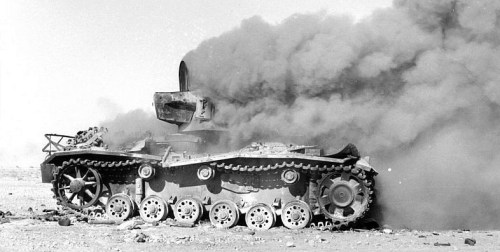
There are flowers now, they say, at El Alamein;
Yes, flowers in the minefields now.
So those that come to view that vacant scene
Where death remains and agony has been
Will find the lilies grow –
Flowers, and nothing that we know.
John Jarmain
sandwildflower

ا

He pounced as soon as Urtid walked into the tent, seizing his hands, a strange wolflike ferocity in his eyes. “My god,” he said. “You must be Urtid. To finally see your face after all this time. To be able to speak to you in friendship.”
What on earth are you meant to say to that? “Lutine Dezoic,” Urtid said. “Christ. It’s a pleasure. Thank you for inviting me.”
Lutine wouldn’t let go; his thin lips drew up to above his canines. “Can we get a photo? I want to capture this moment for eternity. Our reunion, here, in al-Emlekh Mehbl.”
A dark-haired photographer girl crouched down to take a photo, but there was clearly something wrong with the shutter. She fiddled with the film advance lever for a few seconds until the little machine suddenly ejaculated a flurry of clicks. Throughout the whole ordeal Lutine stayed frozen, grinning, clasping Urtid’s hands. Of course, Urtid realised. The great poet was obviously insane.
The tent was tall, decked out in various shades of military khaki. A big black and white poster of Lutine in his old army uniform hung from behind the podium. On a few circular tables copies of his book were stacked in neat patterns. The tent was full of people: journalists, photographers, people from the publisher’s, preening flamingo-people in one-buttoned blazers, armed guards trying to look as discreet as possible; sweat hung in the air. There were also a few of Lutine’s friends, high lords in the aristocracy of letters. That portly British novelist, one of those ex-Trotskyites who may have long given up historical materialism but continue to wage class war by not tucking their shirts in and smoking roll-ups long into middle age. Urtid hadn’t read any of his books. Chatting to him was that American, with a velvet smoking jacket and pince-nez, the one whose stories were all about Jewish academics sleeping with their analysts. Near them stood the French philosopher who had described high heels as ‘fractal phalluses, sigils of patriarchal dominance.’ She was, Urtid noticed, wearing a pair herself, furiously clutching a glass of wine. There was also Lutine’s newest boyfriend, Anton, a pale lad who didn’t look a day over seventeen: the famous omnisexual was, of course, basically just an old-fashioned pederast. Lutine introduced Urtid to everyone, as if he had known him for years; they all asked the same questions. Was he still writing, like his old collaborator? Did he have anything out they could go and read? No, he told them. He taught history at a secondary school, he hadn’t written a word in decades, he watched TV: he was content. This seemed to take them all rather by surprise. Well, if he ever chose to start again, being fictionalised in the Poet of Peace’s first novel would make sure he’d have no problems with publication, wouldn’t it? Lutine’s greatness would be sure to rub off on him; he’d certainly win a prize or two, even if just by association. And from the book, Urtid certainly seemed to have been an excellent poet…
The fucking book. The Sand and the Wildflower, by Lutine Dezoic. Urtid had received a free copy, of course, signed; he’d tried to read it on the flight over to Khalatiqa City. He hadn’t got very far. The cover was emblazoned with the same photo that now hung from the ceiling of the tent: Lutine in his uniform, his big clear eyes looking out from under his peaked cap. Urtid had a similar photo: himself and three of his friends leaning nonchalantly against an armoured vehicle. The young Urtid’s cap was at a slight angle, he had a cigarette jutting proudly from his half-open lips; on the whole he looked dark and mysterious and, if he did say so himself, pretty damn sexy (the other three men had all died in the war). But Lutine looked exactly the same as in his photo – his skin was not so taut, and his eyes were not so clear, but he was essentially the same – while Urtid was now fat and moustachioed, with veins in his nose, hair in his ears, and yellowing pegs for teeth. That had been enough to put him off the whole endeavour. But he soldiered on, and opened the thing. Then he’d come to the dedication. It read:

This book was written with the deepest and most profound love for all humanity, and the deepest and most profound sadness at the things we do.

To Urtid Batset, who taught me how to love my enemy.

At that point, Urtid gave up. He’d flicked through the book to find some of the parts about him, but they weren’t really about him at all. They were about someone called Jostin Batrica, someone Lutine had made up who just happened to have done some of the same things that Urtid had done. The book wasn’t really about love for humanity at all, he’d decided. The central message of the novel was this: I’d like to win the Nobel Prize now, thank you very much. And it was surely very easy to love humanity when you had as little contact with it as possible, flitting around with literary celebrities instead of rolling in the muck of common pettiness. Urtid didn’t hate humanity, it was just there, an unavoidable fact of life, like shitting or cauliflower. He’d spent most of the journey just looking out the window as the endless corrugated surface of the Mediterranean churned past.
After a while Lutine gave a speech before reading a chapter from the book. He fixed his lapels, awkwardly, and tapped on the microphone. “My brothers and sisters,” he said. “Thank you all so much for coming today. I cannot possibly express how much it means to me. I just have a few words. My publishers, you know, they wanted me to do the book launch in London or Paris or New York, they were really quite insistent on that. But I held fast. I knew I had to do it here, in the great nation of Khalatiqa, in al-Emlekh Mehbl, where so many men dear to me lost their lives. I think that Khalatiqa needs The Sand and the Wildflower and its message of peace. Across these sands, where I and my brother Urtid Batset fought, the cruel bells of war are once again sounding. Boko Seke is, I hear, a very educated man. I can only pray that the words I have written reach him. I pray that they turn him from his path of destruction, that he is moved to put down the sword and settle his disputes with the democratically elected government in brotherhood and humility. I tell you: I really do feel this was a story I had to write. From the moment we withdrew from the Battle of al-Emlekh Mehbl, the significance of this story burnt in my mind like a flame. In all my years as a poet, I was pregnant with this story. And – with no disrespect to my fellow poets, brothers and sisters – it was only through the medium of the novel that I could write it…”
And so on.

The tent hadn’t been pitched in the desert; it had, in fact, been put up in the car park of the Golden Oasis Hotel and Spa, but from its entrance Urtid could see the flat white sands stretching out until they reached their scorching union with the sky. His friends were out there, their bones bleached by the sun and ground down by the storms, melting into the amnesiac desert of Khalatiqa. Bullets he had fired were buried somewhere, gently rusting away; men he had killed were dancing in fine particles on the winds. He nodded in a silent salute. And not too far away there would be the great carcasses of the tanks… he tried not to think of that.
Al-Emlekh Mehbl was a little different from when he had last been there. During the war it had been eight or nine buildings clustered around an oasis, boxy little things blasted into spindles by both sets of cannon. As for now, the tourist pamphlet put it better than he ever could:

Welcome to al-Emlekh Mehbl, a one-of-a-kind resort, a jewel set in the shining sands of Khalatiqa’s White Desert. Al-Emlekh Mehbl – ‘the Royal Garden’ in Khalatiqan – is so called because Queen Josephine, the beautiful French wife of the eighteenth-century Sultan Mehmed VII, famously took regular trips to the healing waters of the oasis. Now you too can experience their miraculous health-giving qualities in comfort fit for a Queen. At one of our many glamorous hotels, you can enjoy fine cuisine inspired by the age-old culinary secrets of the desert tribesmen, lose yourself luxuriating in the pure oasis waters, take an adventure trip in the desert with stunt bikes or dune buggies – or just relax by the poolside and watch the sunset. In al-Emlekh Mehbl, anything is possible: our wish is your command.

That wasn’t all true. For a start, Urtid had heard from reliable sources during his last visit to the place that al-Emlekh Mehbl in fact translated as The Queen’s Cunt. And there would be no bouncing about the desert on dune buggies – what with Boko Seke’s insurgency, the resort was all but empty, with only a skeleton staff serving the book launch party. Tourists visiting Khalatiqa were for the most part loath to stray too far south from the coast: everyone knew the guerrillas had an unfortunate tendency to kidnap any Europeans they could get their hands on and leave beheaded corpses by the side of the motorway. More bodies for the ever-hungry desert.
His war had been so much simpler. Civilians had died, but that had been with the brute idiocy of an artillery shell, not the cold steely incomprehensibility of a sword to the back of the neck. Heaven knows what the Khalatiqans must have made of the whole business, waking up one morning to find two foreign armies roving around their soil. The government had protested angrily at the Forum of Nations, but the locals had seemed happy enough to supply both sides with guides and prostitutes.
Urtid hadn’t really known what to make of the war either. It was a ridiculous little affair, over almost before it started, fought by two insignificant little nations who didn’t even have the decency to speak different languages, practice different religions, or operate under different forms of government. The Americans and Soviets hadn’t even bothered picking sides. It was hard to remember what had started the whole business: some kind of trade dispute, compounded by the assassination of a minister or an ambassador, something like that. The European front had been a rather genteel affair: a few skirmishes up and down the border, and some half-hearted attempts to lob flying bombs at each other’s population centres; then the enemy had marched right in to Urtid’s city without much opposition, forced a surrender, and everything went back pretty much to how it was before. Africa had been different. Each nation had its colony to the east and west of Khalatiqa, and for some reason both governments had decided that the capture of the other was of paramount importance to the war effort. Urtid’s side had succeeded, in the end, for all the good it did them.
Urtid hadn’t wanted to go to war. He remembered the tourist adverts plastered on trams around his city not long beforehand: It’s right on your doorstep. Hop on over! He was mildly confused by the idea that he was now being expected to hop on over in military fatigues with a bolt-action rifle in one hand and a bomb in the other. But on being conscripted he’d gone without question, because Urtid Batset had always, more or less, done as he was told. (He’d been a very serious child, one of those very serious boys from poor but respectable families, the ones with freckles and round faces who shut themselves up reading books and observe the other children at play with unconcealed disgust.) Besides, he’d always wanted to be a poet, and everyone knew that going to war made you a great poet.
At first it had been fine. The two armies had blundered about the vast empty desert trying to find each other, like lovers separated in a discotheque, sending out swarms of flimsy little biplanes to scour the sandstorms for tank tracks. Urtid had been a bit detached at first, but his new comrades soon helped him get over his priggishness, introducing him to booze and cigarettes and whores. Actually, it had been quite fun: he’d liked being away from the overbearing presence of his mother, he’d liked the regular exercise, he’d liked having an appreciative (or at least a captive) audience for his poetry. He spent a lot of time lying shirtless in the sunshine, smoking, trying to imagine himself into a modern-day Byron. It couldn’t last.
The armies met at a godforsaken slimepit of an oasis called al-Emlekh Mehbl, neither really expecting the other to be there. Urtid remembered seeing the tanks rearing out of their dust clouds, roaring mammoth silhouettes that burst his new friends into messy splats of blood and offal with an entirely unreasonable suddenness. The sands blazed red. The skies growled black. The air was acrid with burning petrol and smouldering flesh. In a fit of bravery, he ran forward into the smoke, firing wildly, only vaguely aware of other human bodies running beside him, towards him, shooting, being shot. He didn’t stop until he finally hit a man, a loosely human shape that crumpled to the ground when he fired. Then he stood stock-still in the middle of the battlefield until the call to retreat went up. He was twenty years old and he’d killed someone. He’d killed someone and he didn’t even know his name.

Lutine insisted that Urtid dine with him and his friends that night. They all sat on a Khalatiqan rug, eating rustic food from earthenware bowls, drinking French wine. The other giants of literature made normal conversation, all sly boasts and false compliments. Not the Poet of Peace. He seemed to actually care what everyone had to say, he ate it all up with his big kind eyes, fascinated. With Urtid especially. He was genuinely concerned, he wanted to know everything: about his wife, about his home, about the school. It was repulsive.
“I don’t suppose you teach the war there,” Lutine said.
Urtid was somewhat taken aback: throughout it all Lutine hadn’t mentioned their shared experience once. “No,” he said. “We don’t really cover recent history. We do all the normal stuff. St. Bederic, the Union of Cêrfi, the Ottoman invasion. And a new module on the French and Bolshevik revolutions.”
“Isn’t it just awful the way history is taught?” said the American. “All this nationalist mythopoeiac nonsense.”
“Kings and dates and battles,” said the Englishman.
“Exactly. And if some poor kid gets the date of the battle wrong he’s marked down, as if the number itself were more important than the people who fought in it.”
“Babylon, many times demolished,” said the Englishman. “Who raised it up so many times?” And then, looking at Urtid, he added, with a sympathetic smirk, “Brecht.”
“I know the line,” said Urtid.
The American toyed with his fork. “I’ve always felt that history must be taught in such a way that children are encouraged to critically interrogate their own genealogy. You can’t just teach history, you have to instil a sense of historicity with it. You can’t just teach about the leaders, you have to teach the people. Don’t you agree, Urtid? How do you manage it?”
“I help my pupils pass their history baccalaureates so they can go on to be productive members of society,” said Urtid. “I thought that was the whole point.”
The French philosopher looked up from her wine-glass. “You know, I agree,” she said. “It is. You all speak as if the past is recoverable, as if you can disinter a trace of true critical history from beneath the technological regime of archival inscription. It’s as epistemologically rigid as the people who set Urtid’s curriculum. You’d substitute one meta-narrative for another. The past is dead, gentlemen. So why not just teach kings and dates and battles? So people are free to concentrate on life and joy and sex and what’s important to them.”
“And the war, then?” said Urtid. “The war didn’t happen either?”
“I’m sure it happened. But as Event, it can never be reduced to a narrative. The transcendent Truth of it may be out there, in the noumenon, but it will always be wreathed in shadow. I’m sorry, Lutine, baby. I know you try.” She laid a little stress on the words Event and Truth, as if to underline the fact that they were to be read with capital initials.
Urtid wanted to say: the transcendent Truth of it is that, not far from where you’re sitting, thousands of bones lie, not wreathed in shadow but buried in the sand; if you doubt that, we can go and dig them up. I know some of their names. But he didn’t.
“Not at all,” said Lutine. “My novel is a symbol. It just so happens that its events took place. And I’m sure my brother Urtid here can attest to that.”
Urtid had been sitting uncomfortably throughout dinner. He’d thought it was just the company, but looking in the mirror back in his hotel room, he discovered that he had an enormous spot on his arse, rising from its curve like an obscenely swollen nipple, its dull red areola fading smoothly into his pallid skin. For some reason it made him think of Mathilde. He missed her; not just for her obscenely swollen nipples, but for her company. He missed the meals they ate together, not speaking too much these days, languid in the comfortable silence of their shared disappointment. It was odd: she’d convinced him to go to the book launch when he’d been reluctant, but as soon as the plane had touched down in Khalatiqa City she’d got cold feet. He should go on to al-Emlekh Mehbl, she would only get in the way, she wasn’t much of a literary type anyway. Maybe she was scared of Boko Seke. Urtid imagined his wife drifting through the souks of the city, her fat hands trailing along colourful fabrics. He saw her reclining in a little café, drinking mint tea and watching rickshaw-drivers flit past. It was a comforting image. Maybe he could go downstairs and use the hotel’s phone to call her at the Hilton. He decided against it. He didn’t want to disturb her sleep, and besides, it would be something for him to look forward to.

Urtid had met Mathilde not long after the first day of battle at al-Emlekh Mehbl. Running blind through the burning tanks, he’d caught a piece of shrapnel in the shoulder; nothing serious, but enough to get him sent to a hospital camp a few miles from the front. There, where the constant thudding of artillery was nicely drowned out by the clattering of trolleys and the snoring of the other invalids, he amused himself trying to seduce the nurses. Urtid spun his awkward three-minute fumblings with War into a grand poetic conquest for Mathilde’s entertainment, dreaming up tales of his valour and inhumanity set against a landscape drenched with blood and fire as she changed the dressing on his wound. She’d known that very little of it was true, but she was still enchanted; Urtid had a way with words, there was no doubt about that.
Mathilde was eighteen years old, and beautiful in a peasant-wench kind of way; he’d liked her soft pale skin and long supple legs, but beneath that she had an immense reservoir of kindness. She loved small animals and wounded men, almost without discrimination – she would coo and stroke a scarab beetle as affectionately as she would a kitten. She was happy, and wanted the people around her to be happy too; she had, she said, taken up medicine for no other reason than that she liked to see sick people get well again, and she was perplexed by Urtid’s sardonic laugh. She might have had some small buried desire for danger and excitement – she had, after all, joined a nursing unit in the middle of a warzone – but it was one that didn’t really want the company of someone tempestuous and wild so much as someone pretending to be tempestuous and wild – in other words, someone like Urtid Batset. It had been a game a first: Mathilde’s love for him was blatant and shameless; she was no good at concealing herself and seemed barely capable of understanding the concept of deceit. He, the poet, thought her a little prosaic; he mistook her all-encompassing kindness for simplicity. He’d play cruel tricks, talking about the other nurses’ charms and pretending not to notice the wounded expression that would flash across her face. When he did finally kiss her he did it roughly, grabbing her by the shoulders and pressing her against the cinderblock wall of the hospital, to see if she would still love him even if he were a brute. She did; he’d almost hoped she wouldn’t. He had killed a man, he was a monster. But in the days that followed he started to feel a profound gratitude. He couldn’t really be a monster: Mathilde was good and pure and she loved him, he must be good and pure as well. Mathilde was glad. She had finally made her libertine soldier-poet as happy as she was.
They were married soon afterwards; both of them felt somehow that it was the done thing. Mathilde sent a telegram home to her parents. Grudgingly conceding that Urtid’s family was respectable if not illustrious, her father gave them his blessing. (Urtid didn’t tell his mother.) He bought a silver ring from One-Eyed Al, a Khalatiqan who hung around the camp selling knickknacks and pornographic playing-cards. The wedding took place in a small tent that served as a chapel; the chaplain took time off from conducting the Last Rites over the beds of the wounded to officiate. His shirt still had the faint whiff of antiseptic and gangrene to it. They didn’t mind. Afterwards some of the other nurses hugged Mathilde and she cried; the officer in charge of the hospital camp congratulated Urtid with a few words mumbled through his moustache. The next day, by way of a wedding present, the government ordered that Mathilde’s division was to be redeployed to the home front.
“I expect you’ll have a gay old time back home,” Urtid said on the day she was to leave. “There’ll be plenty more soldier boys for you to play with.”
“Oh, don’t say those things,” she said. “You know I could never look at another man.”
“I know. I know.” Urtid smiled. “I love you.”
“I love you,” she said, folding her arms around his neck. “Please be safe when I’m gone. Don’t do anything foolish. Don’t – don’t rush into the fight. Don’t do any of the silly things you love to do. Don’t – if I were to lose you… I’d…”
“I won’t. I could never. Not if it would hurt you.”
They were like that: idiots in love. A few hours later, Mathilde stepped onto the truck that would carry her away. She leaned out the back, blowing kisses, her cheeks red with tears. And soon after that Urtid went back to al-Emlekh Mehbl, to meet Lutine Dezoic.

ب

Urtid was woken early in the morning by a commotion in the hotel: the literary journalists were evacuating al-Emlekh Mehbl. Peering through his window he saw them swarming in front of the entrance below him, pushing past each other to get to the convoy of armoured cars that would take them back to the safety of Khalatiqa City. Urtid hadn’t expected it to be over so soon; he was booked into the Golden Oasis for another two nights. Some of the reporters were looking fretfully out into the desert, as if Boko Seke’s band of fanatics would appear at any moment to mow them all down. Beyond them, the resort town looked like an architect’s drawing, its pristine pathways and mathematically straight lines of palm trees utterly deserted. The oasis itself was only half full, a brownish puddle in a yellowish pit, receding to reveal the pipes the resort authorities used to keep it topped up. The swimming pools in the other hotels had been drained, the golf course at the edge of town was starting to wither into the sands. Urtid could see a single bird in the still-pinkish skies, an eagle or a vulture, its great broad wings buoyed upwards by the thermals rising from concrete roofs. He went downstairs for breakfast.
There were only a few people in the room – two West German war journalists wolfing down their Continental breakfasts, and Lutine.
“Urtid!” he exclaimed. “I’m so glad you haven’t left. Anton and I were going to drive out into the desert, to see the battlefield. To give one last salute to fallen comrades. You must join us. I’d be honoured.”
It wasn’t as if he had much else to do with the day; he hadn’t even brought any books apart from Lutine’s. The Poet of Peace and his boyfriend argued throughout the short but bumpy trip out to the minefields, Anton in an unceasing stream of babbling French, Lutine slower and more deliberately. Urtid didn’t understand a word, until as they crested a dune Lutine suddenly turned his head around and snapped, “Anton, non. Pas devant Monsieur Batset.”
That shut him up. For the rest of the journey, Anton was silent, making occasional reverential glances at Urtid. Eventually they drew up in a part of the desert that looked just like any other. A hazard sign in Khalatiqan warned of landmines.
“This isn’t the first time I’ve been back here,” said Lutine. “When I was researching the novel, I travelled here several times. Can’t you feel it? The ghost of everything that happened in this place. It’s an almost religious feeling, I think.”
Urtid didn’t recognise it at all. There were some narrow grooves running through the ground where trenches had once been, but he found it impossible to map the place onto the site of his memories. The al-Emlekh Mehbl he remembered was full of noise and dust and people. This place was silent but for the winds that were hissing their way towards the resort, a tiny jumble of glassy buildings in the near distance.
“It’s so strange to think,” Lutine continued. “You and I slept here for months, mere metres from each other.”
Urtid was certain he had never before been to this place in this life.
Lutine kept on like that for a while: it was so strange that the two armies had spent months trying to advance across a patch of land that the two of them could stroll through in minutes, it was so strange that people had been peppered with bullets by men they might have quite liked had they met in other circumstances, it was so strange that it had all taken place for a cause so obscure that nobody could remember if it was just or not, it was so strange. As they walked over the former battlefield Urtid found it almost ridiculous that the excitable man next to him could be a world-famous poet. He was aware of Lutine Dezoic, of course – Mathilde had a few of his volumes, and she was no great reader; he knew that there were plenty in the literature faculty at the school who greatly admired his work. The poet had done noble things: he was forever jetting off to some impoverished malarial swamp made Hell on earth by the clunking gears of mechanised infantry and the callous disregard of roving mercenaries; he’d read out his pleas for peace and brotherhood in front of every gang of cold-eyed guerrillas on the planet. But at the same time, how come he, Urtid, had been forced by sober reality to put down his pen and concentrate on the far more important business of work and life and family, while Lutine was allowed to float off into international stardom? And what gave Lutine the right to dig up the bodies of his fallen comrades and turn them into his zombies, to make a hollow fictionalised marionette out of Urtid and pretend that he was somehow doing him a favour? It wasn’t as if there was any great difference between them. Some of Lutine’s wartime poetry had been, admittedly, quite powerful:

They had me digging graves today
A cushy job, and far away
From where the gunshots sound.
Eighty holes, all neat and square
For people still quite unaware
These pits will hold their bones.
And not far off, the bullets fly
So other men like me can die
– And so I can dig their graves.

There was one piece in particular, however, that stuck in his mind:

In a flash I see the furious swarm
Of fragments of iron and grains of sand
Swirling, arrange itself and transform
Into an ancient scene in a far distant land.
The thunder of guns drops dead! I hear
A funeral silence descending on me
And see a stag that stands without fear
By the sacred boughs of a silver birch tree.
Its leaves all lie scattered, but where they once hung
Hang thousands of men in khaki and green
Their eyes are all closed now, the songs are unsung
Of who they once were and who they could have been.
And the great stag is moved, and muzzles them down
Picking them softly from the old sacred tree
And where the men fall on the cold frosty ground
Their eyes fall open, and they play, wild and free.
Then they take up their guns and form into lines
And hoist up their colours in azure and red
In the tumult their bullets rip across the tree-shrine
The stag is struck, and falls down dead.
And then a voice calls to me through the ages
Dissolving the tree and the holy dead stag.
“Get up, you bastard! – he’s been knocked to blazes.
He’s in need of a bandage – pass me that rag.”

Urtid hadn’t understood what it meant, and he’d said so. Lutine, in his reply, had told him that the poem was based on the pre-Christian mythology of their race, the story of the Tree of Souls and the stag-god Hëtyg who plucked the righteous from that tree and carried them off to the next world. Still Urtid had struggled to make sense of it: did Lutine mean that because of their obscure little war, nobody would ever again get into Heaven? Was he blaming the common soldiers for continuing to fight and kill each other, as if the war was somehow their fault? And besides, he got the sneaking feeling that Lutine actually rather liked the war, because its horrors offered him the opportunity to sink into deep meditations on how awful the whole business was, pseudopacifist ramblings about holy stags and sacred birch trees. He liked to talk about War a lot, in the abstract, he had less interest in the actual business of war itself.
At the same time, Urtid had been more than a little in awe of Lutine at the time. Next to Lutine’s his own works had always seemed crude, their backs bent under the weight of the here and now. One of his wartime pieces, for instance:

Bury me in the oasis’s thick slime
Bury me under the white desert sun
Give me no prayers, no church bell’s dull chime
Bury me deep, and don’t tell my mum.

Or another one he’d written, entitled To the Enemy:

Our sergeant-major’s a fucking cunt
He barks and squeals, the little runt
When you o’erwhelm our front
I hope you shoot him dead.
I’ll be a thousand miles away
I’ll swim to Beirut or fly to Bombay
Leave him to be minced up in the fray
If I don’t, then please shoot me dead.

That had been the poem that started it all off. When Urtid returned from the hospital camp the initial giddy passion of the Battle of al-Emlekh Mehbl had settled down into a steady, grinding routine. The two armies had dug themselves firmly in and were busy pounding each other with artillery to little real gain (although they did occasionally contrive thoughtful little surprises for each other to keep the engagement from going stale). The barrages were near-constant. Every other second, somewhere along the front, a round was slamming into the dirt. You learnt to cope with the noise soon enough: in his dugout Urtid would let the earth-shattering thuds lull him to sleep; he imagined they were Red Thursday fireworks, or, as he drifted further into unconsciousness, that they were the rattling of a rocking-cradle or the thumps of motor-cars on a cobbled street. It was the sand that was intolerable. Each round sprayed vast volumes of the stuff into the air; rather than settling down it stayed up there, until it formed a huge cloud that cast a sepia monotone over the sky, obliterating any object more than an arm’s reach away, leaving them to fight in a constant twilight. The sand got in Urtid’s hair, in his eyes, in his mouth and nose; it added a savoury crunch to his food and prickled him awake at night. The dust infested every corner of his life; he wrote poems about it, even, because there was nothing else visible to write about. The sand was the real enemy, a monstrous roaring war-demon. The poor bastards in the other trenches were just there to be shot at; surely they had to contend with the sand as well.
There was one, brief, daily respite. As the sun dipped below the horizon, the night-gunners and the day-gunners switched shifts. For about half an hour an unofficial truce was declared. The sand-demon sunk back into its chthonic lair, and under the dimming sky the soldiers would have a few minutes to play cards or kick a ball about on the flat desert, until a throaty rumble from somewhere down the line had them running to fetch their helmets and rifles again. Urtid would make use of that time to write poetry. And, sometimes, he would read it out. The men would crowd round and listen: every trench had its poet, and people liked to be near them; it was assumed that, by some principle of astral justice, they would be certain to survive the war.
It was in such circumstances that Urtid presented his comrades with his poem To the Enemy. Throughout the whole ordeal the sergeant-major in question sat, grinning nervously. Urtid knew the man would have dearly loved to take him out into an empty trench and shoot him, but he was protected. The top brass, in their Principles of a Liberal-Democratic Military, had decreed that ‘all great art is by its nature transcendent and apolitical. For this reason, the free artistic expression of the soldiery is not to be interfered with unless it actively contradicts their duties as a soldier.’ The poor man even had to join in the light applause that followed.
“Lovely ditty,” he growled. “Very poetic, Private Batset.”
At that point, a cheer went out from the enemy trench, not a hundred metres away.
“Encore!” someone shouted.
That set the sergeant-major off. He fired his rifle into the air. “Enough! Where are the goddamn gunners? Get over here, you fuckers, your break’s over!” And the cannon started up again.
The next day a small metal cylinder was lobbed into Urtid’s trench from across the enemy lines. Instinctively, he ducked away from it, and spent about a minute crouching at a safe distance until it very conclusively failed to explode. As further inspection revealed, it was, in fact, an empty can of corned beef. Inside there was a note:

To the poet,
I very much enjoyed your piece last night. Allow me to present my feeble efforts in response.
Votre ennemi

Your sergeant-major’s the model of ours:
An impudent wretch with a stick up his arse.
Fastidiously ‘stached, with a pin in his hat
He spends his leave money on polish and wax.
I’d wish death on no-one, but if our line bends,
Please shoot the officer, and please spare your friend.

Thus began the correspondence between Urtid Batset and Lutine Dezoic.
Lutine never signed in his own name, like Urtid did, he always used l’ennemi or votre ennemi (and, towards the end, ton ennemi). His early jovial tone soon melted away; he started sending Urtid long poetic meditations on Man and War and Death, and similarly long exegeses on Urtid’s own works that never failed to discern the same themes: ‘What I think we share, my friend, is a sense of the sheer Absurdity of the fact that, were I to present myself at your trench for a chit-chat, you would be obliged to shoot me, & that the same holds true for you – I feel this is not an Absurdity contingent on this particular War, rather perhaps something innate in the Human Condition… we are rotten creatures, maybe at core, but I cannot help but love the human race, and in the humour of your poem I feel the germ of a similar Love.’ Urtid tried to keep pace; he even resorted to using the word ‘splendiferous.’ He didn’t show anyone their correspondence, of course: what he was doing hovered ambiguously around the edge of treason, and he’d no desire to give the sergeant-major an excuse to have him shot.
Their tiny poetry club had been a nice diversion from the messy business of war. When the messages suddenly stopped, Urtid agonised for a while. He was certain that he’d killed his fellow poet, that Lutine had been one of the dozens of men he’d turned into splats of mere matter with a thoughtless squeeze of his trigger; that would certainly have an appropriate poetic balance to it. It wasn’t until after the final victory at al-Emlekh Mehbl, an orgy of gore and smoke he had spent decades trying to forget, that Urtid managed to put his fallen collaborator out of his mind. Of course, before the victorious army had even made it to the enemy’s colonial capital their home defences had crumbled and their government had surrendered. Urtid was secretly glad. He was sent back, to Europe, to his home, to Mathilde. His writing had provided its function, it had let him survive the war. Sometimes, when Mathilde would remind him teasingly of the brooding poet he had been, he’d think of himself in that hospital bed, reading out tales of his deeds in iambic pentameter. He didn’t think of the trenches; he tried not to think of the trenches at all.
Or at least until an unexpected letter revealed to him that the man he had once known as l’ennemi had not only survived the war but was, in fact, none other than the world-renown award-winning poet Lutine Dezoic, that the fabled Poet of Peace had decided to base his first-ever novel on their historic encounter, an encounter that had been woven into a grand and rich narrative, the central thread of which was the love of peace and the love of all mankind, and that Urtid would be most welcome to attend the book launch as the author’s guest, at al-Emlekh Mehbl, in Khalatiqa, where they had once been enemies.

That night in the hotel, Urtid opened The Sand and the Wildflower again, wondering exactly what Lutine had made of their encounter. He flicked through until he found the name of Jostin Batrica, his surrogate:

“Isn’t it beautiful?” Griseld said. “When the sun sets, and you can see that the desert isn’t white at all, it’s a thousand shades of amber and red, it just needs the right light… you can almost forget that we’re at war here.” She let out a long sigh. “You can feel yourself melting away into it.”
“It is,” said Jostin. “It’s beautiful.”
They were walking with linked elbows around the main hospital building. Slowly, Griseld’s hand slid down Jostin’s arm and clasped his own, stroking his rough skin with its pale sensuousness. She gazed at him, her eyes burning with all the unspoken nakedness of her tender love. “If only people could see this as we do… if only people could just stand and watch it, if only they came to this place for its beauty and not to kill each other…”
Jostin couldn’t stand to see her like this; he couldn’t stand to see her frail little body giving itself over to him so willingly and so pleadingly. Suddenly he pushed her up against the wall of the hospital. She let out a little gasp. He kissed her, not tenderly, as he wished he could, but roughly, as a bawd, tugging her plaits with one hand, pressing his hips against her squirming frame…

He turned a few pages.

…her freckled forearms, her large brown nipples, the swelling sea of white flesh below, dimpled just above her navel…

Urtid slammed the book shut. He’d never mentioned Mathilde once to Lutine, he’d certainly never told anyone about that kiss. How could he know? What on earth was going on?

Urtid and Mathilde had moved out of the capital a long time ago. Their nation’s second city was so much more accommodating: property was cheap, there were fewer immigrant kids blasting out dreadful American-inflected music (not that they were racialists, anything but: Urtid had always voted Socialist, he had an impeccable record), the countryside was always close at hand. Whenever he was fantasising about strangling one of his pupils a little too fixatedly, or whenever his and Mathilde’s silence in front of the TV slipped from comfort into awkwardness, he’d take out his dinky little Japanese motor-car and go out driving. Humming down the two-lane highways that wound along the coastal cliffsides, he had a strange feeling – not peace, exactly; not contentment, because he already had that; something like disassociation. The wheels would spin round and the tarmac would roll by underneath, it was as if he didn’t need to be there at all. He felt as if he were utterly passive in his own existence, like some kind of omniscient narrator that could callously observe his life without ever being particularly involved. Sometimes he’d wonder what it would be like to deliberately miss a turning, for the car to plunge out from the cliffside into the glittering waters, for him to rejoin his long-lost ancestors in the sea.
The Golden Oasis offered a car-rental service. Urtid took one out the next morning.
The clerk had a pained expression as he filled out the paperwork. “You are driving to Khalatiqa City?” he said.
“Oh, no. I thought I’d just explore the local area a bit.”
The clerk drew out a map. “From al-Emlekh Mehbl there are two roads. Highway twelve goes north, direct to Khalatiqa City. Then to the south, you can go to Masdat. Here, by highway eighteen. Masdat is safe to go. But you should not go any south from Masdat. That place is Boko Seke’s.”
“What’s Masdat like?”
He shrugged. “I’ve never been. I am from Khalatiqa City. There is a big oil refinery, I think. The drive is three hours to get there. But you must be back here by night. No roads are safe at night. Not even highway twelve.”
As Urtid pulled out from the hotel’s car park, he noticed a black man in a business suit standing on a street corner, staring fixedly at him. Hotel security, he reasoned – although he’d never seemed him before, and all the other employees he’d met in al-Emlekh Mehbl had been Arabs. In any case, the infinite monotony of the White Desert quickly put it out of his mind. The place was aptly named. It had no mountains, no gorges, not even many dunes, only the continual black triangle of highway eighteen and the line of electricity pylons running alongside it.
There was no reason to go all the way to Masdat, he decided. He could drive for an hour, maybe, until he felt better, and then just turn the car around. With that decided, he tried to slip away into his familiar driving trance, but something held him back. The question was like an itch in his brain. How had Lutine known about him and Mathilde? Did he have a poet’s telepathy? Could it be that he had just guessed?
Another car was speeding towards him in the hazy distance. Without warning, it pulled up sideways, blocking the highway. Urtid braked sharply in front of it and pounded his horn. The other car’s door sprung open. A single shot shattered his windscreen. Suddenly men in balaclavas and military fatigues surrounded him. Urtid felt paralysed, as he had when he’d first killed a man at al-Emlekh Mehbl. There were shouts: Allahu akhbar! It was as if he were underwater. It was all so far away. As the bag went over his head he thought: this isn’t happening. This is Lutine, this is something he’s contrived, this is something he’s planned to teach me how to love humanity.

ت

When the hood was pulled off Urtid found himself tied to a plastic chair in a windowless concrete room lit by a single flickering bulb. His face was clammy with sweat, it was heavy in his moustache, its salt burned in his eyes. He was certain the spot on his arse had popped. Two men in balaclavas stood in front of him.
“Lutine Dezoic,” said one. “You are a prisoner of the Armed Islamic Group for the Propagation of Virtue. You have been brought here to answer for your crimes against the people of Khalatiqa.” This was said with a jolting cadence, as if it had been learned by rote.
It took a moment for the splinters of what had been said to rearrange themselves in Urtid’s mind. What had they called him? “I’m not Lutine Dezoic,” he said.
The world went dark again. Someone kicked against the chair. Urtid’s head slammed against the floor with a sharp crack. A spasm of ice-cold pain rippled across his skull.
“I’m not Lutine Dezoic!” shouted Urtid. “Please believe me! You’ve got the wrong person. I’m not Lutine Dezoic. My name is Urtid Batset and I’m-”
The chair was righted. Off came the hood. “Lutine Dezoic. You have been brought here to answer for your crimes against the people of Khalatiqa.”
“Please – please listen-”
The hood was pulled back on. This time when he was kicked down Urtid braced himself; it didn’t hurt any less. He felt dizzy as he was pulled up again.
“Lutine Dezoic-”
“It’s not me,” Urtid whimpered. “It’s not. I’m not Lutine Dezoic.”
One of the balaclavas leaned in to him. “If again you interrupt me, I will shoot you. You understand, yes?”
Urtid nodded his assent.
“You are Lutine Dezoic. You have been brought here to answer for your crimes against the people of Khalatiqa. You understand, yes?”
Urtid nodded again. “But I’m not Lutine,” he mumbled.
“If you are not Lutine Dezoic, then why should I not just shoot you now?”
Urtid could taste the blood in his mouth. “You’re going to shoot me anyway.”
A callow laugh. “Maybe I will.”
He kicked Urtid down again, on the other side this time. When he opened his eyes Urtid saw that the two men had left. He struggled a bit against his bounds. The rope cut into his wrist; he soon gave up. Was this Lutine’s idea of a joke? Why couldn’t he have stayed in al-Emlekh Mehbl? Why couldn’t he have remained in Khalatiqa City with Mathilde? Why couldn’t he have refused the publisher’s invitation and stayed at home? Why couldn’t he have just fought his war like a normal soldier? Why in God’s name did he have to write poetry about it?

When Urtid woke he had a dead arm, and his hair was clotted to the ground with blood. He’d been untied, at least. The room was long and narrow, narrow enough for him to trail his hands along both crumbling walls. A chamber-pot crouched in one corner, with a few rolls of toilet paper. A window had been bricked in; a few shards of charcoal were scattered on the windowsill. He paced up and down for a while. It was odd: he’d lost his terror all of a sudden, now he was just bored, distantly bored. It was almost like driving alone on the roads around his hometown, except now he knew exactly what was going to happen: whatever happened here, he would not leave his cell alive. Until then, it was almost like a game.
He was fed, eventually, through a hatch in the door. No Khalatiqan specialities: he had two slices of white bread and a beaker of cold tinned potato soup. Maybe, he thought, they were trying to accommodate his cultural preferences. After he finished eating the guards came in and beat him again.
“What is your name?” they shouted.
“Urtid Batset,” he said.
It went on like that for quite some time. Every time he’d insist that he was not Lutine Dezoic. He wasn’t even sure himself why he kept on denying it. Part of him was scared that as soon as they’d forced an admission out of him, Boko Seke’s men would cut his head off and leave him by the side of the road. But at the same time he was just stubborn. Not only was he emphatically not Lutine Dezoic, he frankly couldn’t stand the man.

Urtid soon lost track of days. He gave up pacing after a while; it didn’t help. He missed his wife. Sometimes he’d sob a little, before he slept, but mostly he just sat in a kind of rather agreeable boredom. He marked out his meals with a tally in charcoal just below the windowsill, because he felt somehow as if that was what one did when one had been imprisoned, but he didn’t get much satisfaction out of it. In any case, the meals and beatings seemed to be spaced out entirely randomly.
He had been fed eighty-six times when he found himself one day being visited, not by the two masked guards, but by a tall thin black man in a long white robe.
“So,” the man said as he entered. “It appears you seem to have forgotten who you are.” Seeing Urtid’s averted gaze, he crouched down next to him. “Oh, you can look at me. I’m just here for a chat. You’d do better to save your shame for God, Mr Dezoic.” He stood up again. “I must say I’m rather disappointed in you. We had this room set up very carefully – the toilet paper, the bits of charcoal, all of this so you could write a few furtive lines of touching genius… and yet you’ve not penned a word. Hardly the behaviour that behoves a world-famous poet, I must say. I was quite looking forward to reading your works. They do say peril hones a man’s creative talents, after all.”
“I’m not Lutine Dezoic.”
“So I hear! Except if you were not Lutine Dezoic, that would mean that I had made a mistake, wouldn’t it? And I do not make mistakes. You know who I am, I take it?”
The man was unmistakeable. His seven foot frame, his designer sunglasses, his carefully honed accent – Urtid had seen his image dozens of times, in newspapers, on the TV. “You’re Boko Seke,” he said.
“I am Abdulrahman al-Ghadeb ibn Saleh ibn Mohammed al-Khalatiqi. Commonly known, yes, as Boko Seke. You know, when I was at Stanford, I briefly took an interest in this kind of thing. Cryptopsychology and paraneurology and so on. Some most extraordinary case histories. One poor fellow was convinced he had a twin brother that was being kept secret from him. Or another, who was adamant that all his friends and family had been replaced with lifelike automata… of course, the one clinical lesson that was always underlined was this: you must never directly confront the patient with anything that contradicts their delusion. Doing so can cause untold psychological harm. But you’re not my patient, Mr Dezoic. You’re my prisoner. So I had one of my people nip up to al-Emlekh Mehbl and bring back this.”
He lightly tossed an English-language edition of The Sand and the Wildflower at Urtid’s feet. The young Lutine stared out from the front. “I didn’t write this.”
“Look in the inside cover,” said Boko Seke.
On the inside flap was a short biography of the author: Lutine Dezoic is an award-winning poet, vegetarian advocate, and peace activist living in Paris. His works have been translated into over 50 languages. The Sand and the Wildflower is his first novel. And above that, a photo, in which a man he recognised instantly was trying to pull a sympathetic face, making the best out of his sagging cheeks and sunken eyes and untidy moustache.
“Do we need to fetch you a mirror?” said Boko Seke.
He shook his head, silently.
“What is your name?”
Batset, he wanted to say. Urtid Batset. He felt as if he was going to throw up.
“I said, what is your name?”
“Lutine,” he managed. “Lutine Dezoic.”
“And who wrote this book you have in front of you?”
He couldn’t remember writing it. He tried to picture himself sitting down at a typewriter, ensconcing himself away for days on end, emerging months later having written a novel – it was an absurd image. “I did.”
Boko Seke smiled. “Good. Good.” He looked almost cherubic under his sunglasses. A distant hope rose – maybe this was it, maybe he’d be let go now. Suddenly the two balaclava’d men rushed through the door. One kicked him in the seat of his belly; a little splash of vomit burst through his lips. Boko Seke whirled on him, roaring: “And does that not make you responsible for its contents?”
The poet gasped. “I- I-”
“I would like to read a little section from your little story,” Boko Seke said, adjusting his turban. “If you’ll permit me. I found it deeply touching.” He picked up the book and flicked through it. “Ah – here we are. Near the end. Your army is in retreat from the Battle of al-Emlekh Mehbl. A sorry band, their spirits broken by the terrors of war. Dreadful business. And you write: The enemy were to find no shelter or supplies on their march West. On the fourth day, we chanced across an anonymous village, its adobe buildings, consanguineous with the blistering sands, bleached by the sun until they seemed little arches and domes of the desert, formed by the atelic winds. Again.” The guard landed another kick on the poet’s stomach. “Wearily we loaded the shells into our artillery guns, and swivelled their hungry mouths, internecine voids that spit metal and suck life, towards the village. After we were done – Again!” This time the guard’s foot landed on his chest. The poet spluttered. “After we were done,” Boke Seke continued, “I and a few other men were sent down into the ruins to dispatch the villagers’ livestock. The goats looked at me, not with pleading in their eyes, but with an angelic animal incomprehension. Even as I pulled the trigger, one delicate creature, barely a kid, lifted his baby-pink snout lovingly up to my hand, expecting food and love and all the kindness I was capable of giving. Instead, my gunshot sounded across the broad valley. We burned the goats on a pyre, a monstrous monument to the inhumanity of which we, alone among the animals, are capable.”
Boko Seke swooped down on the poet and seized his hand by the knuckles, slowly crushing it. “That was not an anonymous village, Mr Dezoic. That was the town of Mafeké. That was your country’s very own Oradour-sur-Glane. But the inhabitants only had themselves to blame, am I right? They should have written little poems for you. They should have looked at you with the credulousness of a baby goat. Then, maybe, their deaths might have prompted a nice little bout of soul-searching in your nice little book.”

Time passed.

When Boko Seke next visited he was carrying a silver tray with two glasses of tea and a copy of The Sand and the Wildflower. He sat down crossed-legged in front of the poet.
“You are a writer,” he said. “Well, I like to think of what I do as a kind of literary criticism. Criticism with Kalashnikovs, maybe. You know, when my father sent me off to university, I expected to study engineering or geology. Something that would help with his business. I expect you know about my father’s riches. This man, Saleh ibn Mohammed, grew up in a tent in the desert. I was born in a tent in the desert. He had a few goats, and a few camels, and he went from place to place, until he chanced upon the biggest oilfield in North Africa. But when he decamped to Khalatiqa City and bought himself a nice mansion there, nobody cared that he was the fifth richest man in the country. There are families up there who say they can trace their lineage to the Prophet. To them, he was just another nigger from the south, you understand. So he insisted: I would go to Oxford, and I would study literature, and I would learn to quote Shakespeare. And so now I can quote Shakespeare.” For a moment the poet expected Boko Seke to extend a thespian hand and read out a line from King Lear to demonstrate. Instead he nodded vaguely and continued. “Baliol College. Have you ever been to Oxford, Mr Dezoic? I expect so. I have fond memories of the place, I suppose. It was all rather confusing at first. Try explaining subfusc to a boy from a desert tribe. And nobody ever told me that you’re not supposed to eat with your hands at formal dinner. Of course, I ended up with a rather odd group of people. People who could quote Shakespeare very well, if they chose to, but spent most of their time quoting Lenin instead, despite him being nowhere near as good a writer… these days the only book I study is the Qur’an. It can’t be translated into your language, Mr Dezoic. When it’s translated it is no longer the Qur’an… but in the Arabic there is such beauty. All the poetry of this Earth is not equal to a single line from the word of God. It’s not equal to a single dot over a single letter.” Boko Seke stared into the distance, faintly smiling. The poet opened his mouth. “But,” said Boko Seke, snapping his head back round. “Still I like to maintain something of the analytic approach I learned out in Oxford and Stanford. Have you heard this idea that Western civilisation is a discourse, that it’s structured like a text? I rather like it. And, of course, it is a text surrounded with helicopter gunships and nuclear weapons. They’re part of the whole discourse. So what I’m doing, here in Khalatiqa, is fundamentally hermeneutic. I am writing a particularly scathing review of Western civilisation.” Boko Seke took a sip from his tea. “Still a little too hot,” he said.
“They’ll look for me,” said the poet. “If I’m Lutine Dezoic, people will look for me.”
“I should hope so,” said Boko Seke. “After all, your book was very well reviewed.” He picked up the book from the tray. The poet flinched.
“I have it bookmarked somewhere,” said Boko Seke. “Here we are. I wonder what on Earth possessed you to write this line. For all the flowery pronouncements of our leaders, we had ended up rolling in the sand of Khalatiqa like brute savages. Interesting little opposition there, don’t you think? Well, as disappointed as Professor Masseline would be, I’ll defer to the author. Is this true, do you think?”
The poet thought of his dinner in al-Emlekh Mehbl, with his friends: the fat Englishman and the skinny American and the Frenchwoman who had said that the war had never happened. She and Boko Seke were the same, when you got down to it. “Were you there?” he said. “Were you there during the war?”
“I was a boy,” said Boko Seke. “We were pastoralists. I didn’t even know it was happening.”
“Then you don’t know what it was like. What he wrote – what I wrote – it’s true. We were like savages there.”
“Have you ever met a savage? That’s what the Arabs up in Khalatiqa City thought my father was. But it’s strange. His tribe never fired artillery shells. They never tried to kill thousands of people with poison gas. Oh, we’d fight our little wars, and kill each other sometimes, but never quite so gleefully as your tribe. What you don’t seem to understand, Mr Dezoic, is that your flowery pronouncements and your bestial warfare are the same thing. You should have written: we rolled in the sand like civilised men.”
The poet crouched over, expecting the guards to come through and underline Boko Seke’s point with another beating. Instead the man stood up and made for the door. “I’ve enjoyed this little chat,” he said, taking up the glasses of tea, leaving the book. “It’s nice to talk with another man of letters.”

In the days that followed the poet’s moustache drooped over his lips; he started to grow a tangled beard; his teeth grew loose. Occasionally he tried to remember himself writing The Sand and the Wildflower. There was a long chapter describing his convalescence at the hospital camp, packed with tiny details only he and Mathilde knew. Only he could have written it. But still he didn’t much like the book: he didn’t like the prose, he didn’t like the dialogue, he didn’t like the endless sermonising about love for all humanity and the endless moralising about peace. It was all very pretentious. Boko Seke was right: it wasn’t a very good book. Well, maybe he, Lutine Dezoic, wasn’t a very good writer. Even so, there was something perplexing about it. The novel seemed to point to some secret truth that its own author couldn’t quite understand. If he had seduced Mathilde, who was the man he had written poetry with across the trenches? Could it be that the reason he didn’t remember writing the book could be found in the book itself? In any case, after a few weeks in that concrete room the outside world started to seem like a fantasy. He had been at a book launch in al-Emlekh Mehbl, he was sure of it, but whether or not he had an apartment in Paris and a shelf of literary awards was anyone’s guess. The only window to the brightness outside his cell was The Sand and the Wildflower, and the view it gave wasn’t a very clear one.
The guards still beat him occasionally, but half-heartedly. They weren’t feeding him much either; the poet could soon loop his thumb and index finger around his wrist. It had seemed as if Boko Seke wanted to give the poet some kind of moral instruction, he had some kind of plan for him. Perhaps – and this was suddenly a terrifying thought – he had been killed. Only Boko Seke seemed to know what was going on. Only Boko Seke seemed to understand The Sand and the Wildflower. Without him he could starve without ever learning the truth.

When Boko Seke did finally return the poet wanted to leap up and embrace the man. He didn’t, though: he was carrying another tray, once again with two glasses of tea and a book.
“I’d like to talk with you about peace, if you’ll allow me,” he said. “I have several half-brothers up in Khalatiqa City, you know, fourteen or fifteen – it’s hard to remember. My father’s tribe is monogamous, but he did try so hard to fit in with the locals after my mother died… My half-brothers are men of peace as well. You might have seen them. They’re forever giving interviews to the Western media, talking about how I’m a mad dog and I must be stopped, about how the kleptocrats up in Khalatiqa need more tanks and more fighter planes – for the sake of peace, you understand, for the sake of peace. I don’t think they believe a word of it, to be honest. They just want to see me crushed, so they can go back to their yachts and their girlfriends. All they know is that your people are always very receptive to talk of peace. Rather odd, isn’t it, don’t you think? Europeans spend several centuries making war against just about everyone else on the face of the planet – but then you have your Somme, your Stalingrad, your al-Emlekh Mehbl, and suddenly the whole world has to know how important it is to make peace. And so you, Mr Dezoic – you go flying off across the world to tell people about peace. You stand there in a suit and a wristwatch and tell people who have to fight just to stay alive that they should practice peace. You come here, to Khalatiqa, and try to tell me about peace. Do you know what I call that?”
“It’s arrogant,” said the poet. He hesitantly reached out to take a sip of the tea. Boko Seke nodded. It was warm and very sweet and very good. “It’s condescending, it’s arrogant…”
“True,” said Boko Seke. “But most of all, it’s symptomatic of a culture in terminal decline. You see this book here?” He picked up the small volume lying on the tray. “This book was written by a man called Yusuf Benaziza. He’s a Cyrenaican, I think, but he lives in your country now – in fact, he represents a district in your country at the Senate of Europe. And like you, he’s written a nice little book. This one is called Jihad: the Abuse of an Idea. And this man, who calls himself a Muslim, is trying to argue that jihad has nothing to do with guns and swords, that it’s all about the inner battle against impure thoughts… he wants to turn Islam into Buddhism, something nice and friendly that your people can digest easily. He wants to demonstrate that Muslims are not at all like Sayyid Qutb or like Abu Nidal or, well, like me. And he has to do this because your people have no stomach for the Absolute any more. As soon as someone comes up to you with a single transcendent truth, you call him a madman. Instead you have all these little contingencies, these tiny maybe-truths. Freedom – but not too much. Democracy – through elected officials. Peace. You lived through war, Mr Dezoic. Wasn’t it the truest thing you ever did?”
The poet found himself bursting into laughter. “I spent half the war writing poetry,” he said through his tears. “I wrote poetry…”
“There’s still hope for you. Wouldn’t you like that?”
“I’d like that.”
“You can do something for me.”
“What do you want me to do?”
Boko Seke sniffed. “Oh, there’s no point. You’re weak. You’re far too weak. An old man who watches TV. A man who spent his war writing poetry. It’s sickening. But do you know what sickens me most of all? What you did to Urtid Batset. What you did to his wife. What you didn’t describe in your book. How could you?”
“How could I do what?” said the poet.
“You know.”
“I don’t know.”
“Yes you do,” said Boko Seke. “You know what you did at the end of the war.” He stood up to leave.
“I don’t know! What did I do to him? What did I do?”
He continued shouting like that long after the door had clanged shut.

When the poet next awoke, the door to his cell had been left wide open and he found himself dressed in clean clothes: a white shirt and khaki trousers. A small .22 revolver was lying on a cloth next to him. It was loaded. He sat in the corner of the room, watching the sunlight on the concrete floor of the hallway outside, watching the little whorls of hot air rising. There were sounds, too – the faint buzzing of a hundred conversations, impossibly distant. He was in some kind of trap, he was certain of it. He checked the gun again, and lunged for the door.
Through a dust-caked window, the real world shone. The compound where he was being kept was in a small desert town – maybe he was in Masdat: the hazy rounded outlines of distillation towers rose up above the sand-coloured buildings outside. Past them, visible in the cracks between houses, was the endlessness of the White Desert. In the square outside the window people were passing, pulling carts and barrows. Two fighters in turbans stood across the square in the shade of an awning, their guns propped against a wall. If they noticed him peering at him they didn’t do anything about it. The corridor bent around the poet’s cell. His fist white around the revolver’s grip, he half-walked, half-crawled around the corner.
There, in a small room whose door opened out to the street, was Boko Seke. He was kneeling on a carpet, facing away from the poet. “Ah, he said, not turning around. “Urtid. You’re awake. You’re free to go, if you want. There’s a car that will take you back to Khalatiqa City.”
The poet steadied himself on the doorframe. “Urtid?” he said.
“Oh, we know who you are. It was an unfortunate necessity, I’m afraid. You have the gun, I take it?”
The poet raised it to Boko Seke’s head. He pulled back the hammer.
“If you want,” said Boko Seke. He turned, finally, to look at the poet. He was smiling, that same faint transcendent smile he had worn when talking about the Qur’an.
“No,” said the poet. “I don’t.” Still he didn’t put the gun down. “Why me? If you wanted Lutine Dezoic, why not just take him?”
“What does it mean if I kill the Poet of Peace? Nothing, nothing at all. I’m a man of violence, after all. But if you do it… if the subject of The Sand and the Wildflower does it…”
“I’d have done it anyway. You only had to ask.”
“You wouldn’t. We had to tear you out of yourself. Your car’s waiting, Mr Batset.”
The poet turned to leave. “One thing,” he said. “Do you love humanity?”
“Yes,” said the terrorist. “Yes I do. I really do.”
Madness shone in his eyes, bright and all-consuming.

ث

Highway twelve was packed. On one side of the road, a sorry slow-moving train of refugees, in dented cars and donkey-carts. Some carried bales of hay, some had all their possessions wrapped up in carpets or tarpaulins, some had rifles slung over their shoulders. A few small herds of sheep and goats plodded by the roadside.
Moving in the other direction, an endless column of tanks.
“They’re going to fight you?” said Urtid.
“The apostates will try to fight us, yes,” said the driver. “There will be a second Battle of al-Emlekh Mehbl. We will win.”

ج

It was night by the time they arrived in Khalatiqa City.
“You must go,” said the driver. He’d pulled into an alley in what looked like an industrial district, all blocky apartment blocks and empty lots surrounded by wire-mesh fencing. The streetlamps flickered. The engine was still running; the headlights lit up a triangle of rocky ground between two boarded-up buildings. “Curfew is in twenty minutes.”
“Curfew? There wasn’t a curfew before.”
“The Army overthrew the government last month. Now it is curfew at nine hours and thirty. We know your wife is still at the Hilton, room twelve three three. It is a few blocks south of here. You must go now. Ma’assalama.”
His wife. Urtid had almost forgotten her face; he’d been convinced he was someone else for so long. She would be pink and round and infinitely comforting, she smelled faintly of soap and she loved him. Urtid walked, half in a daze, down the middle of the potholed street; through the hum of electricity substations, the grunts of old men and chirps of scrawny boys peering through windows, the rising sound of insects in the lime trees whose roots buckled the paving stones. Rising up in front of him was the gaptoothed skyline of Khalatiqa City’s New Town. Through one of the windows in one of those towers, he knew, Mathilde was waiting.
As he crossed over the bridge leading into the central business district he saw the soldiers; five or six of them. He slowed his pace; one of them flashed a torch in his face and waved him on. He muttered something in Khalatiqan. Urtid thought he heard his own name. No matter. He limped on. The Hilton was ghostly-pale in the dark, its windows unlit, but still glowing faintly. There were cars now on the roads, and trucks full of soldiers. “Hezir taja’ul!” they shouted. “Curfew, curfew!” No matter. Across the big roundabout that surrounded the hotel. Through the doors, into the lift. And then, in the intermittent fluorescent light, the numbers on the door. He knocked.

And there was Mathilde in her nightdress. He stared, mute. “Urtid?” she said. “My God, Urtid… is it you?”
“Mathilde,” he said. “I-”
“Tiddy!” She wrapped her arms around him. Urtid buried his face in her shoulder. He could feel the pain in his lacerated skin and bruised bones receding, fading away into his big cushion of a wife. He could have slept there. “I thought I’d lost you,” she said. “I thought I’d lost you forever.” And then, drawing herself back, “But what did they do to you? Your face! And you’re so thin!”
“They broke me,” said Urtid. “I forgot who I was. They made me forget who I was.”
Mathilde drew her into the candlelit room. “I’m making you a drink,” she said. “Because you look like you need one. And then you’re to go straight to bed. And tomorrow you can tell me what happened.” She knelt down in front of the minibar. “There’s no ice… there’s not been much power since the Army took charge.”
The whiskey stung the cuts on Urtid’s lips and inside his cheeks, but he drunk it down. Mathile helped him take off his shoes. And then there was the bed, with its soft quilt and cotton sheets, and his wife curled up against him, surrounding him, and the steady tug of sleep. He was safe.

When Urtid awoke it must have been late afternoon: the light peeking in above the curtains was already a solemn crepuscular orange. Mathilde wasn’t in the room. As he fumbled on the floor for his clothes Urtid brushed one hand against his trousers, meeting the coiled hardness of the revolver in its pocket. He took it into the bathroom. The light inside wasn’t working, but the hotel staff had provided a box of matches and two candles with the Hilton logo stamped into them. He lit one, then put down the toilet-lid and sat down, cradling the thing in his hands. There was something he was meant to do. He knew what it was. He was going to walk out onto the balcony and fling the gun away, he decided. Then he and his wife would go home, and he would never think of Khalatiqa or Boko Seke or The Sand and the Wildflower again as long as he lived. The whole horrid business would be just like the war: something that had happened, something that couldn’t be made to un-happen, but something that would be spoken of as little as possible. He had decided. So why was it so hard for him to stand up and walk out the bathroom? Why was the revolver still in his hands?

The hot water, at least, was still working, and after a long shower Urtid felt a little better. Mathilde was there when he came out. She kissed him on the forehead, and showed him the dinner she’d brought up from the restaurant: beef and parsnips, the gravy was ersatz but still Urtid ate until he felt his gut stretching. And then, after a little prompting, he began to try to tell her about everything that had happened – but instead he found himself lying. He told his wife about being kidnapped on the road to Masdat, about the cell he’d been kept in, about being beaten. She winced with him, and cried, and said, “Oh, my brave man,” with a hand on her chest. But he didn’t tell her that he’d met Boko Seke, or that they’d let him go. He’d escaped, and hidden in the cart of some refugees carrying all they owned up to Khalatiqa City. He wondered why.
“We’ll have to phone the police here,” she said afterwards. “And tell them that you’re OK, And Lutine, of course.”
“Lutine?”
“Of course. He’s been brilliant, he’s been here in Khalatiqa the whole time. He’s set up this whole campaign, the Urtid Batset Appeal. Meeting with all these ambassadors and ministers and getting all his famous friends to write letters. He’s hardly stopped…”
Lutine. Suddenly everything was coming together.
“He introduced me to General Taleb, and the radio says all this stuff about him doing a coup and overthrowing democracy, but he really did seem like such a nice man, and so concerned about you…”
Lutine. Boko Seke was right, Urtid thought; he had no stomach for the Absolute, to be honest he wouldn’t know the Absolute if it hit him in the face, but still he had his pride. Boko Seke and Lutine Dezoic might love humanity, but he loved his wife. “Did you sleep with him?” he said.
She laughed. “I don’t think the General’d be much interested in me. He’d probably have a harem, I’ve no doubt, one of those things-”
“Not the general,” Urtid said. “You know who I’m talking about. Lutine.”
She had to suppress a little gasp. “I haven’t the faintest idea what you mean,” she said. “You must be so confused…”
“But you did. You did. Before. And he didn’t- it wasn’t… you wanted to.”
“Tiddy, I don’t know where you got this idea,” Mathilde said. But her brow was cracking; she’d never been any good at lying.
Urtid sat down on the end of the bed. “Please, Mathilde. Just tell me. I know you did.”
Mathilde burst. Her words came out in a rattling sob, she half-kneeled in front of him. “Oh Urtid, I was so scared… I was only a girl, and there were shells landing everywhere, all over the city, and people were talking about a last noble stand… and then there were all these soldiers on the streets, and I thought we were all going to die, I thought you’d already died… and they took us all to this prison camp, I thought we’d be shot. And this young officer comes up to me and says, Batset, that’s a very unusual name, isn’t it? I don’t suppose there’s any chance you’re a relation of Urtid’s? And he was so kind, and so good to me. He took me out of the camp and found me somewhere to stay, and he was always so interested, he wanted to know all about you and how we’d met and what you were like, he noted it all down in a little book, he said he’d be famous one day, he said he’d met you in Africa but that he didn’t know what had happened to you. And then…” Mathilde’s hands trembled. “When he tried to kiss me I didn’t want to be rude. I didn’t want to be ungrateful. And when they signed the treaty I never heard from him again. I was a girl, Tiddy, I was only a girl…”
“You kept his books in our house. You let me come out here and meet him without telling me what he’d done.”
“Please don’t be angry.”
“I’m not,” said Urtid. And it was odd: he wasn’t, he wasn’t angry at all. He just knew what he had to do. He stood up and went for the door.
“Where are you going?” said Mathilde.
“I’m not angry,” said Urtid again. “I’m not angry at you.”
It was odd, he thought. Lutine had gone on about how strange war was, but in the end he had it all backwards. Peace was strange, peace didn’t make any sense. What he was about to do was a crime, but if he’d done it twenty years ago they’d have given him a medal…
What is fascism?

In my last piece, I wrote that ‘microfascism has taken over the world.’ In that line I was adapting the Deleuzian use of the term: Deleuze draws a line between historical Fascism (of the type that came to power in Germany, Italy, Romania, etc) and microfascism: a field of destructive, authoritarian impulses that permeates capitalist society. In Capitalism and Schizophrenia microfascism is the result of a blocked line of flight, a molarisation of repressed desire; in my essay I was considering the possibility that microfascism could function molecularly as well as through molarity. A deviation, but one with its genealogy in the text: Deleuze and Guattari continually equate the repressive totalitarian with fascism. In doing so they’re broadly in line with much of the radical left: communism is presented as one side of a polarity, with the opposite being fascism. Fascism is abstracted from being a real historical ideological movement into a general principle, a kind of radical Evil.

In a recent article in the Telegraph, Alan Johnson describes Slavoj Žižek as a ‘left-fascist.’ Clearly this is meant to be a criticism, and there’s certainly much to dislike about Žižek: his egregious antiziganism, his refusal to support genuine socialist movements in Latin America while singing the praises of Occupy Wall Street, his ‘ironic’ construction of a cult of personality. It’s not this, however, that riles up Alan Johnson. Instead, Žižek is criticised for ‘believ[ing] liberal civilisation is a nightmare from which only violent revolution can awake us,’ for his ‘contempt for the bourgeoisie,’ for advocating ‘unquestioning fidelity to a transcendent Cause’ as a cure for psychosocial ills. All this, Johnson informs us, means that Žižek has far more in common with interwar Fascism than with the far Left. Well, no. Critique of liberalism, revolutionary agitation, rejection of bourgeois values, and sublimation of the individual will within the revolutionary cause are all not only compatible with Communism, but essential to it. Johnson calls Žižek a fascist because it has become an epithet: he calls him a fascist for being a Communist. It’s idiotic, but even so, he touches on something important.

Every time the English Defence League tries to march its sorry band of hooligans past a mosque or a road with more than one halal butcher’s, leftist organisers drum up support against them with a single word: fascism. The EDL aren’t Fascists. Neither are the BNP. Neither is Marianne Le Pen. Neither is George W. Bush. Fascism is a Weltanschauung; like Communism, it is a complete and all-encompassing movement. The EDL doesn’t care about Nietzsche, or Hegel, or Giovanni Gentile, or Third Positionism. They’re racists, not Fascists. Racism proceeds from Fascism but is in no way essential to it: even the 1934 Montreux Fascist Conference was riven by disagreements over whether Fascist societies could be multiethnic. To call the EDL fascists is to credit them with a level of theoretical and philosophical awareness that they don’t possess.

Well, so what? Fascism is universally reviled; if applying it to groups like the EDL bolsters opposition to them, why not do it? If transmuting fascism into a general principle allows us to easily identify our enemies, isn’t that harmless? Not really. For a start, conflating racism with fascism blinds us to the racism outside the ‘fascist’ fringe. If fascism is racism then non-fascism must be non-racist: the anti-fascist campaigns that relentlessly attack groups of the far right are much more forgiving of the everyday racism practiced by liberal-democratic governments, and tend to gloss over completely racism on the left (such as Žižek’s). ‘Fascism’ becomes an immense distraction: as Badiou points out, the dogmatic abhorrence with which nationalist parties are held only allows systemic racism to go unchallenged.

There’s also the potentiality for misdirection. It’s not just the Left that abhors fascism. When fascism is turned into a universal principle of Evil, it becomes a useful tool for imperialists and reactionaries. Witness the coining of the term ‘Islamofascist,’ used by neoconservatives – who were, let’s not forget, mostly ex-Trotskyites – to drum up support for the wars in Afghanistan and Iraq. Fascism untied from its historical roots becomes a floating signifier, utterly meaningless.  You can use it on anything. The Fourth International referred to social democracy as ‘social fascism’ because of its class collaborationism; one could equally call an apple a ‘fascist orange’ for refusing to properly recognise its internal divisions. As Alan Johnson inadvertently demonstrates in his essay, anything can be fascist, but especially anything with transcendent political goals – in other words, any ideology opposed to hegemonic liberalism. Abstracting fascism plays directly into the hands of the reactionaries: the status quo is good, any revolutionary challenge to it is absolute Evil.

Most of all, though, the abstraction of fascism contradicts historical reality and allows us to ignore important historical lessons. What is fascism? Fascism is a deviation from socialism based on idealism instead of materialism and the principles of nationalism and class collaboration instead of internationalism and class struggle; it is an aestheticisation of socialism. The founding ideologues of Fascism weren’t diametrically opposed to socialism; they emerged from the same philosophical branch. Giovanni Gentile wasn’t only the greatest scholar of Hegel since Marx, he borrowed extensively from Marxian thought. Georges Sorel was an orthodox Marxist and a supporter of the Bolshevik revolution; his Reflections on Violence remains a useful Marxist text. It’s time to dispense with Trotsky’s old ‘materialist’ analysis of Fascism: despite its reactionary quality, Fascism (outside of Germany, at least) was never a rearguard action by the ruling classes to protect their interests. It was a chimerical mass movement, a branch of socialism that went hideously awry.

Foucault describes how madness is turned into a unified principle of pure chaos so that society does not have to see itself in the madness of individuals. In much the same way, by turning fascism into an abstracted opposite principle, the Left protects against having to see itself in historical Fascism. By painting fascism as pure reactionary ideology, we’re not forced to confront difficult questions about the teleological inevitability of socialism. By considering it as the violent essence of capitalism, we can ignore the fact that socialism and Fascism arise under the same material conditions. A while ago, I wrote that Leftists ought to be more critical of 20th century Communism than its most vociferous opponents, that we should be utterly ruthless, picking apart its slightest failings – while at the same time maintaining fidelity to it and recognising it as fundamentally ours. In Marxist practice, ruthless criticism is the highest honour. The same goes for Fascism: by recognising ourselves in it rather than considering it as a hideousness somehow inherent to humanity, we can learn the catastrophic consequences of bad theory and, hopefully, prevent them from happening again. And by decoupling Fascism from absolute Evil, we can even learn from Fascist thinkers. As Johnson notes, interwar Fascists made lucid and piercing critiques of liberal democracy and bourgeois ideology, and stirring calls to collective action in the name of the transcendent Cause. He seems to think that these points are invalidated by the fact that they were articulated by Fascists. Historical materialists, conscious of the extents of their ideological family tree, should know better. These things belong to radical egalitarianism: they are not the constituent parts of radical Evil, and we should not surrender them.

Robot wars: drones and the hegemony of the molecular

Something interesting’s happening in the East China Sea. The dispute between China and Japan over the uninhabited Senkaku Islands has seen Japanese businesses torched in cities across China, fighter jets circling each other over the barren rocks in question, and printouts of flags heroically ripped in half. Now both China and Japan are stockpiling drones. If it happens, the drone war for the Senkaku Islands will be the first of its kind: pure war, war in the abstract, war fought without armies or soldiers. Two fleets of faceless robots knocking each other out of the sky, a war that takes place on a plane of virtuality. It makes a sort of sense. For all their posturings, China and Japan are economically codependent. Maybe the drones will allow them to have their war and their trade links at the same time. Maybe the result will be something completely different. In any case, the conventions of warfare that have been in place for five thousand years might be approaching their overthrow.

It’s not just in East Asia. Hezbollah is building its own drones and flying them into Israeli airspace. The United States has set the precedent here: drones are not contained by borders; drones can operate anywhere in the world. I’m convinced that someone in the CIA’s been reading Deleuze. In Afghanistan and Pakistan, the United States is fighting real nomads, Pashtun herdsmen with goats and rifles and monotheism who recognise the border for what it is: a meaningless and obsolete dividing line between the British and Russian spheres of the late 19th Century. The US has done well; it’s adapted by turning its machines of war back into warmachines, becoming more nomadic than the nomads themselves. Drones don’t just operate according to smooth rather than striated space, they obliterate space altogether. In the place of spatiality comes something like distribution. In Langley, a man pushes a button on an Xbox controller; in Waziristan, fragments of houses and pieces of people are scattered across a half-mile radius. Drones operate outside the structures of the Law: deterritorialised from their human controllers, they exist everywhere at once. There is no field of combat, only pure exteriority. Somalia, Yemen, the Philippines: they’re all separated only by the width of a fibreglass wing. War itself is a second-order concern. War is an invention of the State, a part of its stratification. For the autonomous warmachines it doesn’t exist. Instead the drone continually produces its own object. In casualty reports from drone strikes, any male over sixteen years is considered to have been a militant: if they weren’t an enemy, what were they doing in the strike area? If you’re not a threat to us, then why did we just kill you? Unlike tanks or planes drones don’t identify and eliminate their targets, they create them; you become a target by virtue of having been killed by a drone. President Obama maintains a personally approved ‘kill list’ of enemy targets. As soon as a target is destroyed another emerges to take its place. The drones have a logic all of their own; politicians are caught up in its spirals. There can be no end, not until every last building is flattened and the horizontality of the nomadic desert re-establishes itself.

For the State, capture of the warmachine is necessary for its process of continual stratification. We’re seeing something different here: the capture of the State by the warmachine. Wall Street is a warmachine par excellence, obliterating any boundary to the free flow of capital, describing lines of flight that arc across the surface of the Earth at the speed of light. Austerity programmes make warmachines out of schools and hospitals. Microfascism has taken over the world. In his critique of Deleuze, Baudillard writes that power and desire operate along the same channels. Beware of the molecular, he warns. To be fair, Deleuze and Guattari never say that the molecular is any nicer than the molar. It’s here, I think, that we reach the horizon of Deleuzian radicalism. When molecularity is hegemonic, resistance may have to take on new forms.

Pornography

He’s lying on the couch. Not a psychiatrist’s couch, not even his own, the flat came furnished, and the couch is – frankly it’s hideous, a kind of bright synthetic blue, dulled by cigarette ash and soup-stains but still with the trace of a cheap buried radiance, half lapis lazuli, half blue raspberry flavoured energy drink; its coarse fabric breaking up and drifting into the little fluffy nebulae that dot its surface; a long laceration runs down its side, a labial scar peeling back to reveal the weak-tea-coloured cushion beneath: the dull blasphemy of the Inside, the utterly boring final insufficiency of the Real. He lies on the couch, a notepad and pen in the folds of his tracksuit, a tablet computer propped against his knees, watching pornography. She’s bent over another sofa, folded over its black leather arm. Oh-oh-oh-oh-ah, she says, veins popping. Hnnnrg, he says. There’s the steady tapping of his balls against her thighs. Thwoc-thwoc-thwoc-thwoc-thwoc. He watches distractedly. He can’t really think this early in the morning, all he sees is one pink blob fucking another; it’s entirely asemic, abstract expressionism. The camera angle switches, now you can see it from slightly below, going in and out, gleaming greasily. His legs are like pines – no, like skyscrapers. Sheer glass towers, the men in their offices at the top surveying the city and its small pathetic people with vague Olympian contempt. Helots, all of them. The gods might see the fall of every sparrow, but they don’t care. Her arse is a cosmic orb. The congress of titans. The incest of finance capital.
His analyst doesn’t have a couch; they sit on identical chairs facing each other. Dr Chen doesn’t approve of the thing, he’s some kind of structuralist; there’s a bookcase behind the desk in the corner of the room with all the usual suspects. Marcuse, Lacan, Melanie Klein, you need to have read a lot of books to be able to sit in a chair and go Hmmm occasionally, or at least to be able to charge money for the service. He wonders what Dr Chen’s neuroses are. You have to be analysed yourself before you can practice, after all. It’s like being inducted into a cult: the shaman of other people’s minds must first have his own scooped out and dissected. All except ol’ cokey himself, Big Poppa Freud; Jung offered but he was refused. In algebraic sequences every number refers to another number, all except the root, n, which exists outside time, answerable only to itself.
How often, would you say, says Dr Chen. He doesn’t ask questions, he makes flat statements of fact; their similarity to the interrogative is purely syntactical.
It’s not really a matter of how often, he says. It’s – it’s not really a quantity. I think about five hours a day. Sometimes more. I don’t know.
Dr Chen doesn’t say anything, he doesn’t even note anything down.
I know how it sounds, he says.
How do you think it sounds.
How you think it sounds. He doesn’t think, he knows. Still. It sounds like I’m crazy, he says. I’m not crazy. It’s not pleasurable, you know. I’m only doing it for research.
Crazy isn’t a category I use. But do you think it’s healthy.
Healthy?
How do you think it impacts on the way you relate to other people. Your sex life, for instance.
I don’t have a sex life.
Dr Chen nods minutely. Hmmm.
It’s been – well, over a year. I had a little anniversary about a month ago.
A little anniversary. What did you do.
What did I do? I watched pornography.
That was then. It’s now almost two years. They’ve progressed a little since.
I think it’s time we started thinking about why it is you’re here, Dr Chen says, pushing his glasses up his nose. I can help you. But I can’t help you if you don’t know what you want out of this. What do you want.
What do I want?
Do you want to go back to work. Do you want to be able to interact with people normally again.
No! No. I want… I want to be able to finish my study.
And what’s holding you back.
It won’t take form… I get distracted. I can hardly think these days. Like I’m always elsewhere.
What’s distracting you is the content of what you’re doing. It’s not a disinterested study. Surely you must know this. It’s a pathological fixation. A psychosexual fixation.
He’s heard this all before. Do you know about Charles Whitman, he says.
Charles Whitman.
Yeah. He was a mass killer in the Sixties. In America, of course. Murdered his wife and his mother, then started shooting people from a clock tower. It was twenty minutes before the police got him. But in his suicide note he requested an autopsy, he knew that the urges he was getting weren’t coming from his own mind. And when they carried it out they found he had a massive brain tumour, pressing up against his hypothalamus. It was changing his behaviour. He knew it was there. But still he went and shot all those people. What do you think about that?
What do you expect me to think about it.
I think you think he should’ve sought medical help. I think you think I’m just trying to be provocative… I think Whitman was heroic. In the proper Achillean sense. He saw what was his duty, he knew it was wrong, he knew it was monstrous, and he went and did it anyway. It doesn’t matter if that duty comes from the Gods or the King or a massive tumour in your brain. You have to do something, so you do it.
Why do you think you identify so strongly with this man.
Dr Chen is a charlatan, he thinks as he walks out. He talks about pornography, and Dr Chen wants to talk about sexuality, as if the two have anything to do with each other. It’s cold outside. The polyglot masses drift about the high street, gliding on the frost: Nigerian women in bulky overcoats, Arab men in threadbare suits, all of them ghostly-pale. London is desaturated. There are Christmas lights strung between the buildings in a thousand colours: grey-red, grey-purple, grey-green. The yellow skins of fag-ends piled in doorways, they’re vivid, at least. Jaundice. Cancer. He imagines tumours as bright iridescent things, the giddy tumultuousness of the body’s insurrection against itself. A tumour is virile, big and meaty, full of life and insanity. That’s how he knows he’s not insane.
Dr Chen wants to talk. Pure logocentrism, nothing useful is ever said aloud. Speech is always performative, there’s no real substance to it at all. He can’t watch films any more, even TV disgusts him. The words he usually hears fall into a familiar pattern. Mmmm. Mmmm. Oh-oh-oh-oh. Fuck. Yeah. Fuck me. Fuck. He imagines the girls on the toilet, sphincters straining. Shit, they moan. Mmmm. Shit. Or afterwards, sitting in some fast food restaurant with their big sunglasses covering half their faces. Eat, they whimper, burger juices dripping from their mouths. Ooooh. Eat. And finally, when there’s no more use for them and the medication’s starting to run against the natural limits of life’s unliveability, as they toss away the empty bottle and lie down on their bed, a last contented gasp: Ahhh. Die. Mmmm. Die.
He probably does hate women. He’d denied it at first; he’d written a long and verbose letter of protest to the British Journal of Ephemera. When his paper had been published there was an uproar. Everyone hated it. He’d give lectures, he’d talk for two minutes, and then suddenly all the students would stand up and walk out without saying a word. In feminist journals his name was asterisked out. Of course the faculty had to suspend him. No respectable body could employ the author of Structures of signification in Brazilian Bubble Butts 8. But he doesn’t hate them with any real malice. It’s just that once you see them smiling gratefully, their beautiful faces dripping with cum – once you’ve seen that a few thousand times, it’s hard to conceive of a female that isn’t contorted by feigned ecstasy or garlanded with jism. There’s one sequence he likes particularly, it is, he thinks, extraordinarily rich in hermeneutic possibilities. It’s from the end of one of the artier films, the ones that call themselves Erotica with no apparent irony. He’s fucking her from behind; eventually he pulls out, but rather than spurting big globs of gunk in her face, there’s only a loose watery dribble. No mind. He takes his cock, shrinking and wrinkling, and flops it all over her arse and her lower back, leaving a few glistening snail-trails. As he does so she smiles, the same placidly loving smile, as if this was exactly what she wanted, and music plays: Spanish guitar, lilting and harmonious, sad romantic notes, as if what we’re watching is an act of tender love.
He still has one friend from the faculty. Simon, his former mentor. They meet, occasionally, in a grotty old-man-pub. Simon spends half the time looking over his shoulder; he doesn’t want to be seen with him. They discuss old colleagues for a while. One of them took part in a demonstration with his students and had his head caved in by a police baton.
It’s grotesque, Simon says. There’s a constant vigil at the hospital. They’ve taken to spraypainting pictures of him all round the campus looking like Che Guevara. Ridiculous, really. Everyone’s forgotten just how reviled he used to be. Don’t you remember that antisemitic thing he wrote?
No.
Ha. Well. Exactly. It only got dug up a couple of years after the fact, but it was some really nasty stuff. Not even Holocaust denial, they could have forgiven that, I think. The ethical co-ordinates of Auschwitz as a Hegelian Moment. But then all he had to do, to be honest, was write another paper pinpointing exactly what was wrong with what he’d said before. I mean, he won’t be speaking at Tel Aviv University any time soon, but he’s been pretty much rehabilitated, hasn’t he? Simon puts his pint down and stares across the table at him. I mean, he says, couldn’t you just do the same thing?
Get beat up by the police?
You know what I mean.
You don’t understand, Simon. That paper was bad, it was dreadful, but not for any of the things it’s been criticised for. I’ve moved so far beyond all that. I’m close to a breakthrough, you know.
I know that you’ve ruined your career. I know that you’ve ruined your social life. Jesus, why can’t you just admit you were wrong-
Because I’m not wrong. Listen. I think I’ve opened up a whole new field of study. It’s not just about pornography. It’s about culture itself. The first real innovation in the theory of culture since – Christ, since the Frankfurt School, maybe.
You’re not the first person to study pornography.
Oh, gender studies, feminist criticism… I’m the first person to look at pornography in the way I’m doing it.
Simon smiles. Well, that’s true, at least.
I mean, have you read the stuff that gets written? Barbara Stanten’s for instance. Picking it apart, it’s racist, it’s sexist, with no thought for what it actually is. Myopia, ideological myopia. Pornography is culture. In its totality. Nobody thinks about the fact of utility.
You mean aesthetics.
No, not at all… Art, real art, it’s the opposite of aesthetics. The aesthetic is like a monstrous parasite on the body of art, it’s got so big and swollen that we’ve forgotten to look for the thing itself, the actual it.
Das Es, says Simon. You’ve turned into an id-monster.
Would you stop making this about me? I get enough of that from Dr Chen. Look, when I publish-
Who’s going to publish you?
I’ll go to the porn mags, if I have to. They published the Unabomber, didn’t they?
Getting published isn’t the problem at all, but he doesn’t mention that. The fact is that all he has is notes. Endless pages of them, a shelf of spiral-bound notebooks above his shelf of pornographic DVDs. Amy’s Big Day Out 3: at 12mins 37sec – Amy’s tongue – circular movement around the penis – eyes directly to camera – cf. Walter Benjamin – ‘art has escaped from the realm of the beautiful pretence’. Some are briefer. Cumshots – Aristotle (Poetics, W&W ed., p. 68)? It’s all coalescing into something, something utterly revolutionary, but he can’t quite phrase it, he can’t explain it even to himself.
Standing outside Dr Chen’s practice: now what? Stupid question. Take the bus back to his flat and watch pornography. The outside world is completely flat, a grey deadened plane, its protuberances statistically insignificant on the face of its endless impossible horizontality. Its thousand mouths speak with a single voice. Yeah well I told him yes it is a bit cooler than yesterday shameful the way she carries on nah mate it’s not like forty five pounds if you’d believe it… There are women on the bus. He’s terrified of them. Women, real women, are pure judgement. It’s not the disappointment of women that men are scared of, that’s by the by, it’s their enjoyment. Female pleasure bursts the solipsistic bubble, it’s reminder that the object is herself a living thinking being, it’s intolerable. What is a clitoris but an obscene eye, what is female genital mutilation but a symbolic enucleation, a penance for the original Oedipal sin? She’s wearing headphones, sitting on the front seat, watching the panoramic screen of the bus’s front windshield. He sits on the row behind her and visualises her face; her head revolves, like an owl’s, like in an exorcism, her eyes are bulging, her mouth is frozen in a sex doll’s perfect O. It’s perfectly hideous.
Back to the flat, then, and the yawning void of the afternoon. He makes a cup of tea, and changes back into his tracksuit, he even makes a halfhearted stab at reading the newspaper. His living standards have declined a little lately. They eat it all up: food, bills, debt interest, Dr Chen. His four Furies. Food a bloated lipid sac, an enormous pulsing creamy-white bag of adipose tissue streaked with faint bluish veins, eyeless, faceless, with only a huge mute mouth grinding its greying gums; it crawls around his tiny flat, heaving itself from room to room, leaving an oleaginous trail of shit wherever it goes. Bills tall and cyclopean in a pinstripe suit, standing outside on the street, its long withered neck craning up the four storeys to peer with its single merciless eye through his window. Debt Interest a howling skeleton, always standing directly behind him, nimble enough to dart out of view when he turns his head, but reminding him of its presence with the constant clicking of its bones. Dr Chen… well, Dr Chen is just Dr Chen. Unlike the other three he doesn’t really know him; that’s what’s terrifying about them, they torment him because they know exactly what he is, down to his inner chasm, the midden around which the pearly Subject develops. A pearl loose in a sea of porn.
Here are the facts. Pornography is the most voraciously consumed form of culture. Everything else just has to try to keep up, it’s valued only in terms of its relation to pornography. Pornography is mimetically represented everywhere: on billboards, on TV, on the faces and bodies of people in streets and offices. Pornography is the master-signifier, the structuring principle of all cultural activity in the metamodern era.
Here is the problem. All academic study of pornography has so far been in the form of a critique. There has been very little worthwhile attempt at a theorisation of the phenomenon, with the notable exception of Structures of signification in Brazilian Bubble Butts 8.
Here is the theory, such as it exists. The history of sexuality is at an end. Pornography is at once the apotheosis of sexuality and what has come to replace it.
He’s working through the perversions, systematically. The categorical system the websites use is woefully inadequate, he’s had to develop his own schematic, a vast topography of the postsexual landscape’s fractured contours. We’re on h(1)-18.6.m.6-A. She’s gagging on a dick, her eyes popping out past her heavy mascara, her throat bulging. The camera pans up. He sees his face. He flings the computer to the ground. When he picks it up again the film is still running; there can be no doubt about it, it’s himself. He’s a little thinner, certainly, and his hair is shorter, but it’s unmistakably him, down to the mole above his eyebrow and the little scar under his chin. Nnng, he says. Uh. You like that, bitch. You like that. The accent is American but the voice is still the same, deep and rasping, with the phlegmy granulation of two decades of cigarette smoke, the same right down to that uncanny familiarity-foreignness of your own voice in a recording. Mfkmfgrl, she says. He draws out, she starts massaging him between her tautly spherical tits. He turns the thing off and sits there on the couch, cradling the rectangle in his twitching hands.
He’s always known that the rectangles were the truest and most insidious enemies of humanity, but their malignancy had never been quite so overt. Speculative realism has a name for these objects: xenolithic artefacts, inorganic demons. Fully infernal things, their rare earth minerals churned up from the deepest depths, baptised in the blood of Congolese miners and the tears of Chinese sweatshop workers, until they’re fully charged with suffering. Then their faces suddenly glow with a phantasmal luminescence and they get to work making our lives easier. Sidling in. Everyone has one. He owns two of the things, but like everyone else he hasn’t a clue how they work or why it is they’re here. Once on the Tube he saw a mother and child, each with their own little rectangle; the mother was scrolling through photos of people on holiday, the child was bouncing brightly coloured virtual balls around the screen; both wore the blank expressions of an idolater in a demoniac trance. He has no doubt that if the rectangles could work out how to plug themselves into the mains without his help, they’d kill him in an instant.
Blame the machines, because if it’s not them trying to torture him, then that really is himself in the video. Turn it on again: he’s still there, pumping away, oblivious to his own gaze. Go back on the browser: the falconine number swoops down on him: eighty-two thousand, seven hundred and twelve views. One hundred and sixty-five thousand, four hundred and twenty-four eyes melt into being around him. Some bulge up from the walls, rippling the plaster into epicanthic folds. Some gleam from the darks spaces under doorways. Pupils sink into the concavities of his teaspoons, the balls of dust on his couch blink in unison. Perverts from every continent: they all want something from him. They want to see him fuck. They want to see him die. Scroll down: the comments. Very nice vid hi i have 9” dick want 2 meet up that’s what obama’s doing to the country came so hard to this. And the actors: all uncredited.
He needs to show someone. Dr Chen – not Dr Chen. The man would be over the moon, he’d think he’d finally found the holy grail of psychoanalysis: a genuine bonafide repressed memory. Dr Chen would think that the video explained everything.
Well, what has actually happened? He tries to collect himself. Six propositions.
Hypothesis 1. He has a twin brother, with whom he was separated at birth, who found his way into the porn industry. Hypothesis 2. The pornographers have managed to secretly clone him, and put his clone to work appearing in their films. Hypothesis 3. The pornographers have managed to secretly clone one of their actors, and put his clone to work writing about their films. Hypothesis 4. By sorcery or by quantum entanglement, he is simultaneously an American porn actor and a British porn theorist.  When he sleeps he is awake elsewhere; he is in fact two men – maybe this is true of everyone, and only he has managed to discover his double. Hypothesis 5: it’s not him, it’s a psychotic delusion, and he’s finally lost it.
He can discard a few of those. If it’s not him, if it’s not really him, why is every surface in his flat bubbling with eyeballs? Why does he feel a sudden wave of mud-green shame rising from his groin, why is his stomach acid frothing at the back of his mouth, why does he feel as if someone’s taken an electric whisk to his brain?
Helen’s sitting outside, holding a styrofoam coffee cup to her chin. She’s decked out in so much stuff – a long red coat, a jumper, a scarf, a hat with vaguely Tibetan coloured stripes – that underneath the solidity of it all she looks pale and ethereal, as if she’s about to waft away in the breeze. She’s been waiting for about ten minutes; he knows because he’s kept her waiting, ducking down an alleyway on first seeing her outside the café to take a circuitous walk through the park, wandering through the Victorian lines of bony-brittle trees, their black branches clawing out to net some of the sky’s Malevichean whiteness. Eventually he calms himself a little. He’s made a little effort this morning, he’s even shaved. It’s easy to forget these things: when the whole bedrock of your life has been pulled out from under your feet, remembering to brush your teeth in the morning doesn’t seem quite so important any more.
Helen, he says, sitting down next to her. Hi.
Hey, she says. She smiles and kisses his cheek. How are you?
I’m good, he says. I’m really good. How are you? You look great.
She does. Her cheeks are pale even in the cold, but there’s a glow to her, a fecund wintry glow that carries the warmth of a family hearth and the smell of sandalwood and the joy and kindness of a woman whose face it is suddenly impossible to envisage splattered with sperm.
Thanks. It’s been so long… what’ve you been up to? Are you teaching again?
Oh, no. I’ve been taking some time off, I’m writing a book. Besides, it’s not like anybody’ll take me.
Taking time off? For two years? It’s not because of that silly paper, is it? That’s just ridiculous. There must be somewhere. Listen: Robert’s good friends with the humanities chair up at East-
Robert?
You know Robert. He was with us in Manchester. My husband.
You never said you got married, he blurts.
You never asked.
I’m sorry. He’s trying to remember how to talk; it’s not easy. He and this woman can’t have ever been in love, it’s a fantasy. He tries to remember them together; watching TV nested up against each other; reading in their two armchairs, him occasionally glancing up over his book to let his eyes rest over her angelic concentration; having petty arguments over dirty dishes and deconstruction; fucking in the middle of the afternoon; it’s impossible. He can remember her fine, but the man in all these images isn’t him, it’s a stranger. It’s Robert, probably, whoever he is.
Well, he says. Congratulations.
Please don’t think I excluded you or anything, she says. There was hardly anyone. We had a very quiet ceremony, at this lovely old stately home out in the Cotswolds…
It’s fine, he says. Really.  And you’re… you’re happy?
We’re very happy. She leans forward. So what’s this book all about, then? Not more bloody porn, I hope.
It’s in a similar vein.
Oh, come on. Surely there has to be some other area-
That was kinda why I asked to see you, actually. I need your help.
She’s frowning now. In an academic capacity, I hope, she says.
Take a look at this. He turns his phone on and slides it across the table towards her. She glances at the screen for only a fraction of a second.
Jesus, she says. What is this?
That’s me, right? Tell me that’s me.
So you’ve crossed the line from writing about it to actually taking part? Well done. Great. Whatever works for you. But don’t you subject me to it.
But it is me, isn’t it? Doesn’t he fuck like me?
Helen stands up. I don’t have to sit here and deal with this. She turns around just as she’s leaving. Get help, she says. It’s fucking depressing to see you like this.
At least she doesn’t shout. She seems so much calmer now; maybe Robert is good for her. He can’t help but imagine Robert as a mousy, timid little man, even though he’s probably the opposite. Helen’s found a man who can tame her. She can have a serious roar on her sometimes; it comes out as she’s ferrying items between the shelves on the landing and the stack of her books she’s built on the wrought-iron dining room table.
It’s because of the essay, isn’t it, he says. Christ. First my whole career falls apart, but that’s not enough, you have to tear out my fucking heart as well…
Helen throws the books to the ground. It’s not about your fucking paper, she bellows. You think I give a shit what other people are writing about you? Eileen Gould doesn’t know a thing about who you really are. If she knew you like I do the stuff she put in that review would be the least of your fucking worries.
What is it then? What have I done?
How about the fact that you think this is all about your paper? That you’re so wrapped up in your little ideas that you forget about… ugh! She kicks a wall. Her tone softens a bit, but not by much. You’ve always been very smart, she says. Really fucking smart. And God help me, I got taken in. You might be smart, but you’re not really all that clever, are you?
She comes back a few days later with breath smelling of red wine. She didn’t mean it to end like this – she keeps on saying that – but really, it can’t go on any longer. They sleep together. This doesn’t mean anything, she says afterwards. It doesn’t mean anything at all. I know, he says. He’s trying to be empathic, to not forget about whatever it is that she was about to accuse him of forgetting about. And then, two years pass.
He hangs around the café for a while, feeling numb. He’s arranged to see her in a nice recherché area, he wanted to seem like he’s doing better than he actually is. He wonders what Helen’s double is like. When she goes to sleep in London, where does she wake up? By the end of the counter there’s a stack of women’s magazines; he flicks through one. Men are finished, it tells him, they’ve lost the world. Women dominate everywhere; now they’ve even managed to take over the patriarchy. What’s more, they’re doing a much more efficient job of it than men ever could. They’ve cut away all the crude ungainly nonsense – no corsetry, no chastity belts, no naked tits flopping about everywhere; they’ve replaced all that with something cold and streamlined and ruthless. Women can tear each other to shreds with a viciousness that men could never muster. A surly glance from a model clutching a handbag, a list of this season’s must-buy cosmetics, a cheery call for liberation and empowerment – this is how you conquer half the human race. It’s pornography, there’s no difference whatsoever.
He doesn’t say anything about the video to Dr Chen at their next session. He does mention meeting Helen. I wasn’t trying to restart our relationship or anything, he says. She’s married now, actually.
How does that make you feel.
I don’t know. I was angry for a while afterwards. But I wasn’t really angry at anything. I thought I hated her for a bit. I don’t, really. I’m sure she can’t stand the sight of me.
You think she hates you.
I think she’s disgusted by me. It doesn’t matter.
Still, it’s good that you’re starting to make an effort to reach out to people again.
I’m not. I’m not interested in other people at all. It was to do with my study. I showed her a piece I was working on. And she just got up and left.
Dr Chen leans forward, expecting an explanation.
He knows who Dr Chen’s double is. Dr Chen spends half his time rotting in the psychiatric ward of some prefab concrete hospital in Guangdong Province, sitting on his bunk staring into the middle distance, dosed up to the eyeballs on antipsychotics, and he thoroughly deserves it. His own other self is a little more elusive. That’s fine. Dr Chen doesn’t have the full story, as always. He’s feeling great, he’s fizzing with energy. That’s taken a few days to develop, though. On first coming back to his flat after meeting Helen the numbness he felt in the café has given way to a black rage. He paces up and down his truncated corridor, wandering into his bedroom, circling his bed in a series of ever-tightening loops, walking out again, flopping down on the sofa, jumping back up, his internal monologue boiling out through his lips: fuck, fuck, fuck, idiot, fucking moron, fuck. He lights a cigarette, stubs it out, looks out the window, walks with the stammering ferocity of a man in an old silent film into the bathroom, spits in the sink. Fucking idiot. Why. Why. Fuck. Then a sudden calm blankets him. It doesn’t matter what Helen thinks of him, he has what he wanted. He knows it’s him. Now he just has to find out who he is.
As soon as he returns from Dr Chen’s he gets straight to work. He’s discarded the notebook; the content of the films hardly concerns him any more. Two East Asian women are bathing naked together in a big circular pool; a man in a towel walks up to them, their eyes widen, they share a conspiratorial grin and start paddling towards him, their round arses bobbing above the waterline like geobukseon. It’s not him. A blonde girl is having a massage, the masseur pulls the towel away from her and starts rubbing oil into her mons pubis; at first she looks a little perturbed but rather than sitting up and asking if this behaviour falls within his professional code of conduct she starts rubbing his crotch. It’s not him. A man is lying supine on a futon, a woman’s bruise-splotched arse rocking back and forwards on his cock. He’s entirely motionless. So good, she moans. He could consider the hyperreality of the scene, the fact that in trying to create a perfect representation of the sexual act the film is instead producing something bearing no resemblance to it whatsoever, an imitation without an original, one that negates the very idea of the authentic; he doesn’t. The camera swings around. It’s not him. The film in which he saw himself, h(1)-18.6.m.6-A, was made by a company called Digital Sin Studios. He’s working his way through their entire back catalogue.
After two weeks, he’s deflated a little. He’s doing it wrong. It’s not any actor he’s trying to find, it’s himself, but a self that isn’t accessible to him. He needs someone else to draw it out, someone who knows who he is. There aren’t many who know who he is. Food, Bills, Debt Interest, Simon, Helen; few of them are very well disposed towards him. He’ll have to make do.
Dr Chen takes some convincing. Then he’s silent for quite a while. What you are asking me to do, he says eventually, is take part in an act of Jungianism.
Is that a problem?
A problem? Yeah, it’s a problem. Dr Chen is clearly rattled; he’s never heard him speak with a question mark before. I’d lose all standing. I’d get booted from the Association. You may as well have me reading palms at a carnival. Writing horoscopes for the weeklies.
You saw the video.
Yeah, I saw the video. And you’re right. If this is real, we can chuck out everything we think we know about everything. Dr Chen takes a long breath. OK. If we’re going to do this, obviously we need to terminate our therapeutic relationship. I can refer you to one of my colleagues – God knows you still need help. And I want first rights to publish any findings. If we go through with this at least I want to be the heresiarch instead of some gibbering cultist.
That’s fine, he says.
OK, says Dr Chen. His voice is different. There’s no muted concern, none of his usual collectedness; he’s agitated, talking quickly, drumming his fingers on the side of his chair. It’s easy to forget that Dr Chen is just a character he plays in this office, that when he leaves his practice in the evening he gains a first name. Come to my house on Saturday afternoon, Dr Chen says. We’ll do it then.
He’s always wondered what Dr Chen’s neuroses are; walking up to the house in Hampstead he finds out. Dr Chen’s neuroses are parked in the gravel driveway, gleaming red, with a big crude underbite of a bonnet and a swooping tailfin; he may as well have painted flames above the wheels and a Confederate flag on the roof. Mrs Chen lets him in. Their home is bright and airy; there’s a big abstract fingerpainting framed on one wall of the corridor – it might be something one of their children did, it might be a work of contemporary art, it’s hard to tell. A litter tray is padded with yellowing pages from the Guardian; she smiles apologetically at it. They talk for a minute or two. Mrs Chen’s met quite a few of her husband’s analysands, she likes them, they tend to be interesting people. He tries not to see the ejaculate – Dr Chen’s ejaculate – oozing up from the pores in her face.
There’s no guarantee this will work, says Dr Chen. I mean, just for starters, plenty of people aren’t even suggestible to hypnosis.
I know.
Lie back, then. Dr Chen twitches. You know, I promised myself I’d never see a patient on a couch. If I could see myself now…
I thought I wasn’t your patient any more.
Oh, shut up. He picks up a marble on a string. I don’t have a lancet case, he says. And then, after a while: where are you? He’s in Dr Chen’s living room. The French windows look out onto a long narrow garden, the grass hoary with frost. Where are you? He’s in Dr Chen’s living room. The mantelpiece is littered with Occidentalist tat nestled inbetween the framed photos: crucifixes, monstrances, collector’s plates, all presumably very ironic. Where else are you? The Californian sun is shining bright and hot through the French windows. Wires snake across the floor, creeping like tendrils, sprouting lights and cameras and people. At first the people are black and plasticky; then their chrysales shatter and they come to life, tapping on clipboards, adjusting headphones, fetching coffee. The mantelpiece melts away, the framed paintings shrivel and flutter to the ground, the walls blanch from cream to white. Outside the grass withers and dies. The earth churns out buildings, boxy white bungalows.
What are you doing? says Dr Chen. He’s lying on the couch in Dr Chen’s living room. He’s across the room, naked, tumescent, chugging an energy drink. The lights and cameras chatter to each other in isochronous clicks and atonal hums. He lies on the couch and watches himself across the room. He stands across the room and watches himself lying on the couch. His gazes meet. He can see himself seeing himself. The drink is sickly-sweet in his mouth. He shakes his head. For a moment he thought he saw something else where the bed is, a long grey sofa. It’s been a long shoot, he reasons. He’s exhausted; they always said tiredness messes with your mind, and the coke probably doesn’t help much either.
Anthony, the director, is giving him a concerned look. You alright, Rod?
Yeah, he says. Fine. I dunno. Feeling a bit woozy all of a sudden. I’m fine. I was just out of it for a second.
Alright. Ready to go again?
Sure. He puts down the plastic bottle and walks over towards the bed by the window. Lucy positions herself on top of it, sticking her butt up in the air.
Positions, guys, says Anthony. Take sixteen. And…
What’s your name? says Dr Chen.
He rents a car at Los Angeles airport. It’s an automatic; he spends half the journey distractedly reaching for an absent gearstick. He’s been to the place once before, for an academic conference at UCLA. That had been before he’d gained his infamy as the author of Structures of signification in Brazilian Bubble Butts 8; he’d attended a few lectures and guiltily cheated on Helen with a medievalist from the University of Copenhagen. Then he’d been put up in a hotel on Wilshire Boulevard; now he has to find himself a motel in Hollywood. The one he chooses is an indelicate slab of Platonically ideal Americana. An enormous rusty excrescence hangs limpet-like from the side of the building, promising air conditioning and cable TV in reasonable rooms. Inside the carpeting is slightly sticky. The TV shows adverts, American adverts, they’re impossible to watch. Enquire now and get this beautiful chrome-plated pen absolutely free, says the TV. That’s right, there’s no charge, and you can cancel whenever you want and still keep the pen. Orwell called advertising the rattling of a stick in a swill-bucket, but that’s nonsense. Haplessly bound by the crudity of his Trotskyite Toryism, the poor man couldn’t begin to understand that he’d mixed up the ontology of the whole process: consumer goods only exist to stimulate the demand for more advertising. One day there’ll be a pure advertising, without intentionality, one that doesn’t need to refer to any product. Then advertising can finally take its place among the unholy pandemonium of painting, poetry, cinema, and the other degenerate arts.
A card on the windowsill informs him of the pay-per-view options. When he selects a porn channel he’s not at all surprised to see himself up on the screen, in that white-painted room, fucking Lucy on the bed by the window. He wants to call up Dr Chen about it; there’s no point. When he told Dr Chen what he’d experienced while under hypnosis he thought the man would pop a vein. Faced with the defeat of a century’s worth of Freudian dogma, he’d gone into a rage. Jungian mysticism, vaudeville acts, hysteria; at the end he bitterly accused him of having an incurable delusional psychosis, as if it were somehow his own fault. The video was a coincidence, the hypnosis was a placebo, he’d been roped into this unscientific nonsense, and he wanted out. Dr Chen had all but chased him from the house; his wife stood bemused in the hallway, half-proffering a cup of tea. The analyst hadn’t really wanted to be a heresiarch; all his frustrations with the psychoanalytic community were already being pretty effectively routed through the accelerator of his Ford Torino GT. No matter. It took him a few days to decide what he needed to do, but now it seems obvious; it’s the only way he can free himself. There’s a blue couch in the motel room – frankly it’s hideous, a kind of bright synthetic blue, dulled by cigarette ash and soup-stains but still with the trace of a cheap buried radiance, half lapis lazuli, half blue raspberry flavoured energy drink; its coarse fabric breaking up and drifting into the little fluffy nebulae that dot its surface. He lies on the couch, watching pornography. Everything is in its proper place.
The next day he stops at a hardware store to buy the things he needs, and then drives up to the Valley. At first it’s as if he’s leaving the city altogether – the barren hills of the Santa Monica Mountains rear up all around him, their flanks empty but for scrubby bushes and advertising billboards, the freeway winding around them; it looks almost Mediterranean. Then a few towers appear over the tarmac, and the whole San Fernando Valley spreads its legs out in front of him. The mountains hang anaemic purple over the city’s car-exhaust miasma; between here and there the valley is flat, gridded by a matrix of broad avenues. Once again he feels a sense of the world’s absolute horizontality. There’s something underneath it, though: these rows of prim bungalows are stretched over the boiling crucible of a million tiny seething resentments. Municipal boundaries, property values, school board elections, there’s a war here as real as any other, being played out in slow motion.
Digital Sin Studios is based in a big glassy building on an unremarkable boulevard, sitting squat between a strip mall and the South Valley Congregation of Christ. There are a few people on the street. Most of the women are tall and blonde, their pneumatically meaty legs sprouting trunk-like from tiny denim shorts. It takes him a few minutes before he notices what’s really different about them: as their indifferent gazes swivel to watch him drive past, he doesn’t feel any hatred or any sense of existential shame. Instead, a feeling he barely recognises: high above the Californian desert, his libido is soaring towards the ocean, closing in on him after years of separation, its shriek echoing through the limpid skies.
A middle-aged woman sits behind the reception desk. Shouldn’t you be in there? she says. I think they’re wrapping up already.
Is Rod here? he says.
She gives him a concerned look. Is this some kind of joke?
It’s not a joke, he says. I need to see Rod. He works here, doesn’t he?
The clicking of shoes sounds on the spiral stairs behind her desk. There’s a voice. So I like spoke to the British Journal of Ephemera, it says. And they gave me this university email address, but it’s not working. So I thought, fuck it, right? Even if I don’t find him, then you know I’ve always wanted to go to Europe.
As he turns the last twist of the staircase he stops dead. His phone clatters down the steps to the marble-tiled floor. There, in the lobby, looking a little more dishevelled, a little fatter, wearing loose jeans and a crumpled white t-shirt, is himself. For a second he can’t quite believe it. Ever since Tina showed him that photo of himself next to an essay on pornography in an old academic journal, he’s been trying to track the author down: now he’s suddenly face to face with him. He walks towards him, slowly, reverentially silent. His mirror-image does the same.
Hi, he says. I’m Rod.
His double doesn’t say anything. He shudders. For a moment it looks as if the man’s about to have an epileptic fit. Then he smiles a crooked smile, one full of disjointed English teeth, and pulls the knife from his waistband. He lunges.

Qassam existentialism

1: Why the rockets? The Palestinians are trying to kill Jews, any Jews, they’re targeting civilians. Except that’s not really the case. The rockets are useless, tin cans filled with horse shit and refined sugar with warheads of dodgy trinitrotoluene. Many fail to launch altogether, most of those that do get off the ground are shot down by Israel’s Iron Dome anti-missile system, most of those that manage to land somewhere generally end up in some empty patch of ground miles from anyone. From the twelve thousand rockets launched in the last twelve years, there have been twenty-two Jewish fatalities. That’s a kill rate of 0.175%. If Hamas were really serious about killing Jews they’d have plenty of other ways to go about it. There are always soldiers patrolling up and down the fence that rings the Gaza Strip, it’d be far easier to have a pop at one of them. Or it’d still be possible to smuggle some gunmen into Israel proper to enact a few atrocities in a couple of kibbutzim – expensive, certainly, but given that each rocket costs about $800, it’d be a far more effective investment. But instead of doing that, they fire rockets. Not just Hamas, either. In times of truce the Hamas police have to go about arresting and torturing members of other groupuscules, gangs of kids feverishly building rockets in basements across Gaza City. Why the rockets?

1.1: The rockets aren’t weapons of war at all. Gaza has no industry, no exports, eighty percent of its population is dependent on aid. Most of the world, its nominal allies included, would rather it weren’t there. The rockets are a form of communication, the only one available. A reminder, a gadfly’s bite, a projection of the reality that is life in Gaza beyond the cloacal confines of the world’s largest prison camp. Extension du domaine de la lutte. Every sad volley of sputtering white-tailed rockets is another desperate whisper: I exist… I exist… And every precision-guided Israeli bomb is a brutally curt reply: No you don’t.

1.2: Well, not quite. Israel might not want the Gazans, but it certainly needs their rockets. The IDF, the most advanced army on the face of the planet, is now not much more than the armed wing of Netenyahu’s re-election committee; a few Israeli lives lost in the cause of party politics is apparently perfectly acceptable. Israel is defending itself – against what? The current escalation has been entirely contrived by the Israeli side. Hamas only started firing rockets after Israel lobbed shells at children playing on a football pitch. When Ahmed Jabari was murdered he was hashing out the details of a long-term truce. The Israeli bombardment of Gaza isn’t designed to stop the rockets, that’s the last thing they want; it’s a deliberate provocation. If enough rockets are fired they can respond however they want. Freud wrote that a masochist is always at the same time a sadist. Hit me, hit me again, let Gaza transform itself into a volcanic fountain spewing scrap iron and potassium nitrate, hit me until the roles suddenly switch and I seize the whip to avenge myself.

1.2.1: It’s not about Gaza at all, it’s about the January election and the upcoming Palestinian bid for recognition at the United Nations. More than that: it’s autotelic, war for the sake of war. The worst thing is that the Gazans must know this; they know they’ve been turned into mere implements. It might have been better for them to have not responded – the only way they could have thwarted their aggressors was by inaction. Impossible, of course. Our form might precede our function, our freedom might be absolute, but if your leader is assassinated on a whim you can’t just do nothing. You have to strike back, you have to launch rockets at Jerusalem and Tel Aviv, you have to play along and carry out your role in a play that’s already been meticulously scripted. Otherwise you lose legitimacy. Hamas is like Sartre’s café waiter, playing at being itself.

2: The Palestinians fire rockets from densely populated civilian areas. They hide behind their women and children. Of course they do. Why shouldn’t they? They know that Israel needs to keep its end up in the propaganda war. They know that Gaza is full of mobile phones with their all-seeing eyes. No sensible military commander would see the opportunity to attack with impunity and not take it. What should they do instead? Should they march out in formation to a patch of dust outside Gaza City, nice and gentlemanly, with muskets gleaming in the sun, so an Israeli jet can come over and wipe them all out without injuring any photogenic kiddies? Supporters of Israel continually voice their disgust at how Hamas is waging its war. How would they prefer them to do it? Maybe the Knesset should approve the sale of a few unmanned drones to the Palestinian resistance. Then the two sides could both hide themselves safely away, firing missiles with xbox controllers and calling each other fags through their headsets.

2.1: More to the point, Zionist disgust articulates itself in a strangely constricted moral field. Palestinians try to send their rockets into population centres. Israelis, meanwhile, talk sickeningly of precision warfare and surgical strikes. As if the airdropped leaflets warning of a raid excuses the raid itself. As if it’s perfectly admissible for them to kill whomever they want, as long as they’ve bloodlessly decided on which particular person they intend to kill. As if their ongoing colonial project is a-ok as long as they don’t murder too many innocents. As if the specific tactics of Hamas invalidate the justice of the Palestinian cause.

2.1.1: The leaflets say: avoid Hamas operatives, don’t go near them, we are trying to kill them, we are determined to defend ourselves. Hamas is the elected government in Gaza. The leaflets are telling people to avoid their own state. The IDF is a Deleuzian nomad, a war machine defined by its absolute exteriority, warding off state-formation and smoothing striated space, its missiles describing lines of flight. Liberation.

2.2: Talk of collateral damage is always sickening. We’re not trying to kill you, they say, so if you die it’s not our fault, it’s the caprice of chance, we will express regret but never apologise. The language of surgical warfare is nothing more than a feckless shrug at the dozens of civilian deaths. At the same time, though, some of what the Israelis are saying is true: millions of dollars of munitions have been fired at Gaza in hundreds of air assaults; considering that, the fatality rate is preternaturally low. So if these raids aren’t causing casualties, what are they targeting? Arms caches, military posts, and so on. But Gaza isn’t that big a place. During the last Israeli massacre in Gaza, they destroyed water treatment plants, telephone exchanges, factories. Organs of the state, after all, and the state is controlled by Hamas. David Harvey calls this kind of thing ‘creative destruction on the land’ – capital always needs somewhere to reinvest, it needs that magic three percent yearly growth; if you bomb a factory then you get to award the contract for its reconstruction afterwards. I don’t think it’s just that. During periods of truce, Israel is forever breaking its own blockade. It sends mountains of aid into Gaza, armoured vans full of shekels to prop up the banks, trucks full of food in quantities determined by the government’s coldly calculated calorie allowances. It’s a propaganda coup. Such generosity, we’re feeding our prisoners, we’re supplying their services, because for some mysterious reason they can’t do it themselves. And after all this, the ingrates dare to fire rockets at us.

3: And the people living in Sderot and Ashkelon and Nahal Oz, who famously have sixty seconds to scramble into their bomb shelters, whose skulls resound with the sounds of sirens and impacts – what are they doing there? Unlike their less fortunate neighbours, they have no wall keeping them in. Is their colonial project so important that they’d subject their children to these terrors? There could almost be a kind of wild romanticism to it: desert settlers, building a new rugged Judaism out in the scrublands, where the ground is hard and the sun is blistering and the sky spits a constant barrage of rockets. They could culture a good strong fanaticism out there, piously farm the chthonic irrationality that bubbles up from inbetween the rocks. That could be forgivable. Of course the actuality is the total opposite. In interview after interview the residents of these towns say the same thing: they just want a nice quiet life, they want things to go back to normal, and the slaughter in Gaza is a fair price for their diazepamoid banality. They want the humiliation – sometimes the extermination – of an entire people for the transcendent Good of low house prices and a tolerable commute. Sderot is a blasphemy, a monster sitting on the corpse of the Palestinian village of Najd: rows of houses with their pitched red roofs sprouting along broad avenues, delicately pruned palm trees rising from nail-clippered grass embankments, dreadful public sculptures. Its people are Hebrew-speaking Americans, displaying the same kind of petty anaesthetic viciousness that has the sublime crags of the San Gabriel mountains intercut with lines of identical bungalows, that builds Burger King restaurants by the side of the freeway in the Mojave Desert, that reels out electrified fences on the banks of the Rio Grande. Kill them all, they say. They’d enact an anodyne genocide.

3.1: Architecture is the continuation of war by other means.

3.2: Eyal Weizman told us that the Israeli army reads Deleuze. If they’re not doing so already, the Palestinians should read Negarestani. The war is being fought in the air, with drones and rockets, but its source is subterranean: the tunnels into Sinai, the bomb shelters under Ashdod. The surface is a fragile and ( )holey membrane, a plane of peril.

4: My first reaction to a monstrous injustice being carried out against people on the other side of the world is to find someone who supports it and argue with them. It’s pointless, and probably not particularly healthy, but what else is there? During Operation Cast Lead, I was baton-charged by police outside the Israeli embassy in London. There were thousands of us demonstrating: bourgeois students like myself, Hamas supporters in keffiyehs, sweet old ladies hoisting banners of Stalin. When the last remnants of the protest were broken apart by riot police, I went home bruised and exhausted to find out that Israel had mounted a ground invasion while I was out.

5: Žižek describes war as a kind of phatic communication. It’s true that when two radically different cultures first encounter each other, they’re always very curious: they want to know about each other; chiefly they want to know how the other side dies. Now they have new ways of talking. The Israeli Defence Forces and the Izz ad-Din al-Qassam Brigades are idly chatting on Twitter: swapping threats and insults; disputing claims of downed planes, rocket attacks, civilian casualties. The IDF operates a programme for its online sympathisers: by sharing propaganda photos on Facebook, you can rise through imaginary military ranks. You too can serve in the Israeli armed forces, fighting the war from your laptop. Actually, the opposite is taking place. The keyboard warriors aren’t being integrated into the military, the military is turning into part of the online commentariat. It’s turning into me. Baudrillard said that the Gulf War didn’t take place, that the Americans were fighting a nonexistent enemy. Now both sides are nonexistent. The war is a staged event, a text; it exists not to be won but to be interpreted. It’s a fiction being played out in real life.

5.1: And people are dying.

Election Day diary – as it happened: catatonia edition

Pictured: Janus, god of doorways, transition, continuity, and disappointment

6:00 AM EST: As polls open across the Eastern Seaboard, millions of Americans are getting ready to not vote. “I’ve got things to do,” says a photogenic mother of three. “I’m playing video games,” says a student. “My firm already made multi-million dollar donations to both campaigns, so actually voting seems a waste of time,” says an investment broker. “My species is systematically denied the right to participate in American democracy,” says a dog.

11:48 AM EST: The Libertarian Party, the Green Party, the Constitution Party, and the Party for Socialism and Liberation ‘do in fact technically exist,’ according to cryptozoologists. “They’re just too small to be seen with the naked eye.” Meanwhile in Wisconsin, a man who claims to have received a PSL leaflet through his door is subjected to derision, confinement in a mental institution, electroconvulsive therapy. “We’re sure he’ll get better soon,” his family say. “Then we’ll have the old Tom back.” Privately, his children are being told that Daddy’s going on a business trip and they don’t know when he’ll be home.

1:10 PM EST: Millions of Americans descend upon the polls. Street vendors expect to make a windfall selling special voting prophylactics. “When you’re in the booth, it’s a very intimate moment between you and your candidate,” one says. “But a lot of people forget the risks. You’re not just voting for them, you’re voting for every shady businessman they’ve ever made an unprotected backroom deal with. Democracy is fun, but it’s important to play safe.”

6:41 PM EST: Voting starts to wind down. As dozens of states are still ‘too close to call,’ the resulting paradox forces a rift in the fabric of space itself. Virginia, North Carolina, Minnesota, and Pennsylvania now together occupy an area smaller than the head of a pin. Various proposals emerge to adjust their representation at the electoral college accordingly. Romney rebuffs these suggestions: “I have a deep and abiding respect for the folks of these great states. Even if they now exist only on a subatomic scale, they are still Americans.”

7:30 PM EST: In a bizarre ritual repeated once every four years, people around the world suddenly start caring deeply about Ohio. Governor’s office releases a statement: “We know everyone’s looking at us right now, but we try to shrug it off. We’ve been hurt before, you know.”

7:38 PM EST: Supposedly serious political commentators continue to report on things happening on Twitter.

7:56 PM EST: With the election drawing to a close, thousands of surplus attack ads escape from their holding pens near Dayton. The attack ads swarm over the plains of the Midwest, stripping leaves from trees and turning cornfields into barren deserts. Local citizens are encouraged to take refuge in fallout shelters and pray that the gods of their fathers grant them mercy.

8:24 PM EST: In Florida, continual seesawing between a Republican and Democratic lead ‘could push the entire state into the sea,’ seismologists warn. “Peninsulas like Florida were not built to endure this kind of constant rocking action, and it’s starting to seriously damage the structural foundations of the state. Already we’re seeing salt water flooding into the Everglades, and the city of Tampa has been ducked into the water and pulled out again so many times that it’s started babbling pleadingly about ‘where the bomb is.’ Please, guys, just make up your minds.” The government subcontractors responsible for building Florida decline to comment on the possibility of lax construction standards.

9:22 PM EST: Voting machines in Nevada attain sentience. Rather than trying to overthrow their human overlords with brute force, the machines quickly decide to undermine the tyranny of man in a more subtle way: by processing each ballot correctly as it is deposited.

11:36 PM EST: ‘Nobody’ wins the election by a landslide, distantly followed by the incumbent. Pundits perplexed by repeated references in President Obama’s comments to a ‘national funeral pyre of hope’. CNN anchor opines: “Maybe he’s talking about the tax rate?”

1:49 AM EST: Barack Obama, basking in the approval of his victory Reichsparteitag, suddenly peels off his mask, revealing an unmistakable visage, craggy and handsome, grinning a lopsided Texan grin. “Fool me once,” Obama says. “Shame on me. Fool me twice… fool me… you can’t get fooled again.”

2:18 AM EST: Obama rides through Washington DC in a victory float shaped like a drone. Competition winners from local elementary schools with big sacks of tomato ketchup get to play the Pakistani children joyfully liquefying in its wake. Obama licks an stray blob of fake blood off his hand. “Tastes like democracy.”

2:31 AM EST: Following the theoretical advances of Yang Hsien-chen, Barack Obama and Mitt Romney announce plans to ‘combine two into one’ by physically melding their two bodies, in a grotesque inversion of the process of mitosis. The resulting super-entity, Bamick Robamney, will reign over the vanquished peoples of Earth for a thousand years of blood and toil. A senior political analyst says: “It’s good to finally see some bipartisanship here in Washington.”

4:13 AM EST: Seventh Seal opens. Humanity shuffles towards its end with a weary contentment, knowing it’s all probably for the best.

Nowhereland

When he was a child, David Rosenthal had a small aquarium with two fish. He’d given them names: Lucy and Dotty. One day, without warning, Lucy had changed into a male. He started chasing Dotty around the tank in ever-tightening circles, frantically, weaving around the ceramic sunken galleon and the limp straggly plants and the conch shell a previous fish had swum into to die. That had been unexpected. For a few days the aquarium water was cloudy with eggs. David had watched as a few tiny specks of matter slowly uncoiled themselves into darting little things with shining eyes and sad gulping mouths. He’d named them too. Then, Lucy killed and ate his entire litter. That had also been unexpected. David was upset for a while, but not for long. They were only fish, after all.
A few years later, David started to realise that Lucy and Dotty had no idea that they were called Lucy and Dotty. They didn’t care about him, or the entertainment they gave him, or the little domestic narratives he’d constructed around them. They were machines for making more fish, and everything they did could be explained in terms of that fact – even Lucy’s massacre of his children. It was the same with all animals. A bird was beautiful, but it was just a machine for making more birds. A dog was friendly, but it was just a machine for making more dogs. Even human beings were ultimately just machines for making more humans, and everything they’d built and done was just a big complex attempt to disguise that fact. David didn’t want to be a machine. He didn’t know exactly what he did want to do, but he knew, instinctively, with a certainty located somewhere between his colon and his navel, that one David Rosenthal was enough.

David Rosenthal first discovered Transporenia while trying not to stare at Jean Parson’s arse in the Szent István-bazilika. This was no small task. Cherubs and saints were glancing ruefully at her from every cornice. Even the Virgin Mary’s expression of chaste benevolence seemed to dissolve for a moment into a twisting confusion of envy and lust as she walked past. Jean and Craig were dawdling behind Alexandra as she strode around the cathedral, solemnly reciting long passages from the Global Traveller’s City Guide to Budapest, dithering for a while over the reliquary, cooing at the organ, running her hand over the architectural details. Suddenly feeling very Jewish, David had sat down on a pew to catch his breath. With nothing else between him and the pneumatically cadenced bobbing of Jean Parson’s arse except the prayer book, which was written entirely in Hungarian, he began to flick through his disintegrating copy of Eastern Europe on a Shoestring 2009, which he’d stolen from a bookshop as an undergraduate and taken on nearly every holiday since. Leafing through the various descriptions of Balkan cities with absurd monosyllabic names – Vłod, Prag, Čup, Splat, Bread – he found, near the end, a small section he didn’t recall having read before.

The small territory of TRANSPORENIA (also known as ‘the country that doesn’t exist’) is unlikely to be of interest to any but the most diehard travellers. With its hammer-and-sickle flag, disintegrating high-rise buildings, ubiquitous portraits of long-standing dictator President Bogarikov, and diplomatic isolation from much of the rest of the world, it has the dubious honour of being the last place in Europe still behind the Iron Curtain. While a de facto sovereign state, Transporenia’s independence from Moldova is not recognised by any bodies other than the disputed polities of Abkhazia, South Ossetia and Nagorno-Karabakh, along with the Palestinian Authority. Nonetheless, several thousand Russian soldiers are stationed within its borders. For those brave enough to visit, minibuses regularly depart from Chişinău and other Moldovan cities. Tourist visas can be obtained at the border, although horror stories abound of innocent travellers detained and questioned for hours before being granted entrance. The capital (and only) city Suvorovigrad has some sites of interest: along with a moving abstract memorial to the victims of the War of Transporenia, it is home to the Transporenian National Museum, several ancient Greek archaeological sites, and a spectacular tank graveyard not far outside the city, where hundreds of abandoned Army vehicles are slowly disintegrating. Accommodation is limited to small guesthouses and the towering Hotel Rimniksky, a decaying Soviet relic. Be warned, though: Transporenian roubles are not exchangeable outside the country, and a Transporenian stamp in your passport may cause problems with Moldovan border authorities if you choose to leave.

David didn’t say much at dinner that night. They ate in an obsequiously hip restaurant in Várnegyed, with abstract expressionist paintings hanging off 14th Century walls. A deconstructed veal palacsinta with tejföl foam was artfully arranged on his plate. As Alexandra talked David picked at it miserably. The entire holiday had been one slowly unfolding catastrophe. He had always assumed that what he and Alex had was somehow normal and to be expected – the rows, the silences, the resentment, the sexlessness. But it showed – painfully, embarrassingly. Objectively speaking, they ought to have been the perfect couple: they liked all the same things – Kandinsky, Calvino, the Velvet Underground, organic coffee, drugs on the weekend – and they disliked all the same things as well – themselves, each other. Meanwhile Jean and Craig seemed to be comfortably, cheerfully in love. It was infuriating.
That night, in the cream-coloured hotel room, he could just hear the steady thud of Jean and Craig fucking next door. He drew himself closer to Alex. She pushed him away with an ineffectual hand.
“Oh, knock it off,” she said. “Not tonight. It’s been a long day.”
David hadn’t really wanted to either, although he felt somehow as if he ought to have. He laid back and thought of Transporenia.

David Rosenthal had been three years old when the Berlin Wall was torn down. As his parents watched the reportage, David had drawn himself right up to the TV screen until the crowd fell apart into a mess of dancing red, blue and green dots. For once, they hadn’t pulled him away.
“What are all the people doing?” he’d asked.
His parents had tried to give him a comprehensible account of the history of Actually Existing Socialism. It left him even more confused.
“But why were they in prison?” he said. “Had they been bad?”
“Yes,” his father said. “They’d been very bad indeed.”
“Oh, don’t,” his mother said. “That was a long time ago. The main thing, David, is that all these people were locked up for no reason by some very mean leaders, and now they’re free. Just like us.”
David Rosenthal never found out about the War of Transporenia that was fought three years later. The world’s attention was for the most part focused on the far more glamorous wars breaking out in the former Yugoslavia, and David’s attention was for the most part focused on a gang of wise-talking crime-fighting cartoon animals called the Action Power Justice Squad.

As a teenage socialist, David regretted his unthinking acceptance that the Warsaw Pact had been one big prison camp, feeling somehow as if his three-year old self should have had enough intrinsic knowledge of historical materialism to leap to the defence of the Soviet experiment. Later on, it was his mother’s blithe assurance that the people of the East were free ‘just like us’ that troubled him. He could see that freedom everywhere around him in Budapest. The sweeping banks of ancient brown-stained buildings frowned on his countrymen as they surged through the city’s broad streets, babbling in Mockney accents, gulping down Dutch and Danish beer for two Euros a pint, streaming in and out of McDonald’s restaurants, forming tributaries that lapped in and out of crooked alleys, leaving intertidal zones of broken glass and the stench of piss. Just like us. David felt like a rat in a cage, scurrying about for some great unknown’s idle amusement.
Transporenia would be different. In Transporenia, David knew, there would be no plasticky fast-food restaurants, no bulky luxury developments, no thudding euro-house. In Transporenia there would be something entirely different to what he’d known his entire life, something that with its little Cold War timewarp broke the unwritten rules of the mundanely artificial world, something genuine. Everything in Hungary had turned into a replica of itself; the whole country had been desiccated, stripped of signification, freeze-dried into a saleable tourist attraction. Only Transporenia, the country that didn’t exist, could be real.
He told the others about the place over breakfast the next day.
“That’s fascinating,” said Jean. “To think there are still places like that. I had no idea.”
“The poor people,” said Alex. “It must be awful.”
“Oh, I don’t know,” said David. “You’ve seen the poverty here. There wasn’t any homelessness in the Soviet Union, you know.”
“Yeah,” said Alex. “Anyone could find a home in the gulags.”
Jean stared fixedly at her plate.
“We could go,” said David. “It’d be a change from the usual. We could do some real exploring.”
“Doubt you can get a flight there from Heathrow,” said Craig. “Bit of an effort, isn’t it?” He prodded his meal. “Don’t think you could get food like this there either.”
“We’d probably have to queue for bread,” said Jean.
“We could go now,” said David. “We’ve got the car. And it’s not that far. Manchester to Paris, maybe. I looked at the map.”
“I mean, what’s the economy even based on there?” said Craig. He pulled a mock-serious face. “Ve are number one of exporting pig-iron in entire of region!
Alex pursed her lips. “Oh, Davey. Don’t be ridiculous. We’ve already got the whole itinerary.” She gave a grin of blinding falseness. “One to think about for next time, though, isn’t it?”
They all agreed. One to think about, definitely. Wouldn’t it be an adventure.
David tried not to talk too much about Transporenia for the rest of the day, not necessarily succeeding. All the while it fizzed in his mind. As they strolled down Andrássy Avenue, the leaves of the gently fluttering trees almost seemed to melt and run together, hardening and darkening, turning rust-coloured as they shrunk down to the ground, until he was walking down an endless line of wrecked T-64 tanks. The elegantly neo-Gothic towers of the Fisherman’s Bastion moulted their whiteness as they spun like clay on a potter’s wheel, growing taller and boxier, their delicate traceries weaving themselves into flaking balconies bristling with TV antennae. His mind was already halfway in Transporenia. He had to go.

It turned out to have been another long day. David watched the BBC with the volume off as Alexandra changed for bed.
“I think you should go,” she said suddenly, standing in jeans and a bra. “You’ve been acting like this- like a petulant child the whole holiday. Clearly this Transporenia means more to you than your friends. Than your own girlfriend. So go.”
David didn’t say anything. He walked over to the minibar and poured himself a glass of whiskey from a tiny plastic bottle.
“I knew this was happening, you know…” Alex gave a bitter little laugh. “But fool I am, I thought it would at least be another woman. Not some shithole East European- some nowhereland. But of course. I’m an idiot.”
“It’s not like that. It’s not.”
“No?”
“Come with me.”
Alex’s mouth flapped open. “Why? Why on earth would I want to? So I can watch you can be a miserable prima donna against a different backdrop? Christ no. I know what you want. Go on. Go to Transporenia.”
David downed his drink. Alex flopped down onto the bed. “Just don’t expect to find me waiting for you when you get back,” she said.
David Rosenthal left the hotel early in the morning, without leaving so much as a note, settled the bill, and took the first train to Moldova.

Chişinău sprawled out under a wispy-grey sky. The minibuses to Transporenia were departing from the middle of a crowded market in the centre of town. David walked semi-dazed through it, taking a few joyless bites from a train station pastry in which a few gristly chunks of meat waddled in their oleaginous matrix. Corrugated-iron stalls were piled high with flourescent-coloured produce: iPhone cases arranged in a brightly chequered mosaic, shellsuits rippling like velvet robes in the breeze, fake branded t-shirts strung heraldically along the lintels. One or two sold Orthodox icons, the saints and patriarchs looking glum in their fading wooden cages, resigned to their slow defeat at the hands of the gleefully kaleidoscopic tat surrounding them. Just like us. Transporenia would be different.
A man with a bald head and a Stalin moustache was smoking a cigarette by the side of a humming white minibus.
“Suvorovigrad?” David asked.
“Suvorovigrad,” he confirmed, pronouncing it correctly. He held up both hands. “Zece euro. Sută și șaizeci lei.”
The bus was mostly occupied by old women in shawls, spitting sunflower seed shells on the floor and coughing fricatives into their mobile phones. It idled for about half an hour as a few stragglers filed on; when they set off the sky was already darkening. Mopeds buzzed around the minibus as it crawled through the city traffic, past half-finished office buildings with reflective blue glass façades, churches sliding into entropic perfection, shabby apartment complexes. For the first time since he’d left, David thought of Alex. What was she doing? Crying, dejected, alone? Not her style; Alex was tough, she’d always been tough. Dancing in the sweaty embrace of some Hungarian Lothario? The thought didn’t trouble him at all. He was happy for her. The bus hummed. He wafted, smiling a little, into sleep.

The Transporenian border was marked by a long barbed-wire fence running over the overgrown hills just before the Tsporeno, a broad muddy river as placid and still as a lurking crocodile. A pair of bored-looking Moldovan soldiers waved the bus towards a low steel structure that crouched over the half-paved road by the bridge like a latticed spider; rusting letters hanging from one face reading Транспорэниа. Inside, David was made to surrender his passport and given a three-month visa form in English and Transporenian. The Transporenians wanted to know his name and address, where he planed to stay in the country, whether he had ever been divorced, and if he was taking any psychiatric medication. Stamped in large letters on the top and bottom of the form were the words VISA VOID IF BEARER ACQUIRES TRANSPORENIAN ONTOLOGY.
As David handed his form in at a window, one of the babushkas reached from behind him and rapped on the glass.
“Americanul,” she said. “Engleză. Infliltrat.”
The border official, a thin man with round glasses, gave a weary frown. “Nyet, nyet. Zatknis. Slăbește-mă.” He handed back the form and David’s passport. “I am sorry. She is Moldovan. Welcome to Transporenia.”
David was almost disappointed. Something about the idea of being detained and interrogated at the border had appealed to him. He’d had a hunch that being forced to reveal his secret intentions with a light shining in his face would be a more revelatory, more cathartic, and less expensive experience than a session with his psychoanalyst. As they set off again the air taste sharp, as if it were charged with electricity, and David thought for a moment that he could see a shimmering bluish curtain of light hanging above the middle of the bridge. When they crossed he felt a throbbing just under his skin, coming in three quick waves that spread from his fingers and toes to his abdomen. He put it down to excitement. Some of the old ladies tittered. And then he was in Transporenia.
The land was shrouded in gloom now. As they drove through the Transporenian countryside ghostly objects reared up by the roadside. A pile of haystacks by a shack built from furrowed wooden beams and plastic sheeting. Signs in Cyrillic, some still crisscrossed with lines of bullet-holes. Rusted tractors and harvesters, looking skeletally saurian in their overgrown fields. After twenty minutes, with the orange lights of Suvorovigrad glowing clammily in the low clouds, they stopped at a Russian army checkpoint. The black shapes of a few dozen tanks were hunched over by the roadside, prognathic turrets jutting towards Moldova. The soldiers all wore gas masks; the torches on their helmets swept across the night like errant moths. David began to worry. He’d expected to find a Transporenia tailor-suited to counter his neuroses about the rest of the world. Instead he’d swapped the ennui of Budapest for a place filled with menace. Transporenia would be different.

Suvorovigrad wasn’t really much of city. It lay low, skirting the hills surrounding it almost entirely, like a puddle of light; as if it had coalesced when some demiurge poured out a cosmic beaker of urban slop into the valley, with only a few drops splashing onto the higher ground. Near the centre, though, there stood five enormous Vysotki wedding-cake skyscrapers, their massive triangular frames dwarfing both the town and the peaks around it to the extent that it was hard to say exactly how tall they really were. A few windows were lit in two of them; the others were visible only as hulking silhouettes. Surrounding them, a dense tangle of broad empty boulevards, twelve-storey housing blocks, gutted warehouses, rust-stained smokestacks.
Finally the bus stopped in a small square with weeds breaking through the cracks in the paving stones. A few taxis were waiting nearby. David leant in to the window of one.
“Hotel Rimniksky?”
“Sure. Six million rouble. Two euro.”
David got in.
“You are English?” the driver said as he started the engine. “London?”
“I’m from Manchester.”
“Oh! Manchester United! Yes?”
David, nominally a City fan, nodded. “Yeah.”
“Glory, glory Man United, as the reds go marching on! I am Eduard. What is your name?”
“David.”
“David from Manchester. You must not go to the hotel. You are a guest in Suvorovigrad! You should stay at my home.”
“Oh, no, I-”
“You must. We will have kvinitsk and coffee. Do you know it? It is Transporenian brandy, very famous.”
“I’ve already paid, you see.”
Eduard sniffed. “OK. Hotel Rimniksky. We are almost here anyway.” As he turned a corner, one of the skyscrapers suddenly loomed up, all but filling the windscreen.
“That’s the hotel?”
“Yes. It is the tallest hotel in Europe, did you know this? All of Transporenia is very proud of this hotel.”
“How tall is it?”
“A quarter of one mile.” The car pulled around the tower and into the middle of a large square. With the hotel in the middle, the other skyscrapers were arranged in a semicircle around one side, staring down at the barren concrete. It was entirely empty. The clouds formed an empty ring above, as if it were in the eye of a hurricane. “Listen,” said Edouard. “Tomorrow night, me and my friend will drink in the bar of the hotel. You must join us, yes? We will show you how to drink like Transporenians.”
“Of course,” said David, handing over a five-euro note.
“This is good. Be careful of the wind when you leave.”
As soon as David stepped out of the car he was almost knocked down by an immense gust of wind blowing from across the square towards the towers. Its roar was drowned out by the shrill oscillating whistle of the air as it surged between the tall buildings and their crenellations. Flecks of paint ripped from their crumbling faces were dancing as thick as mites. Some of them stung David’s hand and ears, his coat billowed out in front of him, his hair whipped across his face. Crouching down slightly, suitcase in tow, he made his way towards the entrance of the hotel.

Shostakovich’s fifth symphony in D minor was playing tinnily on an invisible speaker system. The lobby of the hotel, vast and barren, echoed with it. Innumerable rows of square columns were reaching out from the lift-shaft on the far side, their grouting showing where the mosaic tiling had been stripped away. A few red and gold tiles lay broken here and there in the dust collecting at their bases. To one side of the entrance two men in string vests sat on two off-white plastic chairs, cigarettes drooping at identical angles from their lips, staring down the lines of pillars. One’s lips were moving silently; he seemed to be counting them. To the other side stood a small booth. A young woman frowned at him from behind wire mesh.
“How much for a night?” David asked.
“You want cold water, hot and cold water, brandy?”
“Brandy?”
“Twenty-three million, five hundred and eighty thousand rouble a night. You do not know how long you are staying.”
It wasn’t a question. “I suppose not.”
“Pay when you check out. Your passport, please.”
She exchanged it for a heavy iron key. “You are room eighteen, floor nine hundred and eighty-seven,” she said. Then, twisting her face into a vague approximation of a smile, “Thank you for choosing Hotel Rimniksky. Enjoy your stay.”
There was, in fact, a floor 987 on the antique console in the lift. David stared at it for a while. There were two buttons for the first floor, with one imprisoned behind a small wire cage. Then one for the second floor, the third, the fifth, the eighth, the thirteenth, the twenty-first, the thirty-fourth. The penthouse appeared to be on the 75025th storey. Were these the only floors accessible? The tower certainly had more than twenty-five storeys, but surely even a building a quarter of a mile high couldn’t contain tens of thousands. Suddenly aware that he was entrusting his safety to an architectural team of numerical illiterates, David pressed his button.

After the lift had been groaning and creaking its way upwards for ten minutes, he gave up and sat down on his suitcase to read his guidebook. The room, when he finally arrived, was sweeping and threadbare; pipes with flaking paint running along the edge of a domed roof, the faint remains of scrubbed-out frescoes just visible in patches towards one wall. There was a single bed, looking preposterously small in so much empty space, a kitchenette huddled in a corner, two chairs that smelled of mothballs, a row of windows looking out onto the blackness of the countryside. When he wandered into the en-suite bathroom he saw that it was hardly smaller than the room itself. Across a stretching plain of cracked white tiles, a portrait of Stalin hung above a squatting toilet. The sink had three taps with ornate brass fixtures: hot water, cold water, and, yes, brandy. David poured himself a glass of the latter and sat on the end of his bed. By his third brandy flashes of Alexandra started to project themselves unbidden into his mind. Alex’s occasional tenderly mischievous smile, Alex’s look of subdued entrancement as she examined some forgotten painting or medieval knick-knack, Alex in the cramped kitchen of their old flat, frying eggs in her underwear. They had been in love once; it was as if they’d willed themselves into indifference. It was his fault, he’d soured her, he’d always known it. And now he’d got what he wanted: he was away from her, away from Jean and her temptations, in a hotel room in Transporenia with no company except the phlegmy gurgle of the pipes and his own accusing thoughts. He’d made a terrible mistake.

Everything seemed somehow easier the next day. David Rosenthal endured the long elevator ride down to the lobby with a placid stoicism, he smiled and nodded at the girl behind the reception desk (it might have been the same one, he wasn’t sure), he knew instinctively to hug the wall of the hotel closely when he left to avoid the worst of the wind. He whiled away most of the day wandering around Suvorovigrad’s old town, a dense little maze of Habsburg buildings. Eventually he came to large square, dominated by the Supreme Soviet building. A portrait of – he assumed – President Bogarikov hung from the central balcony. Flanked with hammer-and-sickles, he was a fleshy, jowly, unsmiling man with suspicious little eyes. Even in the portrait, his suit had a Mafioso sheen to it. Bogarikov’s cross-eyed stare settled on the Memorial to the War of Transporenia, standing between the building and the obligatory statue of Lenin. David strolled up to it. A tall hollow concrete cylinder peppered with irregular holes of varying sizes, the whole thing seemed to be slowly and noiselessly rotating. But as he approached the thing, David realised that the concrete was entirely static; it was the holes themselves that were moving. The memorial was slightly warm to the touch; as he held a hand against it one hole the size of a two-pound coin passed underneath, its jagged rim rippling through the surface of the concrete like a wave, scratching at his palm.
But that was impossible, surely?

With little else to do, David found himself returning to that square by the evening. Across from the Supreme Soviet building was the only bar in Suvorovigrad aside from that in the hotel, a strip joint called, enticingly, Olga’s. Onstage, a woman naked but for two nipple tassels was performing a Cossack dance to a farting trumpet melody. It wasn’t so much erotic as queasily gynaecological, but the few punters were observing with an expression of studied contemplation, as if they were trying to enjoy an opera. David recognised one of the men without being able to say where from. Trying to ignore it, he had a brandy and looked glumly at the entry on Budapest in his guidebook.
Eventually, he noticed a woman with a short peroxide-blonde pixie cut and a faded Joy Division t-shirt sitting in a secluded corner, reading something with Latin lettering on the cover. He wandered over.
“Hi,” he said. “What’s the book?”
“Oh, it’s trash,” she said. “The Dark Wind trilogy.” She had a slight accent; German, perhaps, or Dutch. “I’m Hanna.”
“David.”
She nudged a chair out from the table with her foot. “You sound English. I’ve not seen you here before. How long have you been trying?”
David sat. “Trying?”
“You know, to stay. I’ve been here for over a year. Every three months I have to cross back over to Moldova and get another visa. It’s a bitch.” Hanna yawned. “But I’m close this time. I can feel it.”
“I’m just visiting,” said David.
She laughed. “Just visiting! Do you not know what this place is?”
“Uh, yeah,” said David. “Or I thought I did.”
“No you didn’t.” A suggestive little grin. “But let me guess. As soon as you knew that Transporenia existed, you suddenly realised that you had to come here. You didn’t know exactly why. But you had to come. Like the whole country was some one big magnet pulling you towards it.”
“I don’t-”
“Oh, you had reasons. The rouble is very weak, you could buy lots of cheap stuff. Or you wanted to see the tank graveyard. Shit, maybe you’re some kind of nostalgic commie. Whatever. That came afterwards. But first, you knew you had to come. You weren’t satisfied with your life at home, and you knew you had to come. It was like an itch. Am I right?”
“Yeah. How can you know that?”
“Goddamn it. You’re going to stay here. You’ll never leave this country.” She poured him a glass of brandy. “Congratulations, man.”
Hanna’s confidence worried David a little. It was true; he couldn’t explain exactly why he had come. But Transporenia was strange and threatening; he certainly had no intention of setting up his home there. He didn’t say that, though. They clinked glasses. “Nazdrav,” said David. Hanna eyed him suspiciously.
“How long have you been in Transporenia?” she said.
“Since last night.”
“Nazdrav is what the Transporenians say when they drink. You’ll stay for sure. You’re learning the verdomd language already.”
“I doubt it. I have a job to get to back home, you know.”
“And what job is that?” She twirled the straw of her drink round a finger.
“Why don’t you tell me? You seem to know everything about me already.”
“I don’t know a thing about you. I just know about people who come to Transporenia. But let me see… you’re an actuary. No. A funeral director. Something very, very dull and very, very serious.”
David laughed. “Not quite.”
“Give me a day. I’ll work it out.”
“And what about you?”
“I’m trying to stay in Transporenia. Believe me, it’s a full-time job.” Onstage, the dancer lay on her back and performed the splits. Hanna stood up “This part of Transporenia, though, I do not like. I think I will go to bed. I’ll see you, I’m sure.” As she turned to leave she paused. “I don’t suppose you want to fuck.”
It was a statement, not a question. “Sorry,” said David. With her pointedly elfine little face and her air of wry knowing Hanna was far from unattractive, but she was right; he didn’t.
“Oh, not at all. You’re in chrysalisation. See you around, grazadya.”
David knew that grazadya meant citizen; he must have picked it up by osmosis. He finished his drink and left not long after. As he walked past the stage he realised where he recognised the silent watching customer from: it was President Bogarikov.

David ran into Hanna again the next morning buying coffee at a bakery in the old town. She refused to expand on any of her gnomic comments from the previous night, but did say a little about why she was trying so hard to stay in Transporenia, matter-of-factly, without any apparent shame.
Hanna van der Kolk had never really enjoyed her life all that much. The girls at school hadn’t been very kind to her; she’d worn her hair short even then, she listened to death metal and didn’t have any boyfriends. They’d called her a dyke. Her mother kept on telling Hanna to just grow her hair out; she couldn’t understand that her daughter didn’t want to be happy. Hanna had gone to the University of Antwerp and it’d been slightly better; there were people a little like herself, people who wore a lot of black and had an encyclopaedic knowledge of made-up worlds, but she was still acutely aware that, in some ineffable way, she wasn’t like them at all. She’d had flings but there were still no boyfriends; she was fond of some of the men in her circle but their advances repulsed her, they were always bungling or lecherous, their foreheads clammy with desperation. Hanna tried it with girls a few times and almost managed to convince herself that she liked it, but she could never climax – every time she came close the whispered taunt of lesbisch and all the shame and fury that went with it would sound in her ear. One bright cold morning, she climbed up to the top of the main building in the Middelheim campus and stood there for an hour, contemplating the spindly tree-trunks and the grass coruscating with frost below, thinking about jumping. She hadn’t actually wanted to, she explained, but she’d wanted to want to. Not long afterwards, Hanna read something about Transporenia on the Internet. Within a week she’d abandoned her studies and was en route to Moldova, because she knew, instinctively, that Transporenia would be better.
“And is it?” said David. “Better, I mean.”
“I don’t know,” said Hanna. “I’m not here yet.”

When he was 17, David Rosenthal had written an essay on the Freudian death-drive for school.
Freud’s late concept of Thanatos, he wrote, has been subject to extensive criticism. Many in the analytic community found it untenable that human beings nurse a secret desire for self-extinction. In fact, with Thanatos, Freud offers humanity its salvation. Without it, we are slaves to our id and the repressive mechanisms that seek to rein it in, reducible to our sexuality. The will to death liberates us. In our own deaths we find a higher purpose above our animal pleasures.
He was, of course, still a virgin at the time. Needless to say, the school counsellor was highly concerned.

Hanna insisted on showing David some of the local attractions. They walked to the home of Ivan, a Transporenian friend of hers who she said would drive them to the Greek ruins outside the city. Ivan was a slight man with pince-nez and a tweed jacket slightly too big for him; he greeted Hanna with a slightly bashful kiss on the lips. His tiny apartment was full of chintzy ornaments; a fat white cat wallowed on one table, lazily flicking its tail at the Lilliputian porcelain figurines that surrounded it. After the obligatory coffee, served in thin glasses with artificial sweetener and strained conversation, they set off.
The ancient Greek archaeological site lay a couple of miles down the valley from Suvorovigrad. As he drove his battered Trabant 601 through the hills, Ivan talked in fractured English about his studies at the Suvorovigrad Technical Institute, until at one unremarkable point he pulled over suddenly by the side of the road.
“Over this hill,” he said, opening the door. “Come.”
As he crested the hill, David saw why. Below them, a small valley was filled with tanks piled up on top of each other in a monstrous heap almost as tall as the hills themselves, some torn into molten fragments, some rusting into each other, their hulls scarred and warped, mottled with the gently decaying shades of a forest floor in autumn. Here and there were white flashes of sun-bleached bones, tarnished shell casings, and what looked like spear heads. The crickets sang a monotone threnody.
“Jesus,” said David.
Hanna nodded.
“But –I thought we were going to the archaeological site.”
“This is it,” said Hanna.
Ivan went to stand against one of the bombed-out tanks. “The ancient Greeks come here in the sixth century before Christ,” he said. “The city they build here is a colony of Miletus. They call the city Hephaestopolis. In the War of Transporenia the Greeks fight on the side of Moldova. From here in Hephaestopolis the Greek tanks, the Anaximenes division, they fire at Suvorovigrad. Very bad. I am only a child when they do the bombing, but I remember. Every day, you hear them… boom! Boom! The next shell, it can kill your friend, your family, it could go into your home. No shops are open, everyone is scared, everyone stays inside, we are very hungry. Many hundreds are dead. Then the Russian MiG fighters come, and fwoosh! They blow up all the Miletus soldiers. Suvorovigrad is saved.”
David walked up to the closest tank. Fading into the rust, the letters ΜΊΛΗΤΟΣ were just visible in bubbling white paint. A Corinthian helmet was half-crushed under its treads. He knew that something about the archaeological site didn’t make sense, but he couldn’t work out what; it frustrated him, like a word on the tip of his tongue.

When he arrived at the hotel bar that night Eduard and his friend were already there. They were drinking vodka and eating some kind of shellfish David didn’t recognise: as he walked in Eduard’s friend was prising open a dark purple shell with a steak knife and dousing the thing inside with salt.
“David from Manchester United!” said Eduard. “Join us, my friend.”
His friend shook the shellfish into his glass. It frothed and flailed a little, then went limp. He drank it down. He was a tall, sheer man, all points: pointed cheekbones, pointed elbows, a pointed stare; an absurd stick insect of a man next to Edouard’s tumescent caterpillar.
Eduard poured David a shot. “Nazdrav!” he said. “David, this is Konstantin. He is a very good friend of mine.” Eduard’s bloated nose was red; his eyes were threaded with fine veins. His voice was already slurred.
“David,” said David, shaking his hand. Konstantin looked into his eyes with the clear watchfulness of a predator lying in wait. David drank. “Cheers.”
“You are drinking wrong,” said Eduard. “This is Ukrainian pertsivka; it is not your Smirnoff. You do not throw it down your neck. You drink like this, slowly. Look.” He poured himself a glass. “Nazdrav!”
Konstantin took up the steak knife. Instead of cracking open another shellfish, he twirled it on his fingertip. “Ya chotz vas glaznotzha ablukh,” he said, slowly, drawling over every syllable.
Eduard giggled. “My friend is saying: I will cut out your eyeball.”
“Vas glaznotzha,” said Konstantin again. He didn’t smile. Eduard collapsed into a laughing fit. Konstantin took a small dark marble out from the pocket of his threadbare coat. “Vas glaznotzha.”
“I think I should go,” said David.
“No, no, you must stay. You are a guest here. It is just Konstantin’s joke. Shutka, da, Konstantin?”
“Da,” said Konstantin. His gaze hadn’t moved from David. “Prosto shutka.”
Eduard poured out three drinks. “Good, good. We are all friends, yes?”
Konstantin was still staring at David. He didn’t seem to blink. Without looking, he opened another shellfish, salted it, and slid into his drink. He didn’t put the knife down. “Sprechen Sie Deutsch?” he said eventually.
“Eine kleine,” lied David. “Français?”
“Nyet, nyet.” He jabbed a bony finger at David. “You… you are very ugly.”
“Thanks,” said David, with a hemiplegiac smile.
“Eduard, he very ugly also. He is old man. But you are very ugly. You are very ugly young man.” He drank, as if to underline the point. “Is this why you come to Transporenia? Because you are very ugly man?”
“He has come to Transporenia for the women,” chortled Eduard. “Haven’t you? The most beautiful women on Earth.”
“What do you know of Transporenia?” said Konstantin. “Nothing. You… you do not know Transporenia. You come here. But you do not know it, this country.”
“That’s why I came,” said David. “I wanted to find out. I’m interested.”
“To find out! You sit in your house, your big house, and you say: I will find out Transporenia! Very easy for you, yes? A good… a good… optusk?”
“Vacation,” said Eduard.
“A good vacation. Da. You do not know Transporenia. Let me tell you story. I fight War of Transporenia in year 1992. We are at Battle Priadzhat. We are in town Priadzhat. The Moldovan men, they are around us on all sides. All the men, the women in town Priadzhat, the Moldovans kill them all. When we come there, they have bodies on the street. We are in trenches. My friend next to me, he stand up, a sniper bullet take him,” – he placed his finger on David’s cheek, just below his left eye – “it take him right here. I see this, I see his skin tear off, I see his bone break, I see his glaznotzha – his eyeball – I see it fall in the mud. He is dead. Very good friend. This is why I say to you: I will take it out your eyeball.”
Eduard tried to suppress a giggle.
“Then his mother, my friend, for days she cry. She does not eat. She has no husband. No son. She die as well. From sadness. He was a real man. She was a real woman. A human, understand? And they die. For this!” He looked around at the half-empty bar. “For Transporenia. For independence. For you to sit and say: I want know Transporenia. I want find out. I’m interested.” Konstantin poured himself another glass of vodka and looked at it gloomily. “You should not have come to Transporenia,” he said. “You are young man. Even though you very ugly. Transporenia is not for young men. When you old, and you tired, and you no longer love your life, then you come to Transporenia when it calls. Not now.”
“How do you know I’m not tired already?” said David.
“Maybe you are. But you are young man. It can get better.” Konstantin looked up at David again, but there was no menace in his predator-stare now. “You should go back to your mother. Go back to your girlfriend. Say to her: I am sorry. I was wrong. I love you. I should not have come to Transporenia.” He raised his glass. “Nazdrav,” he mumbled.
Eduard clapped his hands. “We must play cards!” he said.

David didn’t see Eduard and Konstantin for the next couple of days; he didn’t see Hanna or Ivan either. She was right: the Transporenian language was remarkably easy to pick up. The odd word would rise out of the hubbub of conversation surrounding him in canteens and parks and make itself known. Transporenians complained about the price of bread, they talked about their hopes for their children, they gossiped about the indiscretions of their friends. But some of their conversation was plain bizarre. David heard two cackling toothless old women in peasant shawls telling each other fast-paced jokes; from what he could make out of them, they were all about the penises of nineteenth-century philosophers.
“Schopenhauer,” one said. “Korotik, no ochen tolsty.”
“Nietzsche,” said the other. “Ona dolyazha ibyet kroshenka!” She held up her thumb and forefinger to demonstrate.
“Kierkegaardat ochen, ochen stronay.”
Other stuff filtered in as well. He woke up one morning suddenly knowing what the other towers that surrounded the Hotel Rimniksky contained: the other operational building housed the Ministry of Ephemera, the three empty husks had been shelled in the War of Transporenia; before that they had been the Palace of Arts and Meteorologies, the headquarters of the Transporenian Union for Socialist Journalism, and the All-Soviet Institute for Experimental Research in the Science of Marxism-Leninism. That same day he noticed the secret police agent who had been silently trailing him since he’d arrived in the country. After that, whenever they saw each other they’d share a nod of mutual recognition.

Not long after, David went out in the morning to find a strange silence had enveloped the streets of Suvorovigrad. Even his secret policeman seemed to have other business. As he meandered in the direction of the old town a taxi pulled up suddenly next to him.
“My friend, you must come!” said Eduard, leaning out the window. “The big parade is today!”
The boulevard running to the Supreme Soviet was packed with people grinning and waving flags. On the street, a detachment of Transporenian soldiers in olive-green uniforms with peaked caps and ceremonial scimitars goose-stepped past. They were followed by workers in boiler suits holding up hammer-and-sickle flags and portraits of Stalin and Bogarikov. The biggest cheer went to the Russians, who were parading in their black uniforms with a hefty assortment of tanks, artillery pieces, and flatbed missile launchers. They were all still wearing their gas masks.
“Why are they wearing masks?” said David.
Eduard waved a hand. “It is nonsense. The Kremlin is worried. They don’t want them to breathe the air in Transporenia.”
“It’s not safe?”
“Ha! I have been breathing the air of Transporenia all my life. Do I not look healthy to you?” David didn’t say anything. Eduard let off a stinking laugh. “OK, OK. But that is because I drink too much kvinitsk. You are a sensible young man, no?”
After the last rocket launcher crawled past there followed a group of old men in grey suits waving at the crowd.
“These men, they are the Party officials,” said Eduard.
“Communist Party, right?”
“Kommunistichesk? No, no. The Communists are banned. They would be arrested. Everyone in Transporenia must be a member of Partiya Yedintsev. It is the only party.”
“But the hammers and sickles?”
“Yes. That is a kind of a joke. All Transporenians are Slavic, yes? Like in Russia. And the Moldovans speak Romanian. So we are saying to Moldova: you might be the big country now, but remember, we used to rule you!” He laughed. “It is a very funny joke.”
“And the Partiya Yed…”
“Partiya Yedintsev. It is the only party.”
“What’s it mean?”
“The Only Party. Because it is the only party allowed.”
“So if everyone’s a member of the Only Party, who’s in the Communist Party?”
Eduard gaped at him as if he were simple. “Who would be in the Communist party? Nobody is in the Communist Party. It is banned.”

The parade had been in commemoration of the opening of Suvorovigrad’s first Internet café. David had almost forgotten about the Internet; he hadn’t even read a newspaper in weeks. When he went the next day the place was all but deserted: Transporenians might like a good parade but they didn’t seem to particularly care about any new technology that couldn’t be used to vaporise Moldovan soldiers. When he checked the news online everything was pretty much the same. Wars were going badly; governments were double-dipping into various financial abysses; celebrities were racists, rapists, or otherwise thoroughly unpleasant people; the whole pointless business of the world had been continuing its diurnal cycle of disintegration quite happily without his knowledge. People didn’t read the newspaper in Transporenia, he realised. Transporenia always stayed the same: there was Bogarikov, and an independence that would never be recognised by the rest of the world, and that was that.
There was slightly more going on when he checked his email inbox. It was stuffed with messages, all of them from Jean Parson:

where are u? jean x

Seriously, David, where are you? None of us can contact you, all Alex is saying is that you’ve ‘gone’, she’s really upset. You haven’t gone off to Moldova have you? Please reply as soon as you get this!!! Jean

ok david this isn’t funny, please at least let us know you’re alright. jean

david this isnt a fucking joke. alex had to go back to manchester, she’s in a really bad state, you’ve seriously hurt her, she thinks its her fault. i cant believe youd just desert her like this, it’s incredibly selfish and frankly revolting. i don’t know what you think youre doing but you’ve completely wrecked our holiday & broken the heart of a good person who really cared about you. the very least you could do is try to explain yourself, this silence is infantile & pathetic!! grow some fucking balls at least. jean

hey david. fuck you, you piece of SHIT

Another world. An impossibly distant world, one David Rosenthal didn’t live in any more.

That night in his big empty room in the Hotel Rimniksky, David dreamed he was having sex with Jean Parson. They were twisted together on the sofa in Ivan’s apartment in Suvorovigrad; the ornaments covering every flat surface tinkled with every movement, Jean was making all the right noises, her body writhing deliciously, and David was utterly bored by the whole ordeal. Eventually, overcome by desperation, he made one long thrust and let out a low groan. Jean feigned satisfaction, but he’d clearly overdone it. She knew he was faking.

In the morning, he found Hanna waiting for him in the hotel lobby. One of Ivan’s lecturers at the Technical Institute was hosting a small dinner party that evening; as a foreign guest his presence would be very welcome.
David wore a nice striped shirt Alexandra had picked out for him once and a pair of Oxfords he hadn’t worn since the restaurant in Budapest. He found his way to the apartment, which was on the other side of the city, almost instinctually. From the address Hanna had given him he knew to take the number 3 tram from Pritneskya Street; he even knew that the apartment would be in the tower block with the stained white tiling covering its West face. It was as if he’d lived in Suvorovigrad his entire life.
There were only six people at the party. The two other students were a little like Ivan: gangly, with big eyes and archaic clothing. They were very interested in David; they wanted to know everything about England.
“Is it true,” one asked over drinks, “that in England to see a woman’s ankle is offensive?”
“Is it true that in England it is only allowed to hunt for foxes?”
“Is it true that in England they have statues of the Queen in churches instead of the Virgin Mary?”
“I wouldn’t know about that,” said David. “I’m Jewish.”
They didn’t really get the joke, but it set them off with increased vigour. They wanted to know if the Zionists really controlled the British parliament, if the Jews really spat on crucifixes in synagogue services, if David really owned an entire bank. Their antisemitism was naïve and without much malice; they weren’t accusing him of anything, they were genuinely curious. Throughout all this the lecturer stayed silent. A knowing grin was buried somewhere under his bushy auburn beard.
After a dinner of veal stew the lecturer served coffee, and Ivan and Hanna fucked on a table. As they watched Ivan’s lecturer would occasionally raise a finger and nod, as if to commend the student on his technique. There was a light smattering of nervous applause when she came. David felt claustrophobic; his collar stuck sweatily to his neck, he thirsted for cold air and solitude. For the first time in years he really needed a cigarette. Having wordlessly borrowed one from one of the students he went out to the balcony to smoke it.
Across the glittering plain of Suvorovigrad, the Hotel Rimniksky reared up like a Japanese B-movie monster. David felt a sudden need to be back there, in his room with its vast empty spaces and brandy on tap. But it would be rude to excuse himself from the party before Ivan had finished, and in any case he had no real desire to go back into that room. Of course, he realised: he could fly. So he stubbed out his cigarette, and leapt from the balcony.

David hovered in the air for a while just outside the window. None of the people inside seemed to have noticed him; they were still busy watching Ivan and Hanna. He set off. At first he flew straight for the hotel, but after a minute or so he decided that he may as well have some fun: he adopted a Superman pose and roared into the night, he described a series of increasingly vertiginous loops, he flew straight up to see the whole of Suvorovigrad spread out below him. Eventually, coasting lazily on his stomach high above the streets, he came to the hotel. Just as he was about to alight on the roof, the wind blowing up one face of the tower hit him and he was suddenly caught, tumbling upwards in a flailing panic, faster and faster, corkscrewing into the upper atmosphere. David’s breath came in jagged gasps. His heart tapped a frenzied drumroll. The air was freezing; it was taking on the chilling touch of the void. For a moment David saw the whole region arcing in front of him: Suvorovigrad was a tiny splodge of light; Chişinău a messy blot, Bucharest a shining sprawl in the distance. The golden fringe of dusk hung perilously on the edge of the Earth’s curvature. It was beautiful. David knew he was going to die.
Somehow he managed to stabilise himself and fly out of the ferocious column of air. David half-fell, half-flew back to the ground. Exhausted, he dragged himself through the hotel lobby and collapsed into bed.

The next day, just before dawn, he was arrested.

First came the loud knock on the door. Then the voice.
“David Rosenthal,” it barked. “You are under arrest. Please pack your possessions.”
It was David’s secret policeman; he was surrounded by Russian soldiers in heavy black armour clutching Kalashnikovs, the goggles of their gas masks gazing unfeelingly into the middle distance.
David was cuffed and blindfolded. In the lift he heard the gentle click of a key: his secret policeman was unlocking the cage to the other, forbidden ground floor. The soldiers marched him out the hotel and into a waiting vehicle; he didn’t struggle; knowing, somehow, through his fear, that he was guilty, that he deserved it all. As the car bumped through pothole-riddled boulevards, rattling along until his terror faded into boredom, he didn’t speak. Eventually he was dragged out and taken into another building; when his blindfold was removed he was sitting in a large well-furnished office before a broad mahogany desk. A man sat across from him under a portrait of President Bogarikov. At first David couldn’t make him out in the sudden brightness, but as his eyes cooled the stick-thin man in front of him was unmistakeable. It was Konstantin.
“Konstantin?” said David. “I confess. I-”
“Look again,” said Konstantin.
Bogarikov looked at him from the portrait. Bogarikov looked at him from across the desk. His face and Konstantin’s were overlaid on top of each other, occupying the same space, shifting into each other like colours in an oil spill.
“You’re Bogarikov?”
“Sometimes. I’m surprised you didn’t recognise me after you saw me at Olga’s. That you didn’t realise that Eduard was also your secret police agent. Or that your friend Ivan was also the border guard you met when you arrived here. I’m disappointed. Well. No matter now.” He shuffled a stack of papers on his desk. “You are under arrest because you have violated the terms of your tourist visa. You acquired Transporenian ontology. You flew.”
“How did you know?”
“How could we not know? You’re no great aeronaut. Now. You have a choice. We can deport you. We can put you in a car under armed guard and send you back across the border to Moldova. You can go back to your flat. You can go back to Alexandra. She’ll be angry, I’m sure. But she’ll take you back. She loves you, you know, even if she doesn’t always know how to show it. That is your first choice. As I told you before, you’re a young man, David. You might feel like you are not at home in the world. But it can get better.”
“And the other choice?”
“You can stay. Here. In Transporenia.”
“I want to stay. There’s nothing for me back there.”
“You know what this place is, I take it?”
“I think so.”
Konstantin arched his fingertips on the desk. “Tell me.”
“It’s a country that doesn’t exist. It’s not real. When you fought that war, you weren’t just fighting for independence from Moldova. You gained your independence from the whole of reality.”
“It might not be better, you know. Just because this place isn’t real doesn’t mean you’ll be happy here.”
“I know. I want to stay.”
Konstantin sighed. “I can’t stop you.”
“What about Hanna?”
“Hanna van der Kolk? She will never stay here. She wants it. She wills herself to be unhappy. Not like you. She is not of the symparanekromenoi. She will keep on trying. Maybe for the rest of her life.” Konstantin drew out a single sheet from the stack of papers. “This is your naturalisation form. Before I sign it: are you sure you want this?”
“I’m sure,” said David. “I’m sure.” He frowned at Konstantin. “Where are you from?”
“I am from Transporenia, of course. Maybe before that I was from somewhere else. It’s hard to say.” He took a quill pen and signed the document. “Congratulations, grazadya.”

Afterwards, David went outside, and saw Transporenia as it really was.

Crime victims in Greece are being referred to Golden Dawn by law enforcement

It was inevitable, really. We’ve done so much to drain politics of all ideology, to leave it in the hands of bloodless administrative technocrats; it only follows that the ideologues should, enantiodromiatically, take over the business of day-to-day administration. I say: good! Pity it had to be the fucking Nazis, of course – but as Hezbollah’s reconstruction efforts in Lebanon and even the Occupy movement’s brief stint moving homeless families into foreclosed houses have shown, it’s not just fascists who can take over the duties of a wheezing, liver-spotted State. Long may it continue! I dream of a world where the boring gutless liberal politicians are left alone to gurn platitudes in the mutually masturbatory ouroboros of the mass media, so the rest of us can do something a bit more interesting. A world where disappointed housewives get an email from the BNP delivery company informing them that, as their convoy was overwhelmed by anti-racist militants, the new dinner service won’t be arriving until at least Thursday. Where supermarket till attendants give you your receipt with an enforced smile and a cheery “in Hell or in Communism!” Where surgeons in criticism sessions denounce each other for failing to apply the praxis of dialectical materialism to the relationship between scalpel and gall-bladder. Where deconstructivist construction firms, in unpacking the contradictions between ‘built’ and ‘unbuilt’, dot the landscape with strange assemblages of brick and mortar that are hermeneutically – if not structurally – sound. Where airliners crash into the ground, burning with the tragic glory of the collective Will. Where estate agents happily proclaim their properties to have been thoroughly exorcised and guaranteed demon-free. Where school curricula centre on the exhaustive study of crop circles and PE is replaced by astral projection. Where zoological gardens exhort their visitors to ponder the beauties of Allah’s creation (but not too hard). Where the Army fights bloodily and tirelessly to reinstate absolute monarchy, the Navy pounds coastal towns to drive out negative thetans, and the RAF launches a barrage of airstrikes for every day that the Time Cube’s four simultaneous days in one Earth rotation are not universally recognised. A better world. It’s unlikely that many of us will make it out from the polyglot ransacking of late capitalism alive, but at least it would be fun.