Idiot Joy Showland

This is why I hate intellectuals

Newt Gingrich is an invented person

Newt Gingrich is an invented person. How could he not be? His name sounds like something inbetween Charles Dickens and Dr Seuss, he appears to have been drawn by a failed caricaturist or an elephant holding a paintbrush in its trunk, he has, to my knowledge, never once done anything to suggest that he’s an actual living human being with the kind of moral and psychological complexities that only storybook villains seem able to go without. But for some unfathomable reason people allow this fictional character to hold political office, and to appear on TV so he can engorge his throat sac at the viewing public. And on Friday, Newt was happily croaking away on the Jewish Channel when his gular burps arranged themselves into a series of incredibly stupid words:

INTERVIEWER: Now on Israel, do you consider yourself a Zionist?

NEWT: Well, I believe that the Jewish people have the right to have a state, and I believe that the commitments that were made at a time- remember there was no Palestine as a state. It was part of the Ottoman Empire. And I think that we’ve had an invented Palestinian people, who are in fact Arabs, and were historically part of the Arab community. And they had a chance to go many places. And for a variety of political reasons we have sustained this war against Israel now since the 1940s, and I think it’s tragic.

I want to briefly address this idea, because besides being jaw-droppingly moronic, it’s also fairly commonly espoused by Zionists (who are, to be fair, always big fans of long-discredited ideas – I remember being constantly fed the old canard about Arab radio broadcasts rather than Jewish ethnic cleansing causing the mass depopulation of Palestinian villages during the 1948 war, and this at a relatively liberal peacenik-y synagogue; and Joan Peters’ From Time Immemorial is still cited as a source by Zionist commentators such as Alan Dershowitz despite its patent nonsense about a ‘country without a people’ being extensively debunked).

I don’t know what kind of definition of ‘people’ our bloated newty friend is using, but it’s a pretty weird one. Of course the notion of a Palestinian people is an invented one. So is that of an Israeli people, an American people, an English people, whatever. I thought it was common knowledge to everyone who hasn’t just stepped out of a time machine from the 19th Century that all ethnic identities are social constructs (although if Newt had just arrived in our time from the days of scientific racism that would certainly explain his economic policies). Unless you’re the kind of swivel-eyed lunatic that goes around measuring people’s cranial sizes it should be pretty obvious that ethnicity doesn’t have any real objective basis. It’s a matter of self-identification, and if a group considers itself to be a distinct people, then that’s exactly what it is. End of.

More to the point, though, even if there wasn’t a distinct Palestinian identity before 1948, so what? Is it then alright to ethnically cleanse them, occupy their ancestral lands, deny them self-determination, bomb them at sporadic intervals, tear down their houses and villages, shoot their peaceful demonstrators in the face with tear gas canisters, import and protect a population of settlers that burns their fields and abuses them on the street, subject them to an extensive system of apartheid, enact blockades that turn their meagre scraps of territory into the world’s biggest prison camp – all because their national identity doesn’t have the same long pedigree as yours does?

If the Incredible Newt is allowed to declare by fiat that the Palestinians are not a people, then I can do the same to him. Newt Gingrich is not a person. He’s a delusion, a collective hallucination. And, of course, invented beings can hardly claim human rights. They certainly shouldn’t be allowed to run for President.


Back II Beckett: naming the unnamable

There’s a novel. Oh not a novel exactly, not exactly, you couldn’t quite call it that, it doesn’t have any of the usual features, no plot, for instance, and precious little in the way of setting, but I’ll call it a novel, for the sake of, for the sake of what exactly? No matter, no matter, it is what it is. I’ll start with what I can see, it’s a good enough place to start as any, or at least I think so. There’s a voice, or several voices, it doesn’t matter, they’re all the same, or they’re all different, or they’re all the same precisely because they’re different, it’s not important, things like difference and similarity and identity don’t have any meaning any more. It doesn’t make any sense to talk about who the voice is, what the I of the novel is, the novel obliterates all is-ness, all ontology falls away in the vague mist, it doesn’t make sense to talk about what the novel is about, there is no room for about-ness either, no space for intentionality, or rather, there’s all the room in the world, an infinite space, but it’s empty, all void. I said I’d talk about what I can see. A voice, then. Or several voices. In a grey mist. It talks about itself. Or sometimes it talks about other people, or it talks about itself on the command of others, except the others are also itself. All it knows is that it must go on, it has to talk about something, except there’s nothing to say, but if it can say the right thing, if it can arrive at some truth it can be silent, but there can be no truth, so it must go on. Every attempt to talk about anything in particular is thwarted, it’s impossible, there can be no signification, there can be no significance. There are flashes of figure and background, a torso in a jar, a family in a cage, a Worm, but they melt away, they were only imagined, or rather, they were only real, the phenomenal world is only a matter of conjecture after all, especially in a novel, where nothing is real in the first place. It asks questions but gives no answers. What is the self, what is fiction, why do artists create, why do we speak, what is meaning, what is existence, meaningless, all meaningless. How am I to even start talking about this book? I could talk about other works, I could talk about Dante, I could talk about Joyce, I won’t do that, it wouldn’t help. I could be Lacan and say that the novel is about the horror of the Real, about subjects without subjectivity, about the unconscious structured like a language and the reality that lies outside language, I could be Deleuze and say that the novel is about difference and repetition, about eternal recurrence, about the multiplicity of the individual, about a subjectivity trying to refer to itself as an Oedipal whole and continually failing, always bursting out into multiple personalities, deterritorialising itself into Mahood and Worm and the others, the them, reterritorialising back into the arborescent structure of the self, insisting that it must say something about itself before it can be at peace, failing because there is no self, or I could be Schopenhauer, and say that the novel is about the Will, always reaching out for something, something it can never quite reach, speaking as willing, futilely willing the end of the Will, or I’m sure if I put my mind to it, if I used all my cunning, I could be Marx, I could talk about the subject alienated from himself, but it wouldn’t help, none of it would get me anywhere, I’d get lost in the words, they’d devour me. The novel is the death of criticism. Criticism is the attempt to draw meaning from a text, the novel has no meaning, its meaning isn’t even that there is no meaning, it points to nothing, the critics stumble over themselves trying to work out what any particular thing means, they’ve made a category error, the novel isn’t for them. It’s written in an emotionless tone but its effect is an emotional one, it is written in abstractions but it’s incredibly visceral, it’s for the reader not the critic, in writing this I’m making the same mistake, I shouldn’t have written anything, except maybe ‘read The Unnamable‘ in big letters, no matter, I’m like the Unnamable myself, I must go on, I must keep on speaking. The emotional effect. It’s like being shaken by the shoulders and slapped around the head, it’s like being a child again, being lost, but the most terrifying thing of all is the ending, I didn’t expect it, the formlessness of the novel is frightening at first, but I get used to it, I settle into its flow, I lose all hope of conclusion, I don’t expect any teleology, everything will go on exactly as it has been before, a wandering that can never end. But it does end, something catastrophic happens, something eschatonic, and the catastrophe at the end is more shocking than everything that has gone on before, at first I am plunged into a novel about nothing, without a distinct narrative voice, one in which the unity of the subject is not assured, but then there’s a door, not a door looking out onto some vague sea, a resolutely symbolic door, it’s not that there’s nothing, that would be too concrete, too definite, there is something, it’s always out of reach, there is hope, there is redemption, it’s not for us, or not yet at least. Meaninglessness is easy enough to accept, after a while, it’s everywhere, we all secretly know it, to be confronted with some vast and distant and transcendent truth is what really scares us, I face it, I cringe from its glare, it is out of reach, the novel is over, I go on.

Morgendämmerung des Technokraten

Mario Monti should be constitutionally obligated to wear BDSM fetish gear for every public appearance.

Seriously, who the fuck is this guy? Mario Monti is a personality void, a lurching zombie, a big ol’ sack o’ jowls and rheumy eyes. Nobody with such a bouncily alliterative name should be allowed to be so boring. Gordon Brown, you can tell, likes the odd pint of bitter. Jimmy Carter had his weird thing with peanuts. Whatever, it’s a hobby. What does Mario Monti do for fun? Did Mario Monti ever have a childhood, or did he just cough himself into existence when the dust left accumulating in a forgotten corner of some business school gained sentience? Does Mario Monti have anything under the white Y-fronts he presumably wears, or is he just leathery and smooth like an Action Man? Is Mario Monti a human being, or just a clockwork automaton built in some secret lab out in a mountain bunker? If you prick him, does he actually bleed? There’s a process of thesis and antithesis here, but the dread gravity of Monti is almost enough to make me yearn for Berlusconi’s exuberant silliness. Almost.

Usually I’m all in favour of politicians being humourless weirdos. They’re not like us, they shouldn’t be like us. That’s why I had a lot of sympathy for Gordon Brown, against all my political instincts. Politicians should be real people, ugly people, not yippy grinning idiot replicants like Blair or the Milibands or Clegg or Cameron or Clinton or Obama or Palin or Cain or… the list goes on. But Monti is a very different type of animal (or mineral, as the case may well be) altogether. His dourness isn’t that of a serious and committed politician, it’s that of an obsessive ideological pervert. The technocrats have not been installed to save their countries. They’ve been brought in unelected because, for whatever reason, democratic politicians (even joke ones like Berlusconi) were unable or unwilling to push through the kind of debilitating austerity measures demanded by the markets. Their supposed ideological neutrality is nothing of the sort. It’s only neutral in the topsy-turvy world that has contorted itself into immanence after the end of history, where the primacy of capital, and finance capital in particular, is axiomatic. They are pursuing a specific ideological agenda, and it’s not a very pretty one.

Austerity, pain, savage cuts: this is the language of a leather-clad dominatrix. The people must suffer, they must be punished for their profligacy, they must be made to wince, they must bleed. It’s not their fault, not really, they just got caught up in a spending bubble promoted by the banks, but if they’re not sacrificed to the markets, the Furies of capitalism will tear them into grisly chunks. Or even worse, the financial institutions themselves might have to bear the brunt of their own fuckup. They need a lashing, and government has been marshalled into holding the whip. The fact that austerity economics doesn’t work is almost irrelevant here – what’s important is that it’s deeply immoral. The dawn of the technocrats marks a very strange turn in the supposed function of government – or, more accurately, a falling away of the abstractions that once surrounded it. The State is no longer a king on a throne, ruling and protecting its people. It’s an instrument; its purpose is to suck out as much from the nation as is possible, and deliver it on a platter to the international ruling class. It’s no longer people and their welfare that’s paramount, but the Economy, an ephemeral other dimension floating somewhere up in the sky, a capricious godly realm from which regular demands for new blood sacrifices emanate. And in such a situation, doesn’t it make sense for the State, relegated to a priesthood of the economy, to be controlled by professional vampires like Monti, rather than clunky old ideologues who may well misplace their priorities?

Who is Mario Monti? Well, for a start, he’s prominent in the Bilderberg Group and the Trilateral Commission. These names crop up a lot in the writings of conspiracy theorists, but this doesn’t mean that they’re not dangerous. They may not secretly run the world, they might not be hiding the truth about UFOs or poisoning us all with water flouridation, but they are institutions dedicated to the preservation of capitalism. The Bilderberg Group, where Monti sits on the ‘steering committee,’ runs a series of annual clandestine conferences where politicians and business interests can make arrangements to their mutual benefit. Its agendas are, needless to say, not made avaliable to the public. The Trilateral Commission, where Monti is European Commissioner, is a group aiming to increase co-operation between the elites of America, Europe, and Japan. What both groups have in common is an admirable sense of bipartisanship; both are composed of self-confessed liberals and conservatives, finding common ground in the preservation of the current mode of production. Ultimately, what they are achieving is the creation of a political consensus that supersedes any ideological distinctions, and right now, that consensus is called Austerity.

I haven’t even got to the good shit yet. Up until he was called to assume political power, Monti was an international advisor for Goldman Sachs. Y’know, Goldman Sachs, the bank that all but caused the current economic recession and that is now taking over Europe like a fungal infection. Details of what exactly his role at the bank consisted of are hard to find, but it’s pretty safe to assume he wasn’t urging them to accept government regulation or channel their obscene profits into combating inequality. Monti isn’t a heroically disinterested expert brought in to solve a tricky economic problem, he’s part of an apparatus of capitalist power. It’s his job to act in the interests of the financial elite, and it’s a job he’s carrying out with humourlessly sadistic gusto. Democratically elected politicians are (supposedly, at least) answerable to the people. Technocrats aren’t.

Let’s not beat around the bush here: let’s call this new technocracy exactly what it is: fascism. And let’s call the installation of these new unity governments in Greece and Italy exactly what it is: a coup. Fascism should not be allowed to hide under the cloak of dour pragmatism. Sadism should not be allowed to masquerade as realism. The old fascists of Italy were for the most part political imbeciles, but at least you could tell what they were from a single glance. That’s why the new Prime Minister of Italy should have to wear a gimp suit. Or at least crack a whip every time he says the word ‘austerità.’ Or, at the very least, pose menacingly with a glass of red wine and lowered eyebrows while an ugly cat purrs in his lap.

In Disagreement, the philosopher Jacques Rancière draws an important distinction between la politique (politics) and le politique (the political). Le politique, or la police, is, as Douzinas puts it, ‘the process of argumentation and negotiation among the various parts of the social whole’ that ‘aims at (re)distributing benefits, rewards and positions without challenging the overall balance.’ Against the political stands politics proper, the politics of the masses: while Rancière is suspicious of the idea of a ‘pure’ politics, nonetheless politics is a disruptive force, a political subjectivity with the potential to overturn the social order. The dawn of the technocrats is the political stripped of any vestiges of politics. With the ascendancy of unelected technocrats like Monti and Papandreou, liberal democracy itself is consigned to the graveyard of ideologies. The parameters have already been set by diktat: austerity is the only solution and the order of the political has no need for politicians. In this, the new technocracy is curiously similar to Lenin’s vision of the post-revolutionary state as being involved in little more than accountancy and book-keeping, as outlined in State and Revolution. The difference is that Lenin retains politics through the armed mass of the people, which is to be the real medium of social change. Technocracy maintains no such balance. If the mechanism of government has been depoliticised, then it’s time for politics proper to make itself known.

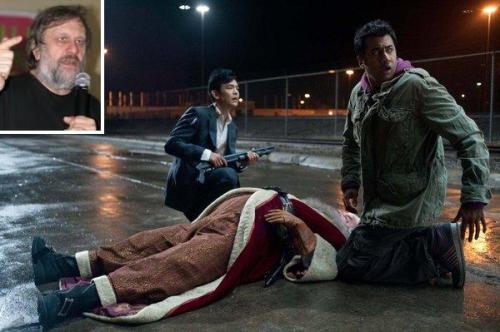
Guest column: Slavoj Žižek reviews ‘A Very Harold & Kumar 3D Christmas’

It would be tempting to perform a crude Freudian analysis of the Harold & Kumar films, to say that in Harold and Kumar we find the basic categories of superego and id respectively, with Kumar as the hedonist that leads the two into a state of peril, and Harold as the rational law-abider who constrains the desires of his friend, and so on, and so on. But this is not the case. We must always be conscious of the fact that the ultimate command of the superego is to enjoy, to fulfil your fantasies; and because the object of desire cannot be attained, it is that same superego that is the source of anxiety. Is it not Kumar, then, who is then the superego? Our desires lead to neurosis only when they are consciously articulated.

We must ask: what is desire in this film? It is not the smoking of marijuana, that forms only a kind of subcultural backdrop to the narrative. Rather, the Harold & Kumar films take the form of the heroic quest: the heroes must go off and find something, they have escapades along the way, eventually it is retrieved and there is the happy ending. In Lacanian terminology this ‘something’ is the objet petit a, the transcendent object of desire. It is the eventual obtainment of this object that renders the first film, Harold & Kumar Go To White Castle, a work of fantasy. What is desirable about the objet petit a is intrinsically linked with its quality of unattainability; it is only in the fantasy-space of the film that such desires can be realised. In the film, the attainment of the hamburger is bound up with the attainment of other fantasies – Harold stands up to the bullies of the workplace, he talks to the girl he is attracted to, and so on, and so on. White Castle is therefore a symbolic representation of all desire. One could comment on the imagery of the white castle itself – in medieval poetry the white castle is a symbol of Heaven or the Kingdom of Truth; then as now the white castle is a transcendent Utopian image – or, as Derrida would have it, a messianic image, an image of that which is always yet to come – in which is encoded our very earthly desires, as in the Islamic fantasy of the seventy-two virgins.

But see what happens in A Very Harold & Kumar 3D Christmas. This is not at all like the first film, the two heroes are not acting on their own desires. Rather, Harold must find a replacement Christmas tree for his father-in-law: he is acting out of a sense of duty towards the Other. The pivotal moment of the film is when Harold tells Kumar that he does not have to replace the tree, rather, it is that he wants to. And again further on, when Kumar faces his responsibility for his unborn child: it is not because he has to, but because he wants to. This is not, I think, a casting aside of duty so much as a reinterpretation of duty. Here, we see the old Kantian conception – Du kannst, denn du sollst! – being dispensed with, it is too rigidly compulsive, it does not sit easy with our liberal individualism. What we get instead is a strange inversion: Du sollst, denn du wollst! – you must, because you want to!

I find this despicable, almost totalitarian, even – far more so than Kant’s formulation. Even our desires are not our own, the hegemonic order insists not only that we do our duty, but that we really want to do so. It is like when Saddam Hussein published his novels under a false name: his megalomania was such that he did not just want good reviews because he is the dictator, he wanted the people to genuinely love his writing. Only when the novels were derided in the newspapers did he republish under his own name and shoot the critics. Is what we see here not the same thing? If there is a message in this film, is it not that we must genuinely love the duties imposed on us by capitalism, that we must find jouissance in the fulfilment of duty?

Where A Very Harold & Kumar 3D Christmas fails is precisely in this attempt to reconcile duty with desire through the matrix of capitalist institutions: the family unit, the workplace, Christmas, and so on, and so on. Duty towards the Other must not be subject to desire! What we must instead admit is that under capitalism our desires are different to our duties, or, in the language of vulgar Marxism, our desires are superstructural to the economic base. Our duty consists of confronting and changing our desires, not in the alienating manner of the Freudian superego, but through the radical project of overturning the current socio-economic order in the name of the Other. Against the false union of duty and desire we must proclaim the primacy of duty, we must, in effect, return to the old Kantian formulation. It is significant that the finale of A Very Harold & Kumar 3D Christmas requires the intervention of the supernatural in the form of Santa Claus: under capitalism, duty and desire cannot ordinarily be reconciled. What is needed in our situation is another form of supernatural intervention – the intervention of Benjaminian divine violence. Only then can this antinomy be untangled.

Acropolis Now

Capital is dead labour, which, vampire-like, lives only by sucking living labour, and lives the more, the more labour it sucks – Karl Marx

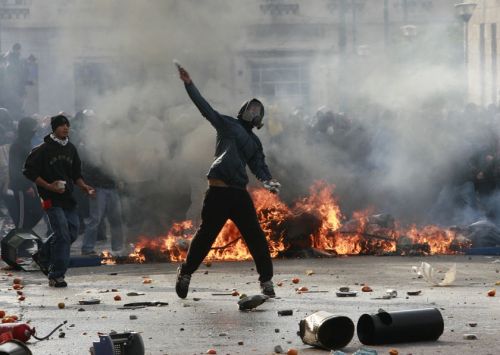
Successive attempts to rescue the Greek economy fail to have any effect. European leaders explain to Papandreou in no uncertain terms that the birthplace of democracy is no place in which to implement it. Forbes magazine hilariously calls for a military coup. The legions of the undead begin to stir… Now the EU casts aside its humanitarian mask to reveal itself for the monster of imperialism it has always been, its neck ringed with the skulls of defeated institutions, its fangs dripping with viscous liquidity. The spectral sallow-cheeked armies of finance capital make circles around the Peloponnese, howling with savage hunger at the juicy public sector, gesturing menacingly with the grim weapons of austerity, their eyes gleaming with blood-lust. A hundred gold coins marked with the stamp of a skull and bearing an ancient curse fall from the bloated fist of Jin Liqun. On the streets of Athens, anarchists fight hand-to-hand with the fire-wraiths of the Elliniki Astynomia. Gibbering poltergeists brandishing court orders pour through cracks in the masonry of family homes and drive out their inhabitants. In a vaulted chamber miles below Strasbourg, decorated with sacred carvings in which Merkel and Sarkozy are depicted in a variety of grotesque sexual positions, the secret haunt of withered seers who divine the will of the Market through the flows of the telluric currents, a thousand hooded forms look on approvingly as Papademos signs their infernal contract in the blood of his people. His hand hesitates over the parchment!… Uproar ensues, dark curses are flung, lightning cracks in the dank air. There is no other option left. Twenty thousand grim-faced German soldiers march in lock-step formation as planes ready their engines for the final assault on Greece: ein Union, ein Währung, ein Zentralbank! Peace and democracy are fine things, but investments are at stake.

Cain vs. Gingrich: Battle of the Scrotums


The Woodlands, Texas. A stage. Two chairs. An audience. The whirring of cameras. Two SCROTUMS are engaged in debate, following the time-honoured traditions of Lincoln and Douglas.

SCROTUM GINGRICH: Mr Cain, as the stunningly handsome business genius who transformed Godfather Pizza into the multinational colossus it is today, what steps do you think will be necessary to infuse American society with the rich tasty lip-smacking goodness that Godfather Mozza-Loaded pizza crusts exemplify?

Frenzied applause.

SCROTUM CAIN: Well, I would say that the American people know better than the Government what they want to do with their money. And clearly what they want to do is use it as kindling to burn down every mosque in the country. And if the Beltway bureaucrats up in Washington DC don’t want to go ahead with that, well then, they need to be taken out of the equation.

Enraptured applause.

SCROTUM CAIN: But returning the question to you, Mr Gingrich: as one our nation’s premier fascists, with decades of experience in the vindictive abuse of personal power under your belt – as a great American, in other words, how do you think we can restore the spirit of our country?

Ecstatic applause.

SCROTUM GINGRICH: I think that there’s this real culture of dependency these days, and that needs to be gotten rid of – if people need food, why can’t they grow it themselves? If people need healthcare, why can’t they perform keyhole surgery on themselves? We have the Internet now, anyone can diagnose themselves with all manner of diseases. Any disease they want. That’s freedom of choice, people! We need to get away from a situation where people are thinking, oh, I have this disease, how is the Government going to help me out? What we need to do is encourage people to start thinking, how can I proactively work to fix my own problems?

Orgasmic applause.

SCROTUM CAIN: Well, I completely agree. This is gonna get taken the wrong way, but, you know, I didn’t take no political correctness school. If people don’t want to go out there and get themselves a job, if they want to be lazy and rely on handouts, and if they’re angry because those handouts are getting taken away – well, that’s their boogie-woogie, as my grandmomma used to say.

Gleeful suicides.

SCROTUM GINGRICH: If I could interject – the other day I received an email from my good friend, the prophylactic industrialist Baron von Rubber. And he told me that our debt crisis could be solved tomorrow if we took everyone currently on government handouts and systematically fed them into an enormous meat grinder to retrieve the trace elements of precious metals within their bodies. And that’s exactly the kind of dynamic forward thinking that the private sector provides, and that’s exactly the kind of thinking we need to meet the challenges of the 21st century.

SCROTUM CAIN: I’m glad we agree. It’s been an honour to debate with you. [He gives an esoteric signal]

Ominous chanting. Lights start to dim. The two SCROTUMS link arms and chant along, a look of hideous glee on their rubbery scrotal faces.

SCROTUMS: [in unison] Ph’nglui mglw’nafh Cthulhu R’lyeh wgah’nagl fhtagn! Ph’nglui mglw’nafh Cthulhu R’lyeh wgah’nagl fhtagn! Ph’nglui mglw’nafh Cthulhu R’lyeh wgah’nagl fhtagn!

A foul-smelling wind is conjured. Lightbulbs shatter. The spectral visage of RONALD REAGAN floats above the podium, his ectoplasm contorting itself into an expression of dread horror. His eldritch Masters promised him an eternity of bliss in the afterlife if he did their bidding on Earth; now he knows that their afterlife contains only more horror. The SCROTUMS chant faster and faster, their jowls visibly distending even in the murky gloom. REAGAN opens his mouth, revealing a dark chamber seething with worms in which rotten teeth protrude like ancient obelisks. Maggots crawl from the depths of his empty eye-sockets. REAGAN blasts the audience with a monstrous scream. The audience prostrate themselves in terror before this Unholy Trinity. A swarm of locusts hovers above them, buzzing like a thousand hellish violins, before coalescing into the shape of the moderator, U.S. REPRESENTATIVE STEVE KING, who strides up onto the stage.

KING: Thank you, Scrotum Cain and Scrotum Gingrich, for this lively and entertaining debate.

The ghastly shape of REAGAN fades. The SCROTUMS shake each other by the hand and exit. Those in the audience that have survived stare blankly into the distance with the deadened eyes of one who has seen past the fictions of everyday life and witnessed the gibbering horror of the Universe as it really is – although they did walk into the room with the exact same expression. There is no respite: the degenerated Punch & Judy show of electoral politics is not over, its grotesque charade can never end – not until the Six Pillared Gate is smashed and the Beast of Khapti’gytag’l is slain. Outside the building, a REPORTER speaks to camera.

REPORTER: Well, Dan, it’s been a very interesting debate here in Texas, with both scrotums agreeing on a whole range of issues. I’m being told that today’s Satanic apparition has caused at most only a few hundred cases of blindness across the country, which as you’ll know is a significant improvement on last month’s debate in Las Vegas. Well, you know what they say, folks: democracy isn’t perfect, but it’s better than all the alternatives.

The dark cloud hanging over the building begins to melt away. Up next on C-SPAN: Michelle Bachmann and Hillary Clinton in a round of Foxy Boxing.

On self-expression

Check this out:

My world is falling, crumbling apart, life is meaningless & that’s just the start
My hearts so sore, I can feel it breaking & I swear to god it leaves me shaking
Late at night till early in the morning, lying in bed eyes wide open. Didn’t sleep last night, like all the others, instead I just lie crying in the covers
Quick, wipe away all the tears before they come near. must hide this depression & the feelings of fear
For all they know I’m happy & always smiling, but deep inside my soul is dying
I can feel it rotting, it wants to scream, but I won’t let it… not for the time being
I can never tell them how I feel cause the happiness I wear to them is real
For them to hear that I wish I was dead… it would kill them, they’d be filled with dread
So I’ll try my best no to be selfish, I’ll keep my secret hidden & just let them rest
but god I can’t take it much longer… I’ll probably be dead before they even wonder.

The teenage author of this poem, as much as they might object, is not really taking off the mask of their day-to-day ‘false’ persona and letting their real unique self shine through in all its tortured tragedy. They are, in fact, simply putting on another mask: their ‘true’ ‘hidden’ self is as much a construct as the face they show to those around them, and this constructed identity is constituted of all manner of external influences: the hegemonic image of the ‘teenager’, music, cinema, television, and, not least, other poems like this one, which are speckled about the Internet like chewing gum and bird shit on a pavement. This example is just one of a brimming ocean of such poems: all employing the same metaphors, using the same key words, expressing the same sentiments. The hormonal turbulence of adolescence and the alienation that pervades society is not enough to account for the sheer homogeneity on display. They are all fundamentally intertextual, in constant dialogue with each other and with other forms of art, creating between them a holographic projection of decentralised teenagerhood. In writing, the author of this piece is adopting the conventions of depression, moulding herself into a particular archetype. It’s not that the depression felt is somehow unreal, but in its articulation it undergoes a culturally informed metamorphosis. Her poem is not an example of art as a form of self-expression, but of the self as something produced by art.

Alexander Semionov, smashing lazy assumptions about socialist realism like Chuck Norris with a paintbrush. I’m not actually going to talk about this painting but I think it’s pretty good

I point all this out because the teenage angst-poem is held to be a paradigm case of art-as-self-expression, and it is in fact nothing of the sort. Writers and artists do not produce their works in a vacuum. A work of art does not emerge from some cloistered part of the soul in which Pure Emotion quivers, unseen by the rest of the world. Artists are not nexuses of infinite subjectivity. They are conduits through which the fabric of ideas and aesthetics that surrounds them achieves its self-actualisation. Art is composed of references and reactions to tradition or the prevailing conventions of the time (sometimes along with outright theft). This holds true for every facet of art: the teenager’s work above is as much informed by cultural norms and the pre-existing canon as Eliot’s frenzied patchwork-poetry. The function of art has never been unadulterated self-expression but always communication. A work of art is a dialogue between creator and viewer; it is at the point of interaction between the two that the actual creation of art takes place. Good art doesn’t just look nice: it is a palimpsest, a space of continual reinscription. A painting locked up in a safety deposit box is not art, it’s just a bunch of chemicals smeared on a canvas. For something to be art it must be engaged with.

Against this, however, we have the Cult of the Artist, which continues to insist that we must know about Van Gogh’s ear to understand his paintings, which situates the Timeless Artist outside his milieu, which upholds individual self-expression as the ultimate source of all art. This obsession has had its opponents from Keats to Barthes, but still it persists: discredited in academia, it hangs on in galleries and auction houses, it dominates the way art is taught in schools, and forms the underlying narrative for the presentation of art to the public.

We don’t always blindly follow the Cult of the Artist, however. When it comes to artefacts from ‘ethnic’ or aboriginal cultures (usually those we Westerners pushed to the edge of extinction and are now equally intent on preserving in some kind of cultural stasis) there’s no consideration for individual artistry or for self-expression. In the popular examination of such works, an emphasis is placed on social function that is unseen in the criticism of contemporary and Western pieces. Art is seen as being representative not of an individual but of an entire culture, as if every member of the tribe gets together to make bone-carvings or tapestries as a commune. This is the case even in instances when such works are exercises in bragging, monuments to shamanistic prowess like the Mojave Desert petroglyph pictured above.

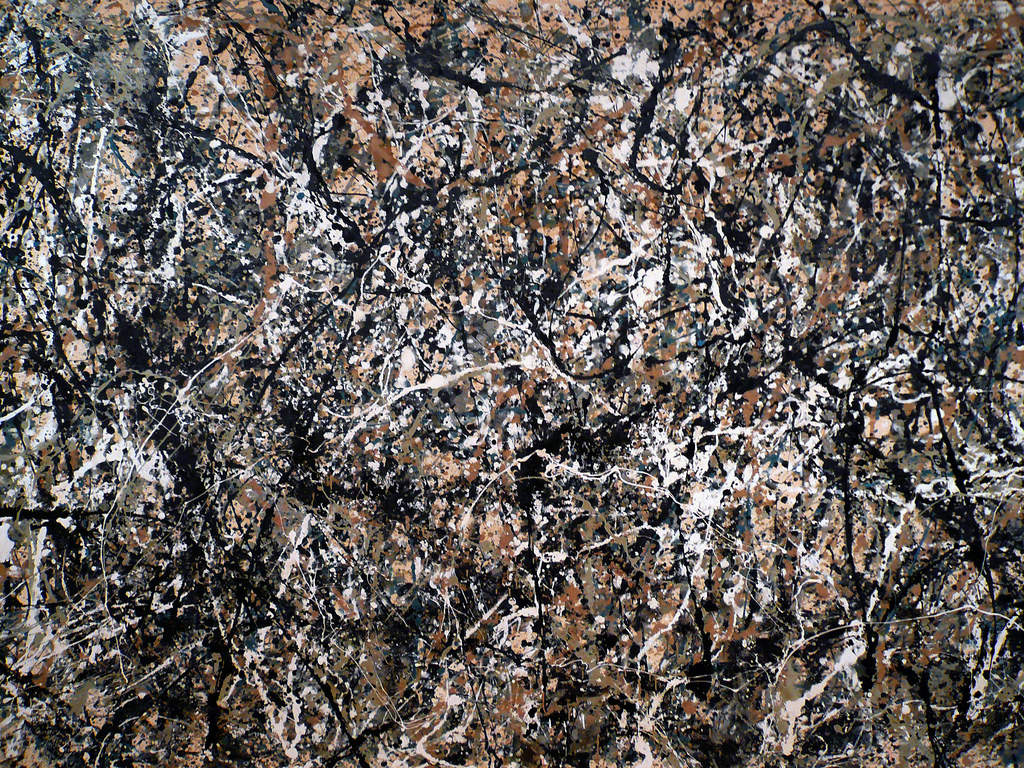
This distinction encodes the idea that ‘our’ art doesn’t actually fulfil any social function. What happens, though, when artists themselves start to buy into their own cult? What happens when, conscious of the existing traditions, they nonetheless attempt to express their Sovereign Indivisible Self? You get asemic awfulness like abstract expressionism, works that sell for millions but that have no discernible aesthetic or semiotic qualities, shit like this:

Jackson Pollock, Aftermath of a Marathon Masturbation Session, oil on canvas, 1950

Here we find the artist so engrossed with the idea that they must be expressing themselves and their hidden inner feelings through art that they forget to actually express anything, let alone communicate. This work induces no emotional response and has no intellectual content; any meaning it might have contained is intelligible only to its creator. If I’m picking on Jackson Pollock here it’s simply because he was by far the worst of the bunch, allowing his vaunted apolitical self-expression to be used as an ideological weapon by the CIA, who believed his series of overpriced squiggles to embody the personal freedom that can (of course) only be realised through the market economy. In a way, they were right: individualism suffuses the work; it’s self-expression for its own sake, empty and meaningless.

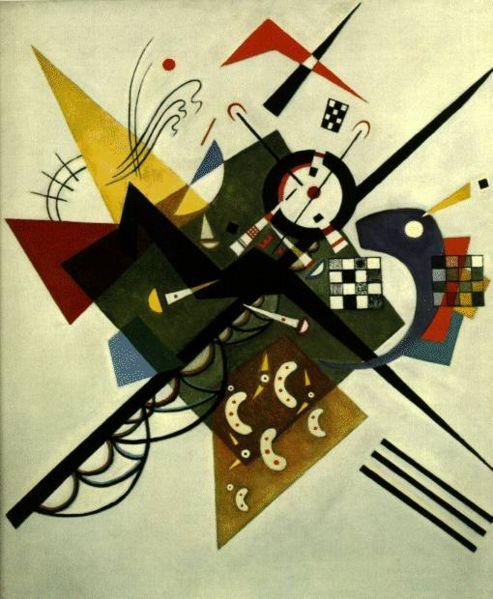
I’m not trying to argue against abstraction itself. There are plenty of artworks even within the expressionist school that are communicative rather than simply expressionistic; but there remains a distressing trend in contemporary art for pieces so wrapped up in their self-expressive qualities that they make any attempt at hermeneutics impossible. As a counter-example, take a work by Kandinsky, one of the pioneers of abstraction:

Wassily Kandinsky, Now That’s How You Fucking Do It, oil on canvas, 1923

In contrast to Pollock, Kandinsky’s abstraction (and even his expressionism) opens up a space for interpretation rather than snuffing it out. We are not commanded to stoke the painter’s ego by trying to imagine how he was feeling as he slapped pigment against parchment. The frozen explosion of lines and colours by themselves communicate a sense of unrestrained exaltation, an emotion not just felt by the artist but induced in the viewer; around its edges we find shapes that could almost be recognisable objects but that stop short of actual representation; in the interplay of organic and geometric forms a strange harmony emerges.

The Futurists of the early 20th Century wanted to burn all the galleries and destroy all the cluttering art of the past (it’s a cruel irony that futurism is now just one of the many aesthetic modes for contemporary art to draw influence from). Perhaps it would be better to leave all the art of the past centuries exactly where it is, but rip the informational labels from gallery walls, blot out the name of the author on every book jacket, to encourage expression, but without the self.

Requiem: Dies iRae

Fig. 1: Infinite fractal reflexivity

There’s a sickeningly hagiographical article in today’s Guardian on the late Steve Jobs and how he ‘changed capitalism,’ courtesy of philosopher Julian Baggini. It’s crude to speak ill of the recently deceased, so I won’t waste too much space pointing out that Steve Jobs made his millions selling consumer goods nobody really needs manufactured in Chinese sweatshops where the workers (clearly not tranquillised into contentment by our clean friendly iFuture) kept on committing suicide. But even within the parameters of obituary, there’s something grotesquely saccharine in Baggini’s article:

Capitalism looks different because of what Jobs’s company achieved. His company challenges both lazy market orthodoxies and idealistic anti-capitalist critiques. In general terms it is true that all these challenges have found voice and expression in our culture elsewhere. But with Jobs they were given a clearer, louder expression, backed up by the incontrovertible evidence his life and company produced. The world may well have been different without Jobs: not so far forward as we are, less beautiful, more in tune with the lowest common denominator. If we found ourselves in that world right now, of course, we would recognise it. But we might not love it quite so much.

Baggini seems to think that Apple’s resistance to the open-source movement somehow proved to the world that quality products demand a premium price, rather than simply showing that a business run along such lines can be successful – and from this somehow draws the conclusion that non-hierarchial modes of production don’t work. At the same time he argues that Jobs’s visionary leadership struck a blow for the Great Man theory against neoliberal models of market forces, because while without him we would still have had mp3 players and tablet computers, they might not have had so much brushed aluminium and those Nice Friendly Rounded Edges we demand in all our consumer products these days. I mean, can you imagine if instead of an iPod everyone had a Zune? What a vale of tears this world would be. This is a shoddily shallow analysis, one blinded by its narrow focus on its phenomenological qualities of capitalism rather than the relations that constitute its actual substance. Steve Jobs didn’t change capitalism, he stuck to its guidebook with unwavering diligence. Style over substance, branding over utility, outsourced production, continually intensifying rate of exploitation, the relentless pursuit of new markets and new profits, all washed down with a syrupy semi-mystical techno-guruism. Henry Ford revolutionised the means of production and the superstructural society that emerges from it. Charging high prices and insisting on proprietary rights does not constitute a restructuring of our economic system. Jobs was an exemplar of the cultural dimensions of late capitalism, but little else.

Across the world, dedicated iVangelicals are leaving flowers outside Apple stores. It’s appropriate, in a way: buried in this gesture is the recognition that Steve Jobs was not so much a man as a projection thrown up by his products. This is commodity fetishism taken to its logical conclusion – products are imbued with so much importance that they take possession of their inventor; not content with mere reification, they eat him from the inside out.

RIP Ms Hou, Liu Bing, Mr Li, Ma Xiang-Qian, Mr Li, Tian Yu, Mr Lau, Rao Shu-Quin, Ms Ling, Lu Xin, Zhu Chen-Ming, Liang Chao, Nan Gan, Li Hai, Mr He, Mr Chen, Mr Liu, Wan Ling, Mr Cai, and two whose names are unknown

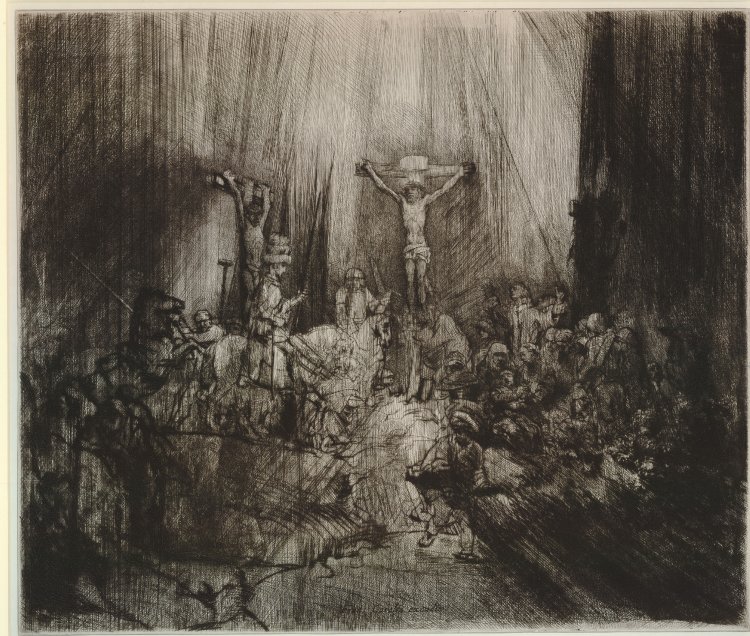
Gestas

Father, forgive them; for they know not what they do

We did it all Dismas and I we took ‘em all I’m not sorry out in the desert we’d wait for the caravans and ride on over slice ‘em across the throat real quick the poor fuckers they had no idea we were coming before we were there and then we’d ride off with their stuff all the camels everything the camels never once faltered they never looked perturbed they don’t give a shit about people frankly and if you ask me they’ve got the right idea I’m not sorry sometimes we were out in the desert for days on end drinking as little as possible thinking about eating our horses the first time I did it with Dismas I was ashamed it’s an abomination I said we’re bandits he said we’re evil in the sight of God anyway and back in Jerusalem we got some whores and I felt better and eventually I wasn’t ashamed at all it’s not like I wasn’t brought up right or nothing our mum knew right from wrong all right she’d never fail to impress the wickedness of my actions on me she could swing a rod like nobody’s business I guess that’s why I went out into the desert because if I’m so bad I might as well do it properly but also because what the fuck else was there to do I could have joined the legions and died in some fetid bog up along the Rhine by the sword of some half-naked barbarian for an emperor who’d never know my name for the fucking Romans who killed my old man or I could hang around in Jerusalem doing odd jobs and living hand to mouth fuck that I’m not sorry every time we came back we’d get completely pissed on that good wine only the Romans can afford and get some girls and I’d see my mum and she’d cry that always left me feeling weird like someone had scooped out all my guts but it’s the life I chose and this is the death I chose too even if I didn’t realise it at the time I’m not sorry

Verily I say unto thee, today shalt thou be with me in Paradise

When they first hammer the nails in it’s all you can think about the pain screams at you it blocks out everything you can’t see there’s nothing except you and the pain but it fades it fades everything does until it’s just a dull ache and after a few hours you forget about your wrists and your feet because it’s every part of your body hurting now being stretched out every time you take a breath you can feel it in your stomach your legs your arms they start to ache but it’s a slow ache you’ve got time to reflect all the time in the world you can hardly speak though it hurts too much but Dismas is trying he’s trying to talk to Yeshua kook if you ask me never had any time for God myself all those priests up in the Temple eating the burnt-offerings they’ve got a pretty good racket going on next to them I’m holier than fucking Ezekiel and Yeshua’s lot I liked even less because they all had this terrifying sincerity about them like they actually believed and all that shit about no more rich men and no more poor men well that’d put me right out of business wouldn’t it if there were no more rich men to steal from I can’t see Yeshua’s face from here but I bet he’s got that look of smug serenity and I croak out even though it hurts so much save us I say if you’re the Messiah then save us why don’t you and Dismas turns to me and I see the sweat running down his face and his blood clotting in the pores of the wood and he says we deserve this Gestas we fucking deserve this we killed all those people and Yeshua ain’t done a thing wrong Dismas of all people coming up with this shit it was his idea to start with I liked the money and the leisure but I think he really enjoyed it when we robbed those people he got off on the violence and he turns to Yeshua and says I believe in you don’t forget me and Yeshua says he says he

Woman, behold thy son!

The aching is worse but I can still see not Dismas he can’t his head is bowed down I think he’s unconscious not sure  his ribcage is still rippling under his chest still breathing I feel betrayed almost but I can’t blame the guy if he really thinks Yeshua can get us into Paradise I envy him there’s people around Yeshua’s cross women disciples his little band of weirdos and outcasts wailing and sobbing soldiers too of course holding them back there’s nobody weeping for me most of the mob’s gone now I thought they were there for us but it was for Yeshua although a good heavy rock to the head would send me off nicely right now better than the alternative if you know what I mean and then down the hill from Golgotha there’s the brown smudge of Jerusalem all the smoke coming out from all the chimneys across the city the whole place is choked by its own miasma and the sounds drifting up an amorphous hubbub the squawk of chickens the cries of traders the clacking of carts everything sourceless formless it swirls around me the Temple though you can see the Temple its crenulated walls with their big cyclopean stones it rises right out of the noxious haze it seems to burn in the sunlight yellow and gold the thin black line of smoke from the burnt-offerings while in the cloud below a thousand colours swirl in the gyre you can’t see exactly where it ends but the hills rising up all around soft and green somewhere in them a little stream is winding merrily through the trees hares are dancing the air is full of the joyful buzzing of the insects everything is throbbing with the sheer vitality of it all there are no trees here no shade only dry earth and rocks scattered about and the holes in the ground where they plant the crosses the dirt is stained sienna piebald with dried blood when the wind picks up it blows all about my face I close my eyes but it still gets in my nose my mouth tastes of my own breath so dry my sweat-salt crystallises everywhere I itch all over so dry

Eli, Eli, lama sabachthani?

The wave of darkness I saw it cross the hills sweep across the forests wipe clean across the city I’m plunged into it the sun’s changed now it’s a thin ring of light and just black in the middle fuck everything’s dark it’s like an eye the eye of God looking down and I shrivel up before its gaze yes I have done wrong yes I have sinned every evil thing I have done it and I am sorry I really am I know I cannot be forgiven cast me into Sheol let me wail in its darkness for eternity only avert Your eye I can’t face its accusation I can’t bear Your presence everyone’s terrified the soldiers too the disciples are praying because they all know that they’ve done wrong they all feel the interrogation of its eschatological gaze I can see them cower I can still see my body is a pallid purple glistening like a cadaver but from him from him from Yeshua there’s a glow faint but there’s a glow tendrils of light barely visible spiral around his head they reach out to the disciples to the Romans too even them encircling them winding around them all over Dismas caressing his face not to me though not to me I know I don’t deserve it I wonder if they can see it or if it’s only me shapes now bursting out phantasms made of light they’re

I thirst

Everything I can see everything still I don’t understand galaxies collide stars burn and fade nebulae swirl and on our little rock our tiny island in a vast empty sea our pinprick speck hanging in the middle of so much emptiness we pull ourselves up from protozoa to Praetors from eukaryotes to Yehudim apes band together and shed their fur they build cities they crucify people outside the walls Golgotha this planet the rock of the skull I don’t understand

It is finished

Torn concrete and the mangled wrecks of cars rubble in every corner no surface is even fractures everywhere fissures running across the ground the churning swirling blackness of the sky not black not black exactly the dim light of the sun up there somewhere its light diffused in the cloud so all its furrows glow with an unearthly light that cloud looking more solid more real than the ruins the broken glass the chunks of concrete the twisted steel littered about in the jagged husks of the skyscrapers a few fires still burn flashes of orange scattered across the scorched landscape the only colour nothing is alive here no birds no insects there’s only the wreckage the charred skeletal trees the bones and the ash hanging in the air twirling in the wind finally coming to rest like it’s snowing heaping on the branches of the dead trees more now a flurry of ash carpeting the craggy ground make it smooth again blanketing the burnt-out tanks the contorted cars hide their shame make everything white again make it white and blank I can see everything still I don’t understand the mud a sea of mud shells bursting overhead the sky glowing with artillery a group of men running across the mud rifles in hand they are mired in its stench a machine-gun rattles and they fall they sink into the mud and in the distance far off but visible villages and vineyards trucks rattling over the unpaved roads I can see men with arms like sticks in striped shirts clinging to barbed wire eyes blank just looking stripped of all feeling not speaking I can see a wooden ship crammed with people shitting and vomiting in cramped cages gaping sores seeping pus rocked by a tumultuous ocean I can see soldiers in red uniforms before a moaning crowd children clinging to their mothers’ saris they fire gunsmoke billows and there is silence I can see a line of people their hands bound slowly walking up the steps of a pyramid to an altar where a man cuts out their hearts with an obsidian knife I can see the riders of the steppe bursting into the city I can see helicopters clattering over thatched roofs I can see missiles streaking through the sky I can see arrows arcing over the green fields I can see Cain weeping over the body of his brother I can see everything but still I don’t understand

Father, into Thy hands I commend my spirit

When I was ten years old I stole a trinket from a market stall a ring I think I didn’t know why I just saw it and took it and afterwards I walked with a strange gait like I wasn’t sure if I should be slouching with shame or striding triumphantly I had this feeling like an insect was gnawing away at me from the inside I showed the ring to Dismas and he said it wasn’t real gold and I said it looked cool anyway and I wore it on my finger just to show him and later that day near dusk when the slow-burning sun drapes a golden veil over the whole city I ran into the market-trader’s son and some of his friends and they recognised me at once and really laid into me they kicked the shit out of me I didn’t cry though even when I was spitting blood I didn’t cry because I remembered my dad didn’t cry when the Romans nailed him up for sedition I limped back home scuffed and bleeding my lip swollen one of my eyes all bloodshot none of the people on the street paid me any attention it wasn’t their business they didn’t want to get involved but when I got home my mum made an awful fuss she was wailing and raging and I told her everything the whole story and she didn’t get out her rod to strike me for stealing she wrapped her arms around me and I cried finally I cried and she said it’s OK now you are safe you are forgiven you are safe and I was I was home and I was safe and I was forgiven.

Stevie Cobb and her Incredible Rhizomatic Orchestra

four in the morning in nasville tennessee.  stevie cobb is deconstructing the keyboard. stevie cobb is dreaming strange dreams. stevie cobb is metabolising glycogen. stevie cobb can do several things at once. stevie cobb is a multiplicity of multiplicities.

silence. the faint dusty smell of an empty theatre. the slightly mournful stage lights bright. all bright. on stevie cobb’s shirt the dandruff. sparkling. on stevie cobb’s arms the fine network of wrinkles. bits of piano everywhere. reels of piano wire. keys scattered all over the wooden floor dispersed. like teeth after a bar fight. the brooding tenebrosity of the concert hall behind her seethes. the hazy orange light coming in through the windows. casting strange shapes on the opposite walls. stevie cobb is deconstructing the keyboard.

the problem with the keyboard is that it is a series of channels. blighted by organicity. entire purpose is to channel and direct musical flows. impede lines of flight. arborescent sequencing built into its construction. but you need a piano. there’s not a piano part in the piece the orchestra is to perform. you need a piano. so you have to deconstruct the keyboard. find the subtext of the piano. probe apart its internal contradictions. start with the black and white notes. a binary in urgent need of expansion. stevie cobb rewires the black and white notes. white notes sound flat and sharp now. but that’s just inversion. make them multiple. there’s a lot to do.

it’s two in the afternoon before the keyboard has been fully deconstructed. light in the windows. people bustling about around her. the light here always has the consistency of treacle. it doesn’t pour in bright and clean like water from a tap. slides down the walls. heavy light. it’s clammy. the sweat of pride. droplets that cover stevie cobb’s forehead. like thorns. like blisters. she pulls back the cloth. behold the schizopiano! there’s only seven strings now. one for each octave. and a sliding mechanism. stevie cobb holds a pedal. runs her hands along the keyboard. hinges churn. mechanical arms sweep up and down from inside the piano. it seems to be working. stevie cobb releases the pedal and plays the first couple of bars from the finale of rachmaninov’s third piano concerto.

dum da-dum da-dum-da-dum-da-daa da (ba bee boop boop ba bee boop boop) DUM da-dum da-dum da-dum-da-dum-da-daa…

players applaud. it’s not quite the same. the sound is different. notes almost melt into each other. like a steel guitar. stevie cobb is pleased with it. could have done more. could have prised apart the false unity of the note. have the whole piano play a single note. b flat.  for instance. every key a different imagining of b flat. different timbres. different moods. you’d need eighty-eight schizopianos. but it would work. the chords that would sound out from such an array! she’d need to write scores in three dimensions. time note emotion. next time.

still work to be done. for a start. how can you deterritorialise a bassoon? how do you situate it away from its bassoonicity? stevie cobb flicks the bassoon with a single serrated fingernail. you have to see beyond the bassoon. you have to consider the bassoon as what it could be rather than what it is. what is the body without organs of a bassoon? how are we to go about precipitating the bassoon’s becoming-other? start by considering everything the bassoon is not. find the break. the line of separation. feel for its molar segmentarity. then dehierarchialise it. smooth out its striated space. what isn’t a bassoon? it’s not a castle. a light-bulb. it’s not a. a. not a. a fish. it’s not a fish. turn the bassoon into a fish. give it gills. in a frenzy stevie cobb stabs the bassoon with a boxcutter denting tearing. give it gills.

so much to do. some of the players are worried. the performance is tonight and stevie cobb is still modifying the instruments. they know of course that ‘performance’ as an event situated in space and time is a structural construct. they know they must operate according to nomadological principles. they know they must tunnel through the various striations. performance. concert hall. audience. wipe them smooth. but still. the performance is tonight. and stevie cobb is still modifying the instruments.

some of them are practicing. but sometimes stevie cobb comes up behind them and grabs the instrument out of their hands seize it. she’ll peer at the thing as if she can’t quite understand what it is. look at all the other ways you can make sound from this. listen to this. she raps on the body of the cello knuckles tapping hollow. a musical instrument is a text. it has its dominant readings. it has its subversive readings. it can be deconstructed. maybe hit yourself over the head with it. she demonstrates. listen. it’s sonorous.

has stevie cobb gone mad?

the performance. people cluster in the lobby. black jackets. white shirts. black dresses. red shoes. cologne. lipstick. a smell. cigarette smoke. malt whiskey. perfume. stevie cobb designed the posters herself. debussy’s la mer. big letters. as performed by stevie cobb’s incredible rhizomatic orchestra. small letters. laura turner concert hall. schermerhorn symphony center. nashville tennessee.

stevie cobb watches them file in. sitting on the podium. small puddle of warm light around her. boxer shorts. grubby t-shirt. skinny legs pale. bristling with fine hairs pale. dandruff. scratches her hair. she hopes there’s a riot. she’d give anything for a riot.

madames et messieurs. sous votre siège il y a une flûte. il peut faire beaucoup de sons. les frapper les uns contre les autres. si vous voulez. some of the audience don’t understand at first. but as their neighbours retrieve the flutes they too reach under their seats. they hold them in their laps. perturbed. we will not play music to you. we reject the false binary of performer and audience. play your flutes. at any time. any way you want. play them now.

silence.

resignation.

one. two. one two three four.

first movement. de l’aube à midi sur la mer. soft. low. brass quiver. shimmering waves of strings. crescendo almost reached. back down. rolling. those in the audience who know the piece sit with an air of studied recognition. the sounds are all a little different. but not too different. a clarinettist rips two pages from his score. suddenly he is playing a triumphant major theme. others follow suit. scores upside down turned. cymbal spins over the audience like a discus. like a frisbee. crash against the far wall. paint and plaster shower down. the whole piece being played at once. no discord though. rhizomaticity is not atonality. swells and lapses still. melodies intertangling. stevie cobb licks her baton. the oboe a plodding melody. stops. silence. cymbalist swings the remaining cymbal by one edge. smashes it against the xylophonist’s head. all instruments burst into sound. drag the players along with them. a glorious swell. you can pick out one instrument. listen to its melody alone for a few seconds. then let it sink back into the harmonious cacophony. or listen to the strings as they cut angles across each other. or the vocalists coughing melodiously. the contrabassoonist and the tubist are kissing passionately. they swap instruments and return to their music. then break again to resume.

first flute notes waft from the audience.

stevie cobb remembers. the old white house in the catskills. running through the forest scabbed knees. climbing the cliffs. blood and mud. why don’t you play with dolls like all the other girls. remembers. later. mrs elderman the piano teacher. stephanie you need to play according to the score. the music rises like the mountains. the flutes. the audience. lofty trees packed like commuters on trains. undulating. and in the autumn the screeching tumult of red and orange and brown. cloud-carpets of leaves. someone rushes on stage from the audience. starts to play the schizopiano. the prickling of leaves on her back as she lay with adam on the forest floor. that summer she saw the sea for the first time. fourteen. a tidal wave of flute music from the audience. like a single note. the music twisting sinuously around it. until the last line of flight stretches out to infinity and the surging sea is stilled. first movement over. a lingering air of melancholy.

the audience leaps to its feet. applause commotion. so daring. so inventive. so unusual. so exciting. what an experience.

the first gentle notes of the second movement. jeux de vagues. scherzo. audience waiting for the furore to begin again. giving them permission to join in. licensed anarchy. structured rhizomaticity. safely ensconced in the soft prison of culture. what fun.

stevie cobb sits dejected. it’s all working perfectly. they loved it. it has been a failure, an utter failure.