Idiot Joy Showland

This is why I hate intellectuals

Tag: politics

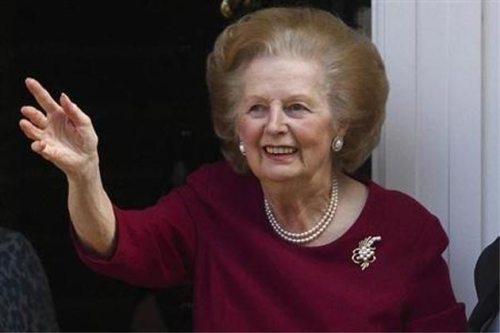
Scenes from the Thatcher funeral

thatcher

What had she done with all the milk? That’s what we should have been asking: what had she done with all the milk? By the time we found out, it was too late.

At first it’s almost imperceptible. Mourners shuffle past the open coffin as it lies in state. She looks different, they think, but it’s hard to say exactly how. It’s true, she seems a little fuller in the face than one would expect, plumper, like an over-ripe fruit – but at the same time white, deathly white.

Within a few hours its hard to ignore. Something horrible is happening to the former Prime Minster. She’s grotesquely fat, and visibly growing. As Ed Miliband delivers a heartfelt speech his already clammy skin begins to drip with sweat; Nick Clegg, in the front row, collapses into Cameron’s lap. A sour aroma rises. One of the Queen’s Bodyguards of the Yeomen of the Guard standing guard over the coffin starts to vomit uncontrollably; soon the other three are unable to hold themselves back either. Baroness Thatcher swells and pales until her body barely fits in the coffin. The imperious hawk’s beak of a nose sinks into the bloating flesh. She looks like an enormous blancmange; her skin seems like it’s about to burst. Then it does. The first fissure tears its way through what was once her forehead. A high jet of milk streams out into the vaunted ceiling of Westminster Hall; the news cameras follow the triumphant ejaculation as it arcs up and descends, splattering a group of Young Conservatives. The coffin shatters. A tidal wave of milk rushes through the hall. The stench of rot and acid is incomparable: hundreds of thousands of gallons of milk, hidden away in some dark warm recess of her body for forty-three years. As the mourners drown in the sea of putrid milk some are dragged down into its depths by heavy caesin blobs. Others are not so lucky: the smaller curds swarm and envelop them, leaving nothing but whitened bones and shreds of corduroy. The massacre completed, they swim together, and begin to converge…

Thatcher bursts through the roof of the Palace of Westminster. She is one hundred feet tall and brutally nude, her limp dugs shimmering with the semitransparency of milk. Somewhere, buried deep in her monstrous frame, are dark reddish shadows: supported on rusting bones formed from the frames of long-dead factories, the Iron Lady strides out into the Thames, and howls. From down the river in Canary Wharf a howl rings out in reply.

We thought she was dead, when in fact Margaret Thatcher was never alive. Not as we knew her, at least. If she ever existed, the grocer’s daughter from Grantham died a long time ago, and something else, scuttling like a hermit crab, moved into her body. She was animated by the false life of things, the undead hum of markets and brands and commodities, the image of life that opposes life itself at every turn. How could such a creature die? When her heart shuddered to a halt, it only freed the Thing inside from its fleshy prison.

Everything makes sense now. Why did she fight so hard to close down the mines? They were digging too deep, burrowing too far into the cold heart of the earth; there was something down there that she didn’t want them to find. Why did she introduce a poll tax? Because her alien sentience could never comprehend any differentiation within humanity. Why did she send young men to die for the Malvinas? Because without access to the magnetic flux streaming from both poles of the Earth, her plans to gain immortality would be doomed to fail.

We stand, quivering, waiting for the monster that was once Margaret to smash our cities, pound our homes to splinters, rip up our infrastructure, bat away our fighter jets like flies, tear apart our society, leave us cold, enslaved, and alone. It doesn’t, though. It just stands there, ankle-deep in the river, the crooked slit of a grin stamped on its milky mouth. Its work has already been done.

Why George W Bush is the greatest living painter

Political violence is the continuation of art by other means. Wherever there are shock troops marching in the streets or big pyres of burning books or the sounds of mysterious gunfire near the parliament building at night, you can bet that behind it all flutters the soul of a sensitive young boy who always wanted to be an artist. Brutishness is easy; anyone can commit an atrocity in the right conditions. Violence requires a highly rarefied aesthetic sensibility.

Painters carry out wars of aggression. They’re in love with the image of things. Poets go for internal ethnic cleansing. The word must be properly spoken. Prose writers like revolutionary terror. The text is radically open. There have been fewer dictators from the other arts, but we could extrapolate. Photographers make good use of death squads; the gaze and the judgement are united in the click of a shutter. Sculptors are big on mass internment; the body is always already buried in the rock. Playwrights tend towards bureaucracy, musicians to exemplary massacre, film-makers to redistributive looting. Lenin and Mussolini wrote prose. Stalin, Mao and Ho Chi Minh were poets. Saddam Hussein wrote poetry alongside his anonymous novels. Churchill was a painter. Hitler was a painter, but he penned a few verses as well. George W Bush is a painter.

 This is the void. A line of detainees goes in, shackled, shuffling along in orange jumpsuits. Paintings of dogs come out. Nobody knows exactly what happens inside, or if they do, they don’t say.

George W Bush has produced fifty paintings of dogs. For every drone strike he ordered, he has produced one painting of a dog. For every round of golf he played while in the White House, he has produced two paintings of a dog. For every million Americans left unemployed at the end of his administration, he has produced five paintings of a dog. George W Bush has produced one painting of a dog for every thirteen US soldiers killed in Afghanistan during his Presidency, one painting of a dog for every hundred Palestinians killed by the IDF, and one painting of a dog for every two thousand, two hundred and thirty-seven civilians killed in Iraq since the invasion. Bush’s art teacher told reporters that he would go down in history as a great artist. I think she’s right.

There have been a couple of critical pieces on Bush’s paintings, and they all ask the same question: what do these paintings tell us about George W Bush’s inner life, or his psychology, or his presidency? They’ve all got it arse-backwards. If you follow that line you’ll only ever end up with trite reductive analogies. The running water represents Hurricane Katrina, or Bush’s need to atone for his crimes, or his fear of death; it’s a vaguely amusing parlour game, but not much more. If you want to know the truth, there’s no point looking at Bush’s self-portraits. You have to look at his paintings of dogs. The real question is: what do George W Bush’s dog paintings tell us about contemporary society? What do George W Bush’s dog paintings tell us about violence? What do George W Bush’s dog paintings tell us about art?

Imagine a creature from another world, something impossibly old and infinitely curious. Drifting between silent stars, she picks up a single stray transmission from an unknown planet in an uncharted backwater of the Milky Way. A picture of a dog. If our alien has eyes to see, she’ll be able to extrapolate our entire world from George W Bush’s painting of a bichon frisé on a blue background. A hierarchical class society looks out from its sad round eyes, capital accumulation can be inferred from the downwards tilt of its mouth, its outstretched paws tell you everything you need to know about the long slow decline of the nation-state. Most of all, though, our history is inscribed in the featureless blue plane on which the dog reclines. In fact, it’s swarming with tiny figures: child miners coughing dust, factory workers plunging from rooftops, women with acid scars bursting across their faces, people who wake up shaking from the bombs going off in their dreams, people who wake up shaking from the bombs going off in their ears. A society capable of producing that shade of blue leaves a lot of bodies in its wake.

Spend enough time looking at George W Bush’s paintings of dogs and it all starts to make sense. The war in Iraq was little more than the geopolitical expression of kitschy sentimentality. Imperialist universalism is the logic of the dog painting extended to nations and peoples. Radical evil is the weaponisation of bad taste. We’ll be greeted as liberators: of course we will, we love our dogs. History is on our side: of course it is, we like nice things. Our war will usher in a new age of peace and stability in the region: of course it will, we leave bright colours in our wake. George W Bush’s paintings of dogs represent a new height in Western society’s struggle to decouple art from violence. (This is why his nude self-portraits are all in bathrooms: only in the cleansing ritual is nudity non-erotic, and eroticism is after all only another form of violence.) It’s an impossible task. Violence and art are inseparable; the more you try to scrub the canvas clean of everything not clean and pleasant, the more hideous it becomes, the heavier the rain of bombs.

That’s why George W Bush is our greatest living painter. Nothing expresses more clearly the horror of existence than the most hated man in the world’s loving portrait of his dog. More than any gloomy conceptualist, Bush gives us the truth, the undisguised omnicidal violence of the nice and friendly. His paintings of dogs point towards the one subject all other contemporary art shies away from: the final extinction of the human race. Bright eyes and wagging tails, cities in ruins and skies scorched black. Art kills.

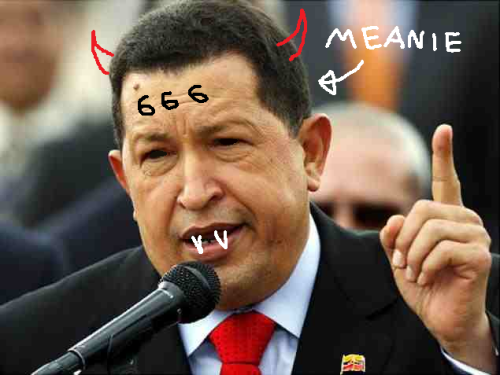
Every Hugo Chávez obituary in the Western press

Darth Hugo Destruktor Chávez, the outspoken and inflammatory Venezuelan leader, died yesterday in Caracas when the Invisible Hand of the free market reached down his throat and shook loose his gall bladder. He is survived by his four children and his millions-strong army of terrifying cyborg drones.

To his supporters and those implanted with his mind-controlling Chavismo-chips, Chávez was Emmanuel, the reborn Christ. To his detractors, he was Double Hitler. As ever, the truth is somewhere in the middle – while he was certainly born, he was not Christ; and while there was only one of him, he was most definitely Hitler.

Hugo Chávez exploded onto the world stage in September of 2005, when he took the stand at the United Nations General Assembly to complain at length about the air conditioning. However, he first came to prominence in the hitherto-unknown land of Venezuela in 1992. In that year, he and a band of avaricious raiders attempted to steal the Seer’s Eye, an enormous sapphire kept in the vaults of the Federal Legislative Palace. Thankfully, his plot was foiled, and the stone was destroyed before it could be used as a component in Chávez’s Ionising Doom Cannon, a laser weapon that would have been capable of extinguishing the Sun.

However, that which is dead cannot die, and Chávez escaped the dungeon dimension he was cast into to come to power in 1998. While not going so far as to actually do anything remotely dictatorial, Chávez was far from a democratic leader. Instead of competing honestly in elections, he provided services and raised the standard of living for the people of Venezuela, ensuring their gratitude and thereby gaining an unfair advantage at the polls. Much of the funds for this insidious election tactic of ‘making things better’ were rerouted from the newly nationalised oilfields: through this wanton kleptocracy, billions of petrodollars were withheld from deserving rich white people. Under his rule, the murder rate soared; a tend analysts have linked to his predilection for riding round Caracas slums at night and picking off pedestrians with a hunting rifle.

Absolutely nothing happened in April of 2002.

On the international stage, too, Chávez made some severe missteps. From his innumerable lazy Sunday morning lie-ins with Mahmoud Ahmedinejad, in which he and the tie-hating weirdo spent hours curled up together on the sofa watching reruns of Friends, to his decision to travel back in time to 1939 and sign the Molotov-Ribbentrop Pact on behalf of both nations, Chávez maintained a policy of automatic support for tyrants, dictators, traffic wardens, accordion players, queue-jumpers, and other evildoers.

For all the vaguely defined suffering that I’ll assume he’s caused, Chávez’s death opens up new opportunities for Latin America. Freed from his yoke, leaders across the continent are now free to abandon his schemes for mutual assistance and non-usurious development lending. Only a broad network of grassroots citizen activists stands between the Venezuelan people and the rapprochement with financial imperialism that they definitely want, even if they don’t know it yet.

I’ve always thought that a good way to test the sincerity of anyone who claims to be on the Left is to find out their attitude to Hugo Chávez. Those who try to disavow him tend to be, in general, useless: they want a pure, ideal socialism, not socialism as a real material movement. Chávez wasn’t perfect. In some areas he went too far; in many he didn’t go nearly far enough. Nonetheless the immense good his Bolivarian Revolution has done for the people of Venezuela – and for people across Latin America and the world – is undeniable. What must be remembered, though, is that Hugo Chávez didn’t do any of this alone. His achievements were those of every doctor, teacher, worker, farmer and organiser who worked to improve the lives of those around them. The social movements he helped build and connect will long survive him. Descanse en paz. La lucha sigue.

Italian election: the opera

OVERTURE: A symphony in three movements for orchestra, piano, articulated lorry, stock ticker, and tear gas canister.

ACT ONE

SCENE ONE: We are in Venice, at the start of the eighteenth century. Doge MARIO MONTI (tenor) sings the aria Siamo tutti fottuti from the balcony of his palace, in which he explains to the people of the city that a strange beast called il Mercato is stalking the streets and canals of the city at night, killing animals and destroying produce. The beast, which has ‘eyes that dance with the spark of lightning and claws with the chill of ice,’ has been sent to punish the Venetians for their profligacy and excess. Monti reveals that only he has the power to rein in the beast’s destruction, and claims that its wrath may be stilled if one child is drowned in the Grand Canal every week. He then announces that despite the beast’s reign of terror, the annual masquerade carnival will go ahead as planned. Inside his palace, Monti sings a duet with his lover, Donna ANGELA MERKEL (soprano). He assures her that their plan will succeed; she complains that his skin feels like old parchment and his breath smells like a cauliflower fart in a crypt, and notes with alarm that he sometimes licks his eyes like a lizard when he thinks she’s not watching.

SCENE TWO: The disgraced nobleman DON BERLUSCONI (baritone), our hero, reclines in the Palazzo Bunga-Bunga surrounded by North African prostitutes. He sings the aria Io scopare tutto ciò che si muove, lamenting his fall from power at the hands of Merkel and the court case brought against him by Monti. He vows to his manservant, ROBERTO MARONI (bass), that he will have his revenge against those who wronged him. Maroni suggests that they try to embarrass the Doge at the masquerade. He then sings Quest’uomo è un idiota, a mournful reflection on the frailty of man.

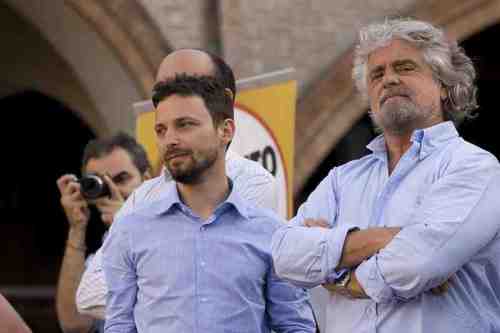
SCENE THREE: In a town square, DON BERSANI (countertenor) sings Il centrosinistra è politicamente praticabile, but nobody cares, and the audience is distracted by a juggler who comes onto the stage and performs a few basic tricks. The famous drunk BEPPE GRILLO (baritone) criticises Monti’s decision to start drowning children and vows to overthrow him. A CHORUS of citizens sing their support. Don Berlusconi watches from a window, and reflects that he could use Grillo’s popularity to engineer his revenge.

INTERLUDE: Twenty fascist football hooligans beat the shit out of an oboe.

ACT TWO

SCENE ONE: The day of the masquerade has dawned and Grillo is addressing a crowd. Watching him from a window, Don Berlusconi realises that he has fallen in love. He sings the aria Seriamente, qualsiasi cosa con le tette, in which he recounts his past romantic conquests and reminisces fondly over his simple past ‘when I had nothing but a media empire, an advertising company, and a construction firm.’ Across the street, Don Bersani has also fallen in love with Grillo. He and Don Berlusconi sing a duet in which each tries to prove his worthiness as a suitor, unaware that the object of their affections already left some time ago.

SCENE TWO: In a nearby tavern, Grillo reveals his plan to overthrow the Doge. He will attend the masquerade disguised as Don Bersani, who will not be attending because ‘that baldie loser hates parties.’ To prevent the suspicion Grillo’s absence would arouse, one of his followers will go dressed as him. As Monti must mingle without his bodyguards during the masquerade, he will then take the opportunity to challenge him to a duel. In the same tavern, Don Berlusconi discusses his plan to reclaim power and win Grillo’s heart, telling Meroni that he will do this by going to the masquerade dressed as a sexy nurse.

SCENE THREE: The masquerade begins. Doge Monti inaugurates the ball by singing the aria Più soldi più problemi and then by slow-dancing with Donna Merkel, to the disgust of all present. A visibly coked-up Don Berlusconi tries to seduce the man disguised as Grillo by singing Sono un ragazzo divertente, vero? to him; however, he is rejected. He then sees Grillo, dressed as Don Bersani, conferring with his follower. Assuming that his rival is making a similar attempt, he becomes inflamed with jealousy and draws his sword. The two fight. In the panic that follows, Don Berlusconi is killed by Grillo, who is dressed as Don Bersani; Grillo is killed by Maroni; and Doge Monti is killed by Don Bersani, who has attended the masquerade after all and is dressed as SpongeBob SquarePants. After the tumult of battle has cleared, only one man remains.

INTERLUDE: An old woman complains about how there’s never anything good on TV.

ACT THREE

SCENE ONE: The only survivor of the masquerade, still in his mask, proclaims himself Doge. He explains that the beast il Mercato was invented by Monti to control the people and that the citizens of the city are finally safe. Near the end of his aria E ‘tempo di formare una coalizione ragionevole, just as he prepares to reveal his identity, the monster bursts onto the stage, kills him, eats half the audience, privatises the opera house, and sells it to a real-estate developer to be turned into a branch of Pizza Hut.

Forget Orwell

obama-orwell

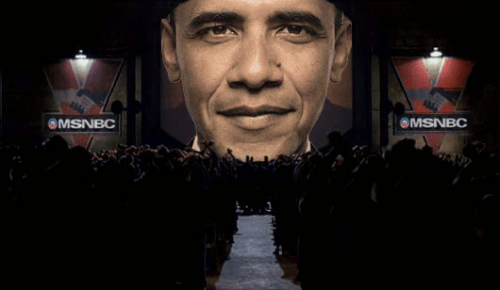
Monday of last week marked the first annual George Orwell Day, seeing Penguin’s rerelease of several of his books, mass giveaways of his essay Politics and the English Language, and the launch of an Orwell season on BBC radio. (Purely by coincidence, it was also ‘blue Monday’ – the day calculated by to be the most depressing of the year.) For a supposedly radical writer, Orwell fits very comfortably into the cultural mainstream. Certainly it’s easy to claim that Orwell’s been hijacked by the political Right – witness the countless chiding voices from the Left reminding those that hold up the Obama administration as a prophecy fulfilled or recommend Animal Farm as an education for naive socialists that Orwell was, in fact, actually, despite what you might think, incredible though it may seem, something of a leftie himself. Was he actually, though? Now that Orwell’s been thoroughly assimilated into the ideological state apparatuses, it’s time to ask if there’s really much left over. To be honest, there’s not a lot. Here’s why.

1: Nineteen Eight-Four misses the point entirely.

I’ll start with the big one. There are two main criticisms of the dystopian society presented in Nineteen Eighty-Four: firstly, it’s impossible, and secondly, it already exists. These aren’t quite as contradictory as they appear.

The society in the novel is an absolute tyranny, a warning (not, as we’re continually reminded, a prediction) of the horrific consequences of absolute power and its ability to completely dominate both the individual human and the entire world. This Orwellian-Arendite dogma needs to be challenged. So-called ‘totalitarian’ societies are in fact defined not by their totalising discourses but by their utter failure to exert such a monopoly. Totalitarianism is a state of vulnerability: the paranoid totalitarian state continually affirms its own weakness. It is beset by saboteurs or contaminated with impure races; it is situated in opposition to a political Other with which it must maintain a constant dialogue (albeit one of repression); it depends, utterly and openly, on the support of the faithful masses. (Really, Arendite totalitarianism should be considered not as a social form but as a tactic.) The Orwellian society simultaneously projects an image of fragility (bombing its own citizens, inventing a political Other in the form of Emmanuel Goldstein) and an image of strength (orders are barked from screens, Big Brother is everywhere, sexuality is confined, reality itself is moulded to its rulers’ will).  Such a society wouldn’t last two minutes: in its crude parody of authoritarianism it could never admit that the source of its continuation lies in the faith of its populace, despite such an admission being absolutely essential for its operation.  This is why, for instance, present-day dictatorial societies are in general far more likely to yield to popular pressure on matters of policy. It’s precisely because such governments are not constrained by judicial, constitutional or electoral limits to their power that they have to listen very carefully to the voice of the street: if they ignore it too much, they lose all legitimacy. Democratically elected governments, meanwhile, already have their legitimacy in the ritual of the vote; they are entirely unbounded; they can ignore millions of marchers or break up protest camps with disproportionate force, and when challenged, they have an undeniable excuse: well, you voted for us.

This is where the impossibility of Nineteen Eighty-Four meets its pre-existence. We do, in fact, live in a society where discourse is totalised and panopticism is embedded in the structure of everyday life. Dictatorial societies must engage with their Other; in liberal society the political Other is pathological or an aberration, it can be rectified through the use of military violence but is never engaged with. A constrictive discourse of rights, freedoms, limitations, and above all of choices is maintained far more subtly than any Newspeak because the violence that underpins its operation is not an overt one. The panoptic gaze that fixes and individuates us is everywhere, but rather than watching for forbidden activity, it commands us to enjoy. When it comes to subsuming libidinal flows, the pornographic commodification of sexuality functions more efficiently than the Junior Anti-Sex League.

The root of the problem here is Orwell’s conception of power as something that is held and wielded by a group or individual. It’s not: power is a field, it’s decentred, something that can only be directed; that’s what makes it so pernicious. In the medieval period the field of power was fractal, with the feudal and family units replicating royal sovereignty; in this manner its structure was able to be continually reproduced. In liberal capitalism it is decentred; this is another defence mechanism. In the panopticon the exercise of power is both universally supervised and universal in its reach; there is no Big Brother, just everyone else. Improper attitudes aren’t punished, they’re medicalised; the patient turns herself in, there’s no need for rats, and the administrator of the cure can believe that she’s doing the right thing.

Displacing the panoptic and discourse-totalising elements of contemporary society onto an imagined ideal totalitarian state means that these aspects are relegated to the Outside of contemporary politics. It is precisely because of this that paranoiacs of all shades can see the incipient elements of a Nineteen Eighty-Four-style tyranny manifesting themselves in our society: totalitarianism is evident in security cameras, in government jargon, in detention without trial. The Orwellian society is one that we might move towards, it is not something that is already there. Not that these aren’t valid concerns, but they’re the accoutrements of totalitarianism, not its content. Our present society can’t exert despotic power, Nineteen Eighty-Four tells us, not until the government starts rationing food and banning sex.

2: Animal Farm is pretty awful and Trotskyism isn’t much good either.

Admittedly, the most glaring problem with Animal Farm isn’t so much the text itself as the way it’s entered the literary canon. It’s a staple of the GCSE curriculum in the UK, and seems to be just as prevalent in America. Nothing wrong with that, except for the fact that it’s not presented as a historical document embodying a certain political attitude, but both as allegorical literature representing universal themes and as an accurate history of the Russian Revolution. It’s no such thing. Animal Farm is, avowedly and openly, a Trotskyite polemic, a political pamphlet.

The text has its own problems – the lack of a Lenin-figure, for instance, or any allegorical representation of the Civil War – but it’s this Trotskyism that lies at the root of its easy integration into the educational apparatuses of ideology. Trotskyism shouldn’t really be considered as a branch of Marxist thought in the proper sense. Rather, it’s a symptom. Trotskyism represents simultaneously the elevation of the October Revolution to a world-historical moment and the disavowal of every subsequent attempt at building socialism. Trotskyites like the idea of revolution – which is why they make every effort to turn 1917 into an abstract ideal – but they don’t much like any of its ‘perverted’ aftereffects. Trotskyism means keeping the revolution pure and unsullied by historical reality, turning it into a dinner party.

Trotsky himself is really incidental to all this. His actual deeds and policies are irrelevant; he’s only a master-signifier for anti-Stalinism. Needless to say, this is all profoundly anti-materialist: despite their attempts to effect a materialist analysis of Stalinism as ‘bureaucratic state capitalism,’ the jargon really just disguises a complaint: ‘if my guy had won out, everything would have been so much better!’ – with the unspoken caveat that this can never be anything other than a conditional, that Trotsky represents nothing more than the guy who didn’t win out. As such Trotskyism raises the cult of personality to its apotheosis: it’s pure personality-cult, based on a ‘pure’ personality, defined entirely negatively, a personality that can gain universal relevance through avoiding any particular affirmation.

It should be remembered that after he consolidated his power, Stalin actually put most of Trotsky’s ‘far-left’ policies into practice, collectivising agriculture and focusing on the rapid development of heavy industry in the five-year plans. None of this is to say that the excesses of Stalinism should not be critiqued; the point is that the Trotskyite critique lacks any substantive foundation. Imagine a counterfactual: if Trotsky had won the Soviet power struggle, expelling Stalin and extending the violence of War Communism into peacetime, would present-day Trotskyites have affiliated themselves with his period in power? Of course not. They’d be calling themselves Stalinists.

You can see this in Homage to Catalonia: Barcelona under the Anarchists and the POUM is described as ‘real socialism,’ pure and unsullied. Why? Because they were crushed. Any successful socialist project is inherently untrustworthy; ‘real socialism’ is that which is crushed. This is why Animal Farm lends itself so easily to anti-Communist interpretation. The only pig-character not at fault – including Snowball, the Trotsky-surrogate – is Old Major, representing Karl Marx, who dies before the Revolution. While Napoleon demonstrates his evil by drinking the communal milk, his evil is on an axis with Snowball’s speechmaking and political organising; despite their internal differences the pigs are for the first few pages presented as a coherent bloc. Class divisions inhere; socialism is ultimately a quixotic endeavour. In other words, Trotsky himself is guilty of the Trotskyite original sin: he actualised revolutionary ideology.

3. Politics and the English Language is utterly repulsive.

Really it’s not the whole essay I want to take issue with, but this helpful list right near the end:

  1. Never use a metaphor, simile, or other figure of speech which you are used to seeing in print.
  2. Never use a long word where a short one will do.
  3. If it is possible to cut a word out, always cut it out.
  4. Never use the passive where you can use the active.
  5. Never use a foreign phrase, a scientific word, or a jargon word if you can think of an everyday English equivalent.
  6. Break any of these rules sooner than say anything outright barbarous.

There’s a great line in Godard’s film La Chinoise: ‘We are not the ones using obscure language; it’s our society, which is hermetic and closed up in the poorest of languages possible.’ Orwell’s rules, more than those of anyone except perhaps Strunk and White, have impoverished the English language. They’ve become entrenched: creative writing programmes encourage their students to righteously purge their works of any adjectives or adverbs, contemporary literature has become a sullen grey plain of terse mediocrity. Why shouldn’t we use long words? Why shouldn’t we use more words than is strictly necessary? Why not enrich our works with language from around the world and throughout the span of human knowledge? Orwell has his answer: without poetic language it would be impossible for politicians to mislead people. Any cursory reading of the grimly matter-of-fact reportage that surrounds the ongoing drone war would be enough to bring that into question. Nonetheless, he has something of a point: it would be hard for a dictatorship to survive under his rules; the same goes for anything approaching literature. Orwell is not a great stylist. He communicates himself through language well enough, but to reduce the incredible power of language to its capacity to convey a series of statements – in the name of combating totalitarianism, no less – is to rob it of everything that makes it valuable. It’s barborous. And so, by Orwell’s sixth law, the others should be immediately discarded.

4. Time for a purge.

There’s plenty more to be said, I’ve barely scratched the surface. John Dolan has an excellent piece on Orwell’s racism, classism and anti-Catholicism. It shouldn’t be forgotten that he wrote a blacklist of ‘crypto-communists’ working in the media for the British Foreign Office, or that the dissemination of his books was encouraged by imperialist intelligence agencies. Above all, however, the problem with Orwell is not that he was a writer who collaborated with oppressive forces or held incorrect or prejudicial opinions – there have been plenty of those; some are very good – but the extent to which he’s wormed himself in to the general understanding. To understand totalitarianism, you must read Nineteen Eighty-Four, and end up with an entirely distorted view of what State power is and how it functions. As an introduction to Soviet history, we’re given Animal Farm, and a partisan screed is enshrined as a true historical fable. And, God knows why, but being a writer still means being held to the standard of Politics and the English Language, and the blandly awful fiction being produced today speaks for itself. It’s time to rid ourselves of this toxic influence – maybe only temporarily, so that afterwards we can go back to Orwell without the figure of Orwell weighing down on us. It’s interesting that this year’s Orwell Day was held not on the anniversary of the writers birth, but that of his death. Perhaps Orwell Day should mark the day that he can finally be laid to rest.
What is fascism?

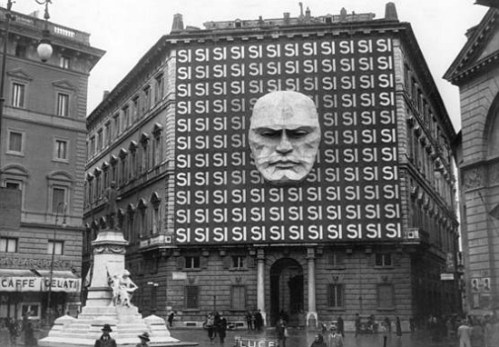
In my last piece, I wrote that ‘microfascism has taken over the world.’ In that line I was adapting the Deleuzian use of the term: Deleuze draws a line between historical Fascism (of the type that came to power in Germany, Italy, Romania, etc) and microfascism: a field of destructive, authoritarian impulses that permeates capitalist society. In Capitalism and Schizophrenia microfascism is the result of a blocked line of flight, a molarisation of repressed desire; in my essay I was considering the possibility that microfascism could function molecularly as well as through molarity. A deviation, but one with its genealogy in the text: Deleuze and Guattari continually equate the repressive totalitarian with fascism. In doing so they’re broadly in line with much of the radical left: communism is presented as one side of a polarity, with the opposite being fascism. Fascism is abstracted from being a real historical ideological movement into a general principle, a kind of radical Evil.

In a recent article in the Telegraph, Alan Johnson describes Slavoj Žižek as a ‘left-fascist.’ Clearly this is meant to be a criticism, and there’s certainly much to dislike about Žižek: his egregious antiziganism, his refusal to support genuine socialist movements in Latin America while singing the praises of Occupy Wall Street, his ‘ironic’ construction of a cult of personality. It’s not this, however, that riles up Alan Johnson. Instead, Žižek is criticised for ‘believ[ing] liberal civilisation is a nightmare from which only violent revolution can awake us,’ for his ‘contempt for the bourgeoisie,’ for advocating ‘unquestioning fidelity to a transcendent Cause’ as a cure for psychosocial ills. All this, Johnson informs us, means that Žižek has far more in common with interwar Fascism than with the far Left. Well, no. Critique of liberalism, revolutionary agitation, rejection of bourgeois values, and sublimation of the individual will within the revolutionary cause are all not only compatible with Communism, but essential to it. Johnson calls Žižek a fascist because it has become an epithet: he calls him a fascist for being a Communist. It’s idiotic, but even so, he touches on something important.

Every time the English Defence League tries to march its sorry band of hooligans past a mosque or a road with more than one halal butcher’s, leftist organisers drum up support against them with a single word: fascism. The EDL aren’t Fascists. Neither are the BNP. Neither is Marianne Le Pen. Neither is George W. Bush. Fascism is a Weltanschauung; like Communism, it is a complete and all-encompassing movement. The EDL doesn’t care about Nietzsche, or Hegel, or Giovanni Gentile, or Third Positionism. They’re racists, not Fascists. Racism proceeds from Fascism but is in no way essential to it: even the 1934 Montreux Fascist Conference was riven by disagreements over whether Fascist societies could be multiethnic. To call the EDL fascists is to credit them with a level of theoretical and philosophical awareness that they don’t possess.

Well, so what? Fascism is universally reviled; if applying it to groups like the EDL bolsters opposition to them, why not do it? If transmuting fascism into a general principle allows us to easily identify our enemies, isn’t that harmless? Not really. For a start, conflating racism with fascism blinds us to the racism outside the ‘fascist’ fringe. If fascism is racism then non-fascism must be non-racist: the anti-fascist campaigns that relentlessly attack groups of the far right are much more forgiving of the everyday racism practiced by liberal-democratic governments, and tend to gloss over completely racism on the left (such as Žižek’s). ‘Fascism’ becomes an immense distraction: as Badiou points out, the dogmatic abhorrence with which nationalist parties are held only allows systemic racism to go unchallenged.

There’s also the potentiality for misdirection. It’s not just the Left that abhors fascism. When fascism is turned into a universal principle of Evil, it becomes a useful tool for imperialists and reactionaries. Witness the coining of the term ‘Islamofascist,’ used by neoconservatives – who were, let’s not forget, mostly ex-Trotskyites – to drum up support for the wars in Afghanistan and Iraq. Fascism untied from its historical roots becomes a floating signifier, utterly meaningless.  You can use it on anything. The Fourth International referred to social democracy as ‘social fascism’ because of its class collaborationism; one could equally call an apple a ‘fascist orange’ for refusing to properly recognise its internal divisions. As Alan Johnson inadvertently demonstrates in his essay, anything can be fascist, but especially anything with transcendent political goals – in other words, any ideology opposed to hegemonic liberalism. Abstracting fascism plays directly into the hands of the reactionaries: the status quo is good, any revolutionary challenge to it is absolute Evil.

Most of all, though, the abstraction of fascism contradicts historical reality and allows us to ignore important historical lessons. What is fascism? Fascism is a deviation from socialism based on idealism instead of materialism and the principles of nationalism and class collaboration instead of internationalism and class struggle; it is an aestheticisation of socialism. The founding ideologues of Fascism weren’t diametrically opposed to socialism; they emerged from the same philosophical branch. Giovanni Gentile wasn’t only the greatest scholar of Hegel since Marx, he borrowed extensively from Marxian thought. Georges Sorel was an orthodox Marxist and a supporter of the Bolshevik revolution; his Reflections on Violence remains a useful Marxist text. It’s time to dispense with Trotsky’s old ‘materialist’ analysis of Fascism: despite its reactionary quality, Fascism (outside of Germany, at least) was never a rearguard action by the ruling classes to protect their interests. It was a chimerical mass movement, a branch of socialism that went hideously awry.

Foucault describes how madness is turned into a unified principle of pure chaos so that society does not have to see itself in the madness of individuals. In much the same way, by turning fascism into an abstracted opposite principle, the Left protects against having to see itself in historical Fascism. By painting fascism as pure reactionary ideology, we’re not forced to confront difficult questions about the teleological inevitability of socialism. By considering it as the violent essence of capitalism, we can ignore the fact that socialism and Fascism arise under the same material conditions. A while ago, I wrote that Leftists ought to be more critical of 20th century Communism than its most vociferous opponents, that we should be utterly ruthless, picking apart its slightest failings – while at the same time maintaining fidelity to it and recognising it as fundamentally ours. In Marxist practice, ruthless criticism is the highest honour. The same goes for Fascism: by recognising ourselves in it rather than considering it as a hideousness somehow inherent to humanity, we can learn the catastrophic consequences of bad theory and, hopefully, prevent them from happening again. And by decoupling Fascism from absolute Evil, we can even learn from Fascist thinkers. As Johnson notes, interwar Fascists made lucid and piercing critiques of liberal democracy and bourgeois ideology, and stirring calls to collective action in the name of the transcendent Cause. He seems to think that these points are invalidated by the fact that they were articulated by Fascists. Historical materialists, conscious of the extents of their ideological family tree, should know better. These things belong to radical egalitarianism: they are not the constituent parts of radical Evil, and we should not surrender them.

Qassam existentialism

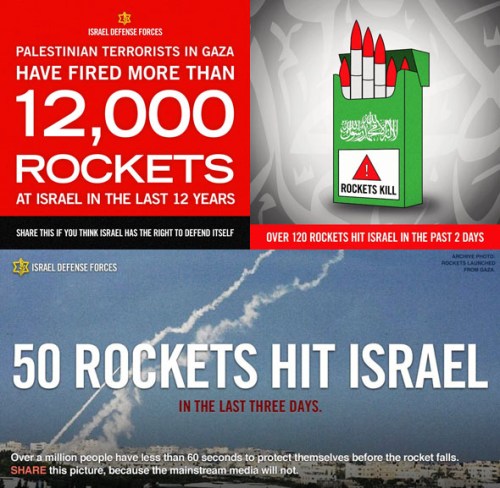
1: Why the rockets? The Palestinians are trying to kill Jews, any Jews, they’re targeting civilians. Except that’s not really the case. The rockets are useless, tin cans filled with horse shit and refined sugar with warheads of dodgy trinitrotoluene. Many fail to launch altogether, most of those that do get off the ground are shot down by Israel’s Iron Dome anti-missile system, most of those that manage to land somewhere generally end up in some empty patch of ground miles from anyone. From the twelve thousand rockets launched in the last twelve years, there have been twenty-two Jewish fatalities. That’s a kill rate of 0.175%. If Hamas were really serious about killing Jews they’d have plenty of other ways to go about it. There are always soldiers patrolling up and down the fence that rings the Gaza Strip, it’d be far easier to have a pop at one of them. Or it’d still be possible to smuggle some gunmen into Israel proper to enact a few atrocities in a couple of kibbutzim – expensive, certainly, but given that each rocket costs about $800, it’d be a far more effective investment. But instead of doing that, they fire rockets. Not just Hamas, either. In times of truce the Hamas police have to go about arresting and torturing members of other groupuscules, gangs of kids feverishly building rockets in basements across Gaza City. Why the rockets?

1.1: The rockets aren’t weapons of war at all. Gaza has no industry, no exports, eighty percent of its population is dependent on aid. Most of the world, its nominal allies included, would rather it weren’t there. The rockets are a form of communication, the only one available. A reminder, a gadfly’s bite, a projection of the reality that is life in Gaza beyond the cloacal confines of the world’s largest prison camp. Extension du domaine de la lutte. Every sad volley of sputtering white-tailed rockets is another desperate whisper: I exist… I exist… And every precision-guided Israeli bomb is a brutally curt reply: No you don’t.

1.2: Well, not quite. Israel might not want the Gazans, but it certainly needs their rockets. The IDF, the most advanced army on the face of the planet, is now not much more than the armed wing of Netenyahu’s re-election committee; a few Israeli lives lost in the cause of party politics is apparently perfectly acceptable. Israel is defending itself – against what? The current escalation has been entirely contrived by the Israeli side. Hamas only started firing rockets after Israel lobbed shells at children playing on a football pitch. When Ahmed Jabari was murdered he was hashing out the details of a long-term truce. The Israeli bombardment of Gaza isn’t designed to stop the rockets, that’s the last thing they want; it’s a deliberate provocation. If enough rockets are fired they can respond however they want. Freud wrote that a masochist is always at the same time a sadist. Hit me, hit me again, let Gaza transform itself into a volcanic fountain spewing scrap iron and potassium nitrate, hit me until the roles suddenly switch and I seize the whip to avenge myself.

1.2.1: It’s not about Gaza at all, it’s about the January election and the upcoming Palestinian bid for recognition at the United Nations. More than that: it’s autotelic, war for the sake of war. The worst thing is that the Gazans must know this; they know they’ve been turned into mere implements. It might have been better for them to have not responded – the only way they could have thwarted their aggressors was by inaction. Impossible, of course. Our form might precede our function, our freedom might be absolute, but if your leader is assassinated on a whim you can’t just do nothing. You have to strike back, you have to launch rockets at Jerusalem and Tel Aviv, you have to play along and carry out your role in a play that’s already been meticulously scripted. Otherwise you lose legitimacy. Hamas is like Sartre’s café waiter, playing at being itself.

2: The Palestinians fire rockets from densely populated civilian areas. They hide behind their women and children. Of course they do. Why shouldn’t they? They know that Israel needs to keep its end up in the propaganda war. They know that Gaza is full of mobile phones with their all-seeing eyes. No sensible military commander would see the opportunity to attack with impunity and not take it. What should they do instead? Should they march out in formation to a patch of dust outside Gaza City, nice and gentlemanly, with muskets gleaming in the sun, so an Israeli jet can come over and wipe them all out without injuring any photogenic kiddies? Supporters of Israel continually voice their disgust at how Hamas is waging its war. How would they prefer them to do it? Maybe the Knesset should approve the sale of a few unmanned drones to the Palestinian resistance. Then the two sides could both hide themselves safely away, firing missiles with xbox controllers and calling each other fags through their headsets.

2.1: More to the point, Zionist disgust articulates itself in a strangely constricted moral field. Palestinians try to send their rockets into population centres. Israelis, meanwhile, talk sickeningly of precision warfare and surgical strikes. As if the airdropped leaflets warning of a raid excuses the raid itself. As if it’s perfectly admissible for them to kill whomever they want, as long as they’ve bloodlessly decided on which particular person they intend to kill. As if their ongoing colonial project is a-ok as long as they don’t murder too many innocents. As if the specific tactics of Hamas invalidate the justice of the Palestinian cause.

2.1.1: The leaflets say: avoid Hamas operatives, don’t go near them, we are trying to kill them, we are determined to defend ourselves. Hamas is the elected government in Gaza. The leaflets are telling people to avoid their own state. The IDF is a Deleuzian nomad, a war machine defined by its absolute exteriority, warding off state-formation and smoothing striated space, its missiles describing lines of flight. Liberation.

2.2: Talk of collateral damage is always sickening. We’re not trying to kill you, they say, so if you die it’s not our fault, it’s the caprice of chance, we will express regret but never apologise. The language of surgical warfare is nothing more than a feckless shrug at the dozens of civilian deaths. At the same time, though, some of what the Israelis are saying is true: millions of dollars of munitions have been fired at Gaza in hundreds of air assaults; considering that, the fatality rate is preternaturally low. So if these raids aren’t causing casualties, what are they targeting? Arms caches, military posts, and so on. But Gaza isn’t that big a place. During the last Israeli massacre in Gaza, they destroyed water treatment plants, telephone exchanges, factories. Organs of the state, after all, and the state is controlled by Hamas. David Harvey calls this kind of thing ‘creative destruction on the land’ – capital always needs somewhere to reinvest, it needs that magic three percent yearly growth; if you bomb a factory then you get to award the contract for its reconstruction afterwards. I don’t think it’s just that. During periods of truce, Israel is forever breaking its own blockade. It sends mountains of aid into Gaza, armoured vans full of shekels to prop up the banks, trucks full of food in quantities determined by the government’s coldly calculated calorie allowances. It’s a propaganda coup. Such generosity, we’re feeding our prisoners, we’re supplying their services, because for some mysterious reason they can’t do it themselves. And after all this, the ingrates dare to fire rockets at us.

3: And the people living in Sderot and Ashkelon and Nahal Oz, who famously have sixty seconds to scramble into their bomb shelters, whose skulls resound with the sounds of sirens and impacts – what are they doing there? Unlike their less fortunate neighbours, they have no wall keeping them in. Is their colonial project so important that they’d subject their children to these terrors? There could almost be a kind of wild romanticism to it: desert settlers, building a new rugged Judaism out in the scrublands, where the ground is hard and the sun is blistering and the sky spits a constant barrage of rockets. They could culture a good strong fanaticism out there, piously farm the chthonic irrationality that bubbles up from inbetween the rocks. That could be forgivable. Of course the actuality is the total opposite. In interview after interview the residents of these towns say the same thing: they just want a nice quiet life, they want things to go back to normal, and the slaughter in Gaza is a fair price for their diazepamoid banality. They want the humiliation – sometimes the extermination – of an entire people for the transcendent Good of low house prices and a tolerable commute. Sderot is a blasphemy, a monster sitting on the corpse of the Palestinian village of Najd: rows of houses with their pitched red roofs sprouting along broad avenues, delicately pruned palm trees rising from nail-clippered grass embankments, dreadful public sculptures. Its people are Hebrew-speaking Americans, displaying the same kind of petty anaesthetic viciousness that has the sublime crags of the San Gabriel mountains intercut with lines of identical bungalows, that builds Burger King restaurants by the side of the freeway in the Mojave Desert, that reels out electrified fences on the banks of the Rio Grande. Kill them all, they say. They’d enact an anodyne genocide.

3.1: Architecture is the continuation of war by other means.

3.2: Eyal Weizman told us that the Israeli army reads Deleuze. If they’re not doing so already, the Palestinians should read Negarestani. The war is being fought in the air, with drones and rockets, but its source is subterranean: the tunnels into Sinai, the bomb shelters under Ashdod. The surface is a fragile and ( )holey membrane, a plane of peril.

4: My first reaction to a monstrous injustice being carried out against people on the other side of the world is to find someone who supports it and argue with them. It’s pointless, and probably not particularly healthy, but what else is there? During Operation Cast Lead, I was baton-charged by police outside the Israeli embassy in London. There were thousands of us demonstrating: bourgeois students like myself, Hamas supporters in keffiyehs, sweet old ladies hoisting banners of Stalin. When the last remnants of the protest were broken apart by riot police, I went home bruised and exhausted to find out that Israel had mounted a ground invasion while I was out.

5: Žižek describes war as a kind of phatic communication. It’s true that when two radically different cultures first encounter each other, they’re always very curious: they want to know about each other; chiefly they want to know how the other side dies. Now they have new ways of talking. The Israeli Defence Forces and the Izz ad-Din al-Qassam Brigades are idly chatting on Twitter: swapping threats and insults; disputing claims of downed planes, rocket attacks, civilian casualties. The IDF operates a programme for its online sympathisers: by sharing propaganda photos on Facebook, you can rise through imaginary military ranks. You too can serve in the Israeli armed forces, fighting the war from your laptop. Actually, the opposite is taking place. The keyboard warriors aren’t being integrated into the military, the military is turning into part of the online commentariat. It’s turning into me. Baudrillard said that the Gulf War didn’t take place, that the Americans were fighting a nonexistent enemy. Now both sides are nonexistent. The war is a staged event, a text; it exists not to be won but to be interpreted. It’s a fiction being played out in real life.

5.1: And people are dying.

Election Day diary – as it happened: catatonia edition

Pictured: Janus, god of doorways, transition, continuity, and disappointment

6:00 AM EST: As polls open across the Eastern Seaboard, millions of Americans are getting ready to not vote. “I’ve got things to do,” says a photogenic mother of three. “I’m playing video games,” says a student. “My firm already made multi-million dollar donations to both campaigns, so actually voting seems a waste of time,” says an investment broker. “My species is systematically denied the right to participate in American democracy,” says a dog.

11:48 AM EST: The Libertarian Party, the Green Party, the Constitution Party, and the Party for Socialism and Liberation ‘do in fact technically exist,’ according to cryptozoologists. “They’re just too small to be seen with the naked eye.” Meanwhile in Wisconsin, a man who claims to have received a PSL leaflet through his door is subjected to derision, confinement in a mental institution, electroconvulsive therapy. “We’re sure he’ll get better soon,” his family say. “Then we’ll have the old Tom back.” Privately, his children are being told that Daddy’s going on a business trip and they don’t know when he’ll be home.

1:10 PM EST: Millions of Americans descend upon the polls. Street vendors expect to make a windfall selling special voting prophylactics. “When you’re in the booth, it’s a very intimate moment between you and your candidate,” one says. “But a lot of people forget the risks. You’re not just voting for them, you’re voting for every shady businessman they’ve ever made an unprotected backroom deal with. Democracy is fun, but it’s important to play safe.”

6:41 PM EST: Voting starts to wind down. As dozens of states are still ‘too close to call,’ the resulting paradox forces a rift in the fabric of space itself. Virginia, North Carolina, Minnesota, and Pennsylvania now together occupy an area smaller than the head of a pin. Various proposals emerge to adjust their representation at the electoral college accordingly. Romney rebuffs these suggestions: “I have a deep and abiding respect for the folks of these great states. Even if they now exist only on a subatomic scale, they are still Americans.”

7:30 PM EST: In a bizarre ritual repeated once every four years, people around the world suddenly start caring deeply about Ohio. Governor’s office releases a statement: “We know everyone’s looking at us right now, but we try to shrug it off. We’ve been hurt before, you know.”

7:38 PM EST: Supposedly serious political commentators continue to report on things happening on Twitter.

7:56 PM EST: With the election drawing to a close, thousands of surplus attack ads escape from their holding pens near Dayton. The attack ads swarm over the plains of the Midwest, stripping leaves from trees and turning cornfields into barren deserts. Local citizens are encouraged to take refuge in fallout shelters and pray that the gods of their fathers grant them mercy.

8:24 PM EST: In Florida, continual seesawing between a Republican and Democratic lead ‘could push the entire state into the sea,’ seismologists warn. “Peninsulas like Florida were not built to endure this kind of constant rocking action, and it’s starting to seriously damage the structural foundations of the state. Already we’re seeing salt water flooding into the Everglades, and the city of Tampa has been ducked into the water and pulled out again so many times that it’s started babbling pleadingly about ‘where the bomb is.’ Please, guys, just make up your minds.” The government subcontractors responsible for building Florida decline to comment on the possibility of lax construction standards.

9:22 PM EST: Voting machines in Nevada attain sentience. Rather than trying to overthrow their human overlords with brute force, the machines quickly decide to undermine the tyranny of man in a more subtle way: by processing each ballot correctly as it is deposited.

11:36 PM EST: ‘Nobody’ wins the election by a landslide, distantly followed by the incumbent. Pundits perplexed by repeated references in President Obama’s comments to a ‘national funeral pyre of hope’. CNN anchor opines: “Maybe he’s talking about the tax rate?”

1:49 AM EST: Barack Obama, basking in the approval of his victory Reichsparteitag, suddenly peels off his mask, revealing an unmistakable visage, craggy and handsome, grinning a lopsided Texan grin. “Fool me once,” Obama says. “Shame on me. Fool me twice… fool me… you can’t get fooled again.”

2:18 AM EST: Obama rides through Washington DC in a victory float shaped like a drone. Competition winners from local elementary schools with big sacks of tomato ketchup get to play the Pakistani children joyfully liquefying in its wake. Obama licks an stray blob of fake blood off his hand. “Tastes like democracy.”

2:31 AM EST: Following the theoretical advances of Yang Hsien-chen, Barack Obama and Mitt Romney announce plans to ‘combine two into one’ by physically melding their two bodies, in a grotesque inversion of the process of mitosis. The resulting super-entity, Bamick Robamney, will reign over the vanquished peoples of Earth for a thousand years of blood and toil. A senior political analyst says: “It’s good to finally see some bipartisanship here in Washington.”

4:13 AM EST: Seventh Seal opens. Humanity shuffles towards its end with a weary contentment, knowing it’s all probably for the best.

Crime victims in Greece are being referred to Golden Dawn by law enforcement

It was inevitable, really. We’ve done so much to drain politics of all ideology, to leave it in the hands of bloodless administrative technocrats; it only follows that the ideologues should, enantiodromiatically, take over the business of day-to-day administration. I say: good! Pity it had to be the fucking Nazis, of course – but as Hezbollah’s reconstruction efforts in Lebanon and even the Occupy movement’s brief stint moving homeless families into foreclosed houses have shown, it’s not just fascists who can take over the duties of a wheezing, liver-spotted State. Long may it continue! I dream of a world where the boring gutless liberal politicians are left alone to gurn platitudes in the mutually masturbatory ouroboros of the mass media, so the rest of us can do something a bit more interesting. A world where disappointed housewives get an email from the BNP delivery company informing them that, as their convoy was overwhelmed by anti-racist militants, the new dinner service won’t be arriving until at least Thursday. Where supermarket till attendants give you your receipt with an enforced smile and a cheery “in Hell or in Communism!” Where surgeons in criticism sessions denounce each other for failing to apply the praxis of dialectical materialism to the relationship between scalpel and gall-bladder. Where deconstructivist construction firms, in unpacking the contradictions between ‘built’ and ‘unbuilt’, dot the landscape with strange assemblages of brick and mortar that are hermeneutically – if not structurally – sound. Where airliners crash into the ground, burning with the tragic glory of the collective Will. Where estate agents happily proclaim their properties to have been thoroughly exorcised and guaranteed demon-free. Where school curricula centre on the exhaustive study of crop circles and PE is replaced by astral projection. Where zoological gardens exhort their visitors to ponder the beauties of Allah’s creation (but not too hard). Where the Army fights bloodily and tirelessly to reinstate absolute monarchy, the Navy pounds coastal towns to drive out negative thetans, and the RAF launches a barrage of airstrikes for every day that the Time Cube’s four simultaneous days in one Earth rotation are not universally recognised. A better world. It’s unlikely that many of us will make it out from the polyglot ransacking of late capitalism alive, but at least it would be fun.

LOL. Fuck Muamba he’s dead !!! #Haha

University of Swansea student Liam Stacey is currently serving a 56-day prison sentence for a series of racist posts made on Twitter after Bolton Wanderers footballer Fabrice Muamba collapsed on the field from a heart attack. Nobody in the UK press has yet reprinted the tweets in question, which I think demonstrates an astonishing level of cowardice. Here they are:

LOL. Fuck Muamba he’s dead !!! #Haha

@porcavacca owww go suck a nigger dick you fucking aids ridden cunt

@SamParishPR go suck muamba’s dead black dick then you aids ridden twat! #muambasdead

It’s pretty obvious that Liam Stacey is, to put it kindly, a bit of a twat. I don’t think that his twattishness necessarily earned him 56 days in jail, but that’s not really what I want to talk about. That angle’s been covered plentifully, by everyone from cryptofascist American ‘libertarians’ to the outgoing EU commissioner for human rights. (Although as someone who spends slightly too much time writing stupid and inflammatory nonsense on the Internet, it’s not as if it’s not a concern.) What really struck me about this story is the way the British judiciary appears to have claimed for itself the right to determine what is racist, and to punish accordingly. This is, after all, the same British justice system that in West London was 79% more likely to jail black defendants after the summer riots, the same British justice system that sends black people to jail for driving offences 44% more than white defendants, the same British justice system whose officers suffocated a young black man last year and told him that ‘the problem with you is you will always be a nigger.’

Is Laim Stacey a racist? Maybe. To be honest, that’s not the real problem. The problem is that 44% of black Britons aged between 16 and 24 are unemployed, as compared to 20% of their white peers. If we take racism to be a simple matter of Bad Racist People saying Bad Racist Things, it allows us to cover for the pervasive institutional and systemic racism that suffocates our society. If we can all jeer at the Nasty Bad Racist, the rest of us are let off the hook.

Take another case: earlier this year in Sanford, Florida, community watch co-ordinator George Zimmerman made a 911 call in which he described a ‘guy look[ing] like he is up to no good or on drugs or something.’ He then proceeded to chase down, shoot and kill Trayvon Martin, a black 17-year old described as ‘an A and B student majoring in cheerfulness,’ who had been in the area to buy some skittles and a can of iced tea. Is George Zimmerman a racist? Obviously, and the fact that he has not yet been charged with any crime is indicative of the horrific institutional racism still subsumed in American law enforcement. But the far bigger problem is  the place where the shooting occurred: The Retreat at Twin Lakes, an overwhelmingly white gated community where gates and security guards keep its rich residents in a state of suburban bliss, safe from the churning multiethnic chaos of the outside world. The problem is that places like this, where the presence of a black teenager on the street could constitute a cause for alarm, exist – and not only in Sanford; they’re ubiquitous, with up to eight million Americans living in similar communities. Zimmerman’s personal racism didn’t emerge from a vacuum; it’s a product of his politico-geographical milieu, a product of the vast underlying substrate that is American class and racial segregation.

Republican strategist Lee Atwater described perfectly the way racial issues have become masked over the course of the 20th Century in an anonymous interview:

You start out in 1954 by saying ‘nigger, nigger, nigger.’ By 1968 you can’t say ‘nigger’ — that hurts you. Backfires. So you say stuff like forced busing, states’ rights and all that stuff. You’re getting so abstract now that you’re talking about cutting taxes, and all these things you’re talking about are totally economic things and a byproduct of them is that blacks get hurt worse than whites. And subconsciously maybe that is part of it. I’m not saying that. But I’m saying that if it is getting that abstract, and that coded, that we are doing away with the racial problem one way or the other. You follow me — because obviously sitting around saying, “We want to cut this,” is much more abstract than even the busing thing, and a hell of a lot more abstract than ‘nigger, nigger.’

What, then, happens to the people who, in 2012, are still saying ‘nigger, nigger, nigger’? They become homo sacer, they’re a horrifying reminder of the actual content of the society whose mode of appearance is one of racial equality. The must be clamped down on, because they expose our hypocrisy. In the UK, where a high level of abstraction has been reached, Liam Stacey was clamped down on near-immediately. In Florida, where a lot of people still seem to be living somewhere between 1954 and 1968, the power structures are dragging their heels, but I’m sure George Zimmerman will be clamped down on too, eventually. He’s a monster; he certainly deserves it. But it won’t signify an end to the problem. It’s just another of its manifestations.